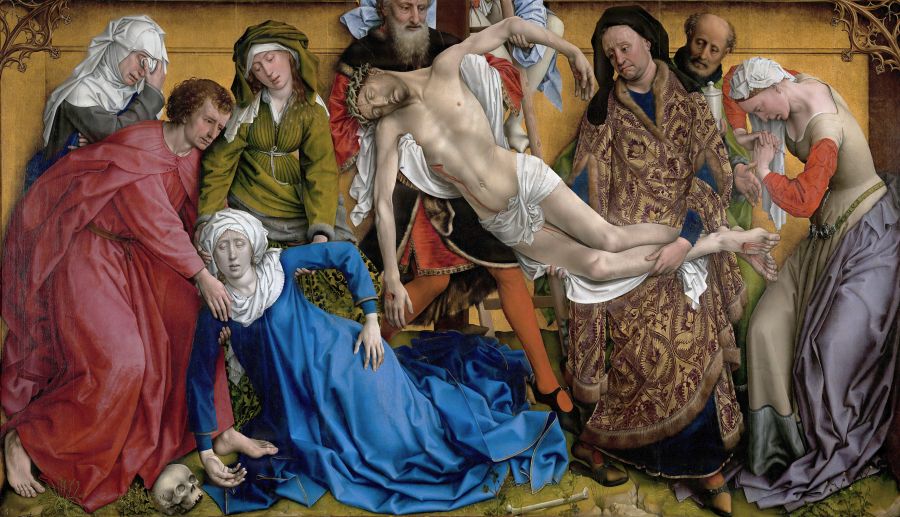
For a little
meditation while attending the Mass, read how the movements and prayers
of the priest mirror the events of
Christ's Passion, Resurrection, and Ascension. Keep in mind always
that while you're at the Mass, you are at the foot of the Cross!
Now that your mind understands, you've got to get your heart right.
Consider this advice from Pope St. Pius X of most happy memory:
|
The Holy Mass is
a prayer itself, even the highest prayer that exists. Is is the
Sacrifice dedicated by our Redeemer at the Cross, and repeated every
day on the Altar. If you wish to hear the Mass as it should be heard,
you must follow with eye, heart, and mouth all that happens at the
Altar.
Further, you must pray with the priest the holy words said by him in
the Name of Christ and which Christ says by him. You have to associate
your heart with the holy feelings which are contained in these words
and in this manner you ought to follow all that happens on the Altar.
When acting in this way, you have prayed Holy Mass.
Don't pray at
Mass, but pray the Mass.
|
And please read
this excerpt from Pope Pius XII's Mediator
Dei in which he explains how we of the royal priesthood should
approach the Most Holy Sacrifice of the Mass:
91. But there is
also a more profound reason why all Christians, especially those who
are present at Mass, are said to offer the sacrifice.
92. In this most important subject it is necessary, in order to avoid
giving rise to a dangerous error, that we define the exact meaning of
the word "offer." The unbloody immolation at the words of consecration,
when Christ is made present upon the Altar in the state of a victim, is
performed by the priest and by him alone, as the representative of
Christ and not as the representative of the faithful. But it is because
the priest places the divine victim upon the Altar that he offers it to
God the Father as an oblation for the glory of the Blessed Trinity and
for the good of the whole Church. Now the faithful participate in the
oblation, understood in this limited sense, after their own fashion and
in a twofold manner, namely, because they not only offer the sacrifice
by the hands of the priest, but also, to a certain extent, in union
with him. It is by reason of this participation that the offering made
by the people is also included in liturgical worship.
93. Now it is clear that the faithful offer the sacrifice by the hands
of the priest from the fact that the minister at the Altar, in offering
a sacrifice in the name of all His members, represents Christ, the Head
of the Mystical Body. Hence the whole Church can rightly be said to
offer up the victim through Christ. But the conclusion that the people
offer the sacrifice with the priest himself is not based on the fact
that, being members of the Church no less than the priest himself, they
perform a visible liturgical rite; for this is the privilege only of
the minister who has been divinely appointed to this office: rather it
is based on the fact that the people unite their hearts in praise,
impetration, expiation and thanksgiving with prayers or intention of
the priest, even of the High Priest himself, so that in the one and
same offering of the victim and according to a visible sacerdotal rite,
they may be presented to God the Father. It is obviously necessary that
the external sacrificial rite should, of its very nature, signify the
internal worship of the heart. Now the sacrifice of the New Law
signifies that supreme worship by which the principal Offerer himself,
who is Christ, and, in union with Him and through Him, all the members
of the Mystical Body pay God the honor and reverence that are due to
Him.
94. We are very pleased to learn that this teaching, thanks to a more
intense study of the liturgy on the part of many, especially in recent
years, has been given full recognition. We must, however, deeply
deplore certain exaggerations and over-statements which are not in
agreement with the true teaching of the Church.
95. Some in fact disapprove altogether of those Masses which are
offered privately and without any congregation, on the ground that they
are a departure from the ancient way of offering the sacrifice;
moreover, there are some who assert that priests cannot offer Mass at
different Altars at the same time, because, by doing so, they separate
the community of the faithful and imperil its unity; while some go so
far as to hold that the people must confirm and ratify the sacrifice if
it is to have its proper force and value.
96. They are mistaken in appealing in this matter to the social
character of the eucharistic sacrifice, for as often as a priest
repeats what the divine Redeemer did at the Last Supper, the sacrifice
is really completed. Moreover, this sacrifice, necessarily and of its
very nature, has always and everywhere the character of a public and
social act, inasmuch as he who offers it acts in the name of Christ and
of the faithful, whose Head is the divine Redeemer, and he offers it to
God for the holy Catholic Church, and for the living and the dead.This
is undoubtedly so, whether the faithful are present - as we desire and
commend them to be in great numbers and with devotion - or are not
present, since it is in no wise required that the people ratify what
the sacred minister has done.
97. Still, though it is clear from what We have said that the Mass is
offered in the name of Christ and of the Church and that it is not
robbed of its social effects though it be celebrated by a priest
without a server, nonetheless, on account of the dignity of such an
august mystery, it is our earnest desire - as Mother Church has always
commanded - that no priest should say Mass unless a server is at hand
to answer the prayers, as canon 813 prescribes.
98. In order that the oblation by which the faithful offer the divine
Victim in this sacrifice to the heavenly Father may have its full
effect, it is necessary that the people add something else, namely, the
offering of themselves as a victim.
99. This offering in fact is not confined merely to the liturgical
sacrifice. For the Prince of the Apostles wishes us, as living stones
built upon Christ, the cornerstone, to be able as "a holy priesthood,
to offer up spiritual sacrifices, acceptable to God by Jesus Christ."
St. Paul the Apostle addresses the following words of exhortation to
Christians, without distinction of time, "I beseech you therefore, . .
. that you present your bodies, a living sacrifice, holy, pleasing unto
God, your reasonable service." But at that time especially when the
faithful take part in the liturgical service with such piety and
recollection that it can truly be said of them: "whose faith and
devotion is known to Thee," it is then, with the High Priest and
through Him they offer themselves as a spiritual sacrifice, that each
one's faith ought to become more ready to work through charity, his
piety more real and fervent, and each one should consecrate himself to
the furthering of the divine glory, desiring to become as like as
possible to Christ in His most grievous sufferings.
100. This we are also taught by those exhortations which the Bishop, in
the Church's name, addresses to priests on the day of their ordination,
"Understand what you do, imitate what you handle, and since you
celebrate the mystery of the Lord's death, take good care to mortify
your members with their vices and concupiscences." In almost the same
manner the sacred books of the liturgy advise Christians who come to
Mass to participate in the sacrifice: "At this . . . Altar let
innocence be in honor, let pride be sacrificed, anger slain, impurity
and every evil desire laid low, let the sacrifice of chastity be
offered in place of doves and instead of the young pigeons the
sacrifice of innocence." While we stand before the Altar, then, it is
our duty so to transform our hearts, that every trace of sin may be
completely blotted out, while whatever promotes supernatural life
through Christ may be zealously fostered and strengthened even to the
extent that, in union with the immaculate Victim, we become a victim
acceptable to the eternal Father.
101. The prescriptions in fact of the sacred liturgy aim, by every
means at their disposal, at helping the Church to bring about this most
holy purpose in the most suitable manner possible. This is the object
not only of readings, homilies and other sermons given by priests, as
also the whole cycle of mysteries which are proposed for our
commemoration in the course of the year, but it is also the purpose of
vestments, of sacred rites and their external splendor. All these
things aim at "enhancing the majesty of this great Sacrifice, and
raising the minds of the faithful by means of these visible signs of
religion and piety, to the contemplation of the sublime truths
contained in this sacrifice."
102. All the elements of the liturgy, then, would have us reproduce in
our hearts the likeness of the divine Redeemer through the mystery of
the cross, according to the words of the Apostle of the Gentiles, "With
Christ I am nailed to the cross. I live, now not I, but Christ liveth
in me." Thus we become a victim, as it were, along with Christ to
increase the glory of the eternal Father.
103. Let this, then, be the intention and aspiration of the faithful,
when they offer up the divine Victim in the Mass. For if, as St.
Augustine writes, our mystery is enacted on the Lord's table, that is
Christ our Lord Himself, who is the Head and symbol of that union
through which we are the body of Christ and members of His Body; if St.
Robert Bellarmine teaches, according to the mind of the Doctor of
Hippo, that in the sacrifice of the Altar there is signified the
general sacrifice by which the whole Mystical Body of Christ, that is,
all the city of redeemed, is offered up to God through Christ, the High
Priest: nothing can be conceived more just or fitting than that all of
us in union with our Head, who suffered for our sake, should also
sacrifice ourselves to the eternal Father. For in the sacrament of the
Altar, as the same St. Augustine has it, the Church is made to see that
in what she offers she herself is offered.
104. Let the faithful, therefore, consider to what a high dignity they
are raised by the sacrament of baptism. They should not think it enough
to participate in the eucharistic sacrifice with that general intention
which befits members of Christ and children of the Church, but let them
further, in keeping with the spirit of the sacred liturgy, be most
closely united with the High Priest and His earthly minister, at the
time the consecration of the divine Victim is enacted, and at that time
especially when those solemn words are pronounced, "By Him and with Him
and in Him is to Thee, God the Father almighty, in the unity of the
Holy Ghost, all honor and glory for ever and ever"; to these words in
fact the people answer, "Amen." Nor should Christians forget to offer
themselves, their cares, their sorrows, their distress and their
necessities in union with their divine Savior upon the cross.
|