|
In a place far
enough away from flammable structures and trees (including tree roots),
a place that is sheltered from strong gusts of wind, dig a shallow pit
(you only need to go a few inches deep) a few feet larger than you want
your fire to be (if you can, it is best to dig a bit deeper and then
fill the pit back up partways with sand). Encircle the perimeter of the
pit with rocks or bricks. Have buckets of water, sand, a fire
extinguisher, or what not, on hand at all times for safety and to put
out the fire when it's all over.
Now gather:
-
Tinder:
lightweight and thoroughly dry material that
burns well and quickly and that allows larger sticks to ignite. Try
twigs, shaved wood, dried leaves, paper, bark, grass, dried pine
needles, broken up pine cones, dried mosses, the heads of cattails,
dryer lint, string, etc. You can also use some charcoal briquets.
-
Small
kindling:
thoroughly dry sticks that are thumb-sized in diameter
-
Medium
kindling:
thoroughly dry sticks that are about wrist-sized in diameter
-
Fuel:
Larger logs that are thoroughly dry (oak, maple, ash, beech, and birch
are the best for burning)
If you use
charcoal briquets, make a flat bed out of them at the center of the
pit. Top them with a large ball of other tinder material or, if you're
not using briquets, just put the tinder in a pile at the center of the
pit.
In any case, take the small kindling and make a teepee -- a standing
triangular structure -- to surround the tinder, setting up the sticks
at 45 degree angles from the ground and leaning them against each other
in the middle. They can be lashed together at the tops, and their ends
can be sort of driven into the ground a bit to keep them steady. Leave
enough gaps to allow oxygen in toward the tinder.
Now build a cabin around the teepee. Lay two of the medium-sized
kindling sticks parallel to each other on either side of the teepee.
Then lay two more on top and perpendicular to the first two. Then lay
two more on top perpendicular to the last two, and repeat until you've
built a structure that is 5 layers high. Make sure the larger logs are
toward the bottom, and the smaller ones are up higher.
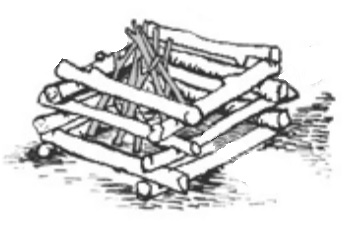
Lay two logs on the top of two opposite cabin "walls."
Position some
smaller kindling so that they touch the foundation of the cabin and the
logs at the top.
Drop a lit match
inside the teepee (using a candle to light it will
keep your hands away from the flames and may be less frustrating if the
matches keep going out). As the fire burns, add more wood as needed,
going from smaller to larger pieces as you go.
When the fire is over, pour water over it and pile dirt on top.
For Colorful Flames
If you want colored flames, you can do the following -- but it must be
prepared well in advance:
Pick the color(s) you want your flames to be and get the chemical(s)
needed to produce the effect. Chemicals can be gotten locally
(sometimes from stores that deal with fireplaces) or online, such as
from this place http://www.chemistrystore.com/ (offsite, will open
in new browser window). You only need "technical grade" chemicals, not
the more expensive "purified grade.":
|
red flames
|
strontium
chloride
|
|
carmine flames
|
lithium chloride
|
|
orange flames
|
calcium chloride
(a bleaching powder)
|
|
white flames
|
magnesium
sulphate (Epsom Salts)
|
|
blue flames
|
cupric chloride
(copper chloride)
|
|
green flames
|
copper sulphate
(blue vitrol)
|
|
yellow flames
|
sodium chloride
|
|
yellowish-green
flames
|
sodium borate
(borax)
|
|
purple flames
|
potassium
chloride
|
|
violet flames
|
potassium
sulphate (chromealum) mixed
3 to 1 with potassium nitrate (saltpeter)
|
Wear rubber glovers during this procedure. Now, add the
chemical(s), singly, to a plastic container of water for each flame
color -- adding as much as the water will absorb (about a half a pound
per gallon of water).
Soak your wood, "logs" made of tightly-rolled newspapers, or some pine
cones in the solution(s) overnight (you can also use sawdust to
sprinkle onto fire to make briefly burning colored flames. Just stir
some liquid glue into the liquid, too, and then add the sawdust. The
glue will allow chunks to form).
Take the wood/cones/sawdust out of the liquid, lay out on newspapers,
and allow to dry thoroughly (for sawdust, spread out onto sheets and
dry). Save the newspapers on which they've dried, and roll them up
tightly to form "logs," too, as they can produce pretty colors from the
chemicals they've absorbed.
Just throw these things on to your fire for pretty flames (can also be
used on indoor fires, but ventilation should be good). The chemicals
can be thrown directly onto the fire, too, for short bursts of color.
|
|


