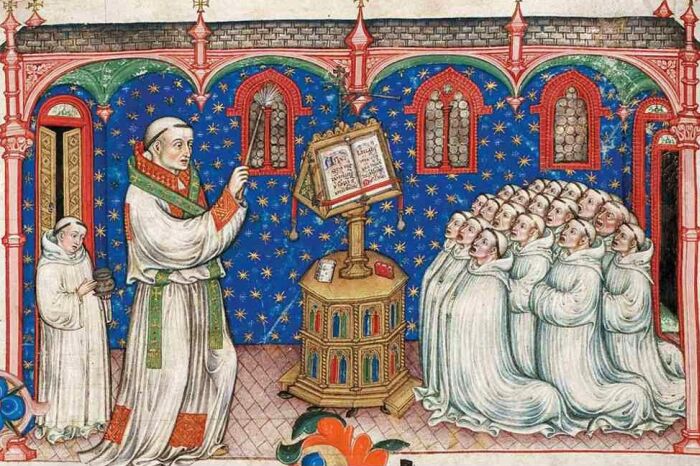
The Romans
divided the hours of the day and night into two
twelve-"hour" periods, with each twelve-"hour" period related to hours
of
lightness and darkness -- i.e., with one of the periods starting at
sunrise, and the other at sunset. Hence, throughout the year, the
length of "an
hour" would change, for example, being equal during the Equinoxes, but
longer at night and shorter during the day in Winter time.
Sunrise indicated the beginning of the first of the 12 hours, so
sunrise would be "the first hour." When the Sun was overhead would be
"the sixth hour."
Sunset would indicate the beginning of the second set of 12 hours, so
sunset would be "the first hour" of night, and midnight would be "the
sixth hour." And so forth.
The first hour of each twelve hour period was called "hora prima"; the
second "hora secunda," the third "hora tertia," the fourth "hora
quarta," the fifth "hora quinta," the sixth "hora sexta," the seventh
"hora sexta," the seventh "hora septima," the eighth "hora octava," the
ninth "hora nona," the tenth "hora decima," the eleventh "hora
undecima," and the twelfth "hora duodecima."
Now, Temple-era Jews devoted certain hours of the day to prayer:
Psalms 54:17
Evening and morning, and at noon I will speak and declare: and he shall
hear my voice.
Psalm 119:164
Seven times a day I have given praise to thee, for the judgments of thy
justice.
Daniel 6:10
Now, when Daniel knew this, that is to say, that the law was made, he
went into his house: and opening the windows in his upper chamber
towards Jerusalem, he knelt down three times a day, and adored and gave
thanks before his God, as he had been accustomed to do before.
Daniel 9:21
As I was yet speaking in prayer, behold the man, Gabriel, whom I had
seen in the vision at the beginning, flying swiftly, touched me at the
time of the evening sacrifice.
This Old
Testament practice was carried on by the Apostles, as recorded in
the New Testament, using Roman timekeeping --
Acts 3:1
Now Peter and John went up into the temple at the ninth hour of prayer.
Acts 10: 3
This man saw in a vision manifestly, about the ninth hour of the day,
an angel of God coming in unto him and saying to him: Cornelius.
Acts 10:9
And on the next day, whilst they were going on their journey and
drawing nigh to the city, Peter went up to the higher parts of the
house to pray, about the sixth hour.
Acts 10:30
And Cornelius said: Four days ago, unto this hour, I was praying in my
house, at the ninth hour and behold a man stood before me in white
apparel and said:
Acts 16:25
And at midnight, Paul and Silas, praying, praised God. And they that
were in prison heard them.
And, of course,
these daily prayers spread and were prayed by other of the earliest
Christians. These times of official prayer developed into the Church's
"canonical hours" or "offices" at
which certain prayers (psalms, canticles, antiphons, responsories,
etc.) are prayed. These prayers are known as "The Divine Office"
(Officium
Divinum), the "Liturgical Office," "The Liturgy of the Hours," or "The
Breviary" (the latter term also applying to the "book of hours" which
contains the prayers). The names of many of the day's prayer times take
their names from the Roman words for those hours.
St. Benedict (A.D. 480-543) writes of the
canonical hours in the Rule he wrote
for his religious Order:
As the Prophet
saith: "Seven times a day I have given praise to Thee," this sacred
sevenfold number will be fulfilled by us in this wise if we perform the
duties of our service at the time of Lauds, Prime, Tierce, Sext, None,
Vespers, and Complin; because it was of these day hours that he hath
said: "Seven times a day I have given praise to Thee." For the same
Prophet saith of the night watches: "At midnight I arose to confess to
Thee." At these times, therefore, let us offer praise to our Creator
"for the judgments of His justice;" namely, at Lauds, Prime, Tierce,
Sext, None, Vespers, and Complin; and let us rise at night to praise
Him.
These prayers of
the Divine Office are most often said by religious
and clergy (in fact,
they are obligated), but because they are liturgical in nature -- i.e.,
they are "the work of the people" -- they should be offered publicly in
churches (especially Matins and Vespers). When they are celebrated
publicly, there are established norms for postures and such, but these
prayers are often said, also, by lay individuals and families, some
saying only certain offices as they are comfortable with, have the time
for, and as it feeds their souls (usually Matins, Lauds, and Vespers).
The canonical offices are below. I include the Novus Ordo version for
informational purposes:
|