|
In the Old
Covenant, God set aside certain times to be honored as sacred. As
recorded by Moses in Exodus 20:8-11, there was to be a weekly "Sabbath"
-- which means "cease" or "rest." In Deuteronomy 16:16-17, Moses
records God's commands to our spiritual ancestors to keep the yearly
Passover, the Feast of Weeks, and the Feast of Tabernacles.
In addition to these weekly and yearly cycles of time, God also ordered
periodic year-long sabbaths. These "sabbatical years" were of two
types: the regular sabbatical year which was to take place every 7th
year, and the special year of Jubilee, which took place after "seven
weeks of seven years," or after 49 years -- that is, in every
50th year. All told, then, every 7th, 14th, 21st, 28th, 35th, 42nd,
49th, and 50th years would be sabbath years, with two years in a row --
the 49th year and the 50th year of jubilee -- being such. The word
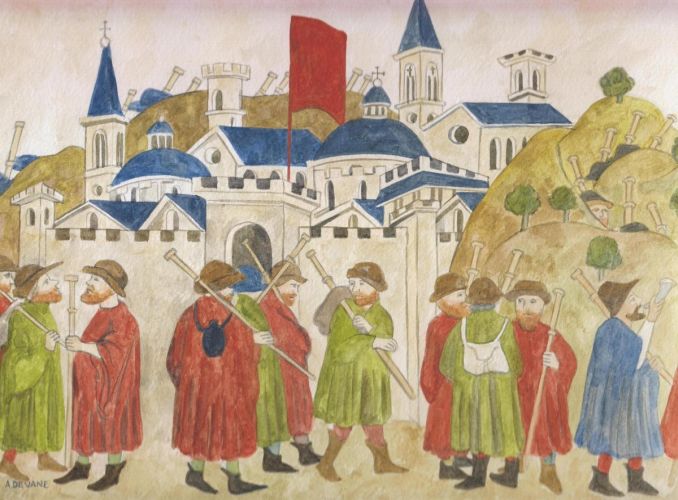
"jubilee" is a Hebrew word which etymologically indicates the ram's
horn -- "jobel" (also "shofar") -- that God ordained should announce
these special sabbatical years:
Leviticus
25:1-13
And the Lord spoke to Moses in mount Sinai, saying: Speak to the
children of Israel, and thou shalt say to them: When you shall have
entered into the land which I will give you, observe the rest of the
sabbath to the Lord. Six years thou shalt sow thy field and six years
thou shalt prune thy vineyard, and shalt gather the fruits thereof:
But
in the seventh year there shall be a sabbath to the land, of the
resting of the Lord: thou shalt not sow thy field, nor prune thy
vineyard. What the ground shall bring forth of itself, thou shalt not
reap: neither
shalt thou gather the grapes of the firstfruits as a vintage: for it is
a year of rest to the land: But they shall be unto you for meat, to
thee and to thy manservant, to thy maidservant and thy hireling, and to
the strangers that sojourn with thee: All things that grow shall be
meat to thy beasts and to thy cattle.
Thou shalt also number to thee
seven weeks of years, that is to say, seven times seven, which together
make forty-nine years: And thou shalt sound the trumpet in the seventh
month, the tenth day of the month, in the time of the expiation in all
your land. And thou shalt sanctify the fiftieth year, and shalt
proclaim remission to all the inhabitants of thy land: for it is the
year of jubilee. Every man shall return to his possession, and every
one shall go back to his former family: Because it is the jubilee and
the fiftieth year. You shall not sow, nor reap the things that grow in
the field of their own accord, neither shall you gather the firstfruits
of the vines, Because of the sanctification of the jubilee: but as they
grow you shall presently eat them. In the year of the jubilee all shall
return to their possessions.

The lands were
let rest ("sabbath"), debts were forgiven, and slaves were freed. These
acts preserved the theocratic order of ancient Israel by disallowing
one man to accumulate material goods and land at the expense of the
community, and by reinforcing the truth that the land belonged not to
them, but to God. In other words, the jubilee interrupted the Pareto
distribution -- the repeatedly observed phenomenon in which 20% of the
people end up with 80% of the wealth (play a game of Monopoly to see
how it works).
Jubilees level and re-level the economic playing field and kept things
harmonious by making almost
impossible monopolies and the division of Israel into warring classes.
And they prevented overfarming and the depletion of potassium,
phosphorus and magnesium from the land, which leads to soil degradation
and, eventually, famine, erosion, and desertification.
But there is
something more to these "days of the Lord": they foreshadow the
Kingdom, and Isaias prophecied to this:
Isaias 61:1-3
The spirit of the Lord is upon me, because the Lord hath anointed me:
he hath sent me to preach to the meek, to heal the contrite of heart,
and to preach a release to the captives, and deliverance to them that
are shut up. To proclaim the acceptable year of the Lord, and
the day of vengeance of our God: to comfort all that mourn: To appoint
to the mourners of Sion, and to give them a crown for ashes, the oil of
joy for mourning, a garment of praise for the spirit of grief: and they
shall be called in it the mighty ones of justice, the planting of the
Lord to glorify hint.
And in
fulfillment of the Prophet's words, Jesus came:
Luke 4:16-21
And he came to Nazareth, where He was brought up: and He went into the
synagogue, according to His custom, on the sabbath day; and He rose up
to read. And the book of Isaias the prophet was delivered unto Him. And
as He unfolded the book, He found the place where it was written: The
Spirit of the Lord is upon me. Wherefore he hath anointed me to preach
the gospel to the poor, he hath sent me to heal the contrite of heart,
To preach deliverance to the captives, and sight to the blind, to set
at liberty them that are bruised, to preach the acceptable year of
the Lord, and the day of reward. And when He had folded the book,
He restored it to the minister, and sat down. And the eyes of all in
the synagogue were fixed on Him. And He began to say to them: This
day is fulfilled this scripture in your ears.
Because of the
Old Covenant ordinances involving the 7th and 50th years, these time
periods also have significance, though spiritualized, in the Christian
era. Jubilee anniversaries of religious profession and ordinations and
the like were always celebrated, for example, but, as far as we can
tell from the Historical record, Pope Boniface VIII is the first Pope
to have instituted regular Holy Years of Jubilee with the accompanying
indulgences as we know them today. He did so in A.D. 1300, and meant
for the Christian Jubilee to be celebrated every 100 years, but a
second Jubilee was called for 1350, then in 1390 and 1423. Thereafter,
since 1450, Jubilees were set to take place every 25 years, and this is
the pattern that's been followed ever since except for the years 1800,
when Napoleon ruled, and 1850, when Pope Pius IX was in exile, and no
Jubilees were called. Extraordinarily, Popes can call for a Jubilee any
time they wish, and sometimes do so at times of great calamity or war,
or on special occasions, such as at the convening of Councils or at the
anniversaries of great events.
What Happens in Jubilee Years
As in the Old
Covenant, the purpose of Jubilee Years is not
only rest and celebration, but forgiveness and the exercise of mercy.
What was foreshadowed by the temporal "even-ing out" of debts in the
Old Covenant, though, is the greater New Covenant reality that Christ's
graces offer us eternal effects. The Sacrament of Confession can be likened to God's granting to
us what He commanded to Moses: "remission to all the inhabitants of thy
land: for it is the year of jubilee." In these holy years, penance is
key (a General Confession in Jubilee Years is recommended by Pope
Benedict XIV).
In addition to the special emphasis on the alleviation of the eternal
effects of sin through the Sacrament of Confession, the temporal
effects of sin are a focus of Jubilee Years, too. A plenary indulgence can be gained, under the usual
conditions, by making a pilgrimage to
the four primary patriarchal churches
in Rome and walking through their Holy Doors (portae sanctae),
which are symbolic of Christ. This is the standard requirement for the
Jubilee indulgence, but the exact requirements (published when the
Jubilee is announced) may vary from Jubilee to Jubilee and usually
include provisions for visiting local churches, doing charitable works,
or fasting, etc
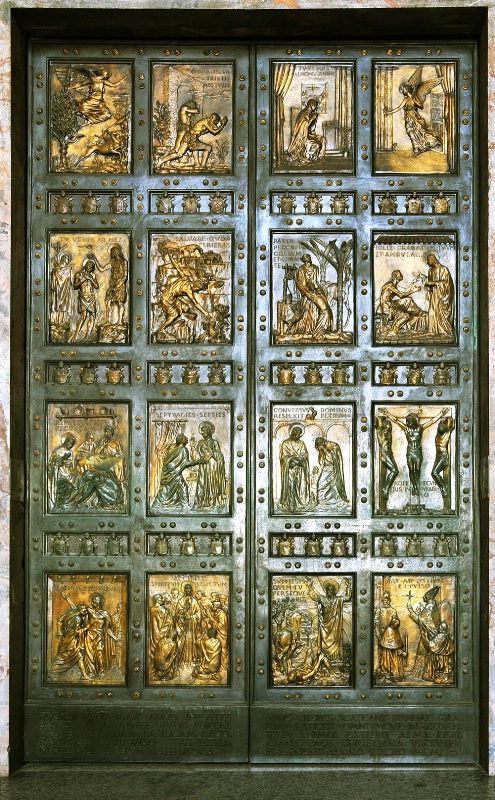
The Holy
Door, St. Peter's Basilia
The four primary patriarchal churches are those churches that are
associated with the Patriarchates of the West, Constantinople,
Alexandria, and Antioch. They are:
- The Church of
St. John Lateran is the cathedral of the Pope and associated with him
as Patriarch of the West
- St. Peter's
Basilica is associated with the Patriarch of Constantinople
- The Church of
St. Paul-without-the-Walls Basilica is associated with the Patriarch of
Alexandria
- The Church of
St. Mary Major is associated with the Patriarch of Antioch
At each of these
patriarchal churches are holy doors which are kept sealed except in
Jubilee Years, their unsealing taking place on Christmas Eve and lasting until
Christmas Day of the following year (or the following Epiphany). The Holy Doors are
opened, and later re-sealed, with great solemnity. The traditional
rites for doing so are as follows:
Opening the Porta Sancta of St. Peter's Basilica, or "the
Door of the Great Pardon"
-
The Pope vests
in a room of the Apostolic Palace and then, together with the
Cardinals, proceeds to the Sistine Chapel. There the sending of the
Cardinal Legates for the opening of the other Doors and the adoration
of the Blessed Sacrament takes place.
-
The procession
makes its way to the Holy Door accompanied by the chanting of the Iubilate
Deo or the Veni Creator Spiritus.
-
The Pope says
the prayer Deus qui per Moysem.
-
He then takes a
silver hammer, recites the verses Aperite mihi portas iustitiae and
strikes the wall covering the Holy Door three times.
-
The Pope returns
to his seat and says the prayer Actiones nostras.
-
The masons
continue the work of opening the Door to the chanting of the Psalm Iubilate
Deo omnis terra.
-
The Pope
genuflects at the threshold of the door. - The Pope is the first to
pass through the Holy Door as the choir chants the Te Deum laudamus.
-
The procession
moves towards the altar for the celebration of Vespers.
Closing the Holy Door
-
The Pope
processes into the Basilica through the Holy Door and presides at
Vespers in the Basilica.
-
He then sends
the Cardinal Legates charged with closing the Doors of the other
Basilicas.
-
A procession
follows, first to the relics and then to the Holy Door, accompanied by
the singing of appropriate hymns.
-
The relics of
the Veronica and the Lance are publicly shown and venerated.
-
The Pope is the
last to leave by the Holy Door.
-
He then blesses
the stones and the bricks.
-
With the trowel
he applies cement to the threshold of the Holy Door and sets in place
three bricks and a few gold and silver coins.
-
Other bricks
are added and then the masons, outside and inside the Basilica, finish
the work of closing the Door while the choir chants the hymn Caelestis
Urbs Ierusalem.
-
The Pope says
the prayer Deus qui in omni loco and ascends to the Loggia of
the Basilica where he solemnly imparts the Apostolic Blessing.
As of this
writing, the most recent Holy Year of Jubilee was called in A.D. 2000.
Look for another Holy Year to come in A.D. 2025, or for one called
extraordinarily outside of the 25-year cycle. When a Jubilee is called,
make a general confession, receive the Eucharist, and either make the
pilgrimage to Rome, if possible, or follow the instructions in the
decree calling for the Jubilee to discover other ways you can receive
indulgences to fulfill the Old Covenant type and most fully receive the
graces of "the acceptable year of the Lord."
See some
pictures of Pope Pius XII's Jubilee
celebrations from Life Magazine, January 9, 1950.
Footnotes
The panels on the Holy Door depict, from left to right, top to bottom:
Adam and Eve sin; Adam and Eve are turned away from Eden by an Angel;
the New Eve utters her fiat; Gabriel making the annunciation; the
Baptism of Christ; Christ as shepherd; the prodigal son; Christ heals
the sick; Jesus and the sinful woman; Jesus talk to Peter about
forgiveness; Jesus trusts St. Peter; Jesus allows the Good Thief into
Heaven; Doubting Thomas; Jesus grants the Apostles the power to forgive
sins; the conversion of St. Paul; Christ stands at the door and knocks.
|
|