|
Background:
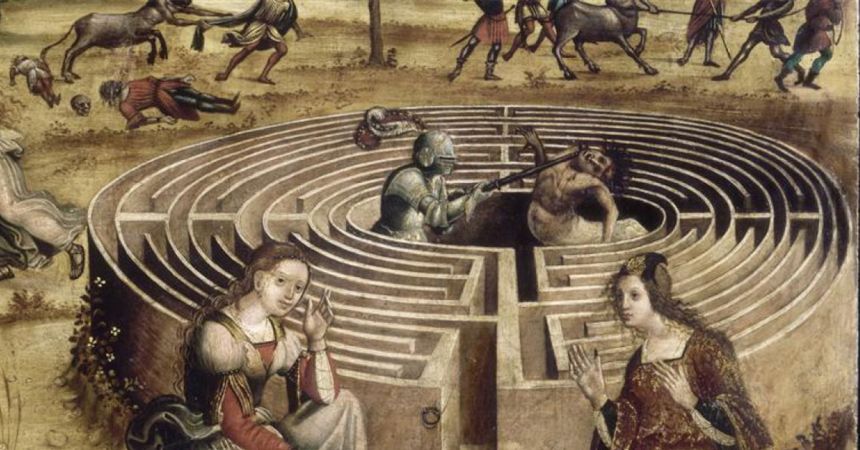
In Greek
mythology, King Minos of Crete defeated King Aegeus of Athens and
threatened to destroy his country unless, every nine years, he
sacrificed seven boys and seven girls to the Minotaur -- a half-man,
half-bull monster -- who lived in the labyrinth in Crete. King Aegeus's
son, Theseus, decided to go to the labyrinth and kill the Minotaur,
releasing the captives and ending the sacrifices once and for all.
On the way to fulfill his mission, he met King Minos's
daughter, Ariadne, who fell in love with him 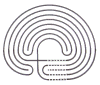 and
promised to help him find his way back out of the labyrinth if he would
marry her and take her back to Athens with him. She gave him a sword
and a ball of thread and told him to fasten one end of thread at the
labyrinth's entrance and unravel the spool behind him as he walked
through to find the Minotaur and kill him with his sword. Following the
thread in reverse, he'd be able to find his way out of the dark,
twisting passages. Theseus did as Ariadne told him, killed the
Minotaur, and followed the thread back out to safety (neither here nor
there with regard to our purposes, he left Ariadne behind when he went
back to Athens! (The classic-style, seven-circuit, Cretan labyrinth is
shown at right.) and
promised to help him find his way back out of the labyrinth if he would
marry her and take her back to Athens with him. She gave him a sword
and a ball of thread and told him to fasten one end of thread at the
labyrinth's entrance and unravel the spool behind him as he walked
through to find the Minotaur and kill him with his sword. Following the
thread in reverse, he'd be able to find his way out of the dark,
twisting passages. Theseus did as Ariadne told him, killed the
Minotaur, and followed the thread back out to safety (neither here nor
there with regard to our purposes, he left Ariadne behind when he went
back to Athens! (The classic-style, seven-circuit, Cretan labyrinth is
shown at right.)
From 19th c.
archaeologist Rodolfo Lanciani's "Pagan and Christian Rome":
Theseus killing
the Minotaur in the labyrinth of Crete, and labyrinths in general, were
favorite subjects for church pavements, especially among the Gauls. The
custom is very ancient, a labyrinth having been represented in the
church of S. Vitale at Ravenna as early as the sixth century. Those of
the cathedral at Lucca, of S. Michele Maggiore at Pavia, of S. Savino
at Piacenza, of S. Maria in Trastevere at Rome (destroyed in the
restoration of 1867), are of a later date. The image of Theseus is
accompanied by a legend in the "leonine" rhythm: Theseus intravit,
monstrumque biforme necavit ["Theseus entered, and killed the
bi-form monster"].
The classical
world's labyrinths were at first seen by Christians as metaphors for
sin and the powers of Hell, as can be seen from this inscription which
was originally found at the center of the Chartres labyrinth:
This stone
represents the Cretan's Labyrinth. Those who enter cannot leave unless
they be helped, like Theseus, by Ariadne's thread.
"Ariadne's
thread" -- the help of the woman, Mary, who leads us from the pits of
Hell by pointing toward her Divine Son. Interestingly, the Chartres
labyrinth is situated at the Western end of the nave and has the same
dimensions as the rose window on that side of the cathedral -- a window
which is as high up on the facade as the
labyrinth is away from the West wall. If you could fold the cathedral
over onto itself as if it were hinged where the West facade and floor
meet, the rose window depicting Our Lady would line up perfectly with
-- and cover -- the maze, beautifully symbolizing the power of Mary's
help in our struggle against evil. Stained glass itself has another
level of symbolism, which St. Bernard of Clairvaux described so
beautifully: “As a pure ray enters a glass window and emerges
unspoiled, but has acquired the colour of the glass … the Son of God
Who entered the most chaste womb of the Virgin, emerged pure, but took
on the colour of the Virgin, that is, the nature of a man and a
comeliness of human form, and He clothed himself in it.”
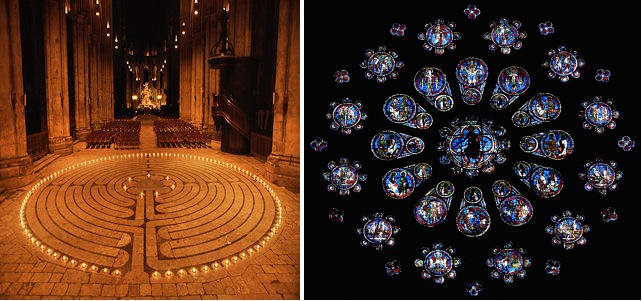 Chartres
labyrinth and West Rose Window Chartres
labyrinth and West Rose Window
Though originally seen as metaphors for the dark powers of Hell and our
need to rely on Our Lady to show us her Son, over time labyrinths came
to be seen quite differently. During the Crusades when Christians
couldn't make visits to the Holy Land, and in the same manner that the Way of the Cross devotion developed as a sort
of substitute "pilgrimage" to the Holy
City, labyrinths came to be used as substitute "Chemins de Jerusalem."
Christians, barred from earthly Zion, would walk the labyrinths, often
on their knees in penance, meditating on the Passion of Our Lord Jesus
Christ.
Sound easy? The
paths of the Chartres labyrinth, for example, make for a journey of 858
feet. Imagine walking on your knees on cold, hard marble for almost the
length of three football fields!
At any rate, the entire symbology of the labyrinth was
reversed: the center of the labyrinth was seen as the goal --
physical Jerusalem or the Heavenly Zion -- instead of that which is to
be escaped -- the pits of Hell. The classical and Carolingian
name "labyrinth" gave way to "Chemin de Jerusalem" or "Rue de
Jerusalem."
No matter which Christian symbology is used to perceive them,
note that, unlike the mythological labyrinth of the Minotaur, church
labyrinths, like classical representations of the Minotaur's
lair, are not designed with dead ends and trickery (for this reason,
some refuse to call them "mazes," though the terms are
interchangeable); they are designed such that one begins at one end and
walks the path, without veering, to the other, the symbol of the
Heavenly Jerusalem (or the escape from Hell). There is only one way in
(or out), one path toward (or away from) the center -- and that path is
direct, as the Way of Christ is direct. Though direct, that path, as in
following Him as "The Way," is a winding road, full of turns and suffering and hardship
(especially if that path is "walked" on one's
knees!). But always, the Heavenly Jerusalem (or the "way out" from sin
and its effects) -- is in sight from any place in the labyrinth, and
one knows that if one remains on that path, he will find himself where
he wants to be.
Be aware that
labyrinths have been enjoying a surge in popularity
recently -- but mostly among pagans and Modernist
Catholics who perceive them as "earth
wombs" or tools for tapping into "earth energies" and such
nonsense. They are over-valued by those who see labyrinths as being magical
and as possessing inherent power -- a
power often imagined as emanating from the earth itself.
In spite of all that, I include the topic here because the traditional
Catholic position must be known, and because I find them lovely
and their original Christian purposes fascinating. Either as
"Chemins de Jerusalem" or metaphors for Hell, the proper use
of labyrinths is quite Catholic and beautiful; it would be sad indeed
if labyrinths were to become associated only with New Agers --
especially when many of the labyrinth designs they use were made
specifically for the great cathedrals and other churches of
Christendom, such as those at Amiens, Reims, and Calais.
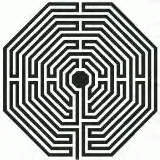 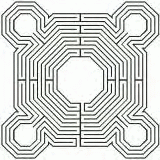 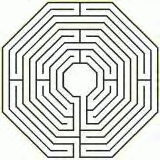
Left to Right:
Labyrinths of Amiens, Reims, and Calais
Large, full-sized labyrinths can be walked in penance on one's knees,
walked as "pilgrimage" much the same as the Way
of the Cross, or walked simply as a way of disciplined prayer in
that it forces one to slow down. In all cases, however, Jesus
Christ and the Christian's journey -- not "one's self," "inner
god/ess," "the unconscious mind," etc. -- is always the focus of any
Catholic devotion and prayer!
If you don't have access to medieval labyrinths, facsimiles --
full-sized affairs made of brick, concrete or tiles, or small ones
drawn on paper and traced with a finger -- can
be used. They can be used in the traditional way if size allows, or can
be enjoyed as a
symbol of the Heavenly Jerusalem, the escape from Hell, the Christian
journey, a memorial to the great cathedrals of the Age of Faith -- or
simply admired for their aesthetic beauty, a beauty enhanced by the
knowledge that our Catholic ancestors used these designs for holy
purposes.
Just for fun: a closer look at the geometry
of the Chartres-style labyrinth or "Chemin de Jerusalem"

The Chartres
labyrinth is an "11 circuit" labyrinth, meaning that from one edge to
the center are 11 "circuits," or rows of paths, made by 12 concentric
circles (i.e, it is 22 circuits across, plus the center). We will let:
A = width of
each circuit (path). This includes the width of the lines that form the
paths (E)
B = diameter of center
C = diameter of entire labyrinth
D = the lenght of only the circuits on both sides of the center, but
not counting the center itself
E = width of actual lines that form the circles and paths
F = radius of center
A = (C-B) / 22
B = C/4
B = 22A / 3
B = C - D
C = 22A + B
C = 4B
C = B + D
D = 3/4C
E = (A/9)2
F = 1/2B
The above equations give the relationships between the size of each
path and the diameters of the center and of the entire labyrinth, and
will let you design your labyrinth by choosing first either the size of
the path, or of the center, or the diameter of the entire thing.
| Example: |
| Say you want
a labyrinth with a diameter (C) of 42 feet. C=42: |
| 1. |
To determine the
diameter of the center (B), divide C by 4:
B = 10.5 feet
|
| 2. |
To determine the
width of the circuits without the center (D), subtract the diameter of
the center from the total diameter C):
D = 31.5 feet
|
| 3. |
To determine the
width of each path (A -- this includes the lines that form the paths!),
divide the number gotten in #2 above by 22:
A = 1.43 feet
|
Example: |
| Say you want
a labyrinth with paths (A) that are each 2 feet wide (the path width
includes the width of the actual lines that form the paths). A=2: |
| 1. |
To determine the
width of just the circuits without the center (D), multiply A by 22:
D = 44
|
| 2. |
To determine the
diameter of the center (B), divide 66 by 3:
B = 14.6
|
| 3. |
To determine the
diameter of the entire labyrinth (C), add D+B:
C = 58.6
|
After you have
your values for A, B, C, D, E, and F, you need to come up with a
measuring guide of some sort. This could be a ruler, if you are drawing
a small design, or a rope if you are making a "life-size" labyrinth in
your garden or some such. Whatever you use as a measuring guide must be
long enough to extend past the edges of the labyrinth from the center
(i.e., it must be a bit longer than 1/2D + 1/2B).
Now, secure the measuring guide to the exact center of B such that the
guide is totally fastened at the center, but can move all the way
around the circle in 360o. Measure out from the center of B,
where the guide is secured, to determine where your
outermost circle will be. To locate that first circle, add the
radius of the center (1/2B ) to 1/2D.
Now you need to mark, in an impermanent way, the entrance and straight
paths that are found on the "south" side of the labyrinth in the
diagram. In churches, the entrances to Chemins de Jerusalem were
built such that when one first entered the labyrinth, one faces
East, as we do at Mass (i.e., in the diagram, the top of the
picture would be "East"). Whatever you decide, from B's
perimeter, lay the guide out so that it reaches the outer perimeter of
the labyrinth, on that side of the labyrinth where you want the
entrance to be. Now measure out two lines, A's width apart, heading
toward the center from the outside of the labyrinth. The actual lines
should be A/9 in width, the width moving from the lines that mark the
first path and toward the center. Now, facing the center, go left
of that path you just made, and mark another line A's width away from
it, making the line no thicker than A/9, the width extending
from that line and toward the other two lines you've already made.
Now you mark the circles of the paths. Mark your guide at regular
distances of A apart (i.e., if A = 2 ft., mark your guide every 2
feet, starting from the perimeter of the center). Lay the guide
down on the surface and mark where its markings indicate. Move
the guide forward a few degrees around the circle, and mark again.
Then connect the dots, taking note of where the turns will be, and
making the lines no more wide than A/9.
Now the turns are added in their proper places, and the rose petals at
the center are added. The rose petals are 6 in number, and their tips
extend halfway from the outer perimeter of the center and the center's
radius.(F/2). There should be a petal point exactly across from the
entrance to the center.
The lunations or little "cogs" on the outside of the labyrinth are
placed as far apart as the diameter of the labyrinth divided by 36
(C/36) (there will be 114 lunations minus one which would have been
where the entrance to the maze is). The length of the lunations will
equal their distance apart. Start the lunations at the entrance: make
the first ones at either side of the entrance exactly 1/2 the distance
away from the entrance path as the lunations are apart from each other:
(C/36)/2.

(To see this graphic by itself for easy printing, click here.
Will open in new browser window.)
|
|