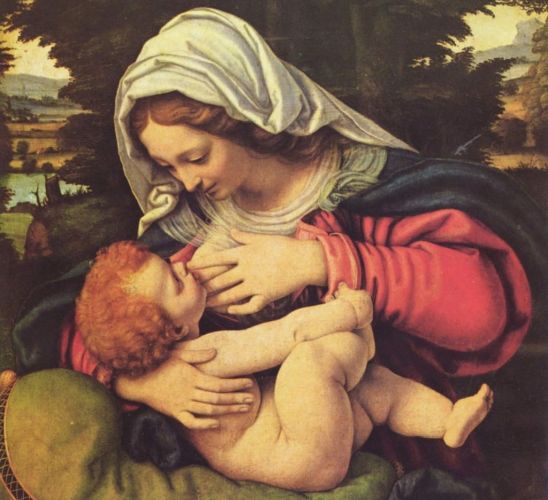
|
view
|
One of the earliest depictions (if not the earliest depiction)
of Mary, this is Our Lady as painted in the Priscilla Catacombs, ca.
A.D. 250 |
|
view
|
An early Coptic nursing Mary |
|
view
|
Amesbury Psalter, 13th c. |
| view |
Artist: Barnaba
da Modena, A.D. 1328-1386 |
|
view
|
Artist: Lorenzetti, ca. A.D. 1330 |
|
view
|
Anonymous French sculpture, ca. A.D. 1335 |
|
view
|
Artist: Berry, 14th. c. |
|
view
|
Artist: Berry, 14th. c. |
|
view
|
Wall painting in a church in Belchamp Walter, Essex, ca. A.D.
1350 |
|
view
|
Artist: Ghissi, ca. A.D. 1350 |
| view |
Artist: Jaume
Serra, A.D. 1359 |
|
view
|
Artist: Pisano, ca. A.D. 1360 |
|
view
|
Artist: Veneziano, ca. A.D. 1370 |
|
view
|
Artist: Orcagna, ca. A.D. 1370 |
|
view
|
Artist: Bertram, ca. A.D. 1383 |
|
view
|
Artist: Serra, ca. A.D. 1390 |
|
view
|
Artist: Gaddi, ca. A.D. 1390 |
|
view
|
Artist: Camerino, ca. A.D. 1400 |
|
view
|
Artist: Bartolo, ca. A.D. 1400 |
|
view
|
Artist: Robert Campin, "The Master of Flemalle," ca A.D. 1400 |
|
view
|
Artist: Robert Campin, "The Master of Flemalle," ca A.D. 1400 |
|
view
|
Artist: Robert
Campin, "The Master of Flemalle," ca A.D. 1400 |
|
view
|
Artist: Robert
Campin, "The Master of Flemalle," ca A.D. 1400 |
| view |
Artist: Robert
Campin, "The Master of Flemalle," ca A.D. 1400 |
| view |
Artist: Robert
Campin, "The Master of Flemalle," ca A.D. 1400 |
|
view
|
From "Les Très Belles Heures du Duc de Berry," ca. A.D. 1409,
illustrated by the brothers Jean, Paul, and Hermann Limbourg. The
brothers also later illustrated the better known "Les Très Riches
Heures du Duc de Berry" (some illustrations for this work were later
added by Jean Colombe). |
|
view
|
Artist: Bartolo, ca. A.D. 1415 |
| view |
Artist: Dieric
the Elder Bouts, 1415-1475 |
|
view
|
Artist: Masolino, ca. A.D. 1420 |
|
view
|
Artist: Masolino, ca. A.D. 1420 |
|
view
|
Artist: di Lorenzo, ca. A.D. 1430 |
| view |
Artist: Carlo
Crivelli, 1430-1498 |
| view |
Artist: Weyden, A.D. 1433 |
|
view
|
Artist: Weyden, A.D. 1435 |
| view |
Artist: Weyden,
A.D. 1435 |
| view |
Artist: Workshop
of Rogier van der Weyden, ca. 1435 |
|
view
|
Artist: Van Eyck, A.D. 1436 |
|
view
|
Artist: Paolo, A.D. 1445 |
|
view
|
Artist: Fouquet, ca. A.D. 1450 |
| view |
Artist: Giovanni
Antonio Boltraffio, 1466-1516, and Leonardo da Vinci
|
| view |
Artist: Giovanni
Antonio Boltraffio, 1466-1516 |
| view |
Artist: Giovanni
Antonio Boltraffio, 1466-1516 |
| view |
Artist: Giovanni
Antonio Boltraffio, 1466-1516 |
| view |
Artist: Giovanni
Antonio Boltraffio, 1466-1516 |
| view |
Artist: Quinten
Metsys, 1466-1530 |
| view |
Artist: Leonardo
da Vinci, 1452-1519 |
| view |
Artist: Lorenzo
di Credi, 1459-1537 |
|
view
|
Artist: Gozzoli, ca. A.D. 1484 |
| view |
Artist: Jan
Mabuse, 1478-1532 |
| view |
Artist: Jan
Mabuse, 1478-1532 |
| view |
Artist: Jan
Mabuse, 1478-1532 |
| view |
Artist: Jan
Mabuse, 1478-1532 |
| view |
Artist: Jan
Mabuse, 1478-1532 |
| view |
Artist: Gian
Giacomo De Alladio, also known as Macrino d'Alba, 1460/5-1528 |
| view |
Artist: Lucas
Cranach, ca. A.D. 1472-1553 |
| view |
Artist: Memling,
ca. A.D. 1478 |
| view |
Artist: Master
of Frankfurt, 1480-1520 |
| view |
Artist: Raphael
Raffaello Sanzio da Urbino, 1483-1520 |
| view |
Artist: Hans
Baldung, 1484-1545 |
| view |
Artist: Hans
Baldung, 1484-1545 |
| view |
Artist: Hans
Baldung, 1484-1545 |
| view |
Artist: Domenico
di Pace Beccafumi, 1486-1551 |
|
view
|
Artist: Memling, ca. A.D. 1487 |
|
view
|
Artist: Memling,
ca. A.D. 1487 |
| view |
Artist: Memling,
ca. A.D. 1487 |
| view |
Artist: Memling,
ca. A.D. 1487 |
| view |
Artist: Follower
of Memling |
| view |
Artist: Master
of the Legend of Mary Magdalene, 1480-1537 |
| view |
Artist: Andrea
del Brescianino, 1487-1525 |
| view |
Artist: Bernard
van Orley, 1487-1541
|
|
view
|
"The Miraculous Lactation of St. Bernard." This painting
depicts the spiritual nourishing of St. Bernard by the milk of Our
Lady, based on this legendary mystical experience: Bernard prayed
before a statue of the Madonna, asking her, "Show yourself a mother"
("Monstra te esse Matrem"). The statue came to life and and squirted
milk from the breast onto the Saint's lips. Artist: Unknown Master,
Netherlandish, 1480-85 |
| view |
Artist: Titian
Tiziano Vercelli, 1488-1556 |
| view |
Artist:
Giampeietrino, possibly Giovanni Pietro Rizzoli, active 1495-1549 |
| view |
Artist:
Giampeietrino, Giovanni Pietro Rizzoli, active 1495-1549 |
| view |
Artist: Antonio
Allegri Correggio, 1489-1534 |
|
view
|
Artist: Domenico, ca. A.D. 1490 |
|
view
|
Artist: Gerard David, ca. A.D. 1490 |
|
view
|
Artist: Gerard David, A.D. 1490 |
|
view
|
Artist: Gerard
David, A.D. 1490 |
|
view
|
Artist: Gerard
David, A.D. 1490 |
| view |
Artist: Jacopo
Carucci, also known as Jacopo da Pontormo, 1494-1577 |
|
view
|
Artist: Michelangelo, A.D. 1496 |
| view |
Artist: Moretto
da Brescia, 1498-1554 |
| view |
Artist: Michiel
Coxie, 1499-1592 |
|
view
|
Anonymous Italian, 15th c. |
|
view
|
Artist: da Vinci, ca. A.D. 1500 |
|
view
|
Artist: Solario, A.D. 1500 |
| view |
Artist: Solario,
A.D. 1500 |
| view |
Artist: Solario,
A.D. 1500 |
|
view
|
Artist: Mainardi, ca. A.D. 1500 |
|
view
|
Artist: Signorelli, ca. A.D. 1500 |
|
view
|
Artist: Romano, A.D. 1510 |
| view |
Artist: Follower
of Leonardo da Vinci, after A.D. 1510 |
|
view
|
Artist: Cleve, ca. A.D. 1512 |
| view |
Artist: Cleve, ca. A.D. 1512/13 |
|
view
|
Artist: Durer, 1512 |
| view |
Artist: Cleve, ca. A.D. 1512 |
| view |
Artist: Lucas
Cranach, ca. A.D. 1512-15 |
| view |
Artist: Master
of the Mansi Magdalen, 1515 |
| view |
Artist: Master
of the Legend of Mary Magdalen, 1520 |
| view |
Artist: Master
of the Legend of Mary Magdalen, 1520 |
| view |
Artist:
Anonymous, 1520 |
| view |
Artist:
Barnardino Luini, ca. 1520 |
| view |
Artist:
Barnardino Luini, ca. 1520 |
|
view
|
Artist: Durer, 1520 |
| view |
Artist: Cleve, ca. A.D. 1520 |
|
view
|
Artist: Cleve, ca. A.D. 1520 |
|
view
|
Artist: Coreggio, ca. A.D. 1520 |
|
view
|
Artist: Conti, ca. A.D. 1520 |
|
view
|
Artist: Durer, ca. A.D. 1520 |
|
view
|
Artist: Michelangelo, A.D. 1520 |
|
view
|
Artist:
Marcellus Coffermans, 1520-1578 |
|
view
|
Artist: Orley, A.D. 1522 |
| view |
Artist: Cleve, A.D. 1525 |
| view |
Artist: Lucas
Cranach, ca. A.D. 1530/5 |
|
view
|
Artist: Morales, A.D. 1520 |
|
view
|
Artist: Orazio
Lomi Gentileschi, 1563-1639 |
| view |
Artist: Orazio
Lomi Gentileschi, 1563-1639 |
| view |
Artist: Orazio
Lomi Gentileschi, 1563-1639 |
| view |
Artist: Orazio
Lomi Gentileschi, 1563-1639 |
|
view
|
Artist: Barocci, A.D. 1575 |
|
view
|
Artist: Coxcie, Michiel van, ca. A.D. 1580 |
|
view
|
Artist: Reni, Guido, A.D. 1575-1642 |
|
view
|
Artist:
Francisco de Zurbaran, 1598-1664 |
| view |
Artist:
Francisco de Zurbaran, 1598-1664 |
|
view
|
Anonymous 16th c. |
|
view
|
Artist: El Greco, ca. A.D. 1600 |
|
view
|
Artist: El
Greco, ca. A.D. 1600 |
| view |
Russian Icon of
the Flight into Egypt, 1600s |
|
view
|
Nuestra Señora de Leche y Buen Parto (Our Lady of Milk and
Good Birth). This statue, ca. A.D. 1600-1620, is kept in the shrine
devoted to Nuestra Señora de Leche y Buen Parto in St. Augustine,
Florida -- the first Marian shrine in the United States. |
| view |
Artist: Erasmus
Quellinus II, A.D. 1607-1678 |
| view |
Artist: Josefa
de Obidos, 1630-1684 |
|
view
|
Artist: Rembrandt, A.D. 1630s |
|
view
|
Artist: Rembrandt, A.D. 1640 |
|
view
|
"The Miraculous Lactation of St. Bernard." This painting
depicts the spiritual nourishing of St. Bernard by the milk of Our
Lady, based on this legendary mystical experience: Bernard prayed
before a statue of the Madonna, asking her, "Show yourself a mother"
("Monstra te esse Matrem"). The statue came to life and and squirted
milk from the breast onto the Saint's lips. Artist: Alonso Cano, A.D.
1650 |
|
view
|
Artist: Zubaran, A.D. 1659 |
| view |
Artist: Pompeo
Batoni, A.D. 1708-1787 |
|
view
|
Artist: Werf, Adriaen van der, 1714 |
|
Unsorted,
Anonymous
|
|
view
|
Anonymous, Peruvian "Cuzco School" |
|
view
|
Anonymous, Peruvian "Cuzco School" |
| view |
Anonymous Master
of Bruges |
| view |
Anonymous, Early
Flemish School, 16th c. |
| view |
Anonymous |
|
view
|
Anonymous |
|
view
|
Anonymous |
| view |
Anonymous |
| view |
Anonymous,
perhaps Simon Marnion, 1425-1489 |
| view |
Not sure.
Possible the Master of the Legend of Mary Magdalen, 1520? |
| view |
Anonymous. Mary
with Joseph and John the Baptist |
| view |
Beautiful icon
of Our Lady nursing |
| view |
Another icon
of Our Lady nursing |
|
view
|
Painting from Bethlehem's ancient "Milk Grotto." The chapel
whence this picture comes was built around the grotto by Franciscans in
1872. |