Gabriel Garcia Moreno, Statesman and
Martyr
by Gary Potter
|
On the Feast of the Transfiguration, August 6, 1875, a
statesman, whom many would call the greatest the world has known since
the so-called Reformation, was cut down by Masonic assassins on the
porch of the cathedral in his nation’s capital. Moments before, until
lured outside by a false message that he was urgently needed elsewhere,
he had been adoring the Blessed Sacrament.
Fallen from the porch and lying stretched out on the ground, his head
bleeding, his left arm severed and right hand cut off by blows of a
machete, the illustrious victim recognized his assailants — recognized
in the sense of understanding for whom they acted. Some accounts say he
gasped his last words, others that he was able to cry them out
defiantly. All agree on the words themselves: "Dios no muere!" "God
does not die!"
Striking as they were as a summing up of the moment — they amounted to
saying, "You may murder me, but you can never kill the One whom men
like you really want dead" — other words voiced by the felled leader on
other occasions can be compared to them for aptness. These would
include, above all, the words of his political creed, one for whose
realization he spent himself in life and would finally die, words that
were and are a summing up of the whole of Christian doctrine when
applied to the sphere of politics, the means by which the life of a
society is governed: "Liberty for everyone and everything, except for
evil and evil-doers."
Insofar as the man was guided by that creed in his governance of the
nation, we can understand how it was that what he wrought would become,
as Pope Leo XIII described it: "The model of a Christian state."
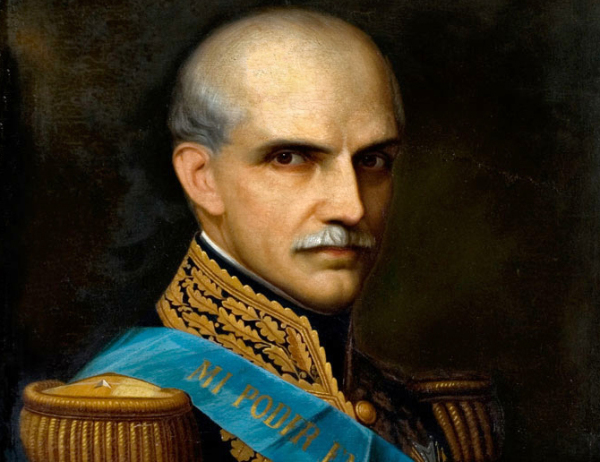
The nation was Ecuador. The man was Gabriel Garcia Moreno, twice
President of the Republic and throughout most of his adult life the
nation’s most commanding figure as a lawyer, legislator, scholar and
soldier, as well as statesman. This essay is about him — rather more
about him as a man than in terms of his career.
That is not to say his achievements will be ignored, but it is not
necessary to detail events and developments in Ecuadorian history to
appreciate them. Still, it is desirable to have some idea of the
history of Ecuador and of the region, especially before Garcia Moreno
arrived on the scene. It is, if only because many in the U.S. are
inclined to suppose that everything south of the Rio Grande,
geographically and politically, if not culturally, is an extension of
their own part of the Hemisphere, or ought to be. When they see it is
not, or does not wish to be, they chalk it down to the cultural
difference, and that difference is defined for them by Latin America
being Catholic.
To most in the U.S., that difference has always made Latin America
"backward" or "less developed." It is taken as one of the indices of
this supposed backwardness that governments in Latin America have often
been headed by authoritarian leaders — usually called "strongmen" or
"dictators" by U.S. news media.
If the views on Latin America held by many U.S. Catholics, perhaps
including some readers of these lines, are colored by the majority’s
notions, it should not be surprising. Most men are susceptible to the
influence of a majority. Further, the views are not entirely mistaken.
The cultural difference between Latin America and North America is very
great, or at least it was before McDonald’s and MTV, and the
difference, indeed, has its roots in religion. Where U.S. Catholics can
let themselves be led astray by majority notions is in accepting the
view that Catholic culture and its fruits are necessarily "backward" —
i.e., inferior.
That includes the political fruits. Gabriel Garcia Moreno was certainly
the kind of authoritarian ruler who would be — who is — condemned as a
"strongman," as if being one of those were necessarily evil. Is it?
Sometimes even the leading organs of secular liberalism seem unable
quite to make up their mind on this question.
Illustrative of this curious ambiguity is the Encyclopedia Britannica’s
online article about Gabriel Garcia Moreno. Therein it is actually
admitted, if but grudgingly, that his rule was, well, "often effective
in its reformist aims." Still, it "eventually cost him his life" since
it was "oppressive." That, of course, was due to his being the
"initiator of a church-oriented dictatorship." Further, "versed in
political theory…he became convinced that the remedy for his nation’s
political and economic plight was the application of moral principles
by a powerful leader." (Moral principles? Good Lord! Would they be more
excusable if applied by a weak leader or one not versed in political
theory?) If it was due to them that Garcia Moreno somehow "reduced
corruption, maintained relative peace, and strengthened the economy,"
he also "placed education under the Roman Catholic Church, signed a
concordat with the Vatican, and officially dedicated Ecuador to the
Sacred Heart." No wonder, then, that "he was assassinated by a group of
young liberals." (And no wonder, either, that the Encyclopedia
Britannica cannot limit itself simply to reporting his positive
achievements.) As for the "young liberals" who murdered him, we have
already seen who they really were. (Signed checks in the pockets of one
provided hard evidence.)
For most Americans, Ecuador is probably among the lesser-known Latin
American nations. To speak of nations, of course, is to speak of
peoples. Some islands belonging to Ecuador are very well known. These
are the Galapagos, 600 miles west of the mainland in the Pacific Ocean.
TV documentaries have made them, if not Ecuadorians, famous as the home
of giant sea turtles, iguanas, and other exotic forms of animal life.
About the size of Colorado, mainland Ecuador is not one of South
America’s larger countries. With no more than six percent of its land
being arable, it is not an agricultural power in the world. It is an
oil-producing nation, however, and also exports other raw materials and
some finished goods. Its population of 12 million is 95 percent
Catholic.
Topographically, two ranges of the Andes Mountains run north and south,
dividing the country into three zones: hot and humid lowlands along the
Pacific Ocean coast; temperate highlands between the two ranges; and
tropical jungle in the east (where the oil is located). The capital,
Quito, is in the highlands. Historically, there has been political
rivalry, sometimes exploding into an outright fight, between
conservative forces centered in Quito and liberal elements with their
base in the chief port and second city, Guayaquil.
Gabriel Garcia Moreno, born on Christmas Eve, 1821, was a native of
Guayaquil. Once his youth was behind him, however, no one would ever
accuse him of liberalism.
History knew no independent nation of Ecuador until nine years after
his birth. Prior to that, history of the land of which we can be sure
began in the 15th century with the subjugation of native inhabitants by
Incas from the south. Inca rule lasted little more than 50 years. It
ended when Spaniards under Sebastian de Belalcazar, a lieutenant of
Francisco Pizarro, the great conquistador, decisively beat the last
Inca warriors defending the northern part of their empire. That was in
1534. There followed nearly three centuries of Spanish government.
Nowhere in Latin America did the Spanish ever try simply to exterminate
native peoples as did the Anglos in North America. Evangelization was
always integral to their colonial enterprise in the Western Hemisphere.
If that made them baptizers instead of killers, they also had to be
civilizers. (They knew that men are not saved simply by baptizing them.
They must also lead morally upright lives.)
Though the civilizing mission of the Spanish deserves more honor and
praise than it receives today, or will receive as long as political
correctness keeps "multiculturalism" a dominating idea on the
intellectual landscape, Catholics should never falsify history. We
ought to acknowledge that the Spanish record in the Americas, glorious
as it was, was not without stain. For instance, development of the
territory that would become Ecuador was frustrated during the early
Spanish years by a series of local civil wars fought among captains
motivated by nothing but greed and ambition. After that, rapacious
individuals, ignoring the expressed will of Spain’s monarchs and
remonstrances of the Church, would abuse and exploit native Indians to
the point of enslaving many. This scandal was made worse with the
importation of slaves from Africa, most of whom arrived in the region
via the Colombian port of Cartagena.
Our reference to that port city and center of the slave trade is not
accidental. To the extent that such a place can be sanctified by the
actions of one man, it was the case of Cartagena from 1610 to 1654 when
it was the arena of St. Peter Claver’s apostolic efforts.
To the south, in the capital of the Viceroyalty of which Ecuador was
then a part, that of Peru, the life of another holy person during some
of those same years tempered what inhumanity and injustice existed at
the time. This was St. Rose of Lima.
A contemporary and friend of hers in Lima, the Dominican lay-brother
St. Martin de Porres, represented in his own person, as the son of a
Spanish nobleman and woman of color, a melding of races that was then
taking place and which has always been characteristic of Catholic,
Hispanic culture. (Nothing like it on as wide a scale ever took place
in Protestant North America. Fifty-five percent of our population,
after all, is not mestizo, as is that of Ecuador today.)
If sanctity could and did exist alongside an evil like slavery in
17th-century Spanish America, it was owed largely to the labors of
religious orders. Those labors included, as we have said, the unceasing
effort to civilize, especially through education, as well as baptize.
Tragically, much of the orders’ work was undone in Ecuador and
elsewhere in Latin America in the last decades of the 18th century. The
poison of the Enlightenment had spread into and infected Spain by then,
and with the infection came the fever of the Revolution. As a result,
the Jesuits were expelled from Ecuador in 1767, as were other orders
soon afterward. The consequences were awful. For example, it is
estimated that 100,000 Indians living in the neighborhood of 33
Dominican missions in the jungle part of the country reverted to
paganism after the sons of St. Dominic were expelled.
If the effort to promote and extend the sway of the Faith made possible
the continuance of Spanish rule despite its deficiencies, the rule
could not endure when the effort ceased. That is to say, the Spaniards
who abandoned the Faith for the Revolution soon paid for their sin. At
home, their country was militarily occupied by Napoleon. In the
Americas, their lands were torn from them one by one.
The movement toward independence from Spain began early in the 19th
century. It is much misunderstood in North America. In numerous places
it was far from revolutionary, though that is how it is always
portrayed. Mexico is a case in point. The Spanish government at the
beginning of the 19th century was liberal and corrupt beyond
description. When its administration in Mexico was finally overthrown,
the first leader of the independent nation was not a Masonic President
like Benito Juarez later on, but a Catholic Emperor, Agustin de
Iturbide. (He took the name Agustin I. That he was a faithful son of
the Church is underlined by the fact that he did not simply crown
himself like Bonaparte. He was anointed monarch by the Archbishop of
Guadalajara.)
In South America, the leading independence figure, by far, was Simon
Bolivar, born in 1783 in Caracas in what is now Venezuela but was then
part of the overseas Spanish territory of New Granada. His name is well
known in the U.S. We even have towns named after him, like Bolivar,
Missouri. Beyond that, we hear he was a Freemason and assume a great
deal from the fact, not all of which is wrong — far from it. If we hear
he was exposed to the writings of such as Locke, Hobbes, Voltaire and
Rousseau while being educated in Europe, we may rightly assume still
more. However, in La Carta de Jamaica (A Letter from Jamaica), a
political declaration written in exile in 1814, he proposed for South
America a form of government consisting of a bicameral legislature with
an elected lower house such as might be expected, but also with a
hereditary upper house and with a president who would serve for life.
Thus we see that from the very beginning, and in the mind of the
veritable father of South American independence, government was
envisioned that featured at its head a leader whose term in office was
not subject to the control of any electorate — a virtual caudillo, to
use the Spanish word English-speakers approximate when they talk about
a "strongman".
Before retiring from politics in 1830 — he would die before the end of
the year, heartsick over the disunity and factionalism he saw rising
all around him — Bolivar served as President of both Gran Colombia
(consisting of today’s Venezuela, Colombia and Ecuador) from 1821 to
1830 and Peru from 1823 to 1829. His occupancy of this dual presidency
underscores something important. Bolivar did not seek to bring into
existence the individual nation-states of South America with which we
are now familiar. He thought in terms of continents. The fulfillment of
his vision could have led to a United States of (South) America.
Whether it would have endured or eventually come apart, as the U.S.
nearly did in the 1860s, the possibility of it suggests one of those
interesting "what if" questions beloved by history buffs: What if there
had been in this Hemisphere and in the world during the past two
centuries a united South America counter-weighing the U.S. in the
north?
A unifying principle would have been needed for it to happen. The U.S.
found one in a conception of freedom compatible with its regnant
Protestantism. Latin American unity would have had to form around some
principle derived from the One True Faith, or even the Faith itself.
From very early on, the U.S. has been alive to the possibility of
exactly that happening, or of even one of the American Hispanic nations
emerging as a real power on the world stage, a Catholic one.
Accordingly, Catholic political leaders, which is to speak of leaders
sympathetic to Catholic social order, have found themselves undermined
and seen the careers of men friendly to the spread of alien ideas
promoted — ideas like the notion of freedom imagined as the license to
do as one pleases instead of the Catholic understanding of it as the
freedom to choose between salvation and eternity in Hell. Iturbide saw
it. The very first envoy sent from the U.S. to Mexico after that nation
became independent presided over his dethronement. Once he was
eliminated, "Freemasonry, so actively promoted in Mexico by the first
minister from the United States, Joel R. Poinssett" — we are quoting
from the old Catholic Encyclopedia (1913) — "began gradually to lessen
the loyalty which both the rulers and the governed had manifested
toward the Church."
The anti-Catholicism of U.S. policy in Latin America has sometimes been
stated explicitly by our leaders. It was by Theodore Roosevelt when he
paid a visit to South America at the turn of the 20th century. "While
these countries remain Catholic," he said, "we will not be able to
dominate them."
To be sure, the policy has not often been reflected in speech quite
that bald, but it has been blatant in a number of historical actions,
as when the U.S., in violation of its own Monroe Doctrine, assisted
England in its invasion of the Western Hemisphere and war against
Argentina in the Malvinas (called the Falklands by England) in 1982.
Gabriel Garcia Moreno would have been the ideal leader of a great
united, Catholic South America. Had he been born a few decades earlier,
he might even have been the man to forge it, as Simon Bolivar finally
proved not to be. The small nation of Ecuador, however, would be the
only theater he knew for the exercise of his very large political
talents. He reached its stage none too soon.
For eight years (1822-30) the nation, as we have already heard, had
been part of the confederation of Gran Colombia, the other sections
being Colombia and Venezuela. Mainstream history books speak of various
territorial and economic disputes leading to the break-up of the
confederation, but we have just finished noting the existence of forces
in the world that would favor such a development, if they did not
foment it.
Whatever, the first fifteen years of Ecuadorian independence were
dominated by two men, Juan Jose Flores and Vicente Rocafuerte. The
former hailed from Quito and had his main support from the country’s
great landed families. Rocafuerte was more of an ideologue, his support
coming from the wealthy bourgeois merchants who controlled Guayaquil
and were influenced by 19th-century liberalism of the kind that had
anti-clericalism as an integral feature. Neither man was much concerned
for the welfare of ordinary Ecuadorians, including the native Indians,
but kept the country fairly stable as they alternated the presidency
between themselves.
In the mid-1840s a series of younger men came on the scene. None was
really fit to serve as president of the fledgling nation, all aspired
to do so, most proclaimed themselves liberal, and as many as did were
ready to commit the vilest acts to prove it. The chaos their rivalries
produced brought Ecuador very near to disintegration before Garcia
Moreno finally took power for the first time in 1859.
We have said it is not necessary to detail here events and developments
in Ecuadorian history in order to appreciate the achievements and
personal qualities of Garcia Moreno. Accordingly, we are not going to
spend time exploring the intramural squabblings of the liberals or
tracing the steps taken by Garcia Moreno to overcome them, except to
say two things.
The first is that he sometimes had to fight during his rise to power —
not figuratively fight, but fight in battle with gun or sword in hand
against one or another of the liberals. Though he was not formally
trained as a military man, a willingness to risk his life and apparent
inborn sense of what was strategically wise as well as tactically sound
won him the victories that were necessary. So it is that we can count
soldiering among his accomplishments.
The second thing to say is that when he was a young man first making a
name in politics, it was as a liberal. When we go further and say that
was very much to the chagrin of his mother and also his first mentor,
it becomes necessary to speak briefly about his early life, and that
raises the subject of sources.
Students who wish to know more about Garcia Moreno than can be told in
this article but who do not read Spanish will have few directions in
which to turn. Further, what little exists in English will often differ
from what is read here. For instance, most of the English-language
sources have Garcia Moreno assassinated on the steps of the National
Palace in Quito, whereas our readers have already heard that it was on
the porch of the close-by cathedral. That is because we are drawing
mainly from a biography that was written by the French Redemptorist
priest, Rev. P.A. Berthe, soon after the death of Garcia Moreno. The
biography, Garcia Moreno, President of Ecuador, was translated by Lady
Herbert and published by Burns and Oates in London in 1889, and never
since, making this English version a book that can now be found only in
a few libraries. The late Hamish Fraser did bring out an abridgment of
Lady Herbert’s translation, but it is no longer available. However,
Fraser’s sponsorship of the book is one of two reasons for our relying
on Fr. Berthe instead of other sources.
During the past half-century, the Church’s authentic social doctrine
has had no champion in the English-speaking world more valiant than
Hamish Fraser. A former Communist Party labor organizer on the docks of
London, who converted to the Faith and for a long time edited the
invaluable and much-missed publication Approaches, Fraser was a student
of the life and career of Garcia Moreno. Not simply did he hail him in
print as "the greatest statesman we have had since the Reformation,"
his admiration was such that he named his home in Scotland for him,
Casa Garcia Moreno. If Fr. Berthe’s biography was good enough for
Hamish Fraser, it’s good enough for us.
The second reason for relying on it: It is Catholic; the happenings of
which it speaks are viewed with the eyes of faith. This means it
reports things that are ignored in other writings, especially things
that relate to Garcia Moreno as a man and which attest to the
thoroughness of his Catholicity. An example: Fr. Berthe quotes the rule
for his daily life that Garcia Moreno wrote down in his own hand on the
back page of the copy of The Imitation of Christ by Thomas a Kempis
that was found in his pocket after his assassination. There could be no
more eloquent testimony to the man’s determination to stay close to
God. (We shall soon read it for ourselves.)
As for his early life, his father, Don Gabriel Garcia Gomez, was born
in Spain and became a successful merchant after emigrating to Ecuador.
It was there that he married Dona Mercedes Moreno. The couple had eight
children — five sons and three daughters — of whom Gabriel was the
youngest. He was still a boy when his father died suddenly. Not merely
was the family then bereft of its head, Don Gabriel had recently lost
nearly all his money in a business reversal. This left the family,
formerly quite well off, in real poverty. In fact, it was impossible
for young Gabriel to continue with the schooling he had just begun.
Fortunately for him and the future of Ecuador, Dona Mercedes was as
persuasive as she was pious. She was able to prevail on a local
Mercedarian priest of some learning, Fr. Jose Betancourt, to take on
her son as a private pupil. The boy justified the cleric’s attention by
mastering Latin in ten months! Before he was 15 he had learned
everything the priest had to teach him.
Earlier, his mother’s appeal to Fr. Betancourt had assured his basic
schooling. Now it was his mentor, Fr. Betancourt, who persuaded the
authorities at the University of Quito to admit young Gabriel,
penurious as he was, as a student. An older, married sister living in
Quito, Josepha, was able to provide him a place to stay. So it was
that, still a boy, he left home for the capital in September, 1836.
There he would become a young man.
He discovered science at the university. The life of his country, as
well as his own, would have been profoundly different had he given in
to his passion for the subject and made a career as a botanist or
chemist. However, it would be with a degree in law that he eventually
left the university. Armed with his degree, he opened a legal practice
and began to become politically active — as a liberal.
If he did not give in to his passion for science, he did surrender to
others. In this regard, we shall continue to follow Fr. Berthe’s lead.
That is, if we are ignoring here the details of Ecuadorian history and
Garcia Moreno’s rise to power, there is less reason for us to dwell on
the period during his young manhood when he drifted away from faithful
religious practice and for a time was guilty, like young St. Augustine,
young St. Ignatius of Loyola and other canonized saints who could be
named, of personal moral failures. Fr. Berthe is quiet about this. So
shall we be.
Though it will not do to dwell on the period, it needs to be noted that
it corresponded to that of his political liberalism, and it must be
observed that his return to religion paralleled the change in his
political views, and this development would prove decisive in his
taking the course he did as leader of the nation.
One historian (Frederick B. Pike) has put the matter like this: "His
personal experiences seem to have influenced his attitude toward
governing his country. In his own case, liberalism and religious
indifference had gone hand-in-hand with personal debauchery and lack of
self-control, while religious fervor had been intertwined with a life
of rigorous self-control and Spartan discipline. After coming to the
presidency, Garcia Moreno set out to rekindle religious fervor among
Ecuadorians in the expectation that the entire country could be made to
undergo a transformation paralleling his own."
Before we consider what he did with political power once he attained
it, there has to be mention of two factors that mightily helped Garcia
Moreno fortify within himself the personal and political transformation
begun by religious conversion. One was his marriage to Dona Rosa
Ascasubi, the member of an aristocratic Quito family who brought to
their union a strong character as well as large fortune. The other
factor was a period of exile that he spent in Paris. It was there that
he actually returned to the practice of the Faith. Louis Veuillot, the
very great 19th-century French Catholic journalist, would write of that
in a tribute he penned for his newspaper, l’Univers, in September,
1875:
"Paris, Christian on the one hand and savage on the other, gives the
world the spectacle of a fight between two opposing elements. It has
schools for priests and martyrs, and others for anti-christs, idols,
and executioners. The future President and Missioner of Ecuador had
before his eyes good and evil. When he returned to his distant home,
his choice was made. He knew where to find true glory, true strength,
and how to become the true workman of God."
Inasmuch as it was in 1848 that Garcia Moreno lived in Europe, he also
had before his eyes all of the violence and disorder of that year’s
revolutionary upheavals in France, Germany, Austria, Italy and
elsewhere. He could see where his own country was likely headed —
unless a "true workman of God" or (in the words of the Encyclopedia
Britannica) a "powerful leader" applied the kind of "moral principles"
(still quoting the Britannica) that could prevent it.
More specifically, what Garcia Moreno saw when he looked at his own
country was one divided by regional resentments (the coast vs. the
highlands), divided by class (the bourgeoisie of Guayaquil vs. the
landed families of the interior), divided between whites and Indians
and even blacks from the old slavery days (they are still 10 percent of
the population). There was not even a single language to unite the
country, many of the Indians being non-Spanish-speaking. The one thing
all Ecuadorians — or nearly all — had in common was Catholicism. Even
liberals who did not practice it had it in their background. Their
culture was Catholic. A "true workman of God" could build on that.
Garcia Moreno did. He had a blueprint: L’Histoire Universelle de
l’Eglise Catholique, an immense work of 29 volumes written by Rev. Rene
Francois Rohrbacher that Garcia Moreno read no fewer than three times.
Fr. Berthe describes L’Histoire: "It sets forth in the most exhaustive
form the whole history of the Church, politically and socially, proving
her to be the head of the great social body, of which the State is the
arms, and which both kings and people must obey. Hence there should be
neither struggle nor divorce between Church and State, but the most
perfect harmony, from the subordination of the State to the Church."
No reader should let himself be swept into clericalism by those words.
Nothing but harmony should exist between Church and state, but the
Church consists of more than clerics. She is also the body of her
beliefs and teachings, and it has sometimes happened in history that
rulers have had to uphold that body when clergy and episcopacy did not.
King St. Louis IX of France, for instance, had to enforce corrective
measures against corrupt and abusive bishops and priests (see From the
Housetops No.45). In regard to Ecuador, it will be remembered that
religious orders had been expelled from the country. That meant there
were not many priests and religious left to minister to the faithful
except local ones. By the time Garcia Moreno came to power, too many of
them had become — not to mince words — degenerate and even dissolute.
Not surprisingly, they criticized the President for being "fanatical"
in his Catholicism. His solution was to lift the ban on foreigners so
the locals could be replaced by them. Further, he basically turned over
the running of the nation’s schools, from the primary ones to the
polytechnical training college in Quito, to the religious orders,
especially the Jesuits. Liberals still have not forgiven him for that,
but the fact is that probably no nation in Latin America at that time
made greater strides in education than Ecuador.
His educational policy was not the only reason Garcia Moreno was
labeled a "fanatic". Under his presidency, not simply was the Faith
established as the religion of the state, the existence of no other
being officially recognized. Citizenship, by law, depended on being a
member of the Church. Enacting such a law was nearly as extraordinary
in the 19th century as it would be inconceivable in the 21st, but the
Catholic scholar Christopher Dawson reminds us in his book
Understanding Europe that "for more than a thousand years the religious
sacrament of baptism which initiated a man into the Christian community
was also a condition of citizenship in the political community." That,
of course, was before society became "Judaeo-Christian" or, as the U.S.
seems on the verge of becoming, Islamo-Judaeo-Christian.
The reader already knows from early in this article that under Garcia
Moreno Ecuador, by an act of its congress, was dedicated as a nation to
the Sacred Heart of Jesus. What will come as a shock to anyone
sufficiently ignorant of history as to imagine that the century or so
before Vatican II was some kind of golden age for the Church is this
fact: When the Papal States were overrun by the troops of Victor
Emmanuel in 1870 and the pope became a virtual prisoner in the Vatican,
the government of Garcia Moreno was the only one in the entire world to
protest. That was not all. Victor Emmanuel’s conquest of the Papal
States having deprived the Holy See of the main source of its revenues,
Garcia Moreno had the Ecuadorian Congress vote a tithe of ten percent
of national monies for the financial support of Bl. Pope Pius IX.
Space does not allow for enumerating all of the material works
undertaken by the Martyr-President for the improvement of the lives of
Ecuadorians of every class and ethnic group. Besides the schools he
built, there were hospitals and roads. A railroad over the mountains
between Quito and Guayaquil was begun so that the two main sections of
the country, the Costa and the Sierra, would be brought together.
Garcia Moreno also saw to the planting of countless eucalyptus trees
from Australia to stop the soil erosion that began when poor Indians
cut down ground cover for fuel.
No enumeration of such works and many others accomplished by Garcia
Moreno as President of Ecuador can provide for a complete appreciation
of his importance to the nation. Perhaps we can get nearer to that by
citing some of what his liberal opponents had to do in order to
dismantle his achievements once they eliminated him. To cite but a few
of their measures (they did complete the railroad), after proclaiming
freedom of religion, they legalized civil marriage and divorce and
lifted controls on the (liberal) press. It should go without saying
that they abolished the tithe to the Church, removed religious orders
from state schools, tore up the Concordat with Rome, and revoked the
republic’s dedication to the Sacred Heart. Eventually they expelled
(once again) religious orders from the country. In other words, they
remade Ecuador from a "model Christian state" into a typical modern one.
But what was Garcia Moreno like? Physically, he was tall, powerfully
built and, judging from his portraits and word descriptions of him,
strikingly handsome with a high and broad forehead. By the time of his
murder his hair was white.
It was a good thing he was strong. Otherwise he could never have pushed
his body the way he did in the service of his countrymen. Urged by
friends and family to slow down, he would say, "When God wants me to
rest, He will send me illness or death."
Such heedlessness of self would be foreign to a man who is "prideful,"
"ambitious," "hungry for power," "arrogant" — all words (among the more
polite) used by Garcia Moreno’s liberal enemies to describe him.
One word they never used: greedy. Charges of corruption would have to
be backed by evidence, and they knew they could never come up with
that. If only by indirection, Fr. Berthe explains why: "Garcia Moreno
believed that the head of a State is simply an instrument in the hands
of God for the good of the people. He was intimately convinced that the
Catholic law was as binding on nations as on individuals, and that the
first duty of the head of the State in this nineteenth century was to
re-establish the Church in all the rights of which the Revolution had
deprived her… ‘Let us do everything for the people through the Church,’
he would say; ‘he who seeks first the Kingdom of God will have all
things added to him.’"
Elsewhere, Fr. Berthe writes of Garcia Moreno that "his passionate love
for justice was united to an exquisite tenderness and kindness of heart
towards all who suffered. The poor knew it well, and one saw him
continually, on his way home from his office, surrounded by people of
every class, to whom he would listen patiently, giving advice to one,
money to another, and sending all away grateful and contented. If all
his deeds of charity were known, or we had space to record them, they
would alone fill a volume."
Probably we should emphasize Fr. Berthe’s words that Garcia Moreno’s
love of justice was passionate. We can see that in his reply to a man
seeking clemency for a group of anarchists sentenced by the courts to
die. "We have enough assassins in this country without them," he said.
"Your sympathy is roused by the fate of the criminals; mine is reserved
for their victims."
His reference to assassins reminds us of his own end. According to Fr.
Berthe: "Not only did he not fear death, but like the martyrs he
desired it for the love of God. How often did he write and utter these
words: ‘What a happiness and glory for me if I should be called upon to
shed my blood for Jesus Christ and His Church.’"
Did he mean that? Had he been truly transformed, truly converted, when
he abandoned the ways of his young manhood and returned to religion? We
have heard here about some of the laws he saw enacted in favor of the
Church, in favor of the Faith. Let us add to the picture that he
attended Mass every day, that he recited the Rosary every day, that he
spent a half-hour every day in meditation. Was he sincere in all this,
or was all of it a pose, a kind of public-relations campaign in days
before PR existed? If he was seen at Mass every morning, was that
simply an 1870’s version of the photo-op? In short, was Garcia Moreno
what he seemed, or a hypocrite? The question inevitably arises in a day
like ours when belief in the moral rectitude of any political leader
would seem misguided if not positively naïve or plain stupid.
It is easy to suppose that, dedicated as he was to defending the
Christian social order, Garcia Moreno would readily have recognized the
social utility of hypocrisy, though nowhere do we find him speaking of
it. (By "social utility," all we mean is that it is more useful to a
society — it is better off for it — if its members, especially its
leading ones, do not parade their vices shamelessly, as is commonplace
today. Of course it is far better for the individual — and society — if
he has no vices to parade.)
If there is no record of Garcia Moreno speaking of the value of
hypocrisy as a social lubricant, Fr. Berthe does quote him talking
about hypocrisy as such. This was when he was accused of it on account
of letting himself be seen practicing the Faith publicly. "Hypocrisy,"
he said, "consists in acting differently from what one believes. Real
hypocrites, therefore, are men who have the Faith, but who, from
respect, do not dare to show it in their practice."
If that were not all the answer needed as to whether Garcia Moreno was
a hypocrite, it can be demonstrated in various ways that the private
man and public one corresponded perfectly. No demonstration could be
clearer, however, than citing the rule for himself that he wrote down
in his copy of the Imitation of Christ. It was mentioned earlier.
Bearing in mind that he did not know death awaited him outside the
cathedral on August 6, 1875, that he did not know the Imitation would
be found in his pocket that day, and that therefore the rule would ever
be read by anyone else, here it is in its entirety:
"Every morning when saying my prayers I will ask specially for the
virtue of humility.
"Every day I will hear Mass, say the Rosary, and read, besides a
chapter of the Imitation, this rule and the annexed instructions.
"I will take care to keep myself as much as possible in the presence of
God, especially in conversation, so as not to speak useless words. I
will constantly offer my heart to God, and principally before beginning
any action.
"I will say to myself continually: I am worse than a demon and deserve
that Hell should be my dwelling-place. When I am tempted, I will add:
What shall I think of this in the hour of my last agony?
"In my room, never to pray sitting when I can do so on my knees or
standing. Practice daily little acts of humility, like kissing the
ground, for example. Desire all kinds of humiliations, while taking
care at the same time not to deserve them. To rejoice when my actions
or my person are abused and censured.
"Never to speak of myself, unless it be to own my defects or faults.
"To make every effort, by the thought of Jesus and Mary, to restrain my
impatience and contradict my natural inclinations. To be patient and
amiable even with people who bore me; never to speak evil of my enemies.
"Every morning, before beginning my work, I will write down what I have
to do, being very careful to distribute my time well, to give myself
only to useful and necessary business and to continue it with zeal and
perseverance. I will scrupulously observe the laws of justice and
truth, and have no intention in all my actions save the greater glory
of God.
"I will make a particular examination twice a day on my exercise of
different virtues, and a general examination every evening. I will go
to confession every week.
"I will avoid all familiarities, even the most innocent, as prudence
requires. I will never pass more than an hour in any amusement, and in
general, never before eight o’clock in the evening."
The medical examination of Garcia Moreno after he was killed showed he
was shot six times and struck by a machete fourteen. One of the machete
blows sliced into his brain.
Incredibly, he did not die immediately. When cathedral priests reached
him, he was still breathing. He was carried back inside and laid at the
foot of a statue of Our Lady of Seven Sorrows. A doctor was called, but
could do nothing. One of the priests urged him to forgive his killers.
He could not speak, but his eyes answered that he had already done so.
Extreme Unction was administered. Fifteen minutes later he was dead,
there in the cathedral.
One hundred and ten years afterward, in 1985, Pope John Paul II went to
the cathedral upon arrival in Quito, during one of his famous
"pastoral" foreign trips, this one to South America. It was part of a
pattern that was already familiar — going by motorcade from the airport
to the local cathedral for a quick prayer of thanksgiving for a safe
arrival and then a homily setting out some theme for the visit.
Naturally enough, the homily would refer to the local scene, including
local historical happenings. This writer knows that has been the
pattern because, as a journalist, I have covered the arrival of John
Paul II in numerous cities in the U.S. and elsewhere.
When I saw in a newspaper an abridged text of the pope’s remarks at the
cathedral in Quito in 1985, I could not believe what was omitted: any
reference to Garcia Moreno and his death at that spot. On the
supposition that reference to the event was edited out for space, I
stopped by the Ecuadorian embassy in Washington (it is not far from
where I live) and explained to an attache that I was interested in
knowing what the pope might have said about Garcia Moreno when he was
in Quito. I saw the attache’s eyes narrow when I mentioned the name of
the great man, but he promised to check on the matter. A day or two
later an underling phoned to tell me that, no, the Holy Father had not
referred to Garcia Moreno, "But, you know, this is not surprising. That
president is very controversial in our history."
If Garcia Moreno is too "controversial" to be honored in our day, here
is what Bl. Pope Pius IX, speaking of himself in the third person, had
to say in a public address in Rome on September 20, 1875:
"In the midst of all this, the Republic of Ecuador was miraculously
distinguished by the spirit of justice and the unshakeable faith of its
President, who showed himself ever the submissive son of the Church,
full of devotion for the Holy See, and of zeal to maintain religion and
piety throughout his nation. And now the impious, in their blind fury,
look, as an insult upon their pretended modern civilization, upon the
existence of a Government, which, while consecrating itself to the
material well-being of the people, strives at the same time to assure
its moral and spiritual progress. Then, in the councils of darkness
organized by the sects, these villains decreed the murder of the
illustrious President. He fell under the steel of an assassin, as a
victim to his faith and Christian charity…. For Pius IX, also, the
death of Garcia Moreno is the death of a martyr."
|
|
 Back to Marian Apparitions Deemed
"Worthy of Belief" Back to Marian Apparitions Deemed
"Worthy of Belief"
Back to Being Catholic
Index
|

