|
The medal of St. Benedict is a very powerful sacramental with
exorcizing properties; the exorcism is written right on it.
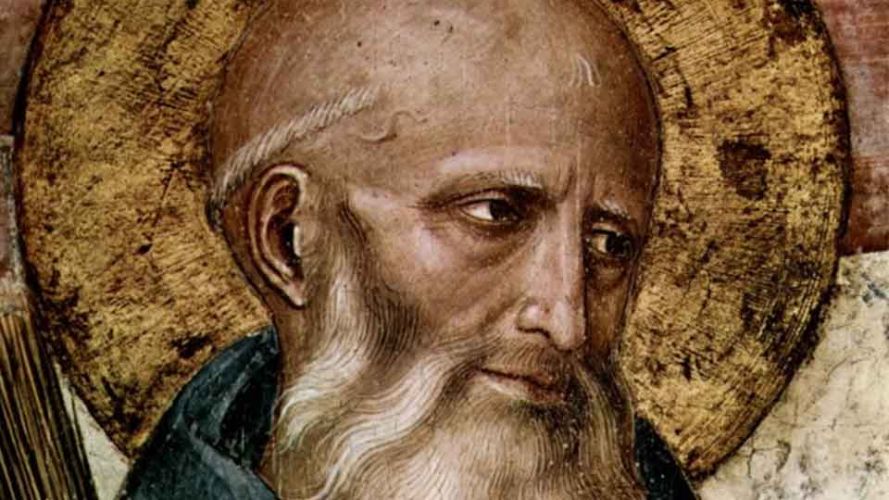
First a little history: St. Benedict of Nursia, Italy (A.D. 480-543),
the twin brother of St. Scholastica, is considered to be the Father of
Western monasticism, and his "Rule of St. Benedict" came to be the
basis of organization for many religious orders (his own Order has its
cradle at Monte Cassino, Italy, about 80 miles South of Rome).
At any rate, in order to understand the symbology of the Medal, you
must know of this event in St. Benedict's life: he'd been living as a
hermit in a cave for three years, famous for his holiness, when a
religious community came to him after the death of their abbot and
asked Benedict to take over. Some of the "monks" didn't like this plan
and attempted to kill him with poisoned bread and wine. Just as St.
John the Divine was miraculously saved from being poisoned, when St.
Benedict made the sign of the Cross over these things, he came to know
they were poisoned, so he toppled the cup and commanded a raven to
carry off the bread.
Now on to the Medal:
From the Catholic Encyclopedia:
It is doubtful
when the Medal of St. Benedict originated. During a trial for
witchcraft at Natternberg near the Abbey of Metten in Bavaria in the
year 1647, the accused women testified that they had no power over
Metten, which was under the protection of the cross. Upon
investigation, a number of painted crosses, surrounded by the letters
which are now found on Benedictine medals, were found on the walls of
the abbey, but their meaning had been forgotten. Finally, in an old
manuscript, written in 1415, was found a picture representing St.
Benedict holding in one hand a staff which ends in a cross, and a
scroll in the other. On the staff and scroll were written in full the
words of which the mysterious letters were the initials. Medals bearing
the image of St. Benedict, a cross, and these letters began now to be
struck in Germany, and soon spread over Europe. They were first
approved by Benedict XIV in his briefs of 23 December, 1741, and 12
March, 1742.
The Jubilee
Medal below was first struck in 1880 to commemorate the 14th centennary
of St. Benedict's birth.
The Front of the Medal
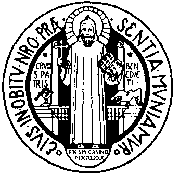
We see St. Benedict holding his Rule; next to him, on a pedestal, is
the cup that once held poison, shattered after he made the Sign of the
Cross over it. The other pedestal is topped by the raven, who is about
to carry away the poisoned bread. In very small print above these
pedestals are the words: Crux s. patris Benedicti (The Cross
of our Holy Father Benedict).
Underneath St. Benedict are the words: ex SM Casino MDCCCLXXX
(from holy Monte Cassino, 1880).
Surrounding the entire face of the medal are the words: Eius in
obitu nostro praesentia muniamur (May we at our death be fortified
by his presence.)
Back of the Medal
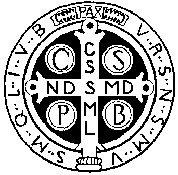
In the arms of
the Cross are the initials C S S M L - N D S M D, which stand for the
rhyme:
Crux sacra sit
mihi lux!
Nunquam draco sit mihi dux!
English:
The Holy Cross be my light;
Let not the dragon be my guide.
In the corners
of the Cross are C S P D, which stand for the same words found on the
front over the pedestals: Crux s. patris Benedicti (The Cross of our
Holy Father Benedict).
Above the Cross is the word "Pax" (Peace), the Benedictine motto.
Surrounding the entire back of the medal are the initials to the words
of the exorcism: V R S N S M V - S M Q L I V B, which stand for the
rhyme:
Vade retro
Satana!
Nunquam suade mihi vana!
Sunt mala quae libas.
Ipse venena bibas!
English:
Begone, Satan,
Do not suggest to me thy vanities!
Evil are the things thou profferest,
Drink thou thy own poison!
Using the Medal
First, note that
the above information pertains to the Jubilee Medal of St. Benedict.
There are, though, other St. Benedict Medals that are almost exactly
like the above, but lack "Eius in obitu nostro praesentia muniamur (May
we at our death be fortified by his presence.)" and "ex SM Casino
MDCCCLXXX" (from holy Monte Cassino, 1880). Either type, though, is
indulgenced, and they are used the same way.
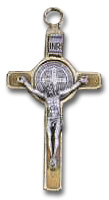
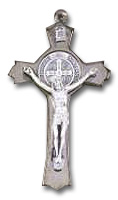
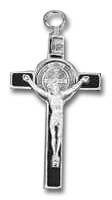
The medal is sometimes combined with a Crucifix
-- a regular Crucifix, often inlaid and ornate, with the St. Benedict
Medal behind Christ's Head.
This Crucifix is known as "The Cross of a Happy Death" not only because
of the exorcizing properties of the Medal and the image of Christ's
Body, but because of St. Benedict's particular patronage based on his
death. Pope St. Gregory the Great (A.D. ca. 540-604) describes his
passing in his Dialogue:
Six days before
he left this world he gave orders to have his sepulchre opened, and
forthwith falling into an ague, he began with burning heat to wax
faint; and when as the sickness daily increased, upon the sixth day he
commanded his monks to carry him into the oratory, where he did arm
himself receiving the Body and Blood of our Saviour Christ; and having
his weak body holden up betwixt the hands of his disciples, he stood
with his own hands lifted up to heaven; and as he was in that manner
praying, he gave up the ghost.
A plenary indulgence is granted under the usual
conditions to one who, at the hour of his death, kisses, touches, or
otherwise reverences the Crucifix, and commends his soul to God.
Most people wear
the Medal around their necks; some bury it in the foundations of
buildings in order to bless them, bury one in each of the four corners
of their property to drive away evil, hang them in their homes, or keep
them in their car. When used in specific circumstances for a specific
effect, such as when placed against a sick part of the body for
healing, one should pray 6 Glorias, 6 Aves, and 6 Paters.
When you get your St. Benedict Medal (on a Crucifix or not), take it to
a priest to be blessed using the following words of the Roman Ritual.
Any priest may do this.
Blessing of the Medal of St. Benedict
|
Priest:
|
Our help is in
the name of the Lord. |
| Response: |
Who made heaven
and earth. |
|
Priest:
|
In the name of
God the Father + Almighty, Who made heaven and earth, the sea and all
that is in them, I exorcise these medals against the power and attacks
of the evil one. May all who use these medals devoutly be blessed with
health of soul and body. In the name of the Father + Almighty, of His
Son + Jesus Christ our Lord, and of the Holy + Spirit the Paraclete,
and in the love of the same Lord Jesus Christ Who will come on the last
day to judge the living and the dead. |
| Response: |
Amen. |
|
Priest:
|
Let us pray.
Almighty God, the boundless Source of all good things, we humbly ask
that, through the intercession of St. Benedict, Thou pourest out Thy
blessings + upon these medals. May those who use them devoutly and
earnestly strive to perform goods works be blessed by Thee with health
of soul and body, the grace of a holy death, and remission of temporal
punishment due to sin. May they also, with the help of Thy merciful
love, resist the temptations of the evil one and strive to exercise
true charity and justice toward all, so that one day they may appear
sinless and holy in Thy sight. This we ask through Christ our Lord. |
| Response: |
Amen. |
|
The medals are
then sprinkled with holy water.
|
The
Blessing of St. Maurus
There is also a
formal, priestly blessing offered to the sick -- the Blessing of St.
Maurus -- that requires either a relic of the True Cross or the St.
Benedict Medal. St. Maurus was a disciple of St. Benedict, and his
defender against those who persecuted him. Pope St. Gregory the Great
described him as a model of religious virtue, especially obedience. The
form of the blessing of the sick is as follows:
| Before the
blessing is imparted, the relic of the true Cross of our Lord or the
medal of St. Benedict is exposed, at least two candles having been lit.
Acts of contrition and firm confidence should then be excited in the
sick person, so that through the merits and intercession of St.
Benedict and St. Maurus, if it should please God, health may be
obtained. Three Our Fathers, Hail Marys and Glory be's are recited in
honor of the Blessed Trinity. Then a priest of the Order of St.
Benedict, or any priest delegated, having put on a red stole, and with
his right hand holding up the relic of the Sacred Cross or the medal of
St. Benedict before the sick person, says the following prayers: |
|
V.
|
Benediction and
glory, and wisdom, and thanksgiving, honor and power and strength to
our God forever and ever. |
|
R.
|
Amen. |
|
V.
|
My foot has
stood in the direct way. |
|
R.
|
In the churches
I will bless You, O Lord. |
|
Invocation
|
|
Through the
invocation of the most holy name of the Lord may that faith, in which
St. Maurus, by employing the words that follow, healed the sick, and in
which I, though an unworthy sinner, utter the selfsame words, restore
your health as you desire:
In the name of the most holy and undivided Trinity and supported by the
merits of the most holy Father Benedict, I bid you, N., to rise, stand
upon your feet and be cured, in the name of the Father and of the Son +
and of the Holy Spirit. |
|
R.
|
Amen. |
| Antiphon: |
Surely He has
borne our infirmities and carried our sorrows: by His bruises we are
healed. |
|
V.
|
He that forgives
the iniquities of his creatures. |
|
R.
|
May He heal your
infirmities. |
|
V.
|
O Lord, hear my
prayer. |
|
R.
|
And let my cry
come to You. |
|
V.
|
The Lord be with
you. |
|
R.
|
And with your
spirit. |
|
V.
|
Let us pray O
God, the Creator, of all things, You ordained that Your only Son should
take flesh of the Virgin Mary by the power of the Holy Spirit for the
restoration of your people and You deigned to heal the wounds and
infirmities of our souls by the redemption accomplished upon the sacred
and glorious wood of the life-giving Cross: do You also vouchsafe
through this powerful sign to restore health to Your servant N. Through
the same Christ our Lord. |
|
R.
|
Amen. |
|
V.
|
Let us pray Lord
Jesus Christ, You conferred upon the master, blessed Benedict, the
privilege of obtaining from You whatsoever he might ask in Your name:
vouchsafe, through his intercession, to heal all the infirmities of
this Your servant: in order that, being restored to health, he (she)
may give thanks to Your holy name.
You live and reign with the Father and the Holy Spirit for ever and
ever. |
|
R.
|
Amen. |
|
The Blessing
|
|
V.
|
Through the
invocation of the Immaculate Mother of God and ever Virgin Mary, and
the intercession of Saints Benedict and Maurus, may the Power + of God
the Father, the Wisdom + of God the Son, and the Strength + of the Holy
Spirit free you from your infirmities. Amen.
May God's holy will be done, and may it be done to you as you wish and
pray, for the praise and honor of the most holy Cross of our Lord Jesus
Christ. |
|
The priest then
blesses the sick person with the relic of the Cross or the medal of St.
Benedict saying:
|
|
V.
|
May the blessing
of Almighty God, of the Father and of the Son + and of the Holy Spirit
descend upon you and abide with you forever. |
|
R.
|
Amen. |
|
The sick person
then kisses the relic or the medal of St. Benedict.
|
This blessing, if need be, may be repeated three times; also three
votive Masses may be celebrated, namely in honor of the Passion, of St.
Maurus, Abbot, and for the Poor Souls; otherwise the fifteen decades of
the Rosary of the Blessed Virgin Mary are to be prayed according to the
aforesaid intentions by the sick person, or by others in the person's
name.
|
|