|
Psalm 49:14-15
"Offer to God the sacrifice of praise: and pay thy vows to the most
High.
And call upon me in the day of trouble:
I will deliver thee, and
thou shalt glorify me."
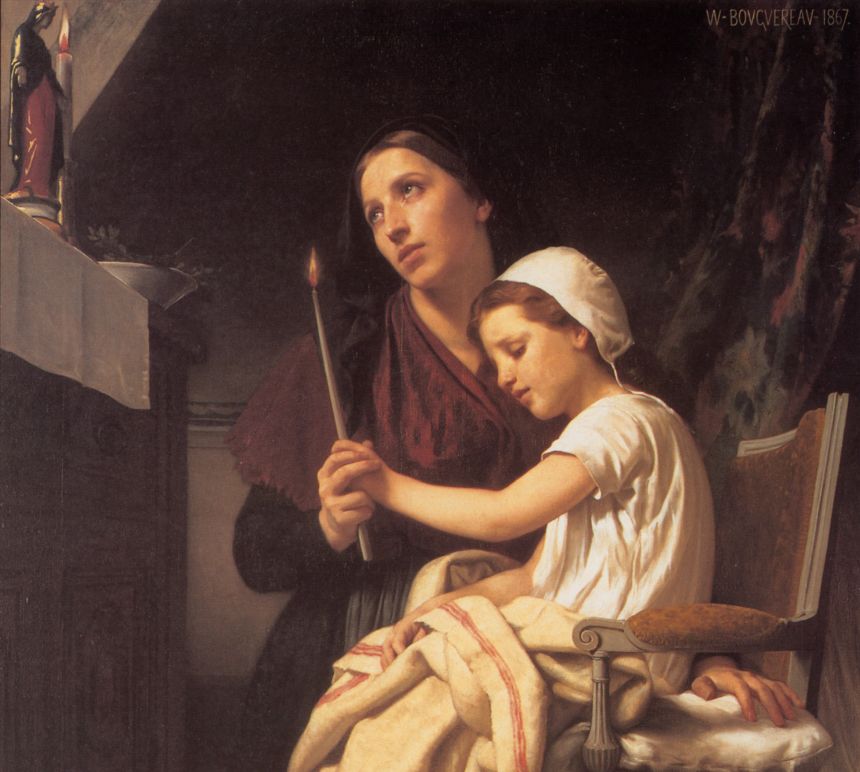
Votive offerings (a.k.a. "votives" and "ex-votos") are actions or
material things vowed to God (or promised to a Saint for their
intercession with God) in return for a hoped-for miracle, offered in thanksgiving for
already-answered prayer, or given in thanksgiving for
blessings not asked for. They can take the form of pieces of art,
tokens, the lighting of candles, offering flowers, among many others.
Art votives can range from the humble to the resplendent; great artists
have made votives -- by their own volition or at the commission of
wealthy patrons -- of statues, paintings, hymns, stained glass -- even
entire churches or shrines have been given "ex voto." Usually,
paintings and other artworks offered ex voto depict the miracles for
which the votive is being offered, and many bear the intials "VFGA"
which stand for the Latin "Votum Fecit Gratiam Accepit" -- "Vow made,
graces received," simply "E.V." for "Ex Voto" ("in fulfillment of a
vow"), or some vernacular equivalent.
Ex-voto artworks -- almost always painted on tin sheets
since the 19th century -- usually include not
only an artistic depiction of the blessings concerned and the Heavenly
intercessor who helped make it happen, but a section of text at the
bottom that describes the event in words. The works are taken to
churches and publicly displayed to act as a witness to God's power and
to give Him thanks. 1 So
popular are ex-voto paintings in Italy and Mexico, that the walls of
some
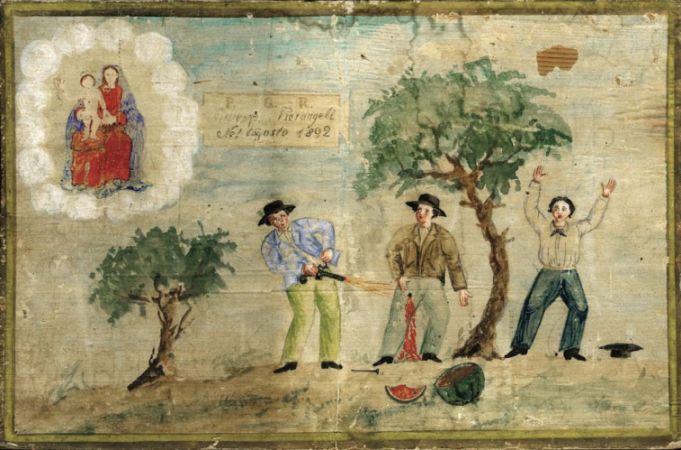
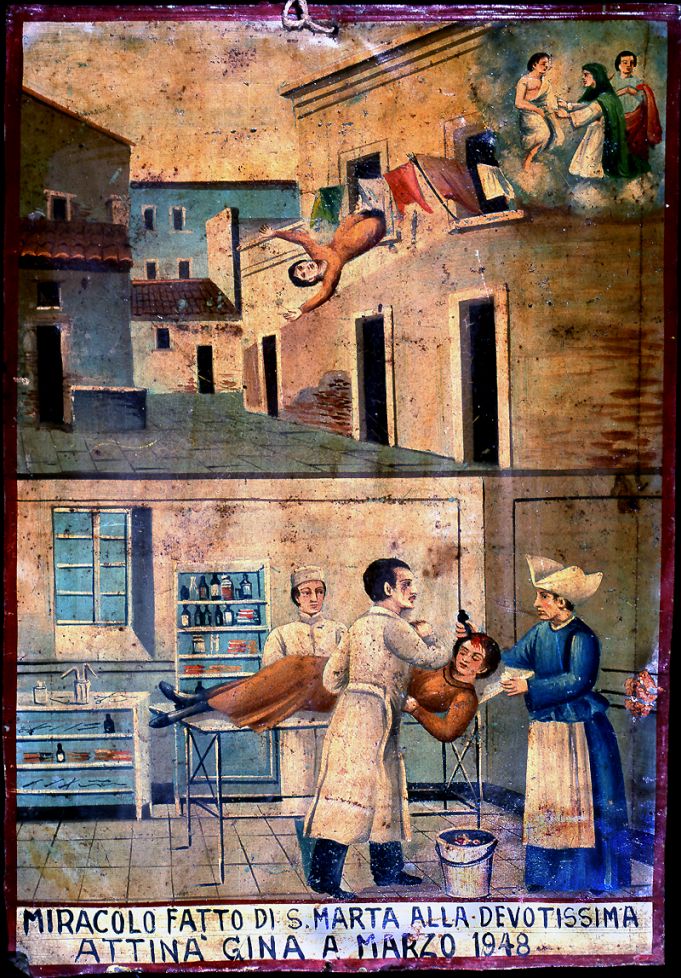
churches are literally covered with them. Below are Italian ex-votos,
the first
depicting a shooting accident from which the victim recovered and gave
thanks to God, the second a two-panel ex-voto showing a woman falling
from a window, and her time in a hospital:
As said, ex-votos need not be painted artworks; they can be much more
fanciful. For example, on his wedding day, the English King Henry III
offered a gold statue of his bride at the shrine of St. Edward, and
King Edward III left a model of a ship at his father's tomb when he was
spared from a shipwreck. One can find many such ships left by sailors
through the centuries in the churches of coastal towns.
Wax candles as tall as the one healed were often given to churches in
return for God's blessings -- and bread, cheese, or grain equal in
weight to that of a sick child were once common votives given to the
the poor in return for the same. A particular example of the latter
took place in A.D. 1263, when a child drowned near the Basilica of St.
Anthony in Padua as it was still being built. The mother prayed to St.
Anthony for his intercession and promised that if her child were
restored to life, she would give to the poor an amount of wheat equal
to the weight of her child. Of course her son was saved, and her
promise was kept. "St. Anthony's Bread,"
then, is a votive of giving alms in return for a favor asked of God
through St. Anthony's intercession. The giving of St. Anthony's Bread
takes place on the great
Saint's feast (13 June), and also throughout the year when parents
give alms after placing their babies under the patronage of St. Anthony.
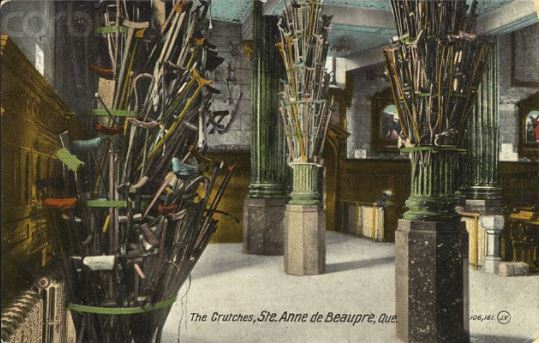
Crippled people bring their crutches and wheelchairs to the
shrines of Saints who've interceded in their healing, and certain
shrines have become known for being places where Saintly intercession
is especially powerful, such as the miraculous healings at Lourdes,
healings
at shrines devoted to St.
Anthony, happy childbirths granted after
praying before the statue of "Madonna del Parto" (Our Lady of
Childbirth) in the Church of Sant'Agostino in Rome or at the shrine of
the infant Jesus in the church of Santa Maria in Aracoeli. Many
healings have been granted after praying at the Basilica of Ste. Anne
de Beaupré in Canada; the picture below shows almost
sculpturesque collections of crutches left after healings at the
Canadian shrine devoted to St. Anne.
The Most Common
Votives
Ex voto
offerings most often take the form of the lighting
of candles, the placing of flowers or pictures before icons, and
leaving thank-you notes, money, or little tokens on or near the altars
or statues of Saints in churches, shrines, or family altars.
This last -- the leaving of little tokens -- is most common in
Mediterranean cultures (Greek, Italian, Portuguese, Spanish) and the
cultures they gave rise to, especially those of Central and South
America. These tokens (known in
Spanish as "milagros" meaning "miracles," or as "promesas") can be made
of anything -- paper, wax, bone, wood, silver, tin, copper, bronze,
gold (the inexpensive metals are the most common nowadays) -- and
almost always take shapes that symbolize the miracle one is seeking or
for which one is offering thanks. For example, if one has bad eyes, an
ex-voto depicting eyes is taken to a church -- especially to a church
dedicated to St. Lucy, Patroness of those with eye problems -- or is
placed on one's home altar near a statue or other icon of the Saint
being besought or thanked. These
ex-votos are pinned to clothing that may adorn a statue, and are nailed
onto wooden crosses, into ornate shadow boxes, and onto frames holding
holy pictures. They are also pinned to ribbons that hang in shrines and
around family altars just for this purpose, and are often accompanied
by thank-you notes to God and His Saints.
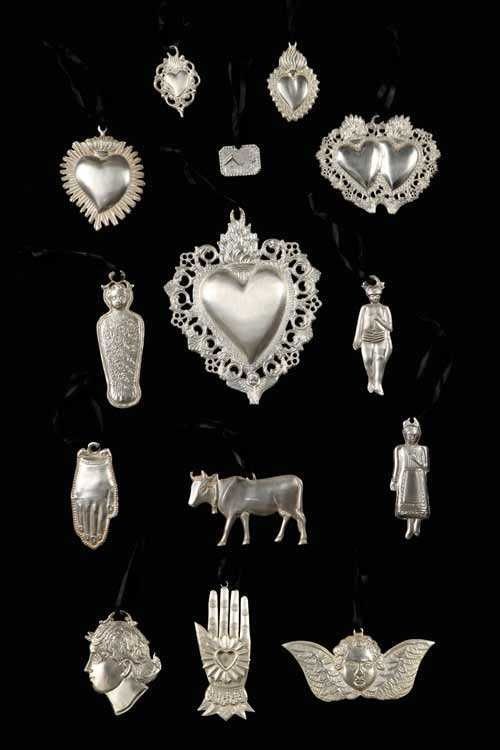
Ex-votos of this type can be shaped like body parts, people,
animals, crops, household objects, houses, cars, boats, etc., and can
be homemade, specially commissioned, or bought from religious vendors.
Their symbology can be straightforward, or more metaphorical; for
example, a dog-shaped charm can represent one's own pet -- or
"faithfulness." A sampling of this sort of ex-voto is below:
Note that some
people mistakenly use this sort of ex-voto as talismans, a
superstitious act
that has no place in our holy religion. They can have secular purposes,
for sure, such as for use in jewelry, or for decoration, souvenirs,
trading, or collecting, but any magical thinking attached to them is
not Catholic thinking. While the use of such items as these as
offerings to what is alleged to be divine is extremely ancient
(Neolithic!) and found in many false religions and in many cultures of
the ancient world (Sumerian, Phoenician, African, Greek, Roman, Aztec),
it is also a practice ordained by the true God in Old Testament times
--
I Kings 6:5, 11
According to the number of the provinces of the Philistines you shall
make five golden emerods [boils or blains], and five golden mice: for
the same plague hath been upon you all, and upon your lords. And you
shall make the likeness of your emerods, and the likeness of the mice
that have destroyed the land, and you shall give glory to the God of
Israel: to see if he will take off his hand from you, and from your
gods, and from your land... And they laid the ark of God upon the cart,
and the little box that had in it the golden mice and the likeness of
the emerods.
-- and by His Church
in this dispensation.
The lighting of candles is likely the most common form of ex-voto in
the English-speaking West. Most churches have rows of tall,
glass-encased votive candles that you can light while offering a
prayer. There will be a place to put a few coins to help offset the
cost of the candles you light (these days, a dollar or two is a fair
amount to leave for lighting a candle), and matches will be found
nearby for you to use. A good prayer to pray when lighting votive
candles and after making your intentions (i.e., formalizing what it is
you're beseeching or thanking God for) is this one, which makes clear
the idea of the candle representing your prayers as ongoing as long as
it continues to burn:
O Lord, may I be
present in this candle, which consumes itself before you.
It's a very Catholic
thing to tell someone, "I'll light a candle for you," which means that
you'll pray for them while offering the ex-voto of lighting a candle
for them in church.
See also the page on Spiritual
Bouquets.
Footnote
1 "Retablos," often
confused with ex-voto paintings, are sacred paintings also made on tin,
but which are not taken to churches, their being kept on family altars
instead (the word comes from the Latin "retro tablua," meaning "behind
the altar.") "Santos" are retablos that depict Saints. "Laminas" refers
to the sheets of tin that all of these types of paintings are made
with, and is a word used to describe the paintings themselves.
|