``Where
the Bishop is, there let the multitude of believers be;
even as where Jesus is, there is the Catholic Church'' Ignatius of
Antioch, 1st c. A.D
Feast of St. John Bosco
("Don Bosco")
With the great
problem of fatherlessness in the West, we more than ever need men to
emulate St. John Bosco and to teach and serve as role models for boys.
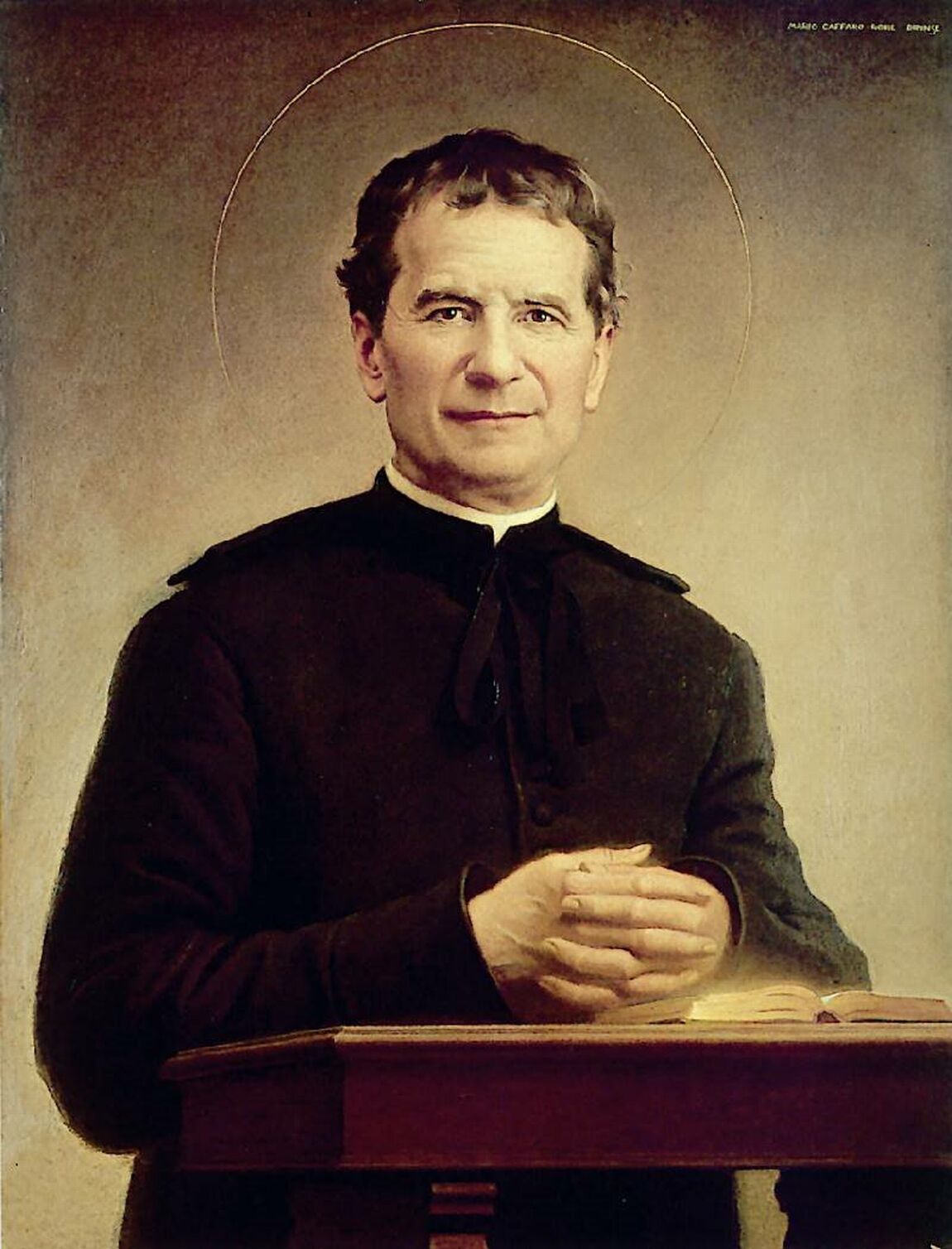
Giovanni ("John") Melchiorre Bosco was born on August 16, 1815 on a
farm in
Becchi, Piedmont, Italy -- the hilly and mountainous region of Italy
that is found, along with the tiny Aosta Valley, in the country's most
north-western part. Becchi is a little hamlet that is in a municpality
once called Castelnuovo d'Asti, but which has been renamed in our
Saint's honor; it is now called Castelnuovo Don Bosco.
He had two older brothers, Antonio and Giuseppe, and all was well in
his world until his father died when he was two -- a remarkable fact
given how he was to become a father figure to many during his lifetime.
But his mother, a very pious woman, catechized her son well and did for
him as she could.
He was in many ways a normal, regular boy, and spent lots of time
running around and playing and fighting with the other boys of his
town. The book "The Secret of John Bosco" by Henri Gheon (1946) relates
that
[h]e had a love
of games and good stories, a fertile imagination never at a loss for
invetions, a gift for comic yet revealing mimicry, worthy of an actor
at the Commedia dell'Arte. He
was a serious small boy, reflective, sparing of words, thinking a great
deal more than he said; but when he came out from his corner to amuse
his brother, you would not have known him; he overflowed with
whimsicality, gaiety, fantasy; he was a poet and comedian with the
barriers down.
But there was one big difference: even at a young age, he was very
aware of the ugliness of sin and of the beauty of the Church, and he
felt a responsibility to bring others to this same sort of
understanding. From a very young age, he was a shepherd of souls, and
he knew it. Then, when he was 9, he had a significant dream -- one of
many he would have throughout his life. From Gheon:
He is near the
house, in a fair-sized yard where are playing a multitude of children;
so far merely an enlargement of his everyday experience. Some laugh,
some play, many blaspheme. This, too, he knows in real life. John Bosco
cannot tolerate direct, wilful and public insult to God. He rushes
forth to silence them, shouting, his fist raised. This is still normal;
it is the way he always reacts, hot-blooded, carried away. So much of
his dream is sher matter of every day: he is simply re-living intensely
an episode with the other boys that has occurred too often for his
taste; even in his sleep he is the champion of the Faith.
At this point in the dream, while he is lashing out
vigorously, there appears a Man in the prime of his age, nobly clad;
a white mantle covers all his body and his face shines so that one
cannot look upon it. This personage calls him by his name, orders him
to put himself at the head of the unruly troop, and adds this counsel:
"It is not with blows, but with gentleness and charity that
you will make them friends. Begin immediately to instruct them on the
ugliness of sin and the reward of virtue."
Confused, overwhelmed, John's one idea is to refuse; he is
but a poor ignorant child, incapable of speaking on religion to boys of
his own age. These, no longer laughing, quarrelling, blaspheming, are
grouped about the Man.
"'Don't you see," murmurs the child, "that you are commanding
the impossible?"
"What seems to you impossible," replied the strange visitant,
"you will make possible, if you choose, by obedience and study."
"Where and how shall I get the knowledge?"
"I shall give you a Mistress under whose guidance alone one
can become wise, without whom all knowledge is foolishness."
"But who are you, then, to speak like this?"
"I am the Son of her whom your mother teaches you to salute
three times a day."
"My mother has forbidden me to have anything to do with
people I don't know. Tell me your name."
"Ask my name of my Mother."
At this word, a Lady approaches, majestic to see, wearing a
cloak that blazed in every tiniest particle, as if each point was made
of the most brilliant star.
More and more overcome, John at her signal comes up to her,
and the Lady takes his hand kindly.
"Look," she bids him.
The children had all vanished; in their place growled a
multitude of wild beats, wild goats, tigers, wolf-dogs, brown bears,
and white bears...
"This is your field, the field in which you must labour. Make
yourself humble, strong, vigorous, and the miracle I shall work in
transforming these wild animals before your eyes shall work upon my
children."
John looked again and now saw only a great flock of lambs,
thronging and gambolling round the Man and the Woman.
At this point in the dream John began to weep and begged the
Lady to explain, for he knew not what it meant. She laid her hand on
his head, saying:
"You will understand all in due time."
Thereupon a great noise woke John Bosco; the dream had ended.
And he did come to understand: he was meant to be a priest. He was
meant to be something else, too -- something that made use of his
already described talents: an entertainer. From Gheon again:
At a fair, he
saw ventriloquists, acrobats, and magicians showing off their talents,
and dedicated himself to learning their arts as well.
Back at home, the moment he is alone, he does his lessons,
says his prayers, and starts on the reproduction of what the
ventriloquist did, and the comedian, and the acrobat, and the conjurer.
He spent hours with his cows, practicing and risking his neck; he
turned catherine wheels, walked on his hands, did complicated
somersaults, tried to keep his balance on a cattle-rope stretched
between two trees.
Spills, failures, bruises: his will was stronger than all. He
had brought his soul to obedience and was not going to be beaten by his
body. He stuck at it, and with such success that very soon he was able
to give a performance. All the decent amusements provided by the actor,
juggler, conjurer, tight-rope man at the fair at Castelnuovo -- one
small boy would provide for his own village...
...John Bosco was a personality, a phenomenon. The rumour
spread. In winter, he was invited round to the houses of neighbouring
farmers, to read aloud to them by firelight or candlelight. He would
read with much gesture such things as the Reali di Francia. But he
always began and ended with a Hail Mary, in which everyone must join,
young or old, with a shrug of the shoulders often enough; there was no
getting out of it; the boy had to be humoured....
In the summer the method was different. In the field by the
house he founded his first Sunday class, his first Oratory. He would
take his stand under the big pear-tree, stretch a rope between two
trees, spread his strip of carpet on the grass, arrange a small table,
set down the bag with his conjuring things. Then he shouted and clapped
his hands; the crowd gathered quickly, for shows are rare in the hamlet
of Becchi. Then he took his Rosary from his pocket.
"We shall say first the third part of the Rosary , the
Glorious Mysteries, in honour of Sunday."
They grumbled under their breath, but they obeyed.
"And now, please, a hymn to the Blessed Virgin."
That over, he stood up on a chair and explained the Gospel of
the day as he had heard it explained that morning at High Mass; and
they might have been listening to the curate of Buttigliera or the
parish priest of Castelnuovo d'Asti. If someone is foolish enough to
object, his answer is instant: "Very well. But I won't do any tricks.
Take it or leave it. Besides, if you don't pray, I may break my neck."
He could always turn a laugh. And then the show began. The
preacher was transformed in the twinkling of an eye into a showman. He
gave them everything, from farce to conjuring, from the leap of death
to walking the tight-rope. He ended with prayer and a short sermon very
much to the point on blasphemy, or obedience to God and the Church.
They came from many miles off to see the show. There were at
times more than a hundred people in that small field, with all the
children of the district in the front row, utterly dazzled.
When he was 11, he attended a mission -- a series of sermons -- in
nearby Buttigliera, and afterwards met an elderly priest, Don Colosso,1
whom he greatly impressed with his
understanding and memory of what was taught. He told Father that he,
too, wanted to be a priest, and the man arranged for the boy to come
visit him in the mornings to be taught grammar, Latin, and other things
priests needed to learn. After these sessions, he'd return home to tend
to the cows, but he had, as often as possible, a book in his hand as he
worked -- a fact that greatly annoyed his brother, Anthony. Anthony's
jealousy and resentment of John became so great that his mother advised
John to find work on a different farm. So off he went. He was 13 years
old, and he had to tuck away his dream of being a priest to focus
instead on farm work which he found nearby. This went on for a few
years until an uncle met up with him and made arrangements for him to
not only return to his studies with Don Colosso, but to board at the
rectory.
Finally ready for official priestly studies, he entered the seminary in
Chiera, a town about 7 miles outside of Turin, and was ordained when he
was 26, in 1841. He was now "Don Bosco."
Once ordained, he joined the Convitto, an Ecclesiastical College
associated with the Franciscans. The purpose of the Convitto was to
provide mutual assistance to priests who'd live there, pray together
there, and go from there out into the world to care for the sick and
the dying, visit the imprisoned, teach catechism, preach retreats, and
perform other priestly duties. It was here that he was to find his
specific
life calling: to educate orphaned or otherwise impoverished boys, teach
them to grow in holiness, and help them learn how to make their way in
the world. In the Convitto, he set up the "Oratory" for them, a place
to gather together and learn. They would meet on Sundays and Don Bosco
would offer them Mass, hear their confessions, and then take them out
into the countryside for recreation. He went out into
the world to seek lost boys, and he readily found them -- boys who'd
likely end up in bad trouble if they were left unguided.
He also made up contracts for the boys to use with employers when they
became apprentices. These contracts prevented the then common abuses of
young apprentices, keeping them from being beaten or overworked.
And all along, he taught the boys. He wrote a series of pamphlets
called "Catholic Readings," and books on math, the Bible, and
literature. Later, in
1877, he would publish a brief outline of his way of education, a
system "based on reason, religion, and loving kindness," which you can
read about it here: Preventive
System in the Education of Youth (pdf).
And he led the
boys down the path of holiness. One of this practices was the "The
Monthly Day of Recollection" -- held on the last Sunday of each month
-- in which he would lead the boys in "The Exercise of a Happy Death,"
having them ponder the Four Last Things
by praying to ask God to give them the grace of not dying a sudden
death, asking St. Joseph for prayers for a happy death, and praying the
chilling Bona Mors litany for
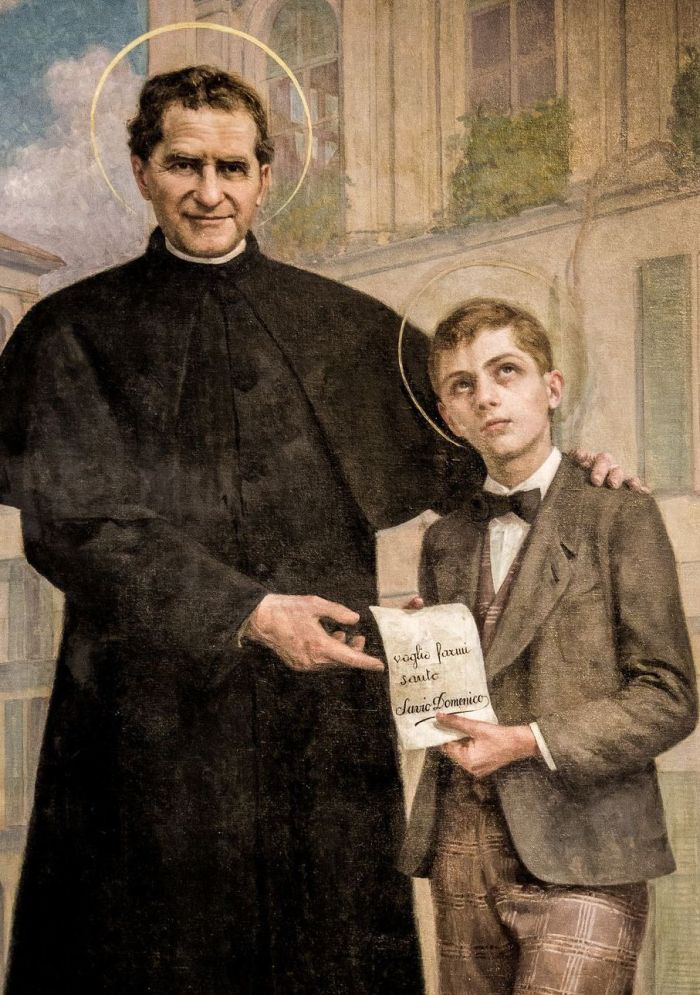
the same. It should be noted that among his students was the boy we've
come to know as St. Dominic Savio, who so much wanted to become a
priest as well, but who died at age 14, likely of pleurisy. St. Dominic
Savio
died prepared, having undergone the Monthly Day of Recollection soon
before he died, knowing it would be his last, and Don Bosco would later
write Dominic's biography.
St. John Bosco and St. Dominic Savio
Eventually, Don Bosco found a shed in a poor area of Turin called
Valdocco. He built it up and set up a chapel dedicated to one of the
Saints who most influenced him: St.
Francis de Sales, whose feast we just celebrated two days ago. Then
he bought the house next to the shed, turning it into a home for
orphaned boys. Don Bosco's mother would feed them and she even allowed
her son to turn a corner of her kitchen into a cobbler's shop, hiring
two cobblers to come teach the boys cobbling; he would do the same with
other trades.
In 1859, he was moved to form a proper religious order. On December 18
of that year, the Congregation of St. Francis de Sales, more commonly
known as the Salesians, was born; it was formally approved in 1869, and
a
few of the boys he'd cared for over the years were to be its first
members. Then, in 1875, he helped Mary Mazzarello form a feminine
counterpart, the Daughters of Mary Help of Christians -- or the
Salesian Sisters.
Now, during this time, revolutionary forces were at work in Italy (see
the page on Mother Cabrini to learn
more). And there was a heretical sect of Waldensians -- Protestants who
adopted some of the thinking of John Calvin -- causing trouble in
Northwest Italy. They spread propaganda all over Turin, attacking
Catholic teaching in any way they could. And Don Bosco was their enemy.
He made pamphlets of his own, fighting back against their lies.
The attacks against Don Bosco turned physical. He was shot at, the
bullet missing his flesh by millimeters, ripping through his
soutane. They tried to poison him. He was beaten. But
something wonderful started to happen in 1852: on his way home, while
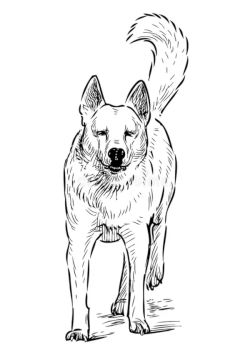
walking through a dangerous slum, he noticed a big gray dog following
him. He beckoned to it, and it approached, even allowing itself to be
petted, and then disappeared once Don Bosco was safely home. And then
it happened again. And again. And again. One night, Don Bosco was shot
at twice from behind a tree. The dog -- whom Don Bosco named "Grigio"
(meaning "Gray") -- went after the bad guy, sending him screaming into
the night. Another evening, twelve Waldensians with sticks in their
hands surrounded Don Bosco, ready to beat him. But Grigio ran them off.
On yet another occasion, Grigio blocked the door to Don Bosco's
residence so the priest couldn't leave. The otherwise well-behaved
canine wouldn't budge, even growling at Don Bosco when he tried to move
him. Don Bosco gave up and stayed home -- only to get a visit from a
neighbor who'd rushed over to tell Don Bosco that the heretics had
planned to kill him that evening.
These persecutions finally ended when the Protestant sects began
fighting among themselves -- and began to have deep respect for the
priest they'd been tormenting. Grigio didn't come back once he wasn't
needed, but he did make two more appearances. One night, fourteen years
later, Don Bosco was visiting the farm he worked at when he was a
13-year old boy. Told the way was dangerous, he sighed out loud about
how he wished he had his Grigio with him. Suddenly, Grigio appeared and
walked the way with him. He even entered the farmhouse with the priest,
making himself comfortable in a corner. When someone went to give
Grigio something to eat, it was discovered that the dog had
disappeared. The doors and windows were closed, but the dog was gone.
The last time Grigio came was in 1883, 31 years after he first showed
up: Don Bosco had gotten lost while journeying, and Grigio came to
guide him to his destination. It's remarkable how God often uses
animals as helpers and signs for us, isn't it?
There are other wondrous stories as well, including an incident
reminiscent of Christ's multiplication of the loaves and the fishes
(Matthew 14:13-21; Mark 6:31-44; Luke 9:12-17; John 6:1-15) which we
recall on Laetare Sunday. From Gheon:
One day the
three hundred pupils of the Oratory were drawn up to receive their
small loaf. The baker's bill was twelve thousand lire -- nearly five
hundred pounds sterling! -- and he would give no more bread till it was
pa id. Don Bosco asked to have brought to him whatever bread was in the
house. They scraped up fifteen small rolls, not one more. They counted
them for him. But he did not bother to count them: what difference did
it make? He began the distribution and, three hundred times, his hand
drew from the bottom of the basket the bread God owes his poor. With
three hundred rolls drawn out of it, the basket was still not empty;
the original fifteen were still there.
This sort of multiplication miracle happened a number of times. And
then
there was this, from Gheon:
A small boy was
on the point of death. His agonised parents had sent for Don Bosco too
late. Like Our Lord, he said as he came among them: "Your son is only
sleeping." They left him alone with the corpse.
"Charles, Charles, arise!"
He drew away the sheet. The child opened his eyes.
"Oh, it's you, Don Bosco. I have been calling you so long. I
thought I was going down to Hell for a sin I have never confessed. I
could tell it only to you. But a beautiful lady chased away the demons,
saying: "Let him be, he is not yet judged." I was delivered and you
have come."
He confessed his fault and lived another two hours.
"Would you rather stay on earth or go to Paradise?" the saint
asked him.
"Oh, to Paradise, Don Bosco!"
"Au revoir, then, my son."
By the time Don Bosco was middle-aged, the Salesian Order had spread,
with its first foreign missionary work taking place thousands of miles
away in Tierra del Fuego, an archipelago shared by Argentina and Chile.
By the time he was old, his Order had spread all over the world.
Hundreds of thousands of children have
been saved from poverty, deprivation, and, spiritual neglect and ruin
because of
the work of St. John Bosco.
Don Bosco died of bronchitis on January 31, 1888, at the age of 72. He
was canonized
in 1934 and is the patron Saint of young people, students, juvenile
delinquents, publishers, and magicians (i.e., stage magicians,
prestidigitators, etc.). His relics may be venerated at
the Basilica of Our Lady Help of Christians (Basilica di Maria Ausiliatrice) in
Turin, Italy.
Customs
Some Catholics may pray the Novena to St.
John Bosco starting on January 22 and ending on January 30, the eve
of this feast. For the feast itself, this prayer is a good one:
O glorious Saint
John Bosco, who, in order to lead young people to the feet of the
divine Master and to form them in the light of faith and Christian
morality, didst heroically sacrifice thyself to the very end of thy
life and didst found a fitting religious Institute destined to endure
and to bring to the farthest boundaries of the earth thy glorious work,
obtain also for us from our Lord a holy love for young people, who are
exposed to so many seductions, in order that we may generously spend
ourselves in supporting them against the snares of the devil, in
keeping them safe from the dangers of the world, and in guiding them,
pure and holy, in the path that leads to God. Amen.
Something
to consider today is emulating St. John Bosco by adopting the practice
of praying the Bona Mors Litany on the last Sunday of each month. It is
like a "little Ash Wednesday" each
month to help keep you and your family focused on what's most
important. Don Bosco prayed the Prayer of Pope Benedict XIII for the
Grace to Not Die Unprovided, and the Prayer to St. Joseph for a Happy
Death before the Litany. All the prayers you need are here: Monthly Day of Recollection As Practiced by St. John Bosco (pdf)
There are no traditional foods that I know of for the day, but making
something from the Piedmont area of Italy where Don Bosco spent his
life could be fun, and Bagna Cauda -- a warm, salty, rich dipping sauce
-- is a very easy recipe to try and one made for mid-Winter:
Bagna Cauda
20 cloves garlic
1/2 c. extra virgin olive oil
1/2 c. well packed anchovies, drained, deboned, rinsed with
red wine, and dried with a towel
1/2 c. unsalted butter, at room temperature (you can replace
this with another 1/2 c. oilive oil, if desired)
Put the 1/2 c. oil and garlic in a small saucepan and heat
very gently over low heat for about 10 minutes, taking care to not let
the garlic change color (make sure the garlic is covered with oil,
adding more oil if needed). After 10 minutes or so, add the anchovies
and smash everything up til
you get a paste-like texture out of the garlic and fish, and simmer
very, very gently for another 10 minutes. Add the butter (or another
1/2 c. oil) and continue cooking over a gentle flame until blended and
warm. Put a little in a fojot (a small ceramic dish heated by a candle
underneath) for each person, or put it all in a communal fondue pot or
chafing dish, or otherwise keep it hot as you serve it as a warm dip
for
crostini (toasted baguette slices) and prepared vegetables, especially
cauliflower florets, slices of red and yellow peppers (fresh and/or
roasted), fennel, baby carrots or sliced carrots, celery, cooked and
halved waxy new potatoes, broccoli, etc. Pair with a Barolo or Barbera
wine.
Speaking of recipes, here is something to ponder. On June 23, 1855 --
the eve of the Feast of St. John the Baptist, Don Bosco's name day --
the boys at the Oratory wanted to throw their beloved priest and
teacher a party the next day. He
thanked the boys, but told them he'd rather get presents for them
instead. He asked each to write down something he really wanted. One
asked for a puppy, one
asked for nougat, one asked for a trumpet because he wanted to join a
marching band. All of the boys wrote something in this manner. But the
boy who'd be known after his death as St. Dominic
Savio wrote, "Help me become a Saint."
Don Bosco replied to him with this:
When your mother
makes a cake, she uses a recipe that indicates the various ingredients
to mix: sugar, flour, eggs, yeast...
Even becoming a saint requires a recipe, and I want to share
it with you. It's made up of three ingredients that must be mixed
together.
First: joy . Whatever disturbs you and takes away your peace
is not pleasing to the Lord. Cast it out.
Second: your duties of study and prayer. Pay attention in
school, study hard, and pray willingly when invited to do so.
Third: do good to others. Help your companions when they need
it, even if it costs you a little trouble and effort. The recipe for
holiness is all here.
A good story to tell your children! Speaking of whom, and as to
entertainments, your kids could emulate Don Bosco by trying their
hand at prestidigation -- or you and your spouse could put on a magic
show for them. In the public domain to help you is this 1926 book by
Howard Thurston: "200 Tricks
You Can Do" (pdf). There is also the movie "Don Bosco" (1988) starring Ben Gazzara
that might interest your family.
There is no music particular to the day that is suitable for the
liturgy, but there is an Italian bubblegum pop song called "Come Voleva
Don Bosco" ("Just as Don Bosco Wished") that you might like to hear:
Casa che
accoglie ti senti in famiglia,
senti che ci stai bene!
Chiesa di Cristo, il nostro oratorio,
che ti parla di Dio!
Scuola che prepara a vivere questa nostra vita
Cortile dove incontrerai tanti nuovi amici troverai.
Vivere in allegria (come voleva don Bosco),
spazio alla fantasia (come voleva don Bosco),
tanti ragazzi insieme (come voleva don Bosco),
c’è un posto anche per te (come voleva don Bosco).
Amici incontrerai (come voleva don Bosco),
felice tu sarai (come voleva don Bosco),
con loro camminerai (come voleva don Bosco),
incontro a questa vita (come voleva don Bosco)
A welcoming home
where you feel like family,
where you feel truly at ease!
The Church of Christ -- our oratory --
that speaks to you of God!
A school that prepares you to live this life of ours,
and a courtyard where you will meet -- and find --so many new friends.
Living with joy (just as Don Bosco wished),
giving space to imagination (just as Don Bosco wished),
many young people together (just as Don Bosco wished),
there is a place here for you, too (just as Don Bosco wished).
You will meet friends (just as Don Bosco wished),
you will be happy (just as Don Bosco wished),
you will walk alongside them (just as Don Bosco wished),
stepping out to meet this life (just as Don Bosco wished).
From the Spiritual Testament by Saint John Bosco, priest
(Epistolario,
Torino 1959, 4, 201-203)
I have always labored out of love
First of all, if we wish to appear concerned about the true happiness
of our foster children and if we would move them to fulfil their
duties, you must never forget that you are taking the place of the
parents of these beloved young people. I have always laboured lovingly
for them, and carried out my priestly duties with zeal. And the whole
Salesian society has done this with me.
My sons, in my long experience very often I had to be convinced of this
great truth. It is easier to become angry than to restrain oneself, and
to threaten a boy than to persuade him. Yes, indeed, it is more fitting
to be persistent in punishing our own impatience and pride than to
correct the boys. We must be firm but kind, and be patient with them.
I give you as a model the charity of Paul which he showed to his new
converts. They often reduced him to tears and entreaties when he found
them lacking docility and even opposing his loving efforts.
See that no one finds you motivated by impetuosity or wilfulness. It is
difficult to keep calm when administering punishment, but this must be
done if we are to keep ourselves from showing off our authority or
spilling out our anger.
Let us regard those boys over whom we have some authority as our own
sons. Let us place ourselves in their service. Let us be ashamed to
assume an attitude of superiority. Let us not rule over them except for
the purpose of serving them better.
This was the method that Jesus used with the apostles. He put up with
their ignorance and roughness and even their infidelity. He treated
sinners with a kindness and affection that caused some to be shocked,
others to be scandalised, and still others to hope for God’s mercy. And
so he bade us to be gentle and humble of heart.
They are our sons, and so in correcting their mistakes we must lay
aside all anger and restrain it so firmly that it is extinguished
entirely.
There must be no hostility in our minds, no contempt in our eyes, no
insult on our lips. We must use mercy for the present and have hope for
the future, as is fitting for true fathers who are eager for real
correction and improvement.
In serious matters it is better to beg God humbly than to send forth a
flood of words that will only offend the listeners and have no effect
on those who are guilty.
Footnotes:
1 "Don" is the Italian way of addressing
secular priests -- i.e., priests who work in the world, in parishes,
etc. Religious priests (priests belonging to religious orders) are
addressed as "Padre." Contrast, for ex., Don Bosco with Padre Pio.