``Where
the Bishop is, there let the multitude of believers be;
even as where Jesus is, there is the Catholic Church'' Ignatius of
Antioch, 1st c. A.D
Feast of St. Firmin of Amiens
(San Fermin)
Saint Fermin --
whom we also know by names such as Firmin, Firminus, etc. -- was the
son of a senator in Pampeluna (now known as Pamplona), in Navarre,
Spain. He and his father were brought to the Faith by a man named
Honestus, who himself was brought to the Faith by St. Saturnino
(Saturninus, or Cernin in Occitan) -- a Bishop of Toulouse, France, who
was brought to the Faith by St. Peter himself and was later martyred.
Fermin and his father were baptized via water from a well that can be
seen today just near the Iglesia de
San Saturnino in Pamplona.
Fermin travelled with Honestus to spread the Gospel all over the land
now called France. The pagans arrested him for this in Lisieux (later
the home of St. Therese),
but he escaped martyrdom there. He was arrested again, but was let go
when the authorities who arrested him died. He then made his way to
Amiens, a city about 75 miles directly north of Paris. There, he became
the city's first Bishop, and he preached with great fortitude, even at
a temple dedicated to Jupiter where now the beautiful gothic cathedral
of
Amiens stands.
He was very successful -- so much so that two Roman officials came to
investigate the situation. The Romans warned everyone that it was
against the law to not offer incense to theif gods, but Fermin
resisted, was arrested, and was beheaded. His body was disposed of
without ceremony such that none of his spiritual children even knew
where it was.
Hundreds of years later, though, in the early 7th century, the Bishop
of Amiens got the people of his diocese to pray for a sign as to where
St. Fermin's body
was. After three days, a ray from the sun hit the wall of a monastery
in such a manner as to bring attention to itself. The faithful dug
there and found Fermin's grave, from which a sweet aroma emanated, and
many
miracles followed.
In the Middle Ages, some of his relics were translated to
his hometown of Pamplona, Navarre, Spain, where they may be venerated
in the Capilla de San Fermin (Chapel
of St. Fermin) in the Iglesia de San
Lorenzo. They are kept in a beautifullly ornate 16th century
wood and silver reliquary shaped like St. Fermin from the waist up.
St. Fermin is the co-patron Saint of Navarre, Spain along with St.
Saturnino. His liturgical feast is on September 25, but he is
celebrated most grandly on July 6-15 in Pamplona, Spain.
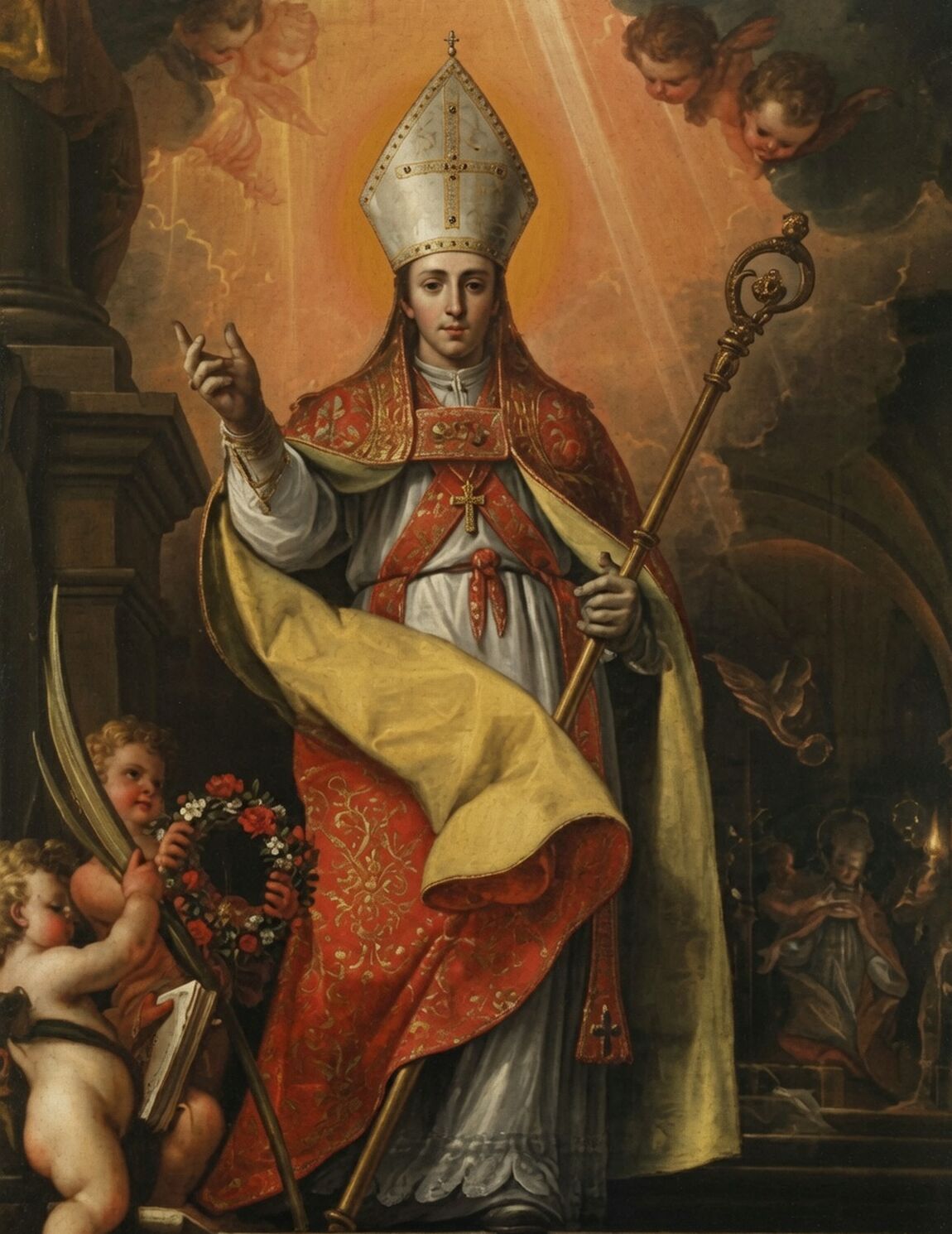
He is not widely represented in art, but when he is
depicted, he is often shown carrying his own head, very much like St.
Denis, the patron Saint of Paris and one of the Fourteen
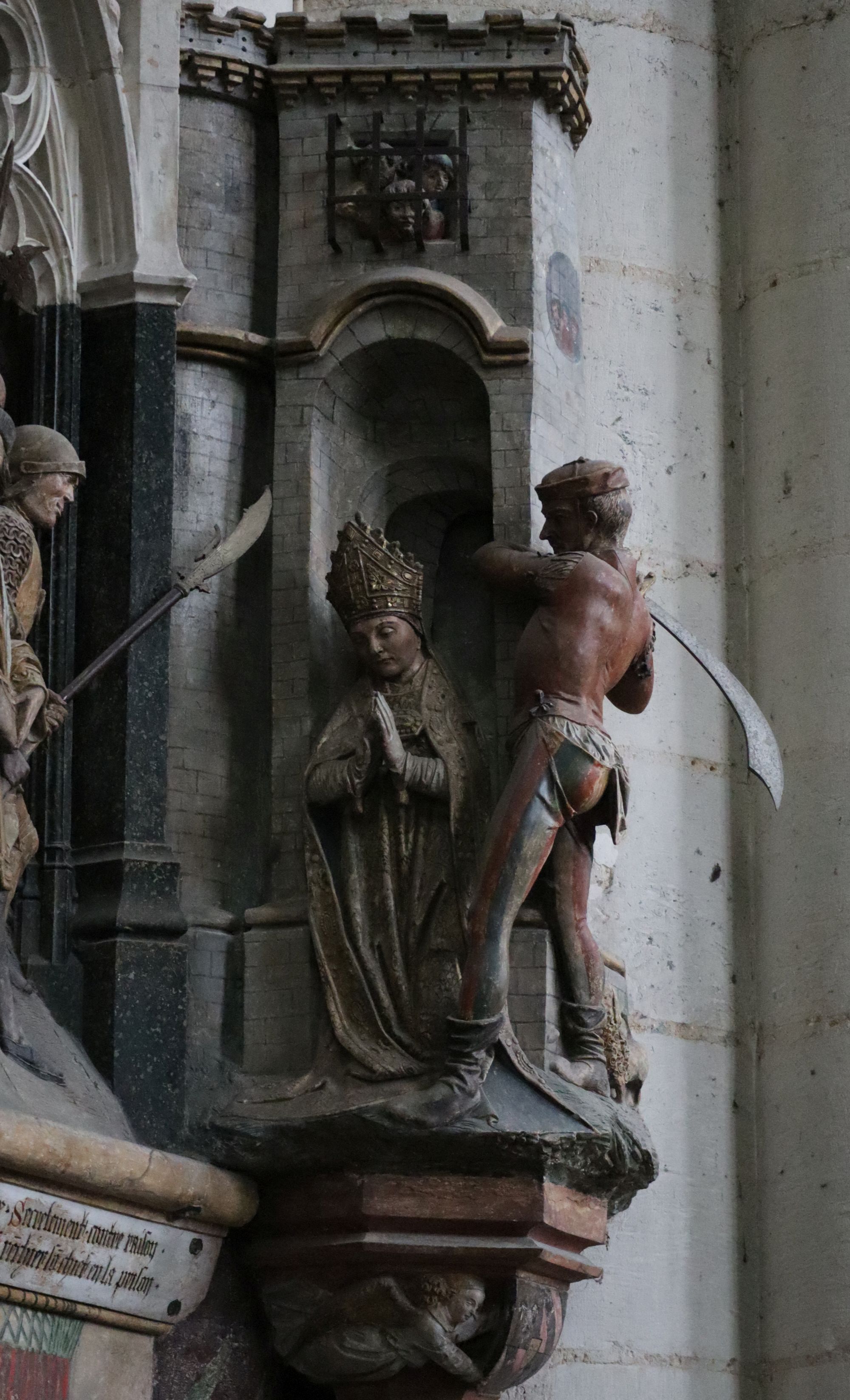
Holy Helpers. The choir of the Amiens cathedral, though, is covered
with
scenes from life of St. Fermin ("Firmin" in France); below is the
depiction of his martyrdom:
Click to enlarge
Customs
First, a prayer for the day:
Lord our God,
Who crowned Saint Fermin the bishop with immortality because he
proclaimed Your word and fought the battle of faith until martyrdom,
grant that we, who celebrate his triumph, may also attain his same
reward. Amen.
Now, about St. Firmin's feast as it's celebrated in Pamplona, Spain
from July 6 to July 15: I
think Ernest Hemingway begins
to describe it well in his
"The Sun Also Rises":
At noon of
Sunday, the 6th of July, the fiesta exploded. There is no other way to
describe it... ...It kept up day and night for seven days. The dancing
kept up, the drinking kept up, the noise went on. The things that
happened could only have happened during a fiesta. Everything became
quite unreal finally and it seemed as though nothing could have any
consequences. It seemed out of place to think of consequences during
the fiesta. All during the fiesta you had the feeling, even when it was
quiet, that you had to shout any remark to make it heard. It was the
same feeling about any action. It was a fiesta and it went on for seven
days.
It's now ten days long, and Mr. Hemingway barely scratched the surface
with
those words. Let me break it down for you: The feast known locally as Sanfermines begins on July 6 at
noon with el Txupinazo (chupinazo) -- the launching of a
rocket off a balcony at City Hall. Crowds of people gather, all dressed
in
white with red sashes around their waists, and red kerchiefs around
their necks, both symbolzing San Fermin's
martyrdom. When the rocket goes off, they yell out in a combination of
Spanish and
Basque “¡Pamploneses, Iruñatarrok,
Viva San Fermín, Gora San Fermin!” --
i.e., "People of Pamplona! Long live San Fermin!" It's July, it's
Spain,
the place is packed with bodies, and the sun is white hot, so buckets
of water are tossed off of
balconies to keep everyone drenched and cooled off all the while.
In the afternoon, there may come the Riau-Riau
-- an on again, off again affair that began in 1911 when a young
Carlist named Ignacio Baleztena started it. The Carlists were very
traditional Catholics who had as their motto “Dios, Patria, Fueros, Rey” (“God,
Fatherland, Regional Rights, King”). The locals with political power at
the time needed calling out, so Ignacio and his group pranked them in
the following way: the local politicians would gather at City Hall and
walk to Vespers at the Chapel of San Fermin in the Church of San
Lorenzo.
The Riau-Riauers gathered there as well -- a huge crowd of them -- and
danced
and sang and slowed things down so much that a walk of 1,640 feet took
a few hours. The song they sang -- and still sing today -- is a waltz
called La Alegría por San Fermín
-- "Joy
for San Fermin":
A las 4, el 6 de
julio
Pamplona gozando va
pasando calles y plazas
las Vísperas a cantar
al glorioso San Fermín
patrón de esta capital
que los pamplonicas aman
con cariño sin igual.
Delante van
chiquillos mil
con miedo atroz dicen: ¡Aquí!
un cabezón viene detrás
dando vergazos y haciendo chillar.
(¡¡Riau-Riau!!)
Después vienen los muchachos
en un montón fraternal
empujando a los gigantes
con alegría sin par
porque llegaron las fiestas
de esta gloriosa ciudad
que son en el mundo entero
una cosa singular.
(¡¡Riau-Riau!!)
Los mozos de blusa
que son los que dan animación
con los pollos-pera
van todos unidos en montón.
Los de la Pamplonesa
detrás vienen tocando
van a honrar a San Fermín.
Toda la ciudad
con movimiento contemplando está
la gran caravana
que alegre hasta San Lorenzo va.
Los del Ayuntamiento
con mazas y timbales
van a honrar a su patrón.
At four o’clock
on the sixth of July,
Pamplona is joyfully on her way,
passing streets and squares,
singing the Vespers
to the glorious San Fermín,
patron of this capital,
whom the people of Pamplona love
with unmatched affection.In front go
a thousand little ones,
terrified they shout: “Here he comes!”
A big-head follows behind
swinging his whip and making them scream.
(¡¡Riau-Riau!!)
Then come the lads
in a fraternal crowd,
pushing the giants
with unmatched joy,
because the fiestas have arrived
in this glorious city —
festivals that are, the world over,
something truly unique.
(¡¡Riau-Riau!!)
The young men in blouses,
who bring all the animation,
together with the “pollo-pera” lads,
all march united in a big group.
Those from the Pamplonesa band
follow behind playing,
coming to honor San Fermín.
The whole city
watches with excitement
the great caravan
that happily makes its way to San Lorenzo.
The members of the Town Hall,
with their maces and kettle drums,
go to honor their patron.
The Riau-Riau happens some
years, and doesn't happen at others (it's never a part of the official
program), but what always happens is Vespers at the Church of San
Lorenzo on the first day of the festival.
The next day, July 7, is the day of the great procession of San
Fermin's relics. The local politicians meet again at City Hall and walk
to the Church of Saint Lorenzo, where the Chapel of San Fermin and his
relics are. His relics are carried counter-clockwise in a big circuit
around the medieval walled city, with certain stops along the way.
Included in the procession are the Gigantes
y Cabezudos -- the Giants and the Big-Heads. The former are
eight 13-feet tall figures of Kings and Queens from, or representing,
four parts of the world: Europe, Africa, Asia, and America. The Cabezudos are five figures -- the
mayor, the councilman, the grandmother, and a Japanese couple -- with
giant heads. Accompanying them are six zaldikos (horses), and six kilikis, the latter of whom carry
toy whips and run after children en route. That the kilikis are called Verrugas (Warts), Napoleón (Napoleon), Barbas (Beards), Coletas (Piglets), Patata (Potato), and Caravinagre (Vinegar Face) makes it
all the more fun.
The
first stop the procession makes is at the intersection of San Antonio
Street (Calle San Antonio) and
Taconera
Street. There, a group sings a jota
(a traditional Spanish folk song) called Quieren todos cantar.
The next stop is at Calle de San Antón, 47 where another jota is sung, this time from a
balcony.
The procession moves on to Plaza Consejo, where the jotaAl
Glorioso San Fermín is sung.
Then the procession moves on to the Church of San Saturnino. Here there
is the well that provided the water with which San Fermin and his
father were baptized. Two children are chosen to place roses here to
honor St. Fermin. After this, traditional txistu (Basque pipe) players
perform perform another jota
-- this one called Agur Jaunak (Farewell,
Gentlemen) -- while others sing: .
After leaving the Church of San Saturnino, the procession returns to
the Church of San Lorenzo, where
a solemn Mass is offered. Then the Giants and Big Heads and others go
to the cathedral where they put on a show. The route the procession
makes can be seen in
red on the map below. It begins at the upper left of the red circle, at
the Iglesia de San Lorenzo
(clicking on certain marked symbols will bring up pictures and more
information):
What also happens starting on day two is -- well, it's madness. It's
the encierro -- the running
of the bulls -- and it happens once a day for every day remaining of Sanfermines. The running of the
bulls has its historical roots in the medieval entrada, in which shepherds of the
area would bring fighting bulls in from the fields to the Plaza Mayor,
which then acted as a sort of a bullring. They'd camp near the city the
night before, and then bring the bulls in at dawn, accompanying them on
foot or on horseback to herd them into their corrals.
By the end of the 19th century, they started to run not behind the
bulls, but in front of them. Why, I don't know, but I imagine it was
for the same reasons that people run in front of bulls today: for the
adrenaline-ridden sport of it all. These days, most anyone can run
with the bulls as long as a few criteria are met (e.g., a runner must
be
18 years of age at a minimum, he can't be drunk, he must run in the
same direction as the bulls, and he cannot touch or incite the bulls).
Those who decide to take on this challenge meet very early in the
morning under a statue of San Fermin found on the Calle Santo Domingo (St. Dominic
Street) near the Corrales de Santo Domingo. There, they chant a prayer
three times to San Fermin in Basque and Spanish:
A San Fermín
pedimos por ser nuestro patrón, nos guíe en el encierro dándonos su
bendición: Entzun, arren, San Fermin zu zaitugu patroi, zuzendu gure
oinak entzierro hontan otoi. ¡Viva San Fermín! ¡Viva! Gora San Fermin!
Gora!
We ask San
Fermín to be our patron, guide us in the running of the bulls by giving
us his blessing: Listen, please, San Fermin, you are our patron, guide
our feet in this running of the bulls. Long live San Fermín! Long live!
Go San Fermin! Go!
Then they move
on to the Corrales de Santo Domingo where the bulls had been kept the
night before. The games begin at 8:00AM: six bulls -- each weighing
well over a half of a ton, each bearing exceedingly sharp horns, each
motivated by pure masculine energy -- are let loose to thunder through
the streets -- and madcap men run in front of them. The route, which
can be seen in blue in the map above, is about a half-mile long, ending
at the Plaza de Toros bullring, and taking about 3 minutes to run. But
it is exceedingly dangerous, especially at the turn made when running
around la Curva de la Muerte
-- the Curve of Death, where Mercarderes Street meets Estafeta Street:
here, bulls and runners make a hard right turn, and the bulls are prone
to swing far to the left by their momentum, often slamming into the
barricades, and
sometimes pinning runners as they do. They're prone to falling here as
well. As I write in 2026, 16 people have died in the event since 1910,
mostly from gorings; non-fatal injuries are much more common.
Around 6:30PM on the days on which the bulls run, corridas de toros (bullfights) are
had at the Plaza de Toros, with toreros
(bullfighters), wearing their trajes
de
luces ("suits of light"), taking on the bulls that had
run earlier. When the fight is over, the meat of the bulls is
distributed and eaten locally; restaurants in the area display signs
letting customers know their beef is authentic beef from the bulls of
San Fermin. The matador, though, gets one ear as a trophy for a good
fight; two ears for an exceptional performance, and two ears and a tail
as the rare, highest honor. They are given to him in the ring, after
the fight if the crowd demands it (by waving white handkerchiefs), and
he'll often take a victory lap while holding them up.1
And at around 11PM on each of the festival days, a 15 to 25-minute
fireworks show is had to wrap things up for the evening.
At the very end of the festival, on the last night, people gather with
candles and, holding
their red scarves aloft, sing Pobre
de mí (Poor me) -- "Poor me, poor
me, the San Fermín festivities are over".
When the Pobre de Mí song
ends, many people go to the
Church of San Lorenzo and
leave a red handkerchief and a candle on the gate.
Ernest Hemingway made the Feast of San Fermin much more popular than it
had been with his book "The Sun Also Rises" as the events of the second
half of which take place during the festivities.
Now, how to celebrate the Feast of St. Fermin in the home? You could
always buy six bulls, get some sneakers for the kids, block off a
half-mile of road, and... Or you could make Leche Frita -- Fried Milk,
a lovely Spanish dessert:
Leche Frita
4 1/2 c. milk, divided
1 c. sugar
1 cinnamon stick
peel of 2 lemons (peel with pith removed, not grated zest)
1/2 c. cornstarch
1/2 c. all-purpose flour
For frying and
dredging:
oil, for frying
1 c. flour
2 medium eggs, beaten
3 TBSP white sugar
3 TBSP ground cinnamon
Line an 8X8 baking dish with parchment paper so some of the
paper sticks up on two sides (so you can use it as a handle later) and
set aside. If you double the recipe, use a 9X13 pan.
Put 4 c. of the milk into a cooking pot, add the peel and
cinnamon and bring just to a boil. Once it comes to a boil, remove from
heat and let it sit until it reaches room temperature. Once it's at
room temperature, remove the peels and cinnamon.
In a separate bowl, whisk together the cornstarch and flour
in the remaining 1/2 c. milk until it's dissolved and smooth.
Add the cornstarch/flour mixture to the infused milk and cook
for 6 to 7 minutes over medium-high heat, stirring constantly with a
wooden spoon. Whisk as needed to remove any lumps. Pour the mixture
into the prepared dish and spread it evenly. Cover with plastic wrap,
making sure it touches the mixture. Chill in fridge overnight.
The next day, peel off the plastic wrap, and carefully lift
the mixture out and onto a cutting board. Cut into squares (about
2"X2"). Heat oil up over medium-high heat in a frying pan (enough to
shallow-fry). Dip each square in the flour, then in the egg, and fry in
batches in the hot oil until golden brown, about 2 to 3 minutes on each
side (don't overcrowd the pan). Drain on paper towels and, while still
warm, coat in a mixture of of the 3 TBSP sugar + 3TBSP cinnamon.
These can be eaten warm or at room temperature. Some like to skip the
cinnamon-sugar mixture and drizzle with honey or chocolate sauce
instead.
Your children might also enjoy these coloring pages, which have less to
do with San Fermin and more to do with bulls: Feast of San Fermin Coloring Pages
(pdf)
I wish I had more prayers to and meditations about St. Firmin for you,
but
alas, I don't. Still, as with all martyrs, one of the best uses of the
day is to seriously, deeply meditate on how well you orient your will
to the Good, and how you practice -- or fail to practice -- fortitude. Are you willing and able
to give up everything,
including your own life, for Christ as He gave up His life for you?
Footnotes:
1 For information's sake: bulls sometimes
win bullfights. If a bull demonstrates what the crowd, the matador, and
the
event president (who has the final say) deem to be exceptional bravery
and nobility during a bullfight, it can win an indulto -- a pardon -- and, instead
of being killed, will live the rest of its life on a ranch as a stud
bull.
There are a number of bulls who have
gotten the rare indulto, and
they
are known by name by aficianados. If a bull gores
or kills a matador, that bull is killed, it is not
thought of as "winning" the fight, and like the other bulls, its meat
is sold locally. If a matador is killed, you will be glad to know that
his meat is not sold locally. Or anywhere else.