``Where
the Bishop is, there let the multitude of believers be;
even as where Jesus is, there is the Catholic Church'' Ignatius of
Antioch, 1st c. A.D
Feast of St. Maria Goretti
Maria Goretti
was born in Corinaldo, Italy on October 16, 1890, the third of seven
children. Her parents, Luigi and Assunta, were dirt poor, forced to
move about quite a bit in search of work. When Maria was around 9 years
old, they ended up working as sharecroppers for a man named Count
Mazzoleni in Le Ferriere, a little town in the province of Latina, in
the Agro Pontino area of Italy -- marshlands that were rife with
mosquitoes.
Count Mazzoleni saw that more workers were needed to farm the land, so
he sent a man named Giovanni Serenelli and his grown son, Alessandro,
to share not only the work, but the house in which the Gorettis lived.
Giovanni's wife had tried drowning Alessandro when he was a baby, and
she died in an asylum. Giovanni was a bit of a
drinker. And Alessandro -- there was a darkness about
him. And there was a roughness, a crudeness he'd picked up from sailors
while working as a stevedore -- a dockworker who loads and unloads
cargo from ships at ports. He used foul language. He hanged the early
20th century equivalent of "cheesecake pictures" on the walls of his
room. It was all unsettling.
The Gorettis hadn't lived in the house long when Luigi contracted
malaria and died. Maria took over all of the household work, including
watching her youngest sister, Teresa, while her mother and other
siblings worked in the fields. It was all rather dreary, but there was
a great bright spot: Maria, preparing for her first communion, was
instructed by Passionist priests, and the more she learned, the more
she fell in love with Jesus. She'd always been a good child, but now
she became even more so, absolutely devoted to serving the Lord.
One day -- it was July 5, 1902 -- when she was eleven years old, Maria
sat on the steps outside her home, mending one of Alessandro's shirts.
Teresa was running about, but Maria had her eye on her. And, horrific
to say, 20-year old Alessandro had an eye on Maria. Though she was only
eleven and tiny -- 4'6" tall -- she was womanly in many ways, both
physically because of early puberty, and in her mature demeanor.
Alessandro not only noticed, but acted on the lust he had for her. At
first, Maria had only sensed her own discomfort in his presence. She
was just a child and likely didn't even have the words to describe or
even formulate clear thoughts about the nebulous thing
she knew he wanted; she just knew it was wrong; she knew her virginity
was precious. Then he got more overt
about it, not just sending the sort of "vibe" that a young girl would
now say gives her "the creeps," but grabbing her. She wrenched herself
away from him and from then on out tried her best to stay as far away
from him as possible. But he got to her once again, this time grabbing
her while she was making the beds. She scratched his face with her
fingernails and ran for the door while he yelled threats at her,
telling her
he'd kill her if she ever told. And she didn't.
Today, though, was different. While she sat on those steps sewing his
shirt, Alessandro walked up them, and by her, and into the house. She
heard him fumbling around inside, apparently looking for something.
Then he appeared in the doorway of the kitchen, yelling for her, asking
her to come up. She balked. He grabbed her and dragged her inside. He
made demands. She refused. He had a very sharp 10-inch awl in his hand
-- a tool used to punch holes in leather or wood. Still she refused,
yelling, "No! No! It is a sin! God does not want this! If you do this,
you will go to Hell! What are you doing, Alessandro? You will go to
Hell!" Then, angered at her feisty resistance, instead of raping her,
he started stabbing her. Fourteen times. Into her chest, her
belly, her back.
Out in the fields, Assunta heard Teresa crying and sent one of her boys
to go check on things. But just as he went off, Giovanni Serenelli was
heard screaming, "Assunta! Come here!" By the time she got there, her
neighbors had gotten there, too. On the floor was Maria, alive, but
covered in blood. Assunta asked what happened. "It was Alessandro,
Mama... Because he wanted to commit an awful sin, and I would not."
Maria was rushed to the hospital 7 miles away in Nettuno. Before she
got there, Alessandro had already been arrested.
A priest came to minister to her soul while surgeons dealt with the
horror
Alessandro had inflicted on her body. Her lungs and intestines had been
pierced, her heart had been grazed, and all the stitching-up was done
without anesthesia. She survived this torture, and was visited again by
a priest. He talked to her about Christ on the Cross, and she told him
regarding Alessandro, "Yes, for the love of Jesus, I too pardon him,
and I want him to be with me in Heaven." She also talked to her mother,
who asked her if Alessandro had bothered her before. Maria told her he
had, and when Assunta asked why she hadn't told her, Maria said, "He
threatened to kill me if I did. And you see, he killed me anyway."
The death penalty was gone from Italy at the time of Maria's murder,
and Alessandro was considered a minor according to Italian law, so he
was sentenced to a mere 30 years in prison. For the first three years
he was not only recalcitrant and unrepentant, but belligerent --
throwing out of his cell priests who came to visit him. Then he had a
dream that
changed his life: he dreamed he was visited by Maria. She was dressed
in dazzling white, gathering beautiful lilies in a garden. She walked
over to him and began handing
the flowers to him one at a time -- fourteen of them, one for each stab
wound
he inflicted on Maria's little body. As he took the lilies from her
hands, they were transformed into flames that glowed like candles, and
he felt Mara's forgiveness and love. When he awoke, he called for a
priest, made his confession, and finally took responsibility for his
evil act.
Assunta went back to Corinaldo, the town in which she and Luigi were
married, the town in which Maria was born. She had to put her remaining
children in an orphanage so they would be well taken care of, and Pope
Pius X arranged for Teresa to be taken care of by Franciscan sisters
(when Teresa came of age, she joined their Order).
Alessandro was released from prison in 1929 -- three years early for
good behavior. After his release, a priest who knew about his radical
transformation, took him under his wing. He knew Alessandro wanted to
meet with Assunta and beg her forgiveness, so he arranged a meeting. It
took place on Christmas Eve of 1934. Assunta told him,
“Alessandro, Maria has forgiven you. God has forgiven you. How can I
not forgive you?” They went to Mass together that night, receiving
Communion while kneeling side-by-side, and stayed in contact with each
other for the rest of their lives.
Alessandro's priest friend then arranged for
him to live as a tertiary with the Capuchin friars. He
spent the rest of his life quietly, tending to the monastic gardens and
helping the brothers as a laborer, first at their monastery in Ascoli
Piceno (from the late 1930s or early 1940s until 1956), then in
Macerata (from 1956 on). In 1961, he wrote the following letter to the
world:
I am now almost
80 years old. I am close to the end of my days.
Looking back at my past, I recognize that in my early youth I
followed a false road -- an evil path that led to my ruin.
Through the content of printed magazines, immoral shows, and
bad examples in the media, I saw the majority of the young people of my
day following evil without even thinking twice. Unworried, I did the
same thing.
There were faithful and practicing Christian believers around
me, but I paid no attention to them. I was blinded by a brute impulse
that pushed me down the wrong way of living.
At the age of 20, I committed a crime of passion, the memory
of which still horrifies me today. Maria Goretti, now a saint, was my
good angel whom God placed in my path to save me. Her words both of
rebuke and forgiveness are still imprinted in my heart. She prayed for
me, interceding for her killer. Thirty years in prison followed.
If I had not been a minor in Italian law I would have been
sentenced to life in prison. Nevertheless, I accepted the sentence I
received as something I deserved.
Resigned, I atoned for my sin. Little Maria was truly my
light, my protectress. With her help, I served those 27 years in prison
well. When society accepted me back among its members, I tried to live
honestly. With angelic charity, the sons of St. Francis, the minor
Capuchins of the Marches, welcomed me among them not as a servant, but
as a brother. I have lived with them for 24 years. Now I look serenely
to the time in which I will be admitted to the vision of God, to
embrace my dear ones once again, and to be close to my guardian angel,
Maria Goretti, and her dear mother, Assunta.
May all who read this letter of mine desire to follow the
blessed teaching of avoiding evil and following the good. May all
believe with the faith of little children that religion with its
precepts is not something one can do without. Rather, it is true
comfort, and the only sure way in all of life’s circumstances -- even
in the most painful.
Peace and all good.
Alessandro Serenelli
Macerata, Italy
5 May 1961
Nine years after writing that, Alessandro died, on May 6, 1970 at the
age
of 87. His body was interred near the altar of what is
now known as the Santuario di Santa Maria Goretti in Corinaldo, the
same
church in which he and Assunta had received communion together. On the
other side of the altar lies the body of Assunta, who had died 16 years
earlier on January 6, 1954.
After Maria's death, miracles began to happen through her intercession.
Two of them were recognized by the Congregation of Rites on December
11, 1949, and the next year, on June 24, 1950, she was canonized. So
many people -- including, for the first time in history, a parent of
the one being canonized -- came to St. Peter's Basilica for Maria's
canonization
that Pope Pius XII had to conduct the proceedings outside, saying, "I
have been forced by the piety of the whole world to
leave the Basilica of St. Peter which, for the first time in its
glorious history, is hopelessly inadequate."
St. Maria Goretti -- "Marietta" (Little Maria) to Italians -- is the
patron Saint of young people (especially young
girls), of rape and assault victims, of purity, and, with St, Mark the
Evangelist, of the Agro Pontino (Pontine Marshes) area of Italy, which
includes such cities as Latina, Nettuno, Gaeta, and Minturno. Though
not an official patron Saint of the Passionist Order, she is heavily associated
with them (as is St. Gemma Galgani) in that they educated her, promoted
the cause of her
canonization, and care for her relics. She can
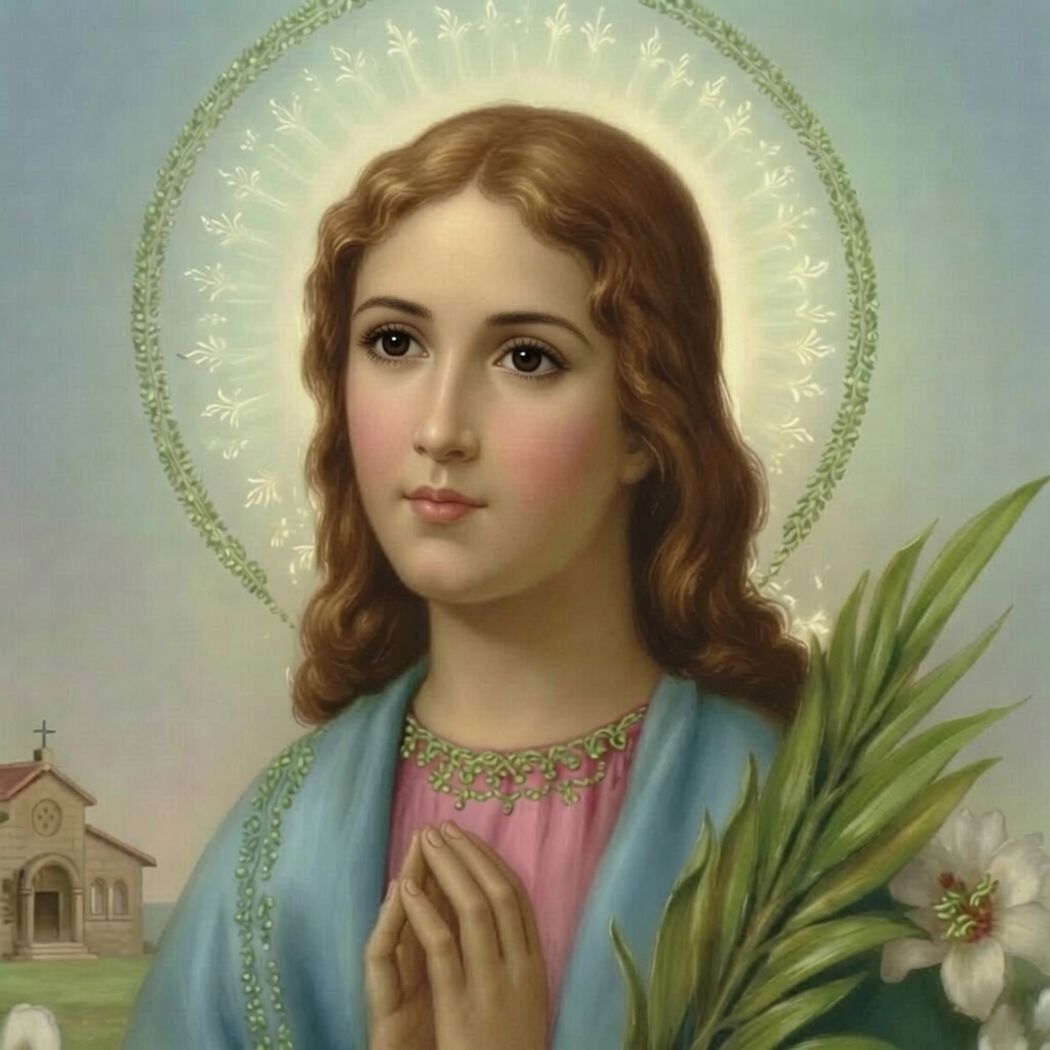
be recognized in art by the presence of palm branches symbolizing
martyrdom, and
lilies symbolizing purity. Her relics may be venerated at the
Santuario di Santa Maria Goretti in Nettuno, Italy.
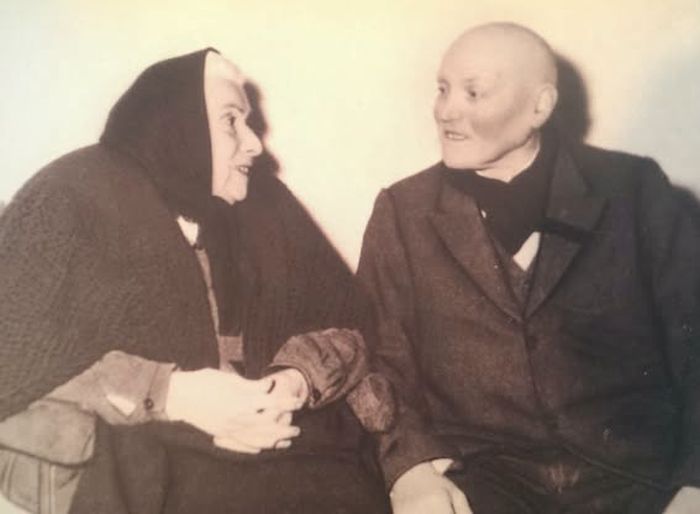
There is a photograph floating about that is said to be of St. Maria
Goretti. After having studied the matter, I believe that it is not, in
fact, a photograph of our Saint. There are a number of photographs of
Assunto and of Alessandro, though. Here is one, showing them both in old age.
An Important Note
Something about Maria's story must be made clear: people say she "kept
her purity" by fighting off Alessandro. But if her ability to resist
rape is what makes her pure, it raises the question: if she had been
raped, would she have "lost" her purity? It must be made crystal clear
that the answer to that is a most definite no, and the Church has
always taught this. As early as around A.D. 413, St. Augustine, in Book
I, Chapter 18 of "City of God" wrote,
For the sanctity
of the body does not consist in the integrity of its members, nor in
their exemption from all touch; for they are exposed to various
accidents which do violence to and wound them, and the surgeons who
administer relief often perform operations that sicken the spectator. A
midwife, suppose, has (whether maliciously or accidentally, or through
unskillfulness) destroyed the virginity of some girl, while endeavoring
to ascertain it: I suppose no one is so foolish as to believe that, by
this destruction of the integrity of one organ, the virgin has lost
anything even of her bodily sanctity. And thus, so long as the soul
keeps this firmness of purpose which sanctifies even the body, the
violence done by another's lust makes no impression on this bodily
sanctity, which is preserved intact by one's own persistent continence.
St. Thomas Aquinas affirms the point in his Summa II:II:152:2:
[T]he integrity
of a bodily organ is accidental to virginity, in so far as a person,
through purposely abstaining from venereal pleasure, retains the
integrity of a bodily organ. Hence if the organ lose its integrity by
chance in some other way, this is no more prejudicial to virginity than
being deprived of a hand or foot.
Or take the words of Lord Christ Himself:
Matthew 15:10-20
And having called together the multitudes unto him, He said
to them: Hear ye and understand. Not that which goeth into the mouth
defileth a man: but what cometh out of the mouth, this defileth a man.
Then came His disciples, and said to Him: Dost thou know that
the Pharisees, when they heard this word, were scandalized?
But He answering them, said: Every plant which My heavenly
Father hath not planted, shall be rooted up. Let them alone: they are
blind, and leaders of the blind. And if the blind lead the blind, both
will fall into the pit.
And Peter answering, said to him: Expound to us this parable.
But He said: Are you also yet without understanding? Do
you not understand, that whatsoever entereth into the mouth, goeth into
the belly, and is cast out into the privy? But the things which proceed
out of the mouth, come forth from the heart, and those things defile a
man. For from the heart come forth evil thoughts, murders, adulteries,
fornications, thefts, false testimonies, blasphemies. These are the
things that defile a man. But to eat with unwashed hands doth not
defile a man.
What came out of Alessandro before his conversion and penance were evil
thoughts, murders, fornications, and false testimonies; what came out
of Maria was pure love. She kept her purity because she valued her
virginity and because she kept her love.
If she'd been unable to fight off Alessandro and prevent him from
raping her, nothing -- not one single
thing -- he could have done to her could have changed that or made her
"impure." And if you're a victim of that sort of abuse, nothing anyone
did to you made you impure.
Customs
Some Catholics might prepare for this feast by praying a Novena to St. Maria Goretti beginning on June 27
and ending on July 5, the eve of her feast. For her feast itself, this
Collect is a good, simple prayer:
O God, Author of
innocence and Lover of chastity, who bestowed the grace of martyrdom on
Your handmaid, the Virgin Saint Maria Goretti, in her youth, grant, we
pray, through her intercession, that, as You gave her a crown for her
steadfastness, so we, too, may be firm in obeying Your commandments.
Through our Lord Jesus Christ, Your Son, who lives and reigns with You
in the unity of the Holy Spirit, One God, for ever and ever.
In Italy, the feast of St. Maria Goretti is typically celebrated in the
places relevant to her life (Corinaldo; the Dioceses of Gaeta,
Latina-Terracina-Sezze-Priverno, and Albano) with a novena and a
triduum (a
three-day
period of preparation) beforehand. The tridua are marked by Masses,
rosaries, and other devotions, along with such things concerts,
readings, outdoor
screenings of films about Maria's life, and other public events. Her
feast itself usually involves a procession of some sort, and pilgrimages. The five
main pilgrimage sites are:
Corinaldo, Italy:
Casa Natale di Santa Maria Goretti
This is the house of St. Maria's birth, located in
the town of Corinaldo, in the Marches region on the eastern side of
Italy. It is
open for visitors.
Corinaldo, Italy:
Santuario di Santa Maria Goretti (Santuario Diocesano)
The sanctuary, just minutes away from the Casa Natale above, contains
the tomb of St. Maria's mother, Assunta, on the left
side of the altar, and the tomb of her attacker, Alessandro Serenelli,
on the right. It also houses a silver urn containing the bones of one
of Maria's arm. This is the church in which Assunta and Alessandro
received communion together on Christmas in 1934.
Corinaldo, Italy:
Chiesa Collegiata San Francesco di Assisi
This is the church in which Maria's parents were married, and the
church in which she was baptized.
Borgo Le Ferriere, Italy:
La Cascina Antica, also
called the Casa del Martirio (House of the Martyrdom)
This is
the house in which St. Maria was attacked. It's located in Borgo Le
Ferriere, a small hamlet of the city of Latina, in the province of
Latina, in the Lazio region, Italy, about 6 miles inland from Nettuno.
Nettuno, Italy:
Santuario di Santa Maria Goretti (The
Sanctuary of Our Lady of Graces and St. Maria Goretti)
This is
the primary shrine, run by Passionists. This is where the St. Maria's
relics are preserved,
enshrined in
a wax effigy clothed in a white dress with a blue sash, lying inside a
glass
reliquary. It's located in Nettuno, a city
right on the west coast of Italy, about 45 miles south of Rome.This
site is also a popular destination for youth pilgrimages, confirmation
groups, and those seeking St. Maria's intercession for the causes of
maintaining purity, receiving the grace to forgive, or healing from
abuse.
You can see pictures of all these places by clicking the
stars
on the map below (you'll need to zoom in closely on Corinaldo at the
top right to see three different sites in that city. You'll need to
zoom in on Nettuno at the left,
to see two different sites in that city):
As to celebating this feast at home, well, there are no special foods
for the occasion, alas. But Pasta e Fagioli ("Pasta Fazool" to
Italian-Amricans) is a classic dish from this area of Italy. A recipe,
if you like:
Pasta e Fagioli
4 oz. pancetta or 4 oz bacon
2 TBSP olive oil, divided
1/4 c. carrot chopped
1/4 c. celery chopped
1 yellow onion chopped
1 TBSP minced rosemary
4 cloves garlic, minced
6 c. water
1 c. dry cranberry (Barlotti) beans, rinsed (can replace
with
dry cannellini or dry great northern beans)
1 tsp salt
freshly ground pepper
2 bay leaves
1 parmesan rind (about a 4" piece)
5 cans whole peeled san marzano tomatoes, chopped
1 1/2 c. ditalini (can replace with elbow macaroni, tubetti,
little shells, or broken-up spaghetti)
If using bacon, blanche it in boiling water for 60 seconds,
then pat dry and carry on with the recipe.
Chop the pancetta (or bacon) and put it in the bottom of a
big heavy pot with the olive oil and saute until cooked. Add the
carrot, celery, onion, and rosemary. Saute
until the onions are almost translucent. Add the garlic and cook a bit
more
until onions are transluscent and the garlic is light golden.
Add water, dry beans, salt, pepper, olive oil, bay leaves and
parmesan rind. Bring to a boil and then reduce to a simmer for 90 to
120 minutes until the beans are tender and creamy. Remove the parmesan
rind and bay leaves. Add the tomatoes.
Now you have a choice: if you're eating right away, add the
pasta, cook for however long the directions on the pasta calls for
(usually 6 to 8 minutes), and serve. If you're eating later or will
have stragglers for dinner, wait and
cook the pasta separately following package instructions, put the pasta
into bowls, and spoon the rest
over it. Either way, serve topped with grated parmesan and chopped
rosemary, with crusty bread and chianti to go with. The recipe should
serve around 6 people.
For a centerpiece for your table, your children or grandchildren might
enjoy making lilies and palm branches to symbolize Maria's purity and
martyrdom. Off the page about the Feast of St. Anthony I
have instructions on folding paper lilies,
but a much less complicated way to make paper lilies is to get white
and yellow construction paper, a green marker, some tape or glue, and
some chopsticks. Trace your child's hands onto the white construction
paper and cut them out. Bring the outside bottom edges of each
handprint
together to make a cone shape, leaving a small hole at the bottom for
the "stems." Tape or glue where the edges meet so the flower holds its
shape. Get a pencil and curl the tops of each finger around it so they
curl down and to the outside. Make the "stems" by coloring the
chopsticks green using the marker. Cut 1" squares out of the
yellow paper, and then make cuts every millimeter or so along one edge
-- about 1/4" deep, so it looks like fringe. Roll the side opposite the
fringy edge around the top of the chopstick and tape or glue into
place. Now place the the bottom of the stem -- the non-fringe side --
inside the cup of the flower and push through the hole at the bottom,
bringing it all the way through until the yellow fringe sits in the
bottom of the cup of the flower.
Regarding music for the day, there is this two-part Italian folk song
about our Saint:
For entertainment's sake, there is a movie about the life of our Saint
called "Maria Goretti," simply
enough. It was made in 2003 in Italy (and has music by Ennio
Morricone), but copies are available that are dubbed or sub-titled in
various languages, including English.
Food, crafts, music, and movies aside, one of the most important uses
of the
day is to consider how well
you forgive others. "Forgive us our trespasses, as we forgive those who
trespass against us" -- the words of the
Lord's Prayer -- are words we
Catholics pray so often. But have you ever stopped to truly meditate on
them? Have you read and thought about The Parable
of the Unmerciful Servant?
Forgiveness does not mean to
not be righteously angry. St. Thomas Aquinas
makes clear in his Summa (II-II, Q.
158) that "if one is angry in accordance with right reason, one’s anger
is deserving of praise" and, quoting St. John Chrysostom, "he who is
not angry, whereas he has cause to be, sins."
Forgiveness does not mean to
forget about and not want
justice. John Paul II in
his encyclical Dives in Misericordia
wrote,
Christ
emphasizes so insistently the need to forgive others that when Peter
asked Him how many times he should forgive his neighbor He answered
with the symbolic number of "seventy times seven," meaning that he must
be able to forgive everyone every time. It is obvious that such a
generous requirement of forgiveness does not cancel out the objective
requirements of justice. Properly understood, justice constitutes, so
to speak, the goal of forgiveness. In no passage of the Gospel message
does forgiveness, or mercy as its source, mean indulgence towards evil,
towards scandals, towards injury or insult. In any case, reparation for
evil and scandal, compensation for injury, and satisfaction for insult
are conditions for forgiveness.
Forgiveness also does not mean having warm feelings for the wrongdoer,
trusting
him or her, leaving yourself open for abuse, allowing him or her to
cause harm to the innocent, or throwing caution to the wind by
forgetting that past behavior is often a good predictor of future
behavior. It simply
means using your will to show
mercy to the repentant as
God shows mercy to us. How many times? As many times as the wrongdoer
is
truly repentant.
And as to the unrepentant, as in the case of Alessandro before his
conversion, "forgiveness" means dealing with any inordinate anger we have toward
those who do us wrong, quashing ideas of unjust retribution toward
them, and willing their good,
which is the very definition of love.
"Willing their good" in no way means
"wishing they succeed materially in life" or "are happy" or some such
(at least not necessarily);
it means praying for what would be
good for that person's soul. In the case of unrepentant
evildoers, it means praying they will repent and turn to Christ so that
they will
have eternal life. We should want no one to choose to go to Hell! We
should want everyone in the world, even our enemies, to turn to Christ,
repent, and seek Heaven. Little Marietta, a child, knew this. And she
knew it in a way that endured through being treated like an object
sexually, being stabbed fourteen times, and withstanding agonizing
pain, including being operated on without anesthesia. If you are having
trouble forgiving someone you need to forgive, I highly encourage you
to ask for St. Maria Goretti's intercession, think of Alessandro's
words "Maria's forgiveness saved me!",
and to adopt this simple, beautiful prayer and pray if often:
Jesus, meek and
humble of heart,
make my heart like unto Thine!
Readings
Message of John Paul II to the Bishop of
Albano
for the Centennary of the Death of St. Maria Goretti
To my Venerable Brother Bishop Agostino Vallini of Albano
1. A hundred years ago, on 6 July 1902, Maria Goretti died in the
hospital at Nettuno, brutally stabbed the day before in the little
village of Le Ferriere, in the Pontine Marshes. Her spiritual life, the
strength of her faith, her ability to forgive her murderer have placed
her among the best-loved saints of the 20th century. Appropriately,
therefore, the Congregation of the Passion (C.P.), entrusted with the
care of the shrine where the saint's remains repose, wanted to
celebrate the anniversary with special solemnity.
St Maria Goretti was a girl whom God's Spirit endowed with the courage
to stay faithful to her Christian vocation even to the point of making
the supreme sacrifice of her life. Her tender age, her lack of
education and the poverty of the environment in which she lived did not
prevent grace from working its miracles in her. Indeed, it was
precisely in these conditions that God's special love for the lowly
appeared. We are reminded of the words with which Jesus blesses the
heavenly Father for revealing himself to children and the simple,
rather than to the wise and learned of the world (cf. Mt 11,25).
It was rightly observed that St Maria Goretti's martyrdom heralded what
was to be known as the century of martyrs. It was in this perspective
that at the end of the Great Jubilee of the Year 2000, I stressed that
"this lively sense of repentance ... has not prevented us from giving
glory to the Lord for what he has done in every century, and in
particular during the century which we have just left behind, by
granting his Church a great host of saints and martyrs" (Novo Millennio
ineunte, n. 7).
2. Maria Goretti, born in Corinaldo in The Marches on 16 October 1890,
was soon obliged to emigrate with her family, and after sometime they
arrived at Le Ferriere di Conca in the Pontine Marshes. Despite the
hardships of poverty which even prevented her from going to school,
little Maria lived in a serene and united family atmosphere, enlivened
by Christian faith, in which the children felt welcomed as a gift and
were taught by their parents self-respect and respect for others, as
well as a sense of duty based on love of God. This enabled the little
girl to grow up peacefully, nourishing her simple but deep faith. The
Church has always recognized the role of the family as the first and
fundamental place for the sanctification of its members, starting with
the children.
In this family environment Maria assimilated steadfast trust in God's
provident love, which she showed in particular at the death of her
father, who died of malaria. "Mother, be brave, God will help us", the
little girl was in the habit of saying in those difficult times,
bravely reacting to her deep feeling of loss at her father's death.
3. In the homily for her canonization, Pope Pius XII of venerable
memory pointed to Maria Goretti as "the sweet little martyr of purity"
(cf. Discorsi e Radiomessaggi, XII [1950-1951], 121), because she did
not break God's commandment in spite of being threatened by death.
What a shining example for young people! The non-commital mindset of
much of our society and culture today sometimes has a struggle to
understand the beauty and value of chastity. A high and noble
perception of dignity, her own and that of others emerges from the
behaviour of this young saint, was mirrored in her daily choices,
giving them the fullness of human meaning. Is not there a very timely
lesson in this? In a culture that idolizes the physical aspect of the
relations between a man and a woman, the Church continues to defend and
to champion the value of sexuality as a factor that involves every
aspect of the person and must therefore be lived with an interior
attitude of freedom and reciprocal respect, in the light of God's
original plan. With this outlook, a person discovers he or she is being
given a gift and is called, in turn, to be a gift to the other.
In the Apostolic Letter Novo Millennio ineunte I noted that "in the
Christian view of marriage, the relationship between a man and a woman
-- a mutual and total bond, unique and indissoluble -- is part of God's
original plan, obscured throughout history by "hardness of heart', but
which Christ came to restore to its pristine splendour, disclosing what
had been God's will "from the beginning' (Mt 19,8). Raised to the
dignity of a sacrament, marriage expresses the "great mystery' of
Christ's nuptial love for his Church (cf. Eph 5,32)" (n. 47).
It cannot be denied that today the threats to the unity and stability
of the family are many. However, at the same time there is a renewed
awareness of the child's right to be raised in love, protected from
every kind of danger and educated so as to be able to set out in life
with confidence and fortitude.
4. In the heroic testimony of the saint of Le Ferriere, her forgiveness
of the man who killed her and her desire to be able to meet him one day
in heaven deserve special attention. This spiritual and social message
is of extraordinary relevance in our time.
The recent Great Jubilee of the Year 2000, among other aspects, was
marked by a profound appeal for pardon in the context of the
celebration of God's mercy. The divine indulgence for human
shortcomings is a demanding model of behaviour for all believers.
Forgiveness, in the Church's opinion, does not mean moral relativism or
permissiveness. On the contrary, it demands the full recognition of
one's sin and the assumption of one's responsibilities as a condition
for rediscovering true peace and for confidently resuming the journey
to evangelical perfection.
May humanity start out with determination on the way of mercy and
forgiveness! Maria Goretti's murderer recognized the sin he had
committed. He asked forgiveness of God and of the martyr's family,
conscientiously expiated his crime and lived the rest of his life in
this spiritual frame of mind.
The saint's mother, for her part, pardoned him on behalf of the family
in the hall of the tribunal where his trial was taking place. We do not
know whether it was the mother who taught her daughter to forgive or
the martyr's forgiveness on her death-bed that determined her mother's
conduct. Yet it is certain that the spirit of forgiveness motivated
relations within the whole Goretti family, and for this reason could be
so naturally expressed by both the martyr and her mother.
5. Those who were acquainted with little Maria said on the day of her
funeral: "A saint has died!". The devotion to her has continued
to spread on every continent, giving rise to admiration and a thirst
for God everywhere. In Maria Goretti shines out the radical choice of
the Gospel, unhindered, indeed strengthened by the inevitable sacrifice
that faithful adherence to Christ demands.
I am especially holding up this saint as an example to young people who
are the hope of the Church and of humanity. As we are now so close to
the 17th World Youth Day, I would like to remind young people of what I
wrote in the Message I addressed to them in preparation for this
longed-for ecclesial event: "In the heart of the night we can
feel frightened and insecure, and we impatiently await the coming of
the light of dawn. Dear young people, it is up to you to be the
watchmen of the morning (cf. Is 21,11-12) who announce the coming of
the sun who is the Risen Christ!" (n. 3).
Walking in the footsteps of the divine Teacher always means standing up
for him and commiting oneself to follow him wherever he goes (cf. Apoc
14,4). However, on this path, young people know that they are not
alone. St Maria Goretti and the many adolescents who down through
centuries paid the price of martyrdom for their allegiance to the
Gospel, are beside them, to instil in their hearts the strength to
remain firm in fidelity. Thus they will be able to become watchmen of a
radiant dawn, illumined by hope. May the Blessed Virgin, Queen of
Martyrs, intercede for them!
In raising this prayer, I am united in spirit with everyone who will be
taking part in the Jubilee celebrations during this centenary year, and
I send a special Apostolic Blessing, the pledge of an abundance of
heavenly favours, to you, Venerable Diocesan Bishop, to the worthy
Passionist Fathers in charge of the Shrine at Nettuno, to the devotees
of St Maria Goretti and especially to the young people.
From the Vatican, 6 July 2002.
John Paul II
City of God Book I, Chapters 16-19 by St. Augustine
Chapter 16.
Of the Violation of the Consecrated and Other Christian Virgins, to
Which They Were Subjected in Captivity and to Which Their Own Will Gave
No Consent; And Whether This Contaminated Their Souls.
But they fancy they bring a conclusive charge against Christianity,
when they aggravate the horror of captivity by adding that not only
wives and unmarried maidens, but even consecrated virgins, were
violated. But truly, with respect to this, it is not Christian faith,
nor piety, nor even the virtue of chastity, which is hemmed into any
difficulty; the only difficulty is so to treat the subject as to
satisfy at once modesty and reason. And in discussing it we shall not
be so careful to reply to our accusers as to comfort our friends. Let
this, therefore, in the first place, be laid down as an unassailable
position, that the virtue which makes the life good has its throne in
the soul, and thence rules the members of the body, which becomes holy
in virtue of the holiness of the will; and that while the will remains
firm and unshaken, nothing that another person does with the body, or
upon the body, is any fault of the person who suffers it, so long as he
cannot escape it without sin. But as not only pain may be inflicted,
but lust gratified on the body of another, whenever anything of this
latter kind takes place, shame invades even a thoroughly pure spirit
from which modesty has not departed — shame, lest that act which could
not be suffered without some sensual pleasure, should be believed to
have been committed also with some assent of the will.
Chapter 17.
Of Suicide Committed Through Fear of Punishment or Dishonor.
And consequently, even if some of these virgins killed themselves to
avoid such disgrace, who that has any human feeling would refuse to
forgive them? And as for those who would not put an end to their lives,
lest they might seem to escape the crime of another by a sin of their
own, he who lays this to their charge as a great wickedness is himself
not guiltless of the fault of folly. For if it is not lawful to take
the law into our own hands, and slay even a guilty person, whose death
no public sentence has warranted, then certainly he who kills himself
is a homicide, and so much the guiltier of his own death, as he was
more innocent of that offense for which he doomed himself to die. Do we
justly execrate the deed of Judas, and does truth itself pronounce that
by hanging himself he rather aggravated than expiated the guilt of that
most iniquitous betrayal, since, by despairing of God's mercy in his
sorrow that wrought death, he left to himself no place for a healing
penitence? How much more ought he to abstain from laying violent hands
on himself who has done nothing worthy of such a punishment! For Judas,
when he killed himself, killed a wicked man; but he passed from this
life chargeable not only with the death of Christ, but with his own:
for though he killed himself on account of his crime, his killing
himself was another crime. Why, then, should a man who has done no ill
do ill to himself, and by killing himself kill the innocent to escape
another's guilty act, and perpetrate upon himself a sin of his own,
that the sin of another may not be perpetrated on him?
Chapter 18.
Of the Violence Which May Be Done to the Body by Another's Lust, While
the Mind Remains Inviolate.
But is there a fear that even another's lust may pollute the violated?
It will not pollute, if it be another's: if it pollute, it is not
another's, but is shared also by the polluted. But since purity is a
virtue of the soul, and has for its companion virtue, the fortitude
which will rather endure all ills than consent to evil; and since no
one, however magnanimous and pure, has always the disposal of his own
body, but can control only the consent and refusal of his will, what
sane man can suppose that, if his body be seized and forcibly made use
of to satisfy the lust of another, he thereby loses his purity? For if
purity can be thus destroyed, then assuredly purity is no virtue of the
soul; nor can it be numbered among those good things by which the life
is made good, but among the good things of the body, in the same
category as strength, beauty, sound and unbroken health, and, in short,
all such good things as may be diminished without at all diminishing
the goodness and rectitude of our life. But if purity be nothing better
than these, why should the body be perilled that it may be preserved?
If, on the other hand, it belongs to the soul, then not even when the
body is violated is it lost. Nay more, the virtue of holy continence,
when it resists the uncleanness of carnal lust, sanctifies even the
body, and therefore when this continence remains unsubdued, even the
sanctity of the body is preserved, because the will to use it holily
remains, and, so far as lies in the body itself, the power also.
For the sanctity of the body does not consist in the integrity of its
members, nor in their exemption from all touch; for they are exposed to
various accidents which do violence to and wound them, and the surgeons
who administer relief often perform operations that sicken the
spectator. A midwife, suppose, has (whether maliciously or
accidentally, or through unskillfulness) destroyed the virginity of
some girl, while endeavoring to ascertain it: I suppose no one is so
foolish as to believe that, by this destruction of the integrity of one
organ, the virgin has lost anything even of her bodily sanctity. And
thus, so long as the soul keeps this firmness of purpose which
sanctifies even the body, the violence done by another's lust makes no
impression on this bodily sanctity, which is preserved intact by one's
own persistent continence. Suppose a virgin violates the oath she has
sworn to God, and goes to meet her seducer with the intention of
yielding to him, shall we say that as she goes she is possessed even of
bodily sanctity, when already she has lost and destroyed that sanctity
of soul which sanctifies the body? Far be it from us to so misapply
words. Let us rather draw this conclusion, that while the sanctity of
the soul remains even when the body is violated, the sanctity of the
body is not lost; and that, in like manner, the sanctity of the body is
lost when the sanctity of the soul is violated, though the body itself
remains intact. And therefore a woman who has been violated by the sin
of another, and without any consent of her own, has no cause to put
herself to death; much less has she cause to commit suicide in order to
avoid such violation, for in that case she commits certain homicide to
prevent a crime which is uncertain as yet, and not her own.