``Where the
Bishop is, there let the multitude of believers be;
even as where Jesus is, there is the Catholic Church'' Ignatius of
Antioch, 1st c. A.D
Bells
Exodus 39:22-24 "And beneath at the feet pomegranates of
violet, purple, scarlet, and fine twisted linen: And little bells of
the purest gold, which they put between the pomegranates at the bottom
of the tunick round about: To wit, a bell of gold, and a pomegranate,
wherewith the high priest went adorned, when he discharged his
ministry, as the Lord had commanded Moses."
Ecclesiasticus 45:9-11 "And he girded him about with a glorious girdle,
and clothed him with a robe of glory, and crowned him with majestic
attire. He put upon him a garment to the feet, and breeches, and as
ephod, and he compassed him with many little bells of gold all round
about, That as he went there might be a sound, and a noise made that
might be heard in the temple, for a memorial to the children of his
people."
When
Christians were still being persecuted by the Romans and overtly by
Jews, the only bells that could be used were small handbells; but when
Constantine put a stop to the persecutions, larger bells came into
general use. Tradition (small "T") attributes Paulinus, Bishop of Nola,
Campania, Italy, with introducing them into Church use around the year
400, and St. Patrick (A.D. 389-446) is said to have taken metalworkers
to Ireland so they could make bells for the churches he built there.
These earlier bells weren't the great cast bells we generally think of,
but were hammered-iron bells, the technology and/or materials for the
former not being readily available out in missionary lands. It wasn't
until the 8th c. that the gorgeous cast bells came to outnumber the
less sonorous iron ones -- bells of great enough size that bell towers
began to be constructed just to house them.
Over time, founders experimented with their bells' shapes and features
to control for pitch and tone, and eventually devised various methods
of ringing them. Where there are different types of bell in one church,
each is used, alone or with others, for a different purpose -- one bell
or stroke pattern to announce death, another to call the faithful to
prayer, another to announce the grade of the Feast being celebrated,
etc. They were once used daily to announce the canonical
hours and the Angelus. Descriptions of
these various functions once made their way onto the bells themselves,
which are often inscribed with their names (see below) and/or a line of
poetry signifying their use. Just one example:
Laudo Deum verum plebem voco congrego clerum
Defunctos ploro, nimbum fugo, festa decoro.
(I praise the true God, I call the people, I assemble the clergy;
I bewail the dead, I dispense storm clouds, I do honour to feasts.)
One
of the most stunning uses of church bells is their
ringing at the elevation of the Host and the elevation of the Chalice
in the Mass, an act that announces to the entire world that a
miracle is taking place. Later this typically came, in most places,
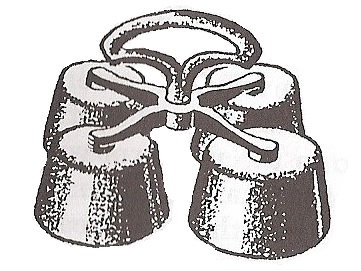
to be done only by a small handbell (the "Altar bell" or "Sanctus
bell") inside the Church (see graphic below), but many places retain
use of the large bells
at this time. It's an exquisite moment (there are no words, really) --
one that would compel one to kneel if one weren't already kneeling.
Note
that each of the bell functions listed are either a call to the
faithful to pray (for the one dying or recently dead, for the storm to
pass, in humility and gratitude to Jesus in the Blessed Sacrament,
etc.) or, at the least, a reminder to them of God's presence in the
world. This is the essence of their powerful sacramental nature, their
sheer beauty being another aspect of it. So important and beloved are
these bells that, since at least the 800s, they have been consecrated
in a ceremony that grew to involve the bell's being given a name, the
reciting of psalms, an exorcism against evil spirits of the air, a
washing in holy water followed by drying it, an annointing with oils (Oil of the Sick on the inside of bells
in 7 places, Chrism on the outside of the
bell in 4 places), an incensing of the bells, and a reading of the
Gospel account of Our Lord's visit to Mary and Martha (Luke 10). Though
not, of course, a true "Baptism," this blessing came to be called
"baptism of the bells."
During the Protestant rebellions, some denominations came to see bells
as being "a Catholic thing," too sacramental in nature to tolerate.
This bit of doggerel sums up the attitude:
Not all the Popes Trinkets, which heere are brought forth,
Can ballance the Bible for weight, and true worth: 1
Your Bells, Beads and Crosses, you see will not doo't
Or pull down your scale, with the divell to boot. 2
So
down came the bells, sometimes out of that anti-Catholic animus, but
beginning for more prosaic reasons. King Henry VIII valued bells less
for their beautiful, sacred purpose, than as scrap metal. R. Chambers's
"Book of Days" (1869) tells us how God's Providence rewarded such a
thing:
King Henry VIII, however, looked upon church-bells only as so
much metal that could be melted down and sold. Hence, in the general
destruction and distribution of church-property in his reign, countless
bells disappeared, to be sold as mere metal. Many curious coincidences
attended this wholesale appropriation. Ships attempting to carry bells
across the seas, foundered in several havens, as at Lynn, and at
Yarmouth; and, fourteen of the Jersey bells being wrecked at the
entrance of the harbour of St. Male, a saying arose to the effect, that
when the wind blows the drowned bells are ringing. A certain bishop of
Bangor, too, who sold the bells of his cathedral, was stricken with
blindness when he went to see them shipped; and Sir Miles Partridge,
who won the Jesus bells of St. Paul's, London, from King Henry, at
dice, was, not long afterwards hanged on Tower Hill.
Other
denominations weren't quite so anti-bell -- some even relishing them;
but the secularism that Protestantism sired came to eclipse even these,
with secular luminaries such as Thomas Paine coming to rail against the
use of bells. In a screed he otherwise used to insult religion3("the men most and
best informed upon the subject of theology...hold all the various
superstructures erected thereon to be at least doubtful, if not
altogether artificial") -- especially public religion -- and to insult
priests and the very existence of the priesthood, he wrote:
As to bells, they are a public nuisance. If one profession is
to have bells, and another has the right to use the instruments of the
same kind, or any other noisy instrument, some may choose to meet at
the sound of cannon, another at the beat of drum, another at the sound
of trumpets, and so on, until the whole becomes a scene of general
confusion. But if we permit ourselves to think of the state of the
sick, and the many sleepless nights and days they undergo, we shall
feel the impropriety of increasing their distress by the noise of
bells, or any other noisy instruments.
Quiet and private domestic devotion neither offends nor incommodes any
body; and the Constitution has wisely guarded against the use of
externals. Bells come under this description, and public processions
still more so. Streets and highways are for the accommodation of
persons following their several occupations, and no sectary has a right
to incommode them. If any one has, every other has the same; and the
meeting of various and contradictory processions would be tumultuous.
Those who formed the Constitution had wisely reflected upon these
cases; and, whilst they were careful to reserve the equal right of
every one, they restrained every one from giving offence, or
incommoding another.
Mr.
Paine was obviously well-schooled in England's incessant anti-Catholic
propaganda and deformed by the same spirit that led to the terrors of
the French Revolution. Religion's OK for idiots who believe it only as
long as it's a matter of "quiet and private domestic devotion" -- in
other words, if you have to be religious, shut up about it (hey, that's
what they used to say about perverted sex. My, how times
change...).
And this ultimately secular Protestant attitude is why the Pledge of
Allegiance has come to be
offensive in America, why prayer in school has been abolished, why the
old bath-house promiscuity associated with active homosexuality is part
of a "lifestyle" that can't be "judged," why abortion is a matter of
personal "rights," and why we can't use the word "morality" to defend
ourselves in the public square against the assaults of pornography,
materialism, and unwarranted, non-contextualized media violence. And,
ultimately, this is why Christians, who dare to take stands on Good and
Evil, have come to be among the last groups in the world (aside from
white boys, smokers, and political traditionalists
and conservatives) whom it is OK to mock and insult --
Catholic Christians most especially. Protestantism throws each of the
teeming millions back on himself and rips apart the the common language
and Christian culture that binds men and their families together. It
amounts to opinion -vs- opinion, which leads to people speaking of
"your reality" and "my reality," or of something being "moral for you,
but not for me," etc. Long live radical individualism; long live
Protestantism! The "divell" has won another victory.
Bring back the bells! Bring back Christ to every facet of our lives!
Cultural Notes Concerning
Bells
I can't resist adding the these little bits about bells:
First, an interesting, almost
point-by-point contrast to Mr.
Paine's view on bells: a passage about
bells
from J. K. Huysmans' "La-Bas.
Second, Edgar Allan Poe's poem "The Bells,"
which enapsulates so beautifully and musically the different moods
bells can evoke.
Third,
a talk by Professor Christopher Page about bells in the Middle
Ages.
This talk is 44:43
long:
And,
finally, the best
song about
bells I know: "Trois Cloches," by the great Edith Piaf. It's about how
the bells ring for a man --"Jean-Francois Nicot" -- when he was born,
when he was married, and when he died.
Footnotes: 1 Hmm.. I wonder if this writer is talking about the entire
Bible (the Bible which was compiled by and given to the world through
the Catholic Church) or just those books the Protestants left in.
2 D. MacColloch, The Later Reformation in England
1547-1603 (London, 1990)
3 He insults religions as
"trades," but has a soft spot for Quakerism: his Daddy was a Quaker,
you see, and Quakers "provide for the poor of their society" and
"...have no priests. They assemble quietly in their places of meeting,
and do not disturb their neighbours with shows and noise of bells.
Religion does not unite itself to show and noise. True religion is
without either." Pope Paine has spoken! All heed his infallible words!
And I wonder if the Quakers got their ideas of "providing for the poor"
from the Catholics, who've run hospitals, orphanages, soup kitchens,
schools, etc., or semblances thereof, ever since they were allowed in
public by Constantine.
This page is dedicated to the bells of Holy Rosary Church,
Indianapolis
-- from smallest to largest: Assumption, St. Rita, St.
Francis, St. Anthony, St. Joseph, San Salvador