|
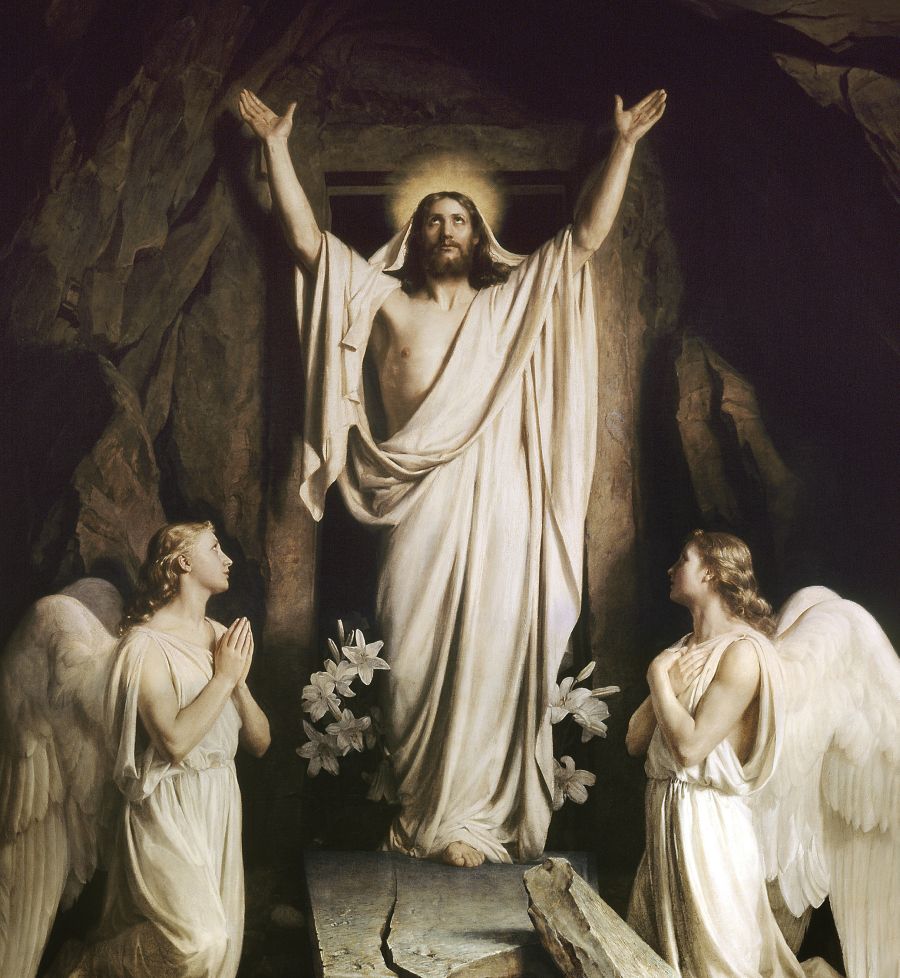
Easter, which begins this Season, is the greatest Feast of
the year for Christ is risen! The alleluia, which was omitted from the
Mass since Septuagesima, returned at Vespers on Holy Saturday, and is
now heard after every Introit, Antiphon verse, and Response. The Vidi
Aquam replaces the Aspèrges, and the Regina Coeli replaces the Angelus.
The Paschal candle remains lit in the Sanctuary until Ascension
Thursday, and like the Christ Candle during the Twelve Days of Christmas, we have a Paschal Candle
in our homes, too, until the Ascension (see the page on Easter Sunday for more on the
Paschal Candle).
...and the Lenten fast is over!
During this Season, we are obliged to receive the Eucharist to fulfill
the Church precept that we receive the Eucharist at least once
a year. During Lent, most of us have already fulfilled the precept to
go to Confession at least once a year, but if we haven't, we
can do that now.
During the Octave of Easter, we greet each other (and even answer our
telephones) with the triumphant "Christus resurrexit!" (Christ is
risen!) to which comes the response "Et apparuit Simoni, alleluia" (and
appeared unto Simon, alleluia!). This joyous greeting totally
crystallizes the mood of this season. This triumphant attitude is also
shown by the replacing of the Angelus with
the Regina Coeli throughout Paschaltide.
A note on terminology: The word "Easter" is actually a word rooted in
the name either of an alleged Teutonic goddess (Eostre) or, more
probably, from the name "Eostur" meaning the "season of rising" and
indicating springtime. It is only used in the English language. It came
into use because the month of April was known in Anglo-Saxon countries
as easter-monadh, and Eastur became an old Germanic
word meaning springtime. Other languages have different names for
Easter -- "Pascha" (Latin and Greek), "Pasqua" (Italian), "Pascua"
(Spanish), "Paschen" (Dutch), Pasg (Welsh), etc. -- all of which
derives from the Hebrew word "Pesach" meaning "Passover." The point is
that the claim that "Easter is a pagan holiday" because of the word
"Easter" is ridiculous. The English word for it might have
pagan origins deriving from Eostre and/or the word for springtime, but
the Solemnity is rooted in the Old Testament Pesach which was fulfilled
at the Crucifixion which gave us the fruits of the Resurrection. In
addition, all the names for the days of the week are "pagan" in origin:
Sunday is named for the Sun; Monday for the Moon; Tuesday for god
Tiu, Wednesday for Woden, Thursday for Thor, Friday for Freya, and
Saturday for Saturn, so anyone who balks at celebrating "Easter"
because of its "pagan origins" had better not refer to the days of the
week by their English names!
The station churches of Easter
Week:
Easter: S. Maria
Maggiore
Easter Monday: S. Pietro in Vaticano
Easter Tuesday: S. Paolo fuori le mura
Easter Wednesday: S. Lorenzo fuori le mura
Easter Thursday: SS. Apostoli
Easter Friday: S. Maria ad Martyres
Easter Saturday: S. Giovanni in Laterano
Octave of Easter, Low Sunday: S. Pancrazio
Reading
"The Mystery
of Paschal Time"
from Dom Gueranger's "The Liturgical Year"
Of all the
seasons of the liturgical year Eastertide is by far the richest in
mystery. We might even say that Easter is the summit of the Mystery of
the sacred Liturgy. The Christian who is happy enough to enter, with
his whole mind and heart, into the knowledge and love of the Paschal
Mystery, has reached the very centre of the supernatural life. Hence it
is that the Church uses every effort in order to effect this: what she
has hitherto done was all intended as a preparation for Easter. The
holy longings of Advent, the sweet joys of Christmas, the severe truths
of Septuagesima, the contrition and penance of Lent, the heartrending
sight of the Passion-all were given us as preliminaries, as paths, to
the sublime and glorious Pasch, which is now ours.
And that we might be convinced of the supreme importance of this
solemnity, God willed that the Christian Easter and Pentecost should be
prepared by those of the Jewish Law-a thousand five hundred years of
typical beauty prefigured the reality: and that reality is ours!
During these days, then, we have brought before us the two great
manifestations of God's goodness towards mankind-the Pasch of Israel,
and the Christian Pasch, the Pentecost of Sinai, and the Pentecost of
the Church. We shall have occasion to show how the ancient figures were
fulfilled in the realities of the new Easter and Pentecost, and how the
twilight of the Mosaic Law made way for the full daylight of the
Gospel; but we cannot resist the feeling of holy reverence, at the bare
thought that the solemnities we have now to celebrate are more than
three thousand years old, and that they are to be renewed every year
from this till the voice of the angel shall be heard proclaiming: 'Time
shall be no more!' The gates of eternity will then be thrown open.
Eternity in heaven is the true Pasch: hence, our Pasch here on earth is
the feast of feasts, the solemnity of solemnities. The human race was
dead; it was the victim of that sentence, whereby it was condemned to
lie mere dust in the tomb; the gates of life were shut against it. But
see! the Son of God rises from his grave and takes possession of
eternal life. Nor is he the only one that is to die no more, for, as
the Apostle teaches us, 'He is the first-born from the dead.' The
Church would, therefore, have us consider ourselves as having already
risen with our Jesus, and as having already taken possession of eternal
life. The holy Fathers bid us look on these fifty days of Easter as the
image of our eternal happiness. They are days devoted exclusively to
joy; every sort of sadness is forbidden; and the Church cannot speak to
her divine Spouse without joining to her words that glorious cry of
heaven, the Alleluia, wherewith, as the holy Liturgy says, the streets
and squares of the heavenly Jerusalem resound without ceasing. We have
been forbidden the use of this joyous word during the past nine weeks;
it behoved us to die with Christ-but now that we have risen together
with him from the tomb, and that we are resolved to die no more that
death which kills the soul and caused our Redeemer to die on the cross,
we have a right to our Alleluia.
The providence of God, who has established harmony between the visible
world and the supernatural work of grace, willed that the Resurrection
of our Lord should take place at that particular season of the year
when even Nature herself seems to rise from the grave. The meadows give
forth their verdure, the trees resume their foliage, the birds fill the
air with their songs, and the sun, the type of our triumphant Jesus,
pours out his floods of light on our earth made new by lovely spring.
At Christmas the sun had little power, and his stay with us was short;
it harmonized with the humble birth of our Emmanuel, who came among us
in the midst of night, and shrouded in swaddling clothes, but now he is
'as a giant that runs his way, and there is no one that can hide
himself from his heat.' Speaking, in the Canticle, to the faithful
soul, and inviting her to take her part in this new life which he is
now imparting to every creature, our Lord himself says: 'Arise, my
dove, and come! Winter is now past, the rain is over and gone. The
flowers have appeared in our land. The voice of the turtle is heard.
The fig-tree hath put forth her green figs. The vines, in flower, yield
their sweet smell. Arise thou, and come!'
In the preceding chapter we explained why our Saviour chose the Sunday
for his Resurrection, whereby he conquered death and proclaimed life to
the world. It was on this favoured day of the week that he had, four
thousand years previously, created the light, by selecting it now for
the commencement of the new life which he graciously imparts to man, he
would show us that Easter is the renewal of the entire creation. Not
only is the anniversary of his glorious Resurrection to be,
henceforward, the greatest of days, but every Sunday throughout the
year is to be a sort of Easter, a holy and sacred day. The Synagogue,
by God's command, kept holy the Saturday or the Sabbath in honour of
God's resting after the six days of the creation; but the Church, the
Spouse, is commanded to honour the work of her Lord. She allows the
Saturday to pass-it is the day on which her Jesus rested in the
sepulchre: but, now-that she is illumined with the brightness of the
Resurrection, she devotes to the contemplation of his work the first
day of the week; it is the day of light, for on it he called forth
material light (which was the first manifestation of life upon chaos),
and on the same, he that is the 'Brightness of the Father,' and 'the
Light of the world,' rose from the darkness of the tomb.
Let, then, the week with its Sabbath pass by; what we Christians want
is the eighth day, the day that is beyond the measure of time, the day
of eternity, the day whose light is not intermittent or partial, but
endless and unlimited. Thus speak the holy Fathers, when explaining the
substitution of the Sunday for the Saturday. It was, indeed, right that
man should keep, as the day of his weekly and spiritual repose, that on
which the Creator of the visible world had taken his divine rest; but
it was a commemoration of the material creation only. The Eternal Word
comes down in the world that he has created; he comes with the rays of
his divinity clouded beneath the humble veil of our flesh; he comes to
fulfil the figures of the first Covenant. Before abrogating the
Sabbath, he would observe it as he did every tittle of the Law; he
would spend it as the day of rest, after the work of his Passion, in
the silence of the sepulchre: but, early on the eighth day, he rises to
life, and the life is one of glory. 'Let us,' says the learned and
pious Abbot Rupert, 'leave the Jews to enjoy the ancient Sabbath, which
is a memorial of the visible creation. They know not how to love or
desire or merit aught but earthly things.... They would not recognize
this world's creator as their king, because he said: "Blessed are the
poor!" and "Woe to the rich!" But our Sabbath has been transferred from
the seventh to the eighth day, and the eighth is the first. And rightly
was the seventh changed into the eighth, because we Christians put our
joy in a better work than the creation of the world.... Let the lovers
of the world keep a Sabbath for its creation: but our joy is in the
salvation of the world, for our life, yea and our rest, is hidden with
Christ in God.'
The mystery of the seventh followed by an eighth day, as the holy one,
is again brought before us by the number of weeks which form
Eastertide. These weeks are seven; they form a week of weeks, and their
morrow is again a Sunday, the glorious feast of Pentecost. These
mysterious numbers-which God himself fixed when he instituted the first
Pentecost after the first Pasch-were adopted by the Apostles when they
regulated the Christian Easter, as we learn from St. Hilary of
Poitiers, St. Isidore, Amalarius, Rabanus Maurus and from all the
ancient interpreters of the mysteries of the holy Liturgy. 'If we
multiply seven by seven' says St. Hilary, 'we shall find that this holy
season is truly the Sabbath of sabbaths, but what completes it and
raises it to the plenitude of the Gospel, is the eighth day which
follows, eighth and first both together in itself. The Apostles have
given so sacred an institution to these seven weeks that, during them,
no one should kneel, or mar by fasting the spiritual joy of this long
feast. The same institution has been extended to each Sunday; for this
day which follows the Saturday has become, by the application of the
progress of the Gospel the completion of the Saturday, and the day of
feast and joy.'
Thus, then, the whole season of Easter is marked with the mystery
expressed by each Sunday of the year. Sunday is to us the great day of
our week, because beautified with the splendour of our Lord's
Resurrection of which the creation of material light was but a type. We
have already said that this institution was prefigured in the Old Law,
although the Jewish people were not in any way aware of it. Their
Pentecost fell on the fiftieth day after the Pasch; it was the morrow
of the seven weeks. Another figure of our Eastertide was the year of
Jubilee, which God bade Moses prescribe to his people. Each fiftieth
year the houses and lands that had been alienated during the preceding
-forty-nine returned to their original owners; and those Israelites who
had been compelled by poverty to sell themselves as slaves recovered
their liberty. This year, which was properly called the sabbatical
year, was the sequel of the preceding seven weeks of years, and was
thus the image of our eighth day, whereon the Son of Mary, by his
Resurrection, redeemed us from the slavery of the tomb, and restored us
to the inheritance of our immortality.
The rites peculiar to Eastertide, in the present discipline of the
Church, are two: the unceasing repetition of the Alleluia, of which we
have already spoken, and the colour of the vestments used for its two
great solemnities, white for the first and red for the second. White is
appropriate to the Resurrection: it is the mystery of eternal light,
which knows neither spot nor shadow; it is the mystery that produces in
a faithful soul the sentiment of purity and joy. Pentecost, which gives
us the Holy Spirit, the 'consuming Fire,' is symbolized by the red
vestments, which express the mystery of the divine Paraclete coming
down in the form of fiery tongues upon them that were assembled in the
Cenacle. With regard to the ancient usage of not kneeling during
Paschal Time, we have already said that there is a mere vestige of it
now left in the Latin Liturgy.
The feasts of the saints, which were interrupted during Holy Week, are
likewise excluded from the first eight days of Eastertide; but when
these are ended, we shall have them in rich abundance, as a bright
constellation of stars round the divine Sun of Justice, our Jesus. They
will accompany us in our celebration of his admirable Ascension; but
such is the grandeur of the mystery of Pentecost, that from the eve of
that day they will be again interrupted until the expiration of Paschal
Time.
The rites of the primitive Church with reference to the Neophytes, who
were regenerated by baptism on the night of Easter, are extremely
interesting and instructive. But as they are peculiar to the two
octaves of Easter and Pentecost, we will explain them when they are
brought before us by the Liturgy of those days.
|
|