This day is known as "Quasimodo Sunday" from the first two
words of the
opening Antiphon at Mass that speak especially to those baptized at Easter:
I Peter 2:2
Quasi modo geniti infantes, rationabile, sine dolo lac concupiscite ut
in eo crescatis in salutem si gustastis quoniam dulcis Dominus.
As newborn babes, alleluia, desire the rational milk without guile,
alleluia, alleluia, alleluia. Rejoice to God our helper. Sing aloud to
the God of Jacob.
It is the day
that the newly baptized officially put away their white robes, hence,
it is known liturgically as "Dominica in albis depositis" or the
"Sunday of putting away the albs."
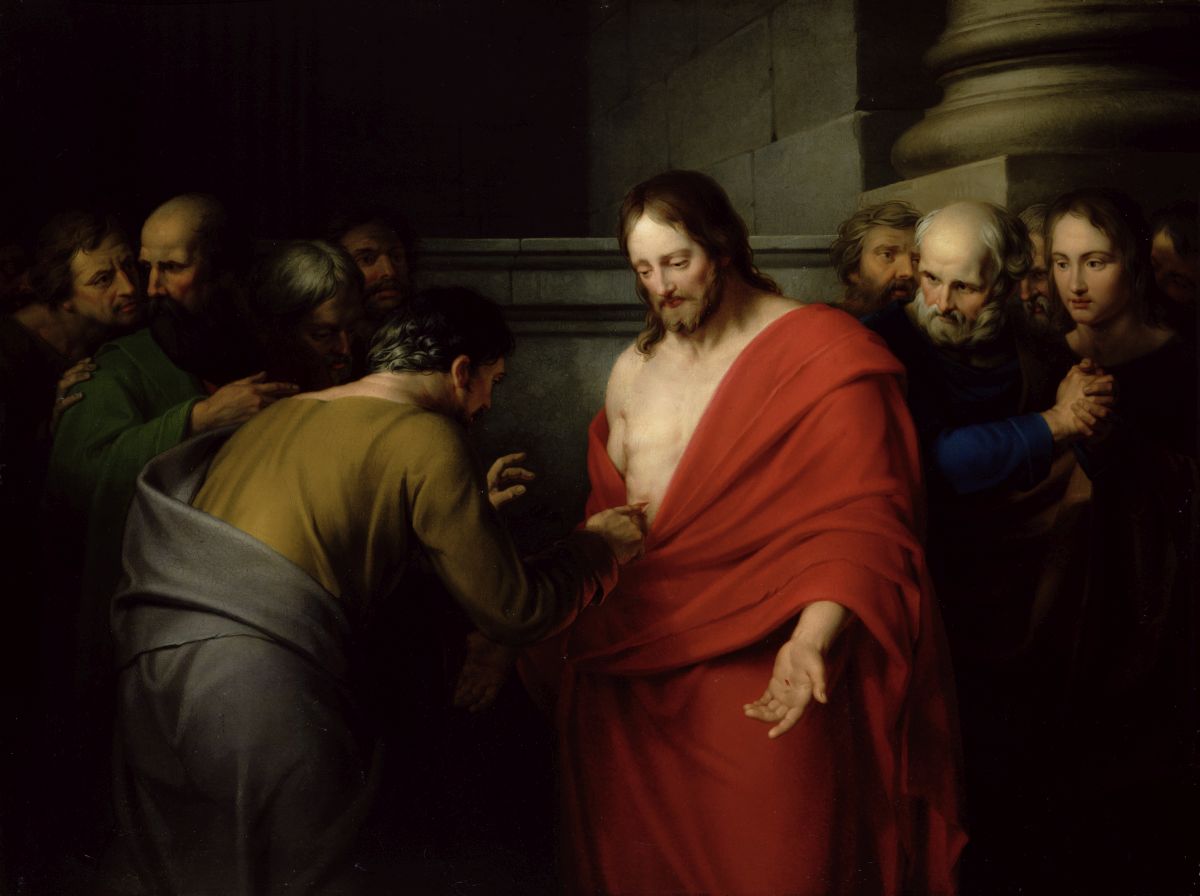
The day's Gospel
reading is John 20: 19-31, which focuses, in part, on the doubts of St.
Thomas -- "Doubting Thomas" -- at
hearing the news of the risen Christ:
Now when it was
late that same day, the first of the week, and the doors were shut,
where the disciples were gathered together, for fear of the Jews, Jesus
came and stood in the midst, and said to them: Peace be to you. And
when he had said this, he shewed them his hands and his side. The
disciples therefore were glad, when they saw the Lord.
He said therefore to them again: Peace be to you. As the Father hath
sent me, I also send you. When he had said this, He breathed on them;
and he said to them: Receive ye the Holy Ghost. Whose sins you shall
forgive, they are forgiven them; and whose sins you shall retain, they
are retained.
Now Thomas, one of the twelve, who is called Didymus, was not with them
when Jesus came. The other disciples therefore said to him: We have
seen the Lord.
But he said to them: Except I shall see in his hands the print of the
nails, and put my finger into the place of the nails, and put my hand
into his side, I will not believe.
And after eight days again His disciples were within, and Thomas with
them. Jesus cometh, the doors being shut, and stood in the midst, and
said: Peace be to you. Then He saith to Thomas: Put in thy finger
hither, and see My hands; and bring hither thy hand, and put it into My
side; and be not faithless, but believing.
Thomas answered, and said to Him: My Lord, and my God. Jesus saith to
him: Because thou hast seen Me, Thomas, thou hast believed: blessed are
they that have not seen, and have believed. Many other signs also did
Jesus in the sight of His disciples, which are not written in this
book.
But these are written, that you may believe that Jesus is the Christ,
the Son of God: and that believing, you may have life in His name.
"Blessed are
they that have not seen, and have believed"!
Now, why would Christ, glorified,
appear with His wounds? Aquinas gives 5
beautiful reasons:
-
It was fitting
for Christ’s soul at His Resurrection to resume the body with its
scars. In the first place, for Christ’s own glory. For Bede says on
Luke 24:40 that He kept His scars not from inability to heal them, “but
to wear them as an everlasting trophy of His victory.” Hence Augustine
says (De Civ. Dei xxii): “Perhaps in that kingdom we shall see on the
bodies of the Martyrs the traces of the wounds which they bore for
Christ’s name: because it will not be a deformity, but a dignity in
them; and a certain kind of beauty will shine in them, in the body,
though not of the body.”
-
Secondly, to
confirm the hearts of the disciples as to “the faith in His
Resurrection” (Bede, on Luke 24:40).
-
Thirdly, “that
when He pleads for us with the Father, He may always show the manner of
death He endured for us” (Bede, on Luke 24:40).
-
Fourthly, “that
He may convince those redeemed in His blood, how mercifully they have
been helped, as He exposes before them the traces of the same death”
(Bede, on Luke 24:40).
-
Lastly, “that in
the Judgment Day He may upbraid them with their just condemnation”
(Bede, on Luke 24:40). Hence, as Augustine says (De Symb. ii): “… So
will [Christ] show His wounds to His enemies, so that He who is the
Truth may convict them, saying: ‘Behold the man whom you crucified; see
the wounds you inflicted; recognize the side you pierced, since it was
opened by you and for you, yet you would not enter.’”
As Isaias
53:3-5 and I Peter 2:24 tell us, it is by His stripes that we are
healed, and His love for us is eternal.
Customs
As you will
note, the Gospel reading concerns not only the story of "Doubting
Thomas," but also the merciful institution of Confession.
Because of this and the particular devotions set in motion by the
controversial Saint
Faustina, today is also known officially (but non-liturgically) since
23 May 2000 in the Novus Ordo world as "Divine Mercy Sunday." Today, a
plenary indulgence is
granted to those who, under the usual conditions, take part in the
public devotion to His Divine Mercy or
who, in the presence of the Blessed Sacrament (in the tabernacle or
exposed), recite the Our Father, the Creed, and a prayer to Jesus
appealing to His mercy.
And yes, the name of this Feast is the origin of the name of the
hunchback, Quasimodo, in Victor Hugo's "The Hunchback of Notre Dame."
Poor Quasimodo was a foundling who was discovered at the cathedral on
Low Sunday and so was named for the Feast. He is introduced in Hugo's
book like this:
Sixteen years
previous to the epoch when this story takes place, one fine morning, on
Quasimodo Sunday, a living creature had been deposited, after Mass, in
the church of Notre- Dame, on the wooden bed securely fixed in the
vestibule on the left, opposite that great image of Saint Christopher,
which the figure of Messire Antoine des Essarts, chevalier, carved in
stone, had been gazing at on his knees since 1413, when they took it
into their heads to overthrow the saint and the faithful follower. Upon
this bed of wood it was customary to expose foundlings for public
charity. Whoever cared to take them did so. In front of the wooden bed
was a copper basin for alms.
The sort of living being which lay upon that plank on the morning of
Quasimodo, in the year of the Lord, 1467, appeared to excite to a high
degree, the curiosity of the numerous group which had congregated about
the wooden bed. The group was formed for the most part of the fair sex.
Hardly any one was there except old women.
In the first row, and among those who were most bent over the bed, four
were noticeable, who, from their gray cagoule, a sort of cassock, were
recognizable as attached to some devout sisterhood. I do not see why
history has not transmitted to posterity the names of these four
discreet and venerable damsels. They were Agnes la Herme, Jehanne de la
Tarme, Henriette la Gaultière, Gauchère la Violette, all four widows,
all four dames of the Chapel Etienne Haudry, who had quitted their
house with the permission of their mistress, and in conformity with the
statutes of Pierre d'Ailly, in order to come and hear the sermon.
However, if these good Haudriettes were, for the moment, complying with
the statutes of Pierre d'Ailly, they certainly violated with joy those
of Michel de Brache, and the Cardinal of Pisa, which so inhumanly
enjoined silence upon them.
"What is this, sister?" said Agnes to Gauchère, gazing at the little
creature exposed, which was screaming and writhing on the wooden bed,
terrified by so many glances.
"What is to become of us," said Jehanne, "if that is the way children
are made now?"
"I'm not learned in the matter of children," resumed Agnes, "but it
must be a sin to look at this one."
Note: In
England, at one time anyway, on the Monday after Low Sunday, between
the hours of 9 and noon, there was the strange custom by which men
"captured" women (often by lifting them up in chairs) for a ransom
which was given to the Church. On Tuesday the women reciprocate by
capturing the men. These two days became known as "Hocktide."
Reading
from Dom
Gueranger's "The Liturgical Year"
Our neophytes
closed the Octave of the Resurrection yesterday. They were before us in
receiving the admirable mystery; their solemnity would finish earlier
than ours. This, then, is the eighth day for us who kept the Pasch on
the Sunday, and did not anticipate it on the vigil. It reminds us of
all the glory and joy of that feast of feasts, which united the whole
of Christendom in one common feeling of triumph. It is the day of
light, which takes the place of the Jewish Sabbath. Henceforth, the
first day of the week is to be kept holy. Twice has the Son of God
honoured it with the manifestation of his almighty power. The Pasch,
therefore, is always to be celebrated on the Sunday; and thus every
Sunday becomes a sort of Paschal feast, as we have already explained in
the Mystery of Easter.
Our risen Jesus gave an additional proof that he wished the Sunday to
be, henceforth, the privileged day. He reserved the second visit he
intended to pay to all his disciples for this the eighth day since his
Resurrection. During the previous days, he has left Thomas a prey to
doubt; but to-day he shows himself to this Apostle, as well as to the
others, and obliges him, by irresistible evidence, to lay aside his
incredulity. Thus does our Saviour again honour the Sunday. The Holy
Ghost will come down from heaven upon this same day of the week, making
it the commencement of the Christian Church: Pentecost will complete
the glory of this favoured day.
Jesus' apparition to the eleven, and the victory he gains over the
incredulous Thomas—these are the special subjects the Church brings
before us to-day.
By this apparition, which is the seventh since his Resurrection, our
Saviour wins the perfect faith of his disciples. It is impossible not
to recognize God in the patience, the majesty, and the charity of him
who shows himself to them. Here, again, our human thoughts are
disconcerted; we should have thought this delay excessive; it would
have seemed to us that our Lord ought to have at once either removed
the sinful doubt from Thomas's mind, or punished him for his disbelief.
But no: Jesus is infinite wisdom, and infinite goodness. In his wisdom,
he makes this tardy acknowledgement of Thomas become a new argument of
the truth of the Resurrection; in his goodness, he brings the heart of
the incredulous disciple to repentance, humility, and love; yea, to a
fervent and solemn retractation of all his disbelief. We will not here
attempt to describe this admirable scene, which holy Church is about to
bring before us. We will select, for our to-day's instruction, the
important lesson given by Jesus to his disciple, and through him to us
all. It is the leading instruction of the Sunday, the Octave of the
Pasch, and it behooves us not to pass it by, for, more than any other,
it tells us the leading characteristic of a Christian, shows us the
cause of our being so listless in God's service, and points out to us
the remedy for our spiritual ailments.
Jesus says to Thomas: 'Because thou hast seen me, thou hast believed:
blessed are they that have not seen, and have believed!' Such is the
great truth, spoken by the lips of the God-Man: it is a most important
counsel, given, not only to Thomas, but to all who would serve God and
secure their salvation. What is it that Jesus asks of his disciple? Has
he not heard him make profession that now, at last, he firmly believes?
After all, was there any great fault in Thomas's insisting on having
experimental evidence before believing in so extraordinary a miracle as
the Resurrection? Was he obliged to trust to the testimony of Peter and
the others, under penalty of offending his divine Master? Did he not
evince his prudence, by withholding his assent until he had additional
proofs of the truth of what his brethren told him? Yes, Thomas was a
circumspect and prudent man, and one that was slow to believe what he
had heard; he was worthy to be taken as a model by those Christians who
reason and sit in judgment upon matters of faith. And yet, listen to
the reproach made him by Jesus. It is merciful, and withal so severe!
Jesus has so far condescended to the weakness of his disciple as to
accept the condition on which alone he declares that he will believe:
now that the disciple stands trembling before his risen Lord, and
exclaims, in the earnestness of faith, `My Lord and my God!' oh! see
how Jesus chides him! This stubbornness, this incredulity, deserves a
punishment: the punishment is, to have these words said to him:
`Thomas! thou hast believed, because thou hast seen!'
Then was Thomas obliged to believe before having seen? Yes,
undoubtedly. Not only Thomas, but all the Apostles were in duty bound
to believe the Resurrection of Jesus even before he showed himself to
them. Had they not lived three years with him? Had they not seen him
prove himself to be the Messias and the Son of God by the most
undeniable miracles? Had he not foretold them that he would rise again
on the third day? As to the humiliations and cruelties of his Passion,
had he not told them, a short time previous to it, that he was to be
seized by the Jews in Jerusalem, and be delivered to the gentiles? that
he was to be scourged, spit upon, and put to death?
After all this, they ought to have believed in his triumphant
Resurrection, the very first moment they heard of his Body having
disappeared. As soon as John had entered the sepulchre, and seen the
winding-sheet, he at once ceased to doubt; he believed. But it is
seldom that man is so honest as this; he hesitates, and God must make
still further advances, if he would have us give our faith! Jesus
condescended even to this: he made further advances. He showed himself
to Magdalen and her companions, who were not incredulous, but only
carried away by natural feeling, though the feeling was one of love for
their Master. When the Apostles heard their account of what had
happened, they treated them as women whose imagination had got the
better of their judgment. Jesus had to come in person: he showed
himself to these obstinate men, whose pride made them forget all that
he had said and done, sufficient indeed to make them believe in his
Resurrection. Yes, it was pride; for faith has no other obstacle than
this. If man were humble, he would have faith enough to move mountains.
To return to our Apostle. Thomas had heard Magdalen, and he despised
her testimony; he had heard Peter, and he objected to his authority; he
had heard the rest of his fellow-Apostles and the two disciples of
Emmaus, and no, he would not give up his own opinion. How many there
are among us who are like him in this! We never think of doubting what
is told us by a truthful and disinterested witness, unless the subject
touch upon the supernatural; and then we have a hundred difficulties.
It is one of the sad consequences left in us by original sin. Like
Thomas, we would see the thing ourselves: and that alone is enough to
keep us from the fulness of the truth. We comfort ourselves with the
reflection that, after all, we are disciples of Christ; as did Thomas,
who kept in union with his brother-Apostles, only he shared not their
happiness. He saw their happiness, but he considered it to be a
weakness of mind, and was glad that he was free from it!
How like this is to our modern rationalistic Catholic! He believes, but
it is because his reason almost forces him to believe; he believes with
his mind, rather than from his heart. His faith is a scientific
deduction, and not a generous longing after God and supernatural truth.
Hence how cold and powerless is this faith! how cramped and ashamed!
how afraid of believing too much l Unlike the generous unstinted faith
of the saints, it is satisfied with fragments of truth, with what the
Scripture terms diminished truths. It seems ashamed of itself. It
speaks in a whisper, lest it should be criticized; and when it does
venture to make itself heard, it adopts a phraseology which may take
off the sound of the divine. As to those miracles which it wishes had
never taken place, and which it would have advised God not to work,
they are a forbidden subject. The very mention of a miracle,
particularly if it have happened in our own times, puts it into a state
of nervousness. The lives of the saints, their heroic virtues, their
sublime sacrifice -- it has a repugnance to the whole thing! It talks
gravely about those who are not of the true religion being unjustly
dealt with by the Church in Catholic countries; it asserts that the
same liberty ought to be granted to error as to truth; it has very
serious doubts whether the world has been a great loser by the
secularization of society.
Now it was for the instruction of persons of this class that our Lord
spoke those words to Thomas: `Blessed are they who havenot seen, and
have believed.' Thomas sinned in not having the readiness of mind to
believe. Like him, we also are in danger of sinning, unless our faith
have a certain expansiveness, which makes us see everything with the
eye of faith, and gives our faith that progress which God recompenses
with a super-abundance of light and joy. Yes, having once become
members of the Church, it is our duty to look upon all things from a
supernatural point of view. There is no danger of going too far, for we
have the teachings of an infallible authority to guide us. `The just
man liveth by faith.' Faith is his daily bread. His mere natural life
becomes transformed for good and all, if only he be faithful to his
Baptism. Could we suppose that the Church, after all her instructions
to her neophytes, and after all those sacred rites of their Baptism
which are so expressive of the supernatural life, would be satisfied to
see them straightway adopt that dangerous system which drives faith
into a nook of the heart and understanding and conduct, leaving all the
rest to natural principles or instinct? No, it could not be so. Let us
therefore imitate St Thomas in his confession, and acknowledge that
hitherto our faith has not been perfect. Let us go to our Jesus, and
say to him: `Thou art my Lord and my God! But alas! I have many times
thought and acted as though thou wert my Lord and my God in some
things, and not in others. Henceforth I will believe without seeing;
for I would be of the number of those whom thou callest blessed!'
This Sunday, commonly called with us Low Sunday, has two names assigned
to it in the Liturgy: Quasimodo, from the first word of the Introit;
and Sunday in albis (or, more explicitly, in albis depositis), because
on this day the neophytes assisted at the Church services attired in
their ordinary dress. In the Middle Ages it was called Close-Pasch, no
doubt in allusion to its being the last day of the Easter Octave. Such
is the solemnity of this Sunday that not only is it of Greater Double
rite, but no feast, however great, can ever be kept upon it.
At Rome, the Station is in the basilica of St Pancras, on the Aurelian
Way. Ancient writers have not mentioned the reason of this Church being
chosen for to-day's assembly of the faithful. It may, perhaps, have
been on account of the saint's being only fourteen years old when put
to death: a circumstance which gave the young martyr a sort of right to
have the neophytes round him, now that they were returning to their
everyday life.
Mass
The Introit
repeats those beautiful words of St Peter, which were addressed, in
yesterday's Epistle, to the newly baptized. They are like new-born
babes, lovely in their sweet simplicity, and eager to drink from the
breasts of their dear mother, the Church, the spiritual milk of faith
-- that faith which will make them strong and loyal.
The Apostle St John here tells us the merit and power of faith: it is,
says he, a victory, which conquers the world, both the world outside,
and the world within us. It is not difficult to understand why this
passage from St John's Epistles should have been selected for to-day's
Liturgy: it is on account of its being so much in keeping with the
Gospel appointed for this Sunday, in which our Lord passes such eulogy
upon faith. If, as the Apostle here assures us, they overcome the world
who believe in Christ, that is not sterling faith which allows itself
to be intimidated by the world. Let us be proud of our faith, esteeming
ourselves happy that we are but little children when there is a
question of receiving a divine truth; and let us not be ashamed of our
eager readiness to admit the testimony of God. This testimony will make
itself heard in our hearts, in proportion to our willingness to hear
it. The moment John saw the winding-bands which had shrouded the Body
of his Master, he made an act of faith; Thomas, who had stronger
testimony than John (for he had the word of the Apostles, assuring him
that they had seen their risen Lord), refused to believe: he had not
overcome the world and its reasonings, because he had not faith.
The two Alleluia Versicles are formed of two texts alluding to the
Resurrection. The second speaks of the scene which took place on this
day, in the cenacle.
We have said enough about St Thomas' incredulity; let us now admire his
faith. His fault has taught us to examine and condemn our own want of
faith; let us learn from his repentance how to become true believers.
Our Lord, who had chosen him as one of the pillars of his Church, has
been obliged to treat him with an exceptional familiarity: Thomas
avails himself of Jesus' permission, puts his finger into the sacred
wound, and immediately he sees the sinfulness of his past incredulity.
He would make atonement, by a solemn act of faith, for the sin he has
committed in priding himself on being wise and discreet: he cries out,
and with all the fervour of faith: My Lord and my God! Observe, he not
only says that Jesus is his Lord, his Master, the same who chose him as
one of his disciples: this would not have been faith, for there is no
faith where we can see and touch. Had Thomas believed what his
brother-Apostles had told him, he would have had faith in the
Resurrection; but now he sees, he has experimental knowledge of the
great fact; and yet, as our Lord says of him, he has faith. In what? In
this, that his Master is God. He sees but the humanity of Jesus, and he
at once confesses him to be God. From what is visible, his soul, now
generous and repentant, rises to the invisible: `Thou art my God!' Now,
O Thomas! thou art full of faith! The Church proposes thee to us, on
thy feast, as an example of faith. The confession thou didst make on
this day is worthy to be compared with that which Peter made, when he
said: `Thou art Christ, the Son of the living God!' By this profession,
which neither flesh nor blood had revealed to him, Peter merited to be
made the rock whereon Christ built his Church: thine did more than
compensate thy former disbelief; it gave thee, for the time, a
superiority over the rest of the Apostles, who, so far at least, were
more taken up with the visible glory, than with the invisible divinity,
of their risen Lord.
The Offertory gives us another text of the Gospel relative to the
Resurrection.
|