``Where the
Bishop is, there let the multitude of believers be;
even as where Jesus is, there is the Catholic Church'' Ignatius of
Antioch, 1st c. A.D
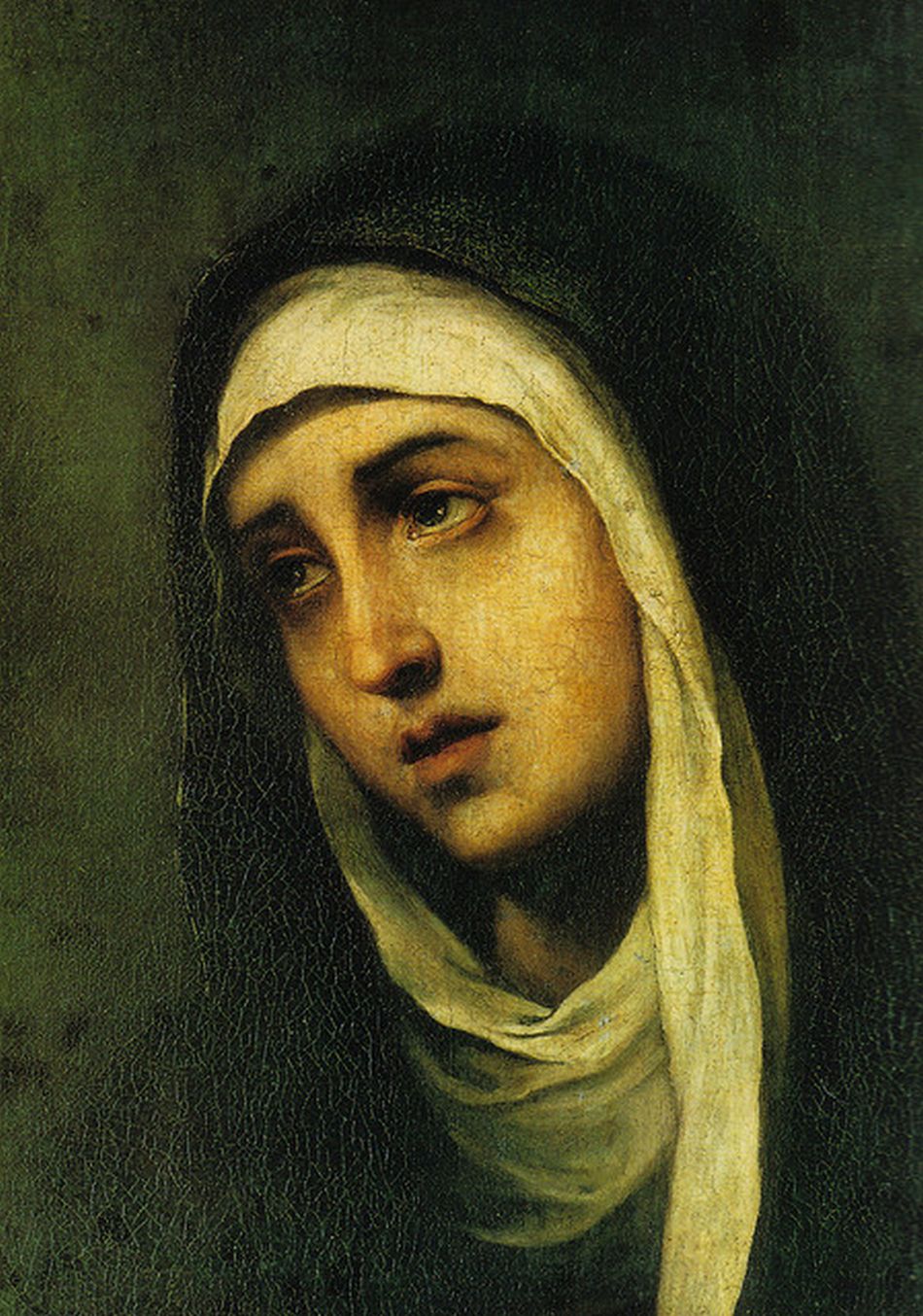
Feast of the Seven Sorrows
of the Blessed Virgin Mary
There are two days we commemorate the dry martrydom -- i.e.,
a martyrom of suffering, but not of blood -- of Our
Lady: on September 15 and today, the "Friday of Sorrows." The seven
sorrows we commemorate are:
The Circumcision
and Prophecy of Simeon
The Flight into Egypt
The Loss of Jesus in the Temple
The Meeting of Jesus and Mary on the Way of the Cross
The Crucifixion
The Taking Down of the Body of Jesus from the Cross
Jesus is laid in the Tomb
The Feast of the Seven
Sorrows in
September is devoted to all of her Seven Sorrows; the feast today
focuses more
specifically the last four of those -- i.e., on what she suffered
during Passiontide. In other words, the
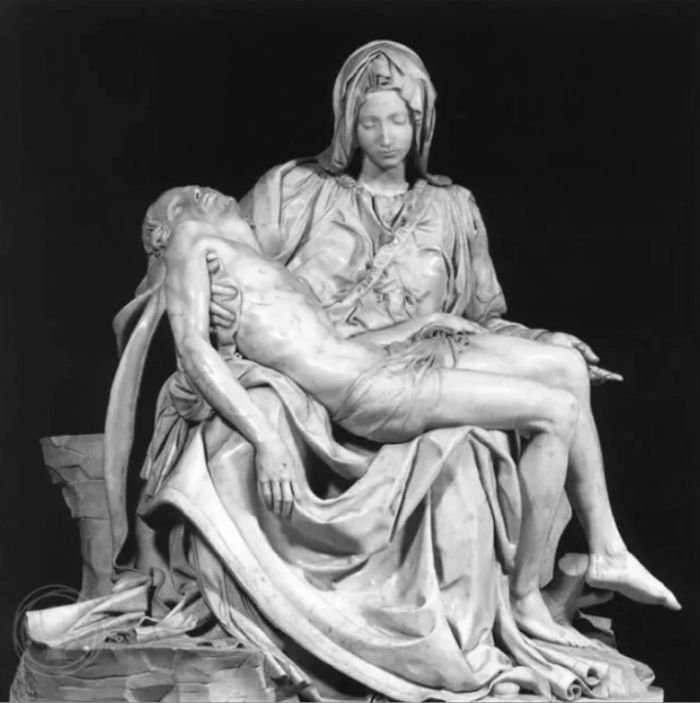
feeling of the day is akin to what one feels when looking at
Michelangelo's Pieta: we imagine Our Lady watching her Son enduring His
betrayal, His arrest, His torture, His crucifixion, His death, and His
burial.
To that end, the
Sequence read after the Epistle, Gradual, and Tract consists of the
haunting Stabat Mater, the text
of which was written by St. Thomas Aquinas.
As for prayer for the day, the Chaplet
of the Seven Sorrows (the Servite Rosary) or Litany
of the Dolorous Virgin Mary, written by Pope Pius VII would be
perfect. And as to music, here is a song to listen to while you pray
and ponder the Virgin's
sorrows: the 13th century Italian Voi
ch'amate lo Criatore (You who
love the Creator):
Voi ch’amate lo
Criatore,
ponete mente a lo meo dolore.
Ch’io son Maria co' lo cor tristo
la quale avea per figliuol Cristo:
la speme mia et dolce acquisto
fue crocifisso pe’ li peccatori.
Capo bello et delicato,
come ti veggio stare enchinato;
li tuoi capelli di sangue intrecciati,
fin a la barba ne va i’ rigore.
Bocca bella et delicata,
come ti veggio stare asserrata,
di fiele e aceto fosti abbeverata,
trista et dolente dentr’al mio core.
Voi ch’amate lo Criatore,
ponete mente a lo meo dolore.
All of you who
love the Creator
Consider my sorrows
I am Mary, and my heart is sad
Whose Son, Jesus:
My hope, my dearest possesion
Was crucified for the wicked ones
Beautiful and gentle leader
I kneel and gaze at You:
Your hair matted with Blood
Till your beard is stiff
Beautiful and delicate mouth
How I gaze at it being closed
Myrrh and vinegar given to drink
Sad and painful inside my soul
All of you who love the Creator
Consider my sorrows
This feast is kept in especially grand ways in Italy (where
it is known as la Festa
dell'Addolorata), Portugal, Malta, the Philippines, Spain, and
other countries with a great Spanish influence (where it is known as Viernes de los Dolores). Devotion
to Our Lady of Sorrows is also important during the Sacred Triduum --
i.e., on Maundy Thursday, Good Friday, and Holy Saturday.
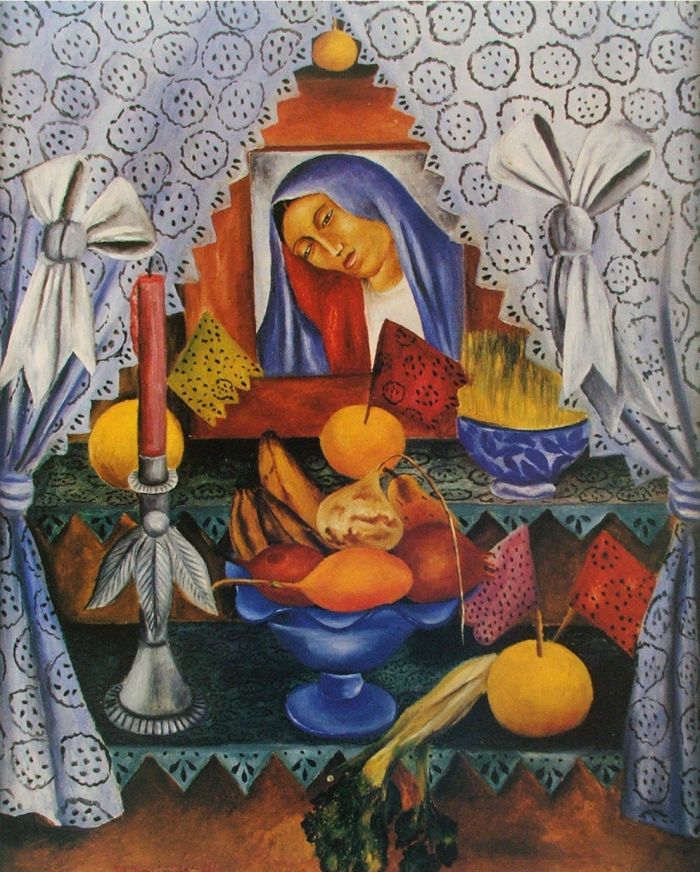
In many parts of Mexico, in a custom that dates back to 13th
century Italian Servites, altars to Our Lady of
Sorrows -- altares de dolores
-- are set up with the Virgin's image as Our Lady of Sorrows as
the focus.
The altars, which are often tiered, are decorated with such things as
often
ornate
purple (or sometimes white, black, or red) tablecloths, seven small
bottles or jars of (sometimes differently colored) water symbolizing
Mary's
tears, white candles, elements that symbolize the Passion (e.g., the
whip, nails, crown of thorns, dice, rooster symbolizing St. Peter's
betrayal, etc.), newly sprouting sage seeds to symbolize the
Resurrection to
come, tear-drop shaped glass droplets or crystals
that hang down from above to symbolize tears, apples that symbolize
Eve's sin, bitter oranges -- sometimes painted gold -- with little
golden flags piercing them to symbolize the swords piercing Our Lady's
heart, flowers (especially carnations, roses, lilies, chamomile,
and calla lilies), etc.
Businesses and public institutions also set up
altars to honor Our Lady's sorrows at this time, and people of a given
neighborhood make tours of each others' altars. Upon visiting, the
visitor asks "Did the Virgin cry?" The altar-owner responds
affirmatively, a prayer is prayed together or a few verses of the Stabat Mater are sung, and the
altar-owner offers the visitor a drink, sometimes fresh water,
sometimes salted water to symbolize Our Lady's tears, or sometimes Agua de Cuaresma that is filled
with chunks of fresh fruit. Agua de
Cuaeresma is a deep red, symbolizing the Blood of Christ.
Agua de Cuaresma
1 large beet (or a few small ones)
1/3 cup sugar
1 1/2 cups chopped cantaloupe
1 cup chopped apple
1 cup chopped strawberries
2 oranges, peeled with pith removed, chopped
2 bananas, sliced
1 1/2 cups shredded iceberg lettuce
Place beet(s) in a saucepan with enough water to cover over
medium heat. Boil for 45 minutes. Drain and let cool. Peel, chop into
large pieces, then place the pieces in a blender with a cup of water
and blend until it's smooth. Add 4 cups of water to a large pitcher.
Add sugar and stir til dissolved. Add the beet puree through a sieve.
Stir in the fruits and lettuce. Refrigerate for at least 1 hour before
serving.
See also this site's page on September's Feast of the Seven Sorrows for
more information about devotion to the Sorrows of the Virgin.
Reading
The
Martyrdom of Mary Was Never Equaled
by St. Alphonsus Liguori
The words of the prophet Jeremias explain my meaning on this point:
To what shall I compare thee? or to what shall I liken thee, O daughter
of Jerusalem? ... for great as the sea is thy destruction; who shall
heal thee? (Lam. 2:13) No, the acuteness of the sufferings of Mary are
not to be compared, even with those of all the Martyrs united. "The
Martyrdom of Mary," says Saint Bernard, "was not caused by the
executioner's sword, but proceeded from bitter sorrow of heart." In
other Martyrs torments were inflicted on the body; but Mary's sorrow
was in her heart and soul, verifying in her the prophecy of Simeon, Thy
own soul a sword shall pierce. (Luke 2:35)
Arnold of Chartres writes that "whoever had been on Mount Calvary, to
witness the great sacrifice of the Immaculate Lamb, would there have
beheld two great altars, the one in the Body of Jesus, the other in the
heart of Mary; for on that Mount, when the Son sacrificed His Body by
death, Mary sacrificed her soul by compassion." So much so, says Saint
Antoninus, that whereas other Martyrs sacrifice their own lives, the
Blessed Virgin consummated her Martyrdom by sacrificing the life of her
Son, a life which she loved far more than her own, and which caused her
to endure a torment which exceeded all other torments ever endured by
any mortal on earth.
As a general rule, the sufferings of children are also the sufferings
of their mothers who are present at and witness their torments. This
Saint Augustine declares, when speaking of the mother of the Machabees,
who witnessed the execution of her children, Martyred by order of the
cruel Antiochus: he says that "Love caused her to endure in her soul
all the torments inflicted on each of her children." Erasmus adds that
"Mothers suffer more at the sight of the sufferings of their children
than if the torments were inflicted on themselves." This, however, is
not always true; but in Mary it was verified; for she certainly
suffered more in witnessing the sufferings of her Son than she would
have done had she endured all the torments in her own person. "All the
wounds," says Saint Bonaventure, "which were scattered over the Body of
Jesus were united in the heart of Mary, to torment her in the Passion
of her Son" so that, as Saint Lawrence Justinian writes, "The heart of
Mary, by compassion for her Son, became a mirror of His torments, in
which might be seen, faithfully reflected, the spittings, the blows,
the wounds, and all that Jesus suffered." We can therefore say that
Mary, on account of the love that she bore Him, was in heart, during
the Passion of her Son, struck, scourged, crowned with thorns, and
nailed to the very Cross of her Son.
The same Saint Lawrence considers Jesus on His road to Calvary, with
the Cross on His shoulders, turning to Mary and saying to her, "Alas,
My Own dear Mother, where are you going? What a scene will you witness?
You will be agonized by My sufferings, and I by yours." But the loving
Mother would follow Him all the same, though she knew that, by being
present at His death, she would have to endure a torment greater than
any death. She saw that her Son carried the Cross to be crucified upon
it; and, adds Abbot William, she also took up the cross of her sorrows,
and followed her Son to be crucified with Him. Hence Saint Bonaventure
considers Mary standing by the Cross of her dying Son, and asks her,
saying, "O Lady, tell me where did you then stand---was it near the
Cross? No, you were on the Cross itself, crucified with your Son."
About these words of the Redeemer, foretold by the prophet Isaias, I
have trodden the wine-press alone, and of the Gentiles there is not a
man with me. (Isaias 63:3) Richard of St. Lawrence says, "It is true, O
Lord, that in the work of human redemption You did suffer alone, and
that there was not a man that sufficiently pitied You; but there was a
woman with You, and she was Your Own Mother; she suffered in her heart
all that You endured in Your Body."
To show the sufferings endured by other Martyrs they are represented
with the instruments of their torture; Saint Andrew with a cross, Saint
Paul with a sword, Saint Lawrence with a gridiron; Mary is represented
with her dead Son in her arms; for He alone was the instrument of her
Martyrdom, and compassion for Him made her the Queen of Martyrs. On
this subject of Mary's compassion in the death of Jesus Christ, Father
Pinamonti gives expression to a beautiful and remarkable opinion: he
says, that "the grief of Mary in the passion of her Son was so great,
that she alone compassionated in a degree by any means adequate to its
merits the death of a God made man for the love of man."
Blessed Amadeus also writes, that "Mary suffered much more in the
Passion of her Son than she would have done if she herself had endured
it; for she loved her Jesus much more than she loved herself," Hence
Saint Ildephonsus did not hesitate to assert, that "the sufferings of
Mary exceed those of all Martyrs united together." Saint Anselm,
addressing the Blessed Virgin, says, "The most cruel torments inflicted
on the holy Martyrs were trifling or as nothing in comparison with your
Martyrdom, O Mary." The same Saint adds, "Indeed, O Lady, in each
moment of your life your sufferings were such that you could not have
endured them, and would have expired under them, had not your Son, the
source of your life, preserved you." Saint Bernadine of Sienna even
says, that "the sufferings of Mary were such that had they been divided
among all creatures capable of suffering, they would have caused their
immediate death." Who, then, can ever doubt that the Martyrdom of Mary
was without its equal, and that it exceeded the sufferings of all the
Martyrs; since, as Saint Antoninus says, "they suffered in the
sacrifice of their own lives; but the Blessed Virgin suffered by
offering the life of her Son to God, a life which she loved far more
than her own."
The Martyrs suffered under the torments inflicted on them by tyrants;
but Our Lord, Who never abandons His servants, always comforted them in
the midst of their sufferings. The love of God, which burnt in their
hearts, rendered all these sufferings sweet and pleasing to them. Saint
Vincent suffered, when on the rack he was torn with pincers and burnt
with hot iron plates; but Saint Augustine says that "the Saint spoke
with such contempt of his torments, that it seemed as if it was one who
spoke and another who suffered." Saint Boniface suffered when the flesh
was torn from his body with iron hooks, sharp reeds were forced under
his nails and melted lead was poured into his mouth; but in the midst
of all, he could never cease to thank Jesus Christ, Who allowed him to
suffer for His love. Saint Lawrence suffered when roasting on a
gridiron; "but the love which inflamed him," says Saint Augustine, "did
not allow him to feel the fire, or even that prolonged death itself."
The greater the love of the Martyrs for Jesus Christ, the less they
felt their pains: and in the midst of them all, the remembrance of the
Passion of Christ sufficed to console them. With Mary it was precisely
the reverse; for the torments of Jesus were her Martyrdom, and love for
Jesus was her only executioner. Here we must repeat the words of
Jeremias: As the sea is all bitterness, and has not within its bosom a
single drop of water which is sweet, so also was the heart of Mary all
bitterness, and without the least consolation: Who shall heal you? Her
Son alone could heal her and heal her wounds; but how could Mary
receive comfort in her grief from her crucified Son, since the love she
bore Him was the whole cause of her Martyrdom?
"To understand, then, how great was the grief of Mary, we must
understand," says Cornelius a Lapide, "how great was the love she bore
her Son." But who can ever measure this love?
Blessed Amadeus says, that "natural love towards Him as her Son, and
supernatural love towards Him as her God, were united in the heart of
Mary."
These two loves were blended into one, and this so great a love that
William of Paris does not hesitate to assert, that Mary loved Jesus
''as much as it was possible for a pure creature to love Him." So that,
as Richard of St. Victor says, ''as no other creature loved God as Mary
loved Him, so there was never any sorrow like Mary's sorrow."
Now there stood by the Cross of Jesus His Mother. Let us stay awhile to
consider these words before concluding our discourse; but I entreat you
to renew your attention.
There stood. When Jesus was on the Cross, the disciples had already
abandoned Him; they had done so from the moment in which He was taken
in the Garden of Olives: then the disciples all leaving Him fled.
(Matt. 26:56) The disciples abandoned Him; but His loving Mother did
not abandon Him; she remained with Him until He expired.
There stood by. Mothers fly when they see their children suffer much,
and are unable to give them relief; they have not the strength to
endure the torment, and therefore fly to a distance. Mary beheld her
Son in agony on the Cross; she saw that His sufferings were slowly
depriving Him of life; she desired to relieve Him in that last
extremity, but could not; but with all this she did not fly, she did
not go to a distance, but drew nearer to the Cross on which her Son was
dying.
She stood by the Cross. The Cross was the hard bed on which Jesus
Christ had to die. Mary, who stood by its side, never turned her eyes
from Him; she beheld Him all torn by the scourges, thorns, and nails;
she saw that her poor Son, suspended by those three iron hooks, found
no repose. She, as I have already said, would have desired to give Him
some relief; she would have desired, at least, that He should have
expired in her arms; but no, even this is forbidden her. "Ah, Cross!"
she must have said, "restore me my Son; you are a gibbet for
malefactors, but my Son is innocent." But wait, O sorrowful Mother;
God's will is that the Cross should only restore you your Son when He
has expired.
Saint Bonaventure, considering the sorrow of Mary in the death of her
Son, writes, that "no grief was more bitter than hers, because no son
was as dear as her Son." Since, then, there never was a son more worthy
than Jesus, nor any mother who ever loved as Mary loved, what sorrow
can be compared with the sorrow of Mary? "Ah, there never has been in
the world a more amiable Son than Jesus," says Richard of St. Lawrence,
"nor was there ever so loving a Mother. Had there been less love
between this Mother and Son, His death would have been less cruel,
their griefs would have been diminished: but the more tender were their
loves, the deeper were their wounds." Mary saw that death approached
her Son; therefore, casting her compassionate eyes upon Him, she seemed
to say, "Ah, Son, You already depart, already You leave me; and are You
silent? Give me a last remembrance." Yes, He did so. Jesus Christ left
her a remembrance; it was this: Woman, He said, behold your son,
referring to Saint John, who stood near; and with these words He bade
her farewell. He called her woman, that by the sweet name of mother He
might not increase her grief: Woman, behold your son, he will take
charge of you when I am dead.
There stood by the Cross of Jesus His Mother. Let us, finally observe
Mary, who stood at the foot of the Cross and beheld her Son expire.
But, a God, what Son was it that died? It was a Son Who from all
eternity had chosen her for His Mother, and had preferred her in His
love to all men and Angels: it was a Son so beautiful, so holy, so
amiable; a Son Who had always obeyed her; a Son Who was her only love,
for He was her Son and her God; and Mary had to see Him die before her
eyes, of pure suffering. But behold, the hour of the death of Jesus has
already come; the afflicted Mother saw her Son then enduring the last
assaults of death; behold, again, His Body was already sinking, His
head drooped down on His breast, His mouth opened, and He expired. The
people cry out, "He is dead! He is dead!" And Mary also said, "Ah, my
Jesus, my Son, You are now dead!"
When Jesus was dead, He was taken down from the Cross. Mary received
Him with outstretched arms; she then pressed Him to her heart, and
examined that head wounded by the thorns, those hands pierced with
nails, and that body all lacerated and torn. "Ah, Son," she said, "to
what has Your love for men reduced You!" But the disciples, fearing
that with her Son clasped in her arms she would die of grief, out of
compassion approached her, and with reverential determination, removed
her Son from her arms, wrapped Him in the winding sheet, and carried
Him away to bury Him. The other holy women accompanied Him, and with
them the sorrowful Mother followed her Son to the tomb; where, having
herself deposited Him with her own hands, she bade Him a last farewell
and retired. Saint Bernard says, that ''as Mary passed along the way,
her sorrow and grief were such, that all who met her were thereby moved
to tears;" and he adds that "those who accompanied her were weeping
rather for her than for Our Lord."
My readers, let us be devout to the sorrows of Mary. Saint Albert the
Great writes, that ''as we are under great obligations to Jesus Christ
for His death, so also are we under great obligations to Mary for the
grief which she endured when she offered her Son to God by death for
our salvation." This the Angel revealed to Saint Bridget: he said that
the Blessed Virgin, to see us saved, herself offered the life of her
Son to the Eternal Father: a sacrifice which, as we have already said,
cost her greater suffering than all the torments of the Martyrs, or
even death itself. But the Divine Mother complained to Saint Bridget
that very few pitied her in her sorrows, and that the greater part of
the world lived in entire forgetfulness of them. Therefore she exhorted
the Saint, saying: "Though many forget me, don't you, my daughter,
forget me." For this purpose the Blessed Virgin herself appeared in the
year 1239 to the founder of the Order of the Servites, or Servants of
Mary, to requested them to institute a religious order in remembrance
of her sorrows; and this they did.
Jesus Himself one day spoke to Blessed Veronica of Binasco, saying,
"Daughter, tears shed over My Passion are dear to Me: but as I love My
Mother Mary with an immense love, the meditation of the sorrows which
she endured at My death is also very dear to Me." It is also well to
know, as Pelbart relates it, that it was revealed to Saint Elizabeth of
Hungary, that Our Lord had promised four special graces to those who
are devout to the sorrows of Mary: First, that those who before death
invoke the Divine Mother, in the name of her sorrows, should obtain
true repentance of all their sins: Second, that He would protect all
who have this devotion in their tribulations, and that He would protect
them especially at the hour of death: Third, that He would impress upon
their minds the remembrance of His Passion, and that they should have
their reward for it in Heaven: Fourth, that He would commit such devout
clients to the hands of Mary, with the power to dispose of them in
whatever manner she might please, and to obtain for them all the graces
she might desire.