``Where the
Bishop is, there let the multitude of believers be;
even as where Jesus is, there is the Catholic Church'' Ignatius of
Antioch, 1st c. A.D
Shrovetide
The Monday and Tuesday before Ash Wednesday are known as
"Shrovetide," from an old English word "shrive," meaning "to confess,"
a name gotten from the tradition of going to Confession
in the days before Lent started. Shrovetide is traditionally the time
for "spring cleaning," and just as we clean our houses in these days in
prepation for Lent, we also "clean our souls" through confession so we
can enter the penitential season fresh.
Shrovetide is
the last two days of "Carnival," an unofficial period that began after
the Epiphany and which takes its name from the Latin carnelevare,
referring to the "taking away of flesh" (meat) during Lent which begins
on Ash Wednesday, In other words,
"Shrovetide" is the Monday and Tuesday before Ash Wednesday. Catholics
want to eat while they can and get the
frivolity out of their systems in preparation for the somber Lenten
spirit to come.
Shrove Monday is known as Collop Monday in England. A "collop" is a
slice of meat, but came by Elizabethan times to usually refer to bacon.
In any case, the tradition is to eat bacon and fried eggs for breakfast
(to make bacon easily, cook it in the oven. Just lay it out on a baking
sheet, put the sheet into a cold oven, turn the oven on to 400F, and
start checking in 15 minutes for doneness. The cooking time will
obviously differ depending on the thickness of your bacon and how crisp
you like it, but 15 or 25 minutes would be the typical amount of time.
No splatter at all, and you can make a lot of it at once. Lining your
baking sheet with parchment makes it even easier.).
In Iceland, Shrove Monday is known as "Bun Day" (Bolludagur). Children make or are
given sticks covered in paper decorations on one end. In the morning,
they sneak into their parents' bedrooms and spank them with these
sticks while yelling for buns ("bolla,
bolla, bolla!"). They are then given round, eclair-like,
choux-paste buns filled with jam and cream in return.
The Tuesday of Shrovetide is a particularly big party day known as
"Mardi Gras" (French for "Fat Tuesday") -- or "Pancake Tuesday" because
fats, eggs, and butter in the house had to be used up before Lent
began, and making pancakes or waffles was a good way to do it. In many
places, especially in England, pancake races became popular and remain
popular today. In these races, women must run while flipping a pancake
so many times, and whoever crosses the finish line first wins. The
largest pancake race in England is in Olney, in Buckinghamshire. There,
the women must wear a dress, apron, and bonnet, and flip the pancake
three times -- while ensuring it is intact after they cross the finish
line, of course. The story told to explain the origins of this race is
that in 1445, a homemaker heard the shriving bell (the bell rung to
summon people to confession on this day) as she was busy working in her
kitchen. Not wanting to be late, she rushed about and ran off with her
skillet still in hand.
At Westminster School in London, the "Pancake Grease" is held, an event
during which the schoolmaster tosses a very large pancake over a bar
that's set to about 15 feet high. The children make a mad scramble for
it, and whoever emerges with the largest piece is the winner.
Below is a recipe for Shrove Tuesday Pancakes:
Shrove
Tuesday Pancakes
4 large eggs
1 cup milk (do not use low-fat or nonfat)
1 tablespoon butter, melted
1 tablespoon sugar
1 teaspoon vanilla, extract
1/2 teaspoon salt
1 cup all purpose flour
Additional melted butter
Powdered sugar
Fresh lemon juice
Preheat oven to 350 degrees. Blend first 6 ingredients in blender.
Gradually add flour; blend until smooth. Let stand 15 minutes.
Heat medium nonstick skillet over medium-high heat. Brush with butter.
Add 2 generous tablespoons batter, tilting pan to coat bottom. Cook
until golden on bottom, about 45 seconds. Turn pancake over. Cook until
bottom is speckled with brown, about 30 seconds. Turn out onto paper
towel. Cover with another paper towel. Repeat with remaining batter,
brushing skillet with butter as needed.
Butter ovenproof dish. Sift powdered sugar over speckled side of each
pancake, then sprinkle lightly with lemon juice; fold pancakes into
quarters. Overlap pancakes in prepared dish. Cover; bake until heated
through, about 10 minutes. Serve with more powdered sugar and lemon
juice.
For American-style fluffy pancakes, try this recipe:
American-style Fluffy Pancakes
3 cups flour
1/4 cup sugar
1 1/2 tsp salt
1 TBSP baking powder
1 1/2 tsp baking soda
2 1/4 cups milk
1/4 cup vegetable oil
1 TBSP vanilla
1/4 cup apple cider vinegar
3 eggs
Mix wet ingredients together. Mix dry ingredients together.
Combine wet and dry ingredients just
until mixed, without overmixing (not overmixing is key! Batter will be
lumpy!). Fry on a hot buttered griddle, flipping when you see bubbles
forming on top. Do not press down on the cakes while they are frying.
Serve with lots of butter and maple syrup.
And here is a recipe for "Dutch Baby" pancakes that are baked:
Dutch Babies
(serves 1 or 2)
1 cup flour
1 TBSP sugar
1 1/4 cup milk
2 eggs
pinch of salt
1 TBSP butter melted in a 9" pie pan in the oven
Powdered sugar and fresh lemons
Mix flour, sugar, milk, eggs and salt, and beat at high speed for 1 to
2 minutes. Pour into buttered pie pan and bake for 25-30 minutes, until
edges have risen and are crisp and golden brown. Sprinkle with powdered
sugar and squeeze lemon juice over the top.
An old German
tale to tell your children while making pancakes:
The Runaway
Pancake
Two women in Jetzschko were baking a pancake, and when it was almost
done they began to quarrel, because each one wanted the whole thing.
The one woman said, "I get the pancake!" The other one replied, "No, I
want all of it!"
Before they knew what was happening, the pancake suddenly grew feet,
jumped out of the pan, and ran away. He came to a fox, who said to him,
"Pancake, pancake, where are you going?" The pancake answered, "I ran
away from two old women, and I shall run away from you as well!"
Then he met a hare. It too shouted, "Pancake, pancake, where are you
going?" The pancake answered, "I ran away from two old women, Reynard
the Fox, and I shall run away from you as well.
The pancake ran on until he came to some water. A ship full of people
was floating on the water. They too cried out to him, "Pancake,
pancake, where are you going?" Again he said, "I ran away from two old
women, Reynard the Fox, Speedy the Hare, and I shall run away from you
as well."
Then he came to a large pig. It too shouted to him, "Pancake, pancake,
where are you going?" "Oh," he said, "I ran away from two old women,
Reynard the Fox, Speedy the Hare, a ship full of people, and I shall
run away from you as well."
The pig said, "Pancake, I am hard of hearing. You'll have to say it
into my ear!" So the pancake went up close, and bam! bam! the pig
snatched him and ate him up, and with that the story is ended.
In Poland, the
food of the day is "Paczki" (pronounced "punch-key") -- large, filled
fried "doughnuts" of sorts ("paczki" is plural; the singular is
"paczek," pronounced "pon-check"). So ubiquitous is this treat among
Poles that Shrove Tuesday is known as "Paczki Day" (this may be more
common among American Poles, as Poles in Poland celebrate Paczki day on
the Thursday prior to Ash Wednesday).
Paczki (3
dozen)
12 egg yolks
4 1/2 cups flour 1 tsp salt
3 TBSP rum or brandy
2 pkg. yeast
1 cup whipping cream (heavy cream), scalded
1/4 cup warm water
1 1/2 cups thick jam or preserves -- esp. cherry, prune, apricot
1/3 cups butter, at room temperature
lard (or oil, or combination of the two) for deep frying
1/2 cup sugar for sprinkling
Beat yolks and salt together a small mixer bowl at high speed until
mixture is thick (about 7 minutes). Soften yeast in warm water in large
bowl. Cream butter, add sugar gradually, creaming until fluffy, then
beat into softened yeast. Stir one-fourth of flour into yeast mixture.
Add rum and half the cream. Beat in another one-fourth flour. Stir in
remaining cream. Beat in half of remaining flour. Then beat in egg
yolks and continue to beat for 2 minutes.. Gradually beat in remaining
flour until dough blisters. Cover bowl with plastic wrap and tea towel
and set in warm place to rise. When doubled in bulk, punch down. Cover;
let dough rise again until doubled. Punch down.
Roll dough on floured surface to about 3/4-inch thickness. Cut out
3-inch rounds. Place 1 teaspoonful jam in center of half the rounds..
Brush edges of rounds with water. Top with remaining rounds and seal
edges. Place on floured surface and let rise until doubled in bulk
(about 20 minutes). Heat fat to 360 degrees F, and fry doughnuts in hot
fat until dark golden brown on both sides (about 3 minutes per side).
Drain on absorbent paper. Sprinkle with powdered sugar.
Shrove Tuesday
has also become a party day in the secular world, too, where, sadly,
decadence tends to reign -- extreme decadence in many places, such as
the French Quarter in New Orleans, Louisiana, infamous for its vulgar
Mardi Gras celebrations. Elsewhere in the "Big Easy," parades and
partying are less Dionysian and
more family-friendly, but still raucous and lots of fun. The sort of
King's Cake eaten on the Feast of the
Epiphany (recipe on that page) which begins
Carnival is often eaten during these Louisiana Mardi Gras celebrations,
all covered in purple, green, and gold sugars -- the colors of Mardi
Gras in New Orleans. Purple, gold, and green beads are thrown from
parade floats to the people who line the streets.
In Venice, Italy, Carnevale celebrations begin in earnest on Giovedi Grasso (the Thursday
before Shrove Tuesday) and end on Shrove Tuesday (Martedi Grasso). The partying in
Venice is especially famous for its beautiful, sometimes creepy masks
and elaborate costumes. While the aesthetic of the New Orleans
celebrations is outlandish fun, the style in Venice is marked by
mystery and elegance, expressed most by the great masquerade balls held
during this season.
The Carnevale di Viareggio in Tuscany, Italy is another famous
pre-Lenten celebration. It's famous for its elaborate parades of
exquisitely crafted molded papier-mâché floats that can sometimes be
almost 100 feet tall and 40 feet wide, a true spectacle. Masquerade
balls and neighborhood parties are held during this time, as is the Coppa Carnevale, the World Youth
Football Tournament.
Near Turin, Piedmont, Italy, in a town called Ivrea, the Thursday
before Ash Wednesday marks the beginning of intense Carnevale
celebrations that culminate in a great battle
that is had on the Sunday, Monday, and Tuesday before Ash Wednesday.
The
ammunition for this battle, though, consists of oranges: the town
divides itself up into nine groups which spend three days throwing the
juicy fruit at each other, often with great force (yes, it can get
literally bloody, especially when oranges hit noses). Who knows how
such things start, but legend has it that it's a comical recreation of
a fight that took place when an evil 12th century duke tried to take
liberties with the miller's just-married daughter, Violetta, by
claiming "droit du seigneur." Violetta was having none of that, so she
cut the duke's head off, triggering a widespread revolt by the
townspeople, who razed the duke's castle and destroyed his army,
finishing off his legacy for good. These historical characters come to
life before the battle, with citizens chosen to represent them during
the festivities. The Mugnaia
(Miller) and his daughter are especially feted, and the entire affair
has the spirit of "freedom from tyranny."
If you want to attend but not participate in this glorified food fight,
you'll have to wear a berretto frigio
-- a Phrygian cap, i.e., a soft conical hat with a bent tip -- to
distinguish yourself as a mere spectator.
At the end of the battle, great wooden poles (scarli) are burned, a funeral for
Carnevale is held, and the man
selected as General of the proceedings tells everyone, "Arvedse a giobia a ‘n bot! ("We
will see each other again next Thursday at 1:00"), by which he means
that everything will begin anew on next year's Thursday before Ash
Wednesday.
Everyone in Ivrea knows the "L'Inno del Carnevale" which is sung at
this time:
La Canzone del Carnevale d'Ivrea
Una volta anticamente
Egli è certo che un Barone,
Ci trattava duramente
Con la corda e col bastone;
D'in sull'alto Castellazzo,
Dove avea covile e possa,
Sghignazzando a mo’ di pazzo
Ci mangiava e polpa ed ossa.
Ma la figlia d'un mugnaro
Gli ha insegnata la creanza,
Ché rapita ad uom più caro
Volea farne la sua ganza.
Ma quell'altra prese impegno
Di trattarlo a tu per tu:
Quello è stato il nostro segno
E il castello non c'è più.
E sui ruderi ammucchiati
Dame e prodi in bella mostra
Sotto scarli inalberati
Noi veniamo a far la giostra;
Su quei greppi, tra quei muri,
Che alla belva furon tana,
Suonan pifferi e tamburi
La vittoria popolana.
Non v'è povero quartiere
Che non sfoggi un po' di gale,
Che non canti con piacere
La Canzon del Carnevale.
Con la Sposa e col Garzone
Che ad Abbà prescelto fu,
Va cantando ogni rione:
Il Castello non c'è più.
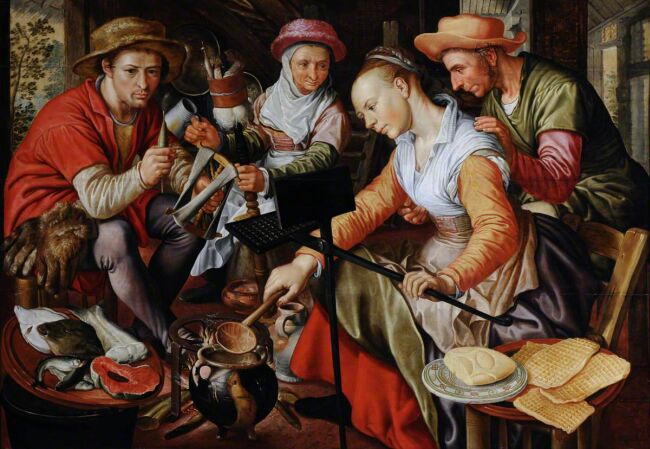
Note: the
painting at the top of the page, which is called
"The Battle of Carnival and Lent."
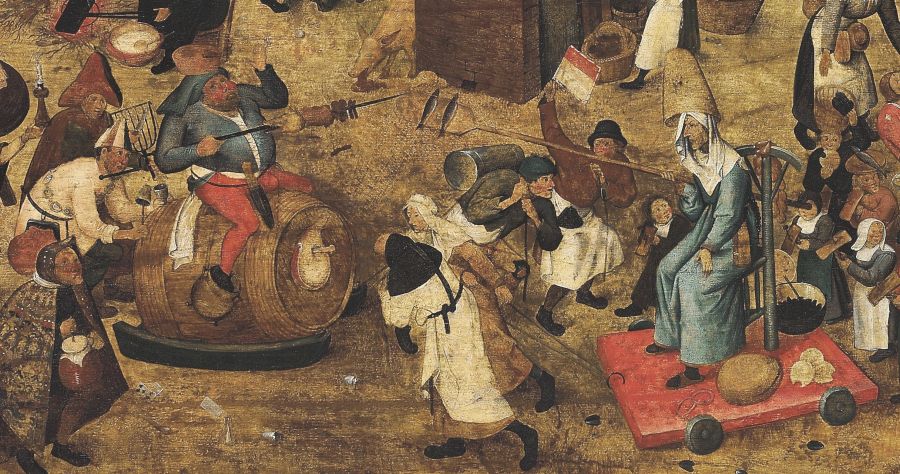
It was painted by Pieter Brueghel the Younger, A.D. 1564-1638. The
portly figure of Carnival on the left leads a procession opposing the
procession on the right, led by the gaunt figure of Lent. I provide a
close-up detail of these two figures below. Note the pretzels at Lent's
feet...