St.Valentine (Valentino) was a Roman priest who performed
marriages in
spite of Claudius II's law against such (Claudius believed that
marriage was distracting to his soldiers, so outlawed it to them for a
time). Fr. Valentine was martyred in A.D. 270 on the Flammian way, and
at the site of his martyrdom, Julius I built a popular basilica.
Other than this, little is known about our Saint. Because two other St.
Valentines
share this Feast day ("Valentine" was an extremely common name for
Christians as it has the same root as the word "valor"), often their
stories are confused, but it is the Roman priest-martyr whom we honor
during the liturgy.
St. Valentine's skull is in Rome, but other of his relics -- at least a
great majority of them --
are, interestingly enough, in the Whitefriar Church associated with the
Calced Carmelites in Dublin, Ireland. They were excavated from the
Cemetery of St. Hippolytus, on the Triburtine Way in Rome in 1835 and
were then given to Fr. Spratt, an Irish Carmelite, by Pope Gregory XVI
in 1836. The relics, "together with a
small vessel tinged with his blood," were deposited "in a wooden case
covered with painted paper, well closed, tied with a red silk ribbon
and sealed with our seals and we have so delivered and consigned to
him, and we have granted unto him power in the Lord, to the end that he
may retain to himself, give to others, transmit beyond the city (Rome)
and in any church, oratory or chapel, to expose and place the said
blessed holy body for the public veneration of the faithful without,
however, an Office and Mass, conformably to the decree of the Sacred
Congregation of Rites, promulgated on the 11th day of August 1691," as
the letter accompanying the relics reads. On this Feast Day, his relics
are carried in procession, and a special Mass is offered for young
people and lovers.

St.
Valentine's relics in Dublin
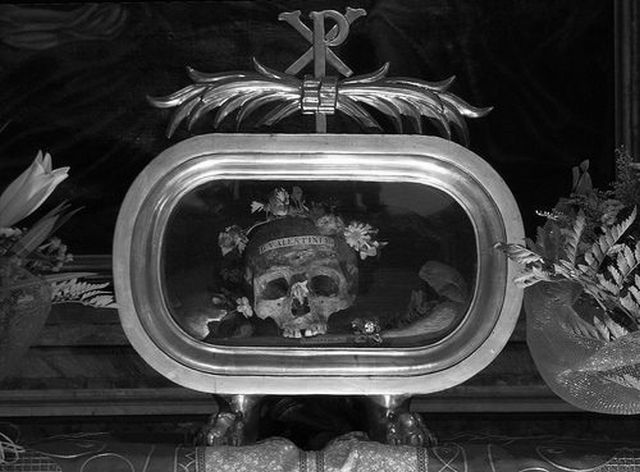
St.
Valentine's skull in Chiesa di Santa Maria in Rome
St. Valentine is
the patron Saint of lovers, epileptics, and beekeepers.
Customs
The Novena to St. Valentine can be
prayed always, but is especially prayed starting on February 5 and
ending on the eve of his feast today. As to prayers for the feast
itself, this one is nice:
Grant, we
beseech you, O almighty God, that we who keep the festival of your holy
martyr Valentine, may be delivered by his intercession from all dangers
that threaten us. Through Our Lord Jesus Christ: Who lives and reigns
with you in the unity of the Holy Spirit, one God forever and ever.
Amen.
Because of his
Nuptial Masses, he became the patron of lovers, the affianced, and
married couples, and fortuitous to the priest's association with
romance is the belief that halfway through the month of February, birds
choose their mates, hence St. Valentine's association with birds,
especially lovebirds and doves. Chaucer mentions this belief in his
"Parliament of Foules":
For this was
sent on Seynt Valentyne's day
Whan every foul cometh ther to choose his mate.
Also fortuitous
is the fact that red is both the color of Martrys and the color
associated with love. Red roses are also a symbol of both martyrom and
love, and had also always been associated with the Roman godess of
love, Venus.
Venus' son, Cupid ("Eros" in Greek), god of love, was originally
depicted as a very handsome young man, but now as a winged putto
bearing a bow and arrow with which to smite hearts with love. His
image, along with the image of hearts he has pierced with his arrows,
are ubiquitous symbols of romantic love on this day.
St. Valentine's
Day cards are a very ancient custom; one of the oldest extant
"valentines," as such St. Valentine's Day greetings -- and the persons
to whom they're sent -- came to be known, was sent in 1477 by Margery
Brews to her fiancé, John Paston, and can be seen now in the British
Museum. It reads:
Unto my right
well-beloved Valentine John Paston, squire, be this bill delivered.
Right reverent and worshipful and my right well-beloved valentine, I
recommend me unto you full heartedly, desiring to hear of your welfare,
which I beseech Almighty God long for to preserve unto his pleasure and
your hearts desire.
And if it pleases you to hear of my welfare, I am not in good health of
body nor of heart, nor shall I be till I hear from you.
For there knows no creature what pain that I endure, And even on the
pain of death I would reveal no more.
And my lady my mother hath laboured the matter to my father full
diligently, but she can no more get than you already know of, for which
God knoweth I am full sorry.
But if you love me, as I trust verily that you do, you will not leave
me therefore. For even if you had not half the livelihood that you
have, for to do the greatest labour that any woman alive might, I would
not forsake you.
And if you command me to keep me true wherever I go, indeed I will do
all my might you to love and never anyone else.
And if my friends say that I do amiss, they shall not stop me from
doing so.
My heart me bids evermore to love you truly over all earthly things.
And if they be never so angry, I trust it shall be better in time
coming.
No more to you at this time, but the Holy Trinity have you in keeping.
And I beseech you that this bill be not seen by any non earthly
creature save only yourself.
And this letter was written at Topcroft with full heavy heart.
By your own Margery Brews
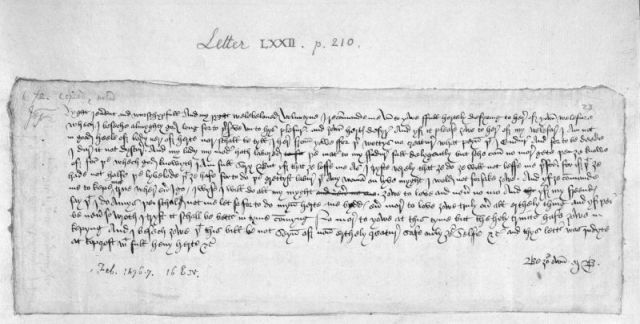 Oldest existing valentine, British Museum
To send a very Catholic valentine to someone you love, how about using
a paraphrase of today's Collect as the basis for the text?
Grant, I
beseech Thee, O almighty God, that (Name of loved one), who celebrates
the heavenly birthday of blessed Valentine, Thy Martyr, may by his
intercession be delivered from all the evils that threaten (him/her).
Through our Lord Jesus Christ, Thy Son, Who liveth and reigneth with
Thee in the unity of the Holy Ghost, one God, world without end.
...with all the
personal, mushy stuff at the bottom? For a romantic card for a spouse,
some of the poetry found in Solomon's Canticle of Canticles -- a Book
which uses marital love as a metaphor for God's love for His Church --
cannot be surpassed for inspiration.
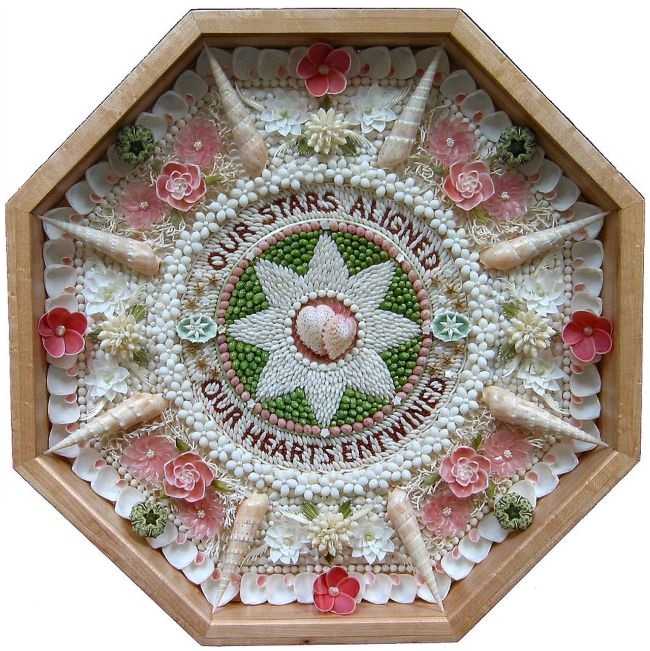
Another option -- one that will take some time -- is the making of
"Sailors Valentines." These beautiful mosaic-like pictures are made of
seashells arranged in exquisite patterns inside frames (sometimes in
hinged frames
that close like large lockets). The seashells and other bits of things
found in nature are arranged to form words, flowers, designs, nautical
themes, etc. In the late 18th and early 19th centuries, they were made
in the West Indies and sold to sailors to give to their sweethearts
back home. Even if you don't have lots of seashells, your children
might be inspired to make these mosaic-like objects using things they
find in nature, bits of glass or tile, beads, etc.
On this day, the
giving of roses is standard (consider offering Spiritual Bouquets, too), and as to
foods, oysters, chocolates (especially chocolates that come in a
heart-shaped box),1 champagne, and heart-shaped foods are
all considered to be romantic. To make a heart-shaped cake without a
special heart-shaped pan, pour half of your cake batter into an 8"
round pan, and the other half into an 8" square pan (make sure equal
amounts of batter go into each pan). After they're baked, removed from
pans, and cooled, position the square cake on the diagonal so a corner
is pointed toward you. Cut the round cake in half across its diameter,
then place half up against the top left diagonal side of the square
cake, and the other half against the top right diagonal side of the
square cake. Press it all together with buttercream, and then decorate
as usual. Note that the cake will be rather large in terms of surface
area. You might have to get a 17"X17" piece of cardboard and cover it
with foil to use as a base for it. Note, too, that you could use 9"
pans; just be sure that the pans are of equal size -- either both 8" or
both 9"
In the town of Terni, Umbria, Italy, of which St. Valentine is patron,
he is honored for almost the entire month of February. On the Sunday
before his feast comes what is called la
Festa della Promessa (the "Feast of the Promise"), a Mass to
which all the engaged couples of Italy are invited and at which they
exchange promises of marriage. The couple are given a commemorative
parchment and flowers for the brides-to-be. Before his feast day
itself, some
of St. Valentine's relics are processed
from the Basilica named for him to the town's cathedral, where the
Bishop offers Mass (terraces and balconies all along the way are lit up
with candles); after the Feast, they are processed back again. On the
third Sunday of the month is la Festa
delle Nozze d'argento -- a
special celebration for all couples celebrating their Silver
Anniversaries (25 years of marriage), and on the fourth Sunday is la Festa delle Nozze d'oro --
a celebration for all those celebrating their Golden Anniversaries (50
years of marriage). Isn't that lovely?
And a note to all: be sure to wish people "Happy Saint
Valentine's Day" rather than just "Happy Valentine's Day." This will
help keep the deeper meaning of the day in focus!
Reading
About St.
Valentine from "The Golden Legend"
by Jacobus de Voragine, Archbishop of Genoa, 1275
Here beginneth the Life of S. Valentine, and first the interpretation
of his name.
Valentine is as much to say as containing valour that is perseverant in
great holiness. Valentine is said also as a valiant knight, for he was
a right noble knight of God, and the knight is said valiant that fleeth
not, and smiteth and defendeth valiantly and overcometh much
puissantly. And so S. Valentine withdrew him not from his martyrdom in
fleeing, he smote in destroying the idols, he defended the faith, he
overcame in suffering.
Of S. Valentine the Martyr.
S. Valentine, friend of our Lord and priest of great authority, was at
Rome. It happed that Claudius the emperor made him to come tofore him
and said to him in demanding: What thing is that which I have heard of
thee, Valentine? Why wilt thou not abide in our amity, and worship the
idols and renounce the vain opinion of thy creance? S. Valentine
answered him: If thou hadst very knowledge of the grace of Jesu Christ
thou shouldest not say this that thou sayest, but shouldest reny the
idols and worship very God. Then said to S. Valentine a prince which
was of the council of the emperor: What wilt thou say of our gods and
of their holy life? And S. Valentine answered: I say none other thing
of them but that they were men mortal and mechant and full of all
ordure and evil. Then said Claudius the emperor: If Jesu Christ be God
verily, wherefore sayst thou not the truth? And S. Valentine said:
Certainly Jesu Christ is only very God, and if thou believe in him,
verily thy soul shall be saved, thy realm shall multiply, and he shall
give to thee alway victory of thine enemies. Then Claudius turned him
unto all them that were there, and said to them: Lords, Romans, hear ye
how wisely and reasonably this man speaketh? Anon the provost of the
city said: The emperor is deceived and betrayed, how may we leave that
which we have holden and been accustomed to hold sith our infancy? With
these words the emperor turned and changed his courage, and S.
Valentine was delivered in the keeping of the provost.
When S. Valentine was brought in an house in prison, then he prayed to
God, saying: Lord Jesu Christ very God, which art very light, enlumine
this house in such wise that they that dwell therein may know thee to
be very God. And the provost said: I marvel me that thou sayest that
thy God is very light, and nevertheless, if he may make my daughter to
hear and see, which long time hath been blind, I shall do all that thou
commandest me, and shall believe in thy God. S. Valentine anon put him
in prayers, and by his prayers the daughter of the provost received
again her sight, and anon all they of the the house were converted.
After, the emperor did do smite off the head of S. Valentine, the year
of our Lord two hundred and eighty. Then let us pray to S. Valentine
that he get us pardon of our sins. Amen.
Footnotes:
1 The Beverly Hillbillies call candies
that come in a heart-shaped box "courtin' candy." I think that's
hilarious.
|