``Where the
Bishop is, there let the multitude of believers be;
even as where Jesus is, there is the Catholic Church'' Ignatius of
Antioch, 1st c. A.D
Exaltation of the Holy Cross
(Roodmas)
Roodmas 1 -- more commonly known
simply as "Holy Cross Day" -- was first begun to commemorate the
Dedication of the Basilica of the Resurrection, built by St. Helena
(Constantine the Great's mother), in Jerusalem in A.D. 355 -- but the
true Cross was found shortly thereafter, also by St. Helena, so the two
events were joined.
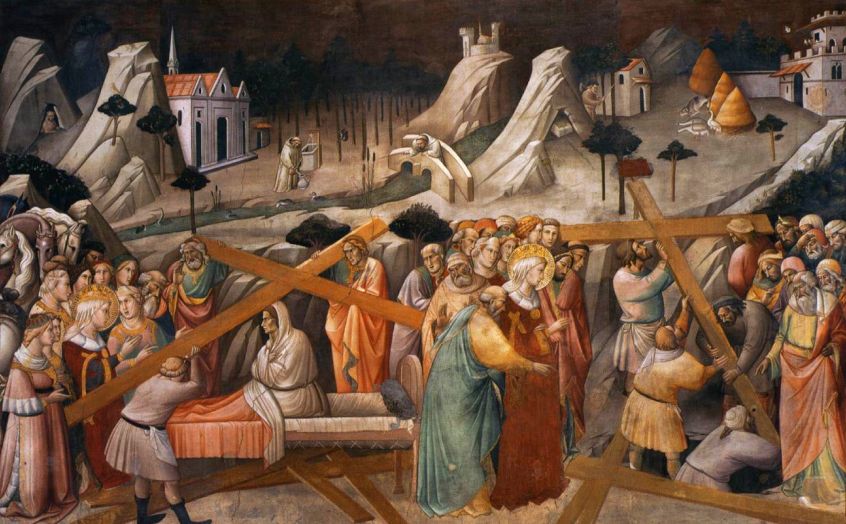
The story of the finding of the True Cross, from the Catholic
Encyclopedia:
In the year 326
the mother of Constantine, Helena, then about 80 years old, having
journeyed to Jerusalem, undertook to rid the Holy Sepulchre of the
mound of earth heaped upon and around it, and to destroy the pagan
buildings that profaned its site. Some revelations which she had
received gave her confidence that she would discover the Saviour's Tomb
and His Cross. The work was carried on diligently, with the
co-operation of St. Macarius, bishop of the city.
The Jews had hidden the Cross in a ditch or well, and covered it over
with stones, so that the faithful might not come and venerate it. Only
a chosen few among the Jews knew the exact spot where it had been
hidden, and one of them, named Judas, touched by Divine inspiration,
pointed it out to the excavators, for which act he was highly praised
by St. Helena. Judas afterwards became a Christian saint, and is
honoured under the name of Cyriacus.
During the excavation three crosses were found, but because the titulus
was detached from the Cross of Christ, there was no means of
identifying it. Following an inspiration from on high, Macarius caused
the three crosses to be carried, one after the other, to the bedside of
a worthy woman who was at the point of death. The touch of the other
two was of no avail; but on touching that upon which Christ had died
the woman got suddenly well again.
From a letter of
St. Paulinus to Severus inserted in the Breviary of Paris it would
appear that St. Helena herself had sought by means of a miracle to
discover which was the True Cross and that she caused a man already
dead and buried to be carried to the spot, whereupon, by contact with
the third cross, he came to life. From yet another tradition, related
by St. Ambrose, it would seem that the titulus, or inscription, had
remained fastened to the Cross.
After the happy discovery, St. Helena and Constantine erected a
magnificent basilica over the Holy Sepulchre, and that is the reason
why the church bore the name of St. Constantinus. The precise spot of
the finding was covered by the atrium of the basilica, and there the
Cross was set up in an oratory, as appears in the restoration executed
by de Vogüé. When this noble basilica had been destroyed by the
infidels, Arculfus, in the seventh century, enumerated four buildings
upon the Holy Places around Golgotha, and one of them was the "Church
of the Invention" or "of the Finding". This church was attributed by
him and by topographers of later times to Constantine. The Frankish
monks of Mount Olivet, writing to Leo III, style it St. Constantinus.
Perhaps the oratory built by Constantine suffered less at the hands of
the Persians than the other buildings, and so could still retain the
name and style of Martyrium Constantinianum. (See De Rossi, Bull. d'
arch. crist., 1865, 88.)
A portion of the True Cross remained at Jerusalem enclosed in a silver
reliquary; the remainder, with the nails, must have been sent to
Constantine, and it must have been this second portion that he caused
to be enclosed in the statue of himself which was set on a porphyry
column in the Forum at Constantinople; Socrates, the historian, relates
that this statue was to make the city impregnable. One of the nails was
fastened to the emperor's helmet, and one to his horse's bridle,
bringing to pass, according to many of the Fathers, what had been
written by Zacharias the Prophet: "In that day that which is upon the
bridle of the horse shall be holy to the Lord" (Zechariah 14:20).
Another of the nails was used later in the Iron Crown of Lombardy
preserved in the treasury of the cathedral of Monza.
Scientific study
of the relics of the True Cross show it to be made of some species of
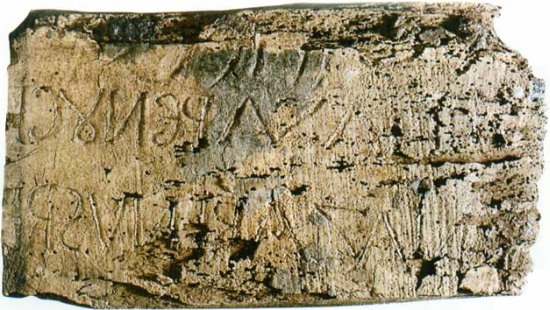
pine. The titulus crucis -- the wood on which the inscription "Jesus of
Nazareth, King of the Jews" was written in Latin, Greek, and Hebrew
(Matthew 27:37, Mark 15:26, Luke 23:38 and John 19:19) -- is made of an
olive wood. The titulus has been scientifically dated to the 1st c. and
the script is still legible (interestingly, the Latin and Greek are in
reverse script), though the Hebrew is missing due to the entire thing
being halved, the second half having been lost in the 6th century. It
is from the Latin inscription -- "Iesus Nazarenus Rex Iudeorum" that we
get the abbreviation "I.N.R.I." that is found on many Crucifixes.
The titulus crucis (or a medieval copy thereof; I'm not
certain) and relics of
the True Cross can be seen in Rome's Basilica di Santa Croce in
Gerusalemme.
Customs
It's a good day to reflect on the deep meaning of the Cross and to
consider the ways in which we fail to pick up our own crosses and carry
them with grace. The readings below may help you do this. Other things
to think about: how well or badly do you make the
Sign of the Cross? Do you have at least one Crucifix displayed prominently in your
home? Do your children or grandchildren treat the Cross with reverence?
As to music, few songs are as apt as "The Old Rugged Cross." It's not a
specifically Catholic song, but it's a good one that your children
should know. Here it is, sung beautifully by G. Michael Eldridge and
his sister.
Mr. Eldridge's music can be found at acapeldridge.com:
On a hill far
away,
Stood an old rugged Cross
The emblem of suff'ring and shame
And I love that old Cross
Where the dearest and best
For a world of lost sinners was slain
So I'll cherish the old rugged Cross
Till my trophies at last I lay down
I will cling to the old rugged Cross
And exchange it some day for a crown
Oh, that old rugged Cross
So despised by the world
Has a wondrous attraction for me
For the dear Lamb of God,
left his Glory above
To bear it to dark Calvary
In the old
rugged Cross,
Stain'd with blood so divine
A wondrous beauty I see
For the dear Lamb of God
Left his Glory above
To pardon and sanctify me
To the old rugged Cross
I will ever be true
Its shame and reproach gladly bear
Then He'll call me some day
To my home far away
Where his glory forever I'll share
For something
interesting to look into today, learn about the ancient
Anglo-Saxon Ruthwell Cross in Scotland, and the 8th century poem "Dream
of the Rood" that is said to be partially inscribed on it: Dream of the Rood.
And to learn of a great conversion that happened on this day, at
Jerusalem's Church of the Holy Sepulchre, see the Feast of St. Mary of Egypt.
Finally, if you happen to be in Aínsa, Spain at this time of year, you
might experience a great drama called "La
Morisma." This elaborate play, which traditionally takes place every
two years, on the Sunday closest to the Exaltation of the Holy Cross,
depicts the victory of Christians, led by Garcí Ximénez, over the
Muslims in A.D. 724.
Excerpt from a Sermon by John Henry Cardinal Newman
The world
seems made for the enjoyment of just such a being as man, and man is
put into it. He has the capacity of enjoyment, and the world supplies
the means. How natural this, what a simple as well as pleasant
philosophy, yet how different from that of the Cross! The doctrine of
the Cross, it may be said, disarranges two parts of a system which seem
made for each other; it severs the fruit from the eater, the enjoyment
from the enjoyer. How does this solve a problem? does it not rather
itself create one?
I answer, first, that whatever force this objection may have, surely it
is merely a repetition of that which Eve felt and Satan urged in Eden;
for did not the woman see that the forbidden tree was “good for food,”
and “a tree to be desired”? Well, then, is it wonderful that we too,
the descendants of the first pair, should still be in a world where
there is a forbidden fruit, and that our trials should lie in being
within reach of it, and our happiness in abstaining from it? The world,
at first sight, appears made for pleasure, and the vision of Christ’s
Cross is a solemn and sorrowful sight interfering with this appearance.
Be it so; but why may it not be our duty to abstain from enjoyment
notwithstanding, if it was a duty even in Eden?
But again; it is but a superficial view of things to say that this life
is made for pleasure and happiness. To those who look under the
surface, it tells a very different tale. The doctrine of the Cross does
but teach, though infinitely more forcibly, still after all it does but
teach the very same lesson which this world teaches to those who live
long in it, who have much experience in it, who know it. The world is
sweet to the lips, but bitter to the taste. It pleases at first, but
not at last. It looks gay on the outside, but evil and misery lie
concealed within. When a man has passed a certain number of years in
it, he cries out with the Preacher, “Vanity of vanities, all is
vanity.” Nay, if he has not religion for his guide, he will be forced
to go further, and say, “All is vanity and vexation of spirit;” all is
disappointment; all is sorrow; all is pain. The sore judgments of God
upon sin are concealed within it, and force a man to grieve whether he
will or no. Therefore the doctrine of the Cross of Christ does but
anticipate for us our experience of the world. It is true, it bids us
grieve for our sins in the midst of all that smiles and glitters around
us; but if we will not heed it, we shall at length be forced to grieve
for them from undergoing their fearful punishment. If we will not
acknowledge that this world has been made miserable by sin, from the
sight of Him on whom our sins were laid, we shall experience it to be
miserable by the recoil of those sins upon ourselves.
It may be granted, then, that the doctrine of the Cross is not on the
surface of the world. The surface of things is bright only, and the
Cross is sorrowful; it is a hidden doctrine; it lies under a veil; it
at first sight startles us, and we are tempted to revolt from it. Like
St. Peter, we cry out, “Be it far from Thee, Lord; this shall not be
unto Thee.” [Matt. xvi. 22.] And yet it is a true doctrine; for truth
is not on the surface of things, but in the depths.
And as the doctrine of the Cross, though it be the true interpretation
of this world, is not prominently manifested in it, upon its surface,
but is concealed; so again, when received into the faithful heart,
there it abides as a living principle, but deep, and hidden from
observation. Religious men, in the words of Scripture, “live by the
faith of the Son of God, who loved them and gave Himself for them:”
[Gal. ii. 20.] but they do not tell this to all men; they leave others
to find it out as they may. Our Lord’s own command to His disciples
was, that when they fast, they should “anoint their head and wash their
face.” [Matt. vi. 17.] Thus they are bound not to make a display, but
ever to be content to look outwardly different from what they are
really inwardly. They are to carry a cheerful countenance with them,
and to control and regulate their feelings, that those feelings, by not
being expended on the surface, may retire deep into their hearts and
there live. And thus “Jesus Christ and He crucified” is, as the Apostle
tells us, “a hidden wisdom;”—hidden in the world, which seems at first
sight to speak a far other doctrine,—and hidden in the faithful soul,
which to persons at a distance, or to chance beholders, seems to be
living but an ordinary life, while really it is in secret holding
communion with Him who was “manifested in the flesh,” “crucified
through weakness,” “justified in the Spirit, seen of angels, and
received up into glory.”
This being the case, the great and awful doctrine of the Cross of
Christ, which we now commemorate, may fitly be called, in the language
of figure, the heart of religion. The heart may be considered as the
seat of life; it is the principle of motion, heat, and activity; from
it the blood goes to and fro to the extreme parts of the body. It
sustains the man in his powers and faculties; it enables the brain to
think; and when it is touched, man dies. And in like manner the sacred
doctrine of Christ’s Atoning Sacrifice is the vital principle on which
the Christian lives, and without which Christianity is not. Without it
no other doctrine is held profitably; to believe in Christ’s divinity,
or in His manhood, or in the Holy Trinity, or in a judgment to come, or
in the resurrection of the dead, is an untrue belief, not Christian
faith, unless we receive also the doctrine of Christ’s sacrifice. On
the other hand, to receive it presupposes the reception of other high
truths of the Gospel besides; it involves the belief in Christ’s true
divinity, in His true incarnation, and in man’s sinful state by nature;
and it prepares the way to belief in the sacred Eucharistic feast, in
which He who was once crucified is ever given to our souls and bodies,
verily and indeed, in His Body and in His Blood. But again, the heart
is hidden from view; it is carefully and securely guarded; it is not
like the eye set in the forehead, commanding all, and seen of all: and
so in like manner the sacred doctrine of the Atoning Sacrifice is not
one to be talked of, but to be lived upon; not to be put forth
irreverently, but to be adored secretly; not to be used as a necessary
instrument in the conversion of the ungodly, or for the satisfaction of
reasoners of this world, but to be unfolded to the docile and obedient;
to young children, whom the world has not corrupted; to the sorrowful,
who need comfort; to the sincere and earnest, who need a rule of life;
to the innocent, who need warning; and to the established, who have
earned the knowledge of it.
One more remark I shall make, and then conclude. It must not be
supposed, because the doctrine of the Cross makes us sad, that
therefore the Gospel is a sad religion. The Psalmist says, “They that
sow in tears shall reap in joy;” and our Lord says, “They that mourn
shall be comforted.” Let no one go away with the impression that the
Gospel makes us take a gloomy view of the world and of life. It hinders
us indeed from taking a superficial view, and finding a vain transitory
joy in what we see; but it forbids our immediate enjoyment, only to
grant enjoyment in truth and fulness afterwards. It only forbids us to
begin with enjoyment. It only says, If you begin with pleasure, you
will end with pain. It bids us begin with the Cross of Christ, and in
that Cross we shall at first find sorrow, but in a while peace and
comfort will rise out of that sorrow. That Cross will lead us to
mourning, repentance, humiliation, prayer, fasting; we shall sorrow for
our sins, we shall sorrow with Christ’s sufferings; but all this sorrow
will only issue, nay, will be undergone in a happiness far greater than
the enjoyment which the world gives,—though careless worldly minds
indeed will not believe this, ridicule the notion of it, because they
never have tasted it, and consider it a mere matter of words, which
religious persons think it decent and proper to use, and try to believe
themselves, and to get others to believe, but which no one really
feels. This is what they think; but our Saviour said to His disciples,
“Ye now therefore have sorrow, but I will see you again, and your heart
shall rejoice, and your joy no man taketh from you.” … “Peace I leave
with you; My peace I give unto you; not as the world giveth, give I
unto you.” [John xvi. 22; xiv. 27.] And St. Paul says, “The natural man
receiveth not the things of the Spirit of God; for they are foolishness
unto him; neither can he know them, because they are spiritually
discerned.” “Eye hath not seen, nor ear heard, neither have entered
into the heart of man, the things which God hath prepared for them that
love Him.” [1 Cor. ii. 9, 14.] And thus the Cross of Christ, as telling
us of our redemption as well as of His sufferings, wounds us indeed,
but so wounds as to heal also.
And thus, too, all that is bright and beautiful, even on the surface of
this world, though it has no substance, and may not suitably be enjoyed
for its own sake, yet is a figure and promise of that true joy which
issues out of the Atonement. It is a promise beforehand of what is to
be: it is a shadow, raising hope because the substance is to follow,
but not to be rashly taken instead of the substance. And it is God’s
usual mode of dealing with us, in mercy to send the shadow before the
substance, that we may take comfort in what is to be, before it comes.
Thus our Lord before His Passion rode into Jerusalem in triumph, with
the multitudes crying Hosanna, and strewing His road with palm branches
and their garments. This was but a vain and hollow pageant, nor did our
Lord take pleasure in it. It was a shadow which stayed not, but flitted
away. It could not be more than a shadow, for the Passion had not been
undergone by which His true triumph was wrought out. He could not enter
into His glory before He had first suffered. He could not take pleasure
in this semblance of it, knowing that it was unreal. Yet that first
shadowy triumph was the omen and presage of the true victory to come,
when He had overcome the sharpness of death. And we commemorate this
figurative triumph on the last Sunday in Lent, to cheer us in the
sorrow of the week that follows, and to remind us of the true joy which
comes with Easter-Day.
And so, too, as regards this world, with all its enjoyments, yet
disappointments. Let us not trust it; let us not give our hearts to it;
let us not begin with it. Let us begin with faith; let us begin with
Christ; let us begin with His Cross and the humiliation to which it
leads. Let us first be drawn to Him who is lifted up, that so He may,
with Himself, freely give us all things. Let us “seek first the kingdom
of God and His righteousness,” and then all those things of this world
“will be added to us.” They alone are able truly to enjoy this world,
who begin with the world unseen. They alone enjoy it, who have first
abstained from it. They alone can truly feast, who have first fasted;
they alone are able to use the world, who have learned not to abuse it;
they alone inherit it, who take it as a shadow of the world to come,
and who for that world to come relinquish it.
Excerpt from Three Fragments from the Homily on the Cross and Passion
of Christ By Methodius
The Same
Methodius to Those Who are Ashamed of the Cross of Christ
Some think that God also, whom they measure with the measure of their
own feelings, judges the same thing that wicked and foolish men judge
to be subjects of praise and blame, and that He uses the opinions of
men as His rule and measure, not taking into account the fact that, by
reason of the ignorance that is in them, every creature falls short of
the beauty of God. For He draws all things to life by His Word, from
their universal substance and nature. For whether He would have good,
He Himself is the Very Good, and remains in Himself; or, whether the
beautiful is pleasing to Him, since He Himself is the Only Beautiful,
He beholds Himself, holding in no estimation the things which move the
admiration of men. That, verily, is to be accounted as in reality the
most beautiful and praiseworthy, which God Himself esteems to be
beautiful, even though it be contemned and despised by all else — not
that which men fancy to be beautiful. Whence it is, that although by
this figure He has willed to deliver the soul from corrupt affections,
to the signal putting to shame of the demons, we ought to receive it,
and not to speak evil of it, as being that which was given us to
deliver us, and set us free from the chains which for our disobedience
we incurred. For the Word suffered, being in the flesh affixed to the
cross, that He might bring man, who had been deceived by error, to His
supreme and godlike majesty, restoring him to that divine life from
which he had become alienated. By this figure, in truth, the passions
are blunted; the passion of the passions having taken place by the
Passion, and the death of death by the death of Christ, He not having
been subdued by death, nor overcome by the pains of the Passion. For
neither did the Passion cast Him down from His equanimity, nor did
death hurt Him, but He was in the passible remaining impassible, and in
the mortal remaining immortal, comprehending all that the air, and this
middle state, and the heaven above contained, and attempering the
mortal to the immortal divinity. Death was vanquished entirely; the
flesh being crucified to draw forth its immortality.
Excerpts from Dialogue with Trypho (a Jewish Man)
By St. Justin
Martyr
Chapter 86.
There are various figures in the Old Testament of the wood of the cross
by which Christ reigned
Justin: Hear, then, how this Man, of whom the Scriptures declare that
He will come again in glory after His crucifixion, was symbolized both
by the tree of life, which was said to have been planted in paradise,
and by those events which should happen to all the just. Moses was sent
with a rod to effect the redemption of the people; and with this in his
hands at the head of the people, he divided the sea. By this he saw the
water gushing out of the rock; and when he cast a tree into the waters
of Marah, which were bitter, he made them sweet. Jacob, by putting rods
into the water-troughs, caused the sheep of his uncle to conceive, so
that he should obtain their young. With his rod the same Jacob boasts
that he had crossed the river. He said he had seen a ladder, and the
Scripture has declared that God stood above it. But that this was not
the Father, we have proved from the Scriptures. And Jacob, having
poured oil on a stone in the same place, is testified to by the very
God who appeared to him, that he had anointed a pillar to the God who
appeared to him. And that the stone symbolically proclaimed Christ, we
have also proved by many Scriptures; and that the ointment, whether it
was of oil, or of stacte, or of any other compounded sweet balsams, had
reference to Him, we have also proved, inasmuch as the word says:
'Therefore God, even Your God, has anointed You with the oil of
gladness above Your fellows.' For indeed all kings and anointed persons
obtained from Him their share in the names of kings and anointed: just
as He Himself received from the Father the titles of King, and Christ,
and Priest, and Angel, and such like other titles which He bears or did
bear. Aaron's rod, which blossomed, declared him to be the high priest.
Isaiah prophesied that a rod would come forth from the root of Jesse,
[and this was] Christ. And David says that the righteous man is 'like
the tree that is planted by the channels of waters, which should yield
its fruit in its season, and whose leaf should not fade.' Again, the
righteous is said to flourish like the palm-tree. God appeared from a
tree to Abraham, as it is written, near the oak in Mamre. The people
found seventy willows and twelve springs after crossing the Jordan.
David affirms that God comforted him with a rod and staff. Elisha, by
casting a stick into the river Jordan, recovered the iron part of the
axe with which the sons of the prophets had gone to cut down trees to
build the house in which they wished to read and study the law and
commandments of God; even as our Christ, by being crucified on the
tree, and by purifying [us] with water, has redeemed us, though plunged
in the direst offenses which we have committed, and has made [us] a
house of prayer and adoration. Moreover, it was a rod that pointed out
Judah to be the father of Tamar's sons by a great mystery.
Chapter 89. The cross alone is offensive to Trypho on account of the
curse, yet it proves that Jesus is Christ
Trypho: Be assured that all our nation waits for Christ; and we admit
that all the Scriptures which you have quoted refer to Him. Moreover, I
do also admit that the name of Jesus, by which the the son of Nave
(Nun) was called, has inclined me very strongly to adopt this view. But
whether Christ should be so shamefully crucified, this we are in doubt
about. For whosoever is crucified is said in the law to be accursed, so
that I am exceedingly incredulous on this point. It is quite clear,
indeed, that the Scriptures announce that Christ had to suffer; but we
wish to learn if you can prove it to us whether it was by the suffering
cursed in the law.
Justin: If Christ was not to suffer, and the prophets had not foretold
that He would be led to death on account of the sins of the people, and
be dishonoured and scourged, and reckoned among the transgressors, and
as a sheep be led to the slaughter, whose generation, the prophet says,
no man can declare, then you would have good cause to wonder. But if
these are to be characteristic of Him and mark Him out to all, how is
it possible for us to do anything else than believe in Him most
confidently? And will not as many as have understood the writings of
the prophets, whenever they hear merely that He was crucified, say that
this is He and no other?
Chapter 90. The stretched-out hands of Moses signified beforehand the
cross
Trypho: Bring us on, then, by the Scriptures, that we may also be
persuaded by you; for we know that He should suffer and be led as a
sheep. But prove to us whether He must be crucified and die so
disgracefully and so dishonourably by the death cursed in the law. For
we cannot bring ourselves even to think of this.
Justin: You know that what the prophets said and did they veiled by
parables and types, as you admitted to us; so that it was not easy for
all to understand the most [of what they said], since they concealed
the truth by these means, that those who are eager to find out and
learn it might do so with much labour.
Trypho's group: We admitted this.
Justin: Listen, therefore, to what follows; for Moses first exhibited
this seeming curse of Christ's by the signs which he made.
Trypho: Of what [signs] do you speak?
Justin: When the people waged war with Amalek, and the son of Nave
(Nun) by name Jesus (Joshua), led the fight, Moses himself prayed to
God, stretching out both hands, and Hur with Aaron supported them
during the whole day, so that they might not hang down when he got
wearied. For if he gave up any part of this sign, which was an
imitation of the cross, the people were beaten, as is recorded in the
writings of Moses; but if he remained in this form, Amalek was
proportionally defeated, and he who prevailed prevailed by the cross.
For it was not because Moses so prayed that the people were stronger,
but because, while one who bore the name of Jesus (Joshua) was in the
forefront of the battle, he himself made the sign of the cross. For who
of you knows not that the prayer of one who accompanies it with
lamentation and tears, with the body prostrate, or with bended knees,
propitiates God most of all? But in such a manner neither he nor any
other one, while sitting on a stone, prayed. Nor even the stone
symbolized Christ, as I have shown.
Chapter 91. The cross was foretold in the blessings of Joseph, and in
the serpent that was lifted up
Justin: And God by Moses shows in another way the force of the mystery
of the cross, when He said in the blessing wherewith Joseph was
blessed, 'From the blessing of the Lord is his land; for the seasons of
heaven, and for the dews, and for the deep springs from beneath, and
for the seasonable fruits of the sun, and for the coming together of
the months, and for the heights of the everlasting mountains, and for
the heights of the hills, and for the ever-flowing rivers, and for the
fruits of the fatness of the earth; and let the things accepted by Him
who appeared in the bush come on the head and crown of Joseph. Let him
be glorified among his brethren; his beauty is [like] the firstling of
a bullock; his horns the horns of an unicorn: with these shall he push
the nations from one end of the earth to another.' Deuteronomy 33:13-17
Now, no one could say or prove that the horns of an unicorn represent
any other fact or figure than the type which portrays the cross. For
the one beam is placed upright, from which the highest extremity is
raised up into a horn, when the other beam is fitted on to it, and the
ends appear on both sides as horns joined on to the one horn. And the
part which is fixed in the centre, on which are suspended those who are
crucified, also stands out like a horn; and it also looks like a horn
conjoined and fixed with the other horns. And the expression, 'With
these shall he push as with horns the nations from one end of the earth
to another,' is indicative of what is now the fact among all the
nations. For some out of all the nations, through the power of this
mystery, having been so pushed, that is, pricked in their hearts, have
turned from vain idols and demons to serve God. But the same figure is
revealed for the destruction and condemnation of the unbelievers; even
as Amalek was defeated and Israel victorious when the people came out
of Egypt, by means of the type of the stretching out of Moses' hands,
and the name of Jesus (Joshua), by which the son of Nave (Nun) was
called. And it seems that the type and sign, which was erected to
counteract the serpents which bit Israel, was intended for the
salvation of those who believe that death was declared to come
thereafter on the serpent through Him that would be crucified, but
salvation to those who had been bitten by him and had betaken
themselves to Him that sent His Son into the world to be crucified. For
the Spirit of prophecy by Moses did not teach us to believe in the
serpent, since it shows us that he was cursed by God from the
beginning; and in Isaiah tells us that he shall be put to death as an
enemy by the mighty sword, which is Christ.
Chapter 97. Other predictions of the cross of Christ
Justin: For it was not without design that the prophet Moses, when Hur
and Aaron upheld his hands, remained in this form until evening. For
indeed the Lord remained upon the tree almost until evening, and they
buried Him at eventide; then on the third day He rose again. This was
declared by David thus: 'With my voice I cried to the Lord, and He
heard me out of His holy hill. I laid me down, and slept; I awoke, for
the Lord sustained me.' And Isaiah likewise mentions concerning Him the
manner in which He would die, thus: 'I have spread out My hands unto a
people disobedient, and gainsaying, that walk in a way which is not
good.' And that He would rise again, Isaiah himself said: 'His burial
has been taken away from the midst, and I will give the rich for His
death.' Isaiah 53:9 And again, in other words, David in the
twenty-first Psalm thus refers to the suffering and to the cross in a
parable of mystery: 'They pierced my hands and my feet; they counted
all my bones. They considered and gazed on me; they parted my garments
among themselves, and cast lots upon my vesture.' For when they
crucified Him, driving in the nails, they pierced His hands and feet;
and those who crucified Him parted His garments among themselves, each
casting lots for what he chose to have, and receiving according to the
decision of the lot. And this very Psalm you maintain does not refer to
Christ; for you are in all respects blind, and do not understand that
no one in your nation who has been called King or Christ has ever had
his hands or feet pierced while alive, or has died in this mysterious
fashion— to wit, by the cross — save this Jesus alone.
Footnote: 1 "Rood" is the Middle
English word for "Cross." People would once swear "by the rood," as
Shakespeare's Hamlet attests with his line to Queen Gertrude, from
Scene III Act IV: "No, by the rood, not so: You are the queen, your
husband's brother's wife; And--would it were not so!--you are my
mother."
From the old Gallican calendar there came another Feast known as
"Roodmas." May 3 was a day that celebrated the finding of the True
Cross, and this Feast made its way into the Roman calendar when the two
were combined together. It was celebrated liturgically pre-1962, and
would, then, be celebrated by priests who use pre-1962 Missals. The May
feast focused on the finding of the True Cross, while the September
feast focused on the the dedication of the Basilica and on the rescuing
of the Cross from Persians in 629. In the 1962 Missal, all of these are
combined.