``Where the
Bishop is, there let the multitude of believers be;
even as where Jesus is, there is the Catholic Church'' Ignatius of
Antioch, 1st c. A.D
Feast of
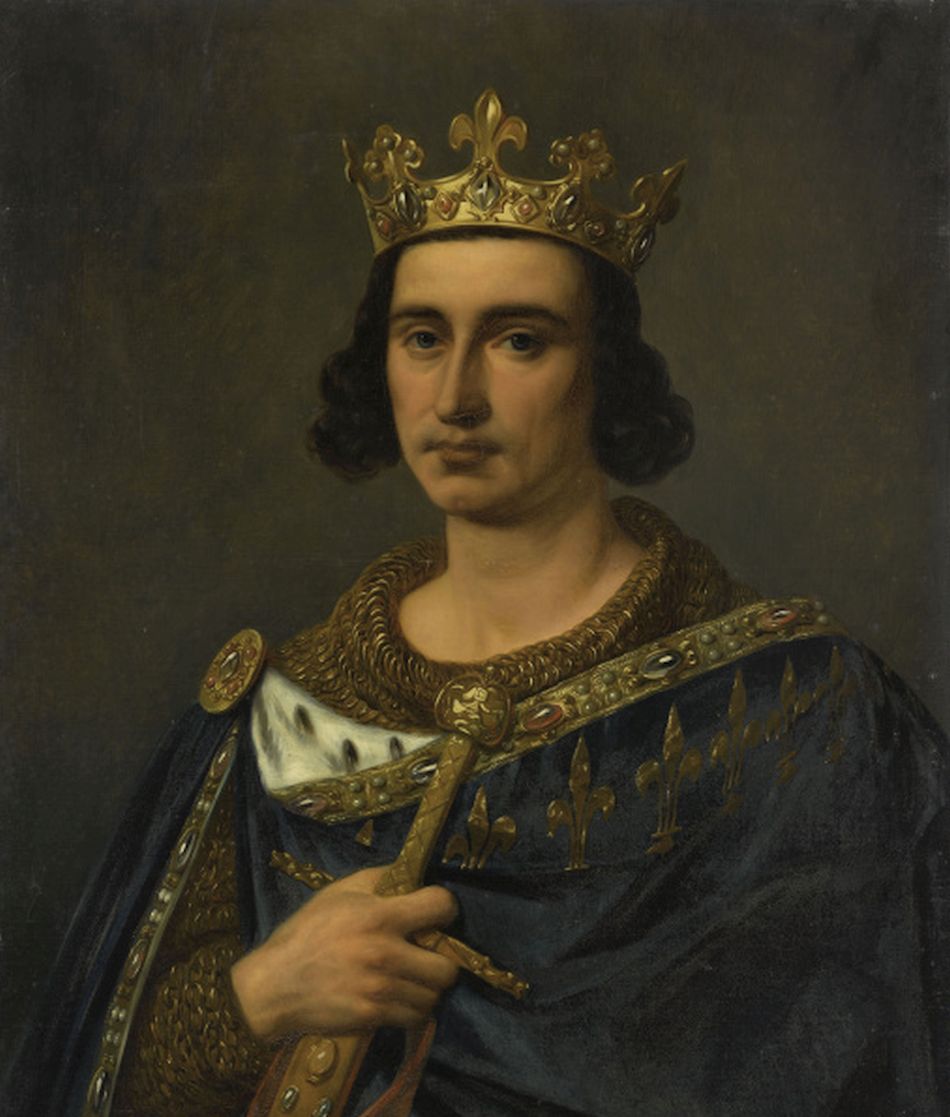
King St. Louis IX
Louis, the
quintessential Christian Prince, was born in Poissy, France on 25 April
1215 to King Louis VIII and Blanche of Castile. His father died when he
was just eleven years old, and he was crowned -- at Rheims, like almost
all French Kings -- on the First Sunday of Advent in 1226. His very
strong and pious mother acted as his regent, supressing various revolts
to secure her son's place. She acted as regent even after he reached
the age of majority, and guided his career with strong Christian
advice, forming his character in holiness. She would say to him, "Never
forget that sin is the only great evil in the world. No mother could
love her son more than I love you. But I would rather see you lying
dead at my feet than know that you had offended God by one mortal sin"
-- sentiments that he took to heart and would later pass on to his own
successor (see below).
In 1230, he outlawed all forms of usury and compelled usurers to
contribute toward the Crusades when their debtors could not be found to
be compensated (later under his reign, in 1240, would come the famous
disputation of the Talmud in Paris, after rulers and churchmen
discovered what blasphemies the Talmud taught. Copies of the Talmud
were burned in great fires in the streets of Paris).
Louis married at age nineteen, in 1234, taking to wife Marguerite of
Provence, with whom he had eleven children -- five sons and six
daughters. He went on a Crusade in 1248, and fought nobly and with
great honor, forbidding his men to kill prisoners and always expecting
them to act as Christians. But he lost the battle and, weakened by
dystentery, was captured in Mansoura, Egypt. During his captivity, he
sang the Divine Office every day with two chaplains and conducted
himself with such honor
as to impress his captors. When the Sultan was killed by his own emirs,
he was set free, but didn't immediately return to Europe; instead, he
went to the Holy Land, and remained there in order to help fortify the
Christian colonies, not returning until 1254, during which time his
mother died.
Very dedicated to the cause of peace, he not only arbitrated and made
treaties with Henry VIII and James I of Aragon, but did much to curb a
lot of the petty, feudal warfare that caused so much harm. He was a
great patron of learning, the arts, and architecture, and under his
patronage, the Sorbonne was founded; abbeys built; the choir, apse, and
nave of St. Denis Basilica -- which contains the tombs of almost all
French Kings -- were refurbished, etc. His crowning architectural
glory, though, is Ste. Chapelle, the beautiful chapel with the walls of
stained glass that sits on the tiny Ile de la Cité right in the middle
of Paris, in the Seine River (the same island where Notre Dame
Cathedral is found). This chapel was built to house a part of the Crown
of Thorns and a piece of the True Cross which he purchased from Emperor
Baldwin II in Constantinople, and it became St. Louis's personal royal
chapel. To stand in it is to seem to stand inside a luminous jewel box:
Interior
of Ste. Chapelle, Paris
Glorious and fruitful was his reign! Indeed, having dealt
with economic woes by expelling the usurers from France, King St. Louis
ruled over a time that became known as "the golden century of Saint
Louis."
He was most famous, though, for his charity, humility, and concern for
the poor, something undoubtedly inspired by his having become a
Franciscan Tertiary. He built many hospitals, among them the hospital
known as
"Quinze-vingt" ("Fifteen-Twenty") -- a hospital for the blind and whose
name comes from the fact that it could care for 300 patients. He built
homes for reformed prostitutes. Every day, he met with the poor
personally and saw to it that they were fed, inviting them to dine with
him, and washing their feet in imitation of Christ at the Last Supper.
He gave special attention to the indigent during Advent and Lent. All
who knew him admired him; no one spoke ill of him and he spoke ill of
no one else. His biographer, Joinville, wrote, "I was a good twenty-two
years in the King's company and never once did I hear him swear, either
by God, or His Mother, or His saints. I did not even hear him name the
Devil, except if he met the word when reading aloud, or when discussing
what had been read."
He was also very devoted to the cause of Justice, and eliminated the
feudal method of conflict resolution through combat, replacing it with
arbitration and judicial process. He eradicated his ancestors' "King's
Court" and established popular courts in which he, himself, would hear
his subjects' grievances.
In 1270, he went off on another Crusade, this time in an attempt to
convert the Emir of Tunis after being inspired by acting as godfather
to a Jewish convert. Again, his Crusade failed, and again he became
sick with dysentery. This time, though, he did not recover. He died, in
Tunis, at
three in the afternoon on 25 August 1270. His last words were the last
words of
Christ: "Into Thy hands I commend my spirit." He was canonized in 1297,
27 years after his death, and was succeeded by his son, Philip III (see
Louis's letter to him below). His line continued after him until the
French Revolution, when King Louis XVI was guillotined on 21 January
1793. At this act of regicide, the Abbe Edgeworth said, "Son of St.
Louis, ascend to Heaven!"
King St. Louis's remains were laid to rest, like those of almost all
French
Kings, in the Basilica of St. Denis, located in what is now a northern
suburb of Paris.
The Basilica was sacked during the infamous Revolution and its royal
tombs were emptied into a mass grave -- with some of the tombs
themselves being destroyed, including that of St. Louis (the
tomb-smashing was stopped when an archaeologist of the time urged the
revolutionaries to consider them "works of art"). In 1817, the mass
grave was opened and all of the bones were placed in a single ossuary,
with the names of the monarchs recorded.
St. Louis is the patron of builders, kings, large families, Crusaders,
and, of course, St. Louis, Missouri. He is also, along with St. Elizabeth of Hungary -- a
fellow Franciscan Tertirary -- patron of the Franciscan Third Order. He
is represented in
art by the Crown of Thorns, crown, scepter, and the fleur-de-lis (the
symbol of French monarchy, most likely a stylized depiction of the
Yellow Flag Iris -- Iris pseudocorus).
Today would be a good day to pray the Litany of Saint
Louis of France. And the day's collect makes for a more succinct
prayer for the day:
O God, Who didst
exalt blessed Louis Thy Confessor from an earthly realm to the glory of
Thy Heavenly kingdom: grant, we pray Thee, that by his merits and
intercession we may be made heirs of the King of Kings, Thy Son our
Lord Jesus Christ, Who lives and reigns for ever and ever. Amen.
Much is made of this Feast in parts of French Canada, and in
France,
especially in Aigues-Mortes, the port city from which King St. Louis
departed for the 7th and 8th Crusades, and which he'd transformed from
a backwater area into a regular town, building
roads and towers after purchasing land from the Benedictines who lived
there. Great medieval re-enactments, mystery
plays, parades, and a medieval market can be enjoyed in
Aigues-Mortes on the days surrounding this feast. In that spirit, this
medieval song
written in King St. Louis's honor is perfect for the day:
Le Roi Louis
Le Roy Louis a convoqué,
Tous ses barons et chevaliers.
Le Roy Louis a demandé,
"Qui veut me suivre où que j'irai?"
Les plus ardents se sont dressés,
Ont juré Foi, Fidélité.
Les plus prudents ont deviné,
Où le Roy voulait les mener.
Ainsi parla le Duc de Baume,
"Je combattrai pour le royaume."
Le Roy lui dit "c'est point assez:
Nous défendrons la Chrétienté."
Ainsi parla Seigneur d'Estienne:
"Je défends la terre chrétienne,
Mais je ne veux pas m'en aller
Semer la mort dessus la mer."
"Ah", dit le Roy, "notre domaine,
S'étend sur la rive africaine,
Jusqu'au désert le plus avant.
C'est notre fief, et prix du sang."
S'en est allé le Roy Louis.
Les plus fidèles l'ont suivi.
S'en sont allés bien loin, bien loin,
Pour conquérir le fief divin.
King Louis
The King Louis summoned,
All his barons and knights.
The King Louis asked,
"Who wants to follow me where I will go?"
The more ardent ones were prepared,
they swore for faith, fidelity.
The more prudent ones guessed,
Where the king wanted to lead them to.
Then spoke the Duke of Baume,
"I will fight for the kingdom."
The king told him "It's not enough:
We will defend the Christianity."
Then spoke the Lord of Estienne:
"I defend the christian lands,
But I do not want to go
To sow the dead under the sea."
"Ah", said the king, "our dominance
extends over the African river,
Until the desert farther forward.
It's our fief, and price of blood."
The King Louis came from there.
The most faithful ones followed him.
He came quite, quite afar.
To conquer the divine fief.
If you've ever wanted to really "go medieval" and
recreate a
medieval feast, today would be a good day to
do it! If you don't want to prepare an entire feast, maybe this
medieval spice bread will serve the cause (the baking soda is a modern
addition). It's best, though, if prepared the day before!:
Pain d’épices
1 1/3 cups honey
1 cup sugar
3/4 cup boiling water
1/2 tsp salt
1 tbsp baking soda
3 to 4 cups rye flour (whole wheat flour can be substituted)
2/3 cup pulverized blanched almonds
1 tsp almond extract
1 tsp anise extract
1/4 cup dark rum or bourbon whiskey
1/2 tsp cinnamon
1/2 tsp ground cloves
1/2 tsp mace
1 cup mixed glacéed fruits, diced and rinsed in boiling water
Preheat the oven to 325°F. Beat the honey, sugar, and boiling
water using the mixer in a bowl until the sugar is dissolved. Add the
salt, soda, and 3 cups of rye flour. Gradually add enough of the
remaining flour until you make a heavy, sticky, but still manipulable
mass.
Add the remaining ingredients and mix at a slow speed to
incorporate. Turn the batter into a 9" X 2" non-stick loaf pan
that you've lined with parchment, filling it up by about two-thirds.
Smooth the top with a damp finger or spatula. Bake on the middle rack
for 50 minutes to 1 1/4 hours, 'til a toothpick comes out clean. Let
sit a day, covered, to "ripen." Good paired with
savory things (e.g., foie gras, salmon, duck breast, or Roquefort) and
sweet white wine. Also good toasted for breakfast and served
with butter and jam, along with coffee, tea, or cider.
Reading
King Saint
Louis's
Last Instructions to his Eldest Son, Philip III
1. To his dear
first-born son, Philip, greeting, and his father's love.
2. Dear son, since I desire with all my heart that you be well
"instructed in all things, it is in my thought to give you some advice
this writing. For I have heard you say, several times, that you
remember my words better than those of any one else.
3. Therefore, dear son, the first thing I advise is that you fix your
whole heart upon God, and love Him with all your strength, for without
this no one can be saved or be of any worth.
4. You should, with all your strength, shun everything which you
believe to be displeasing to Him. And you ought especially to be
resolved not to commit mortal sin, no matter what may happen and should
permit all your limbs to be hewn off, and suffer every manner of
torment, rather than fall knowingly into mortal sin.
5. If our Lord send you any adversity, whether illness or other in good
patience, and thank Him for it, thing, you should receive it in good
patience and be thankful for it, for you ought to believe that He will
cause everthing to turn out for your good; and likewise you should
think that you have well merited it, and more also, should He will it,
because you have loved Him but little, and served Him but little, and
have done many things contrary to His will.
6. If our Lord send you any prosperity, either health of body or other
thing you ought to thank Him humbly for it, and you ought to be careful
that you are not the worse for it, either through pride or anything
else, for it is a very great sin to fight against our Lord with His
gifts.
7. Dear son, I advise you that you accustom yourself to frequent
confession, and that you choose always, as your confessors, men who are
upright and sufficiently learned, and who can teach you what you should
do and what you should avoid. You should so carry yourself that your
confessors and other friends may dare confidently to reprove you and
show you your faults.
8. Dear son, I advise you that you listen willingly and devoutly the
services of Holy Church, and, when you are in church, avoid to
frivolity and trifling, and do not look here and there; but pray to God
with lips and heart alike, while entertaining sweet thoughts about Him,
and especially at the mass, when the Body and Blood of our Lord Jesus
Christ are consecrated, and for a little time before.
9. Dear son, have a tender pitiful heart for the poor, and for all
those whom you believe to be in misery of heart or body, and, according
to your ability, comfort and aid them with some alms.
10. Maintain the good customs of your realm, and put down the bad ones.
Do not oppress your people and do not burden them with tolls or
tailles, except under very great necessity.
11. If you have any unrest of heart, of such a nature that it may be
told, tell it to your confessor, or to some upright man who can keep
your secret; you will be able to carry more easily the thought of your
heart.
12. See to it that those of your household are upright and loyal, and
remember the Scripture, which says: "Elige viros timentes Deum in
quibus sit justicia et qui oderint avariciam"; that is to say, "Love
those who serve God and who render strict justice and hate
covetousness"; and you will profit, and will govern your kingdom well.
13. Dear son, see to it that all your associates are upright, whether
clerics or laymen, and have frequent good converse with them; and flee
the society of the bad. And listen willingly to the word of God, both
in open and in secret; and purchase freely prayers and pardons.
14. Love all good, and hate all evil, in whomsoever it may be.
15. Let no one be so bold as to say, in your presence, words which
attract and lead to sin, and do not permit words of detraction to be
spoken of another behind his back.
!6. Suffer it not that any ill be spoken of God or His saints in your
presence, without taking prompt vengeance. But if the offender be a
clerk or so great a person that you ought not to try him, report the
matter to him who is entitled to judge it.
17. Dear son, give thanks to God often for all the good things He has
done for you, so that you may be worthy to receive more, in such a
manner that if it please the Lord that you come to the burden and honor
of governing the kingdom, you may be worthy to receive the sacred
unction wherewith the kings of France are consecrated.
18. Dear son, if you come to the throne, strive to have that which
befits a king, that is to say, that in justice and rectitude you hold
yourself steadfast and loyal toward your subjects and your vassals,
without turning either to the right or to the left, but always
straight, whatever may happen. And if a poor man have a quarrel with a
rich man, sustain the poor rather than the rich, until the truth is
made clear, and when you know the truth, do justice to them.
19. If any one have entered into a suit against you (for any injury or
wrong which he may believe that you have done to him), be always for
him and against yourself in the presence of your council, without
showing that you think much of your case (until the truth be made known
concerning it); for those of your council might be backward in speaking
against you, and this you should not wish; and command your judges that
you be not in any way upheld more than any others, for thus will your
councillors judge more boldly according to right and truth.
20. If you have anything belonging to another, either of yourself or
through your predecessors, if the matter is certain, give it up without
delay, however great it may be, either in land or money or otherwise.
If the matter is doubtful, have it inquired into by wise men, promptly
and diligently. And if the affair is so obscure that you cannot know
the truth, make such a settlement, by the counsel of s of upright men,
that your soul, and the soul your predecessors, may be wholly freed
from the affair. And even if you hear some one say that your
predecessors made restitution, make diligent inquiry to learn if
anything remains to be restored; and if you find that such is the case,
cause it to be delivered over at once, for the liberation of your soul
and the souls of your predecessors.
21. You should seek earnestly how your vassals and your subjects may
live in peace and rectitude beneath your sway; likewise, the good towns
and the good cities of your kingdom. And preserve them in the estate
and the liberty in which your predecessors kept them, redress it, and
if there be anything to amend, amend and preserve their favor and their
love. For it is by the strength and the riches of your good cities and
your good towns that the native and the foreigner, especially your
peers and your barons, are deterred from doing ill to you. I will
remember that Paris and the good towns of my kingdom aided me against
the barons, when I was newly crowned.
22. Honor and love all the people of Holy Church, and be careful that
no violence be done to them, and that their gifts and alms, which your
predecessors have bestowed upon them, be not taken away or diminished.
And I wish here to tell you what is related concerning King Philip, my
ancestor, as one of his council, who said he heard it, told it to me.
The king, one day, was with his privy council, and he was there who
told me these words. And one of the king's councillors said to him how
much wrong and loss he suffered from those of Holy Church, in that they
took away his rights and lessened the jurisdiction of his court; and
they marveled greatly how he endured it. And the good king answered: "I
am quite certain that they do me much wrong, but when I consider the
goodnesses and kindnesses which God has done me, I had rather that my
rights should go, than have a contention or awaken a quarrel with Holy
Church." And this I tell to you that you may not lightly believe
anything against the people of Holy Church; so love them and honor them
and watch over them that they may in peace do the service of our Lord.
23. Moreover, I advise you to love dearly the clergy, and, so far as
you are able, do good to them in their necessities, and likewise love
those by whom God is most honored and served, and by whom the Faith is
preached and exalted.
24. Dear son, I advise that you love and reverence your father and your
mother, willingly remember and keep their commandments, and be inclined
to believe their good counsels.
25. Love your brothers, and always wish their well-being and their good
advancement, and also be to them in the place of a father, to instruct
them in all good. But be watchful lest, for the love which you bear to
one, you turn aside from right doing, and do to the others that which
is not meet.
26. Dear son, I advise you to bestow the benefices of Holy Church which
you have to give, upon good persons, of good and clean life, and that
you bestow them with the high counsel of upright men. And I am of the
opinion that it is preferable to give them to those who hold nothing of
Holy Church, rather than to others. For, if you inquire diligently, you
will find enough of those who have nothing who will use wisely that
entrusted to them.
27. Dear son, I advise you that you try with all your strength to avoid
warring against any Christian man, unless he have done you too much
ill. And if wrong be done you, try several ways to see if you can find
how you can secure your rights, before you make war; and act thus in
order to avoid the sins which are committed in warfare.
28. And if it fall out that it is needful that you should make war
(either because some one of your vassals has failed to plead his case
in your court, or because he has done wrong to some church or to some
poor person, or to any other person whatsoever, and is unwilling to
make amends out of regard for you, or for any other reasonable cause),
whatever the reason for which it is necessary for you to make war, give
diligent command that the poor folk who have done no wrong or crime be
protected from damage to their vines, either through fire or otherwise,
for it were more fitting that you should constrain the wrongdoer by
taking his own property (either towns or castles, by force of siege),
than that you should devastate the property of poor people. And be
careful not to start the war before you have good counsel that the
cause is most reasonable, and before you have summoned the offender to
make amends, and have waited as long as you should. And if he ask
mercy, you ought to pardon him, and accept his amende, so that God may
be pleased with you.
29. Dear son, I advise you to appease wars and contentions, whether
they be yours or those of your subjects, just as quickly as may be, for
it is a thing most pleasing to our Lord. And Monsignore Martin gave us
a very great example of this. For, one time, when our Lord made it
known to him that he was about to die, he set out to make peace between
certain clerks of his archbishopric, and he was of the opinion that in
so doing he was giving a good end to life.
30. Seek diligently, most sweet son, to have good baillis and good
prevots in your land, and inquire frequently concerning their doings,
and how they conduct themselves, and if they administer justice well,
and do no wrong to any one, nor anything which they ought not do.
Inquire more often concerning those of your household if they be too
covetous or too arrogant; for it is natural that the members should
seek to imitate their chief; that is, when the master is wise and
well-behaved, all those of his household follow his example and prefer
it. For however much you ought to hate evil in others, you shoud have
more hatred for the evil which comes from those who derive their power
from you, than you bear to the evil of others; and the more ought you
to be on your guard and prevent this from happening.
3!. Dear son, I advise you always to be devoted to the Church of Rome,
and to the sovereign pontiff, our father, and to bear him the the
reverence and honor which you owe to your spiritual father.
32. Dear son, freely give power to persons of good character, who know
how to use it well, and strive to have wickednesses expelled from your
land, that is to say, nasty oaths, and everything said or done against
God or our Lady or the saints. In a wise and proper manner put a stop,
in your land, to bodily sins, dicing, taverns, and other sins. Put down
heresy so far as you can, and hold in especial abhorrence Jews, and all
sorts of people who are hostile to the Faith, so that your land may be
well purged of them, in such manner as, by the sage counsel of good
people, may appear to you advisable.
33. Further the right with all your strength. Moreover I admonish you
you that you strive most earnestly to show your gratitude for the
benefits which our Lord has bestowed upon you, and that you may know
how to give Him thanks therefore
34. Dear son, take care that the expenses of your household are
reasonable and moderate, and that its moneys are justly obtained. And
there is one opinion that I deeply wish you to entertain, that is to
say, that you keep yourself free from foolish expenses and evil
exactions, and that your money should be well expended and well
acquired. And this opinion, together with other opinions which are
suitable and profitable, I pray that our Lord may teach you.
35. Finally, most sweet son, I conjure and require you that, if it
please our Lord that I should die before you, you have my soul succored
with masses and orisons, and that you send through the congregations of
the kingdom of France, and demand their prayers for my soul, and that
you grant me a special and full part in all the good deeds which you
perform.
36. In conclusion, dear son, I give you all the blessings which a good
and tender father can give to a son, and I pray our Lord Jesus Christ,
by His mercy, by the prayers and merits of His blessed Mother, the
Virgin Mary, and of angels and archangels and of all the saints, to
guard and protect you from doing anything contrary to His will, and to
give you grace to do it always, so that He may be honored and served by
you. And this may He do to me as to you, by His great bounty, so that
after this mortal life we may be able to be together with Him in the
eternal life, and see Him, love Him, and praise Him without end. Amen.
And glory, honor, and praise be to Him who is one God with the Father
and the Holy Spirit; without beginning and without end. Amen.