Fasting and Abstinence
|
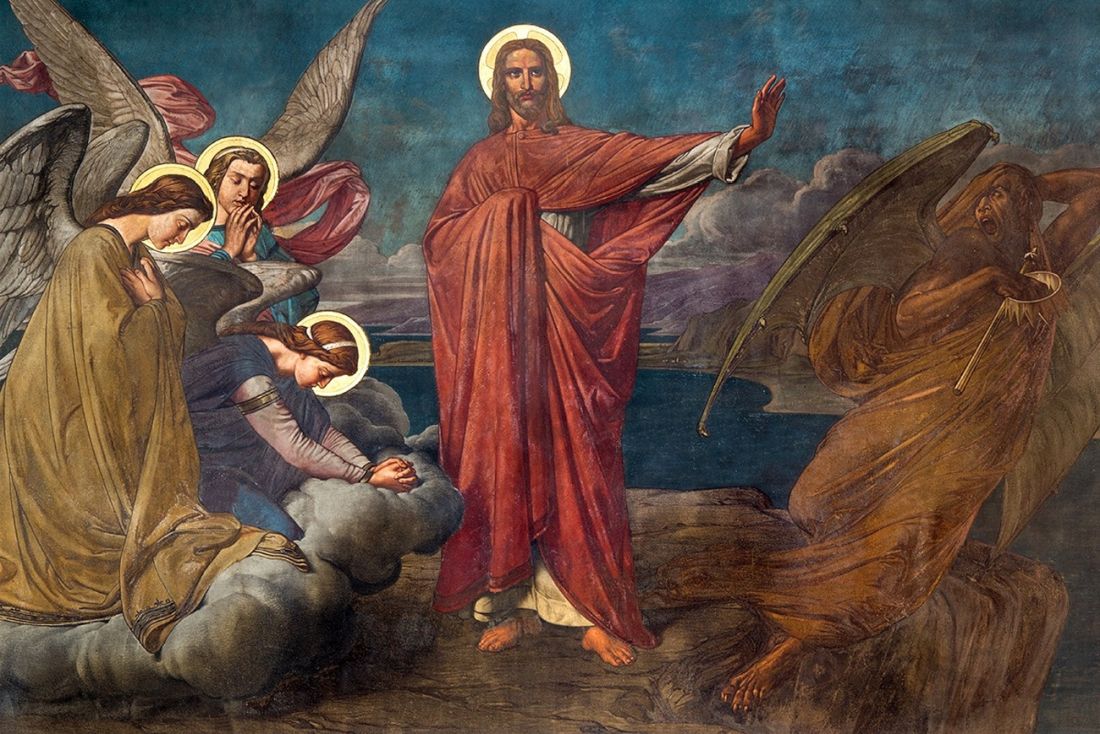
Matthew
4:1-2: Then Jesus was led by the spirit into the
desert, to be tempted by the devil. And when he had fasted forty days
and forty nights, afterwards he was hungry.
Matthew 17:17-20: And Jesus rebuked him, and the devil went out of him,
and the child was cured from that hour. Then came the disciples to
Jesus secretly, and said: Why could not we cast him out? Jesus said to
them: Because of your unbelief. For, amen I say to you, if you have
faith as a grain of mustard seed, you shall say to this mountain:
Remove from hence hither, and it shall remove: and nothing shall be
impossible to you. But this kind is not cast out but by prayer and
fasting.
In the time of Christ's Incarnation, practitioners of the Old
Testament religion fasted or abstained on Mondays and Thursdays, but
Christians opted to take Wednesdays (the day Our Lord was betrayed) and
Fridays (the day Our Lord was crucified) as their penitential days.
Wednesdays and Fridays are still days of penance in most Eastern
Catholic Churches (and among the Orthodox), but in the Roman Church,
only Fridays, as memorials to the day our Lord was crucified, remain as
weekly penitential days on which abstinence from meat and other forms
of penance are expected as the norm. 1
From the 1983 Code of Canon Law:
Can. 1249 All
Christ's faithful are obliged by divine law, each in his or her own
way, to do penance. However, so that all may be joined together in a
certain common practice of penance, days of penance are prescribed. On
these days the faithful are in a special manner to devote themselves to
prayer, to engage in works of piety and charity, and to deny
themselves, by fulfilling their obligations more faithfully and
especially by observing the fast and abstinence which the following
canons prescribe.
Can. 1250 The days and times of penance for the universal Church are
each Friday of the whole year and the season of Lent.
Can. 1251 Abstinence from meat, or from some other food as determined
by the Episcopal Conference, is to be observed on all Fridays, unless a
solemnity should fall on a Friday. Abstinence and fasting are to be
observed on Ash Wednesday and Good Friday.
Can. 1252 The law of abstinence binds those who have completed their
fourteenth year. The law of fasting binds those who have attained their
majority, until the beginning of their sixtieth year. Pastors of souls
and parents are to ensure that even those who by reason of their age
are not bound by the law of fasting and abstinence, are taught the true
meaning of penance.
Can. 1253 The Episcopal Conference can determine more particular ways
in which fasting and abstinence are to be observed. In place of
abstinence or fasting it can substitute, in whole or in part, other
forms of penance, especially works of charity and exercises of piety.
Check with your
local Bishops to see what you are bound to in your area -- but know
that Fridays are penitential, you are bound to perform some sort of
penance, and abstaining from eating meat is the traditional Friday
penance practiced by Catholics for century upon century. Most
traditional Catholics keep the Friday abstinence from meat whether
bound to by
their local Bishops or not.
Other penitential days are listed in the table below. In this table, I
give the fasting and abstinence practices for those who, out of
personal devotion, want to keep the older practices given for the
Universal Church in 1962. I also give the requirements for the
Universal Church according to the
1983 Code of Canon Law, which is what we are bound to.
Note that if any of the Fasting and/or Abstinence Days falls on a
Sunday or a first class Feast outside of Lent,
the requirements (except
for the Eucharistic Fast) are totally abrogated. Those who need to be
excused from the obligations of fasting and abstaining for medical
reasons (pregnancy, breastfeeding, the demands of extraordinarily hard
labor,
hypoglycemia, etc.) should speak with their priests for a dispensation.
True charity trumps all law, and law exists to serve true charity.
|
|
Definitions
|
|
Abstinence
In the Latin
Church, abstinence means refraining from eating the meat from mammals
or fowl, and soup or gravy made from them. Fish is allowed, hence
Fridays are known as "Fish Fridays." Traditionally, the laws of
abstinence apply to all aged 7 and over, but the new Code of Canon Law
applies it to all who have completed their 14th year.
Partial
Abstinence
Meat and soup or
gravy made from meat may be eaten once a day at the principle meal.
Fasting
Fasting is the
taking of only one full meal (which may include meat) and two smaller,
meatless meals that don't equal the large one meal. No eating between
meals is allowed, but water, milk tea, cofee, and juices are OK. Meat
is allowed at one meal (assuming abstience isn't also expected on a
given day). Traditionally, everyone over 21 years of age and under 59
years of age is bound to observe the law of fast; but the present Code
of Canon Law sets the ages of 18 and 59 as the limits.
|
|
|
Summary
|
|
Before
receiving the Eucharist (the "Eucharistic Fast")
|
1962: nothing but water and
medicines for three hours
|
| 1983: nothing
but water and medicines for 1 hour |
|
All Fridays
|
1962: Abstain.
American Catholics have a dispensation, from Pope Pius XII, to refrain
from abstinence on the Friday following Thanksgiving Thursday, and if a
solemnity falls on a Friday, there's no need to fast (for ex., the
Octave of Easter requires no fasting).
|
| 1983: To
abstain is the universal law. Check with your local Bishops to learn
what you are bound to. |
|
Advent
Embertide
|
1962: Abstain
and Fast
|
| 1983: abolished |
|
Vigil of
Christmas
|
1962:
Abstain and Fast.
|
| 1983: abolished |
|
Ash Wednesday
|
1962: Abstain
and Fast
|
| 1983: Abstain
and Fast |
|
Lenten
Embertide
|
1962: Abstain
and Fast
|
| 1983: abolished |
|
All days of
Lent but Fridays, Saturdays, Sundays and 1st Class Feasts
|
1962: Partially
Abstain and Fast
|
| 1983: abolished |
|
Fridays and
Saturdays of Lent
|
1962: Abstain
and fast |
| 1983: Abstain
on Fridays (not Saturdays), even if you don't abstain on all other
Fridays |
|
Good Friday
|
1962: Abstain
and Fast |
| 1983: Abstain
and Fast |
|
Holy Saturday
|
1962: Abstain
and Fast until the noon (after the Vigil Mass, to be more precise,
which nowadays is most often at night)
|
| 1983: abolished |
|
Vigil of the
Pentecost
|
1962: Abstain
and Fast
|
| 1983: abolished |
|
Whit Embertide
|
1962: Abstain
and Fast
|
| 1983: abolished |
|
Michaelmas
Embertide
|
1962: Abstain
and Fast |
|
1983: abolished
|
| Rogation Days |
1962: Abstain
and Fast |
| 1983: abolished |
|
To follow the
traditional path, it might be easier to follow through on these
disciplines if one just decides to fast and abstain on all the
days mentioned except for normal Fridays (which just require abstaining
from meat). Remembering simply "one regular meatless meal, two
small meatless meals that together don't equal the regular meal, and no
snacks"
is a lot easier than trying to memorize that chart. For those who fast
frequently, it might be easiest of all to have a "go-to" menu for
fasting days (e.g., a boiled egg and a piece of bread for breakfast, a
small side salad for lunch, and a small piece of roasted fish with a
roasted vegetable for dinner, no snacking).
Note that in following these disciplines designed to make one mindful
of Christ's sacrifice, to put the world into perspective, and to
discipline the body, Catholics are not Pharisees, and true
charity trumps every other law. For example, if you are asked to a
sit-down dinner at a Protestant's house on Friday, and the host,
unaware of Catholic practices, has worked hard to prepare a huge roast
beef, eat the beef and shut up unless you believe this person, upon
learning of the discipline, would, say, see your having eaten the meat
as a sign of Catholic weakness or hypocrisy and it would cause scandal
or something. In other words, weigh the situation and show
the Love of Christ.
This same charity applies to yourself: if you truly forget that
it's "Fish Friday" 2 and you find yourself
eating a big, juicy steak,
stop eating the steak and don't beat yourself up over what you've
already eaten. If the will isn't involved, there is no
culpability (though one should pay better attention next week).
Why should we fast?
We fast for many
reasons: to imitate Christ, for penance, and to conquer ourselves among
them. And we fast out of
obedience: Our Lord and His Apostles tell us to. This last reason is
described
well by Pope Clement XIII in his "Appetente Sacro," written in 1759. In
this document, he exhorts his Bishops to explain to their flocks the
reasons for fasting:
You will begin
most appropriately, and with hope of the greatest profit, to recall men
to the observance of the holy law of fasting, if you teach the people
this: penance for the Christian man is not satisfied by withdrawing
from sin, by detesting a past life badly lived, or by the sacramental
confession of these same sins. Rather, penance also demands that we
satisfy divine justice with fasting, almsgiving, prayer, and other
works of the spiritual life. Every wrongdoing -- be it large or small
-- is fittingly punished, either by the penitent or by a vengeful God.
Therefore we cannot avoid God's punishment in any other way than by
punishing ourselves. If this teaching is constantly implanted in the
minds of the faithful, and if they drink deeply of it, there will be
very little cause to fear that those who have discarded their degraded
habits and washed their sins clean through sacramental confession would
not want to expiate the same sins through fasting, to eliminate the
concupiscence of the flesh. Besides, consider the man who is convinced
that he repents of his sins more firmly when he toes not allow himself
to go unpunished. That man, already consumed with the love of penance,
will rejoice during the season of Lent and on certain other days, when
the Church declares that the faithful should fast and gives them the
opportunity to bring forth worthy fruits of penance.
The Proper attitude when fasting
St. John
Chrysostom, in this excerpt from Homily III of his "Homilies on the
Statues," summed it up well:
7. ...We have
this fast too as an ally, and as an assistant in this good
intercession. Therefore, as when the winter is over and the summer is
appearing, the sailor draws his vessel to the deep; and the soldier
burnishes his arms, and makes ready his steed for the battle; and the
husbandman sharpens his sickle; and the traveller boldly undertakes a
long journey, and the wrestler strips and bares himself for the
contest. So too, when the fast makes its appearance, like a kind of
spiritual summer, let us as soldiers burnish our weapons; and as
husbandmen let us sharpen our sickle; and as sailors let us order our
thoughts against the waves of extravagant desires; and as travellers
let us set out on the journey towards heaven; and as wrestlers let us
strip for the contest. For the believer is at once a husbandman, and a
sailor, and a soldier, a wrestler, and a traveller. Hence St. Paul
saith, "We wrestle not against flesh and blood, but against
principalities, against powers. Put on therefore the whole armour of
God." Hast thou observed the wrestler? Hast thou observed the soldier?
If thou art a wrestler, it is necessary for thee to engage in the
conflict naked. If a soldier, it behoves thee to stand in the battle
line armed at all points. How then are both these things possible, to
be naked, and yet not naked; to be clothed, and yet not clothed! How? I
will tell thee. Divest thyself of worldly business, and thou hast
become a wrestler. Put on the spiritual armour, and thou hast become a
soldier. Strip thyself of worldly cares, for the season is one of
wrestling. Clothe thyself with the spiritual armour, for we have a
heavy warfare to wage with demons.
Therefore also it is needful we
should be naked, so as to offer nothing that the devil may take hold
of, while he is wrestling with us; and to be fully armed at all points,
so as on no side to receive a deadly blow. Cultivate thy soul. Cut away
the thorns. Sow the word of godliness. Propagate and nurse with much
care the fair plants of divine wisdom, and thou hast become a
husbandman. And Paul will say to thee, "The husbandman that laboureth
must be first partaker of the fruits. He too himself practised this
art. Therefore writing to the Corinthians, he said, "I have planted,
Apollos watered, but God gave the increase." Sharpen thy sickle, which
thou hast blunted through gluttony--sharpen it by fasting. Lay hold of
the pathway which leads towards heaven; rugged and narrow as it is, lay
hold of it, and journey on. And how mayest thou be able to do these
things? By subduing thy body, and bringing it into subjection. For when
the way grows narrow, the corpulence that comes of gluttony is a great
hindrance. Keep down the waves of inordinate desires. Repel the tempest
of evil thoughts. Preserve the bark; display much skill, and thou hast
become a pilot. But we shall have the fast for a groundwork and
instructor in all these things.
8. I speak not, indeed, of such a fast as most persons keep, but of
real fasting; not merely an abstinence from meats; but from sins too.
For the nature of a fast is such, that it does not suffice to deliver
those who practice it, unless it be done according to a suitable law.
"For the wrestler," it is said, "is not crowned unless he strive
lawfully." To the end then, that when we have gone through the labour
of fasting, we forfeit not the crown of fasting, we should understand
how, and after what manner, it is necessary to conduct this business;
since that Pharisee also fasted, but afterwards when down empty, and
destitute of the fruit of fasting. The Publican fasted not; and yet he
was accepted in preference to him who had fasted; in order that thou
mayest learn that fasting is unprofitable, except all other duties
follow with it. The Ninevites fasted, and won the favour of God. The
Jews fasted too, and profited nothing, nay they departed with blame.
Since then the danger in fasting is so great to those who do not know
how they ought to fast, we should learn the laws of this exercise, in
order that we may not "run uncertainly," nor "beat the air," nor while
we are fighting contend with a shadow. Fasting is a medicine; but a
medicine, though it be never so profitable, becomes frequently useless
owing to the unskillfulness of him who employs it. For it is necessary
to know, moreover, the time when it should be applied, and the
requisite quantity of it; and the temperament of body that admits it;
and the nature of the country, and the season of the year; and the
corresponding diet; as well as varous other particulars; any of which,
if one overlooks, he will mar all the rest that have been named. Now
if, when the body needs healing, such exactness is required on our
part, much more ought we, when our care is about the soul, and we seek
to heal the distempers of the mind, to look, and to search into every
particular with the utmost accuracy.
11. I have said these things, not that we may disparage fasting, but
that we may honour fasting; for the honour of fasting consists not in
abstinence from food, but in withdrawing from sinful practices; since
he who limits his fasting only to an abstinence from meats, is one who
especially disparages it. Dost thou fast? Give me proof of it by thy
works! Is it said by what kind of works? If thou seest a poor man, take
pity on him! If thou seest an enemy, be reconciled to him! If thou
seest a friend gaining honour, envy him not! If thou seest a handsome
woman, pass her by! For let not the mouth only fast, but also the eye,
and ear, and the feet, and the hands, and all the members of our
bodies. Let the hands fast, by being pure from rapine and avarice. Let
the feet fast, but ceasing from running to the unlawful spectacles. Let
the eyes fast, being taught never to fix themselves rudely upon
handsome countenances, or to busy themselves with strange beauties. For
looking is the food of the eyes, but if this be such as is unlawful or
forbidden, it mars the fast; and upsets the whole safety of the soul;
but if it be lawful and safe, it adorns fasting. For it would be among
things the most absurd to abstain from lawful food because of the fast,
but with the eyes to touch even what is forbidden. Dost thou not eat
flesh? Feed not upon lasciviousness by means of the eyes. Let the ear
fast also. The fasting of the ear consists in refusing to receive evil
speakings and calumnies. "Thou shalt not receive a false report," it
says.
Footnote:
1 During Embertides, the traditional practice is to
revert to the older pattern of abstaining and fasting on Wednesdays in
addition to Fridays. Saturdays are added, too, during these times.
2
Fridays are often called "Fish Fridays" not because Catholics must eat
fish on those days, but because it's permissible to eat fish, and
eating fish has become a small-T tradition. It's because of the
Catholic practice of abstaining from meat that
McDonalds restaurants sell fish fillet sandwiches. From a Standpoint
magazine article, "Dechristianity by the numbers," written by Damian
Thompson:
In 1959, Lou
Groen, president of the Cincinnati Restaurant Association, opened the
first branch of McDonald’s in the area. Immediately he ran into a
problem: sales of hamburgers dropped sharply every Friday. That was
because the restaurant was in Montfort Heights, a suburb full of
Catholics. Sixty years ago, no Mass-goer would have dreamt of eating
meat on Fridays. So Groen, himself a practising Catholic, approached
Ray Kroc, the control-freak founder of the McDonald’s franchise, who
flew into a rage if unused ketchup sachets were thrown away and spent
his last years spying on his local McDonald’s with a telescope.
Groen suggested
that his branch should sell a non-meat sandwich, with fish instead of
beef in the middle. That was a brave thing to do. Old Ray had an almost
religious devotion to McDonald’s hamburgers, finding “grace in the
texture and softly curved silhouette of a bun”. He didn’t want “my
stores stunk up with the smell of fish”, but he agreed to an
experiment. On Good Friday, 1962, Groen sold his fish sandwich
alongside an alternative of Kroc’s own devising: the Hula Burger, which
substituted a slice of pineapple for the beef. The Catholics of
Montfort Heights chose fish over pineapple by an enormous margin. And
so the Filet-O-Fish was born, and survives today—unlike the Hula
Burger, which Kroc launched nationally and then had to kill off
quietly.
|
|
 Back to Being Catholic Back to Being Catholic
Index
|

