|
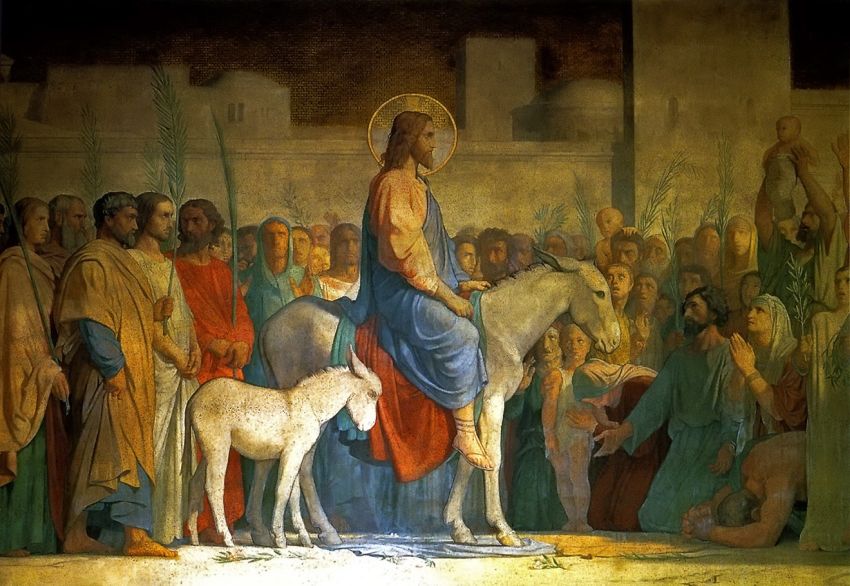
Palms are
sacramentals of the Church distributed to the faithful on Palm Sunday (the Sunday before Easter)
-- the day that commemorates Christ's entry into Jerusalem. Their
purpose is to honor Christ's glory and Kingship, as did the inhabitants
of Jerusalem who met Him, strewing palm branches on the street before
Him.
Carrying palms (or olive or willow branches, etc., if palms aren't
available) in procession goes way back into the Old Testament, where it
was not only approved but commanded by God at the very foundation of
the Old Testament religion. In the fall of the year, after the harvest,
when the people gathered for the Feast of Tabernacles God said in
Leviticus 23:40:
And you shall
take to you on the first day the fruits of the fairest tree, and
branches of palm trees, and boughs of thick trees, and willows of the
brook: And you shall rejoice before the Lord your God.
Again we read of
palms in the II Machabees 10:6-8:
And they kept
eight days with joy, after the manner of the feast of the tabernacles,
remembering that not long before they had kept the feast of the
tabernacles when they were in the mountains, and in dens like wild
beasts. Therefore they now carried boughs and green branches and palms,
for him that had given them good success in cleansing his place. And
they ordained by a common statute, and decree, that all the nation of
the Jews should keep those days every year.
And in the 7th
chapter of the Apocalypse, we see that those who were "sealed" are seen
by John carrying palms:
Apocalypse
7:9-10:
After this, I saw a great multitude, which no man could number, of all
nations and tribes and peoples and tongues, standing before the throne
and in sight of the Lamb, clothed with white robes, and palms in their
hands. And they cried with a loud voice, saying: Salvation to our God,
who sitteth upon the throne and to the Lamb.

The palms are
blessed before the High Mass on Palm Sunday. Vested in red cope and
standing at the Epistle side of the Altar, the priest recites a short
prayer, and then reads a lesson
from the book of Exodus which tells of the children of Israel coming to
Elim on their way to the Promised Land, where they found a fountain and
seventy palm trees. It was at Elim that God sent them manna.
After a few verses from the New Testament, the priest reads the story
of Christ's triumphal entry into Jerusalem the Sunday before His death,
and about how the people put palms in the Savior's path and sang
hosannas because, ironically, they expected a temporal victory by the
One they thought would be the great military leader who would conquer
the Romans..
Then we pray, begging God that we may in the end go meet Christ, that
we may enter with Him into the eternal Jerusalem. The following preface
and prayers ask God to bless the palms, that they may be sanctified and
may be a means of grace and divine protection to those who carry them
and treasure them with faith.
The palms are distributed to the people at the Communion rail. The
priest will press the palm against your lips so you can kiss it, and
then his hand. Alternatively, the palms may be handed out by the altar
boys. In any case, Scripture and prayers follow, and then a procession
of clergy, servers, and people through the church or outside around the
church.
Some of these same palm branches are saved and burned
the next year to make the ashes for the next Ash Wednesday -- the palms, which
symbolize triumph over evil, and the ashes, which sympbolize death and
penitence,
forming a great symbolic connection between suffering and victory.
The branches given to the faithful are held in the hand at the singing
or reading of the Passion and the Gospel during the Mass, but when Mass
is finished we take them home and hang them over crucifixes or holy
pictures. Men will sometimes wear a piece of it in their hats or
pin it to their lapels, and a piece should also be placed with one's sick call set.
It is custom to break off a
piece of the palm and -- while praying to St. Barbara (or St. Walburga) for her intercession, and
lighting a blessed candle (especially one blessed at Candlemas) -- burn it for
protection against storms. I offer this prayer against storms from the
Pieta prayerbook (make the Sign of the Cross
at each + sign):
Jesus Christ a
King of Glory has come in Peace.+ God became man, + and the Word was
made flesh.+ Christ was born of a Virgin.+ Christ suffered.+ Christ was
crucified.+ Christ died.+ Christ rose from the dead.+ Christ ascended
into Heaven.+ Christ conquers.+ Christ reigns.+ Christ commands.+
May Christ protect us from all storms and lightning. + Christ went
through their midst in Peace, + and the Word was made Flesh.+ Christ is
with us with Mary.+ Flee you enemy spirits because the Lion of the
Generation of Juda, the Root David, has won.+ Holy God! + Holy Powerful
God! + Holy Immortal God! + Have mercy on us. Amen.
It's customary
for some to shape the palm into Latin Crosses 1
before hanging them (for instructions, see the Palm Sunday page).
The next year, when we get new palms, the old palms are burned and
their ashes buried.
St. Peter's
Palms
As symbols of victory over evil, palms are also symbols of martrydom,
and those who've died for the cause of the Faith are often depicted in
art holding palm branches. Because of this, another custom involving
palms is the blessing of palms on April 29,
the feast of St. Peter of Verona,
also known as St. Peter Martyr, a
Dominican who, in A.D. 1252, was murdered by Cathar heretics for
defending the holy Faith. His last words were "Credo in unum Deum," the
first words of the Apostle's Creed.
At Mass on his day,
palms may be blessed by the priest with the following blessing:
V: Our help is
in the name of the Lord.
R: Who made heaven and earth.
V: The Lord be with you.
R: And with your spirit.
Let us pray. Lord Jesus Christ, Son of the living God, we beg you to
bless + these tree-branches, to pour out on them a heavenly blessing,
by the power of the holy + cross and the prayers of St. Peter Martyr;
for when you once went forth to triumph over the enemy of mankind, you
willed that little children pay honor to you, waving palms and
tree-branches before you. By the sign of the holy + cross, let these
branches be so endowed with your blessing, that wherever they are kept
the prince of darkness with all his followers may flee in fear and
trembling from such homes and places; no damage may be done there from
lightning and storm; no inclement weather consume or destroy the fruits
of the earth; no happening disturb or molest those who serve you, the
almighty God, who live and reign forever and ever.
R: Amen.
|
|
V. Adjutórium
nostrum in nómine Dómini.
R. Qui fecit caelum et terram.
V. Dóminus vobíscum.
R. Et cum spíritu tuo.
Orémus. Dómine Jesu Christe, Fili Dei vivi, bene+díc hos árborum ramos
supplicatiónibus nostris et infúnde eis, Dómine, per virtútem Sanctae
Cru+cis et per intercessiónem beáti Petri Mártyris, benedictiónem
caeléstem, qui triumphatúrus de hoste géneris humáni per manus puerórum
palmas et árborum ramos in honórem tuum adhibéri voluísti, talémque
benedictiónem signáculo Sanctae Cru+cis accípiant: ut, in quibuscúmque
locis áliquid ex eis pósitum fúerit, discédant príncipes tenebrárum et
contremíscant et fúgiant pávidi cum ómnibus minístris suis de locis vel
habitatiónibus illis. Non ibi nóceant fúlmina et tempestátes, non
fructus terrae consúmat aut depérdat ulla intempéries eleménti,
nihílque inquiétet aut moléstet serviéntes tibi omnipoténti Deo. Qui
vivis et regnas in saécula saeculórum.
R. Amen. |
These palms are then taken home, shaped into crosses, and buried at
the four corners of one's property in order to protect one's home from
natural disasters, and evil.
Footnote: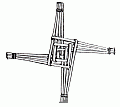
1 There's another type of Cross that
is woven by Catholics -- St. Brigid's Crosses (see picture at right).
They are made on St. Brigid's Feast Day (1 February) out of rushes or
reeds and hung on the inside of the front door of one's house,
especially in Irish Catholic homes. They are left there all year and
replaced the next St. Brigid's Day. St. Brigid's Crosses have their
origin in the fact that a dying chieftan asked St. Brigid about a Cross
she was shaping out of reeds. In explaining her gesture, she told him
the story of Christ, and he converted. For instructions on how to make
a St. Brigid's Cross, see the page on the Feast of St. Brigid.
|
|