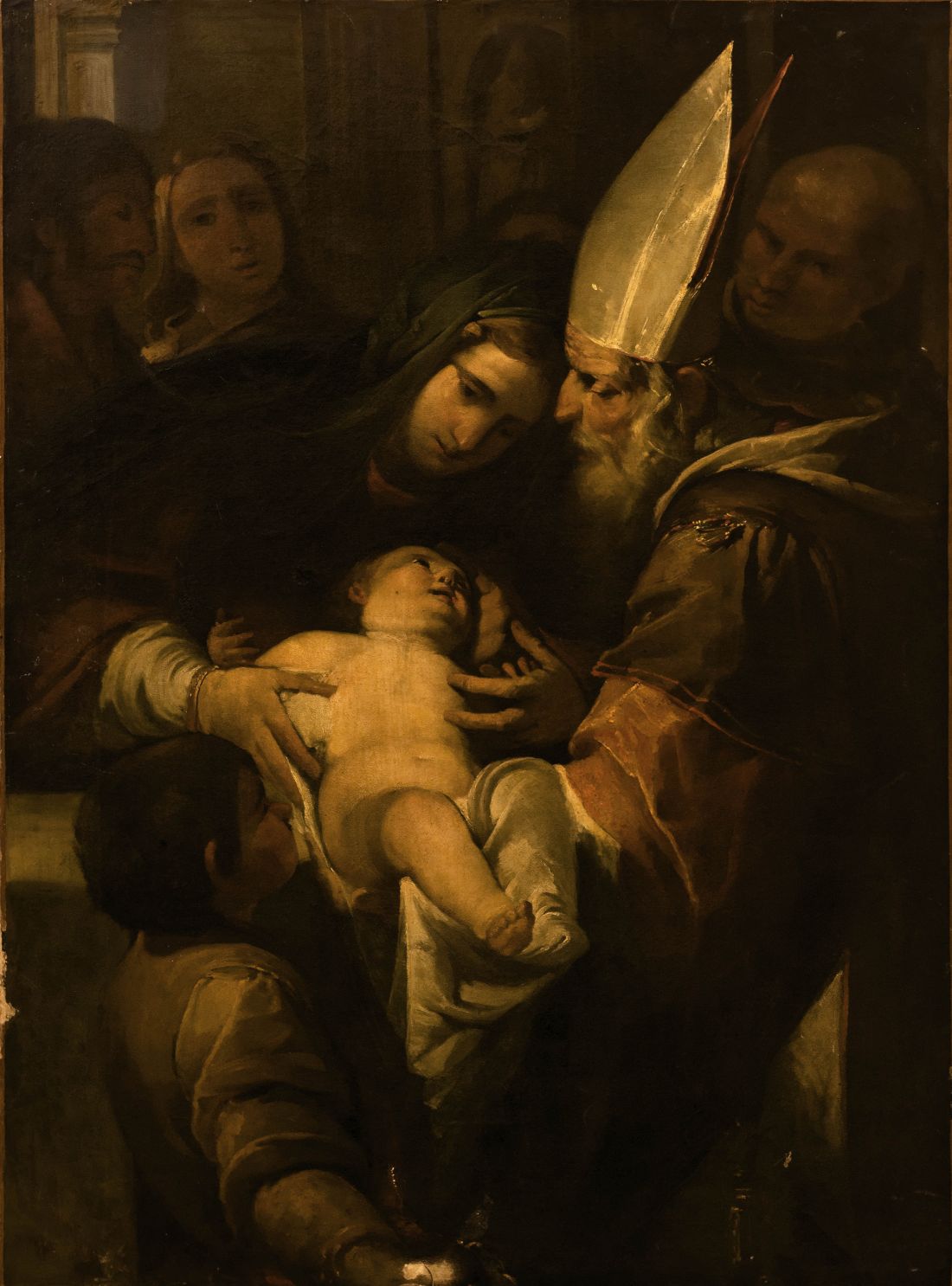
``Where the
Bishop is, there let the multitude of believers be;
even as where Jesus is, there is the Catholic Church'' Ignatius of
Antioch, 1st c. A.D
Candlemas
Today is a day of purification, renewal, hope, an honoring of
obedience, and light. On this
day, exactly 40 days after Christmas, we commemorate Mary's obedience
to the Mosaic law by submitting herself to the Temple for the ritual
purification, as commanded in Leviticus:
Leviticus 12:2-8
Speak to the children of Israel, and thou shalt say to them: If a woman
having received seed shall bear a man child, she shall be unclean seven
days, according to the days of separation of her flowers. And on the
eighth day the infant shall be circumcised: But she shall remain three
and thirty days in the blood of her purification. She shall touch no
holy thing: neither shall she enter into the sanctuary, until the days
of her purification, be fulfilled. But if she shall bear a maid child,
she shall be unclean two weeks, according to the custom of her monthly
courses, and she shall remain in the blood of her purification
sixty-six days.
And when the days of her purification are expired, for a son, or for a
daughter, she shall bring to the door of the tabernacle of the
testimony, a lamb of a year old for a holocaust, and a young pigeon or
a turtle for sin, and shall deliver them to the priest: Who shall offer
them before the Lord, and shall pray for her, and so she shall be
cleansed from the issue of her blood. This is the law for her that
beareth a man child or a maid child.
And if her hand find not sufficiency, and she is not able to offer a
lamb, she shall take two turtles, or two young pigeons, one for a
holocaust, and another for sin: and the priest shall pray for her, and
so she shall be cleansed.
Mary, of course,
didn't need this purification -- which Catholic women imitate,
in a sense, with the rite of the Churching
of Women -- but she submitted out of obedience to the Law.
Also on this day, as
the Lukan verses revealed, Our Lady and St. Joseph presented Jesus to
the Temple for His "redemption," also per the Law:
Exodus 13:2,
12-13:
Sanctify unto me every firstborn that openeth the womb among the
children of Israel, as well of men as of beasts: for they are all
mine...Thou shalt set apart all that openeth the womb for the Lord, and
all that is first brought forth of thy cattle: whatsoever thou shalt
have of the male sex, thou shalt consecrate to the Lord. The firstborn
of an ass thou shalt change for a sheep: and if thou do not redeem it,
thou shalt kill it. And every firstborn of men thou shalt redeem with a
price
Numbers 18:15-16
Whatsoever is firstborn of all flesh, which they offer to the Lord,
whether it be of men, or of beasts, shall belong to thee: only for the
firstborn of man thou shalt take a price, and every beast that is
unclean thou shalt cause to be redeemed, And the redemption of it shall
be after one month, for five sicles of silver, by the weight of the
sanctuary. A sicle hath twenty obols.
Luke 2:22-24
And after the days of her purification, according to the law of Moses,
were accomplished, they carried him to Jerusalem, to present him to the
Lord: As it is written in the law of the Lord: Every male opening the
womb shall be called holy to the Lord: And to offer a sacrifice,
according as it is written in the law of the Lord, a pair of
turtledoves, or two young pigeons:
This "redeeming
of the firstborn," known as pidyon ha-ben in Hebrew, is why
this day is also known as "Feast of the Presentation." Now, there are
two things here to carefully note:
Note that
"firstborn" means "the the male child that opens the womb," not "the
first of a series of children born." Therefore, the Protestant
objections to Mary's eternal virginity based on references to Jesus as
"firstborn" are totally without foundation.
Note also that
the Holy Family must've been poor as Our Lady offered birds rather than
the lamb, as the Leviticus verses above indicate is the way of the poor.
Also
commemorated on this "Feast of Light" ("Lichtmess" in German) or "Feast
of the Candles" ('Candelora" in Italian,
"Candelaria" in Spanish, and
"La Fête de la Chandeleur" in French) is the prophecy of Holy Simeon --
the "just and devout" man of Jerusalem who was inspired by the Holy
Ghost to know that he would live to see the "consolation of Jerusalem"
-- and the encounter with the aged widow, Anna the Prophetess, who
lived in the Temple and confessed Christ upon meeting Him. These two
are described by St. Methodius (b. 826) in symbolic terms. He wrote
that by
the old man was
represented the people of lsrael, and the law now waxing old; whilst
the widow represents the Church of the Gentiles, which had been up to
this point a widow -- the old man, indeed, as personating the law,
seeks
dismissal; but the widow, as personating the Church, brought her joyous
confession of faith and spake of Him to all that looked for redemption
in Jerusalem...
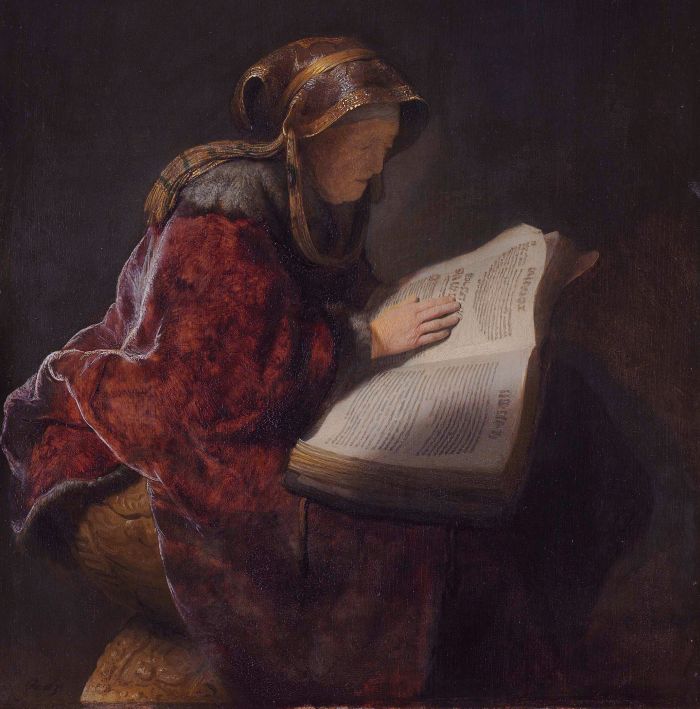
Anna the
Prophetess, by Rembrandt
It was Simeon to
whom Mary presented Jesus, and in his prophecy to her, he told Mary her
heart would be pierced with a sword, a prophecy found in the second
chapter of the Gospel according to St. Luke 2:34-35:
And Simeon
blessed them, and said to Mary his mother: Behold this child is set for
the fall, and for the resurrection of many in Israel, and for a sign
which shall be contradicted; And thy own soul a sword shall pierce,
that, out of many hearts, thoughts may be revealed.
This prophecy
and the sorrows that befell the Virgin during her time on earth are why
depictions of the Immaculate Heart almost always
show her or her heart itself being pierced by a sword. Depictions of
Our Queen as the Mother of Sorrows (Mater Dolorosa) often show her
being pierced by seven swords, one for each of her Seven Sorrows.
Now, before Simeon gave this prophecy to Our Lady, he referred to her
Infant Son as the Light to the revelation of the Gentiles, and because
of this, light and candles play an important role before and during the
Mass, hence the most common name for this Feast -- "Candlemas."
On this day, there will be a Blessing of the Candles and Procession.
The symbolism of the candles is described by Dom Prosper Guéranger,
OSB, in his "Liturgical Year":
The mystery of
today's ceremony has frequently been explained by liturgists, dating
from the 7th century. According to Ivo of Chartres, the wax, which is
formed from the juice of flowers by the bee, always considered as the
emblem of virginity, signifies the virginal flesh of the Divine Infant,
who diminished not, either by His conception or His birth, the spotless
purity of His Blessed Mother. The same holy bishop would have us see,
in the flame of our Candle, a symbol of Jesus who came to enlighten our
darkness. St. Anselm, Archbishop of Canterbury, speaking on the same
mystery, bids us consider three things in the blessed Candle: the wax,
the wick, and the flame. The wax, he says, which is the production of
the virginal bee, is the Flesh of our Lord; the wick, which is within,
is His Soul; the flame, which burns on top, is His divinity.
The Golden
Legend, by Jacobus de Voragine, A.D. 1275, gives us another level of
symbolism -- one that illustrates the error of Protestantism's idea of
"sola fide," or that we are saved by "faith alone":
...if we will
appear in this feast tofore the face of God, pure and clean and
acceptable, we ought to have in us three things which be signified by
the candle burning: that is good deeds, true faith, with good works.
And like as the candle without burning is dead, right so faith is dead
without works as Saint James saith, for to believe in God without
obeying his commandments profiteth nothing. And therefore saith Saint
Gregory: The good work ought to show withoutforth that thy intention
abide good withinforth the heart, without seeking within any vain glory
to be allowed and praised. And by the fire is understood charity, of
which God saith: I am come to put fire in the earth, and whom I will, I
will burn.
The candle
blessing -- one of the three principle blessings of the liturgical
year, the others being the blessing of palms
and ashes -- will be given by the priest
wearing a purple cope. He will pray 5 prayers over the candles placed
near the Altar. The candles are sprinkled three times while the Aspérges
me is sung, and then they are incensed and distributed. When we
take a blessed candle from the priest's hand, we kiss the candle and
then the priest's hand, just as we do on Palm Sunday when we kiss the
palm and then the priest's hand when receiving the blessed palms.
During the Distribution, the Nunc Dimittis -- the Canticle of
Simeon (Luke 2:29-32) -- is sung. Here is a setting for Simeon's
Canticle by Gustav Holst, one for eight voices, performed by a group
called "The Sixteen" (pdf of music here: Gustav Holst: Nunc Dimittis):
Now dismiss Thy
servant, O Lord,
In peace, according to Thy word:
For mine own eyes hath seen Thy salvation,
Which Thou hast prepared in the sight of all the peoples,
A light to reveal Thee to the nations
And the glory of Thy people Israel.
Nunc dimittis
servum tuum, Domine
Secundum verbum tuum in pace:
Quia viderunt oculi mei salutare tuum
Quod parasti ante faciem omnium populorum:
Lumen ad revelationem gentium,
Et gloriam plebis tuae Israel.
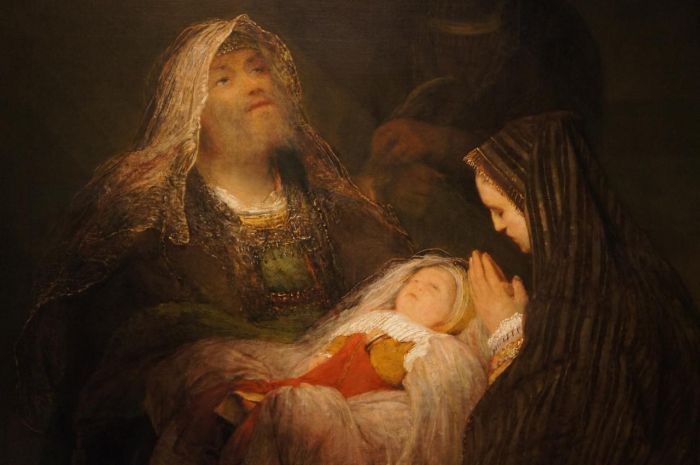
Simeon's
Song of Praise, by Aert De Gelder, c. 1700 (detail)
There follow a procession with the
lighted candles, and the singing of
anthems. Then the Mass begins, and the lighted candles are held during
the reading of the Gospel and from the beginning of the Canon of the
Mass to Communion.
It is customary to bring candles from home to be blessed -- at least
51% beeswax candles that one uses for devotional purposes (candles for
the family altar, Advent candles, etc.) -- so they can be lit after
dusk on All Saints' Day
(1 November), during the Sacrament of Unction,
and during storms and times of trouble. A bit of very old poetry
summarizes the use of blessed candles to ward off troubles:
This done, each
man his candle lights,
Where chiefest seemeth he,
Whose taper greatest may be seen;
And fortunate to be,
Whose candle burneth clear and bright:
A wondrous force and might
Both in these candles lie, which if
At any time they light,
They sure believe that neither storm
Nor tempest cloth abide,
Nor thunder in the skies be heard,
Nor any devil's spide,
Nor fearful sprites that walk by night,
Nor hurts of frost or hail.
From the Pieta
prayer book comes this prayer to pray while burning a blessed candle
(and/or pieces of blessed palm) during
those storms:
Jesus Christ a
King of Glory has come in Peace.+ God became man, + and the Word was
made flesh.+ Christ was born of a Virgin.+ Christ suffered.+ Christ was
crucified.+ Christ died.+ Christ rose from the dead.+ Christ ascended
into Heaven.+ Christ conquers.+ Christ reigns.+ Christ commands.+
May Christ protect us from all storms and lightning. + Christ went
through their midst in Peace, + and the Word was made Flesh.+ Christ is
with us with Mary.+ Flee you enemy spirits because the Lion of the
Generation of Juda, the Root David, has won.+ Holy God! + Holy Powerful
God! + Holy Immortal God! + Have mercy on us. Amen.
In Poland, the
candles brought from home to be blessed are decorated with symbols and
ribbons. There, the custom is to let a blessed candle burn all night
tonight before an icon of Our Lady who, when
the world still had forests, was relied upon to keep the wolves away
during these cold nights. Now, our "wolves" tend to be of a different
sort, but the pious burning of a blessed candle tonight, with prayers
offered to Our Lady, still might help keep them at bay. The tradition
of burning these candles during storms, too,
gives Candlemas its Polish name -- Matka
Boska Gromniczna, or "Mother
of God of the Blessed Thunder Candle."
Symbols, Customs, and
Foods
Snowdrops
(Galanthus
nivalis) are known as "Candlemas Bells" because, being the usual
earliest blooming flower of all, they often bloom before Candlemas
(some varieties bloom all winter long in some places). Legend says that
they sprang up by the hand of an angel, who then pointed them out as a
sign of hope to Eve, who was weeping in repentance and in despair over
the cold and death that entered into the world after she and her
husband sinned. Because our Hope is Christ, the Light of the World as
Simeon says in his canticle today, it is providential that the snowdrop
should bloom by this Feast! If possible, gather some Candlemas Bells to
bring inside (folk belief is that bringing them indoors before this
date is bad luck, and bringing them indoors today "purifies" one's
house.) These flowers, along with carnations, are also the "birth
flower" for those born in January.
As to foods, tamales and hot chocolate are eaten today in
Mexico, the
party being given by the one who found the trinket inside the Kings'
Cake on Twelfthnight.
Crepes are the traditional Candlemas fare in many parts of Europe.
These crepes can be filled with savory things or be used with sauces to
make them a dessert. Below is a recipe for the classic Crepes Suzette
as created by Henri Charpentier, protegé of Escoffier, for Edward,
Prince of Wales:
Crepes Suzette
Crepes
2 eggs
2 tablespoons flour
1 tablespoon cream
2 tablespoons milk
1 pinch of salt
Stir the ingredients smoothly to the consistency of olive oil, or until
it will pour back silently and smoothly from a foot or more above the
mixing bowl. Remember this is a French pancake and must be thin. Put 1
teaspoon of butter into a small round-bottomed frying pan (not
aluminum) and when it bubbles pour in enough paste to cover the bottom
of the pan. Be quick in moving the pan so as to spread the paste
thinly. Keep the pan moving; that paste is a delicate substance. After
1 minute turn the pancake over, then turn it again and again until it
is nicely browned. Fold the circle in half, then again to form a
triangle. Make eight of these, which should serve four. This first step
is a smoky one and should be done in the kitchen. The pancakes,
however, are to be cooked a second time, a procedure which occurs in
the dining room.
Note that when it comes time to turn the pancake over, there's a French
tradition of doing so while also flipping a fine coin (in the manner
you'd flip a coin to determind heads or tails) in your other hand. If
you're able to do both at the same time, then good luck follows. It
could be great fun to have any guests you might have gather in the
kitchen to try their hand at mastering the flipping of both at the same
time!
Suzette Sauce
Vanilla sugar
Juice of 2 oranges
Skin of 2 oranges
Juice of 1 lemon
Orange Blossom water
Rum
Kirsch
Maraschino
White Curacao
This sauce should be made in advance since it keeps for many months
without spoiling. It can be made in great quantities; like good wine,
it will improve with age. Vanilla sugar is one of the requisites for a
fine cuisine. Put three or four vanilla beans in a quart jar of
granulated sugar. After several days the sugar will be delicately
flavored by the vanilla in the beans.
With a knife peel 2 oranges and 1 lemon so thin that the pulp remains
on the fruit. Cut the peel julienne style and mix it with 4 tablespoons
of vanilla sugar. Squeeze the strained juice of the 2 oranges and 1
lemon into a chafing dish. Add the vanilla sugar, etc. and 1/8 pound of
butter. Let it come to a boil and then add 1 teaspoon of orange blossom
water, 2 ponies* of kirsch, 2 ponies of white curacao, 2 ponies of rum
and 1 pony of maraschino. When it comes to a boil, remove it from the
fire. This is the sauce which, if prepared in advance, will keep
indefinitely.
After the Crepes Suzette have been made and have been brought to the
dining room, the final step is ready to be taken. Put some of the above
prepared sauce into a large chafing dish (the quantity depends on your
desire) and when it begins to bubble lay the pancakes in the sauce.
Those who have no chafing dish need not worry: it's not the chafing
dish that makes the Crepes Suzette, it's the sauce. If necessary, make
it in the kitchen using a pan. Cut minute pieces of orange and lemon
peel (no pulp) and put a little on top of each pancake. Blend 1 pony*
of each of the cordials used in the making of the sauce by placing them
in a small heated casserole. Make the cordials flame and pour it over
the pancakes which are in the bubbling sauce. Serve immediately. The
perfect Crepes Suzette are not too liqueur-y. This is an equally
delicious sauce for compotes, puddings, ice cream or sweet omelets. *
[Ed. a pony is 2 TBSP, approx.]
Another food
eaten on this day in France, especially in Provence, are Navettes --
little boat-shaped hard cookies (they're like what Americans call
biscotti -- what are called cantucci in Italy -- but much
smaller) that are shaped as they are to recall the boat which brought St.
Mary Magdalene and the St.
Martha and Lazarus to France. Why they're eaten at Candlemas and
not on the Feast of St.
Mary Magdelene or her sister is a mystery to me, but they're made
or bought on Candlemas in twelves and eaten for luck, one for each
month of the year. Here is how you make them:
Navettes
18 oz. flour
9 oz. sugar
5 tbsp. butter, softened with a fork
3 eggs + 1 yolk
3 tbsp. orange flower water
3 tbsp. water
1 tsp. milk or water
A pinch of salt
In a bowl, combine the flour, sugar and salt; make a well in the centre
of the dry ingredients and add in the three whole eggs, orange flower
water and butter; mix together, adding the water gradually to form a
fairly firm dough. Let the dough rest in a cool place for one hour.
Divide the dough into small balls of about 4 tablespoonsful each, and
roll each ball roll into an oval shape and pinch the two ends to create
the points of the "boat." Using a knife, make a deep lengthwise cut
down the tops of the navettes, and spread the middle open a bit. When
they bake, the incision will open up further to form the interior of
the boat. Place them on a buttered and floured baking sheet, and
let rest again for two hours. Beat the egg yolk with the water or milk,
and brush this mixture onto each navette. Bake in a 3500 F
oven until lightly browned. Check them often since they cook quickly.
These are best dipped in coffee or tea, etc.
Serve whatever
Candlemas foods you eat today with candles burning everywhere!
The eve of this Feast is the absolutely last (and best) day for taking
down the Christmas tree, putting away the creche,
etc. In some Latin countries, the creche isn't just put away, but is
replaced with a figure of the Child Jesus sitting on a chair, acting as
a sign that it is time for the devotion to
the Divine Childhood to give way to a focus on the grown-up Savior
and the public ministry, forty days of fasting, and Passion to come.
In any case, when Candlemas is finished, all feelings of Christmas give
way to the penitential feelings of Septuagesima and then Lent. The
English poet, Robert Herrick (A.D. 1591-1674), sums it up in his poem
"Ceremony Upon Candlemas Eve" -- and reveals a folktale in the process:
Ceremony Upon
Candlemas Eve
Down with the
rosemary, and so
Down with the bays and misletoe ;
Down with the holly, ivy, all,
Wherewith ye dress'd the Christmas Hall :
That so the superstitious find
No one least branch there left behind :
For look, how many leaves there be
Neglected, there (maids, trust to me)
So many goblins you shall see.
This very
ancient carol also speaks of the departure of Christmas on this day. It
is called "I Am Christmas," and was written by James Ryman, a
Franciscan Friar, ca. 1492. Note that the reference to Hallowtide (the
days of the dead centering around All Saints Day) here
refers to the fact that it was during Hallowtide that monarchs used to
announce where they would be spending Christmas.
I Am Christmas
Here have I dwelled with more or lass
From Hallowtide till Candelmas,
And now must I from you hens pass;
Now have good day.
I take my leve of king and knight,
And erl, baron, and lady bright;
To wilderness I must me dight;
Now have good day!
And at the good lord of this hall
I take my leve, and of gestes all;
Me think I here Lent doth call;
Now have good day!
And at every worthy officere,
Marshall, panter, and butlere
I take my leve as for this yere;
Now have good day!
Another yere I trust I shall
Make mery in this hall,
If rest and peace in England fall;
Now have good day!
But oftentimes I have herd say
That he is loth to part away
That often biddeth 'Have good day!";
Now have good day!
Now fare ye well, all in fere,
Now fare ye well for all this yere;
Yet for my sake make ye good chere;
Now have good day!
Old stories relate how the weather of Candlemas portends the
length of Winter. The English have
a
saying, "If Candlemas Day be bright and clear, there'll be two winters
in the year." And the German say:
Wenn der Bär zu
Lichtmess
seinen Schatten sieht,
so kriecht er wieder auf sechs Wochen ins Loch.
When the bear
sees
his shadow at Candlemas,
he will crawl back into his hole for another six weeks.
Ist's zu
Lichtmess mild und rein
wirds ein langer Winter sein.
If Candlemas is
mild and pure,
Winter will be long for sure.
Wenn's an
Lichtmess stürmt und schneit,
ist der Frühling nicht mehr weit;
ist es aber klar und hell,
kommt der Lenz noch nicht so schnell
When it storms
and snows on Candlemas Day,
Spring is not far away;
if it's bright and clear,
Spring is not yet near.
Immigrants
brought their lore to the United States, where Candlemas is also known
as "Groundhog's Day." On this day, groundhogs' shadows -- or the
lack thereof -- predict the weather. In
Punxsutawney, Pennsylvania, a place settled in large part by German
immigrants, a
great to-do is made over the town's official groundhog, "Punxsutawney
Phil," who emerges from his den to predict the weather, said prediction
being broadcast by all the major media in the U.S.A. If Phil sees his
shadow, more Winter is on the way; if he doesn't, then Spring is coming
soon. Legend holds that the Punxatawney Phil we see today is the same
groundhog who's been making Candlemas predictions ever since 1886. The
1993 movie
"Groundhog Day," starring Bill Murray and Andie MacDowell, centers
around an endless Groundhog's Day in Punxsutawney, a town located at
the intersection of Rt.36 and Rt.119 on the western side of
Pennsylvania. And on this day, your children might enjoy the old
tongue-twister about
groundhogs, also known as "woodchucks":
How much wood
would a woodchuck chuck
if a woodchuck could chuck wood?
A woodchuck would chuck all the wood he could
if a woodchuck could chuck wood!
Finally, for
some music for the day, enjoy Bach's Erfreute
Zeit
im neuen Bunde (BWV 83), written for this Feast:
Excerpt from
"Homily on Our Lord"
By St. Ephraem (d. A.D. 373)
48. Now Simeon
the priest, when he took Him up in his arms to present Him before God,
understood as he saw Him that He was not presenting Him, but was being
himself presented. For the Son was not presented by the servant to His
Father, but the servant was presented by the Son to his Lord. For it is
not possible that He, by Whom every offering is presented, should be
presented by another. For the offering does not present him that offers
it; but by them that offer are offerings presented. So then He Who
receives offerings gave Himself to be offered by another, that those
who presented Him, while offering Him, might themselves be presented by
Him. For as He gave His body to be eaten, that when eaten It might
quicken to life them that ate Him; so He gave Himself to be offered,
that by His Cross the hands of them that offered Him might be
sanctified.
So, then, though the arms of Simeon seemed to be presenting the Son,
yet the words of Simeon testified that he was presented by the Son.
Therefore we can have no dispute concerning this, because that which
was said put an end to dispute; 'Now lettest Thou Thy servant depart in
peace. He then who is let depart to go in peace to God, is presented as
an offering to God. And in order to make known by whom he was
presented, he said, For lo! mine eyes have seen Thy mercy.'
If there was no grace wrought on him, why then did he give thanks? But
rightly did he give thanks, that he was thought worthy to receive in
his arms Him, Whom angels and prophets greatly desired to see. For lo!
mine eyes have seen Thy mercy. Let us understand then and see. Is mercy
that which shows mercy to another, or is it that which receives mercy
from another? But if mercy is that which shows mercy to all, well did
Simeon call our Lord by the name of the mercy that showed mercy to him,
Him Who freed him from the world which is full of snares, that he might
go to Eden which is full of pleasures; for he who was priest said and
testified that he was offered as an offering, that from the midst of
the perishing world he should go and be stored up in the treasure-house
which is kept safe. For one for whom it may be that what he has found
should be lost, to him it belongs to be diligent that it should be kept
safe. But for our Lord it could not be that He should be lost; but by
Him the lost were found. So then, through the Son Who could not be
lost. the servant who was very desirous not to be lost, was presented.
Lo! mine eyes have seen Thy mercy. It is evident Simeon received grace
from that Child Whom he was carrying. For inwardly he received grace
from that Infant, Whom openly he received in his arms. For through Him
Who was glorious, even when He was carried, being small and feeble, he
that carried Him was made great.
49. But inasmuch as Simeon endured to carry on his weak arms that
Majesty which the creatures could not endure, it is evident that his
weakness was made strong by the strength which he carried. For at that
time Simeon also along with all creatures was secretly upheld by the
almighty strength of the Son. Now this is a marvel, that outwardly it
was he that was strengthened that carried Him Who strengthened him; but
inwardly it was the strength that bore its bearer. For the Majesty
straitened itself, that they who carried it might endure it; in order
that as far as that Majesty stooped to our littleness, so far should
our love be raised up from all desires to reach that Majesty.
50. So likewise the ship that carried our Lord; it was He that bare it,
in that He stayed from it the wind that would have sunk it. Peace, for
thou art shut up. While He was on the sea, His arm reached even to the
fountain of the wind, to shut it up. The ship bare His manhood, but the
power of His Godhead bare the ship and all that was therein. But that
He might show that even His manhood needed not the ship, instead of the
planks which a shipwright puts together and fastens, He like the
Architect of creation, made the waters solid and joined them together
and laid them under His feet.
So the Lord strengthened the hands of Simeon the Priest, that his arms
might bear up hi the Temple the strength that was bearing-up all; as He
strengthened the feet of Simeon the Apostle, that they might bear
themselves up on the water. And so that name which bore the
first-begotten in the Temple was afterwards borne up by the
first-begotten in the sea; that He might show that as in the sea the
drowning was borne up by Him, He did not need to be borne by Simeon on
the dry ground. But our Lord bare Simeon up openly in the midst of the
sea to teach that also on the dry land He supported him secretly.
51. Accordingly, the Son came to the servant; not that the Son might be
presented by the servant, but that by the Son the servant might present
to His Lord Priesthood and Prophecy, to be laid up with Him. For
prophecy and priesthood, which were given through Moses, were handed
down, both of them, and reached to Simeon. For he was a pure vessel,
who sanctified himself that he might be like Moses, capable for both of
them. There are small vessels which are capable for great gifts. There
are gifts for which one is capable, by reason of their. grace; yet many
are not capable for them, by reason of their greatness.
Thus, then, Simeon presented our Lord, and in Him offered both these
things; so that that which was given to Moses in the wilderness, was
received from Simeon in the Temple. But seeing that our Lord is the
vessel wherein all fulness dwells, when Simeon was offering Him before
God, he poured over Him as a drink-offering those two gifts, priesthood
from His hands and prophecy from His lips. Priesthood continued to oil
the hands of Simeon, because of his purifications; and prophecy dwelt
in operation upon his lips, because of revelations. When then these two
powers saw Him who was Lord of both, they two united together and
poured themselves into the vessel that was capable of both; that could
contain priesthood and kingdom and prophecy.
That Infant then, who was wrapped in swaddling clothes, because of His
graciousness, clothed Himself in priesthood and prophecy because of His
Majesty. For Simeon clothed Him in these, and gave Him to her who had
wrapped Him in swaddling clothes. For when he gave Him to His mother,
he gave along with Him the priesthood; and when he prophesied to her
concerning Him, This Child is set for the fall and rising again, he
gave prophecy also with Him.
52. Then Mary received her firstborn and went forth. He was outwardly
wrapped in swaddling clothes, but secretly He was clothed with prophecy
and priesthood. Whatsoever then was handed down from Moses, was
received from Simeon, but continued and was possessed by the Lord of
both. So then the steward first, and the treasurer lastly, handed over
the keys of priesthood and prophecy to Him who has authority over the
treasurer of them both.
Therefore, His Father gave Him the spirit not by measure, because all
measures of the spirit are under his hand. And that our Lord might show
that He received the keys from the former stewards, He said to Simeon
[Simon Peter]: To thee I will give the keys of the doors. But how
should He have given them to another, had He not received them from
another? So, then, the keys which He had received from Simeon the
priest, them He gave to another Simeon the Apostle; that even though
the People had not hearkened to the former Simeon, the Gentiles might
hearken to the latter Simeon.
53. But because John also was the treasurer of baptism, the Lord of the
stewardship came to him to receive from him the keys of the house of
reconciliation. For John used to wash away in common water the
blemishes of sins; that bodies might become meet for the garment of the
Spirit, given by our Lord. Therefore, because the Spirit was with the
Son, He came to John to receive from him baptism, that He might mingle
with the visible waters the invisible Spirit; that they whose bodies
should feel the moistening of the water, their souls should feel the
gift of the Spirit; that even as the bodies outwardly feel the pouring
of the water upon them, so the souls inwardly may feel the pouring of
the Spirit upon them.
Accordingly, even as our Lord when He was baptised, was clothed in
baptism and carried baptism with Him, so also when He was presented in
the Temple, He put on prophecy and priesthood, and went forth bearing
the purity of the priesthood upon His pure members, and bearing the
words of prophecy in His wondrous ears. For when Simeon was sanctifying
the body of the Child who sanctifies all, that body received the
priesthood in its sanctification. And again, when Simeon was
prophesying over Him, prophecy quickly entered the hearing of the
Child, For if John leaped in the womb and perceived the voice of the
Mother of our Lord, how much more should our Lord have heard in the
Temple? For lo! it was because of Him that John knew so as to hear in
the womb.
54. Accordingly, each one of the gifts that was stored up for the Son,
He gathered from their true tree. For He received baptism from the
Jordan, even though John still after Him used to baptise. And He
received priesthood from the Temple, even though Annas the High Priest
exercised it. And again, He received prophecy which had beets handed
down amongst the righteous, even though by it Caiaphas in mockery
platted a crown for our Lord, and He received the kingdom from the
house of David, even though Herod held the place and exercised it.
55. This is He Who flew and came down from on high; and when all those
gifts which He had given to those of old time saw Him, they came flying
from every quarter and rested on Him their Giver. For they gathered
themselves together from every side, to come and be grafted into their
natural tree. For they had been grafted into hitter trees, namely into
wicked kings and priests. Therefore they hastened to come to their
sweet parent-stock; namely to the Godhead Who in sufficiency came down
to the people of Israel, that the parts of Him might be gathered to
Him. And when He received of them that which was His own, that which
was not His own was rejected; since for the sake of His own He had
borne also with that which was not His own. For He bore with the
idolatry of Israel, for the sake of His priesthood; and He bore with
its diviners, for the sake of His prophets; and He bore with its wicked
dominion, for the sake of His holy crown.
56. But when our Lord took to Himself Priesthood from them, He
sanctified by it all the Gentiles. And again, when He took to Himself
prophecy, He revealed by it His couusels to all nations. And when he
wove His crown, He bound the strong One who takes all men captive, and
divides his spoils. These gifts were barren, with the fig-tree, which
while it was barren of fruit made barren such glorious powers as these.
Therefore as being without fruit, it was cut off, that these gifts
might pass forth from it and bring forth fruit abundantly among all the
Gentiles.
57. So He, Who came to make our bodies abodes for His indwelling,
passed by all those dwelling-places. Let each one of us then be a
dwelling-place for Him Who loves me. Let us come to Him and make our
abode with Him. This is the Godhead Whom though all creation cannot
contain, yet a lowly and humble soul suffices to receive Him.
The Dream of the Candle
A Tale from the Golden Legend
By Jacobus de Voragine, A.D. 1275
We read an
example of a noble lady which had great devotion in the blessed Virgin
Mary, and she had a chapel in which she did do say mass of our Lady
daily by her chaplain. It happed that the day of the purification of
our Lady, her chaplain was out, so that this lady might that day have
no mass, and she durst not go to another church because she had given
her mantle unto a poor man for the love of our Lady. She was much
sorrowful because she might hear no mass and for to make her devotions
she went into the chapel, and tofore the altar she kneeled down for to
make her prayers to our Lady.
And anon she fell asleep, in which she had a vision, and her seemed
that she was in a church, and saw come into the church a great company
of virgins, tofore whom she saw come a right noble virgin crowned right
preciously. And when they were all set each in order, came a company of
young men which sat down each after other in order like the other;
after, entered one that bare a burden of candles, and departed them to
them above first, and so to each of them by order he gave one, and at
the last came this man to this lady aforesaid and gave to her also a
candle of wax.
The which lady saw also come a priest, a deacon and a subdeacon, all
revested, going to the altar as for to say mass. And her seemed that S.
Laurence and S. Vincent were deacon and sub-deacon, and Jesu Christ the
priest, and two angels bearing tofore them candles, and two young
angels began the introit of the mass, and all the company of the
virgins sang the mass.
And when the mass was sung unto the offering, her seemed that thilk
virgin so crowned went tofore, and after, all the others followed, and
offered to the priest, kneeling much devoutly, their candles.
And when the priest tarried for this lady that she should also have
come to the offering, the glorious queen of virgins sent to her to say
that she was not courteous to make the priest so long to tarry for her.
And the lady answered that the priest should proceed in his mass forth,
for she would keep her candle and not offer it. And the glorious virgin
sent yet once to her, and she said she would not offer her candle.
The third time the queen said to the messenger: Go and pray her that
she come and offer her candle, or else take it from her by force. The
messenger came to this lady, and because in no wise she would not come
and offer up her candle, he set hand on the candle that this lady held
and drew fast, and she held fast, and so long he drew and haled that
the candle brake in two pieces, and that one half abode still in the
hand of the lady aforesaid, which anon awoke and came to herself; and
found the piece of the candle in her hand, whereof she much marvelled,
and thanked our Lord and the glorious Virgin Mary devoutly which had
suffered her that day not to be without mass.
And all the days of her life after she kept that piece of that candle
much preciously, like an holy relic, and all they that were touched
therewith were guerished and healed of their maladies and sicknesses.
Let us pray then humbly to the glorious Virgin Mary, which is comfort
to them that forsake their sins, that she will make our peace to the
blessed Son and impetre and get of him remission of all our sins, and
after this life to come to the glory and joy of heaven, to the which
bring us the Father, the Son, and the Holy Ghost. Amen.