``Where the
Bishop is, there let the multitude of believers be;
even as where Jesus is, there is the Catholic Church'' Ignatius of
Antioch, 1st c. A.D
Feast of
St. Mary Magdelen
St. Mary Magdalen -- the Myrrh Bearer, the Penitent, the
woman whose story tells us more than any other in Scripture of the
mercy of God -- is an inspiration to all, especially to women whose
lives before conversion were once filled with sin. But so much
confusion and agenda-driven obfuscation have arisen about our Saint!
What do we know of her from Sacred Scripture?
that her name
comes from the word "Magdala" (Hebrew, literally, for "tower" or
"fortress"), either referring to the name of the town (also known as
Taricheae) where she may have been born, or from the euphemism (seen in
the Talmud) for "curling women's hair" which designates an adultress.
that she was a
repentant sinner who went to the house of the Pharisee Simon and washed
Our Lord's feet in her tears, dried them with her hair, and annointed
them with ointment she carried in an alabaster box. Because of this
act, "many sins are forgiven her, because she hath loved much." John
Chrysostom even says about this, "Thus the harlot became then more
honourable than the virgins." (Luke
7:36-50)
that,
immediately after the Luke 7 annointing above, "Mary, who is called
Magdalen" is said to have had seven devils cast out of her and to be
travelling with Jesus and the Apostles (Luke 8:1-2)
that after
leaving Galilee, Jesus visited "a certain town" (somewhere on the road
between Jericho and Jerusalem, and, therefore, undoubtedly Bethany,
c.f. John 11:1-45) and went to the house of Mary's sister, St. Martha
(Luke 10:38-43), who busied herself with serving food while Mary,
having chosen the "best part," sat at Our Lord's feet (John 11:1-45)
that Saints
Martha and Mary's brother was St. Lazarus, whom Christ raised from the
dead at St. Martha's sign of faith (John 11:1-45)
that Saints
Mary, Martha, and Lazarus lived in Bethania (Bethany) (John 11:1-45)
that Mary is
described as one who had annointed Our Lord's feet with
ointment from an alabaster box and then wiped His feet with her hair
(John 11:1-45, c.f. Luke 7:36-50) and that she annointed them
again (with ointment made of spikenard, 1
kept in an alabaster box 2) in
Bethany, just before the Last Supper, an act about which Our Lord said,
"...she is come beforehand to anoint my body for burial. Amen, I say to
you, wheresoever this gospel shall be preached in the whole world, that
also which she hath done, shall be told for a memorial of her."
(Matthew 26:6-13, Mark 14:1-9, John 12:1-8).
that she, St.
John the Evangelist, Mary of Cleophas, and Our Lady were the few who
remained faithful and fearless, staying with Our Lord even at the Foot
of the Cross (John 19:25, Luke 15:33-40)
that she, the
"other Mary," and Salome went to annoint Our Lord's Body on the morning
of the Resurrection, found the tomb empty, and met the risen Christ Who
said to her, "Do not touch me ("Noli me tangere"), for I am not yet
ascended to my Father. But go to My brethren, and say to them: I ascend
to My Father and to your Father, to My God and your God. " This mission
given to her by Christ thereby made her an "Apostle to the Apostles."
(Matthew 28:1-10, Mark 16:1-11, Luke 24:1-10, John 20:1-18)
So what is all
the clamor about? The first issue of contention is the Church's
identification of "the sinner" of Luke 7:36-50 with Mary Magdalen.
Luke 7:36-50
And one of the Pharisees [Simon] desired him to eat with him. And he
went into the house of the Pharisee, and sat down to meat. And behold a
woman that was in the city, a sinner, when she knew that he sat at meat
in the Pharisee's house, brought an alabaster box of ointment; And
standing behind at his feet, she began to wash his feet, with tears,
and wiped them with the hairs of her head, and kissed his feet, and
anointed them with the ointment. And the Pharisee, who had invited him,
seeing it, spoke within himself, saying: This man, if he were a
prophet, would know surely who and what manner of woman this is that
toucheth him, that she is a sinner. And Jesus answering, said to him:
Simon, I have somewhat to say to thee. But he said: Master, say it.
A certain creditor had two debtors, the one who owed five hundred
pence, and the other fifty. And whereas they had not wherewith to pay,
he forgave them both. Which therefore of the two loveth him most? Simon
answering, said: I suppose that he to whom he forgave most. And he said
to him: Thou hast judged rightly. And turning to the woman, he said
unto Simon: Dost thou see this woman? I entered into thy house, thou
gavest me no water for my feet; but she with tears hath washed my feet,
and with her hairs hath wiped them. Thou gavest me no kiss; but she,
since she came in, hath not ceased to kiss my feet.
My head with oil thou didst not anoint; but she with ointment hath
anointed my feet. Wherefore I say to thee: Many sins are forgiven her,
because she hath loved much. But to whom less is forgiven, he loveth
less. And he said to her: Thy sins are forgiven thee. And they that sat
at meat with him began to say within themselves: Who is this that
forgiveth sins also? And he said to the woman: Thy faith hath made thee
safe, go in peace.
But the first
two verses of John 11 tells us who that "sinner" was:
John 11:1-2
Now there was a certain man sick, named Lazarus, of Bethania, of the
town of Mary and Martha her sister. (And Mary was she that anointed the
Lord with ointment, and wiped his feet with her hair: whose brother
Lazarus was sick.)
Despite this
verse, dissenters of various stripes attribute the Church's view of
Mary as the repentant sinner solely to a sermon given by Pope St.
Gregory the Great, and then deem this sermon misogynist, as some sort
of insult against her dignity as a follower of Christ. But here is what
this great Pope also said about Mary Magdalen:
When Mary
Magdalen came to the tomb and did not find the Lord's Body, she thought
it had been taken away and so informed the disciples. After they came
and saw the tomb, they too believed what Mary had told them. The text
then says: "The disciples went back home," and it adds: "but Mary wept
and remained standing outside the tomb."
We should reflect on Mary's attitude and the great love she felt for
Christ; for though the disciples had left the tomb, she remained. She
was still seeking the One she had not found, and while she sought she
wept; burning with the fire of love, she longed for Him Who she thought
had been taken away. And so it happened that the woman who stayed
behind to seek Christ was the only one to see Him. For perseverance is
essential to any good deed, as the voice of truth tell us: "Whoever
perseveres to the end will be saved."
This strange,
modern obsession to twist Mary Magdalen's story has a few definite
purposes:
it attempts to
undermine the authority of the Church and paint Her hierarchs as
"woman-haters"
it attempts to
provide a radical feminist justification for the ordination of women by
emphasizing Mary Magdalen's importance -- but in an inordinate,
unhistorical way
it attempts to
downplay sexual sins by keeping Mary Magdalen away from them and,
thereby, keeping them out of mind, ignoring the need of repentance for
such acts
But these
modernist critics forget that what we know about Mary comes
from Scripture and Sacred Tradition (their Gnostic "gospels" were
written hundreds of years after Christ). They forget that the Church
recognizes that St. Paul had been a murderer of Christians -- surely
more of a sin than Mary's promiscuity -- and he is honored above all
apostles but St. Peter! They forget that we hold Mary in such great
esteem that we celebrate her Feast, name churches for her, build
shrines in her memory, and refer to her as the "Apostle to the
Apostles"! And "misogynist"? It is funny how Catholics are
accused by some of "hating women" while Protestants accuse us of
worshipping one -- the Blessed Virgin -- as equal to God!
Mary's story of redemption and grace is very important and relevant to
today's world, a world in which such sinful behaviors are seen as
normal and good. Mary's story gives hope to all who have dark pasts
that Christ, the Divine Physician, heals and redeems. Alleluia!
Today is a good day, then, to ponder Christ's mercy, to recall the sins
of your life and how you are forgiven of them through the Sacrament of Penance.
Mary
Magdalen after
the Resurrection
The Roman
tradition is that, in A.D. 48, St. Mary Magdalen -- along with SS.
Martha and Lazarus -- were seized by the Jews of Palestine who put them
on a rickety boat without any oars and cast them away into the stormy
sea. They made their way to France, and once there, settled in and
converted the people of Provence. While St. Martha gathered about her a
community of women, and while St. Lazarus became a Bishop, Mary is said
to have retired to a cave in a hill in La Sainte-Baume to live a life
of penance for thirty years. When she was dying, the angels are said to
have carried her to the Oratory of St. Maximinus in Aix where she
received Viaticum and died. Her body is
said to have been deposed in St. Maximin Oratory in Villa Lata until
A.D. 745, when she was moved to protect her relics from the Saracens.
Later, when the Dominicans built a convent in La Sainte-Baume, the
shrine was found intact, with an inscription indicating why the relics
were hidden. This church was destroyed during the French Revolution,
but was later restored, and the head of Mary Magdalen can be venerated
there now.
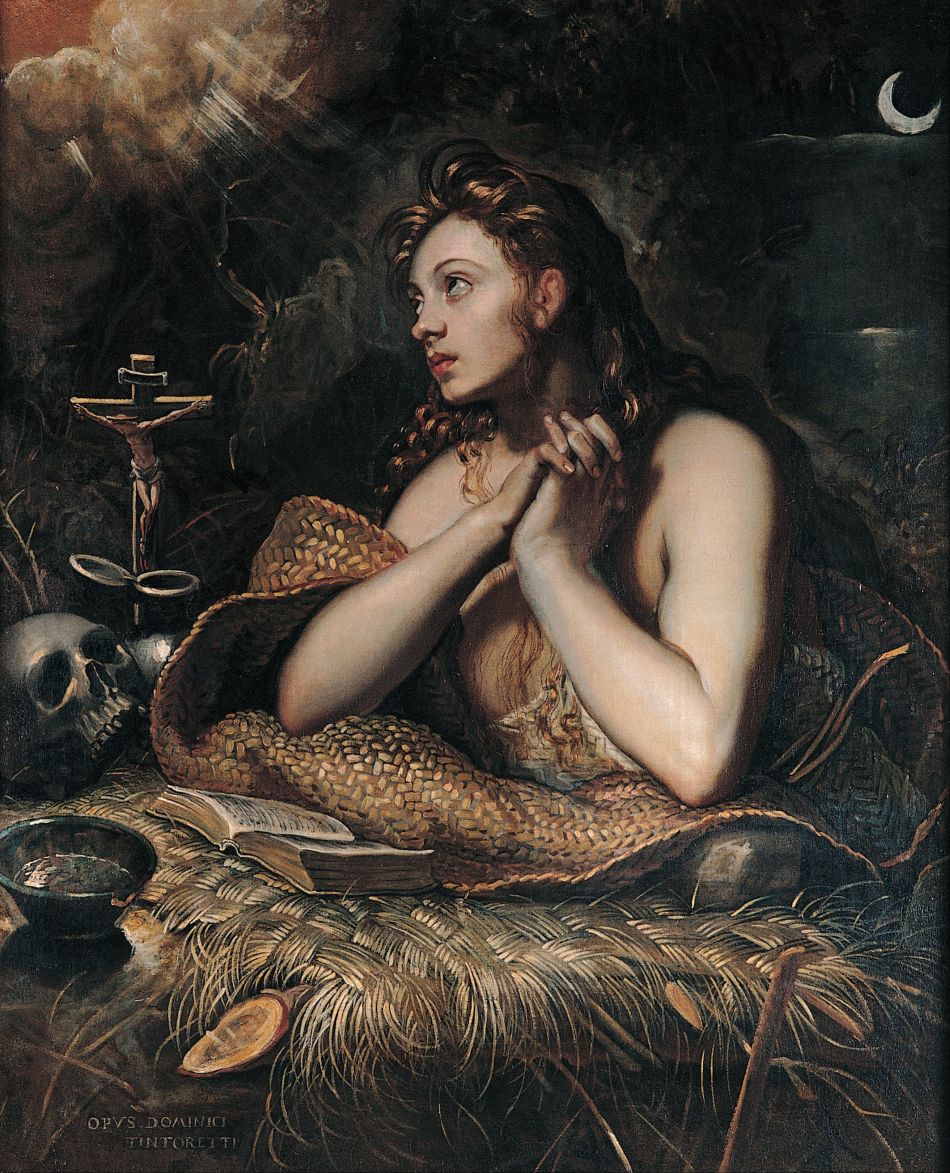
St. Mary Magdalen is the patroness of penitents, reformed prostitutes,
perfumers, hairdressers, and apothecaries. She is usually depicted
artistically in a posture of penance or an attitude of reflection,
annointing Our Lord's feet, at the Foot of the Cross or before a
Crucifix, at the empty tomb, meeting the risen Christ (often with the
words "Noli me tangere" --
"Touch Me not" -- in the painting), being
fed Viaticum at death, or carried by angels after her death. She is
symbolized by her alabaster jar; a skull symbolizing penance and acting
as a memento mori; a mirror; long, unveiled hair (often red); tears;
red robes; and an egg (especially a scarlet one; see the Easter page). Her relics can be
venerated in Basilique Sainte-Marie-Madeleine in
Saint-Maximin-la-Sainte-Baume in Provence-Alpes-Côte d'Azur, France.
For those
interested in perfumery and essential oils, the blending of oils and
making of ointments as gifts or for personal use, all in honor of Mary,
is a natural for this day. Perfumes, massage oils, healing ointments --
all of these are easy to make (see footnote 3).
Food-wise, there are Proust's famous
madeleines (French for "magdalens"), a light, cake-like,
shell-shaped cookie that require a special madeleine pan to make.
Madeleines
1 stick (1/4 lb.) unsalted butter
3 eggs
3/4 cup sugar
1 lemon
2/3 cup milk
2 cups all purpose flour
1-1/2 teaspoons baking powder
butter (at room temperature) for the madeleine pan molds
Butter 2 madeleine molds (molds of 12) and put into the refrigerator.
Butter them again in 15 minutes, making sure the butter coats the
indentations on the top. Chill molds until ready to use.
Grate the zest from 1/2 of the lemon and reserve. Squeeze the lemon and
reserve the juice. Whisk the flour and baking powder together. Melt the
butter and set aside. Whisk the eggs, sugar, lemon zest and lemon juice
together for about 30 seconds. Don't overmix.
Thin the mixture with 1/2 cup of the milk. Add the flour all at once
and, using a whisk, blend just long enough to eliminate lumps.
Gently stir in the rest of the milk and the melted butter.
Refrigerate the batter for 20 minutes. Preheat oven to 425°. Spoon the
batter into the shell-shaped molds and bake for 15 to 20 minutes,
turning the pans halfway through the cooking time so they bake evenly.
Immediately remove the cookies from the molds and allow to cool on
racks. Sprinkle with powdered sugar just before serving (not
when hot!).
If you don't
have madeleine pans, this Spanish recipe for lemon-flavored Magdalena
tea cakes might serve you well. They're baked in muffin tins:
Magdalena Cakes
4 eggs
3/4 cup granulated sugar + extra for sprinkling
1 stick (8 tablespoons) unsalted butter, melted and cooled so
it's not bubbling
1 2/3 cups unbleached white flour
1 tablespoon baking powder
zest of 1 lemon
1 teaspoon vanilla extract
1 tablespoon milk
Preheat oven to 375F. Beat the eggs
with 3/4 cup sugar until the mixture is light. As you continue to beat
the egg mixture, slowly pour in the melted butter, making sure to mix
thoroughly. Stir in the lemon zest, vanilla, and milk.
Measure out the flour into a separate bowl.
Add the baking powder to the flour and mix thoroughly. Add
the flour mixture to the egg mixture, stirring all the while, and mix
'til well blended (the batter will be very thick).
Place paper liners in a cupcake pan. Use a large serving
spoon to spoon batter into pan, filling each only half full. Sprinkle
tops with a bit of sugar, then bake in the middle of the oven for 18-20
minutes, until golden. Cool 5 minutes in pans before removing.
As to music, there's the 13th c. Italian Magdalena degna da laudare you
might enjoy:
Magdalena degna
da laudare,
sempre degge Dio per noi pregare!
Ben è degna d'essare laudata
ché foe peccatrice nominata:
per servire fo ben meritata,
Iesù Cristo volse sequitare.
Magdalena degna da laudare,
sempre degge Dio per noi pregare!
Lo suo peccato pianse cum dolore
e del mondo volse uscire d'errore,
et a Cristo cum verace amore
in sue mani si volve commendare.
Magdalena degna da laudare,
sempre degge Dio per noi pregare!
A li piei de Cristo s'imchinòe
et molto dolcemente li bascione;
di lagrime tutti li bagnòe,
colli capelli presele a 'schiugare.
Mary Magdalene,
worthy of praise,
deign plead with the Lord for us always.
Worthy of praise indeed, is she
who was once called a sinner;
her merits made her worthy of
serving the Lord,
Mary Magdalene, worthy of praise,
deign plead with the Lord for us always.
She wept bitterly over her sins
and wanted to give up the erring ways of the world;
Out of true love of Christ
she put herself in His hands.
Mary Magdalene, worthy of praise,
deign plead with the Lord for us always.
She threw herself at Christ's feet,
and kissed them most sweetly,
and wet them with her tears
and wiped them with her hair.
And this more recent work by Marc-Antoine Charpentier may
enrich your day. It is called Magdalena
lugens
and designated as H.343:
As to readings for today, see St.Ephraem's "Homily on the Sinful Woman,"
and the prayer by St. Anselm below.
One final note:
an old English saying is that if it rains today, it is Mary Magdalen
washing out her handkerchief, preparing to attend St. James's fair. The
Feast of
St. James is a few days from now, on the 25th of July (her sister Martha's Feast
follows hers in one week).
St. Mary
Magdalene, you came with springing tears to the spring of mercy,
Christ; from Him your burning thirst was abundantly refreshed through
Him your sins were forgiven; by Him your bitter sorrow was consoled.
My dearest lady, well you know by your own life how a sinful soul can
be reconciled with its Creator, what counsel a soul in misery needs,
what medicine will restore the sick to health. It is enough for us to
understand, dear friend of God, to whom were many sins forgiven,
because she loved much.
Most blessed lady, I who am the most evil and sinful of men do not
recall your sins as a reproach, but call upon the boundless mercy by
which they were blotted out. This is my reassurance, so that I do not
despair; this is my longing, so that I shall not perish.
I say this of myself, miserably cast down into the depths of vice,
bowed down with the weight of crimes, thrust down by my own hand into a
dark prison of sins, wrapped round with the shadows of darkness.
Therefore, since you are now with the chosen because you are beloved
and are beloved because you are chosen of God, I, in my misery, pray to
you, in bliss; in my darkness, I ask for light; in my sins, redemption;
impure, I ask for purity.
Recall in loving kindness what you used to be, how much you needed
mercy, and seek for me that same forgiving love that you received when
you were wanting it. Ask urgently that I may have the love that pierces
the heart; tears that are humble; desire for the homeland of heaven;
impatience with this earthly exile; searing repentance; and a dread of
torments in eternity.
Turn to my good that ready access that you once had and still have to
the spring of mercy.
Draw me to him where I may wash away my sins; bring me to him who can
slake my thirst; pour over me those waters that will make my dry places
fresh. You will not find it hard to gain all you desire from so loving
and so kind a Lord, who is alive and reigns and is your friend.
For who can tell, beloved and blest of God, with what kind familiarity
and familiar kindness he himself replied on your behalf to the
calumnies of those who were against you? How He defended you, when the
proud Pharisee was indignant, how He excused you, when your sister
complained, how highly He praised your deed, when Judas begrudged it.
And, more than all this, what can I say, how can I find words to tell,
about the burning love with which you sought him, weeping at the
sepulchre, and wept for Him in your seeking?
How He came, who can say how or with what kindness, to comfort you, and
made you burn with love still more; how He hid from you when you wanted
to see Him, and showed Himself when you did not think to see Him; how
He was there all the time you sought Him, and how He sought you when,
seeking Him, you wept.
But you, most holy Lord, why do You ask her why she weeps? Surely You
can see; her heart, the dear life of her soul, is cruelly slain. O love
to be wondered at; O evil to be shuddered at! You hung on the wood,
pierced by iron nails, stretched out like a thief for the mockery of
wicked men; and yet, "Woman," You say, "why are you weeping?" She had
not been able to prevent them from killing You, but at least she longed
to keep Your Body for a while with ointments lest it decay. No longer
able to speak with You living, at least she could mourn for You dead.
So, near to death and hating her own life, she repeats in broken tones
the words of life which she had heard from the living.
And now, besides all this, even the Body which she was glad, in a way,
to have kept, she believes to have gone. And can You ask her, "Woman,
why are you weeping?" Had she not reason to weep? For she had seen with
her own eyes -- if she could bear to look -- what cruel men cruelly did
to You; and now all that was left of You from their hands she thinks
she has lost. All hope of You has fled, for now she has not even Your
lifeless Body to remind her of You.
And someone asks, "Who are you looking for? Why are you weeping?"
You, her sole joy, should be the last thus to increase her sorrow. But
You know it all well, and thus you wish it to be, for only in such
broken words and sighs can she convey a cause of grief as great as
hers. The love You have inspired You do not ignore,
And indeed You know her well, the Gardener, who planted her soul in His
garden. What You plant, I think You also water. Do You water, I wonder,
or do You test her? In fact, You are both watering and putting to the
test.
But now, good Lord, gentle Master, look upon your faithful servant and
disciple, so lately redeemed by Your Blood, and see how she burns with
anxiety, desiring You, searching all round, questioning, and what she
longs for is nowhere found. Nothing she sees can satisfy her, since You
whom alone she would behold, she sees not.
What then? How long will my Lord leave his beloved to suffer thus? Have
You put off compassion now You have put on incorruption? Did You let go
of goodness when you laid hold of immortality?
Let it not be so, Lord. You will not despise us mortals now You have
made Yourself immortal, for You made yourself a mortal in order to give
us immortality.
And so it is; for love's sake He cannot bear her grief for long or go
on hiding Himself. For the sweetness of love He shows Himself who would
not for the bitterness of tears.
The Lord calls His servant by the name she has often heard and the
servant knows the voice of her own Lord. I think, or rather I am sure,
that she responded to the gentle tone with which He was accustomed to
call, "Mary." What joy filled that voice, so gentle and full of love.
He could not have put it more simply and clearly:
"I know who you are and what you want; behold Me; do not weep, behold
Me; I am He whom you seek."
At once the tears are changed; I do not believe that they stopped at
once, but where once they were wrung from a heart broken and
self-tormenting they flow now from a heart exulting. How different is,
"Master!" from "If you have taken Him away, tell me"; and, "They have
taken away my Lord, and I do not know where they have laid Him," has a
very different sound from, "I have seen the Lord, and he has spoken to
me."
But how should I, in misery and without love, dare to describe the love
of God and the blessed friend of God? Such a flavour of goodness will
make my heart sick if it has in itself nothing of that same virtue. But
in truth, You who are very Truth, You know me well and can testify that
I write this for the love of Your love, my Lord, my most dear Jesus. I
want Your love to burn in me as You command so that I may desire to
love You alone and sacrifice to You a troubled spirit, "a broken and a
contrite heart."
Give me, O Lord, in this exile, the bread of tears and sorrow for which
I hunger more than for any choice delights. Hear me, for Your love, and
for the dear merits of your beloved Mary, and Your blessed Mother, the
greater Mary. Redeemer, my good Jesus, do not despise the prayers of
one who has sinned against You but strengthen the efforts of a weakling
that loves You. Shake my heart out of its indolence, Lord, and in the
ardour of Your love bring me to the everlasting sight of Your glory
where with the Father and the Holy Spirit You live and reign, God, for
ever. Amen.
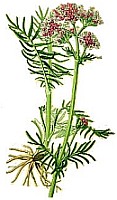
Footnotes: 1 Spikenard, or "nard"
(right), is Nardostachys grandiflora (or Nardostachys
jatamansi), a pink-flowered plant of the family Valerianaceae --
the valerian family. The portion of the plant just above the roots has
a strong, patchouli-like scent. It is used internally like common
valerian (Valeriana officinalis) -- for nerves, depression,
headaches, and insomnia. Externally, it is used for rashes and as a
deodorant. There is a fascinating legend about the nard used to annoint
Our Lord. It begins at the Nativity,
and is recounted in the apocryphal Arabic Infancy Gospel, a translation
of a Syriac original whose date is unknown, but estimated to be 4th c.:
Joseph
therefore arose, and taking Mary his spouse, went away to Jerusalem,
and came to Bethlehem, to be enrolled along with his family in his
native city. And having come to a cave, Mary told Joseph that the time
of the birth was at hand, and that she could not go into the city; but,
said she, let us go into this cave. This took place at sunset. And
Joseph went out in haste to go for a woman to be near her. When,
therefore, he was busy about that, he saw an Hebrew old woman belonging
to Jerusalem, and said: Come hither, my good woman, and go into this
cave, in which there is a woman near her time.
Wherefore, after sunset, the old woman, and Joseph with her, came to
the cave, and they both went in. And, behold, it was filled with lights
more beautiful than the gleaming of lamps and candles, and more
splendid than the light of the sun. The child, enwrapped in swaddling
clothes, was sucking the breast of the Lady Mary His mother, being
placed in a stall. And when both were wondering at this light, the old
woman asks the Lady Mary: Art thou the mother of this Child? And when
the Lady Mary gave her assent, she says: Thou art not at all like the
daughters of Eve. The Lady Mary said: As my son has no equal among
children, so his mother has no equal among women. The old woman
replied: My mistress, I came to get payment; I have been for a long
time affected with palsy. Our mistress the Lady Mary said to her: Place
thy hands upon the child. And the old woman did so, and was immediately
cured. Then she went forth, saying: Henceforth I will be the attendant
and servant of this child all the days of my life.
Then came shepherds; and when they had lighted a fire, and were
rejoicing greatly, there appeared to them the hosts of heaven praising
and celebrating God Most High. And while the shepherds were doing the
same, the cave was at that time made like a temple of the upper world,
since both heavenly and earthly voices glorified and magnified God on
account of the birth of the Lord Christ.
And when that old Hebrew woman saw the manifestation of those miracles,
she thanked God, saying: I give Thee thanks, O God, the God of Israel,
because mine eyes have seen the birth of the Saviour of the world. And
the time of circumcision, that is, the eighth day, being at hand, the
Child was to be circumcised according to the law. Wherefore they
circumcised Him in the cave. And the old Hebrew woman took the piece of
skin; but some say that she took the navel-string, and laid it past in
a jar of old oil of nard. And she had a son, a dealer in unguents, and
she gave it to him, saying: See that thou do not sell this jar of
unguent of nard, even although three hundred denarii should be offered
thee for it. And this is that jar which Mary the sinner bought and
poured upon the head and feet of our Lord Jesus Christ, which
thereafter she wiped with the hair of her head.
2
"Alabaster" is a usually white, translucent gypsum.
3 Ways to make perfumes, massage oils, and other
such things using essential oils:
Massage Oil
Add about 4 to 10 drops of essential oils to 1 tablespoon of Jojoba oil
(apricot kernel oil or grapeseed oil can be used instead, but these and
other vegetable oils will go rancid. Jojoba keeps best. It is best to
make these ointments as you use them, or at least not make very large
quantities in advance.).
For
Use
sore muscles
Cajeput, Sage
and Basil oils
congestion
1 drop Basil, 2
drops Lemon, 2 drops Eucalyptus
the marital bed
4 drops Rose, 6
drops Sandalwood, 1 drop Ylang Ylang
In a 1-oz dark-colored bottle, mix 4 tsp Jojoba oil with 10-15 drops of
essential oil. Cap tightly and let sit a week, shaking periodically and
testing the fragrance, adding drops of whatever you think it needs as
you go along and testing in a few days (it will develop as it sits).
Alcohol-based Perfume
In a dark-colored bottle, mix 25 drops of essential oil with 1 oz of
Vodka. Let age 2 weeks, shaking periodically and testing the fragrance,
adding drops of whatever you think it needs as you go along and testing
in a few days (it will develop as it sits).
Solid Perfume
Heat together 1/4 cup Jojoba oil with 1/2 ounce beeswax. Off the heat,
stir in essential oils, starting with 20 -30 drops. Play with amounts
of wax and carrier oil to achieve desired texture. Pour into
containers. It will develop over time.
Lip Balm
Heat together 2 parts Jojoba oil (or olive oil) with 1 part beeswax (or
candelilla wax) until melted. Stir in food flavorings (1/4 to 1/2
teaspoon for every 1/4 cup of oil) and any healing oils desired. A
capsule of Vitamin E can be squeezed into this mixture also. Pour into
containers. Ratio of oil to wax can be played with to gain desired
texture.
All Purpose Healing Salve for Skin Afflictions
Melt together a bit over a half ounce of Beeswax with 4 ½ tablespoons
of Jojoba oil (half of this can be Calendula oil for more healing
properties). Remove from heat, stir in contents of a Vitamin E capsule,
and 40 drops of some combination of these: Lavender oil, Tea tree oil,
Oregano oil, Roman or German Chamomile. Pour into tins to firm up. Use
within 6 months.
Regular Bath Salts
Put 1 cup sea salt and 1/2 cup Epsom salt into a bowl and blend.
Seperately, mix 2 tablespoons baking soda with add 20-25 drops of
essential oils (a few drops of vegetable food coloring may be added a
few drops at a time, too, mixing well after each addition), and then
add to the salts. Mix well with a fork and pack into a jar with a
tight-fitting lid and shake. Let sit for a few days, shaking
periodically. Add 1/4 - 1/2 cup to bathwater just before getting in the
tub, and swirl to dissolve.
Jewel Bath Salts
To 1 cup of sea salt (or rock salt or mineral salt), add 3-5 drops of
vegetable food coloring 2 drops at a time, shaking, shaking well after
each addition). Add 20-25 drops of essential oil, and shake once more.
Add a teaspoon of glycerine and the salts will gleam like jewels. Store
airtight.
Fizzing Bath Salts
Mix 2/3 cup baking soda with 1/2 cup citric acid crystals in a bowl.
Add 5-8 drops of essential oil to 2 Tbsp. cornstarch (a few drops of
vegetable food coloring can be worked into the cornstarch before
adding), and add. Pack into airtight jars, and let sit a few days. Pour
some into bathwater just before getting in the tub.