Excerpt from "Remembrance of Things
Past"
by Marcel Proust
|
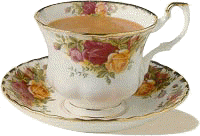 I feel that
there is much to be said for the Celtic belief that the souls of those
whom we have lost are held captive in some inferior being, in an
animal, in a plant, in some inanimate object, and so effectively lost
to us until the day (which to many never comes) when we happen to pass
by the tree or to obtain possession of the object which forms their
prison. Then they start and tremble, they call us by our name, and as
soon as we have recognised their voice the spell is broken. We have
delivered them: they have overcome death and return to share our life. I feel that
there is much to be said for the Celtic belief that the souls of those
whom we have lost are held captive in some inferior being, in an
animal, in a plant, in some inanimate object, and so effectively lost
to us until the day (which to many never comes) when we happen to pass
by the tree or to obtain possession of the object which forms their
prison. Then they start and tremble, they call us by our name, and as
soon as we have recognised their voice the spell is broken. We have
delivered them: they have overcome death and return to share our life.
And so it is with our own past. It is a labour in vain to attempt to
recapture it: all the efforts of our intellect must prove futile. The
past is hidden somewhere outside the realm, beyond the reach of
intellect, in some material object (in the sensation which that
material object will give us) which we do not suspect. And as for that
object, it depends on chance whether we come upon it or not before we
ourselves must die.
Many years had elapsed during which nothing of Combray, save what was
comprised in the theatre and the drama of my going to bed there, had
any existence for me, when one day in winter, as I came home, my
mother, seeing that I was cold, offered me some tea, a thing I did not
ordinarily take. I declined at first, and then, for no particular
reason, changed my mind. She sent out for one of those short, plump
little cakes called 'petites madeleines,' which look as though they had
been moulded in the fluted scallop of a pilgrim's shell. And soon,
mechanically, weary after a dull day with the prospect of a depressing
morrow, I raised to my lips a spoonful of the tea in which I had soaked
a morsel of the cake. No sooner had the warm liquid, and the crumbs
with it, touched my palate, a shudder ran through my whole body, and I
stopped, intent upon the extraordinary changes that were taking place.
An exquisite pleasure had invaded my senses, but individual, detached,
with no suggestion of its origin. And at once the vicissitudes of life
had become indifferent to me, its disasters innocuous, its brevity
illusory--this new sensation having had on me the effect which love has
of filling me with a precious essence; or rather this essence was not
in me, it was myself. I had ceased now to feel mediocre, accidental,
mortal. Whence could it have come to me, this all-powerful joy? I was
conscious that it was connected with the taste of tea and cake, but
that it infinitely transcended those savours, could not, indeed, be of
the same nature as theirs. Whence did it come? What did it signify? How
could I seize upon and define it?
I drink a second mouthful, in which I find nothing more than in the
first, a third, which gives me rather less than the second. It is time
to stop; the potion is losing its magic. It is plain that the object of
my quest, the truth, lies not in the cup but in myself. The tea has
called up in me, but does not itself understand, and can only repeat
indefinitely with a gradual loss of strength, the same testimony; which
I, too, cannot interpret, though I hope at least to be able to call
upon the tea for it again and to find it there presently, intact and at
my disposal, for my final enlightenment. I put down my cup and examine
my own mind. It is for it to discover the truth. But how? What an abyss
of uncertainty whenever the mind feels that some part of it has strayed
beyond its own borders; when it, the seeker, is at once the dark region
through which it must go seeking, where all its equipment will avail it
nothing. Seek? More than that: create. It is face to face with
something which does not so far exist, to which it alone can give
reality and substance, which it alone can bring into the light of day.
And I begin again to ask myself what it could have been, this
unremembered state which brought with it no logical proof of its
existence, but only the sense that it was a happy, that it was a real
state in whose presence other states of consciousness melted and
vanished. I decide to attempt to make it reappear. I retrace my
thoughts to the moment at which I drank the first spoonful of tea. I
find again the same state, illumined by no fresh light. I compel my
mind to make one further effort, to follow and recapture once again the
fleeting sensation. And that nothing may interrupt it in its course I
shut out every obstacle, every extraneous idea, I stop my ears and
inhibit all attention to the sounds which come from the next room. And
then, feeling that my mind is growing fatigued without having any
success to report, I compel it for a change to enjoy that distraction
which I have just denied it, to think of other things, to rest and
refresh itself before the supreme attempt. And then for the second time
I clear an empty space in front of it. I place in position before my
mind's eye the still recent taste of that first mouthful, and I feel
something start within me, something that leaves its resting-place and
attempts to rise, something that has been embedded like an anchor at a
great depth; I do not know yet what it is, but I can feel it mounting
slowly; I can measure the resistance, I can hear the echo of great
spaces traversed.
Undoubtedly what is thus palpitating in the depths of my being must be
the image, the visual memory which, being linked to that taste, has
tried to follow it into my conscious mind. But its struggles are too
far off, too much confused; scarcely can I perceive the colourless
reflection in which are blended the uncapturable whirling medley of
radiant hues, and I cannot distinguish its form, cannot invite it, as
the one possible interpreter, to translate to me the evidence of its
contemporary, its inseparable paramour, the taste of cake soaked in
tea; cannot ask it to inform me what special circumstance is in
question, of what period in my past life.
Will it ultimately reach the clear surface of my consciousness, this
memory, this old, dead moment which the magnetism of an identical
moment has travelled so far to importune, to disturb, to raise up out
of the very depths of my being? I cannot tell. Now that I feel nothing,
it has stopped, has perhaps gone down again into its darkness, from
which who can say whether it will ever rise? Ten times over I must
essay the task, must lean down over the abyss. And each time the
natural laziness which deters us from every difficult enterprise, every
work of importance, has urged me to leave the thing alone, to drink my
tea and to think merely of the worries of to-day and of my hopes for
to-morrow, which let themselves be pondered over without effort or
distress of mind.
And suddenly the memory returns. The taste was that of the little crumb
of madeleine which on Sunday mornings at Combray (because on those
mornings I did not go out before church-time), when I went to say good
day to her in her bedroom, my aunt Léonie used to give me, dipping it
first in her own cup of real or of lime-flower tea. The sight of the
little madeleine had recalled nothing to my mind before I tasted it;
perhaps because I had so often seen such things in the interval,
without tasting them, on the trays in pastry-cooks' windows, that their
image had dissociated itself from those Combray days to take its place
among others more recent; perhaps because of those memories, so long
abandoned and put out of mind, nothing now survived, everything was
scattered; the forms of things, including that of the little
scallop-shell of pastry, so richly sensual under its severe, religious
folds, were either obliterated or had been so long dormant as to have
lost the power of expansion which would have allowed them to resume
their place in my consciousness. But when from a long-distant past
nothing subsists, after the people are dead, after the things are
broken and scattered, still, alone, more fragile, but with more
vitality, more unsubstantial, more persistent, more faithful, the smell
and taste of things remain poised a long time, like souls, ready to
remind us, waiting and hoping for their moment, amid the ruins of all
the rest; and bear unfaltering, in the tiny and almost impalpable drop
of their essence, the vast structure of recollection.
And once I had recognized the taste of the crumb of madeleine soaked in
her decoction of lime-flowers which my aunt used to give me (although I
did not yet know and must long postpone the discovery of why this
memory made me so happy) immediately the old grey house upon the
street, where her room was, rose up like the scenery of a theatre to
attach itself to the little pavilion, opening on to the garden, which
had been built out behind it for my parents (the isolated panel which
until that moment had been all that I could see); and with the house
the town, from morning to night and in all weathers, the Square where I
was sent before luncheon, the streets along which I used to run
errands, the country roads we took when it was fine. And just as the
Japanese amuse themselves by filling a porcelain bowl with water and
steeping in it little crumbs of paper which until then are without
character or form, but, the moment they become wet, stretch themselves
and bend, take on colour and distinctive shape, become flowers or
houses or people, permanent and recognisable, so in that moment all the
flowers in our garden and in M. Swann's park, and the water-lilies on
the Vivonne and the good folk of the village and their little dwellings
and the parish church and the whole of Combray and of its surroundings,
taking their proper shapes and growing solid, sprang into being, town
and gardens alike, all from my cup of tea. |
|
 Back to:
Introduction to the Mass Back to:
Introduction to the Mass
Back to Being Catholic
Index
|

