``Where the
Bishop is, there let the multitude of believers be;
even as where Jesus is, there is the Catholic Church'' Ignatius of
Antioch, 1st c. A.D
Introduction to the Traditional Latin
Mass
"We must
admit it is a master blow of Protestantism to have declared war on the
sacred language. If it should ever succeed in destroying it, it would
be well on the way to victory. Exposed to profane gaze, like a virgin
who has been violated, from that moment on the Liturgy has lost much of
its sacred character, and very soon people find that it is not
worthwhile putting aside one's work or pleasure in order to go and
listen to what is being said in the way one speaks on the marketplace.
. . ." -- Dom Prosper Gueranger, Liturgical Institutions, 1840
"It is now theologically possible for Protestants
to use the same Mass as Catholics." -- Max Thurian, Protestant
theologian, on the New Mass, 1969
"At this critical juncture, the traditional Roman rite, more than one
thousand years old, has been destroyed." -- Msgr. Klaus Gamber,
considered to
be the greatest liturgist of the 20th c.
"Let those who like myself have known and sung a Latin-Gregorian High
Mass remember it if they can. Let them compare it with the Mass that we
now have. Not only the words, the melodies, and some of the gestures
are different. To tell the truth, it is a different liturgy of the
Mass. This needs to be said without ambiguity: the Roman Rite as we
knew it no longer exists." -- Fr. Joseph Gelineau
"What happened after the Council was something else entirely; in place
of liturgy as the fruit of development over centuries came fabricated
liturgy. We abandoned the organic process of growth and development
over centuries and replaced it -- as in a manufacturing process -- with
a fabrication, a banal, on-the-spot product." -- preface to Msgr. Klaus
Gamber's "The Reforms of the Roman Liturgy," written by Joseph Cardinal
Ratzinger's (future Pope Benedict XVI)
When going to Mass today, Latin Catholics generally have five options:
1)
attend the
vernacular Novus Ordo Mass published in 1970 by Pope Paul VI. This is
the Mass offered in most parishes today
2)
attend the very
rarely-offered 1970
Novus Ordo Mass offered in the Latin language (note: this is not
the same Mass that was offered before Vatican II, and is not the Mass traditional Catholics
refer to when they speak of "the Latin Mass").
3)
attend Mass at a
non-Latin ritual Catholic Church (Byzantine, Greek, Maronite, etc.)
4)
attend the
hard-to-find
Masses offered by certain religous Orders who have their own Rites,
e.g., the Dominican Rite, the Carmelite Rite ("The Rite of the Holy
Sepulchre"), etc.
5)
attend the
traditional Latin Mass that sustained millions of Roman Catholics for
centuries and centuries. The traditional Latin Mass (TLM) is also
referred to as:
the the Mass of Pope St. Peter, the Mass of Pope St. Gregory the Great;
the Mass of Pope St. Pius V; the Tridentine Mass, the Pian Rite, the
"Vetus Ordo" (VO), and now, commonly, "The Extraordinary Form" (EF).
Contrary to popular belief and in spite of the wishes of progressive
types, the traditional Mass has not disappeared;
it is offered by
various priestly fraternities, such as the Priestly Fraternity of St.
Peter (FSSP), the Institute of
Christ the King (ICK), the Society of St. Pius X (SSPX), etc.,
and, since the 1988 motu
proprio "Ecclesia Dei," by parish
priests according to the 2007 motu proprio "Summorum
Pontificum," (This has changed in some dioceses due to Pope
Francis's motu proprio "Traditiones Custodes," which has as its purpose
eradicating the traditional Mass altogether).
In this section,
I focus solely on the traditional Latin Mass based on the Missal of
1962 which is used by most traditional priests (including the FSSP
and the SSPX). After much study, I've come to the conclusion that,
validity issues aside, the "Novus Ordo Mass" is tragically flawed,
something my instincts and "common sense" have told me since I was a
child. The very name of this Mass -- "Novus Ordo," i.e., "New Order" --
should make anyone with a true Catholic nature cringe, and its effects
are so incredibly sad it almost hurts to think about it.
The "Novus Ordo," whether offered in English or Latin, whether offered
reverently or with severe abuses, is a violent break with
Tradition, directly responsible, in
part, for the great loss of faith which followed its publication.
"Lex credendi legem statuat supplicandi" -- let the rule of belief
determine the rule of prayer" is the rule of liturgy -- but the Novus
Ordo, designed to make Protestants comfortable with the
Mass, expresses Protestant belief not by what it is, but by what it
fails to be -- that is, by its omissions. It leads
us to believe as Protestants in that it practically nullifies the
experience of the realities of the Sacrifice and the priesthood. The
Novus Ordo -- not so much for what it is inherently, but for
what it isn't, for what it lacks -- appears as the
"Mass of Cain," arrogantly bringing his
own works to God; the ancient
Mass is the "Mass of Abel," who humbly offered God a sacrifice -- a
lamb that prefigured the Passover lamb which, in turn, prefigured the
Lamb Who takes away the sins of the world, Whose offering of Himself to
us is eternal.
The stripping away of the signs and symbols of the Mystery, the
eradication of the poetic, the blurring of the line between
the ordained and common priesthoods, music that typically ranges from
the banal
to the offensive, the ignoring of Gregorian chant, the failure to
retain our sacred language, the "busy-ness," the dearth of silence,
and, most of all, the almost total lack of emphasis on the Sacrifice --
to not be offended by these things after having
studied the purpose of the Mass and our worship's relationship to our
belief, is to be either ignorant of or ill-willed toward the Catholic
Faith. Please know that I say this without any intention whatsoever to
impugn the motives or holiness of those who haven't studied these issues.
Further problems with the Novus Ordo are the International Committee on
English in the Liturgy's (ICEL) translations of the text, its failure
to conform itself with Vatican II and Council of Trent documents, and
the fact that its own pale rubrics are so often abused.
The lectionary
has been stripped of mention of sin, miracles, the demonic, or anything
that offends
Jewish people; see this pdf -- Gutting
the Gospels -- and be shocked at what's been torn away from our
liturgy. Just one example: The words of I Corinthians 11:27-29 --
"Therefore whosoever shall eat this bread, or drink the chalice of the
Lord unworthily, shall be guilty of the body and of the blood of the
Lord. But let a man prove himself: and so let him eat of that bread,
and drink of the chalice. For he that eateth and drinketh unworthily,
eateth and drinketh judgment to himself, not discerning the body of the
Lord." -- are words heard three different times throughout the year in
the
traditional liturgy. But they've been stripped away entirely from the Novus Ordo. Gone.
Abuses not inherent in the 1970 Missal but which predominate thanks to
the "the spirit of Vatican II" -- the use of altar girls which destroys
priestly vocations, not kneeling to receive the Eucharist, lay people
taking the Blessed Sacrament in their hands, lay people (usually women)
swarming the sanctuary in perfect imitation of Korah (see Jude 1:11 and
Numbers 16) -- there is no defense for these practices. None. But they
are so prevalent as to be almost universal.
Even celebrated according to its rubrics (and God bless those few,
well-intentioned priests who even try to do that), the New Mass is a
Protestantized (not Protestant) "service" up to its
core, with an abbreviated Kyrie thrown in. Even with the few
words retained in the Consecration to keep it valid, its semblance to
the ancient Mass is like that of a dry twig to a flowering tree. What
the modernists (may God have mercy on them!) have done to the Church is
the liturgical equivalent of whitewashing the ceiling of the Sistine
Chapel, and this has happened with all of the sacramental rites, from Baptism to Unction.
Each Catholic must study this issue prayerfully. And each must know
that believing -- knowing -- that the 1970 Mass was an
extremely bad idea, a break with Sacred Tradition, an unlovely thing
that leads to heterodoxy and disbelief -- is not "disobedient" and does
not make you a "bad Catholic"; it makes you an informed one with eyes
to see. Saying these things aloud does not make you "dissident" or
"schismatic"; it makes you a warrior for the true Faith.
Now, I can imagine a dialogue with some of you who are new to the
concept of "liturgy" -- and many who have been Catholic for years but
"really like" or are at least not bothered by the Novus Ordo Mass:
"What's
the big deal?"
The 'big deal'
is that Jesus Christ glorified becomes really and truly present at the
Mass -- Body, Blood, Soul, and Divinity -- under the appearances of
bread and wine, in fulfillment of all the Old Testament sacrifices and
as predicted by the Prophet Malachias. The Annunciation is made present
again when the Holy Ghost comes upon "the gifts" of bread and wine,
bringing Christ to us in the Flesh just as He came to us in the Flesh
in Mary's womb. The Crucifixion is re-presented as He is offered up to
appease
the Father 's wrath at our sins and for the remission of those sins;
Calvary is made
present before our eyes. You either believe this and are Catholic, or
you do not believe this and are not Catholic. If you believe this and
are Catholic, you will want everyone else to believe this, too. You
should, therefore, want liturgy that points to the reality of these
Mysteries in every way possible, and should be extremely bothered by
liturgy that is banal, ugly, sterile, offensive, and that may as well
have been designed to lead to heterodoxy. Think those words are
too harsh? This is what Cardinal Josef Ratzinger, who was to become
Pope Benedict XVI, said about the new Mass, my emphasis:
The liturgical
reform, in its concrete realization, has distanced itself even more
from its origin. The result has not been a reanimation, but devastation. In place of the
liturgy, fruit of a continual development, they have placed a fabricated liturgy. They have
deserted a vital process of growth and becoming in order to substitute
a fabrication. They did not
want to continue the development, the organic maturing of something
living through the centuries, and they replaced it, in the manner of technical production, by a
fabrication, a banal product
of the moment.
The Most Holy Sacrifice of the Mass is our greatest prayer to
God and
our most solemn act of worship; should't we give Him our very best?
"We
shouldn't get 'hung up' on this 'religious' stuff!"
Was God "hung
up" on "religious stuff" when He commanded the ancient Israelites to
take a male lamb without blemish (not a female one or one with
blemishes), one year old (not two), and to kill it on the 14th day of
that month (not the 15th day of the next month), in the evening (not
the afternoon)? Was our Lord "hung up" on "religious stuff" when He
kept the Old Testament Feasts or demanded that His Father's House be
kept holy? Was He "hung up" on "religious stuff" when He told His
disciples to do what the Pharisees told them because they sat on the
chair of Moses? Was Jude "hung up" on "religious stuff" when he
admonished those who followed in Korah's footsteps?
Those who believe that "religion" is unimportant because we are under
Grace and not the Law seem not to understand that the Sacraments
are media of Grace. Balking about "religious"stuff" as though it's
sheer
silliness is to betray ignorance about the nature of man: look around
and see all the "religous stuff" in every culture of the world. This is
so for a reason. The question is, "Which 'religious stuff' is true?
Which 'religious stuff' honors well the true God? Which 'religious
stuff' serves the needs of human nature?"
Christ founded a Church, and for almost 2,000 years, Her liturgy
developed in a manner meant to preserve Tradition, dignity, beauty, and
deep Catholic truths. This was veritably undone a mere half-century
ago, and the evidence is in the percentage of Catholics who don't know
the Faith, the closing parishes, the dwindling priestly vocations, etc.
So, what,
are you saying the Mass can never change? Has never changed?
Of course the
Mass can change in some ways. But the words of consecration, its
expressed theology and catechetical qualities, its sacred purposes, its
holiness, its beauty, and its and arrows toward the Transcendent --
these things
cannot be changed without danger.
When the Mass has changed in the past, it was done in
keeping with
Tradition, the Mass's sacred purposes, and the purpose of
expressing sound Catholic teaching. This is the key. What was done
post-Vatican II was not a "face-lift"; it was a head transplant, and
the patient woke up almost Protestant. The millions of Catholics who've
left
the Church, the horrible state of the Faith, the scandals, and the
crisis of Catholic culture are evidence that the Novus Ordo Missae has
failed to teach and inspire Catholics.
But I really
like the sound of guitars at Mass, and the
Protestant song 'Shine, Jesus, Shine' really makes me happy!"
Buy CDs. You
can listen to them after the the Most Holy Sacrifice of the Mass.
What's the
matter with being "upbeat" and happy and
joyful and stuff?
Not a thing! We
are called to be joyful! But if you think that glee is the appropriate
attitude while standing at the foot of the Cross, I think there
might be a little something wrong with your wiring. If you don't
understand what I mean here, then trust me, my friend, with all due
respect, you don't understand what
the Mass is. I beg you to
consider that possibility and study this! Really, do you think Our Lady
and St. John were standing at the foot of the Cross singing anything
like "Shine Jesus Shine" or dancing or waving their arms around in joy?
Even if the Mass were only a memorial of the "Last Supper" as
in the Protestant way, what's the "mood" of a Jewish seder, anyway?
Are they be-bopping all over the place and raising the roof? Or are
they somberly, with gratitude and humility, re-experiencing their
deliverance? Even if the Mass were a mere memorial of Calvary,
would you commemorate the Sacrifice of anyone or anything else by
bringing out the Rock and Roll and having a party? Have we lost all
sense of majesty, awe, thanksgiving, gratitude, and duty?
But He is
risen!
Amen and
alleluia! But we are not; we have work to do. And Christ, the High
Priest and Perfect Victim, appearing to St. John in Heaven
as a "lamb as it had been slain," pours out the graces of His once and
for all time Sacrifice to us in the Mass so we might be sanctified --
something we must become in order to have our own "little Easter." We
get to the Resurrection through the Cross. It must be always
remembered that it isn't Christ's Resurrection that saves us in itself,
by itself; it was the shedding of His Blood on the Cross that led to
His Resurrection! His having shed His Blood is what remits our sins and
is what will allow us to experience the fruits thereof: our own
resurrection.
Our awareness of the glorious fact of His Resurrection is ever-present
(it is the very reason we worship on Sundays!); but that joy is
tempered by the Sacrifice and by the knowledge that while He is risen,
He pours Himself out to us yet -- and we still have our own Calvary to
go through.
Well, who
the heck are you? You like the traditional Mass, I like the New Mass.
Why should your opinion matter more than mine?
My opinion doesn't
matter more than yours per se; neither of
our opinions are what matters because the Mass isn't a matter of
"opinion" or "preference." The Mass is not about me or you; it is about
the worship of Almighty God, and the way it is "supposed to be done"
has been shown to us by the Apostles, Fathers, and Saints over the
course of 2,000 years. We can no
more treat it as a plaything than we can Sacred Scripture. The Mass
isn't a
coffee flavor or a new Fall TV show one either "prefers" or not. It's
not a performance in which "creativity" and "getting the
audience's attention" matter. To paraphrase the Talking Heads, "It
ain't no party, it ain't no disco, it ain't no fooling around!" And
it's not (despite popular jargon) a mere "meal" where we all "gather"
to admire ourselves, ponder the "mystery of man," and bond over a
snack the priest
"Eucharistic minister" hands us. It is a matter of divine realities --
Christ's very
sacrifice!
And, very importantly, aside from the Sacrifice itself, the Mass has
distinct purposes which are either fulfilled or not: it either feeds
the Faith or it destroys the Faith through either negligence or
positively dangerous changes. That so many "Catholics" are about as
"Catholic" as Calvin, Zwingli, or your neighborhood Wiccan is proof
enough for me that the New Mass does too little to feed the Faith. And
it's no great
shock considering that Jean Guitton, close friend of Paul VI said
… the intention
of Pope Paul VI with regard to what is commonly called the Mass, was to
reform the Catholic liturgy in such a way that it should almost
coincide with the Protestant liturgy… there was with Pope Paul VI an
ecumenical intention to remove, or at least to correct, or at least to
relax, what was too Catholic in the traditional sense, in the Mass and,
I repeat, to get the Catholic Mass closer to the Calvinist mass.
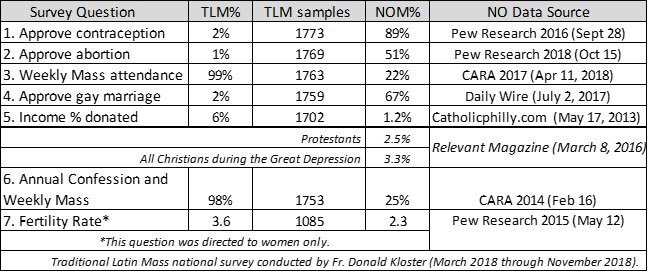
In this
graphic, "TLM" refers to the Traditional Latin Mass; "NOM" refers to
the Novus Ordo Mass
But I
don't speak Latin! How can I understand what's going on?
Quite frankly,
you don't have to intellectually understand the minutiae of the Mass
(though this is of tremendous subjective benefit and is absolutely
encouraged); one doesn't need to understand every word of Latin to
offer his own heart to Jesus, to pray, to understand the basic purpose
of the Mass and kneel in awe and humility as the Sacrifice takes place.
As to "understanding what's going on," consider that now, since the
institution of Bugnini's Mass, 70% of Catholics between the ages of 18
and 44 do not believe in the Real Presence -- that is, they are
material heretics. Can you honestly say that the Novus Ordo
Mass increases understanding of what the Mass is?
As to not speaking Latin, neither do I, and neither did most Catholics
who attended the traditional Mass throughout its history -- including
many of the great Saints. But that's what they make Missals for -- and
after a while, one can recognize and easily understand those parts of
the Mass that do not change. You've heard the expression "hasta la
vista" enough times to know what it means, right? I'm sure you know
what "merci," "la vida loca," and "je ne sais quoi" mean, too, eh? Then
you can come to know what "Deo gratias" and "per omnia saecula
saeculorum" mean, too, just as have millions of Catholics before you.
Consider: Millions of Muslims can figure out how to pray in Arabic,
even if they are not native Arabic speakers. Jews from the Midwest, USA
manage to pray in Hebrew, even though English is the language they grew
up with; their young boys even learn to pray in Hebrew at a very young
age when they go through their "bar-mitzvahs." Our Lord Himself prayed
in Hebrew -- even though Aramaic was His family language, Greek was the
lingua franca of the area, and Latin was the official tongue (Hebrew
may well have been, outside of Jewish liturgy, a dead or dying
language)! Hindus all over the world have the intelligence to handle
prayer in Sanskrit. Are we Christians too stupid to figure out a little
Latin?
Besides, and this is the greater point, not all understanding comes
from hearing language; it also comes from silence and prayer and beauty
and sign and gesture, from the other things one hears (chant and
bells), and from what one sees (stained glass, statues, beautiful
vestments) and smells (incense) and experiences (majesty). All of these
things teach us and impress themselves onto our minds in a way that
words alone can't. Recall how Proust wrote that one taste of a
tea-soaked madeleine brought forth a rush of associations which "taking
their proper shapes and growing solid, sprang into being...all from
[his] cup of tea." (read a short excerpt from the
relevant scene in "The Remembrance of Things Past").
In the
same way, incense and bells and silence can affect the Catholic.
Imagine two married couples:
Couple 1:
They never say in words that they love each other, but: he brings her
bouquets of lillies, he touches her lovingly and for no other purpose
than to make her feel cherished, he listens to her and looks deep into
her eyes when he talks to her, his respectful protectiveness of her
shows in every gesture. She bakes his favorite muffins every Satuday
evening for breakfast the next day, she kisses his receding hairline
and calls it beautiful, she signs "XO" at the bottom of grocery lists
she gives to him, she brings him coffee in bed every morning and wakens
him gently with a warm smile.
Couple 2:
They say they love each other and, well, that's about it.
Both marriages
are "valid" -- they each have a license. But which couple leads you to believe
that a marriage exists? Which couple would you want your children
to see as an example of what marriage should be? Which couple makes
a mockery out of marriage? Which couple teaches you what marriage is --
and which couple has the potential to destroy the concept of marriage
in your mind? Which couple inspires you? And which couple leaves you
feeling empty?
Couple 1 is to Couple 2 what the traditional Mass is to the Novus Ordo
liturgy -- except that the traditional Mass has the language, too -- a
much richer language that makes no bones about things like the
Sacrifice, sin, contrition, etc. The language is just in Latin, so we
use Missals or learn the language.
In addition to the importance and catechetical value of those
"right-brained" elements (as it were), the use of Latin assures unity
in a way that the sole use of the vernacular cannot. As things are, the
English Catholic travelling to Italy or Brazil or Korea would be lost
during the liturgy; "back in the day," a Catholic could travel anywhere
in the world and hear the exact same Mass he would have heard at home,
and his Missal would've been good anywhere. Now we have, in a
single parish, an English Mass at 9:00 and a Spanish Mass at 10:00 --
with the English-speaking Catholics and Spanish-speaking Catholics
fighting over the best Mass Times and saying not a word to each other
in between. All this "diversity" is nothing but divisive! Latin unifies
us all -- Hispanic, Anglo, African, Asian -- into one people
worshipping God in the same way, the way of our ancestors.
Another analogy for those who've seen Mel Gibson's "The Passion of the
Christ": did the fact that the movie was in Aramaic and Latin take
anything away from the experience of it -- or did it, on the other
hand, add richly to the experience? Could the movie have possibly been
experienced in the same way if Jesus had spoken in the standard
movie-Jesus English with a British accent? That movie, as I write, is
being shown all over the world -- France, England, Brazil, the United
States -- and each movie-goer experiences the exact same film in the
same way, just as traditional Catholics from all over the world
experience the Mass in the same way. The only difference is in the
subtitles, which are the equivalent of the translation of the Mass's
Latin found in our Missals. If a "Novus Ordo-oriented" person had
directed that movie, Jesus would have spoken English with an American
accent (to be dubbed into local dialects for other countries), and
would have thrown in slang and politically correct, inclusive language
to make everyone (but traditional Catholics) feel more "comfortable."
The movie wouldn't have been shot in rich amber hues with deep
Caravaggio-esque shadows, but on a stripped-down sound stage with bare
walls. The Jews would have been nowhere in sight unless they were
pleading for His release, or somehow shown as victims in the entire
spectacle. There would have been no brutal Cruficixion, but maybe one
slap across His Face, a bloodless nailing to the Cross and a rapid
death (for political causes, of course) -- all followed by a
Resurrection and images of people -- some of them noticeably active
lesbian
couples -- holding hands and singing vapid happy-songs. Wow! If
anything would not lead one to examine one's conscience and
desire to appease the Father for one's sins, that would be it.
The smallest of rubrics in the traditional Mass all point to
the Sacred. The priest facing East, toward the tabernacle, signals that
he is worshiping God with us and for us. In the Novus
Ordo, whether or not it is through the actual rubrics or how it is
almost always done, the priest faces us, forcing him into a
"show business" mentality -- and, worst of all, putting him in the
position of literally turning his
back to God in the tabernacle. Our
focus is not on the Transcendent, but on the priest himself, his face,
his mood, his banter, his jokes. It's that focus on priests'
personalities that's helped lead to such incredibly irreverent
phenomena like priests processing to the altar on hoverboards, priests
wearing clown make-up, priests doing Elvis impersonations, and so on.
The traditional priest's keeping his fingers joined after the
consecration of the Host so that not even the tiniest particle
could be lost : contrast that with "Extraordinary Eucharistic
Ministers" or "Extraordinary Ministers of Holy Communion" -- lay
people, usually women, dressed in anything they may have thrown on that
morning --- handling the Blessed Sacrament with their unconsecrated
hands and placing it in your unconsecrated hands. What a radically
different attitude toward the most profound Mystery of the
Eucharist! Is it any wonder at all that Catholics of 100 years ago
believed in the Real Presence while those of today don't?
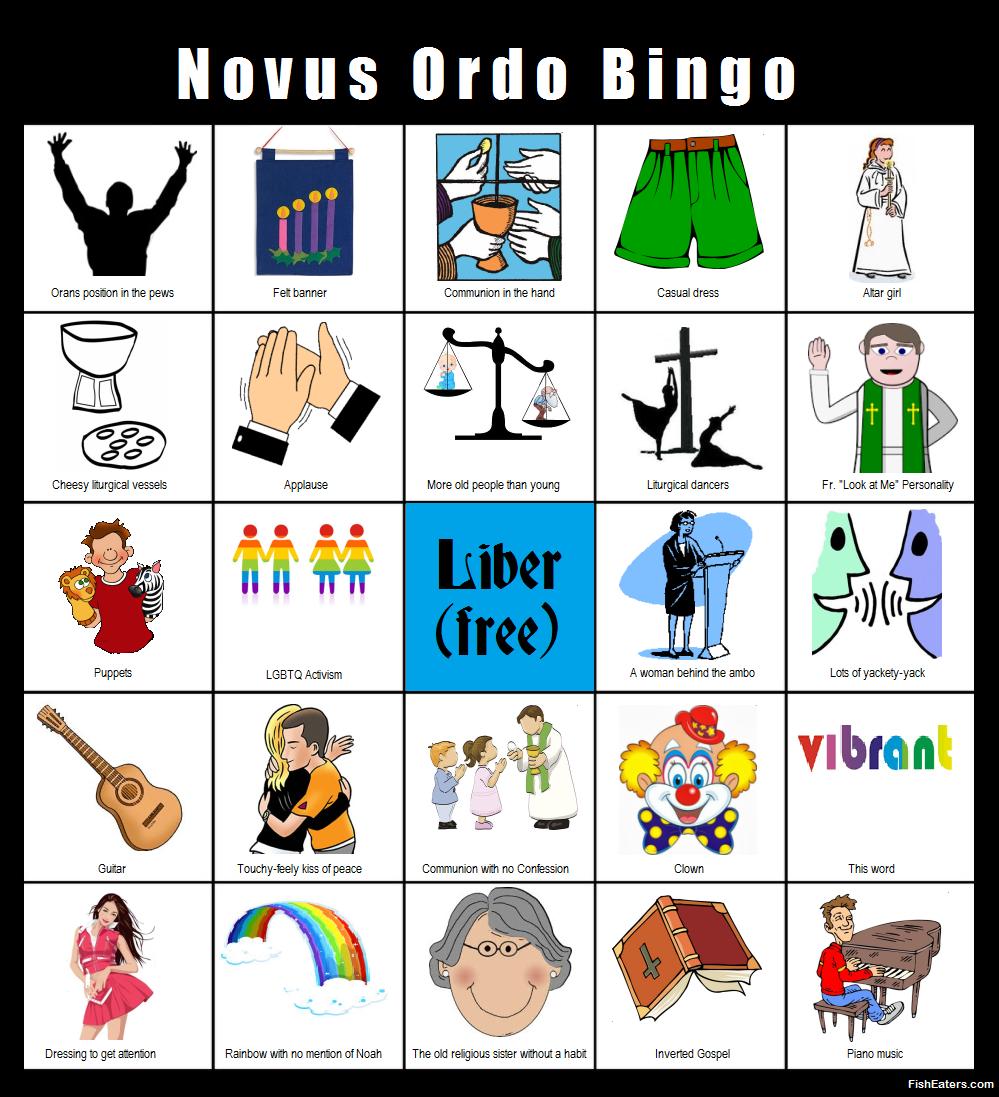
To cut to the chase, this stuff wouldn't happen if the
traditional Latin Mass were being offered:
Aren't you a little tired of the nonsense?
Using the old
Missal is a step backwards! We must move
forward; we can't go back in time, and traditionalists' longing for the
old Mass is mere nostalgia. Get over it, and get with the times! Sure
the Novus Ordo is sometimes sloppily celebrated, but there's no real
difference between the old Mass and the new. What we need is a reform
of the reform, not a leap backwards.
A "reform of the
reform," eh? Why would you waste time trying to fix up a rusted-out
Pinto when you have a polished, classic, perfectly-running Ferrari in
the garage? And why would you do that when the situation is urgent? Souls
are at stake!
Now, first, the alleged "reform" was not a reform at all; it was a
destructive, revolutionary exercise in politically correct ecumenism --
an experiment that resulted in a tragic loss of faith. Why should one
use that as a starting point for the Mass of the future?
Second, those who see no "real difference" between the Novus Ordo Mass
and the ancient Mass are like the
"personage" of Hillaire Belloc's youth who insisted that a diamond "is
the same thing" as a lump of coal. They can point to the Novus
Ordo's short Kyrie, the Canon, the changed words of Consecration, etc.,
and say that because these elements are there, "it is the same" as the
ancient Mass, but this sort of thinking makes me wonder if those same
people would buy their wives rings encrusted with coal because both
diamonds and coal are made of carbon. Belloc would say these people
have lost their power to know "an oak tree when they see one" without
having to examine every leaf. In short, he'd say they've lost their
powers of "integration."
Finally, on a practical level, even if the Novus Ordo were
worth salvaging, how could you possibly "reform the reform," in any
sense that even a moderately orthodox Catholic could mean by the word
"reform," when so many of our hierarchs are so liberal? Would you leave
this "reform of the reform" in the hands of a Cardinal Kasper? A
Weakland? A Mahony? A Pope Francis? What sorts of "working groups" and
"dialogues"
would have to take place to please all the political elements in the
human element of the Church in getting the Mass "just right" for them?
And how would each country's Bishops
handle all the hundreds of vernacular translations? What further
committees and working groups would have to be thrown together to
manage all that -- and all the rubrics? Stand? Kneel? When? Isn't there
enough confusion?
We have a Mass that has worked for two millennia, a Mass that is the
product of Apostolic Tradition and the greatest Popes and Doctors
who've ever lived, a Mass that perfectly reflects Catholic theology;
why not use it and fight for it?
But the
Latin High Mass is so long!
"Can you not
watch one hour with Me?"
Yes, the traditional High Mass is longer than the Novus Ordo Mass, but
don't
think of it that way; think of it as the amount of time it takes to
watch a few episodes of "Friends."
Look, a microwaveable McMass isn't healthy; you really need to slow
down and eat something substantial. Take some time....
Shhhhh...quiet yourself. Breathe in the sounds of bells that call you
here, and the stillness between the chimes. Contemplate. Don't you know
why you've been summoned? It is the Lord's Day! Christus
resurrexit! -- and a miracle will occur again at the Altar when the
bread and wine become the Body, Blood, Soul and Divinity of Christ --
the Pure Offering as predicted by Malachias (Malachias 1:10-11). Has
the "Our Father" ever sounded so beautiful as when it is chanted in the
same ancient melody heard by Sts. Augustine and Thomas, Catherine and
Joan -- made our brothers and sisters by the very sacrifice which will
be re-presented today? Pray for His coming. Offer your life to
Him -- your joys, your sorrows, your suffering. Give yourself to Him as
He gave Himself to you at Calvary and gives Himself to you now in
the Eucharist. Look at the Crucifix above the Altar and behold the Lamb
Who appears "as it had been slain"; He pours out His life for you, now
and ever and unto Ages of Ages. Kneel when you receive Him, and tell me
if it doesn't feel right and, more importantly, is not
right. Savor the sweetness of the incense that blesses this holy place.
Can you locate yourself in time, Christian, as you sit in that pew
praying as your ancestors have done for two millenia and as the Saints
do now in Heaven with the angels beside them? Or are you both in time
and touching eternity?
Here's the bottom line: though "emotional highs" and "good times"
aren't the purpose of the Sacrifice, you will emotionally take
from the Mass what you bring to it, and the more you understand the
Mass, its Sacred purpose, its history, and, most of all, the
more you pray the Mass, the more you will "get out of it"
emotionally. Everyone has bad days - days they are sick, tired,
distracted, easily bored, or just not "in the mood" to be at Mass (and
that's OK); but it remains true that these challenges are problems with
you, not the Mass. And it remains true that the Mass is not about us,
but about honoring, glorifying, beseeching, and appeasing God, and
offering to Him His Son. I
imagine our Israelite ancestors didn't find the incessant slaying of
lambs and red heifers entertaining after a thousand years or so.
Please, for the love of all that is Holy, study this issue (links
below). And then fight for the traditional Mass, support traditional
orders which train priests in orthodoxy, and ask the Ordinary of your
diocese to support the traditional Mass in your diocese. And, no matter
what, if your parish is filled with dissidence, if its priest and
catechists water down Catholic teaching, if your pastor abuses even
the rubrics of the Novus Ordo, if he is soft on sin -- do not support
that parish, and tell your priest and Bishop why. Support the Church as
is your duty, but do it in a way that does not hurt the Church. Give
your tithe to orthodox, fully traditional
priests, parishes, orders, missions, and apostolates.
Note for those who are new to Tradition
There are two main types of Latin Masses, Low and High. And
there are different sorts of High Masses:
Low Masses (Missa Privata): the
priest isn't assisted; no part of the Mass is sung (but hymns may be
sung as priest enters and exits, and during the Offertory or
Communion); incense isn't used; only two candles are lit. The Low Mass
is usually seen for daily Masses, but it's sometimes offered on
Sundays, too. It's a much quieter and much less impressive affair than
the High Mass, but even it is more dignified and reverent than the
Novus Ordo.
High Mass (Missa Cantata): the
celebrant is not assisted by a deacon or subdeacon; some parts of the
Mass are chanted or said aloud, all sung parts of the Mass are sung by
the choir or a cantor; incense may be used; six candles are lit. This
is likely the most commonly Sunday Masses offered by most traditional
priests.
Solemn High Mass (Missa Solemnis):
celebrant is assisted by a deacon and subdeacon; all parts of the Mass
that are said aloud are chanted; all sung parts of the Mass are sung by
a choir; incense is used; six candles are lit.
Pontifical High Mass: celebrated by
a Bishop. In addition to the six candles which are lit, another candle
is lit to symbolize the Bishop's office. A Mass offered by the Pope
(the Bishop of Rome) is a Pontifical High Mass called a "Papal Mass".
The Missa Cantata
and Missa Solemnis are the
silver and gold, respectively, of Sunday Masses. Don't be too
disappointed if only the Low Mass is available to you -- but do know
that there's much better out there, and "you ain't seen nothing yet" if
the Low Mass is all you have to attend for the time being.
You might also encounter traditional Masses offered according to the
rites of various religious orders, such as the Dominican Rite.