|
Attire
and Etiquette
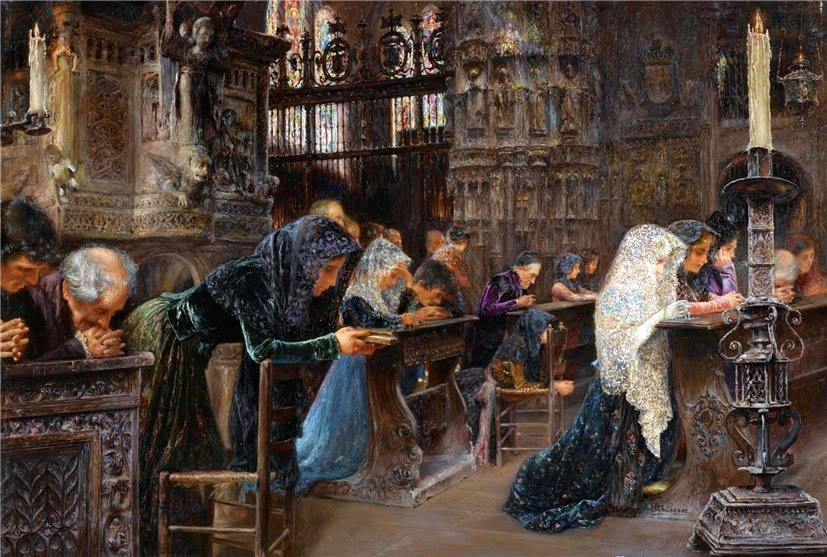
|
The basic idea of how we should behave in Church is summed up by the
Second Council of Lyons, A.D. 1274:
It is fitting
that He Whose abode has been established in peace should be worshipped
in peace and with due reverence. Churches, then, should be entered
humbly and devoutly; behaviour inside should be calm, pleasing to God,
bringing peace to the beholders, a source not only of instruction but
of mental refreshment. Those who assemble in church should extol with
an act of special reverence that Name which is above every Name, than
which no other under Heaven has been given to people, in which
believers must be saved, the Name, that is, of Jesus Christ, Who will
save His people from their sins. Each should fulfil in himself that
which is written for all, that at the Name of Jesus every knee should
bow; whenever that glorious Name is recalled, especially during the
sacred Mysteries of the Mass, everyone should bow the knees of his
heart, which he can do even by a bow of his head. In churches the
sacred solemnities should possess the whole heart and mind; the whole
attention should be given to prayer.
|
|
Attire
People have no
problem, it seems, dressing for weddings, funerals, office parties, or
dates -- but seem to think that dressing to meet Almighty God at the
Mass is passé. But dressing for Mass is simply a matter of showing
proper respect, not only for God, but for others around you. It's
certainly not a matter of showing off one's finery -- lots of people
don't even have fine clothes. Certainly, too, some people may attend
certain Masses -- say the 5:30 PM Masses -- on their way home from
their construction jobs. Fine! There is nothing to worry about in these
things! Never let circumstances out of your control make you feel
embarrassed or keep you away from the Sacraments! But one should always
wear clothes that are modest, and, if possible, all things being equal,
clean and the nicest clothes one has.
Below are some guidelines for proper attire (which also apply for other
liturgies, such as Eucharistic Adoration or the Divine Office, etc.):
|
| Cover up: |
Both sexes:
cover your shoulders and your knees -- and everything in between. Avoid
revealing necklines. |
|
Shorts &
Sweats:
|
Just say no. |
|
Blue Jeans:
|
Nice blue jeans can be OK (but just OK), especially if
dressed up, but are not ideal. But if jeans are all you have, then, by
golly,
wear jeans! |
|
Ties and
Jackets:
|
Typical for men and considered the mark of the "well-dressed"
male in the West. If you have no suit or jacket, then come in the best
you
have. |
|
Head
Coverings:
|
Laymen never wear hats in churches (except for rare
ceremonial reasons on the part of some confraternities and lay
associations).
On the other hand, as a matter of tradition, women do cover
their heads and have from the
very first day of the Church. Headcoverings (mantillas, scarves, hats,
etc.) are put on before entering the church -- at least before entering
the church proper; they aren't necessary in the narthex) and can be
removed after leaving the church (or in the narthex). Please read more about veiling here. Some parishes and
chapels will have veils available for women who don't have any. |
|
Special to
Women:
|
Like men, women should wear their "Sunday best," which in the
West is typically considered to be a dress or skirt. If dresses or
skirts are worn, hemlines should cover the knees when standing and
sitting, shoulders should be covered (i.e., "tank top" dresses and
spaghetti straps are not kosher), and necklines should be modest. If
you have no dress or skirt, then wear the best outfit you have.
Just a note on lipstick: if you wear some, be sure to blot
really well before kissing icons, statues, the priest's hands, etc. |
|
Cell
Phones/Pagers:
|
Turn them off. Or at least set
them to vibrate if you truly need to know if you're getting a call.
|
Etiquette
- This is beyond
"etiquette," but I will note here that you are to fast before receiving the Eucharist, and are
to refrain from receiving the Eucharist if you are in a state of mortal
sin. If you are a public, unrepentant sinner, the priest has every
right and duty to not offer you the Body of Christ.
- General
deportment in a church and at the Mass should be based on these Truths:
- Christ is
present in the tabernacle. Therefore, respect the sanctuary as the
holiest area of the church; it is the Holy of Holies.
- During the Mass,
we are at the foot of the Cross, witnessing the re-presentation of the
Sacrifice at Calvary. How would you behave if you could see, in a way
very apparent to the senses, Christ on the Cross, pouring out His Blood
for you? What sort of gratitude and reverence would you exhibit? Look
upon the Mass with the eyes of faith, and know that the all too common
focus on the Mass only or primarily as "celebratory
meal" or a "happy gathering" is in no way Catholic and in no way
represents the Truth of what the Mass is.
- If you're not
shy, greet newcomers outside or in the Narthex (NOT in the church
itself!) as they come in or leave. Make them feel welcome; learn their
names. Give them eye contact, a warm handshake, a friendly pat on the
back. Introduce them to the priest after Mass if they haven't already
met. Let them know they are welcome, wanted, and entering the House of
God. If they are new parishioners, talk to them sometime about events
and associations in your parish. If there are coffee and donuts or some
such being served after Mass, invite them! Go out of your way to make
them feel at
home. (Of course, on the other hand, some people are loners or are
in very contemplative moods before Mass or just like to go to Mass and
be left alone. Use your intuition and respect their wishes -- but a
smile never hurt a loner, either!)
- If you are a
newbie, understand that the traditional Mass is a radically different
experience from the new Mass. It is quiet and prayerful, not boisterous
and focused on meeting and greeting others. Don't mistake quiet
reverence for "meanness"; folks are there to pray, not form a social
club (hopefully, though, your parish will have extraliturgical social
events, such as post-Mass coffee and donut get-togethers).
- When you enter
the Church, cross yourself with Holy Water and thank God for the grace given to
you at Baptism.
- When you reach
your pew,
genuflect toward the Tabernacle in the Sanctuary before sitting down.
- Keep sacred
silence in the church. Avoid unecessary conversation and keep necessary
conversation to a very low whisper. The Church is a lot holier
than a library, eh?
- Please try to be
on time for Mass! Sometimes things can't be helped, without doubt --
cars break down, babies need changing, alarm clocks fail to go off --
but chronic lateness for the Mass is rude and disruptive.
- Confession: If
you go to Confession right before Mass, let
the priest know how many people are in line behind you for the
Confessional. If you have an extremely long confession to make and
there are many people behind you and Mass begins soon, mention only
mortal sins; make your confession at a later date if you only have
venial sins to confess. If you're unable to go to Confession, do not
receive
the Eucharist if any of the sins you need to confess are mortal.
When someone is in the Confessional, keep a very wide berth of
it. It's very, very rude -- very rude -- to stand anywhere near
the Confessional when it is in use by another. (I always put a hand
over my ear that faces the Confessional if I have to pass by it and
someone is in there with the priest. It's not that one can overhear
what is going on inside the Confessional -- I never have, at least --
but it helps signal to others that the Confessional is a very safe,
private place that all Catholics understand needs to be respected as
such). 
- Children: Children
sometimes can't help making a bit of noise at Mass -- but it's usually
the kind of noise we Catholics love to hear (what's better
than new Catholics, especially little tiny ones?). If your child is out
of control, though, or disruptive enough to distract people or makes it
hard for others to hear or contemplate, take him to the Narthex, the
"Cry Room," or outside. Remember, too, that an acceptable level of
noise to you as a parent might be one thing because you are so used to
hearing your children that you take their sounds for granted; others
might find that same noise very distracting. And, please, don't let
your children kick the backs of the pews or turn around and stare at
people behind them.
Note that children under the age of reason (7 years old) aren't required
to assist at Mass, so, while it is extremely laudable to bring
children of all ages to Mass, it is also OK to leave them at home, too,
if it makes things easier on you or if they are particularly cranky or
boisterous one day.
It might be best if couples with tiny infants and very young toddlers
sat in the back of the church and at the end of the pew, if possible,
so that if you must leave to tend to your children, your departure
won't be distracting. Children who are old enough to pay some
attention, though, might be better off sitting in front so that they
can watch more closely what the priest and altar boys do. This will not
only help them learn about the Mass, but will keep their attention
occupied so they'll be less restive. Children who are old enough to
read should have children's missals so they can follow along.
Encourage your child's attention at the Mass by teaching him and by
asking him questions beforehand, giving him things to watch for. As an
example, you could ask him: how many times the priest makes the Sign of
the Cross during the Mass, and let him try to count them; what side of
the Altar the priest chants the Epistle from; at what times the bells
ring; how often the exchange "Dominus vobiscum" and "Et cum spiritu
tuo" is made; to discover what his favorite chanted melody is and what
the words mean, etc. Ask him to look and listen for things that help us
to know what liturgical season it is, for example the presence or
absence of the alleluia or gloria, the liturgical colors used, etc.
Have him listen to the priest's sermon and to the Gospel readings, and
then have him repeat it back to you at the after-Mass breakfast or
during dinner. Ask him questions about what he heard during the sermon
and Gospel readings, what it means, what he thinks about what he heard,
what questions he might have, to draw pictures that depict today's
Gospel, etc. Make these exchanges fun and interesting, though; we don't
want "Church" to be seen as a chore or a bore, and the child shouldn't
feel as if he's being put through an inquisition.
- Do not chew gum
or bring food or drinks into the church. The only exceptions are
discreetly
breastfeeding or giving a bottle to an infant (or, of course, rare
medical emergencies such as giving water to a person reviving from
having fainted, etc. True charity trumps all law, and law exists to
serve charity.).
- Never applaud in
church for any reason.
- Do not pray in
the orans position (with arms extended upwards or outwards)
during the liturgy. Though it is an ancient, natural, and beautiful
prayer posture -- rather like a child reaching up to his Father -- and
though it is commonly seen among the laity in the Novus Ordo Mass, it
is a posture reserved for priests during the properly-offered
Mass. Pray in the orans position all you want at home.
- Hand-holding
during the Our Father: This is not
a traditional Catholic practice. It's fine if you want to hold hands
with family or friends you've come with, but don't grab strangers'
hands or engage in the pew-jumping and running down the aisles to find
someones' hand that goes on during the Novus Ordo rite.
- During the
Offertory (the very first part of the Mass of the Faithful) is when the
collection is taken. Have your offering prepared before you get to
church and ready to pull out at this time. The ushers will move from
the front of the church to the back, away from the Altar. How
much to give is left to your discretion, as we are not bound by the Old
Testament laws of tithing but are bound, as a precept
of the Church, to
support the Church as a general command.
- If you're not receiving the Eucharist, be sure
to raise the kneeler, if necessary, and make room for people to cross
in front of you so they can go stand in line.
- When you receive
the Host, don't chew on it like it's a piece of steak; let it soften in
your mouth, then swallow. One does not respond "Amen" or with any
gesture but the Sign of the Cross after
receiving the Host, unlike in the Novus Ordo.
- After receiving
Communion, keep a "custody of the eyes." Walk back to your seat with
eyes in front of you, toward the floor. The most traditional posture
after receving Communion is to walk with your hands in the "prayer
position" -- palms together, fingers pointing upward, held at chest
level. When you reach your pew, it is customary to kneel after
Communion.
Both before and after you've received, maintain this "custody of the
eyes" and don't watch people as they return to their seats. Though the
Eucharist unites us into one Body, it is, paradoxically, a very
intimate time that calls for intense gratitude and individual
contemplation (you may see people cover their faces with their hands or
veils for a sense of privacy).
- The Mass is not
truly over until the priest has left the Altar. Don't sneak out after
Communion.
- When it is time
to leave (i.e., after the
priest has descended from the Altar and left
the building), those sitting in the front pews generally leave first
("first in, first out"). This order should be maintained because we
genuflect again upon leaving our pew -- and we shouldn't be
genuflecting
toward some guy walking toward us down the aisle or blocking his exit.
- When you do exit
your pew to leave the church, genuflect once again
toward the Tabernacle. Some Catholics also again sign themselves with
Holy Water when leaving the Church (a perfectly fine, pious custom, but
one which isn't related to the historically-rooted purposes of blessing
oneself upon entering the church).
- Non-Catholic
Guests: If you bring a non-Catholic guest to Mass, explain to him
the meaning of the Mass, its parts, what to expect, etc, beforehand.
And definitely explain to him lovingly, before you arrive at
church, why he is not allowed to receive the Eucharist. Assure him that
he is most welcome, and that we are glad he is with us, but
that we Catholics know that the apparent "mere bread and wine" are
truly the very Body, Blood, Soul and Divinity of Christ. Tell him
that if that is not how he sees it, we believe he would be eating
and drinking judgment on himself -- 1 Corinthians 11:29 -- and
that we would be absolutely remiss in allowing him to receive the
Eucharist without discerning the Body of Christ. Explain that even if
he does believe it, Catholics who are not in a state of grace and young
Latin Catholics who haven't yet been properly prepared for their "First Communion" don't
receive the Eucharist, so it's nothing personal.
...and if he does believe in the Real Presence of Christ in the
Eucharist, teach him about the rest of Catholic teaching and get him to
convert!
- Refraining
from judgementalism: Do not sit in judgement of those who come to
Mass not knowing the proper attire and etiquette (I speak here of the
good-willed who are simply ignorant, not of public, persistent,
unrepentant types who use the Mass for political purposes, who are
intentionally disrespectful, etc. Even with that latter group of
people,
we are to
refrain from personal judgments and are to love them in Truth, even as
we judge their actions and protect our Church).
Instruct those who are new to the Church gently and lovingly -- and
mostly by good example. Ideally, churches and chapels will have the
basic expectations written somewhere in the Narthex, in parish
bulletins, in pamphlets in the pews, etc, but in any case, dirty looks
and an accusing tone hurled at a newcomer are uncalled for; much more
Christian -- and effective -- is a simple, "Ah! You're new here!
Welcome! It's great that you're here! Here is some information that
will help you feel comfortable at this parish; please, if you have any
questions, just ask!" -- all wrapped up in a warm, genuine smile.
Instead of thrusting a veil at an unveiled
woman and looking at her as
though she's the devil incarnate, give her a big smile and a "Oh,
sister, you don't have a veil? Here's one that would look pretty on
you!" or some other such thing (assuming you can speak genuinely). If
she isn't receptive, just mind your own danged business and let Father
deal with it his way.
Finally, don't assume the ill-dressed even have better clothes or were
in the circumstance of being able to access better clothes (maybe
they'd been in a hospital waiting room all night, who knows? None of
your business!). While we do owe our Lord our best, the Mass
isn't a fashion show, and we've lost the Christian message entirely if
we are are "like to whited sepulchres, which outwardly appear to men
beautiful but within are full of dead men's bones and of all
filthiness" -- which sitting in judgement
of other people without
knowing their situation and acting like holier-than-thou Pharisees
would make us.
 Back to Being Catholic Back to Being Catholic
Index
|
|
|

