|
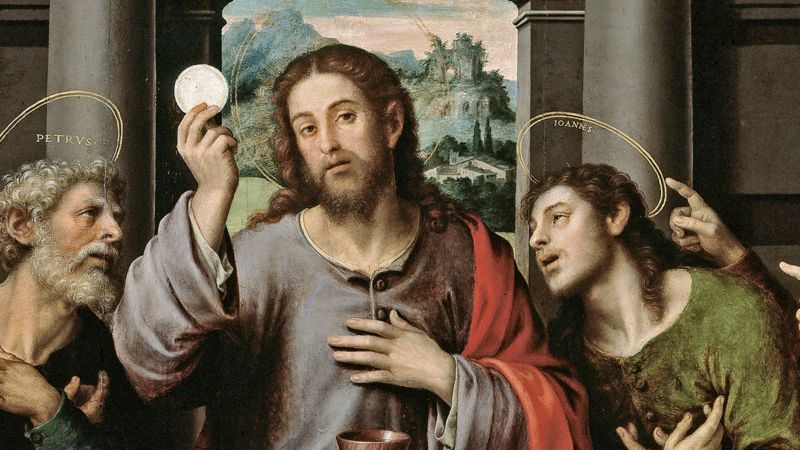
First, a definition: "Holy Communion" is the reception of the
Blessed Sacrament (the Eucharist) that has been confected by a priest
during the Holy Mass. The Blessed Sacrament may only be received
sacramentally by one who:
- is a living
human being
- is baptized
- has proper intent
- has fasted the proper amount of time: 3 hours is
the 1962 practice that most traditional Catholics follow (some follow
the older practice of a 12-hour fast); 1 hour is what we are
canonically bound to by the 1983 Code of Canon Law. Viaticum -- the
"Food for the Journey" given during Extreme
Unction -- may be given at any time.
- is in a state of
grace, i.e., is not in a state of mortal sin. If one is in a state of
mortal sin, he must go to Confession first
lest he sin further as St. Paul warns in I Corinthians 11:26-30:
Therefore
whosoever shall eat this bread, or drink the chalice of the Lord
unworthily, shall be guilty of the body and of the blood of the Lord.
But let a man prove himself: and so let him eat of that bread, and
drink of the chalice. For he that eateth and drinketh unworthily,
eateth and drinketh judgment to himself, not discerning the body of the
Lord. Therefore are there many infirm and weak among you, and many
sleep.
In addition,
because Communion is also a sign of Christian unity, those who receive
are declaring to the world that they accept all of the dogmas of the
Church. Canon 915 of the 1983 Code of Canon Law affirms the Apostolic
practice of the Church in insisting that priests refuse Communion to
those who are "manifest, obstinate, persistent sinners" -- i.e., those
who are public sinners (which includes those who publicly disagree with
Church teaching) who refuse to publicly repent -- lest they cause
scandal and confuse others as to what Church teaching is. Those who
disagree with what the Church teaches should not try to receive
Communion.
Summary: one in grave sin is to police himself and refrain from
receiving Communion until he's received the Sacrament of Penance. If he
fails to, his spiritual father is to advise him, if possible, in order
to make him
aware of his sin and of the added sin of receiving Communion while not
in a state of grace. If, after being advised by his spiritual father,
he still fails to police himself, he may be refused
the Eucharist if (and only if) the grave sin is a public one (e.g., if
he is a heretic or schismatic, if he publicly sins and doesn't publicly
repent, if he publicly proclaims positions contrary to the Faith,
etc.). Private sins are between the individual, his priest, and God. A
priest can't refuse Communion to someone who is guilty of grave sin
done privately because a priest can't publicly reveal the private sins
of anyone.
The Eucharist
must be received at least once a year, during the Easter Season, by
those who've reached the age of reason, though frequent -- even daily
-- Communion is encouraged. Traditionally, the Eucharist shouldn't be
received more than once a day unless it is given as Viaticum during Extreme Unction (the 1983 Code of Canon Law
strangely allows for a second reception of the Eucharist "only within a
eucharistic celebration in which that person participates.")
The matter of the Sacrament itself are wheat bread made only of flour
and water, with nothing added (no honey, no spices, etc; nothing may
be added; the use of leavening in the Latin Church is illicit) and wine
fermented from grape juice. The former is confected by God through a
true priest using the words:
This is My Body
Latin:
Hoc est enim Corpus Meum.
The latter is
confected by the words "this is the Chalice of My Blood," which are
spoken in the below context in the traditional Mass:
For this is the
Chalice of My Blood, of the new and eternal Testament: the Mystery of
Faith: which shall be shed for you and for many unto the remission of
sins
Latin:
Hic est enim Calix Sanguinis mei, novi et aeterni testamenti: mysterium
fidei: qui pro vobis et pro multis effundetur in remissionem peccatorum.
After the
substance of bread and wine are changed into His Body and Blood, the
accidents -- the appearance, taste, texture of bread and wine --
remain, but what looks like "bread" and "wine" are, in substance,
the Body, Blood, Soul, and Divinity of Christ. In other words, outside
of Eucharistic miracles which have taken
place over 2,000 years, what
the eyes and mouth see and taste are the accidents of "bread"
and "wine," but what is truly received is Christ and remains
Christ until and unless the accidents change such that they are no
longer compatible with the species of "bread" and "wine." By this we
know, for example, that once the Host goes into one's stomach and is
digested, or if a liquid were added to the Precious Blood such that the
accidents are no longer recognizable as the accidents of "wine," the
Sacrament is no longer there.
Because of the above, it is not okay to refer to the Blessed Sacrament
as "bread" or to the Precious Blood as "wine." Once the bread and wine
have been consecrated, they are no longer "bread" and "wine"; they are
Christ -- Body, Blood, Soul, and Divinity, and the proper words to use
to speak of them are "Blessed Sacrament," "Eucharist," "Precious
Blood," "Sacred Host" ("Host" comes from the Latin word "hostia"
meaning "victim"), etc. The consecrated Hosts and Precious Blood are
and will remain Christ regardless of the faith of the people in the
pews. They are and will remain Christ whether on the Altar or in the
tabernacle or in your mouth or, God forbid, on the floor. They are and
will remain Christ for ten years or a thousand years, as long as the
accidents of bread and wine remain.
That said, note that the accidents
of bread and wine remain even as their substance changes. And the
accidents of bread might mold, the accidents of wine might sour, and so
forth, even though Christ is truly present. So please note: those who
think that receiving Communion incorrectly or if the accidents were to
become contaminated brings no risk of
transmission of a virus or bacteria -- say, for ex., if two or more
people were to drink the Precious Blood from the same chalice -- are
wrong.
The Precious Blood is always consumed totally by the priest at the
Mass, and the priest will always consume one Sacred Host, distributing
others to the people, if present. Remaining Hosts are kept in a ciborium inside the tabernacle between Masses,
and this Divine Presence is signalled to us by the sanctuary
lamps that burn always outside the tabernacles of our churches and
invite us to adore Him and be
in His Presence to pray.
The effects of receiving the Sacrament are:
- union, by love,
with Christ
- an increase in
sanctifying grace in the soul when received by a "living member of the
Church" (i.e., one who is in a state of grace)
- the blotting out
venial sin and preserving the soul from mortal sin, in proportion to
the communicant's devotion
- the rewards
promised by Christ in His words, "He that eateth My Flesh and drinketh
My Blood, hath everlasting life: and I will raise him up on the last
day."

The most proper
way
to receive the Blessed Eucharist at the altar rail at Mass is to kneel,
keep your eyes downcast,
and fold your hands in the "prayer" gesture at about mid-chest level,
no higher
(or place them under the
houseling cloth at the altar rail, if such a cloth is used; don't touch
the cloth or the rail in either case). When the priest reaches you and
it is time for you to receive Christ, an acolyte or altar boy will
hold a paten underneath your chin so that no precious particles will
fall to the floor. The priest will bless you by making a Sign of the
Cross with the Sacrament (a small one in the air) and then place the
Sacrament on your tongue, all while saying these words:
|
Corpus Dómini
nostri Jesu Christi custódiat ánimam tuam in vitam æternam. Amen.
|
May the Body of
Our Lord Jesus Christ preserve your soul unto life everlasting. Amen.
|
Tilt your head
backwards slightly (say twenty degrees), open your mouth, stick out
your tongue far
enough so the priest can place the Host on your tongue, and don't move
at all. Many priests recommend closing your eyes when receiving so
that you're not tempted to follow your priest's hand. And, of course,
don't close your mouth until the Host is safely on
your tongue and the priest's hand is out of the way. Don't say "Amen"
or anything else after receiving. Just make the Sign
of the Cross, then
return to your pew and kneel in thanksgiving (many people cover their
faces with their hands or veils at this time to increase a sense of
intimacy).
Please note that the Eucharist is not chewed, but is allowed to soften
in the mouth and then swallowed. 1
This is to avoid having the smallest particle stuck in one's teeth
where it might be desecrated later by coming into contact with the
profane. Having the very Body, Blood, Soul, and Divinity of Christ
mingle with a gulp of Mountain Dew is hardly the treatment He deserves
-- but pondering the very possibility of such a thing is to induce
gratitude for the amazing humility with which He comes to us under the
appearance of bread; why, if He were to come to us in a way that
revealed His glory to our senses, we would no doubt die from being in
the Presence of such obvious Holiness.
If, God forbid, the Host is dropped, don't move or say anything. The
priest and acolytes will move into action, retrieving every particle.
Everything will stop until this work is finished. Just stay in place.
To help prevent one source of accidents like this, if you're carrying a
baby when you receive, hold the child's hands when the priest is giving
you Communion.
The Eucharist should never be touched but by consecrated hands (i.e.,
the hands of a priest, who is the ordinary minister of the Sacrament,
or of a delegated deacon, who is the extraordinary minister of the
Sacrament) unless emergency or true charity dictate otherwise,
and women should have their heads covered
whenever they are in His Presence -- whether during simple visits to a
church where the tabernacle is, during sick
calls or Unction, during Eucharistic processions, and when
receiving
the Eucharist at Mass.
In the Novus Ordo, many non-Catholics and Catholics who aren't
receiving Communion will go up to the priest with arms crossed in order
to receive a priestly blessing. This isn't done during the traditional
Mass. If you're not receiving, just remain in your pew.
A beautiful, traditional, partially indulgenced
prayer to pray after receiving Communion is the "Anima Christi" (Soul
of Christ) -- a favorite prayer of St. Ignatius of Loyola. The origins
of this ancient prayer are unknown, but it dates to at least
A.D. 1334.
|
Anima Christi
|
Soul of Christ,
sanctify me.
Body of Christ, save me.
Blood of Christ, inebriate me.
Water from the side of Christ, wash me.
Passion of Christ, strengthen me.
O good Jesus, hear me.
Within Thy wounds, hide me.
Separated from Thee let me never be.
From the malignant enemy, defend me.
At the hour of death, call me.
To come to Thee, bid me,
That I may praise Thee in the company
Of Thy Saints, for all eternity. Amen. |
|
Anima Christi,
sanctifica me.
Corpus Christi, salva me.
Sanguis Christi, inebria me.
Aqua lateris Christi, lava me.
Passio Christi, conforta me.
O bone Iesu, exaudi me.
Intra tua vulnera absconde me.
Ne permittas me separari a te.
Ab hoste maligno defende me.
In hora mortis meae voca me.
Et iube me venire ad te,
Ut cum Sanctis tuis laudem te
in saecula saeculorum. Amen. |
When offering
the Eucharist outside of the Mass (such as during sick calls or
Unction), the priest should wear a surplice and stole. If the
communicant (the one receiving Communion) is able to kneel, he should;
if he is bedridden, a white linen cloth should be laid over his breast
to ensure no particles fall and are desecrated. If one is unable to
receive the Host, the priest may arrange for some of the Precious Blood
to be given instead. Under either species -- i.e., either the Host or
the Precious Blood -- the Sacrament is "the entire Christ" -- Body,
Blood, Soul, and Divinity, so one should never feel as though one is
being "deprived" by receiving Christ in one form rather than the other.
Also note the language used in reference to Holy Communion: while many
Protestants speak of "taking Communion," Catholics use the phrase
"receiving Communion" -- a more passive terminology that emphasizes
humility, that reminds us that it is by grace that we are saved, and
that emphasizes the role of the ordained priesthood.
First Communion
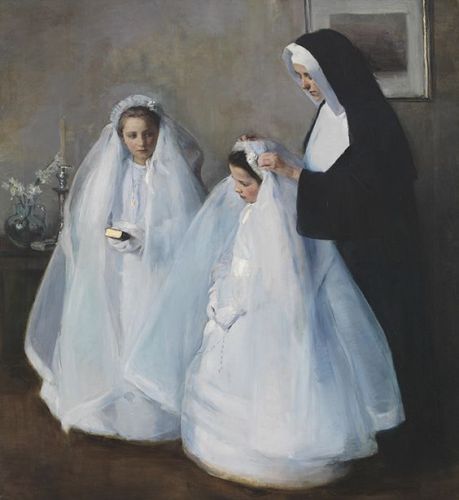
If one enters the Church as an adult, First Communion is
usually given on the same day of Baptism
and Confirmation (which both take
place, typically but not necessarily, during the Easter Vigil).
If one grows up in the Church, First Communion is offered at the
discretion of one's priest. It may be given to a lone child after the
priest has discerned that the child understands the Sacrament and is
able to form proper intent, or it may be given to a group of children
who've been properly prepared together, such as a first grade class. In
either case, the Sacrament of Confession is
received first before Communion.
Little boys will dress in their finest suits and each wear a white
rosette pinned to their lapels, and little girls will often wear
special white First Communion dresses and veils (their dresses should
fit the rules of feminine modesty in Church -- nothing sleeveless,
etc.). On a mundane, sociological level, a child's "First Communion" is
a rite of passage, an acknowledgement that he has reached the age
of reason and is now liable for many of the penalties involved in
ecclesiastical censure; it is, in other words, a marker that the child
is growing up...
Gifts are given to the new communicant (typically
Rosaries, prayer books, Bibles, etc.), and a party typically follows
the Mass during which he first receives the Sacrament. These mundane
aspects of a child's "First Communion" should never overshadow
the greater reality! In some parts of the world, a child's First
Communion is turning into a lavish, extravagant,
keeping-up-with-the-Joneses bat-mitzvah, with little girls, wearing
dresses that cost hundreds and hundreds of dollars, carried about by
limousine to parties with expensive ice sculptures and la-di-da waiters.
It is disgusting!
While a child's First Communion should be memorable and very
beautiful, it should, above all, be holy and with all
priorities in place. On the more fundamental and profound level, First
Communion is an initiation into one of the Great Mysteries. Parents
should prepare the child by firmly grounding him in basic catechesis.
While it's the priest's decision as to whether or not your child is
adequately prepared, it is your job as a parent or godparent to do the
preparing; it is the parents and godparents who are ultimately
responsible for the Catholic education of the child. The child
should understand what transubstantiation is. He should know that God,
Who created all things -- the Sun and Moon and Stars -- is able to
speak things into reality, and that at the Mass, this is what God,
through His priest does. The child should understand that though the
accidents of bread and wine remain, what the bread and wine truly
become is Sacrament. He will learn all of this best by watching
the adults around him, especially parents and godparents, who should
ask themselves:
- Do I treat and
speak of the Blessed Sacrament with reverence?
- Do I kneel
toward the tabernacle when I enter a church?
- Do I bow my head and cross
myself when passing by a church to honor the Real Presence of
Christ in the tabernacle?
- Do I fast before receiving Communion?
- Am I sure to
never receive the Sacrament in a state of mortal sin?
- Do I make visits to the Blessed Sacrament?
- Do I allow the
children to attend a parish in which lay people sacrilegiously handle
the Sacrament as "extraordinary Eucharistic ministers"?
- Do I allow the
children to attend Masses wherein the rubrics and prayers after
consecration destroy faith in the Real Presence?
- Do I attend
Protestant worship services? If I do, for the cause of charity, do I go
through the motions of receiving "communion" at the services of
Protestant faith communities? (Catholics may not attend Protestant
services except for attending weddings in which neither of the couple
had ever been Catholic, and attending funerals, which Catholics may
certainly attend out of charity. Never may a Catholic eat the
bread/crackers or drink the wine/juice offered during the services, and
in no case may he join in prayers that are in no way Catholic.)
Your children
will learn more from your example than anything else.
As to preparation for the Rite itself, parents and godparents should
consider the natural intimidation that most children experience in such
formal circumstances (especially if the child is receiving his First
Communion alone) and affirm
their child emotionally, letting them know it's OK to be nervous. A
"practice-run" with everyday, ordinary bread might be helpful, 2 with the parent or godparent showing
the child the proper posture and gesture. Anticipate the child's
questions ("What will it taste like?" for example) and encourage the
child to express any concerns and fears he might have. Teach him to
pray the sentiments expressed in the Anima Christi prayer, if not the
prayer itself, after receiving the Host. Perhaps getting a holy card that contains this prayer, or
writing the prayer out for him on a small piece of paper so he can
refer to it after Communion will help.
I'll note here, too, that Pope St. Pius X, the "Pope of the Eucharist,"
is one of the patrons of First Communicants as it was he who especially
encouraged frequent and early Communion -- as soon as a child is able
to understand the Sacrament -- in the Latin Church. Teach your child
about this great Pope and encourage him to pray to him, asking St. Pius
X to intercede in making your child's First Communion most fruitful.
One standard prayer to this holy man is this one, the first part of
which is most appropriate to the day:
Glorious Pope of
the Eucharist, St. Pius X, who sought to restore all things in Christ,
obtain for me a true love of Jesus that I may live only for Him. Help
me, that, with lively fervour and a sincere will to strive for sanctity
of life, I may daily avail myself of the riches of the Holy Eucharist
in Sacrifice and Sacrament. By your love for Mary Mother and Queen of
all, inflame my heart with tender devotion to her.
Blessed model of the priesthood, obtain for us holy and zealous priests
and increase vocations to the religious life. Dispel heresy and incline
hearts to peace and concord, that all nations may place themselves
under the sweet reign of Christ. Amen.
St. Pius X, pray for me.
Another patron
of First Communicants is Blessed Imelda Lambertini (A.D. 1322-1333),
who died while receiving her First Holy Communion. Very much in love
with Jesus, she'd begged her family to let her live at the Dominican
convent at the age of nine. Her family relented, as did the Dominicans,
but she still could not yet receive Communion. She longed for it,
however, and watching the Sisters receiving Our Lord, would pray for spiritual Communion. One day -- it was
the Vigil of the Ascension --
she was making her spiritual Communion, and the Sisters saw a beautiful
light glowing over her, and a Host at the center of it, hovering above
her head. The priest was summoned, and Imelda received the Eucharist at
once -- but in such an ecstasy that she literally died of love. Her
relics can be venerated in the Church of Saint Sigismondo in Bologna.
Italy (see relics page for a picture). Pope
St. Pius X made her a Patroness of First Communicants. Here, in pdf
format, is the story of Blessed Imelda for
your children. Use
your discretion, as the story might frighten young ones who don't
understand death and ecstasies.
Footnotes:
1 If you take medications that dry
the mouth, or otherwise lack enough saliva to swallow the Host without
chewing, go ahead and chew. We're not Pharisees.
2 A little American
Catholic cultural trivia: some Catholic schools used to teach their
First Communion classes using NECCO ® Wafers candies made by the New
England Confectionery Co. (hence the name "NECCO") as "hosts" for
practice.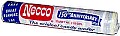 Catholic
children often use them to "play Mass," too, and many a priest has
memories of using the candies that way as a child. The chalky-sweet
wafers come in 8 flavors, all mixed in a single roll: lemon (yellow);
orange (orange); lime (green); clove (purple); cinnamon (white);
wintergreen (pink); licorice (black); and chocolate (brown). The New
England Confectionery Company, by the way, is the same company that
makes "Mary Janes" and "Conversation Hearts" -- those little hearts,
created in 1866 and imprinted with love messages such as "Be Mine" or
"Kiss Me," that are sold for St.
Valentine's Day. Catholic
children often use them to "play Mass," too, and many a priest has
memories of using the candies that way as a child. The chalky-sweet
wafers come in 8 flavors, all mixed in a single roll: lemon (yellow);
orange (orange); lime (green); clove (purple); cinnamon (white);
wintergreen (pink); licorice (black); and chocolate (brown). The New
England Confectionery Company, by the way, is the same company that
makes "Mary Janes" and "Conversation Hearts" -- those little hearts,
created in 1866 and imprinted with love messages such as "Be Mine" or
"Kiss Me," that are sold for St.
Valentine's Day.
|
|