Posture and Gesture
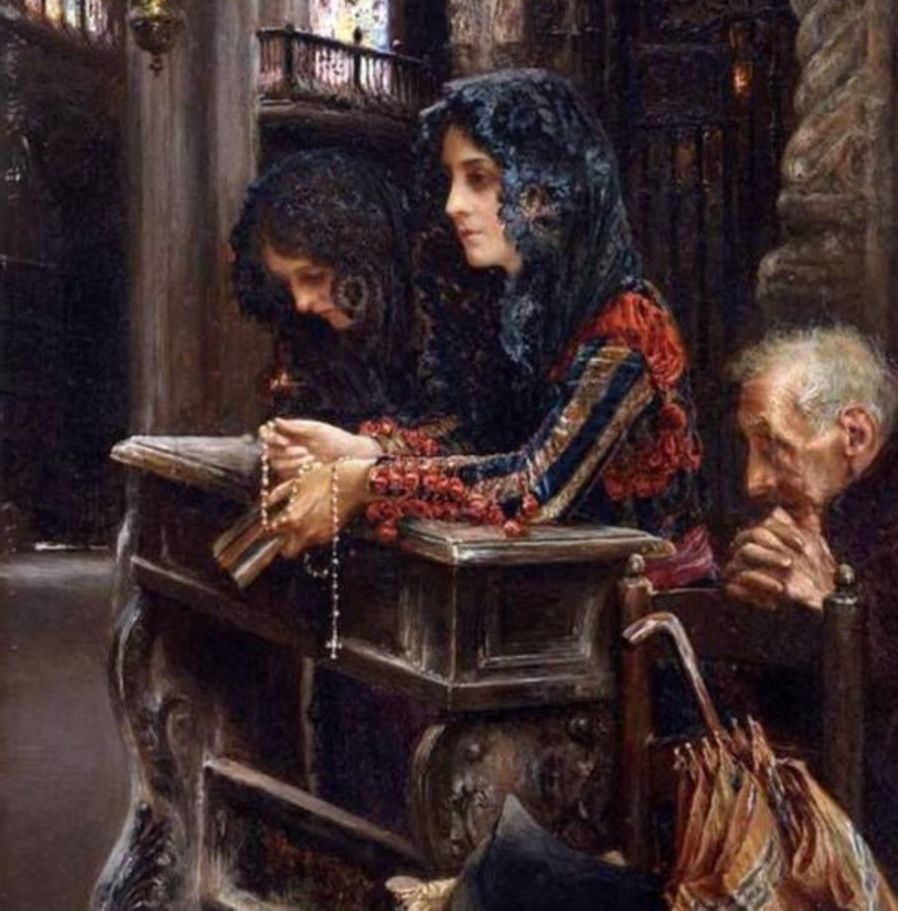
In a speech Delivered at the Twelfth Convention of the
Fellowship of Catholic Scholars in Philadelphia, Pennsylvania, John M.
Haas spoke of how certain Catholic practices made such an impression on
him when he was still a Protestant. He wrote of how the "adverting to
Our Lord" manifest in the Catholic custom of bowing the head in honor
of the Real Presence when passing a Catholic church affected him:
And other
Catholics could surely add innumerable other [Catholic practices]: some
silly, some profound, some a source of comfort, others the source of
light-hearted humor. Catholic practices make up the daily life of a
Catholic individual and a Catholic society. The morning offering, the invocation of
Jesus, Mary and Joseph, the sprinkling of holy
water on children at bedtime, the incantation to Saint Anthony
("Tony, Tony, come around; something's lost and can't be found"), the
pleas to Saint Jude to prevent a bankruptcy, the novenas
for a sick spouse. All of these many practices fill the lives of the
faithful, enrich, comfort and orient them. Often it is difficult to
trace their origin. Often the ones which seem most intimate and natural
to a people were never even introduced by ecclesiastical authority.
They emerged as natural, faith-filled expressions of love or joy or
thanksgiving or grief or desperation.
The one characteristic these Catholic practices all seem to
share is their ability to turn people away from the mundane, the
worldly, the everyday, and direct them toward the sacred, the
transcendent, the eternal. One could be travelling on the streetcar in
Pittsburgh thinking about how to make new sales contacts or how to
position oneself to meet the new girl in the office when suddenly, on
the part of a half-dozen people, there was an adverting to another
reality, another dimension, not separate from this realm, but
permeating it, leavening it, making sense of it. Perhaps the adverting
to Our Lord in the Blessed Sacrament by those on the street car was
only fleeting, with virtually no break in the train of thought
regarding increasing sales or meeting the new girl. But the adverting
took place; Our Lord was acknowledged; and implicitly at least, the
statement was made that increased sales was no end in itself and any
future wife would, one would hope, be married in the Lord.
Below are
instructions on some of these ways of "adverting to Our Lord" by the
use of posture and gesture...
|
|
Bow of
the
head (or "simple bow")
|
|
How:
|
- Simply lower
your chin toward your throat and hold a moment
|
|
When:
|
- When you pass by
a Church, bow your head and make the Sign of the
Cross to honor the Real Presence of Christ in the tabernacle.
- Any time
you hear or say the Holy Name "Jesus"
(note that
"Christ" is His title, meaning
"Annointed One"; there is no need to bow the head at just the mention
of the word "Christ"). Men should remove their hats and bow their heads
when passing a church or when His Name is spoken; this practice is for
both inside and outside of Mass. All Catholics bow their heads at these
times (yes, if you're having a casual conversation with someone on the
subway and you pass a church or mention His Name, you actually are
supposed to bow your head, removing your hat if you are a man). 1
- Before Mass:
when the priest and Crucifer (the acolyte bearing the Cross) walk down
the aisle
During Mass: any time you
hear "Father, Son, and Holy Ghost (or
"Holy Spirit")" mentioned together, or any time you hear the word
"Trinity"; when hearing the name of Mary; and when hearing the name of
the
Saint in whose honor the Mass is
being celebrated.
After Mass: as
the priest leaves the Altar (some make a profound bow). It
is also customary to pray for him at this time.
|
|
Striking
of
the Breast
|
|
How:
|
- With either a
fist or with the tips of the fingers, held close together, strike your
chest over the heart to express regret and sorrow2
|
|
When:
|
- at the Mass,
formally: at each "mea culpa" during the Confiteor; at the Nobis Quoque
Peccatoribus (priest); three times during the Agnus Dei; and three
times during the Domine, Non Sum Dignus
- informally, at
the "forgive us our trespasses" ("dimitte nobis debita nostra") in the
"Our Father"
- informally, any
time to express penitence or remorse inside or
outside of the Liturgy
- informally, when
the bells are rung at Consecration and the Host or Chalice are raised,
bow the head and strike the breast three times. The mental prayer at
this moment should be, "My Lord and my God."
|
|
Bow at
the
waist (or "profound bow")
|
|
How:
|
- Bow at the waist
in the manner of the Japanese (about 30o forward)
|
|
When:
|
- at the Aspérges
at Mass when the priest sprinkles the congregation with holy water
- when the Altar
boy incenses the congregation during the
Mass
- Cross yourself and make a profound bow when the
priest and Crucifer walk down the aisle before and after Mass. After
Mass, as the priest leaves the Altar, it is also customary to pray for
him. (Some simply bow the head instead of making a profound bow at
these times)
- when greeting a
hierarch who doesn't have jurisdiction over you (e.g., the Bishop of a
diocese other than one in which you live). As you bow, kiss the
hierarch's ring. This bow and ring-kissing are only done if the Pope is
not present.
|
|
Genuflection
on Left Knee
|
|
How:
|
Kneel on your left knee for a moment, bringing the left knee
all the way to the floor and keeping the back straight. Hold for a
moment, then stand. (The word is pronounced "jen-you-flek'-shun") |
|
When:
|
- When greeting or
leaving the Pope or other hierarchs with the
rank of Bishop or above and who have jurisdiction over you (only when
the Pope is not present) -- e.g., to the Bishop or Archbishop of your
diocese, not of a neighboring diocese. During the left-knee
genuflection, a kiss is given to the hierarch's ring. Then stand. This
honor is being shown to their office, not to them as persons.
|
|
Genuflection
on Right Knee
|
|
How:
|
- Looking at what
you are genuflecting toward, kneel on your right knee for a moment in
the manner of a man proposing to a woman, bringing the right knee all
the way to the floor, close to the heel of the left foot, keeping the
back and neck erect. Hold for a moment, then stand.
|
|
When:
|
- Genuflect toward
the Tabernacle where the Blessed Sacrament is reserved, and each time
you pass in front of it (except when you're in procession, such as
standing in line for Communion, or returning to your seat afterward).
While this should, on one level, be a matter of habit, it shouldn't be
done thoughtlessly. Remind yourself when genuflecting toward the
Tabernacle that you are kneeling before God. Praying mentally, "My Lord
and My God" is a good habit to get into while genuflecting on the right
knee. If the Tabernacle is not on the Altar, genuflect toward the Altar
and the Altar Crucifix.
- Before a relic
of the True Cross when it is exposed for public adoration.
- On Good Friday
to Holy Saturday, after the ceremony of the Adoration of the Cross,
genuflect when passing in front of the exposed Crucifix on the Altar.
- Before entering
or after exiting your pew at church, while facing toward Christ in the
tabernacle.
|
|
Kneeling
(Double Genuflection)
|
|
How:
|
- Kneel on both
knees
|
|
When:
|
- any time the
Blessed Sacrament is exposed, to show adoration and humility
- many times
during the Mass: during the Prayers at the Foot of the Altar, after the
Sanctus, after the Agnus Dei, at the altar rail when receiving
Communion, and at the Last Blessing
- during Confession, inside or, in emergencies, outside
of the Confessional
- when receiving a
priestly blessing, inside or outside of the Liturgy. If you are unable
for some reason to kneel, then bow your head.
- during private
prayer (see St. Dominic's "Fourth Way""
of prayer)
|
|
Prostration
|
|
How:
|
- Keeping your
legs together, drop to your knees and then lie down flat on the floor
on your face, crossing your hands underneath your forehead forming a
"pillow" on which to rest your forehead
|
|
When:
|
- Prostrations,
which signify total humility and penance, are
made during the Rite of Ordination,
during rites of religious profession (i.e., entry into religious
orders), as penance in religious orders, and by anyone during private
prayer before a Crucifix or the Blessed Sacrament. It is also
occasionally made by adults, at the priest's invitation, before the
Profession of Faith in the solemn Rite of
Baptism. (See St. Dominic's "Second
Way" of prayer)
|
|
Kisses
|
|
How:
|
- To paraphrase
Lauren Bacall in "To Have and Have Not," you know how to kiss, don't
you? You just put your lips together... but don't blow.
|
|
When:
|
- Kissing Crucifixes and Icons
(2-D or 3-D): In icons that depict more than one person, kiss first Our
Lord (His Feet, Hem of His garment, or hands), then Our Lady (her hands
or veil), then the angels and Saints. To reverence a Crucifix or
icon that you can't reach too well with your lips, kiss your fingers
and then touch where you would kiss.
- Many Catholics
kiss the Bible before opening and reading.
- Kissing rings of
Bishops and Popes: see above under "Genuflection on Left Knee." The
kissing of rings ("baciamano") is to honor the office the ring-wearer
holds, not
their person. The Pope's ring -- called “the fisherman’s ring” -- has
been used as far back as the 13th century. The signet on the ring was
used as a seal to press into wax used to enclose papal documents. Each
Pope has his own ring, which is destroyed after his death.
- Kissing a
priest's hands (literally "baciamano"): the priest's hands may be
kissed when greeting or
leaving him because they alone are able to confect the Holy Eucharist.
This is an honor being shown to Holy Orders,
not to them as persons.
Priests' hands are also kissed on Palm Sunday when receiving a palm (which is also kissed). During the
Mass, the priest's hands are kissed by the acolytes/altar boys.
|
|
Orans
|
|
How:
|
- Raise arms
either at your sides and with hands up to shoulder height, or raise
arms up over your head as a child would when wanting his father to pick
him up
|
|
When:
|
- Priests
perform this gesture (the first method mentioned) during the Mass.
- Laymen
sometimes adopt this position during private prayer. It should
not be used by laymen at the Mass. (See St. Dominic's "Seventh Way" of prayer) 3
|
|
Also, see the
special page on the Sign of the Cross
which will teach you about the different Signs of the Cross and when,
where, and how they are made.
For more information on when to kneel, etc., during Mass, see the Order of the Mass page. For an
interesting work that shows how St. Dominic used posture in prayer, see
"The Nine Ways of Prayer of St. Dominic."
Footnotes:
1 The custom of
bowing the head at the mention of His Name was formally written into
law at the Second Council of Lyons, A.D. 1274, convened by Pope Gregory
X: "Those who assemble in church should extol with an act of special
reverence that Name which is above every Name, than which no other
under Heaven has been given to people, in which believers must be
saved, the Name, that is, of Jesus Christ, Who will save His people
from their sins. Each should fulfil in himself that which is written
for all, that at the Name of Jesus every knee should bow; whenever that
glorious Name is recalled, especially during the sacred Mysteries of
the Mass, everyone should bow the knees of his heart, which he can do
even by a bow of his head."
A religious Sister told me once that "back in the day," Catholic
schoolkids would sometimes make a game of saying Our Lord's Name
as often as they could in order to force their teaching Sisters to bow
their heads. Apparently, getting the nuns' heads bobbing up and down
was a sport for the mischievous wee ones.
2
The Catholic Encyclopedia cites St. Augustine (A.D. 354-430)
as saying in his Sermo de verbis Domini, "No sooner have you
heard the word 'Confiteor' than you strike your breast. What does this
mean except that you wish to bring to light what is concealed in the
breast, and by this act to cleanse your hidden sins?"
It also cites St. Jerome (ca. A.D. 340-420) as saying in Ezechiel, c.
xviii, "We strike our breast because the breast is the seat of evil
thoughts: we wish to dispel these thoughts, we wish to purify our
hearts."
3 The orans position is frequently
depicted in the art of the Catacombs where figures praying in this
manner represented departed souls praying for the soul of the one whose
tomb the figures adorn. The Catholic Encyclopedia says, "Numerous
Biblical figures, for instance, depicted in the catacombs—Noah,
Abraham, Isaac, the Three Children in the Fiery Furnace, Daniel in the
lions' den—are pictured asking the Lord to deliver the soul of the
person on whose tombs they are depicted as He once delivered the
particular personage represented." It goes on to say that in addition
to the Biblical Orans figures, there are idealized figures in that
"ancient attitude of prayer" which symbolize the soul of the entombed
one in heaven, praying for its friends on earth. "This symbolic meaning
accounts for the fact that the great majority of the figures are
female, even when depicted on the tombs of men."
|
 Back to Being Catholic Back to Being Catholic
Index
|

