|
For the Christian, water, as the matter of Baptism, is life. Tertullian
(b. 160), making a play on words based on the Greek acrostic ICQUS , or Ichthys, meaning "fish" and
indicating "Jesus Christ, Son of God, Saviour", wrote in "De
Baptismo,""But we, little fishes, after the example of our Ichthys
Jesus Christ, are born in water, nor have we safety in any other way
than by permanently abiding in water; so that most monstrous creature,
who had no right to teach even sound doctrine, knew full well how to
kill the little fishes, by taking them away from the water!" In the
same treatise, he wrote of water's symbolism:
"In the first
beginning," saith Scripture, "God made the heaven and the earth. But
the earth was invisible, and unorganized, and darkness was over the
abyss; and the Spirit of the Lord was hovering over the waters." The
first thing, O man, which you have to venerate, is the age of the,
waters in that their substance is ancient; the second, their dignity,in
that they were the seat of the Divine Spirit, more pleasing to Him, no
doubt, than all the other then existing elements. For the darkness was
total thus far, shapeless, without the ornament of stars; and the abyss
gloomy; and the earth unfurnished; and the heaven unwrought: water
alone -- always a perfect, gladsome, simple material substance,pure in
itself -- supplied a worthy vehicle to God.
He continues:
See how many
then are the advocacies of nature, the special provisions of grace, the
customary observances of conduct, the types, the preparations in act or
word, which have laid down the rule for the sacred use of water. The
first, that when the people of Israel are set free from bondage in
Egypt and by passing through the water are escaping the violence of the
Egyptian king, the king himself with all his forces is destroyed by
water. This is a type made abundantly clear in the sacred act of
baptism: I mean that the Gentiles are set free from this present world
by means of water, and leave behind, drowned in the water, their
ancient tyrant the devil.
Secondly, water is healed of the blemish of bitterness, hand restored
to its own sweet usefulness, by the tree Moses throws in: and that tree
was Christ, who from within Himself heals the springs of that nature
which was previously poisoned and embittered, converting them into
exceedingly healthful water, that of baptism. This is the water which
flowed forth for the people of Israel from the rock that followed them:
and as that rock was Christ, without doubt this shows us that baptism
is made blessed in Christ by water. See how great is the grace that
water has in the presence of God and His Christ for the corroboration
of baptism.
Wherever Christ is, there is water: He himself is baptized in water:
when called to a marriage He inaugurates with water the first rudiments
of His power: when engaged in conversation He invites those who are
athirst to come to His everlasting water: when teaching of charity He
approves of a cup of water offered to a little one as one of the
worksof affection: at a well-side He recruits His strength: He walks
upon the water, by His own choice He crosses over the water, with water
He makes Himself a servant to His disciples. He continues His witness
to Baptism right on to His Passion: when He is given up to the Cross
water is in evidence, as Pilate's hands are aware: when He receives a
wound water bursts forth from His side, as the soldier's spear can
tell.
St.
Hipplolytus(d. 236), in his Discourse on the Holy Theophany, writes of
water's excellence as an element, saying:
Good, yea, very
good, are all the works of our God and Saviour -- all of them that eye
seeth and mind perceiveth, all that reason interprets and hand
handles, all that intellect comprehends and human nature understands.
For what richer beauty can there be than that of the circle of heaven?
And what form of more blooming fairness than that of earth's surface?
And what is there swifter in the course than the chariot of the sun?
And what more graceful car than the lunar orb? And what work more
wonderful than the compact mosaic of the stars? And what more
productive of supplies than the seasonable winds? And what more
spotless mirror than the light of day? And what creature more excellent
than man?
Very good, then, are all the works of our God and Saviour. And what
more requisite gift, again, is there than the element of water? For
with water all things are washed and nourished, and cleansed and
bedewed. Water bears the earth, water produces the dew, water
exhilarates the vine; water matures the corn in the ear, water ripens
the grape cluster, water softens the olive, water sweetens the
palm-date, water reddens the rose and decks the violet, water makes the
lily bloom with its brilliant cups. And why should I speak at length?
Without the element of water, none of the present order of things can
subsist. So necessary is the element of water; for the other elements
took their places beneath the highest vault of the heavens, but the
nature of water obtained a seat also above the heavens. And to this the
prophet himself is a witness, when he exclaims, "Praise the Lord, ye
heavens of heavens, and the water that is above the heavens."
At the Creation,
"the spirit of God moved over the
waters," and then God "divided the waters that were under the
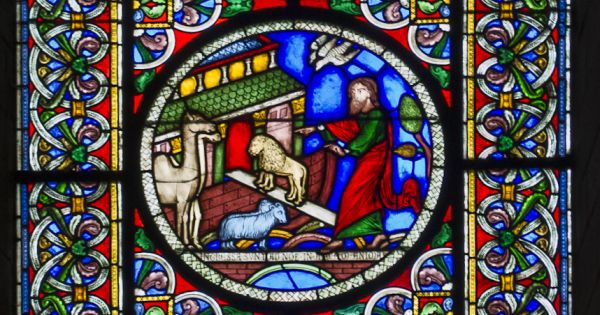
firmament, from those that were above the firmament." At the flood
survived by Noe and his family, this was reversed when "all the
fountains of the great deep were broken up, and the flood gates of
heaven were opened." The earth was cleansed by this deluge of water
-- and it was the Spirit (wind, "ruach") that caused the waters to
abate. Further foreshadowing Baptism, it was a dove that flew back to
the ark bearing an olive branch, signalling to Noe that the flood was
coming to an end. St. Peter makes this connection between the cleansing
effects of Noe's Flood and Baptism, when "the heavens opened, and the
Spirit as a dove descending" came upon Christ:
1 Peter 3:18-21
Because Christ also died once for our sins, the just for the unjust:
that he might offer us to God, being put to death indeed in the flesh,
but enlivened in the spirit, In which also coming he preached to those
spirits that were in prison: Which had been some time incredulous, when
they waited for the patience of God in the days of Noe, when the ark
was a building: wherein a few, that is, eight souls, were saved by
water. Whereunto baptism being of the like form, now saveth you also:
not the putting away of the filth of the flesh, but the examination of
a good conscience towards God by the resurrection of Jesus Christ.
St. Hippolytus
describes this beautifully in his Discourse, continued from above:
Nor is this the
only thing that proves the dignity of the water. But there is also
that which is more honourable than all -- the fact that Christ, the
Maker of all, came down as the rain, and was known as a spring, and
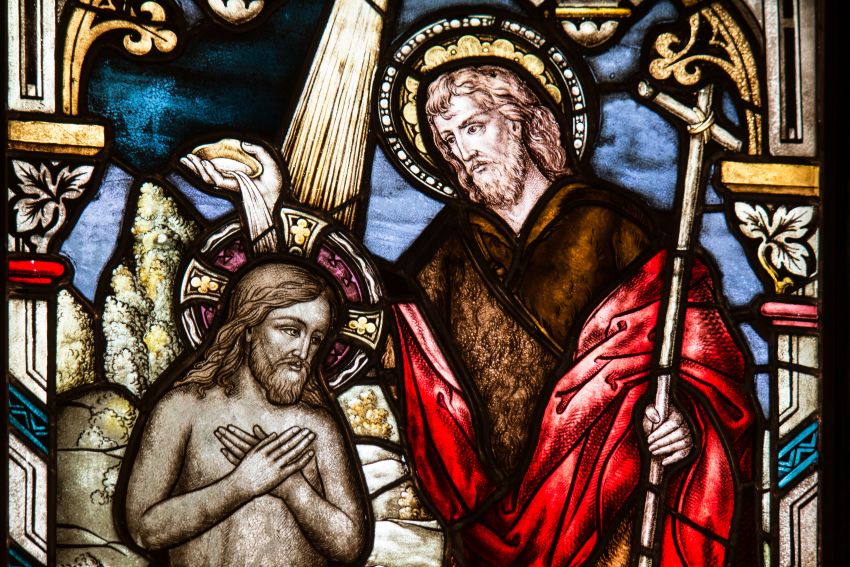
diffused Himself as a river, and was baptized in the Jordan. For you
have just heard how Jesus came to John, and was baptized by him in the
Jordan. Oh things strange beyond compare! How should the boundless
Rivers that makes glad the city of God have been dipped in a little
water! The illimitable Spring that bears life to all men, and has no
end, was covered by poor and temporary waters! He Who is present
everywhere, and absent nowhere -- Who is incomprehensible to angels and
invisible to men -- comes to the baptism according to His own good
pleasure.
The Spirit
appeared as a Dove over the waters of the Jordan on that day,
completing the symbolic connection between water and Spirit, and
proving the rightness and beauty of the Church's use of water in Her
rites.
The Use of Water in the Church
The ritual use
of this precious substance is ancient and rooted in the Old Testament.
When the Israelites entered the Temple, they had to undergo purifcation
by immersion in a mikvah (modern Jews still make use of mikva'ot on Yom
Kippur, on wedding days, for purification after menstruation or
cominginto contact with a dead body or semen, etc.). These ritual
purifications by water prefigured Christian Baptism, which we recall
when we bless ourselves (cross ourselves)
using holy water upon
entering our churches. Devoutly blessing one's self with Holy Water
remits venial sins.
When you enter a church, you might find a holy water font (or "stoup")
attached to the wall at one or both sides of each door, or you might
find a free-standing font. Simply dip the tips of the fingers of your
right hand into the water and cross yourself
while mentally contemplating the words, "In the name of the Father, and
of the Son, and of the Holy Ghost." Don't rush through this; make it
meaningful, remembering the meaning of your Baptism and mentally
expressing your gratitude to God. Many Catholics repeat this process
upon leaving the church, too. (Note: you might see one Catholic dip his
fingers into the Holy Water and touch fingers with another Catholic to
share it if that second Catholic can't reach the font comfortably).
This holy water is also used by the priest to sprinkle the people
before the beginning of Mass. He will have a pail-like vessel called an "aspersory" to hold the
holy water, and into this he will dip a stick called an "aspergillum"
(or an"aspergill"). The aspergillum has holes in it to catch droplets
of the water, and the priest's swinging it toward the congregation
causes the drops of water to fly out. This blessing of the congregation
before Mass is called "Aspérges" and the accompanying, chanted words
come from Psalm 50:
|
Aspérges
me,Domine, hyssopo, et mundabor: lavabis me, et super nivem
dealbador.Miserére mei, Deus, secundum magnam misericordiam tuam
|
Thou shalt
sprinke me, O Lord, with hyssop and I shall be cleansed; Thou shalt
wash me, and I shall become whiter than snow. Have mercy on me, O
God,according to Thy great mercy
|
Back in the day,
the herb rue (Ruta graveolens)
was used to do the sprinkling. Shakespeare alludes to this in Hamlet,
when Ophelia, mad with love and mourning her father, hands out flowers,
referring to rue as "grace o' Sundays." She says,
There’s
rosemary, that’s for remembrance; pray, love, remember;
and there is pansies, that’s for thoughts...
There’s fennel for you, and columbines;
here’s rue for you, and here’s some for me;
we may call it herb of grace o’ Sundays.
Holy water is
blessed on the Feast of the Epiphany
(January 6) and any time thereafter that holy water is needed.
First, the salt to be added to the water is
exorcized and blessed. Then the water itself is blessed with these
words:
| I exorcise thee
in the name of God the Father almighty, and in the name of Jesus Christ
His Son, our Lord, and in the power of the Holy Ghost, that you may be
able to put to flight all the power of the enemy, and be able to root
out and supplant that enemy and his apostate angels; through the power
of our Lord Jesus Christ, who will come to judge the living and the
dead and the world by fire |
Exorcizo
te,creatura aquĉ, in nomine Dei Patris omnipotentis, et in nomine Jesu
Christi, Filii ejus Domini nostri, et in virtute Spiritus Sancti:
utfias aqua exorcizata ad effugandam omnem potestatem inimici, et
ipsuminimicum eradicare et explantare valeas cum angelis suis
apostaticis, per virtutem ejusdem Domini nostri Jesu Christ: qui
venturus estjudicare vivos et mortuos et sĉculum per ignem. |
| God, Who for the
salvation of the human race has built your greatest mysteries upon this
substance, in your kindness hear our prayers and pour down the power of
your blessing into this element, prepared by many purifications. May
this your creation be a vessel of divine grace to dispel demons and
sicknesses, so that everything that it is sprinkled on in the homes and
buildings of the faithful will be rid of all unclean and harmful
things. Let no pestilent spirit, no corrupting atmosphere, remain in
those places: may all the schemes of the hidden enemy be dispelled. Let
whatever might trouble the safety and peace of those who live here be
put to flight by this water, so that health, gotten by calling Your
Holy Name, may be made secure against all attacks. Through Our Lord
Jesus Christ, Thy Son, Who liveth and reigneth with Thee in the unity
of the Holy Ghost, God, world without end. Amen. |
Deus, qui
adsalutem humani generis maxima quĉque sacramenta in aquarum
substantiacondidisti: adesto propitius invocationibus nostris, et
elemento huic,multimodis purificationibus prĉparato, virtutem tuĉ
benedictionisinfunde; ut creatura tua, mysteriis tuis serviens, ad
abigendos dĉmones morbosque pellendos divinĉ gratiĉ sumat effectum; ut
quidquid indomibus vel in locis fidelium hĉc unda resperserit careat
omniim munditia, liberetur a noxa. Non illic resideat spiritus
pestilens,non aura corrumpens: discedant omnes insidiĉ latentis
inimici; et siquid est quod aut incolumitati habitantium invidet aut
quieti,aspersione hujus aquĉ effugiat: ut salubritas, per invocationem
sanctitui nominis expetita, ab omnibus sit impugnationibus defensa.
PerDominum nostrum Jesum Christum filium tuum, qui tecum vivit et
regnatin unitate Spiritus Sancti, Deus, per omnia saecula saeculorum.
Amen.
|
A very important note: Know that the exorcism and the actual
blessing of water is
omitted in the new rite, just as they've been removed from the blessing
of salt. Also note that water taken directly
from the Jordan River, the river in which Christ was baptized by St.
John the Baptist, is treated as holy water in itself, requiring no
priestly exorcism or blessing to make it a sacramental.
Holy Water for Personal Use
Where to get
it
To get holy water to use in your home, bring a clean flask to your
parish church and look for a faucet that will probably be labelled
"Holy Water." If there is no faucet, it might be kept in an urn of some
sort. If you can't find it, don't be shy; just ask! Unlike the use of votive
candles, there is no real cost to the church in making holy water, so
there is no offering expected.
How to use it
You can keep it in decorative bottles 1
for storage at home or in little flasks, made for this purpose, to
carry with you. Most Catholics keep at least some in holy water fonts.
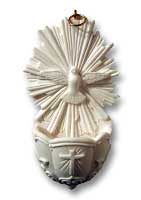
Holy water fonts
for the home come in all sizes and shapes, some plastic and not so
nice,
others quite lovely and made of alabaster, marble, porcelain,
sandstone,
or metals -- as inexpensive or as expensive as you like. Some rest
on tables, but most hang on walls (one example is shown at right). You
can buy one from most Catholic gift shops or make your own (consider
using bivalve seashells as basins, or the shell motif in design. The
seashell is a very ancient symbol of Baptism,
and the shells of large molluscs -- weighing up to 500 pounds -- have
been used in churches as basins for holy water). Tip: putting a thin
sponge inside the font is said to make the water evaporate less quickly.
Catholics often keep a font near their front door, in their bedrooms'
doorways, and near the family altar. Use the water in the same way you
do at church, dipping your fingers into it and making the Sign of the Cross. Bless your children with it as
you tuck them in at night, using your thumb to sign them with a cross
of holy water on their foreheads.
Most Catholics pray "In the Name of the Father, and of the Son, and of
the Holy Ghost" when blessing themselves with Holy Water, but this is
another beautiful prayer:
By Thy Precious
Blood and by this Holy Water, cleanse me (him/her) from my (his/her)
sins, O Lord.
Another use of
holy water is to give tiny sips to the sick or spiritually oppressed. It
shouldn't be consumed as a beverage, mind you, but the
ingestion of small amounts, or adding a few drops to foods, is common.
Note that as long as your container of holy water is just over half
full, you can
top it off, rendering the new water you've added holy as well after
it's been mixed with your remaining water.
How to dispose of
Holy water is usually made with a touch of salt which is a
preservative, but if your holy water were to go a little, um, green,
the proper way to dispose of it is the same
as for any sacramental: you want to return it to the earthly
elements. You should dig a hole and pour it into the earth.
Easter Water
Easter water, or
baptismal water, is the water that is blessed on Holy Saturday (the day before Easter) and is used to baptize
Catechumens. This water receives a more solemn sort of blessing than
"regular holy water": the Easter Candle is dipped into it three times,
and the priest blows his breath over it thrice, recalling the Spirit
over the waters at Creation, and the Spirit causing the waters of Noe's
flood to subside, and how the Spirit appeared as a dove over the waters
at Christ's Baptism.
Mind you, any clean water can be used in Baptism, and often is, as in
cases of emergency; but the use of Easter water is the normal way of
doing things.
Gregorian Water
There is another
type of holy water called "Gregorian Water" -- holy water mixed
with wine, salt, and ashes -- which is used in the consecration of
churches, altars and altar stones.
Peter Martyr Water
And finally (on
the liturgical level), there is water that is blessed on the Feast of
St. Peter Martyr (whom we also know as St. Peter of Verona). It is
sipped or sprinkled to bless the sick, heal the soul, etc., in the same
way regular holy water is used.
Non-Liturgical Holy Water
There are also
waters derived from holy wells and from places associated with saintly
apparitions or evidence of saintly intercession, said waters having
special curative properties by the
grace of God. That some waters are curative is seen in Sacred
Scripture. In IV Kings, for example, we're told how Naaman the Syrian
is healed of leprosy by bathing seven times in the Jordan River,
thereby prefiguring Christ's Baptism in the same body of water, and the
Baptism we receive to enter His Church.
In the 5th chapter of St. John's Gospel, we're told about the healing
waters of Bethesda, where Lord Christ made a lame man walk:
Now there is at
Jerusalem a pond, called Probatica, which in Hebrew is named Bethsaida,
having five porches. In these lay a great multitude of sick, of blind,
of lame, of withered; waiting for the moving of the water. And an angel
of the Lord descended at certain times into the pond; and the water was
moved. And he that went down first into the pond after the motion of
the water, was made whole, of whatsoever infirmity he lay under.
There are many other such places with healing waters, the
most famous being Lourdes,
where Our Lady appeared
to the young girl who was to become known as St. Bernadette and
instructed her to dig. St. Bernadette did so, with her hands, and
revealed a spring whose waters have cured many.
There are also many, many holy wells that exist in the world, and
they're especially
prevalent in Ireland, England, and Scotland.
Holy wells
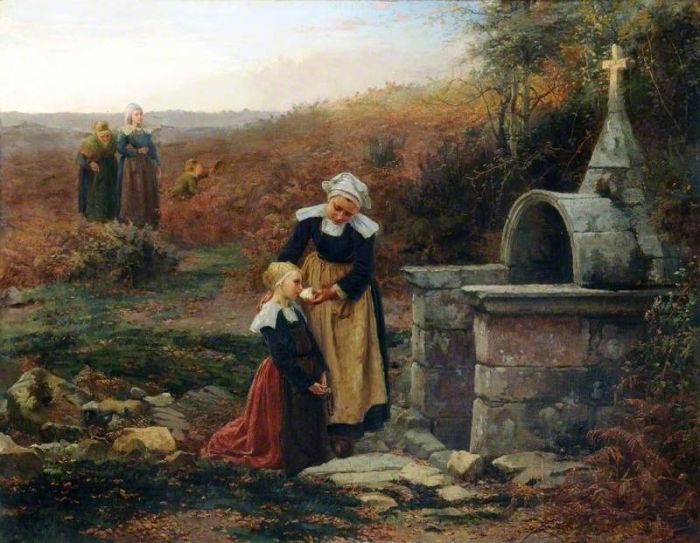
associated with Saints are often visited on those Saints' feast days,
but they're also used as related in the account below, such as in
petition for cures or for help with other problems:2
We go to holy
wells in the summer and in the winter. We go to pray for other people
and for ourselves. Holy wells are very special. Some wells are very
important to other people, too. The names of the some of the wells we
visit are St. Ann’s Well in Killanne in Wexford and Our Lady’s Well up
the Half-Way Road outside Bunclody, St. Kevin’s Well in Wicklow, St.
Patrick’s Well in Rathvilly Co. Carlow, St. Bridget’s Well in Myshall
Co. Carlow and St. David’s Well in Oylegate in Co. Wexford.
God blesses Holy Wells. Sometimes you can see visions in the
well. Lots of people go to visit them a lot of time. We don’t have
special prayers for each well, we just go to pray if something is gone
wrong. Holy wells are called holy wells because Saints are seen there.
And some people go to pray when things go wrong for them.
The holy water from some of the wells cures people. My
sister’s hair began to fall out. She went to St. Kevin’s Well and now
her hair is all grown back. My aunt had a problem. She went to Mt.
Mellary and her problem was solved.
In many places, rags, handkerchiefs or clothes are tied to
the trees above or around the well. The idea about this custom is that
as the rag rots away, so does your illness.
Pilgrims to holy wells might also "make the stations" -- that
is, they might stop at sites marked out near the well and pray
prescribed prayers. They recite these prayers this while "paying the
rounds" -- walking a certain number of times clockwise around the
stations. Pilgrims might also "pay the rounds" around the well itself,
too.
Votive offerings
are often left near holy wells after the stations are made and the
rounds are paid. These offerings could be any
object that has personal meaning or symbolic value relating to one's
petition, such as beads, pictures, tiny statues, jewelry, etc. Those
suffering from some sort of anxiety will often drive a nail into a tree
near the well as an offering; because this harms the tree, some wells
are stocked with wooden crosses into which one drives a nail. And, as
noted in the account above, pieces of cloth are sometimes tied to trees
as ex-votos. Red flannel is the traditional fabric used for this
purpose, and it's rubbed against the sick person's afflicted body part
before affixing to the tree.
After the stations are made, rounds are paid, and ex-votos are left,
the well's water is consumed and applied to the body, especially to
parts that are diseased or aching.
In parts of England (for ex., Derbyshire), feasts are had in
which local wells are "dressed" by building wooden frames around them,
filling the frames with clay, inscribing pictures in the clay, and then
filling in the clay with colorful flower petals, moss, leaves, and
other (usually) natural objects to outline the picture inscribed. This
sort of "well dressing" is a very old custom, dating back to at least
the early 14th century.
Footnotes:
1 For an idea on how to
make a decorative bottle to store your Holy Water, see this page.
2
Source:http://www.irishcultureandcustoms.com/ALandmks/HolyWells.html
|