Unlike pagan religions which see time as an endless cycle,
Christians
see time as being linear; it has a beginning and will have an end. But within
Christianity's linear, "big picture" sense of time, the passing
of hours is experienced as cycles of meditations on holy things - a
great wheel of time that doesn't spin in place, but moves forward.
Think
of a spiral -- of a circle moving ever forward toward His
Coming -- and you will have a sense of "Catholic time."
The traditional Catholic year (the "liturgical year") is made special
by cycles of
celebrations commemorating the lives of Jesus and His mother, the
angels, and the legion of Saints who modelled lives of sanctity. Below
are 25 Feasts and times, in chronological order, that
demonstrate how the liturgical year is a reliving of the life of Christ:
| Advent |
He is coming |
| Nativity |
He comes |
| Circumcision |
He follows Old Testament Law |
| Epiphany |
He reveals Himself as God |
| Holy Family |
He grows up in a human family |
| Candlemas |
Simeon's prophecy |
| Septuagesima |
We are in exile without Christ |
| Ash Wednesday |
Without Christ, we are dust |
| Lent |
Christ is in the Desert |
| Passion Sunday |
Jews make plans to kill Jesus |
| 7 Sorrows |
Mary's suffers at what is to come |
| Palm Sunday |
He triumphantly enters Jerusalem |
| Spy Wednesday |
Jesus is betrayed by Judas |
| Maundy Thursday |
He offers the first Holy Mass |
| Good Friday |
He is put to death and fulfills Old Testament Law |
| Holy Saturday |
He is in the tomb |
| Easter |
He is risen |
| Ascension |
He ascends into Heaven |
| Pentecost |
He sends the Holy Ghost |
| Trinity Sunday |
The Most Holy Trinity has been fully revealed |
| Assumption |
Mary is assumed into Heaven & crowned Queen |
| Christ the King |
We recognize Christ's Kingship now and forever |
| All Saints |
We will triumph as have our heroic Saints |
| All Souls |
We pray for those who are awaiting their triumph |
Last Sunday in
Time after Pentecost |
Apocalypse. He
will come to judge the world. |
Every
single year, aware Catholics "re-live" the Gospel, from Christ's
Incarnation and Birth to His Ascension and Heavenly reign. In Spring He
enters the world by coming to rest in Mary's immaculate womb; nine
months later, in Winter, He is born, circumcized, and given a Name. He
is raised in the Holy Family, and meets His cousin, John. He goes into
the Desert and we go with Him during our Lenten Season. Then follow His
Passion and Agony, which are soon vanquished by His Resurrection, His
Ascension, and the Pentecost. Now He reigns -- and forever, and we
await His Second Coming as we prepare to celebrate again His First
Coming. Then the cycle begins again, like a wheel that's been spinning
for two millennia. The Catholic who is aware of this wheel is
necessarily aware of Christ; the Catholic who also celebrates the Feasts well and practices the
traditions of the Church lives intimately with Him.
All of the Church's Feasts1 fall
into one of the 2 main "liturgical cycles" made of 7 "liturgical
seasons." Each of the Seasons has an associated mood, its own "feeling
in the air," its own scents and ornaments. There is even for each
Season an associated color which will be
reflected in the priests' vestments and liturgical art, church
decoration, and so on (though on certain Holy Days within a particular
season, that Day's color will take precedence over the season's color).
There is a definite rhythm to Catholic life, a rhythm expressed well in
this poem by Robert Herrick (1591-1674):
Ceremonies
for Candlemas Eve
Down with the rosemary and bays,
Down with the misletoe;
Instead of holly, now up-raise
The greener box (for show).
The holly hitherto did sway;
Let box now domineer
Until the dancing Easter day,
Or Easter's eve appear.
Then youthful box which now hath grace
Your houses to renew;
Grown old, surrender must his place
Unto the crisped yew.
When yew is out, then birch comes in,
And many flowers beside;
Both of a fresh and fragrant kin
To honour Whitsuntide.
Green rushes, then, and sweetest bents,
With cooler oaken boughs,
Come in for comely ornaments
To re-adorn the house.
Thus times do shift; each thing his turn does hold;
New things succeed, as former things grow old.
Here's an overview of the two liturgical cycles and their
seven seasons -- those times that "do shift".
| Cycle 1: The
Christmas Cycle |
|
| Season 1:
Advent |
| The word
"Advent" comes from the Latin "advenire" which means "arrival" and
refers to our awaiting the arrival of the commemoration of Christ's
birth, and His Second Coming. This somber, penitential season of
expectation lasts from the first Sunday of Advent ("Advent Sunday") to
24 December (22 - 28 calendar days). The first Sunday
of Advent will be the Sunday closest to (on or before or after) St.
Andrew's day
(November 30). Its color is
violet. |
| Season 2:
Christmastide |
| As it's the
celebration of Christ's Incarnation, the mood of Christmastide is of
humble, grateful, joyous celebration. This season lasts from Vespers
of 24 December to 13 January (the Octave of the Epiphany) inclusive (19
calendar days in terms of liturgical calculations). The Feast of
Christmas itself lasts 12 days ("The Twelve Days of
Christmas"), but the spiritual focus of Christmas doesn't end truly
until Candlemas on 2 February. Its color is white or gold. |
| Season 3:
Time After Epiphany |
| This season,
which continues the Christmas focus on and the Divine Childhood
and segues into focusing on Jesus' public ministry, lasts from 14
January to the vigil of Septuagesima Sunday (the ninth Sunday before
Easter, which is the same as 3 Sundays before Ash Wednesday) inclusive
(4 - 38 calendar days). Its color is green. |
|
| Cycle 2: The
Easter Cycle |
|
| Season 4:
Septuagesima |
| This Season,
whose name name means "Seventy" and which recalls the Babylonian Exile,
lasts from Septuagesima Sunday (the 3rd Sunday before Ash Wednesday, or
the 10th Sunday before Easter Sunday, inclusive, with Easter counting
as 1) to Shrove Tuesday (the day before Ash
Wednesday) (16 calendar days). Its color is violet. |
| Season 5:
Lent (Quadragesima) |
This season,
also called "Quadraegesima," meaning "Forty," is a somber, penitential
Season that recalls Christ's 40 days in the desert, prefigured by the
Israelites' wandering in the desert for 40 years.
"Passiontide" is the last two weeks of Lent, from Passion Sunday (the
5th Sunday of Lent) to the day before Easter Sunday. The second week of
Passiontide is called "Holy Week." The last three days of Holy Week --
i.e., Maundy Thursday, Good Friday, and Holy Saturday -- are called the
Sacred Triduum.
Lent lasts 40 days (but temporally includes six Sundays which aren't
counted as "Lent" because Sundays are always about the Resurrection and
are joyous), from Ash Wednesday to the Saturday before Easter, with the
last three days -- the Sacred Triduum -- being treated separately
liturgically speaking (46 calendar days). Its color is
violet. |
| Season 6:
Paschaltide (Eastertide) |
| The joyous,
victorious Easter season lasts from the Easter Vigil to the day before
Trinity Sunday (56 calendar days, not counting the Easter Vigil). Its
color
is white or gold. |
|
|
| Season 7:
Time After Pentecost |
| This Season's
focus is the Holy Spirit in the Millennium, the Church Age that we now
live in, and Christ's Reign as King of Kings -- the time between the
Age of the Apostles and the Age to Come. This season lasts from Trinity
Sunday to the day before Advent Sunday (per the calendar, its length
varies). Its color is green. |
|
"Overlaid"
on this grid of Seasons are two sets of dates: the Proper of Saints (also called the "Sanctoral
cycle") and the Proper of Seasons (also
called the "Temporal cycle"). The Proper of Saints are Feast Days
which are not movable, that is, they fall on the same date each year.
The Proper of Seasons are those Sundays and other Feasts of the year,
whose dates of celebration depend on the dates of Easter Sunday and
Advent Sunday and are, therefore, movable (they change each year).
In other words, to imagine the liturgical year:
- Imagine a regular, standard, everyday calendar
- Mentally overlay on that the Proper
of the Saints, filling in each day of the regular calendar with the
names of the Feasts for each day, the dates of which don't change --
e.g., January 21 will always be the Feast of St. Agnes, February 3 will
always be the Feast of St. Blaise, etc.
- Then determine the dates of the Proper of Seasons and overlay
that on top of the Proper of Saints.
To determine the dates of the Proper of Seasons:
- Mark the Season of Easter:
First, we determine the date of Easter,
which will be the first Sunday after the first full moon on or
after March 21 (if the full moon on or after March 21 falls on a
Sunday, go to the Sunday after). The Vigil of this Feast marks
the beginning of Eastertide.
- Mark the Season of Time after Pentecost:
Counting Easter as "one," count 9 Sundays forward from Easter and mark
that Sunday as the beginning of Time After Pentecost. A Sunday of this
Season is referred to as "First, Second, Third, etc. Sunday after
Pentecost."
- Mark the Season of Septuagesima:
Counting Easter as "one," count 10 Sundays back from Easter and mark
that day as the beginning of Septuagesima. The three Sundays of this
Season are referred to, respectively, as Septuagesima Sunday,
Sexagesima Sunday, and Quinquagesima Sunday.
- Mark the Season of Lent:
Counting Septuagesima Sunday as "one," count 3 Sundays forward from
Septuagesima Sunday, then go to the following Wednesday and mark that
Wednesday as "Ash Wednesday," the beginning of Lent. A Sunday in this
Season is referred to as "(First, Second, Third, etc). Sunday of Lent."
- Mark the Season of Advent:
Then, starting with the date of Christmas (always December 25), we
count back 4 Sundays to mark Advent Sunday (if Christmas is a Sunday,
don't count it; count back 4 entire Sundays so that there are 4 Sundays
in Advent). Another way to do this is to simply
mark the Sunday closest to -- whether before or after or on the date
itself of -- St. Andrew's Day (30 November). This date
marks the beginning of Advent. A Sunday in this Season is referred to
as "(First, Second, Third, etc.) Sunday of Advent."
- Mark the Season of Christmas:
Mark the Vigil of December 25 as the beginning of Christmastide
- Mark the Season of Time after Epiphany:
Mark January 14 as the beginning of Time After Epiphany. A Sunday of
this Season is referred to as "Second, Third, etc. Sunday after
Epiphany." Note, the first Sunday of this Season is the "Second Sunday
after Epiphany," the "after Epiphany" referring to the Feast of the
Epiphany, not to the Season.
Then refer to the Temporal Cycle page
to fill in any movable Feasts whose dates depend on the date of Easter
or Advent Sunday as determined above. The only things left to do
are:
- to mark the "Octaves":
Octaves are 8-day periods of observance, beginning with the Feast
day itself. Not all Feasts have "Octaves"; only the most important ones
do. So, starting with the Feast Day itself, counting it as "one," mark
8 days of the following Feasts as "Octaves": Christmas, Easter, and
Pentecost. Then mark the octave before Christmas Eve as
"The Golden Nights."
- to mark Ember Days and Rogation Days:
- the Wednesday,
Friday, and Saturday after the Third Sunday of Advent (Gaudete Sunday)
are the days of Advent Embertide
- the Wednesday,
Friday, and Saturday after the First Sunday of Lent are known as Lenten
Embertide
- the Wednesday,
Friday, and Saturday after Pentecost Sunday make up Whit Embertide
- the Wednesday,
Friday, and Saturday after the Feast of the Exaltation of the Holy
Cross (14 September). Note that these Ember Days must come a full week
after the Holy Cross Day.
- Mark the Major
Rogation on April 25, and the Minor Rogation on the three days --
Monday, Tuesday, and Wednesday -- before Ascension Thursday
- to mark your cathedral's patronal Feast:
Mark the Feast of the patron Saint of your diocese's cathedral (e.g.,
if your cathedral is named "SS. Peter and Paul Cathedral," the priests
of your diocese will celebrate 29 June, the Feast of SS. Peter and
Paul, as a first class Feast)
Now, each of the Sundays of a Season has its own "Propers" --
prayers that are specific to that day in the liturgy (the Divine Office
and the Mass). Each of the Feasts in the Proper of Saints will also
have its own Propers. So, because the Feasts in the Proper of Saints
and the Proper of the Seasons can sometime overlap with two Feasts
falling on the same day, all Feasts are ranked according to their
importance. The higher ranking Feast will be the one celebrated.
Feasts fall into one of a few categories, in descending order of
precedence 2:
- 1st Class
- 2nd Class
- 3rd Class
- Commemoration
When two Feasts of the same rank fall on the same day, they
are ranked further by whether they relate to (in descending order of
preference):
- Our Lord
- Our Lady
- the Holy Angels
- St. John the Baptist, St. Joseph, St. Peter, St. Paul, the
other Apostles
- Martyrs
- Other Saints
If a day is neither a Sunday nor commemorative of any other
Feast, it is called a "feria" (the word means "free day").
Holy Days of Obligation
In addition to each Sunday, there are a handful of other Holy
Days of Obligation on which we must attend Mass. These Holy Days differ
from country to country:
|
United States
|
Canada
|
England &
Wales
|
|
Circumcision
Ascension
Assumption
All Saints
Imm. Conception
Christmas
|
Circumcision
Epiphany
Ascension
All Saints
Imm. Conception
Christmas
|
Circumcision
Epiphany
Ascension
Corpus Christi
SS Peter & Paul
Assumption
All Saints
Christmas
|
|
Ireland
|
Scotland
|
Australia
& New Zealand
|
|
Circumcision
Epiphany
St. Patrick
Ascension
Corpus Christi
SS Peter & Paul
Assumption
All Saints
Imm. Conception
Christmas
|
Circumcision
Epiphany
St. Joseph
Ascension
Corpus Christi
SS Peter & Paul
Assumption
All Saints
Imm. Conception
Christmas
|
Circumcision
Ascension
Assumption
All Saints
Christmas
|
Other Days to Note
Other days a family might want to mark on their home
calendars are:
- the family's "Name Days"
- Thursday Holy Hours
- the first
Fridays of nine consecutive months, and the first Saturdays of five
consecutive months, for
devotions to the Sacred Heart and to the Immaculate Heart respectively
- the anniversaries of loved ones' deaths so we remember to
have Masses said for them, and light
candles, fast, and pray for them
- the starting dates of any seasonal or feast day-related
novenas
you're wanting to pray or other feast-based devotions you may want to
make to favorite Saints (e.g., the Fifteen
Thursdays of St. Rita of
Cascia; the Thirteen
Tuesdays of St. Anthony, St.
Michael's Lent, the Supplica, etc.)
See Novenas
Arranged by Date
off the Novenas page.
- For those interested, one set of the starting and
consecration date options for the St. Louis de Montfort's 33-day Total Consecration to the Blessed
Virgin.
The liturgical year is less confusing than it seems at first,
but to follow along, you can do what most Catholics do and just pay
attention to your parish bulletins and/or get a Catholic calendar each
year (Angelus Press sells a beautiful traditional
calendar each year).
For customs and traditions related to the liturgical year, see this page.
Footnotes:
1 In the Novus Ordo:
- the Seasons of Time After Epiphany and Septuagesima have been
replaced by "Ordinary Time";
- The Season of Time After Pentecost is referred to also as
"Ordinary Time";
- the Feast of the Circumcision is referred to as "Mary, Mother
of God";
- Ascension Thursday is celebrated on "Ascension Sunday" (the
7th Sunday of Easter) in some provinces;
- the Feast of Christ the King is not celebrated on the last
Sunday of October but on the last Sunday in Pentecost, disrupting the
relationship between Christ's Kingship and the Triumph of the Saints
celebrated on November 1 (All Saints Day), and leading to the idea that
Christ doesn't need to be recognized as King now, on earth, by all
nations -- but only after the Last Judgment will His Kingship matter;
- some Saints' Days have been removed from the Calendar (e.g.,
St. Christopher). Please know that this removal from the liturgical
calendar doesn't mean that the Saint in question has been
"uncanonized," "de-sainted," or "demoted" as is commonly and
frustratingly believed;
- some Feasts have been added;
- Ember Days have been done away with in most places;
- Holy Days of Obligation in the United States are not
celebrated if they fall on a Saturday or a Monday;
- the cycle of readings are not based on a yearly cycle but a
three-year cycle Results: the entire rhythm of the liturgical year as
it's been known for millennia is disrupted; though a greater quantity
of Scripture is covered, it is a lower quality of Scripture in that the
new readings tend to omit mention of miracles, demons, Hell, evil, the
sin of divorce, anything that offends Jews, etc.
2 In older Missals, the Feasts are
ranked thus:
| Before mid-1950s |
1962 Equivalent |
| Double of the First Class |
First Class |
| Double of the 2nd Class |
Second Class |
| Greater Double |
Second or Third Class |
| Lesser Double |
Third Class |
| Semi-Double |
Third Class |
| Simple |
Commemoration |
About
the painting at the top of the page
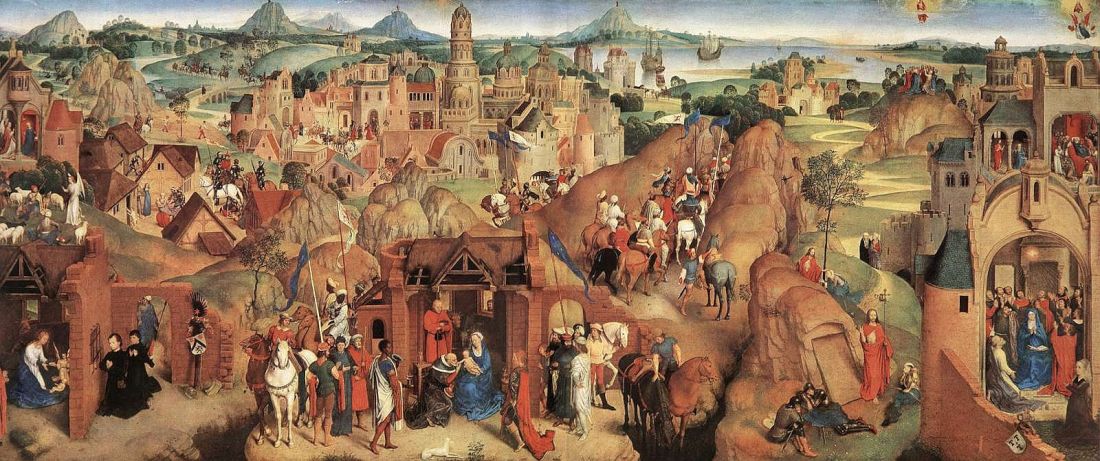
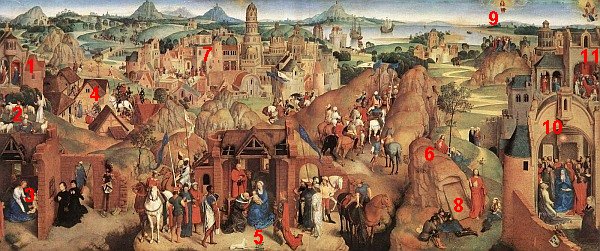
| The painting at
the top of the page -- painted by Hans
Memling in A.D. 1480 -- depicts the life of Christ and, so, depicts the
Catholic's journey through the liturgical year, from Advent to
Christmas, from Lent to Easter and Pentecost. The scenes include: 1)
The Annunciation; 2) the announcement of the Nativity to the shepherds;
3) the Nativity; 4) the Slaughter of the Innocents; 5) the Adoration of
the Magi; 6) Christ and Mary Magdalen; 7) the Passion; 8) the
Resurrection; 9) the Ascension; 10) the Pentecost; 11) the Dormition
and Assumption of Mary. To see the painting enlarged, click here. |
 Back to Being Catholic Back to Being Catholic
Index
|