April 25 and the
Monday, Tuesday, and Wednesday before Ascension
Thursday
are known as "Rogation Days," with
April 25 being the "Major Rogation," and the Monday, Tuesday, and
Wednesday
before Ascension Thursday -- "Rogationtide" -- being the "Minor
Rogation."
"Rogation" comes from the Latin "rogare," which means "to
ask," and Rogation Days are penitential days of fasting and abstinence
during which we seek to
ask God's
mercy, appease His anger, avert the chastisements He makes manifest
through
natural disasters, and ask for His blessings, particularly with regard
to farming, gardening, and other agricultural pursuits. They are set
aside to remind us how radically dependent we are on God through His
creation, and
how prayer can help protect us from nature's often cruel ways.
Hence, its mood is somber and beseeching; its liturgical color is
purple.
It is quite easy, especially for modern city folk, to sentimentalize
nature and to forget how powerful, even savage, she can be. Time is
spent focusing only on her lovelier aspects -- the beauty of snow, the
smell of cedar, the glories of flowers -- as during Embertides -- but in an instant, the veneer
of civilization we've built to keep nature under control so we can
enjoy her without suffering at her hand can be swept away. Ash and fire
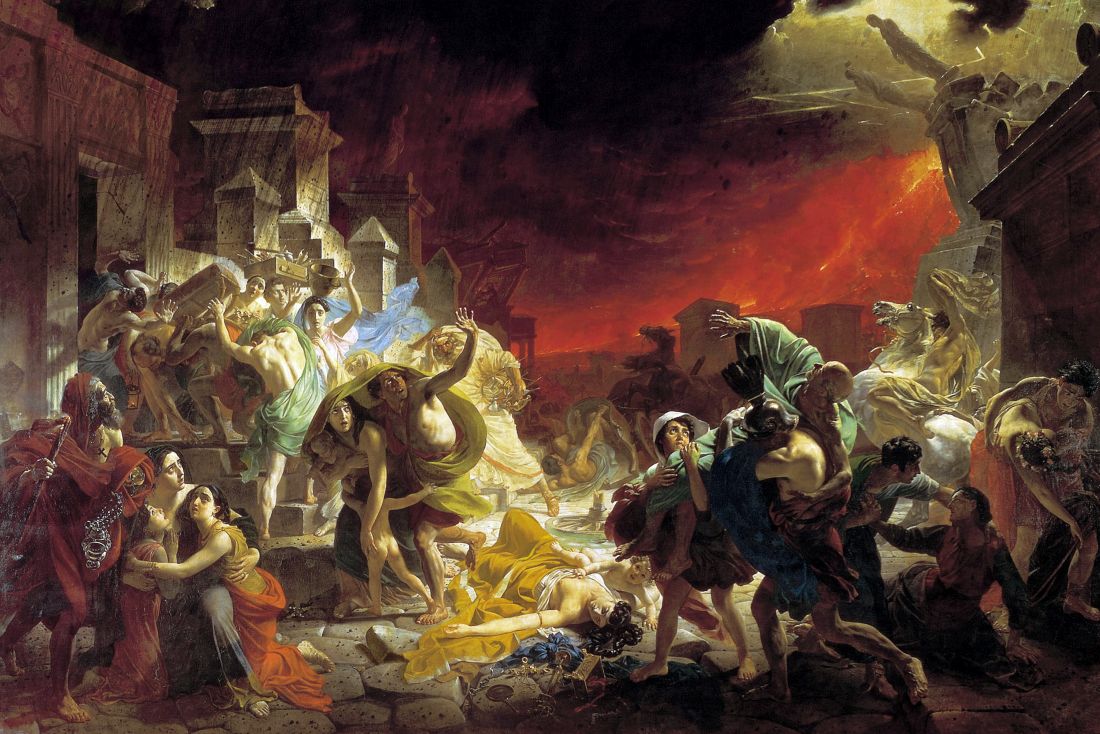
raining down from great volcanoes; waters bursting through levees;
mountainous tidal waves destroying miles of coastland and entire
villages; meteors hurling to earth; tornadoes and hurricanes sweeping
away all in their paths; droughts; floods; fires that rampage through
forests and towns; avalanches of rocks or snow; killer viruses and
plagues; the
very earth shaking off human life and opening up beneath our feet;
cataclysmic events forming mountains and islands; animals that prey on
humans; lightning strikes; great swarms of locusts that devastate food
supplies and cause famine; disease-carrying ticks, fleas, and
mosquitoes -- these, too, are a part of the natural
world. And though nature seems random and fickle, all that happens is
either by God's active or passive Will, and all throughout Scripture He
uses the elements to warn, punish, humble, and instruct us: earth
swallowing up the rebellious, power-mad sons of Eliab; wind
destroying Job's house; fire raining down on Sodom and
Gomorrha; water destroying everyone but Noe and his family
(Numbers 16, Job 1, Genesis 19, Genesis 6). We need to be humble before
and respectful of nature, and aware not to take her for granted or
overstep our limits. But we need to be most especially humble before
her Creator, Who wills her existence and doings at each instant,
whether actively or passively. Consider the awe-inspiring words of
Nahum 1:2-8:
The Lord is a
jealous God, and a revenger: the Lord is a revenger, and hath wrath:
the Lord taketh vengeance on His adversaries, and He is angry with His
enemies. The Lord is patient, and great in power, and will not cleanse
and acquit the guilty. The Lord's ways are in a tempest, and a
whirlwind, and clouds are the dust of His feet. He rebuketh the sea,
and drieth it up: and bringeth all the rivers to be a desert. Basan
languisheth and Carmel: and the dower of Libanus fadeth away. The
mountains tremble at Him, and the hills are made desolate: and the
earth hath quaked at His presence, and the world, and all that dwell
therein.
Who can stand before the face of His indignation? and who shall resist
in the fierceness of His anger? His indignation is poured out like
fire: and the rocks are melted by Him. The Lord is good and giveth
strength in the day of trouble: and knoweth them that hope in Him. But
with a flood that passeth by, He will make an utter end of the place
thereof: and darkness shall pursue His enemies.
Recalling these
Truths, beseeching God and His Saints to protect us from disaster, and
doing penance so He does not see us as His enemies are what Rogation
Days are about. As said, these days are divided between the Major
Rogation -- 25
April (by coincidence alone, the Feast of St. Mark) -- and the Minor
Rogation, which consists of the Monday, Tuesday and Wednesday before Ascension Thursday. And they're a
very old tradition.
The Major Rogation is of Roman origin, instituted by Pope St. Gregory
the Great (b. 540) after a great plague besieged Rome. The Golden
Legend, written by Jacobus de Voragine in 1275 explains:
For as the
Romans had in the Lent lived soberly and in continence, and after at
Easter had received their Saviour. After, they disordered them in
eating, in drinking, in plays and in lechery. And therefore our Lord
was moved against them, and sent to them a great pestilence, which was
called the botche of impedimy. And that was cruel and sudden, and
caused people to die in going by the way, in playing, in being at
table, and in speaking one with another suddenly they died. In this
manner sometime sneezing they died, so that when any person was heard
sneezing anon they that were by said to him: God help you, or Christ
help: and yet endureth the custom. And also when he sneezeth or gapeth,
he maketh tofore his face the sign of the Cross, and blesseth him; and
yet endureth this custom.
The Minor
Rogation Days -- Rogationtide -- are of French origin, coming about in
the 5th c., when
St. Mamertus, Bishop of Vienne, Dauphiné instituted them after a series
of natural calamities. According to the Golden Legend:
For then, at
Vienne, were great earthquakes of which fell down many churches and
many houses, and there was heard great sounds and great clamours by
night. And then happed a terrible thing on Easter-day, for fire
descended from heaven that burnt the king's palace. Yet happed more
marvellous thing; for like as the fiends had entered into the hogs,
right so by the sufferance of God for the sins of the people, the
fiends entered into wolves and other wild beasts, which every one
doubted, and they went not only by the ways ne by the fields, but also
by the cities ran openly, and devoured the children and old men and
women. And when the Bishop saw that every day happed such sorrowful
adventures, he commanded and ordained that the people should fast three
days; and he instituted the Litanies, and then the tribulation ceased.
Pope St. Leo III
-- the Pope who crowned Charlemagne on Christmas
Day of 800 -- introduced these days of penance into Rome in 816,
the year of his death, after which they became standard throughout the
Roman Church.
The liturgy for the Rogation Days, during which the priest is vested in
purple, begins with Psalm 43:26 --"Arise, O Lord, help us and redeem us
for Thy name's sake" -- which is followed by the Litany of the Saints. At the Litany's
"Sancta Maria," all stand and a procession
begins, which in older times
was (and still is in rural areas) usually around the boundaries of the
parish, giving to the procession the name of "beating the bounds."
The Litany is followed by Psalm 69, a series of petitions, and the
Mass, with readings from James 5:16-20 and Luke 11:5-14. Prayer for
God's blessing of farmers' fields so that they yield a bountiful
harvest is common.
Just for informational purposes, here is what the Rogation
Days' processions were like in medieval times, again from the Golden
Legend. How marvelous!:
And in this
procession the Cross is borne, the clocks and the bells be sounded and
rung, the banners be borne, and in some churches a dragon with a great
tail is borne. And aid and help is demanded of all Saints.
And the cause why the Cross is borne and the bells rung is for to make
the evil spirits afraid and to flee; for like as the kings have in
battles tokens and signs-royal, as their trumpets and banners, right so
the King of Heaven perdurable hath His signs militant in the Church. He
hath bells for business and for trumps, He hath the Cross for banners.
And like as a tyrant and a malefactor should much doubt when he shall
hear the business and trumps of a mighty king in his land, and shall
see his banners, in like wise the enemies, the evil spirits that be in
the region of the air, doubt much when they hear the trumpets of God
which be the bells rung, and when they see the banners borne on high.
And this is the cause why the bells be rung when it thundereth, and
when great tempests and outrages of weather happen, to the end that the
fiends and the evil spirits should be abashed and flee, and cease of
the moving of tempests. Howbeit also that there is another cause
therewith; that is for to warn the Christian people, that they put them
in devotion and in prayer, for to pray God that the tempest may cease.
There is also the banner of the King, that is the Cross, which the
enemies dread much and doubt. For they dread the staff with which they
have been hurt. And this is the reason wherefore in some churches in
the time of tempest and of thunder, they set out the Cross against the
tempest to the end that the wicked spirits see the banner of the
sovereign King, and for dread thereof they flee. And therefore in
procession the Cross is borne, and the bells rung for to chase and hunt
away the fiends being in the air, and to the end that they leave to
tempest us. The Cross is borne for to represent the victory of the
Resurrection, and of the Ascension of Jesu Christ. For He ascended into
Heaven with all a great prey. And thus this banner that flyeth in the
air signifieth Jesu Christ ascending into Heaven.
And as the people follow the Cross, the banners, and the procession,
right so when Jesu Christ styed up into Heaven a great multitude of
Saints followed Him. And the song that is sung in the procession
signifieth the song of angels and the praisings that came against Jesu
Christ and conducted and conveyed Him to Heaven where is great joy and
melody.
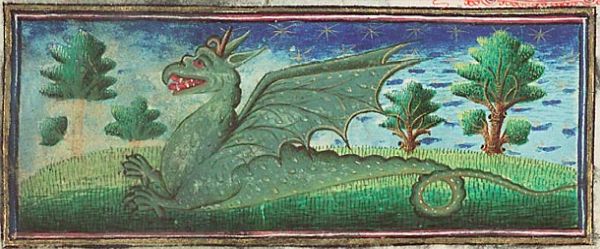
In some churches, and in especial in them of France, is accustomed to
bear a dragon with a long tail filled full of chaff or other thing. The
two first days it is borne before the Cross, and on the third day they
bear it after the Cross, with the tail all void, by which is understood
that the first day tofore the law, or the second under the law, the
devil reigned in the world, and on the third day, of grace, by the
Passion of Jesu Christ, he was put out of his realm.
Dom Gueranger,
in his work on the liturgical year, describes the processions as well,
and who would march in them:
The main part of
the Rogation rite originally consisted, (at least in Gaul) in singing
canticles of supplication whilst passing from place to place, -- and
hence the word Procession. We learn from St. Casesarius of Aries, that
each day's Procession lasted six hours ; and that when the Clergy
became tired, the women took up the chanting. The Faithful of those
days had not made the discovery, which was reserved for modern times,
that one requisite for religious Processions is that they be as short
as possible.
The Procession for the Rogation Days was preceded by the Faithful
receiving the Ashes upon their heads, as now at the beginning of Lent ;
they were then sprinkled with Holy Water, and the Procession began. It
was made up of the Clergy and people of several of the smaller
parishes, who were headed by the Cross of the principal Church, which
conducted the whole ceremony. All walked bare-foot, singing the Litany,
Psalms and Antiphons. They entered the Churches that lay on their
route, and sang an Antiphon or Pesponsory appropriate to each.
Such was the original ceremony of the Rogation Days, and it was thus
observed for a very long period. The Monk of St. Grail's, who has left
us so many interesting details regarding the life of Charlemagne, tells
us that this holy Emperor used to join the Processions of these three
Days, and walk bare-footed from his palace to the Stational Church. We
find St. Elizabeth of Hungary, in the 14th century, setting the like
example : during the Rogation Days, she used to mingle with the poorest
women of the place, and walked bare-footed, wearing a dress of coarse
stuff.
St. Charles Borromeo, who restored in his Diocese of Milan so
many ancient practices of piety, was sure not to be indifferent about
the Rogation Days. He spared neither word nor example to re-animate
this salutary devotion among his people. He ordered fasting to be
observed during these three Days; he fasted himself on bread and water.
The Procession, in which all the Clergy of the City were obliged to
join, and which began after the sprinkling of Ashes, started from the
Cathedral at an early hour in the morning, and was not over till three
or four o'clock in the afternoon. Thirteen Churches were visited on the
Monday; nine, on the Tuesday; and eleven, on the Wednesday. The
saintly Archbishop celebrated Mass and preached in one of these
Churches.
Customs
In addition to
the penance, fasting, abstinence, processions and Masses mentioned
above, all done
to appease God's anger and avoid His chastisements, Rogation days are
days to pray for farmers and to realize how dependent we are on them.
If your children don't understand where food comes from, teach them.
Explain the supply chain to them so they know how our ability to eat
involves God's blessings and man's labor at every step. Teach them how
food begins with God and then
is raised by farmers, handled by pickers and butchers, packaged by
workers, kept fresh by refrigeration invented and maintained by men,
delivered around
by truckers, pilots, and train engineers, bought by stores, sold by
clerks, etc. (see this site's page on Gratitude).
A prayer for the day:
O God, Source
and Giver of all things, Who manifests Thine infinite majesty, power
and goodness in the earth about us, we give Thee honor and glory. For
the sun and rain, for the manifold fruits of farmers' fields, for the
increase of their herds and flocks we thank Thee. For the enrichment of
their and our souls with divine grace, we are grateful. We beseech Thee
to pour out Thy blessings on our farmers, their families, their crops,
and their herds, and to grant to them all the graces they need to be
good stewards of Thy creation. Protect them and theirs, and us and
ours, from floods, drought, fires, pestilence, hail, dangerous winds
and storms, lightning, infestations, disease, sickness, and all other
natural evils. Protect them and us, too, from the evils of men. We ask
this in the name of the Father, and of the Son, and of the Holy Ghost,
one God, for ever and ever. Amen.
If you are a farmer, ask your priest to bless your farm; the
Roman Ritual is full of blessings for everything from seed to swine to
stables. A few of them:
Blessing of a Farm
Bless, O Lord, Almighty God, this house (or this farm). May health and
purity, goodness and meekness, and every virtue reign here. May
all those who dwell here be filled with faithfulness to Thy law and
with thanksgiving to God, the Father, the Son, and the Holy Spirit. May
this blessing remain on this house (or this farm) and all who dwell
here. Through Christ our Lord. Amen.
Blessing of All
Domestic Animals
Lord God, King of heaven and earth, Thou the Word of the Father by whom
all creatures were given us for our support; look down, we beseech
Thee, on our lowliness. As Thou hast given us these animals to assist
us in our labors and needs, so mayest Thou in thy great goodness and
mercy bless them from above, guard and preserve them; and, while Thou
givest thy servants temporal benefits, mayest Thou grant us Thy
continual grace so that we may praise Thy holy name with
thanksgiving. Amen.
Blessing of Orchards
and Vineyards
We beseech Thee, Almighty God, in Thy goodness, to pour down Thy
blessings on these young shoots and sprouts which Thou wouldst grow
into mature fruit. Grant to Thy people that they may always be
permitted to grow, with due sunshine and rain, and make them gifts
which the fruitful earth produces in fullness so that the poor and
needy may praise Thy glory. Amen.
The Solemn Exorcism
of Harmful Animals
I conjure you mice (worms, sails, snakes, spiders, lice, ticks, etc.)
in the name of God, the Almighty Father, of Jesus Christ, His only Son,
and of the Holy Spirit who proceeds from both, that you go out from
these fields and pastures and remain no more in them, but depart for
places where you can harm no one. In the name of God, the Almighty, of
the whole heavenly court, and of God's holy Church, I declare you
accursed wherever you go so that you will become fewer day by day. May
no part of you be found again, unless it be for man's welfare. May He
graciously grant this, who will come to judge the living and the dead
and the world by fire.
Meditating on how
devastating natural forces can be is also in order for the day. We are
usually so
buffered from the natural world with our cozy, modern homes, air
conditioning, ability to fly through the air from Chicago to Paris in
hours, and other wonders, that we can easily sentimentalize nature and
see her in a Rousseauian way -- taking her for granted, being
condescending toward her, and exhibiting masterful instead of masterly
behaviors in our dealings with her. It is rare that nature breaches in
cataclysmic ways the
walls of civilization and technology we've set up around us, but breach
them she can, and does, and this reality must be appreciated.
Tell your
children about how the elements can escape our control, and how we
should remember our place as those who've been given dominion over
nature, but never apart from God -- something modern scientists
arrogantly forget as a group. Tell them about some of the great
disasters that have fascinated and frightened us throughout History --
e.g., the stories of Pompeii and Herculaneum, the Black Death, the
London Fire of 1666, the great early 19th c. earthquakes along the New
Madrid fault line that reversed the course of the Mississippi River,
the Chicago Fire of 1871, the 1883 explosion of Krakatoa, the Yellow
River Floods of 1887 and 1931, the 1906 San
Francisco earthquake, the Spanish Flu epidemic of 1918 that killed many
millions... Tell
them stories, including fictional ones, about how science and
technology unmoored from
theology and divorced from humility can
wreak havoc -- e.g., the story of the Tower of Babel (Genesis 11); the
story of Mao Tse Tung's "Four Pests"1
program
to
eradicate mosquitoes, flies, rats, and sparrows and how it all led to
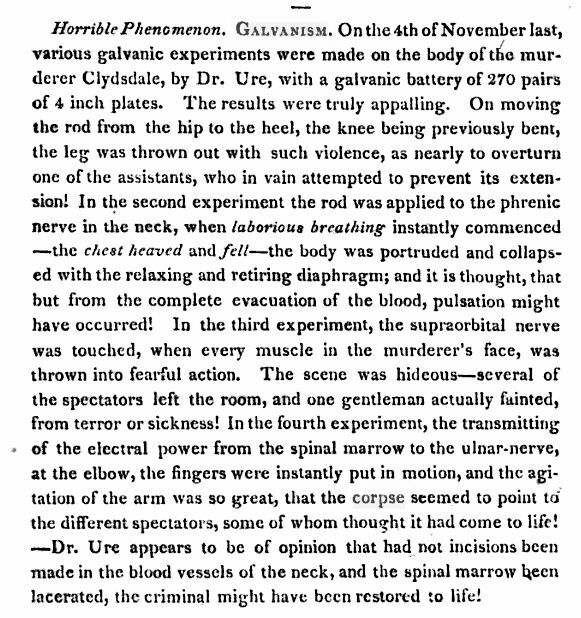
the starvation of millions; the story of Frankenstein's monster;2
the
fates of the "unsinkable" Titanic and the Hindenburg dirigible, etc.
Teach them to not inordinately
sentimentalize wild animals by telling them stories such as the ones
related in Werner Herzog's "Grizzly Man" (2005) or the show "Human
Prey." Teach them to
have a fundamental humility before
God, gratitude toward Him, and a humble respect and love for His
creation. Read to them and meditate on Psalms 103 and 104 together.
Note: the station churches for
Rogation Days are:
Major Rogation:
S. Pietro in Vaticano
Rogation Monday: S. Maria Maggiore
Rogation Tuesday: S. Giovanni in Laterano
Rogation Wednesday: S. Pietro in Vaticano
Note, too, that
the date of the Major Rogation often falls on Easter or Easter Monday
(the Monday following Easter Sunday). When this happens, the feast is
moved to Easter Tuesday (that is, two days after Easter). Otherwise, it
is still celebrated, even if its date falls during the Easter Octave.
See also the
pages
on Ember Days.
Reading
Jeremias
10-11:1-6
Hear ye the
word which the Lord hath spoken concerning you, O house of Israel. Thus
saith the Lord: Learn not according to the ways of the Gentiles: and be
not afraid of the signs of heaven, which the heathens fear: For the
laws of the people are vain: for the works of the hand of the workman
hath cut a tree out of the forest with an axe. He hath decked it with
silver and gold: he hath put it together with nails and hammers, that
it may not fall asunder. They are framed after the likeness of a palm
tree, and shall not speak: they must be carried to be removed, because
they cannot go. Therefore, fear them not, for they can neither do evil
nor good.
There is none like to thee, O Lord: thou art great and great is thy
name in might. Who shall fear thee, O king of nations? for thine is the
glory: among all the wise men of the nations, and in all their kingdoms
there is none like unto thee. They shall all proved together to be
senseless and foolish: the doctrine of their vanity is wood. Silver
spread into plates is brought from Tharsis, and gold from Ophaz: the
work of the artificer, and of the hand of the coppersmith: violet and
purple is their clothing: all these things are the work of artificers.
But the Lord is the true God: he is the living God, and the everlasting
king, at his wrath the earth shall tremble, and the nations shall not
be able to abide his threatening.
Thus then shall you say to them: The gods that have not made heaven and
earth, let them perish from the earth, and from among those places that
are under heaven. He that maketh the earth by his power, that prepareth
the world by his wisdom, and stretcheth out the heavens by his
knowledge. At his voice he giveth a multitude of waters in the heaven,
and lifteth up the clouds from the ends of the earth: he maketh
lightnings for rain, and bringeth for the wind out of his treasures.
Every man is become a fool for knowledge every artist is confounded in
his graven idol: for what he hath cast is false, and there is no spirit
in them. They are vain things and a ridiculous work: in the time of
their visitation they shall perish.
The portion of Jacob is not like these: for it is he who formed all
things: and Israel is the rod of his inheritance: the Lord of hosts is
his name. Gather up thy shame out of the land, thou that dwellest in a
siege. For thus saith the Lord: Behold I will cast away far off the
inhabitants of the land at this time: and I will afflict them, so that
they may be found. Woe is me for my destruction, my wound is very
grievous. But I said: Truly this is my own evil, and I will bear it. My
tabernacle is laid waste, all my cords are broken: my children are gone
out from me, and they are not: there is none to stretch forth my tent
any more, and to set up my curtains.
Because the pastors have done foolishly, and have not sought the Lord:
therefore have they not understood, and all their flock is scattered.
Behold the sound of a noise cometh, a great commotion out of the land
of the north: to make the cities of Juda a desert, and a dwelling for
dragons. I know, O Lord, that the way of a man is not his: neither is
it in a man to walk, and to direct his steps. Correct me, O Lord, but
yet with judgement: and not in fury, lest thou bring me to nothing.
Pour out thy indignation upon the nations that have not known thee, and
upon the provinces that have not called upon thy name: because they
have eaten up Jacob, and devoured him, and consumed him, and have
destroyed his glory.
The word that came from the Lord to Jeremias, saying: Hear ye the words
of this covenant, and speak to the men of Juda, and to the inhabitants
of Jerusalem, And thou shalt say to them: Thus saith the Lord the God
of Israel: Cursed is the man that shall not hearken to the words of
this covenant, Which I commanded your fathers in the day that I brought
them out of the land of Egypt, from the iron furnace, saying: Hear ye
my voice, and do all things that I command you: and you shall be my
people, and I will be your God: That I may accomplish the oath which I
swore to your fathers, to give them a land flowing with milk and honey,
as it is this day. And I answered and said: Amen, O Lord.
And the Lord said to me: Proclaim aloud all these words in the cities
of Juda, and in the streets of Jerusalem, saying: Hear ye the words of
the covenant, and do them...
St. Augustine
City of God
Book XXII,
Chapter 22
That the whole
human race has been condemned in its first origin, this life itself, if
life it is to be called, bears witness by the host of cruel ills with
which it is filled. Is not this proved by the profound and dreadful
ignorance which produces all the errors that enfold the children of
Adam, and from which no man can be delivered without toil, pain, and
fear? Is it not proved by his love of so many vain and hurtful things,
which produces gnawing cares, disquiet, griefs, fears, wild joys,
quarrels, lawsuits, wars, treasons, angers, hatreds, deceit, flattery,
fraud, theft, robbery, perfidy, pride, ambition, envy, murders,
parricides, cruelty, ferocity, wickedness, luxury, insolence,
impudence, shamelessness, fornications, adulteries, incests, and the
numberless uncleannesses and unnatural acts of both sexes, which it is
shameful so much as to mention; sacrileges, heresies, blasphemies,
perjuries, oppression of the innocent, calumnies, plots, falsehoods,
false witnessings, unrighteous judgments, violent deeds, plunderings,
and whatever similar wickedness has found its way into the lives of
men, though it cannot find its way into the conception of pure minds?
These are indeed the crimes of wicked men, yet they spring from that
root of error and misplaced love which is born with every son of Adam.
For who is there that has not observed with what profound ignorance,
manifesting itself even in infancy, and with what superfluity of
foolish desires, beginning to appear in boyhood, man comes into this
life, so that, were he left to live as he pleased, and to do whatever
he pleased, he would plunge into all, or certainly into many of those
crimes and iniquities which I mentioned, and could not mention?
But because God does not wholly desert those whom He condemns, nor
shuts up in His anger His tender mercies, the human race is restrained
by law and instruction, which keep guard against the ignorance that
besets us, and oppose the assaults of vice, but are themselves full of
labor and sorrow. For what mean those multifarious threats which are
used to restrain the folly of children? What mean pedagogues, masters,
the birch, the strap, the cane, the schooling which Scripture says must
be given a child, beating him on the sides lest he wax stubborn, Sirach
30:12 and it be hardly possible or not possible at all to subdue him?
Why all these punishments, save to overcome ignorance and bridle evil
desires — these evils with which we come into the world? For why is it
that we remember with difficulty, and without difficulty forget? Learn
with difficulty, and without difficulty remain ignorant? Are diligent
with difficulty, and without difficulty are indolent? Does not this
show what vitiated nature inclines and tends to by its own weight, and
what succor it needs if it is to be delivered? Inactivity, sloth,
laziness, negligence, are vices which shun labor, since labor, though
useful, is itself a punishment.
But, besides the punishments of childhood, without which there would be
no learning of what the parents wish — and the parents rarely wish
anything useful to be taught — who can describe, who can conceive the
number and severity of the punishments which afflict the human race —
pains which are not only the accompaniment of the wickedness of godless
men, but are a part of the human condition and the common misery — what
fear and what grief are caused by bereavement and mourning, by losses
and condemnations, by fraud and falsehood, by false suspicions, and all
the crimes and wicked deeds of other men? For at their hands we suffer
robbery, captivity, chains, imprisonment, exile, torture, mutilation,
loss of sight, the violation of chastity to satisfy the lust of the
oppressor, and many other dreadful evils. What numberless casualties
threaten our bodies from without — extremes of heat and cold, storms,
floods, inundations, lightning, thunder, hail, earthquakes, houses
falling; or from the stumbling, or shying, or vice of horses; from
countless poisons in fruits, water, air, animals; from the painful or
even deadly bites of wild animals; from the madness which a mad dog
communicates, so that even the animal which of all others is most
gentle and friendly to its own master, becomes an object of intenser
fear than a lion or dragon, and the man whom it has by chance infected
with this pestilential contagion becomes so rabid, that his parents,
wife, children, dread him more than any wild beast! What disasters are
suffered by those who travel by land or sea! What man can go out of his
own house without being exposed on all hands to unforeseen accidents?
Returning home sound in limb, he slips on his own doorstep, breaks his
leg, and never recovers. What can seem safer than a man sitting in his
chair? Eli the priest fell from his, and broke his neck. How many
accidents do farmers, or rather all men, fear that the crops may suffer
from the weather, or the soil, or the ravages of destructive animals?
Commonly they feel safe when the crops are gathered and housed. Yet, to
my certain knowledge, sudden floods have driven the laborers away, and
swept the barns clean of the finest harvest. Is innocence a sufficient
protection against the various assaults of demons? That no man might
think so, even baptized infants, who are certainly unsurpassed in
innocence, are sometimes so tormented, that God, who permits it,
teaches us hereby to bewail the calamities of this life, and to desire
the felicity of the life to come. As to bodily diseases, they are so
numerous that they cannot all be contained even in medical books. And
in very many, or almost all of them, the cures and remedies are
themselves tortures, so that men are delivered from a pain that
destroys by a cure that pains. Has not the madness of thirst driven men
to drink human urine, and even their own? Has not hunger driven men to
eat human flesh, and that the flesh not of bodies found dead, but of
bodies slain for the purpose? Have not the fierce pangs of famine
driven mothers to eat their own children, incredibly savage as it
seems? In fine, sleep itself, which is justly called repose, how little
of repose there sometimes is in it when disturbed with dreams and
visions; and with what terror is the wretched mind overwhelmed by the
appearances of things which are so presented, and which, as it were so
stand out before the senses, that we can not distinguish them from
realities! How wretchedly do false appearances distract men in certain
diseases! With what astonishing variety of appearances are even healthy
men sometimes deceived by evil spirits, who produce these delusions for
the sake of perplexing the senses of their victims, if they cannot
succeed in seducing them to their side!
From this hell upon earth there is no escape, save through the grace of
the Saviour Christ, our God and Lord. The very name Jesus shows this,
for it means Saviour; and He saves us especially from passing out of
this life into a more wretched and eternal state, which is rather a
death than a life. For in this life, though holy men and holy pursuits
afford us great consolations, yet the blessings which men crave are not
invariably bestowed upon them, lest religion should be cultivated for
the sake of these temporal advantages, while it ought rather to be
cultivated for the sake of that other life from which all evil is
excluded. Therefore, also, does grace aid good men in the midst of
present calamities, so that they are enabled to endure them with a
constancy proportioned to their faith. The world's sages affirm that
philosophy contributes something to this — that philosophy which,
according to Cicero, the gods have bestowed in its purity only on a few
men. They have never given, he says, nor can ever give, a greater gift
to men. So that even those against whom we are disputing have been
compelled to acknowledge, in some fashion, that the grace of God is
necessary for the acquisition, not, indeed, of any philosophy, but of
the true philosophy. And if the true philosophy— this sole support
against the miseries of this life — has been given by Heaven only to a
few, it sufficiently appears from this that the human race has been
condemned to pay this penalty of wretchedness. And as, according to
their acknowledgment, no greater gift has been bestowed by God, so it
must be believed that it could be given only by that God whom they
themselves recognize as greater than all the gods they worship.
Footnotes:
1 As described by Israel Shamir:
At the height of
the Great Cultural Revolution, the Chinese had the temerity to embark
upon a monumental, nature-changing enterprise: they decided to
exterminate all flies. The spirit of their solidarity was so powerful
that they succeeded. For a while, they enjoyed peaceful summer evenings
without this great annoyance. No buzz, no fuss: life was great without
flies!
But soon they discovered that mighty eagles weren't seen
anymore in the welkin. Big noble salmon much favored by connoisseurs
died out in their rivers. And soon the opulent palace of Chinese nature
began to collapse as a house of cards, for it had thrived on flies as
much as on eagles. Every species is a precious cornerstone of the
world.
Remove it, and the consequences are unpredictable. The Chinese
understood this, laid off the remaining flies, and soon they had salmon
again for dinner, and eagles to compare their helmsmen with.
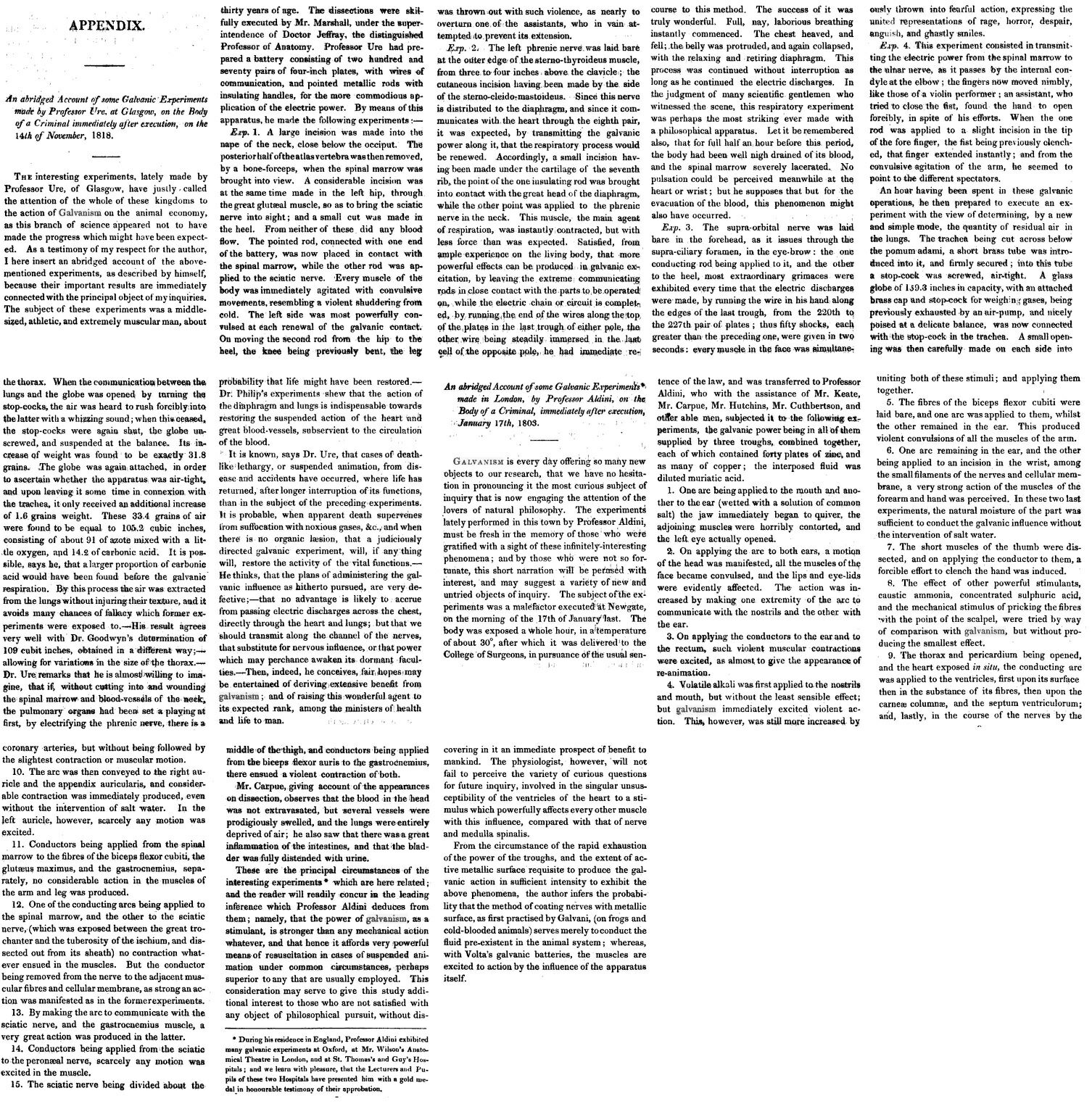
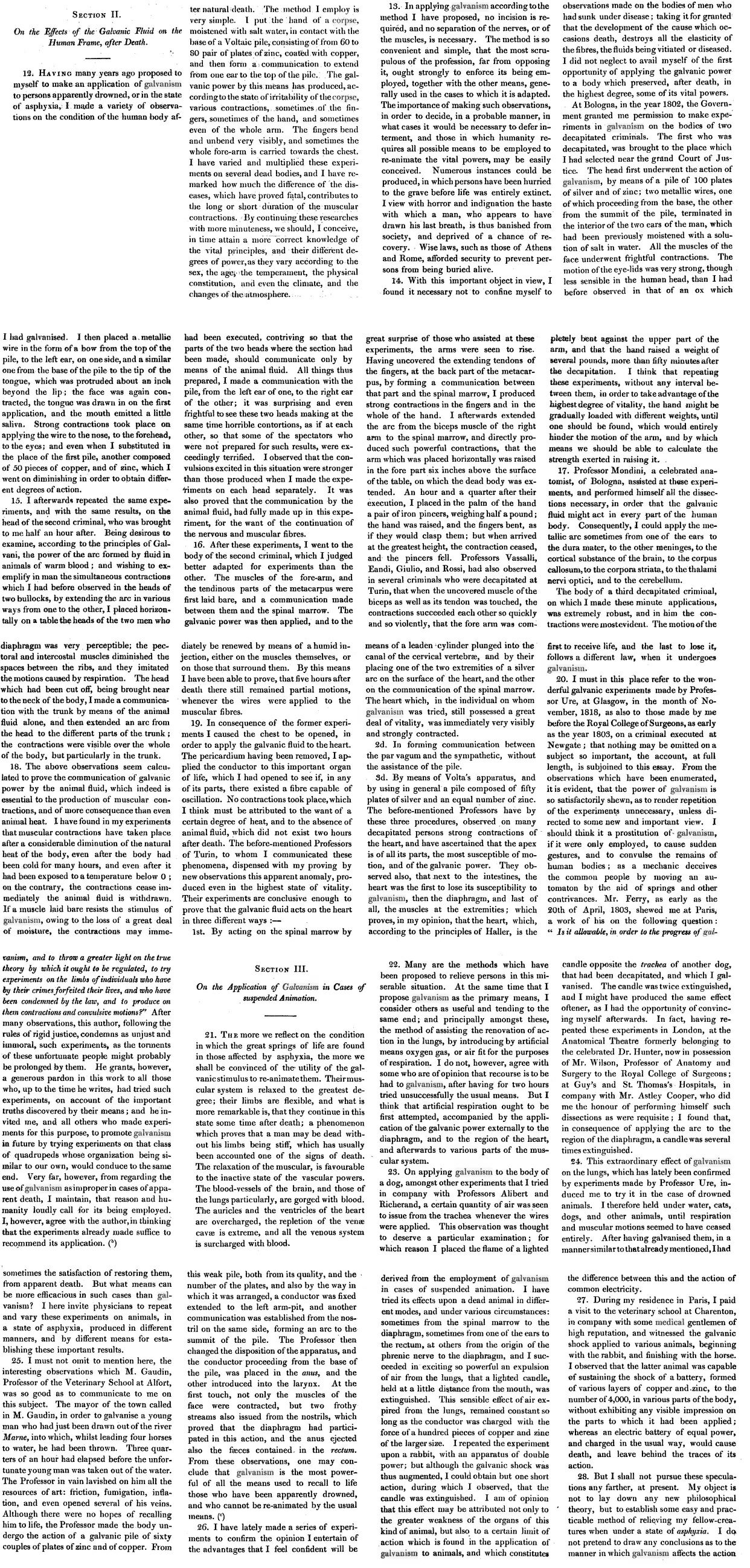
2 The story of Frankenstein was partly inspired by
the scientific work of Luigi Galvani and Alessandro Volta. They founded
what came to be called "Galvanism" -- the use of chemicals to create
electricity, and the study of the effects of electricity on biological
organisms. Galvani's nephew, Giovanni Aldini, carried on his uncle's
work, and was a contemporary of Mary Shelley, author of Frankenstein.
As a lover of old newspapers and medical journals, I've come across
descriptions of Aldini's experiments, and the experiments of others
working in that field, and they're fascinating -- and gruesome. You can
see three
medical journal entries here, in graphic format:
|