``Where the
Bishop is, there let the multitude of believers be;
even as where Jesus is, there is the Catholic Church'' Ignatius of
Antioch, 1st c. A.D
Christmas Eve
and Christmas Day
Exactly nine months after the Gabriel appeared to Mary, which
we celebrate on the Feast of the
Annunciation, Christ is born in Bethlehem, alleluia! The mood of
this Feast
is summed
up by words of the angels to the shepherds in Luke 2:10-14:
And the angel
said to them: Fear not; for, behold, I bring you good tidings of great
joy, that shall be to all the people: For, this day, is born to you a
Saviour, who is Christ the Lord, in the city of David. And this shall
be a sign unto you. You shall find the infant wrapped in swaddling
clothes, and laid in a manger. And suddenly there was with the angel a
multitude of the heavenly army, praising God, and saying: Glory to God
in the highest; and on earth peace to men of good will.
The long-awaited
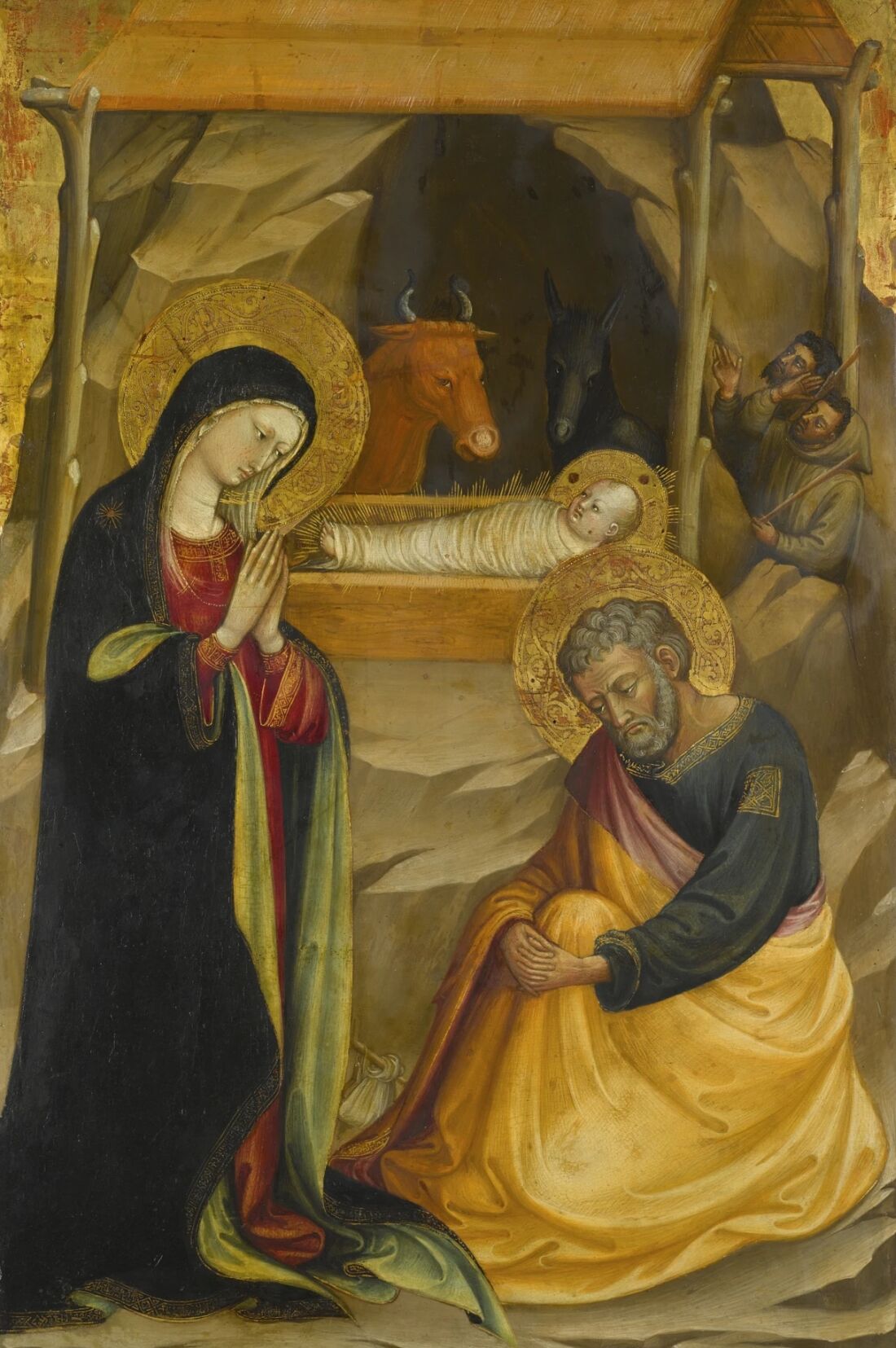
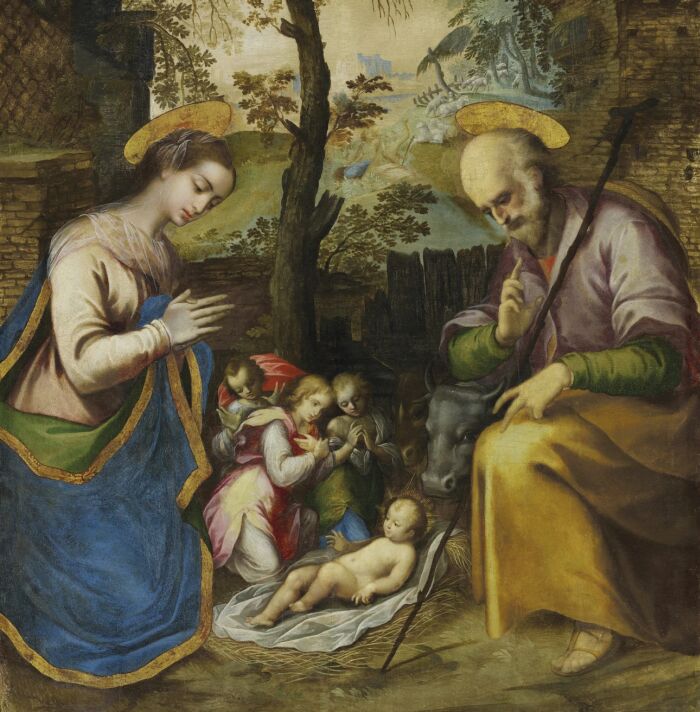
Messias is born, and His Nativity is filled with Mystery. Did you know
that "Bethlehem" means "House of Bread"? Yes, the Bread of Life, the
Living Bread from Heaven, was born in a town called "House of Bread" --
and, fortelling His future as the Bread of Life Who feeds His sheep,
was laid in a manger -- a trough that holds food for animals. St.
Gregory Thaumaturgus (a.k.a. Gregory of
Neocaesarea), A.D. 213 - ca. 270, describes the significance of the
manger in his Homily on the Annunciation:
In the board
from which cattle eat was laid the heavenly Bread, in order that He
might provide participation in spiritual sustenance for men who live
like the beasts of the earth.
The Feast of the
Nativity is a most joyous
one that celebrates the incredible reality that the Second Person of
the Trinity was born of a Virgin so He could redeem us. "It was He, the
Infant of days, that could appease, O Lord, the Ancient of Days," wrote
St. Ephraem the Syrian and Doctor of the Church.
And how providential that He was born at the time of year that the
light of the
Sun increases -- the very opposite of St. John the Baptist, who was
born as the light of the Sun begins to decrease, per his words, "He
must increase, but I must decrease." St. Gregory of Nyssa writes of
this:
On this the Day
which the Lord hath made, darkness decreases, light increases, and
Night is driven back again. No, Brethren, it is not by chance,
nor by any created will, that this natural change begins on the Day,
when He shows Himself in the brightness of His coming, which is the
spiritual Life of the world. It is Nature revealing, under this symbol,
a secret to them whose eye is quick enough to see it; to them, I mean,
who are able to appreciate this circumstance of our Saviour's coming.
Nature seems to me to say: Know, O Man, that under the things which I
show thee, there lie Mysteries concealed. Hast thou not seen the Night,
that had grown so long, suddenly checked? Learn hence, that the black
night of sin, which had got to its height by the accumulation of every
guilty device, is this day its duration shall be shortened, until at
length there shall be naught but Light. Look, I pray thee, on the Sun ;
and see how his rays are stronger, and his position higher in the
heavens: learn from that, how the other Light, the Light of the Gospel,
is now shedding itself over the whole earth.
See this page for
some interesting information on the date of Christmas.
Customs
If Advent
preparations have been handled well, the house should be clean, work
should be done, and things should be fresh and ready for twelve days of
rejoicing!
Once the sun
goes down on Christmas Eve, a lit candle is placed in front of a window
to guide the Holy Family, and the Yule log is lit in the fireplace.
Back
when homes had great fireplaces, fires were lit on Christmas Eve using
logs so huge as to be able to burn for all the days of Christmas. These
Yule logs now tend to be much smaller, but the traditions surrounding
them remain: the fire on Christmas Eve should be lit using a piece of
last year's Yule Log which has been stored under the bed of the
mistress of the house, which folk belief says brings good fortune and
prevents lightning strikes to the home. In Provence, the Yule log is
lit with great ceremony. The Grandfather will pour sweet wine over it
three times while saying:
Alègre! Alègre!
Alègre! Que nostre Segne nous alègre!
S’un autre an sian pas mai, moun Dieu fugen pas men!
Which means:
Joy! Joy! Joy!
May God bring us joy!
And if, in the year to come, we are not more, let us not be less!
Then he and the
youngest child carry the log three times around the Christmas table
before taking it to the fireplace. Alas, fireplaces are less common
than they once were, but if you have no fireplace, a decorated log can
be used as a centerpiece, as is done in Italy where the log is known as
a "ceppo."
While the Yule log burns, a candle is put in the window. This is an old
Irish custom stemming from the Protestant persecutions: the candle
signalled to priests that the home was a safe place for Mass to be
offered, but when the English asked questions, they were told that it
was a symbolic invitation to Joseph and Mary.
Note that "the old wives" say that the weather of the twelve days of
Christmas
foretells the weather of the coming year -- i.e., the weather of the
first day of Christmas (December 25) foretells the weather of January,
the weather of the second day of Christmas (December 26) foretells the
weather of February, and so on. For some fun, print out this Twelve Days of Christmas Weather Lore
Chart (pdf) and fill it in today and for the next eleven days, hang
it on your fridge, and see if it comes true (note that there is similar
folklore for the twelve Ember Days that
are scattered throughout the year).
Foods
Christmas Eve
(before the Vigil Mass) is a day of fasting and abstinence. The 1983
Code of Canon Law eliminated this fast altogether, but many traditional
Catholics still keep the fast, eating seafood (the Italians eat fish --
often seven of them!), noodles, other forms of pasta, etc. for the
Christmas Eve Supper.
In any case, on both Christmas Eve and on Christmas Day, special
dinners are served, some families beginning their Christmas Eve meals
when a child sees the first star of the evening in the Noel sky. The table should be
beautiful, with greenery and candles, especially the Christ Candle.
Some families set a place setting for those who've died during the year
or for those who are otherwise unable to attend, and then set a lit
candle on it to burn throughout the meal. An Eastern European tradition
is to use a white tablecoth to represent Christ's purity and His
swaddling clothes, and to place underneath it a bit of hay to recall
where he was born. In Provence, three white table cloths of different
sizes are used, with the smallest on top.
Christmas Eve and Christmas Day foods vary from country to country, but
Christmas Eve dinners are traditionally meatless, while Christmas Day
is the day of
unrestricted feasting, when Christmas candies, marzipan, oranges,
apples, tangerines, nuts, and the cookies baked during Advent are all
laid out. From a German tradition, the nuts are cracked open with a
nutcracker (nussknacker) shaped like a soldier. E. T. A. Hoffmann's
Christmastime story, "The Mouse King," written in 1816, uses this type
of nutcracker as a character, and since Tchaikowsky wrote his famous
"The Nutcracker" ballet based on this story, both the nutcracker itself
and the ballet have become seasonal favorites.
On Christmas
Eve, the Poles have a beautiful custom that recalls the Eucharist:
Oplatki ("oplatek" in the singular) -- very thin, crisp, large
rectangular breads with the consistency of Communion wafers and
impressed with religious designs -- are eaten on Christmas Eve (Wigilia)
. They are laid at the center of the table this night, on a bed of
straw. Just before supper, the father wishes all a holy Christmas and
recalls those who've died during the year and brings to memory
Christmas Eve suppers past. He takes an oplatek that's been blessed by
a priest, and breaks off a piece to give to his wife. He places it in
her mouth with a blessing such as, "May the Lord bless and keep you
through this next year." The mother reciprocates and then hands a piece
to the person next to her and blesses him. That person does the same to
the one next to him, and so on, until all have received and given a
piece. If it is more than just the immediate family present, the oldest
person present will initiate by offering an Oplatek to another, and the
two break off a piece between them, passing the remainder on to the
next person. Oplatki are shared with the family's animals, too. So
loved is this tradition that Poles will mail small oplatki inside
Christmas cards to those who aren't present for Christmas Eve.
Remaining pieces of oplatki are given to animals to bless them, too
(note: the "L" in the word for this bread is pronounced as a "W")."
In Denmark and Norway, a Christmas Eve requirement is a rice pudding,
sometimes served with a raspberry or cherry sauce, and inside of which
is a peeled almond. The lucky person who finds the almond wins a
marzipan pig!
The after-Midnight Mass time (see below) is known as "le réveillon"
(the "awakening") in France and French Canada. Foods from the Christmas
Eve Supper are served up, and, depending on the region of France or
Canada, crêpes, foie-gras, oysters, etc. are served, always ending with
the fanciful, Yule Log-shaped Bûche de Noel cake. In Provence, seven
meatless dishes are eaten for supper, and then, after Mass, thirteen
desserts appear on the table and remain there for three days.
On Christmas
Day, the English prefer gingerbread, plum
puddings, and mincemeat pies. Mincemeat pies are baked in an oblong
shape to recall Jesus' crib. To them were added cinnamon, cloves, and
nutmeg to symbolize the gifts of the Magi. These pies were once made
illegal by Puritan Oliver Cromwell, Lord Chancellor of England, because
it was considered a "popish" dish (their loss!). An old bit of doggerel
2 that
describes the anti-Catholic animus:
The high-shoe
lords of Cromwell's making
Were not for dainties -- roasting, baking;
The chiefest food they found most good in,
Was rusty bacon and bag-pudding;
Plum-broth was popish, and mince-pie --
O that was flat idolatry!
Along with
Christmas Day Feast's "popish foods," the English serve Christmas
Crackers -- not a food, but a device invented in 1844 by
Thomas Smith. It is a tube filled with candy, trinkets, jokes, and a
party hat, all wrapped in colorful paper and broken open by two people,
one pulling and twisting at each end. A cracker is placed beside each
dinner plate at the Christmas table, and guests pick them up in their
right hand, cross their arms, and, with their free left hand, pull the
cracker of their neighbor to the right. When the cracker breaks open, a
bang is produced when two strips of cardboard treated with silver
fulminate strike against each other.
Italians have to have a wonderful Christmas bread called panettone;
Germans have their stollen (also crib-shaped, like mincemeat pies, and
then "swaddled" in powdered sugar); Americans tend to go for their
grandmothers' recipes from the "Old Country." See this page for a few recipes for a
classic Christmas.
The Christ
candle -- a large white candle decorated with holly and such
-- is lit for Christmas Supper, replacing the Advent wreath. It is re-lit each night
until the Epiphany to represent
Christ's Light and in order to help
guide the Magi to the manger. 1
The greenery of the Advent wreath itself is now decorated and hanged on
the front door, remaining there throughout the Christmas season.
Another tradition some Catholics practice is the praying of the Litany of the Infant Jesus
during the twelve days of Christmas -- that is, starting on December 25
and ending on Twelfthnight. Perhaps the
praying of this litany could be incorporated with the lighting of the
Christ Candle during Christmastide dinners.
In all your feasting, don't forget God's other creatures! St. Francis of Assisi
preached that animals should be well fed on Christmas, too. 3 He said
If I could see
the Emperor, I would implore him to issue a general decree that all
people who are able to do so, shall throw grain and corn upon the
streets, so that on this great feast day the birds might have enough to
eat, especially our sisters, the larks.
Give your dog
some cheese and your kitty a little saucer of cream in honor of this
great Saint and the Christ Child!
After Supper
It is believed
that Christ was born at midnight based on tradition and the time of the
Passover that preceded the Exodus from Egypt as recounted in Exodus
12:21-23, 29-31:
And Moses called
all the ancients of the children of Israel, and said to them: Go take a
lamb by your families, and sacrifice the Phase. And dip a bunch of
hyssop in the blood that is at the door, and sprinkle the transom of
the door therewith, and both the door cheeks: let none of you go out of
the door of his house till morning. For the Lord will pass through
striking the Egyptians: and when he shall see the blood on the transom,
and on both the posts, he will pass over the door of the house, and not
suffer the destroyer to come into your houses and to hurt you...
...And it came to pass at midnight, the Lord slew every firstborn in
the land of Egypt, from the firstborn of Pharao, who sat on his throne,
unto the firstborn of the captive woman that was in the prison, and all
the firstborn of cattle. And Pharao arose in the night, and all his
servants, and all Egypt: for there was not a house wherein there lay
not one dead. And Pharao calling Moses and Aaron, in the night, said:
Arise and go forth from among my people, you and the children of
Israel: go, sacrifice to the Lord as you say.
-- and the words
of Wisdom 18:14-15 --
For while all
things were in quiet silence, and the night was in the midst of her
course, Thy almighty word leapt down from heaven from thy royal throne,
as a fierce conqueror into the midst of the land of destruction.
-- and a line
from the Parable of the Ten Virgins in
Matthew 25:
And at midnight
there was a cry made: Behold the bridegroom cometh, go ye forth to meet
him.
So, as near to
Midnight as possible on Christmas Eve, or at least when it is dark and
"symbolically midnight," the official Proclamation of Christmas can be
read to begin Christmas as the Baby Jesus is laid in the manger, and
the
Christmas tree is lit on a big, glorious display of light and beauty.
Dom Gueranger describes the
proclamation thus:
At the Office of
Prime, in cathedral chapters and monasteries, the announcement of
tomorrow's feast is made with unusual solemnity. The lector, who
frequently is one of the dignitaries of the choir, sings, to a
magnificent chant, the following lesson from the martyrology. All the
assistants remain standing during it, until the lector comes to the
word Bethlehem, at which all genuflect, and continue in that posture
until all the glad tidings are told.
The proclamation
itself:
The Eighth of
the Calends of January
Octavo
Kalendas Januarii
The year from
the creation of the world, when in the beginning God created heaven and
earth, five thousand one hundred and ninety-nine:
Anno a creatione
mundi, quando in principio Deus creavit coelum et terram, quinquies
millesimo centesimo nonagesimo nono:
From the deluge,
the year two thousand nine hundred and fifty-seven:
A diluvio vero,
anno bis millesimo nongentesimo quinquagesimo septimo:
From the birth
of Abraham, the year two thousand and fifteen:
A nativitate
Abrahae, anno bis millesimo quintodecimo:
From Moses and
the going out of the people of Israel from Egypt, the year one thousand
five hundred and ten:
A Moyse et
egressu populi Israel de Aegypto, anno millesimo quingentesimo decimo:
From David's
being anointed king, the year one thousand and thirty-two:
Ab unctione
David in regem, anno millesimo trigesimo secundo:
In the
sixty-fifth week according to the prophecy of Daniel:
From the
building of the city of Rome, the year seven hundred and fifty-two:
Ab urbe Roma
condita, anno septingentesimo quinquagesimo secundo:
In the
forty-second year of the reign of Octavian Augustus:
Anno imperii
Octaviani Augusti quadragesimo secundo:
The whole world
being in peace:
toto urbe in
pace composito,
In the sixth age
of the world: Jesus Christ, the eternal God, and Son of the eternal
Father, wishing to consecrate this world by his most merciful coming,
being conceived of the Holy Ghost, and nine months since his conception
having passed, In Bethlehem of Juda is born of the Virgin Mary, being
made Man:
sexta mundi
aetate, Jesus Christus aeternus Deus, aeternique Patris Filius, mundum
volens adventu suo piisimo consecrare, de Spiritu Sancto conceptus,
novemque post conceptionem decursus mensibus, in Bethlehem Judae
nascitur ex Maria Virgine factus homo:
THE NATIVITY OF
OUR LORD JESUS CHRIST ACCORDING TO THE FLESH!
NATIVITAS DOMINI
NOSTRI JESU CHRISTI SECUNDUM CARNEM!
How beautiful it would be to follow up the Proclamation with
Psalm 148, Laudate Dominum de caelis:
Praise ye the
Lord from the heavens: praise ye him in the high places. Praise ye him,
all his angels: praise ye him, all his hosts. Praise ye him, O sun and
moon: praise him, all ye stars and light. Praise him, ye heavens of
heavens: and let all the waters that are above the heavens Praise the
name of the Lord. For he spoke, and they were made: he commanded, and
they were created. He hath established them for ever, and for ages of
ages: he hath made a decree, and it shall not pass away. Praise the
Lord from the earth, ye dragons, and all ye deeps: Fire, hail, snow,
ice, stormy winds which fulfill his word: Mountains and all hills,
fruitful trees and all cedars: Beasts and all cattle: serpents and
feathered fowls: Kings of the earth and all people: princes and all
judges of the earth: Young men and maidens: let the old with the
younger, praise the name of the Lord: For his name alone is exalted.
The praise of him is above heaven and earth: and he hath exalted the
horn of his people. A hymn to all his saints: to the children of
Israel, a people approaching to him. Alleluia.
Alleluia
laudate Dominum de caelis: laudate eum in excelsis . Laudate eum omnes
angeli eius laudate eum omnes virtutes eius. Laudate eum sol et luna
laudate eum omnes stellae et lumen. Laudate eum caeli caelorum et aqua
quae super caelum est. Laudent nomen Domini quia ipse dixit et facta
sunt ipse mandavit et creata sunt statuit ea in saeculum et in saeculum
saeculi praeceptum posuit et non praeteribit. Laudate Dominum de terra
dracones et omnes abyssi. Ignis grando nix glacies spiritus procellarum
quae faciunt verbum eius. Montes et omnes colles ligna fructifera et
omnes cedri : Bestiae et universa pecora serpentes et volucres
pinnatae. Reges terrae et omnes populi principes et omnes iudices
terrae : iuvenes et virgines senes cum iunioribus laudent nomen Domini
: quia exaltatum est nomen eius solius. Confessio eius super caelum et
terram et exaltabit cornu populi sui hymnus omnibus sanctis eius filiis
Israhel populo adpropinquanti sibi. Alleluia.
While these
beautiful words (download below) proclaim Christmas and praise God, the
Christmas tree
can be lit for the first time. The Christmas tree 4 will remain, like other Christmas decorations and symbols,
at least until the Epiphany or its Octave, but more
properly, until Candlemas
(February 2). Some
families decorate the tree as a family; in others,
the parents decorate the tree outside of the children's sight, then
darken the room, light candles and the tree's lights, play music, burn
incense, and otherwise set a glorious scene before they lead the
children into the room to enjoy the splendor, especially as close as
possible to Midnight. Some parents have one special ornament that they
will put on the tree last, hiding it so that the first child who finds
it gets an extra present or privilege. 5
And note, too, that December 24 is also the Feast Day of Adam and Eve,
so an ornament (an apple?) on the tree in their honor would be a lovely
touch.
Of course, and most importantly, Baby Jesus must
arrive in your nativity set's crib this
night! A
ceremony is made of enthroning Baby Jesus in the manger, with the
youngest child given the honor of placing the figurine in the manger as
his siblings hold candles whose light symbolize the Light of Christ.
A prayer for the occasion:
A Prayer to the
Infant Jesus Lying in the Manger
O Divine Redeemer Jesus Christ, prostrate before Thy crib, I believe
Thou art the God of infinite Majesty, even though I do see Thee here as
a helpless babe. I humbly adore and thank Thee for having so humbled
Thyself for my salvation as to will to be born in a stable. I thank
Thee for all Thou didst wish to suffer for me in Bethlehem, for Thy
poverty and humility, for Thy nakedness, tears, cold and sufferings.
Would that I could show Thee that tenderness which Thy Virgin Mother
had toward Thee, and love Thee as she did. Would that I could praise
Thee with the joy of the angels, that I could kneel before Thee with
the faith of St. Joseph, the simplicity of the shepherds. Uniting
myself with these first adorers at the crib, I offer Thee the homage of
my heart, and I beg that Thou wouldst be born spiritually in my soul.
Make me reflect in some degree the virtues of Thy admirable nativity.
Fill me with that spirit of renunciation, of poverty, of humility,
which prompted Thee to assume the weakness of our nature, and to be
born amid destitution and suffering. Grant that from this day forward,
I may in all things seek Thy greater glory, and may enjoy that peace
promised to men of good will. Amen.
After you've lit the tree and candles, and placed Baby Jesus in the
manger,
tell your children how it is said that at midnight on Christmas Eve,
animals fall to their knees in adoration and speak in Latin praising
God. It is said that church bells can be heard ringing from the bottom
of the sea, and that the honeybees awaken to sing the 99th Psalm...
A psalm of
praise. Sing joyfully to God, all the earth: serve ye the Lord with
gladness. Come in before his presence with exceeding great joy. Know ye
that the Lord he is God: he made us, and not we ourselves. We are his
people and the sheep of his pasture. Go ye into his gates with praise,
into his courts with hymns: and give glory to him. Praise ye his name:
For the Lord is sweet, his mercy endureth for ever, and his truth to
generation and generation.
The earth's
rivers are said to turn to wine, her trees blossom, and she lets
loose of some of her gems, too -- but one must have a totally pure
heart to see and hear these things! Shakespeare wrote in Act I Scene I
of Hamlet about how malignant spirits and witches are rendered harmless
on Christmas Eve:
Some say that
ever 'gainst that season comes
Wherein our Saviour's birth is celebrated,
The bird of dawning singeth all night long:
And then, they say, no spirit dare stir abroad;
The nights are wholesome; then no planets strike,
No fairy takes, no witch has power to charm,
So hallow'd and so gracious is the time.
So holy is
Christmas that folklore says that babies born today are considered
especially blessed and able to see spirits, and those who die at the
holy hour of Midnight tonight are said to enter straight into Heaven.
Christmas Mass
Mass is
obligatory on Christmas, and this can be fulfilled by going to any one
of three Masses:
the already
mentioned Mass at Midnight, called the "Angels' Mass"
the Mass on
Christmas morning, called the "Shepherds' Mass"
the Mass on
Christmas day, called the "Mass of the Divine Word" or "Kings' Mass"
The Midnight
Mass, though, is the one most Catholics clamor to attend. If the family
attends the Midnight Mass, it might be a good idea to have the children
take naps after supper so they'll be alert for it and for the placing
of Jesus in His Crib, the lighting of the Christmas tree, etc.
Since the invention of television, it's been the custom for a papal
Mass to be broadcast on Christmas Eve. This papal Mass is offered at
Santa
Maria Maggiore (St. Mary Major), which is always one of the station churches for Christmas Eve and
Christmas Day. The station churches for Christmas are as follows:
Christmas Eve:
S. Maria Maggiore
Christmas Angel's Mass: S. Maria Maggiore
Christmas Shepherds' Mass: S. Anastasia
Christmas Kings' Mass: S. Maria Maggiore
Note, too, that at some point around Christmas, the Pope
will give a Christmas address (England's monarch gives an address, too
-- "His (or Her) Majesty's Most Gracious Speech" -- on Christmas
Day).
Gift-giving
Gift giving is
done differently by different Catholic households and in different
(formerly) Catholic countries. Some families present gifts on December
6, the Feast of St. Nicholas Bishop of Myra after whom "Santa Claus"
was partly modelled. Many Catholics (such as Italian Catholics) present
gifts on January 6, the Feast of the Epiphany, in imitation of the
Magi. And some exchange them on Christmas Eve or on Christmas Day -- or
both, perhaps with extended family exchanging them on Christmas Eve,
and children finding presents on Christmas morning.
Stories are told to children to explain who brings the gifts, and they
vary greatly around the world:
Italy
La Befana on
the Epiphany and, more recently, Babbo Natale on Christmas
England
Father Christmas
France
Père Noel
Austria and
Switzerland
Christkind (the
Christ Child Himself)
Russia
Baboushka
Sweden
Jultomten
Mexico and Spain
the Three Kings
(on the Epiphany)
United States
St. Nicholas
(Santa Claus) (on Christmas eve/morning)
Hungary
angels
Poland
Mikolaj or
St.Nicholas (on St. Nicholas's Day)
Parents should be extremely careful with any stories
they might want to tell their children in this way. If it is done in a
very obvious manner of pretending, if it is done is such a way as to
keep Christ the focus of the day, then fine. But one must be careful
not to let one's children confuse fantasy with eternal Truth, to focus
on the former more than the latter, or to get greedy. Two ideas to help
prevent Christmas from becoming too commercialized and "consumerist":
Give one small
gift to the children, in their shoes or stockings, on 6 December (in
honor of/"from" St. Nicholas/Santa Claus),
larger ones
on 25 December (in honor of/"from" Baby Jesus or "Saint Nicholas/Santa
Claus"), and another small one on the Epiphany (in honor of/"from" the
Magi or La Befana). One benefit of doing this is that you can still
give to your children things they'd love to have, but Christmas won't
be a deluge of commercialism; another is that the Feast of St. Nicholas and Twelfth Night (the Vigil of the Epiphany)
will be more memorable for them.
Give your
children only three gifts each, in honor of the three gifts Our Lord
received from the Magi.
In any case, though, as said, if parents tell
stories of mysterious strangers who leave gifts, they need to be
careful not to conflate them with the Truth; there should be a most definite
difference in the way these two things are spoken of, and of course,
Christ should hold first place in the celebrations. And then there's
the matter of parents lying about the source of Christmas presents. On
the one hand, lying is obviously not an okay thing; on the other,
parents want their kids to have fun and a sense of enchantment.
Solution: speak of the stories
surrounding "Santa" in a "they say" sort of way. I.e., instead of
saying "Santa's coming tonight; you need to go to bed!" say "They say that Santa comes tonight
-- but only if you're asleep!"
No matter what, though, parents shouldn't
spoil their children too
much either or allow them to become overcome by a spirit of greed.
Christmas in the Western world truly is becoming seen as a secular day
of merry-making and lust for material things; the holy meaning of this
wondrous day needs to be restored. Limiting the number of gifts,
limiting the prices of gifts, insisting only on homemade gifts,
spreading the gift-giving throughout the Advent and Christmas seasons,
etc.,
are some ways to defeat the intense commercialism.
Aside from the fun gift-giving, Christmas Day is spent
with family, feasting, enjoying one another's company, singing songs,
playing games, telling stories...
Scripture, Stories
and Poems for Christmastide
What is better
than being told a story? Below are links to .pdf files of things to
read to your children.
Collection of Christmas Stories
Includes: When the Animals Talk; Why the Evergreen Trees Never Lose
Their Leaves; The Christmas Truce;7 Chesterton
Christmas
Carol; The
Little Match Girl; The Gift of the Magi; The Fir Tree; and A Visit from
St. Nicholas
See also: The footnote on the page
about the Feast of St. Mary Magdalen for an interesting legend positing
a connection between Mary's midwife and the Magdalen's ointment.
Note: 25 December is also one of the 4 English "Quarter Days," days
which fall around the Equinoxes or Solstices and mark the beginnings of
new natural seasons (i.e., Spring, Summer, Winter, Fall) and which were
used in medieval times to mark "quarters" for legal purposes, such as
settling debts. The other days like this are: Lady Day (the Feast of
the Annunciation) on March 25, the Feast of St. John on June 24, and
Michaelmas on September 29.
Footnotes: 1 An unscented candle can be
scented by burning it a while, and then adding a few drops of fragrance
oil (not essential oil, which is rather volatile) to the melted wax.
For your Christ Candle during the 12 Days of Christmas, why not try
cinnamon, nutmeg, clove, cedar, pine, peppermint, frankincense, myrrh,
etc.?
3
Some families decorate trees outside with foods that will keep the
birds happy. Hang garlands made of strung popcorn, cranberries,
raisins, other dried fruits, orange halves, etc., and decorate further
with suet balls or other items treated with suet. You can make such
suet treats by mixing together warm, melted suet fat, bacon grease, or
lard with corn meal, oat meal, raisins and other dried fruits, chopped
nuts, tablespoonfuls of peanut butter, sunflower seeds, etc. Dip pine
cones into
the mixture, or let cool, form into balls, wrap up in mesh, and let
harden.
if time is an
issue, you could always put the tree up earlier than Christmas, get the
lights on it, but save the ornaments and tinsel and the turning
on of the lights 'til Christmas Eve at
midnight. Or if wanting to decorate it outside the children's presence
for lighting at Midnight, the tree can be fully decorated in a separate
room, or kept covered by a screen or sheet, etc., until the time of the
unveiling.
to keep real
trees green and help them retain their needles, keep them away from
heat sources and keep as cool as possible. Add sugar to the tree's
water, and check the water a few times a day, replenishing as needed.
To make artificial trees smell good, put about a teaspoon of pine or
cedar essential oils into 4 ounces of distilled water inside a spray
bottle and mist. Hang pomanders with the same scents from the branches.
Test lights
before hanging and have a power strip ready so you won't have to deal
with so many cords. The general rule of thumb is that you need a strand
of
100 lights for every one foot of tree of average girth, but more are
fine if you like a brighter tree.
Hang lights
first (wrap the trunk first, then the middle of the branches, and then
the outer branches for a sense of depth), then garlands, then
ornaments. (If you use an artificial tree and have room to store it all
set up, keep the lights on it and they will be ready next year.)
When hanging
ornaments, hang your ornaments first in the middle of the branches, and
then at the ends. This will make the tree look fuller, and reflective
ornaments in the middle of the tree towards the trunk will reflect any
lights you use and make it seem as though you have more of them.
For a designer
effect, choose a dominant theme for the tree -- Stained glass,
Victorian, silk or dried flowers, birds, St. Nicholas and other Saints,
whatever you love. For every foot of the tree's height, use roughly 10
larger theme ornaments to every 25 smaller, more "generic" ornaments
for color and fullness. Using green-colored hanging hooks, hang the
smaller ornaments first, tapering the size of the ornaments so that the
smallest ornaments are toward the top of the tree.
Some people
decorate with chrismons -- monograms of Christ and other Christian symbols (e.g., different types of
Crosses, a lamb, fish, anchor, pelican, etc.). Usually chrismons used
to decorate Christmas trees are white and gold in color.
For a dramatic
effect with inexpensive ornaments, take 1 large ball ornament, 1 medium
sized one, and 1 small one, monochromatic or in the color scheme of
your choice; bind their hangers together and adjust so that the small
ornament sits highest, the medium-sized ornament sits in the middle,
and the large one lies the lowest. Hang as a cluster.
5
There's a relatively recent American custom regarding the
hiding of a special ornament for children to find. It's become not
uncommon for parents to hide a green glass ornament shaped like a
pickle -- and called the "German Pickle." This practice poses as an
old-country German tradition, but is actually a charming
German-American one -- and a clever one, too, in that the green pickle
is challenging to spot among the green branches.
6 Beware of certain carols
and hymns that are full of heresy. The popular "Mary, Did you Know?",
for ex., with its lines "Did you know that your baby boy has come to
make you new? This child that you've delivered, will soon deliver you"
insults the Blessed Virgin terribly. Yes, Mary knew Who Her Son would
be the moment He was conceived; she knew the Messianic prophecies (this
is why she is often depicted in
Catholic art reading Sacred Scripture as a child), and she encountered
the archangel Gabriel. She was
also conceived without sin, so didn't need to be made "new."
7 Read about the Christmas Truce in an animated
format here (embedded sound!).