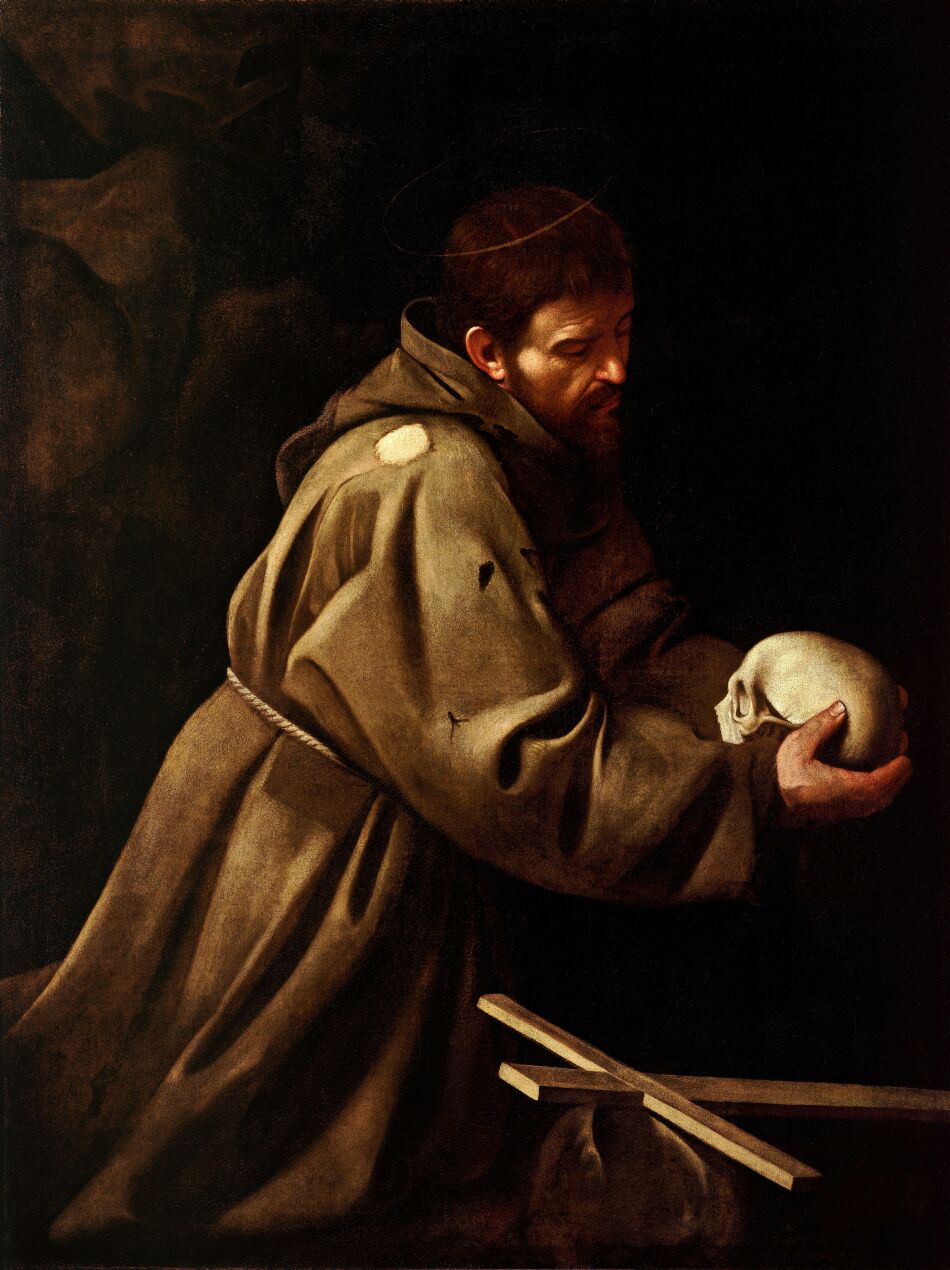
Perhaps, after Our Lady, the most beloved Saint of all time
is St.
Francis of Assisi, "il Poverello" (the Little Poor Man). His character
twisted into that of an idiotic hippie, St. Francis's image hasn't
fared well, so one must dig to find the truth about this glorious Saint.
He was born in Assisi in 1181 or 1182, the son of Pietro Bernardone, a
wealthy cloth merchant, and his wife, Pica. Christened "Giovanni," his
father -- most likely because of his fondness for France -- later
changed his name to "Francesco" while Francis was still an infant.
He grew up to be not only handsome, but fun-loving, even frivolous due
to his parents having spoiled him a bit. He dressed in fine clothes,
loved feats of arms, and was lavish with money though, even then during
his wild days, he had great compassion for the poor.
When he was twenty years old or so, he and his townsmen got involved
with a skirmish with the townsmen of Perugia. The men of Assisi lost
that battle, and Francis was taken prisoner. For a year he languished
in a Perugian prison, becoming ill and, in his adversity, began to turn
his thoughts to greater things. When his health returned and he was
released, however, he put those greater things to the back of his mind
and resolved to have a military career, but it is now that God began to
intervene in interesting ways. He'd arranged to join with a local
knight to take arms against the emperor, but the night before he was to
leave, he had a dream of a long hall lined with armor, all of which was
marked with a cross. A voice said, "These are for you and your
soldiers," and Francis took it to mean he would be a great prince. He
and the knight set off, but when they reached Spoleto, Francis became
ill again and was told in another dream, by the same voice, to return
to Assisi. He did. But he returned a different man, a more spiritual
man who had less interest in the reveleries of his youth, and more
interest in solitude and prayer.
He soon decided to "take a wife of surpassing fairness" -- "Lady
Poverty" -- and began spending his wealth on the poor, the sick, and
the Church. One day he was riding a horse across the plains of Umbria
when he encountered a leper. He was naturally repelled, but the spirit
of Christ overcame his repulsion, and he embraced the man, giving him
all the money he had. He emptied his pockets again during a pilgrimage
to Rome, when he saw the paucity of offerings left at St. Peter's tomb.
After he did so, he exchanged his
fine clothes for the tattered rags of
a beggar.
After
returning to Assisi, he was praying one day in the Chapel of San
Damiano, before an iconic Crucifix which has become known as the "San Damiano Crucifix."

While deep in prayer, he heard a voice say to him, "Go,
Francis, and
repair my house, which as you see is falling into ruin." He went to his
father's shop, took expensive cloth, and sold it and his horse for the
money to make literal repairs to the chapel. The chapel's priest
wouldn't accept money gained in that manner, and Francis threw it at
him in disdain. Francis's father was livid, so his son hid himself away
in a nearby cave for a month, emerging squalid and emaciated. His
appearance invited mockery, and he was tormented by locals until his
father retrieved him, beat him, bound him, and imprisoned him in a
closet. His mother freed him in his father's absence, and he returned
to San Damiano where he found a a place to live with the priest's help.
Francis's father, though, went to the city consuls to force his son to
give up his inheritance, something Francis was very happy to do. He
took off his clothes and handed them to his father with the words,
"Hitherto I have called you my father on earth; henceforth I desire to
say only 'Our Father Who art in Heaven.'" His embrace of Lady Poverty
was almost complete.
He took to the hills of Assisi where he was confronted by a band of
robbers. When asked who he was, he told them, "I am the herald of the
great King!" whereupon they took what little he had and threw him into
a snow bank. He emerged half frozen and crawled to a monastery where he
stayed for a time, working in the kitchen.
From there he went to Gubbio, where a friend gave him the cloak, scrip,
and staff of a pilgrim.
He returned to Assisi and begged people for stones with which he could
restore the chapel of San Damiano that he'd been commanded to repair.
Stone by stone, with his own hands, he did rebuild it, and then went on
to repair the Chapel of San Pietro outside the city, and the tiny
chapel of the tiny town of Santa Maria degli Angeli (St. Mary of the
Angels) below the city.
In 1208 he was attending Mass at that third chapel, in Santa Maria
degli Angeli, and heard Our Lord's words as recounted in the tenth
chapter of Matthew: "Do not possess gold, nor silver, nor money in your
purses: Nor scrip for your journey, nor two coats, nor shoes, nor a
staff; for the workman is worthy of his meat." He took these words
literally and to heart, and immediately threw away his cloak, wallet,
and staff. Now his embrace of Lady Poverty, the keystone of the
Franciscan charism, was consummated, and he began to wear the coarse
tunic made of wool, with a cincture made of a knotted rope. Instead of
the mockery that had met him earlier, people began to listen and
wonder, attracted by his peace and demeanor.
He acquired two disciples, the first among these being a town magnate,
Bernard of Quintavalle, and the second being the canon of the
cathedral, Peter of Cattaneo. They repaired the church of San Niccolo
where Francis tried to determine God's will for them by three times randomly
opening the Gospel that sat on the altar. Each time he did so,
the passages he found recounted Christ's telling His disciples to leave
all and follow Him. Taking this to be their rule of life, Bernard, and
Peter began to wear habits like that of Francis, and built huts near
his by the chapel of Santa Maria degli Angeli.
They were soon joined by a third man, Giles, and so were able to go two
by two into the world and spread the message of Christ. The group grew
from four to eleven, and it was at this point that Francis made his
first written Rule and went to Rome for Pope Innocent III's approval of
it so they could form an official religious
order. Innocent is said to have rejected Francis at first,
but then changed his mind after he had a dream in which he saw Francis
holding up the St. John Lateran Basilica. In any case, Francis and his
men returned to Assisi with the tonsure (Francis was ordained a deacon)
and known as the "Friars
Minor," the official name for the Franciscan Order.
In 1211, the Benedictines
gave them the tiny chapel at Santa Maria degli Angeli which Francis had
repaired earlier, along with the small tract of land (a "porziuncola")
that surrounded it. This became the center of the Franciscan Order, and
the small chapel came to be known as "the Porziuncola" 1 since
then. There near the Porziuncola they built a few huts of wattle,
straw, and mud which they surrounded by a hedge. From there, they would
go out two by two, finding work where they could, and begging when
there was no work to be found. More men joined up, including Brother
Juniper -- the exasperating "renowned jester of the Lord" whose story
is recounted in "The Little Flowers of St. Francis" -- and "the Three
Companions" who later wrote about Francis's life: Angelus, Leo, and
Rufinus, a cousin of St. Clare who was to meet up with St. Francis
during Lent of 1212.
The eighteen-year old Clare, after hearing Francis preaching, was moved
to beg to be allowed to follow his way of life. On Palm Sunday she
secretly left her father's house and, with two friends, went to join up
with the friars who met them bearing torches in a procession at the
Porziuncola. Francis cut her hair, gave her a habit, and sent her to
live with Benedictine nuns until the friars could build a convent for
her. The Benedictines were kind enough to give him the Chapel of San
Damiano, the first chapel Francis had repaired with his own hands, and
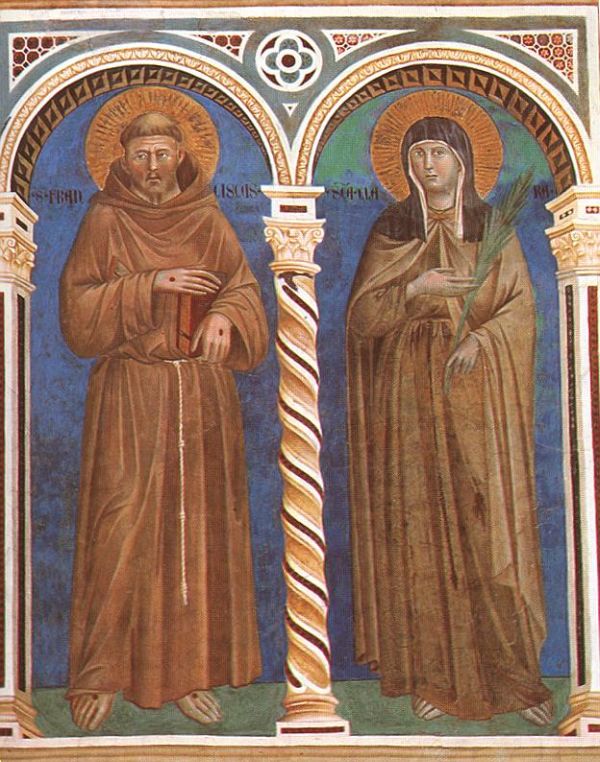
the friars built a convent there to adjoin it. Clare and her Sisters --
who were then known as the "Order of Poor Ladies" but are now known as
the "Poor Clares" -- made this their home.
In Autumn of that same year, Francis's plan to go
to Syria to convert the Saracens was spoiled when he was shipwrecked en
route, off the coast of what is now Eastern Croatia and Western Serbia.
He evangelized in central Italy before making another attempt to
convert the infidels, this time in Morocco. But once again, he ran into
trouble: he became quite ill and never made it out of Spain. Back to
Italy he went, to preach and to convert souls. He became wildly
popular, with crowds gathering where he went and falling under his
spell. Once, while preaching in Camara, Italy, so many people wanted to
join his order after hearing him preach that he decided to fashion a
third order for laypeople.
In 1219, he made his third -- and this time successful -- attempt to
encounter the infidels. He made it to Syria was taken
prisoner, but
used the opportunity to meet with the Sultan and attempt to convert
him. Though he was unable to convince him of the Truth of Christ, he
was able to get the Sultan to agree to treat the Christian prisoners of
war better.
Back in Italy, he had to spend time reorganizing his Order and
re-writing his Rule, said Rule becoming known as the "Regula Bullata." In
1223, in Greccio, Italy, he was inspired by his love of Christmas to
set up a nativity scene,
a devotion that Catholics still practice to
this day.
In 1224, he was given the great honor to bear the stigmata of
Christ. The story is told by Thomas of Celano, in his biography of St.
Francis -- Vita prima
S. Francisci -- written in 1228-1229:
Two
years before Francis gave his soul back to heaven, while he was staying
in a hermitage called "Alverna" after the place w here it was located,
he saw in a vision from God a man with six wings like a seraph,
standing above him with hands extended and feet together, affixed to a
cross. Two wings were raised over his head, two were extended in
flight, and two hid his entire body.
When the blessed servant of God saw these things he was filled with
wonder, but he did not know w hat the vision meant. He rejoiced greatly
in the benign and gracious expression with which he saw himself
regarded by the seraph, whose beauty was indescribable; yet he was
alarmed by the fact that the seraph was affixed to the cross and was
suffering terribly. Thus Francis rose, one might say, sad and happy,
joy and grief alternating in him. He wondered anxiously what this
vision could mean, and his soul was uneasy as it searched for
understanding. And as his understanding sought in vain for an
explanation and his heart was filled with perplexity at the great
novelty of this vision, the marks of nails began to appear in his hands
and feet, just as he had seen them slightly earlier in the crucified
man above him.
His hands and feet seemed to be pierced by nails, with the heads of the
nails appearing in the palms of his hands and on the upper sides of his
feet, the points appearing on the other side. The marks were round on
the palm of each hand but elongated on the other side, and small pieces
of flesh jutting out from the rest took on the appearance of the
nail-ends, bent and driven back. In the same way the marks of nails
were impressed on his feet and projected beyond the rest of the flesh.
Moreover, his right side had a large wound as if it had been pierced
with a spear, and it often bled so that his tunic and trousers were
soaked with his sacred blood.
Alas, how few were worthy of viewing the wound in the side of this
crucified servant of the crucified Lord. How fortunate was Elias, who
was worthy of seeing it while the holy man lived, but no less fortunate
was Rufinus, who touched the wound with his own hands. For once, when
the aforesaid brother Rufinus put his hand on the holy man's chest in
order to rub him, his hand fell to his right side, as often occurs, and
he happened to touch that precious wound. The holy man of God suffered
great anguish from that touch and, pushing the hand away, he cried out
to the Lord to forgive him.
He carefully hid the wound from outsiders and cautiously concealed it
from those near him, so that even his most devoted followers and those
who were constantly at his side knew nothing of it for a long time. And
although the servant and friend of the most high saw himself adorned
with many costly pearls as if with precious gems, and marvelously
decked out beyond the glory and honor of other men, he did not become
vain or seek to please anyone through desire for personal glory, but,
lest human favor should steal away the grace given to him, he attempted
to hide it in every way possible.
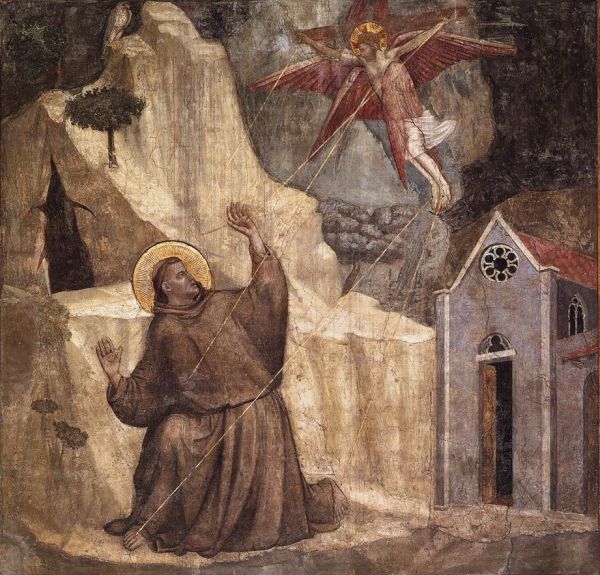
His reception of the stigmata happed on September 17, during "St.
Michael's Lent" -- a period of fasting which St. Francis
voluntarily
kept as a personal discipline, and which some Catholics still emulate,
from the Feast of the
Assumption (August 15) to the Feast of St. Michael the
Archangel (September 29).
But at around this time, too, his body -- which he humorously referred
to as
"Brother Ass" -- began to betray him. Tubercolosis, dropsy, eyesight
failing almost to the point of blindness, he knew his time was upon
him. He went to the Chapel of San Damiano to vist St. Clare, and there,
living in a little hut in the garden of the convent, wrote his
"Canticle of the Sun." He then moved on to Assisi, to die in his
beloved Porziuncola, surrounded by his brothers -- including a woman he
deemed a brother, the Lady Jacoba whom he referred to as "Brother
Jacoba." On Ocotber 3, 1226, they read to him the account of Christ's
Passion from the Book of St. John, and then he recited Psalm 141. After
praying the last verse, after having prayed, "Bring my soul out of
prison," he died. The Catholic Encyclopedia tells us what happened
next:
...his
body was, on 4 October, borne in triumphant procession to the city, a
halt being made at St. Damian's, that St. Clare and her companions
might venerate the sacred stigmata now visible to all, and it was
placed provisionally in the church of St. George (now within the
enclosure of the monastery of St. Clare), where the saint had learned
to read and had first preached. Many miracles are recorded to have
taken place at his tomb. Francis was canonized at St. George's by
Gregory IX, 16 July, 1228.
The day after he was canonized, Pope Gregory IX started
building a great church around the little porziuncula chapel and the
cell in which St. Francis died. Pope Pius V, leaving the chapel and
cell intact, tore down Pope Gregory's structure and built in its place
a large basilica which still stands today. The little chapel, which is
only 13 and a half feet wide and 22 feet long, became the place where
one could receive the Portiuncula Indulgence,
an indulgence which came
about when St. Francis was praying in his chapel, "O God, although I am
a great sinner, I beseech You to grant a full pardon of all sins to all
who, having repented and confessed their sins, shall visit this
church." and was answered wit the words, "Francis, you ask much, but
you are worthy of greater things, and greater things you shall have."
Pope Honorius III ratified it, letting it be known that anyone who,
with a contrite heart, visited the chapel between the afternoon of
August 1 and sunset of August 2 could receive a plenary indulgence.
This indulgence has been expanded many, many times throughout the
centuries, and is now structured such that, on August 2, the faithful
may receive a plenary indulgence, under the usual conditions, by 1)
wanting to receive the indulgence, 2) visiting any parish church
(though a Franciscan church is traditional, and the Portiuncula itself
is the most traditional), 3) praying one Our Father, one Apostle's
Creed, and one other prayer of the individual's choice, 4) praying for
the Pope's intentions, 5) while being free from all sin (including
venial sin), and 6) going to Confession and receiving the Eucharist
within a week before or after.
Note that if you're ever able to visit the Portiuncula and go to its
rose garden, you'll find a very interesting sort of rose. There, a type
of dog rose3 grows, but this cultivar (Rosa canina Assisiensis) has lost its
thorns. This loss is said to have come about when St. Francis, in the
spirit of mortification, threw himself naked into the rose bushes to
subdue his flesh. God, not wanting him harmed, stripped the roses of
their thorns then and there, and they've been growing that way ever
since. Numerous sources say that the Portiuncula's rose garden is the
only place in which these thornless dog roses grow.
St. Francis is the patron of Italy (along with St. Catherine
of Siena), of ecology, and animals.
Customs
Some may prepare
for this feast by praying a Novena to
St. Francis starting on September 25 and ending on the eve of his
feast (October 3). For his feast itself, there is the Litany of the Seraphic
Father Saint Francis (but be warned; it contains some Latin at the
end).
Because of his
great love for God's creatures, today might bring the blessing of animals at your church. Spoil your pets today;
give them an extra snack in honor of St. Francis!
As to music, there are lots of cheesy songs (and prayers, and books,
and movies) in his honor (beware of the
"hippie-fication" of St. Francis; it's truly terrible). But along with
that sort of thing, which I refuse to include on this page, there are Cantico del sol di
Francesco d'Assisi: and St.
François d'Assise: La Prédication aux
oiseaux (St. Francis of Assisi: Preaching to the Birds) by Franz
Liszt who was, himself, a Third Order Franciscan:
As to foods, a sweet raisin bread is eaten in Italy on this
day. A recipe:
Pagnotta dolce di San Francesco
4 (1/4 ounce) packages yeast
1 cup lukewarm water
1 teaspoon sugar
7 cups flour
1 1/2 cups raisins, soaked in water for 30 minutes, drained
and patted dry
4 tablespoons olive oil
6 large eggs, room temperature
1 1/2 cups sugar
1 ounce anise flavoring (optional)
Zest of 1 lemon
Zest of 1 orange
1 dash salt
In a large bowl, dissolve yeast and sugar in lukewarm water.
Separately, beat together the eggs and sugar. When yeast has foamed
after 5 or 10 minutes, add the egg mixture to the yeast mixture. Add
the anise, grated rinds, and salt.
In a big bowl, mix flour and raisins. Add yeast mixture to
flour, mixing and blending to form a dough. Rub olive oil over dough
and set covered in a warm place to rise. In about 2 hours, oil your
hands, punch dough down the dough, and let rise again. After the second
rise, divide dough into four pieces. Shape into loaved and place into 4
oiled bread loaf pans. Let rise to double in bulk. Bake at 350oF
degrees 10 minutes. Loosely cover pans with foil, reduce heat to 300oF
degrees and bake 20 minutes longer.
Catholics who live in Mexico or the Southwestern part of the United
States might consider making a pilgrimage to the Nuestra Señora de la Purisima Concepcion
church in the town of Real de Catorce, in the Mexican state of San Luis
Potosí. Around the feast of St. Francis, pilgrimage is made there to
ask for -- or in gratitude for -- miraclulous healings and other
favors. The hundreds of a sort of ex-voto
called retablos that can be seen in the church are testament to God's
doings in response to prayer made there. While there in the days
honoring St. Francis, there are religious processions, music, dancing,
etc.
The
stories concerning St. Francis were collected and put together by
Brother Ugolino in the early 14th century, roughly seventy years after
St.
Francis died. The collection is referred to as "The Little Flowers of
Saint Francis" (I
Fioretti), and contains the stories of St. Francis
preaching to the birds (Chapter XVI), his interaction with the wolf at
Gubbio (Chapter XXI), his taming the doves (Chapter XXII), etc. I
present them here: The
Little Flowers of Saint Francis of Assisi.
Or download it and the following works in .pdf format from
this site's Catholic library to learn more about the
great St. Francis of Assisi:
Reading
The Bull of Canonization of St. Francis of Assisi
Pope Gregory IX,
A.D. 1228
Given on the occasion of the canonization of St. Francis of Assisi
(1182-1226 A. D.) in 1228 A. D.
1. How wondrously considerate of us is God's pity! How priceless a love
of charity which would sacrifice a Son to redeem a slave! God neither
neglected the gifts of his mercy nor failed to protect uninterruptedly
the vineyard planted by his hand. He sent laborers into it at the
eleventh hour to cultivate it, and with their hoes and plowshares to
uproot the thorns and thistles, as did Samgar when he killed 600
Philistines (Judges 3: 31). After the copious branches were pruned and
the sucker roots with the briars were pulled out, this vineyard will
produce a luscious, appetizing fruit, one capable of storage in the
wine cellar of eternity, once purified in the wine-press of patience.
Wickedness had indeed blazed like fire, and the human heart had grown
cold, so as to destroy the wall surrounding this vineyard, just as the
attacking Philistines were destroyed by the poison of worldly pleasures.
2. Behold how the Lord, when he destroyed the earth by water, saved the
just man with a contemptible piece of wood (Wis. 10:4), did not allow
the scepter of the ungodly to fall upon the lot of the just (Ps 124:3).
Now, at the eleventh hour, he has called forth his servant, Blessed
Francis, a man after his own heart (I Sam 13: 14). This man was a
light, despised by the rich, nonetheless prepared for the appointed
moment. Him the Lord sent into his vineyard to uproot the thorns and
thistles. God cast down this lamp before the attacking Philistines,
thus illumining his own land and with earnest exhortation warning it to
be reconciled with God.
3. On hearing within his soul his friend's voice of invitation Francis
without hesitation arose, and as another Samson strengthened by God's
grace, shattered the fetters of a flattering world. Filled with the
zeal of the Spirit and seizing the jawbone of an ass, he conquered not
only a thousand, but many thousands of Philistines (Judges 15: 15-16)
by his simple preaching, unadorned with the persuasive words of human
wisdom (I Cor 1:17), and made forceful by the power of God, who chooses
the weak of this world to confound the strong (I Cor 1:17). With the
help of God he accomplished this: God who touches mountains and they
smoke (Ps 103:32), so bringing to spiritual service those who were once
slaves to the allurements of the flesh. For those who died to sin and
live only for God and not for themselves (namely, whose worse part has
died), there flowed from this jawbone an abundant stream of water:
refreshing, cleansing, rendering fruitful the fallen, downtrodden and
thirsty. This river of water reaching unto eternal life (Jn 7: 38),
might be purchased without silver and without cost (Is 55:1), and like
branches far and wide its rivulets watered the vineyard whose branches
extended unto the sea and its boughs unto the river (Ps 79:12).
4. After the example of our father Abraham, this man forgot not only
his country and acquaintances, but also his father's house, to go to a
land which the Lord had shown him by divine inspiration (Gen 12).
Pushing aside any obstacle he pressed on to win the prize of his
heavenly call (Phil. 3:14). Conforming himself to Him (Rom 8:29) who,
though rich, for our sake became poor (II Cor 8:9), he unburdened
himself of a heavy load of material possessions so as to pass easily
through the narrow gate (Mt 7:13). He disbursed his wealth to the poor,
so that his justice might endure forever (Ps 111:9).
Nearing the land of vision he offered his own body as a holocaust to
the Lord upon one of the mountains indicated to him (Gen 22:2), the
mountain which is the excellence of faith. His flesh, which now and
then had tricked him, he sacrificed as Jephte his only daughter (Judges
11:34), lighting under it the fire of love, punishing it with hunger,
thirst, cold, nakedness and with many fasts and vigils. When it had
been crucified with its vices and concupiscences (Gal 5:24), he could
say with the Apostle: "I live now, not I, but Christ lives in me" (Gal
2:20). For he really did not live for himself any longer, but rather
for Christ, who died for our sins and rose for our justification (Rom
4:25), that we might no longer be slaves to sin (Rom 6:6).
Uprooting his vices and like Jacob arising at the Lord's command (Gen
35:1-11) he renounced wife and farm and oxen and all which might
distract those invited to the great feast (Lk 14:15-20), and took up
the battle with the world, the flesh and the spiritual forces of
wickedness on high. And as he had received the sevenfold grace of the
Spirit and the help of the eight beatitudes of the Gospel, he journeyed
to Bethel, the house of God, on a path which he had traced in the
fifteen steps of the virtues mystically represented in the Psalter
(gradual Psalms). After he had made of his heart an altar for the Lord,
he offered upon it the incense of devout prayers to be taken up to the
Lord at the hands of angels whose company he would soon join.
5. But that he might not be the only one to enjoy the blessings of the
mountain, clinging exclusively to the embraces of Rachel, as it were to
a life of contemplation lovely but sterile, he descended to the
forbidden house of Leah to lead into the desert the flock fertile with
twins (Cant 4:2) and seeking pastures of life Gen 29). There, where the
manna of heavenly sweetness restores all who have been separated from
the noisy world, he would be seated with the princes of his people and
crowned with the crown of justice. Sowing his seed in tears, he would
come back rejoicing carrying his sheaves to the storehouse of eternity
(Ps 125:5-6).
Surely he sought not his own interests (Phil 2:21), but those of
Christ, serving Him zealously like the proverbial bee. As the morning
star in the midst of a cloud, and as the moon at the full (Eccles.
50,6), he took in his hands a lamp with which to draw the humble by the
example of his glorious deeds, and a trumpet wherewith to recall the
shameless with stern and fearsome warnings from their wicked abandon.
Thus strengthened by charity he courageously took possession of the
Midianite camp (Judges 7:16-22), that is, the camp of those who
contemptuously disregard the teaching of the Church, with the support
of Him who encompassed the whole world by His authority, even while
still cloistered in the Virgin's womb. He captured the weapons on which
the well-armed man trusted while guarding his house and parceling out
his spoils (Lk 11:21-22), and he led captivity captive in submission to
Jesus Christ (Eph 4:8).
6. After defeating the threefold earthly enemy, he did violence to the
kingdom of heaven and seized it by force (Mt 11:12). After many
glorious battles in this life he triumphed over the world, and he who
was knowingly unlettered and wisely foolish, happily returned to the
Lord to take the first place before many others more learned.
7. Plainly a life such as his, so holy, so passionate, so brilliant,
was enough to win him a place in the Church Triumphant. Yet, because
the Church Militant, which can only observe the outer appearances, does
not presume to judge on its own authority those not sharing its actual
state, it proposes for veneration as Saints only those whose lives on
earth merited such, especially because an angel of Satan sometimes
transforms himself into an angel of light (II Cor 11:14). In his
generosity the omnipotent and merciful God has provided that the
aforementioned Servant of Christ did come and serve Him worthily and
commendably. Not permitting so great a light to remain hidden under a
bushel, but wishing to put it on a lampstand to console those dwelling
in the house of light (Mt 5:15), God declared through many brilliant
miracles that his life has been acceptable to God and his memory should
be honored by the Church Militant.
8. Therefore, since the wondrous events of his glorious life are quite
well known to us because of the great familiarity he had with us while
we still occupied a lower rank, and since we are fully convinced by
reliable witnesses of the many brilliant miracles, we and the flock
entrusted to us, by the mercy of God, are confident of being assisted
at his intercession and of having in heaven a patron whose friendship
we enjoyed on earth. With the consultation and approval of our
Brothers, we have decreed that he be enrolled in the catalogue of
saints worthy of veneration.
9. We decree that his birth be celebrated worthily and solemnly by the
universal Church on the fourth of October, the day on which he entered
the kingdom of heaven, freed from the prison of the flesh.
10. Hence, in the Lord we beg, admonish and exhort all of you, we
command you by this apostolic letter, that on this day reserved to
honor his memory, you dedicate yourselves more intensely to the divine
praises, and humbly to implore his patronage, so that through his
intercession and merits you might be found worthy of joining his
company with the help of Him who is blessed forever. Amen.
Given at Perugia, on the fourteenth calends of August, in the second
year of our pontificate.
Footnotes:
1
"Porziuncola" is also sometimes written as "Porzioncula,"
"Porziuncula," "Portiuncola," or "Portiuncula." Since the time of Pope
Honorius III, a pilgrim can gain a plenary indulgence on August 2, the
date of the Portiuncula's dedication, by visiting the chapel and making
a good confession. This tradition is called "The Feast of Pardon."
2
There is a prayer commonly, but erroneously, attributed to St. Francis.
Though it's a lovely prayer, it was written not by the Saint, but in
1912 by an
unknown in France. As
explained by the Franciscan Archive:
The
first appearance of the Peace Prayer occurred in France in 1912
in a small spiritual magazine called La Clochette (The Little Bell). It
was published in Paris by a Catholic association known as La Ligue de
la Sainte-Messe (The Holy Mass League), founded in 1901 by a French
priest, Father Esther Bouquerel (1855-1923). The prayer bore the title
of 'Belle prière à faire pendant la messe' (A Beautiful Prayer to Say
During the Mass), and was published anonymously. The author could
possibly have been Father Bouquerel himself, but the identity of the
author remains a mystery.
The text of the prayer in English and its original French, which,
unlike the English version, also speaks of discord and unity, of error
and Truth, and of finding by losing oneself:
Lord,
make me an instrument of your peace.
Where there is hatred, let me sow love;
where there is injury,pardon;
where there is doubt, faith;
where there is despair, hope;
where there is darkness, light;
and where there is sadness, joy.
O Divine Master, grant that I may not so much seek
to be consoled as to console;
to be understood as to understand;
to be loved as to love.
For it is in giving that we receive;
it is in pardoning that we are pardoned;
and it is in dying that we are born to eternal life. Amen. |
Seigneur,
faites de moi un instrument de votre paix.
Là où il y a de la haine, que je mette l'amour.
Là où il y a l'offense, que je mette le pardon.
Là où il y a la discorde, que je mette l'union.
Là où il y a l'erreur, que je mette la vérité.
Là où il y a le doute, que je mette la foi.
Là où il y a le désespoir, que je mette l'espérance.
Là où il y a les ténèbres, que je mette votre lumière.
Là où il y a la tristesse, que je mette la joie.
Ô Maître, que je ne cherche pas tant
à être consolé qu'à consoler,
à être compris qu'à comprendre,
à être aimé qu'à aimer,
car c'est en donnant qu'on reçoit,
c'est en s'oubliant qu'on trouve,
c'est en pardonnant qu'on est pardonné,
c'est en mourant qu'on ressuscite à l'éternelle vie. |
3 There's an old riddle -- "The Five Brethren of
the Rose" -- that acts as a mnemonic device that helps one recognize
dog roses:
Quinque sumus
fratres, et eodem tempore nati,
Sunt duo barbati, duo sunt barba absque creati.
Unus et e quinque non est barbatus utrinque. |
On a summer’s
day, in sultry weather
Five brethren
were born together.
Two had beards
and two had none
And the other
had but half a one. |
This refers to
the sepal pattern found on dog roses. Two of the five sepals are plain;
two are jagged on both sides; and the fifth is jagged on one side. The
riddle's been attributed to St. Albert Magnus.
|