|
First, a prayer
for the day, this one from the 1910 Raccolta:
I acknowledge
thee and I venerate thee, most holy Virgin, Queen of Heaven, Lady and
Mistress of the Universe, as Daughter of the Eternal Father, as Mother
of His well-beloved Son, and most loving Spouse of the Holy Spirit.
Kneeling at the feet of thy great majesty, with all humility I pray
thee in thy divine charity, the gift with which thou wert so
bounteously enriched on thy assumption into heaven, to vouchsafe to
grant in thy favor and thy pity, so far as to place me under thy most
safe and faithful protection, and to receive me into the number of
those thy happy and highly favored servants whose names thou dost carry
graven on thy virgin breast.
Deign, Mother and Lady most tender, to accept this poor heart, my
memory, my will, and all my other powers and senses, internal and
external; accept my eyes, my ears, my mouth, my hands, my feet; govern
them all in conformity to the good pleasure of thy Son, as I intend by
every movement of them to give thee infinite glory.
And by that wisdom with which thy well-beloved Son glorified thee, I
pray and beseech thee to obtain for me light and vision clearly to know
myself and my own nothingness, and in particular to know my sins, that
so I may hate and loathe them; I pray thee also to obtain for me light
to discern the snares of the infernal enemy, and all his modes of
attack, whether open or hidden. Above all, most tender mother, I beg of
thee the grace of (insert your
intention here).
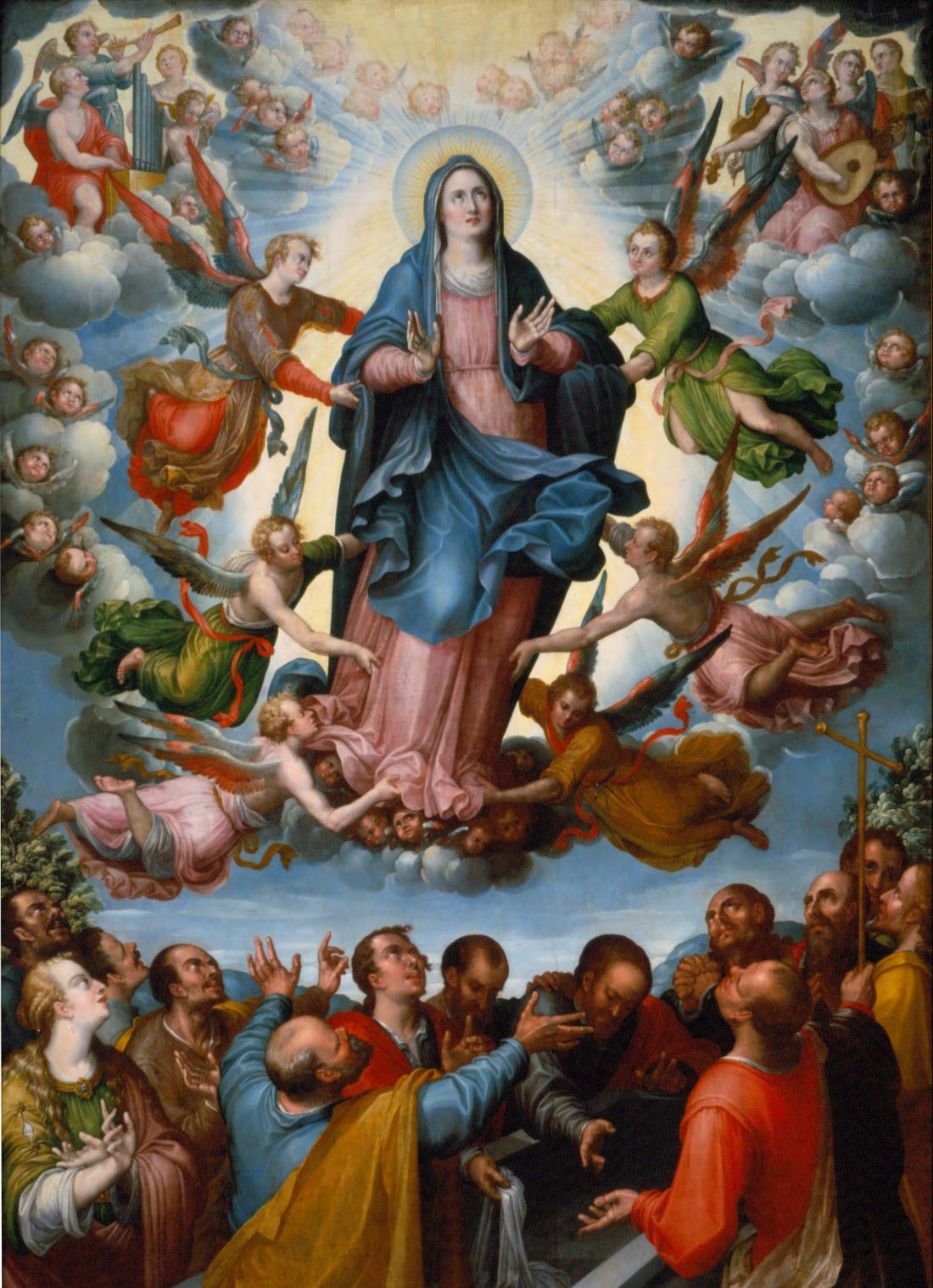
On this day, a
Holy Day of Obligation, we recall Our Lady's being
assumed into Heaven. Though the Church has always believed in the
Assumption of Mary, the dogma was only formally defined by Pope Pius
XII in his 1950 Bull Munificentissimus
Deus. Note that Mary
was assumed into Heaven -- taken up by the power of
God, like Elias and Enoch -- while Christ ascended into Heaven
under His own power. He took her up because she is His mother,
and He loves her; she was able to be taken up because He made her holy
-- "full of grace" -- and did so from the moment of her conception,
which we honor on December 8. Psalm
131:8 foretells of her being taken up --
Arise, O Lord,
into thy resting place: thou and the
ark, which thou hast sanctified.
And St. John's
Patmos vision, recorded in the Apocalypse, includes Our Lady, in
Heaven, crowned:
And the temple
of God was opened in heaven: and the ark of His testament was seen in
His temple, and there were lightnings, and voices, and an earthquake,
and great hail. And a great sign appeared in heaven: A woman
clothed with the sun, and the moon under her feet, and on her head a
crown of twelve stars... (Apocalypse 11:19-12:1)
According to the
Catholic Encyclopedia, the date of Mary's dormition
(her "falling asleep" into death) is placed from anywhere between 3 and
15 years after Our Lord's Ascension,
when she had lived seventy-two years. Most beautifully, the cause of
her death was neither disease, nor violence, nor senescence; it was,
according to tradition, love -- a desire to be reunited with her Son.
After three days in the tomb, her body and soul were reunited, and she
was assumed by the power of God, whereupon, according to Apocalypse
8:1, "there was silence in heaven, as it were for half an hour." The
site of these events is remembered either as Jerusalem, where her tomb
has been placed since around the 6th century, or Ephesus. At any rate,
St. John Damascene (John of Damascus, A.D. 676 - 754/787) writes:
St. Juvenal,
Bishop of Jerusalem, at the Council of Chalcedon (A.D. 451), made known
to the Emperor Marcian and Pulcheria, who wished to possess the body of
the Mother of God, that Mary died in the presence of all the Apostles,
but that her tomb, when opened, upon the request of St. Thomas, was
found empty; wherefrom the Apostles concluded that the body was taken
up to heaven.
According to
tradition, however, Our Lady's tomb was not exactly found empty;
lilies and roses were found where her body "should" have been. Maria
Von Trapp relates the story in her book "Around the Year with the Trapp
Family," and, in the process, relates a legend that explains why herbs
and flowers came to be associated with this Feast:
The connection
between the feast of the Assumption and the blessing of herbs is told
in an old legend When Mary the Mother of Jesus felt that her end was
drawing near, she sent her guardian angel to summon the Apostles, who
had gone out into the world to preach the Gospel of her Son, Our Lord
Jesus Christ. When they received the summons, they came in a great
hurry and were just in time to witness the happy death of their dear
Mother. Everyone had come except Thomas. He was three days late. When
he heard that the Blessed Mother had been resting in the tomb for days,
he cried bitterly and pled with the Apostles to open the tomb once more
and let him glance at the beloved features. The other Apostles yielded
to his plea, but as they opened the tomb, they found it filled with
flowers, which gave out a heavenly scent. On the place where they had
laid the body there was only the shroud left — the body had been borne
up to heaven by the angels, where it was joined by the holy soul of the
Mother of God. According to the legend, all the flowers and herbs on
earth had lost their scent after Adam and Eve committed the first sin
in the Garden of Eden. On the day of the Assumption of the Blessed
Mother, however, the flowers were given back their scent and the herbs
their power to heal.
The Roman
Ritual includes a
blessing for those herbs and flowers, which raises them to the status
of sacramentals. In many parishes and chapels, congregants will bring
fresh flowers to adorn the church in Mary's honor, and will bring the
same along with fruit and herbs -- especially healing herbs -- to be
blessed and take home. The blessed herbs are used throughout the year,
especially in food made for the sick. The
main part of the blessing reads:
|
Omnipotens
sempiterne Deus, qui cęlum, terram, mare, visibilia et invisibilia
verbo tuo ex nihilo creasti, quique herbas, arboresque ad usus hominum
animaliumque terram gignere, et unumquodque juxta sementem in semetipso
fructum habere pręcepisti; atque non solum ut herbę animantibus ad
victum, sed ęgris etiam corporibus prodessent ad medicamentum, tua
ineffabili pietate concessisti: te supplici mente et ore deprecamur, ut
has diversi generis herbas et fructus tua clementia benedicas, et supra
naturalem a te inditam virtutem, eis benedictionis tuę novę gratiam
infundas; ut ad usum hominibus et jumentis in nomine tuo applicatę,
omnium morborum et adversitatum efficiantur pręsidium. Per Dominum
nostrum Jesum Christum, Filium tuum, qui tecum vivit et regnat in
unitate Spiritus Sancti Deus, per omnia sęcula sęculorum. .
|
|
Almighty,
everlasting God, who by Thy Word hast created out of nothing heaven,
earth, sea, visible and invisible things; who hast commanded the earth
to bring forth herbs and trees for the use of men and animals and for
them to have fruit each according to its kind; and who hast granted out
of Thine unspeakable mercy for these to serve not only as food for the
living, but as medicine for sick bodies: with mind and mouth we humbly
implore Thee to bless with Thy clemency these herbs and fruits of
various kinds, and to pour forth upon their natural power already given
by Thee the grace of Thy new blessing; that when used by men and beasts
who apply them in Thy name, they may provide protection against all
disease and adversity. Through our Lord Jesus Christ, Thy Son, who
liveth and reigneth with Thee in the unity of the Holy Spirit, God unto
endless ages.
|
| R. Amen |
|
R. Amen. |
|
Oremus. Deus,
qui per Moysen famulum tuum mandasti filiis Israel, ut manipulos
novorum fructuum benedicendos deferrent ad sacerdotes, tollerentque
fructus arboris pulcherrimę, et lętarentur coram te Domino Deo suo:
adesto propitius invocationibus nostris, et infunde tuę benedictionis
abundantiam super nos, et super manipulos novarum frugum, novarum
herbarum, et fructuum collectionem, quę cum gratiarum actione tibi
repręsentamus, et in nomine tuo in hac sollemnitate benedicimus; et
concede, ut hominibus, pecoribus, pecudibus et jumentis contra morbos,
pestes, ulcera, maleficia, incantationes, veneficia serpentum, et
aliorum venenosorum animalium et bestiarum morsus, nec non quęcumque
venena, remedium pręstant; atque contra diabolicas illusiones, et
machinationes, et fraudes tutamen ferant, in quocumque loco positum vel
portatum aut habitum aliquid ex eis fuerit: quatenus cum manipulis
bonorum operum, meritis beatę Marię Virginis, cujus Assumptionis festum
colimus, quo ipsa assumpta est, suscipi mereamur. Per Dominum nostrum
Jesum Christum.
|
|
Let us pray. O
God, who by Moses Thy servant didst command the children of Israel to
carry their sheaves of new fruits to the priests for a blessing, to
take the finest fruits of the orchards, and to make merry before Thee,
the Lord their God: Kindly hear our supplications, and pour forth the
abundance of Thy blessing upon us and upon these sheaves of new grain,
new herbs, and assortment of fruits, which we gratefully present to
Thee and which we bless on this feast in Thy name. And grant that men,
cattle, sheep, and beasts of burden may find in them a remedy against
sickness, pestilence, sores, injuries, spells, the poison of snakes,
and the bites of other venomous and non-venomous creatures. And may
they bring protection against diabolical illusions, machinations, and
deceptions wherever they are kept or carried, or with whatever
arrangement is made of them: that with sheaves of good works and
through the merits of the Blessed Virgin Mary whose Feast of the
Assumption we celebrate, we may deserve to be lifted up to heaven.
Through our Lord Jesus Christ.
|
| R . Amen. |
|
R. Amen. |
|
Oremus. Deus,
qui virgam Jesse, Genetricem Filii tui Domini nostri Jesu Christi,
hodierna die ad cęlorum fastigia ideo evexisti, ut per ejus suffragia
et patrocinia fructum ventris illius, eundem Filium tuum, mortalitati
nostrę communicares: te supplices exoramus; ut ejusdem Filii tui
virtute, ejusque Genetricis glorioso patrocinio, istorum terrę fructuum
pręsidiis per temporalem ad ęternam salutem disponamur. Per eundem
Dominum nostrum.
|
|
Let us pray. O
God, who on this day didst raise up to the heights of heaven the rod of
Jesse, the mother of Thy Son our Lord Jesus Christ, that through her
prayers and patronage Thou mightest communicate to our mortality the
Fruit of her womb, Thy Son: we humbly pray that by the power of Thy Son
and the glorious patronage of His Mother, we may be so affected by the
aid of these fruits of the land as to proceed from temporal to eternal
welfare. Through the same Jesus Christ.
|
| R. Amen. |
|
R. Amen. |
| Et benedictio
Dei omnipotentis, Patris, et Filii, et Spiritus Sancti, descendat super
has creaturas, et maneat semper. |
|
And may the
blessing of Almighty God, Father, Son, and Holy Spirit, descend upon
these creatures and remain forever. |
| R. Amen. |
|
R. Amen. |
The giving of these blessed herbs and fruit baskets -- and,
as always on Marian feasts,
flowers -- is a lovely custom of the day, and our prayer is that we
emulate Mary by using the blessed herbs to bring healing to the world.
While the folks from Australia and New Zealand hash it out over which
country came up with the dessert first, a pavlova remains the perfect
thing to make today to make good use of the fruit. The
"pav's" fluffy meringue and mounded whipped cream resemble clouds,
which
brings to mind Our Lady's being taken up into the Heavens. A recipe:
Pavlova
6 egg whites
1/4 tsp salt
1/4 tsp cream of tartar
1 1/2 cups sugar
2 Tbsp cornstarch
1 Tbsp white vinegar
1 1/2 tsp vanilla
1 1/2 cups whipping cream
3 cups sliced fruit (I like strawberries and blueberries)
Line a baking sheet with parchment paper.
In a bowl, beat egg whites, salt and cream of tartar until
soft peaks form. Gradually beat in sugar in thin steady stream until
stiff glossy peaks form. Sift in cornstarch; fold in vinegar and
vanilla. Batter should be a marshmallow consistency. Spoon batter onto
prepared pan in the shape of an 8-inch or so circle; smooth top (or
make slightly bowl-like, piping sides on, if desired). Bake at 275 F
oven for 2 to 2 1/2 hours or until crisp and lightly browned on outside
but still soft in middle. Let cool completely (meringue may deflate).
Run knife under meringue. Carefully remove paper. (Meringue can be
loosely covered and stored for up to 3 days.) Remove loose bits from
meringue.
Whip cream (you can sweeten it with sugar if you like);
spread over top of meringue. Garnish top with
fruit, preferably in a pretty pattern. Eat right away.
While you're eating your pav, you might like to listen to
Vivaldi's Concerti in CMajor (RV 581) and DMajor (RV 582), written for
this feast:
In some coastal areas, the seas are also blessed on this
day,
especially in fishing communties. The passages from the 21st chapter of
the Gospel of St. John in which Jesus went fishing with His Apostles
are read, along with sections of Luke 5. The Magnificat is prayed and
then the sea is sprinkled with Holy Water and the Sign of the Cross
made over it. It is believed that to swim in the waters blessed on this
day is curative.
In Italy, this day is also known as Ferragosto, and it has its origins
in a holiday instituted by the Emperor Augustus on August 1. Ferragosto
was a day of rest, and workers who wished their employers "buon
ferragosto" would get a bonus, a custom that still prevails. The Church
moved the celebration of this holiday to the Feast of the Assumption,
and today and surrounding days -- for the next two weeks -- are days
Italians take off work and use
to travel, have barbecues and picnics, and otherwise have a good time
and rest.
Since 1582, in Palmi, Italy -- in the region of Calabria -- the
Assumption is also honored on the last Sunday of August. This
celebration, which is known as "la Varia di Palmi," is preceded by a
procession the day before, and on the Sunday itself comes an even more
magnificent procession, one with a great 50-feet tall shoulder-borne
platform that represents the universe. The platform is adorned with
figures representing the Apostles and angels, with Mary being assumed
into Heaven at the top.
In Foggia, Puglia, Italy, festivities regarding the Assumption are
mixed with honoring Our Lady as the Madonna
dei Sette Veli -- Our Lady of the Seven Veils (also known as Santa Maria Icona Vetere), whose
feast is on March 22. The story of Our Lady with this title begins in
1062 when shepherds saw three flames floating above a watery bog. They
started digging in the ground over which they'd seen the flames and
found a Byzantine icon of the Blessed Virgin, wrapped in cloth, caked
in mud, and saturated with water. They took the icon to a local tavern
to be venerated, and soon pilgrims came from all over to see it. A
large church which was to become Foggia's cathedral was built on the
spot where the flames had alerted the shepherds, and the icon was moved
there, kept covered in richly embroidered cloths with an opening over
the Virgin's darkened, barely visible face. In 1731, an earthquake
struck, and Foggia was very affected. The church was so damaged that
the icon had to be moved to the church of San Giovanni Battista. There,
on March 22 of that year -- it was Maundy
Thursday -- the face of the virgin on the icon became bright and
visible, appearing clearly through the little "window" made by the
cloths. St. Alphonsus di Liguori went to see it, and described the
Virgin he saw as very different from the one usually barely visible on
the icon: she appeared as a young girl around 14 years of age -- the
age she would have been at the Annunciation -- and wearing a white
veil. The people of Foggia took this miraculous appearance -- which
would happen for the next fourteen years -- as assurance
that their city would thereafter be safe from earthquakes. As noted
earlier, the Feast of the Madonna
dei Setti Veli takes place on March 22, but ten days before the
Assumption, the icon is taken from its shrine in the side chapel of
Foggia's cathedral and carried to the main altar where it is stripped
of its veils and covered in an 18th century silver case, which now
bears a crown, a gift from Pope John Paul II. During the first 9 days,
the people of Foggia pray a novena, and then on the the novena's last
day -- on the eve of the Assumption -- the icon is carried in
procession through the streets of the city while crowds cheer. On the
Assumption itself, the icon is returned to the cathedral which is
packed with the people of Foggia.
In Randazzo, near Catania, Sicily, a great procession
includes a
60-foot tall float -- la vara di
Randazzo -- depicting the dormition and assumption of the
Virgin. The float has different levels to it, the first showing the
Virgin on her deathbed, surrounded by angels, the apostles, and
flowers. The next level up depicts St. Michael the Archangel, Our Lord
and His mother. Around them all are the Sun, Moon, planets, and stars.
The next level up show the Most Holy Trinity and the angelic hierarchy.
Saints are scattered throughout -- and 30 children represent them all,
even the figures 60 feet up. On the vigil of the Assumption, there is a
procession of just the sleeping Madonna; on the morning of the next day
comes the full float with the great cast of characters.
In the town of Elche, near Valencia Spain, a great sung mystery play has been put on at the Cathedral of
Santa Maria since the 15th century. The performance takes place over
two days -- the 14th and the 15th of August. Known as the Mystery Play
of Elche (Misteri d'Elx in
Valencian Spanish), the drama comes in two acts: La Vesprą ("The Vigil") depicts the
death or falling asleep (dormition) of Our Lady, and La Festa ("The Feast") depicts her
assumption and coronation. In between these parts of theplay great
candlelit processions are held.
In Croatia, where this feast is known as Velika Gospa, today is a major
holiday. And nowhere is it celebrated as grandly there as it is in the
city of Sinj. Throngs of pilgrims
journey -- often barefoot -- to the city in order to honor an image of
the Virgin kept at the Sanctuary of the Miraculous Lady of Sinj. To the
sounds of cannons and bells, a great procession is held, and firemen,
military men, veterans, the religious, girls in their traditional
costumes -- everyone takes part, processing, praying the Rosary,
chanting litanies, and singing.
In the diocese of Lafayette in Louisiana, U.S.A., the Feast of the
Assumption has been marked by a procession that takes place by boat
rather than on foot. The Fźte-Dieu du Teche begins with a Mass at the
Church of the Assumption in Franklin, and is followed by processing the
Blessed Sacrament to a boat on the Bayou Teche. The boat then goes up
river, making three stops on its route, ending up at St. Peter's Church
in New Iberia. Many churches have been built along the bayou, and
people line the way to reverence Christ. People who live along the
bayou build shrines for the occasion.
In some places, especially in areas of France, the Assumption is one of
the favored days to propose marriage.
As on all Marian feasts, praying the Little
Crown of the Blessed Virgin, the Glorious Mysteries of the Rosary, the Litany
of Loreto, the Akathistos Hymn to
the Theotokos, etc., would be most appropriate. Some Catholics start a 54-Day Rosary Novena on this day, ending on
the Feast of the Most Holy
Rosary (October 7).
Finally, the
Feast of the Assumption marks the beginning of a totally
optional
period of sacrifice called "St. Michael's Lent." It lasts 40 days --
from today until September
29, the Feast of St.
Michael the Archangel (like all such sacrifical devotions, Sundays
and other holy
days are excluded). "St. Michael's Lent"
is made in
emulation of St. Francis,
who kept this period as a sort of personal Lent in honor of Our Lady
and St. Michael, a
custom which spread to his fellow Franciscans. It ends with a
Consecration to St. Michael the Archangel.
See also the Queenship of Mary (31
May) to read about our honoring Our Lady as Queen, crowned after her
Assumption.
Reading
Sermon II on
the Dormition of Mary
By St. John Damascene (John of Damascus), (A.D. 676 - 754/787)
There is no one
in existence who is able to praise worthily the holy death of God's
Mother, even if he should have a thousand tongues and a thousand
mouths. Not if all the most eloquent tongues could be united would
their praises be sufficient. She is greater than all praise. Since,
however, God is pleased with the efforts of a loving zeal, and the
Mother of God with what concerns the service of her Son, suffer me now
to revert again to her praises. This is in obedience to your orders,
most excellent pastors, so dear to God, and we call upon the Word made
flesh of her to come to our assistance. He gives speech to every mouth
which is opened for Him. He is her sole pleasure and adornment. We know
that in celebrating her praises we pay off our debt, and that in so
doing we are again debtors, so that the debt is ever beginning afresh.
It is fitting that we should exalt her who is above all created things,
governing them as Mother of the God who is their Creator, Lord, and
Master. Bear with me you who hang upon the divine words, and receive my
good will. Strengthen my desire, and be patient with the weakness of my
words. It is as if a man were to bring a violet of royal purple out of
season, or a fragrant rose with buds of different hues, or some rich
fruit of autumn to a mighty potentate who is divinely appointed to rule
over men. Every day he sits at a table laden with every conceivable
dish in the perfumed courts of his palace. He does not look at the
smallness of the offering, or at its novelty so much as he admires the
good intention, and with reason. This he would reward with an abundance
of gifts and favours. So we, in our winter of poverty, bring garlands
to our Queen, and prepare a flower of oratory for the feast of praise.
We break our mind's stony desire with iron, pressing, as it were, the
unripe grapes. And may you receive with more and more favour the words
which fall upon your eager and listening ears.
What shall we offer the Mother of the Word if not our words? Like
rejoices in like and in what it loves. Thus, then, making a start and
loosening the reins of my discourse, I may send it forth as a charger
ready equipped for the race. But do Thou, O Word of God, be my helper
and auxiliary, and speak wisdom to my unwisdom. By Thy word make my
path clear, and direct my course according to Thy good pleasure, which
is the end of all wisdom and discernment.
Today the holy Virgin of Virgins is presented in the heavenly temple.
Virginity in her was so strong as to be a consuming fire. It is
forfeited in every case by child-birth. But she is ever a virgin,
before the event, in the birth itself, and afterwards. To-day the
sacred and living ark of the living God, who conceived her Creator
Himself, takes up her abode in the temple of God, not made by hands.
David, her forefather, rejoices. Angels and Archangels are in
jubilation, Powers exult, Principalities and Dominations, Virtues and
Thrones are in gladness: Cherubim and Seraphim magnify God. Not the
least of their Praise is it to refer praise to the Mother of glory.
To-day the holy dove, the pure and guileless soul, sanctified by the
Holy Spirit, putting off the ark of her body, the life-giving
receptacle of Our Lord, found rest to the soles of her feet, taking her
flight to the spiritual world, and dwelling securely in the sinless
country above. To-day the Eden of the new Adam receives the true
paradise, in which sin is remitted and the tree of life growl, and our
nakedness is covered. For we are no longer naked and uncovered, and
unable to bear the splendour of the divine likeness. Strengthened with
the abundant grace of the Spirit, we shall no longer betray our
nakedness in the words: "I have Put off my garment, how shall I put it
on?" The serpent, by whose deceitful promise we were likened to brute
beasts, did not enter into this paradise. He, the only begotten Son of
God, God himself, of the same substance as the Father, took His ] human
nature of the pure Virgin. Being constituted a man, He made mortality
immortal, and was clothed as a man. Putting aside corruption, He was
indued with the incorruptibility of the Godhead.
Today the spotless Virgin, untouched by earthly affections, and all
heavenly in her thoughts, was not dissolved in earth, but truly
entering heaven, dwells in the heavenly tabernacles. Who would be wrong
to call her heaven, unless indeed he truly said that she is greater
than heaven in surpassing dignity? The Lord and Creator of heaven, the
Architect of all things beneath the earth and above, of creation,
visible and invisible, Who is not circumvented by place (if that which
surrounds things is rightly termed place), created Himself, without
human co-operation, an Infant in her. He made her a rich treasure-house
of His all-pervading and alone uncircumscribed Godhead, subsisting
entirely in her without passion, remaining entire in His universality
and Himself uncircumscribed. To-day the life-giving treasury and abyss
of charity (I know not how to trust my lips to speak of it) is hidden
in immortal death. She meets it without fear, who conceived death's
destroyer, if indeed we may call her holy and vivifying departure by
the name of death. For how could she, who brought life to all, be under
the dominion of death ? But she obeys the law of her own Son, and
inherits this chastisement as a daughter of the first Adam, since her
Son, who is the life, did not refuse it. As the Mother of the living
God, she goes through death to Him. For if God said: "Unless the first
man put out his hand to take and taste of the tree of life, he shall
live for ever," how shall she, who received the Life Himself, without
beginning or end, or finite vicissitudes, not live for ever.
Of old the Lord God banished from the garden of Eden our first parents
after their disobedience, when they had dulled the eye of their heart
through their sin, and weakened their mind's discernment, and had
fallen into death-like apathy. But, now, shall not paradise receive
her, who broke the bondage of all passion, sowed the seed of obedience
to God and the Father, and was the beginning of life to the whole human
race ? Will not heaven open its gates to her with rejoicing ? Yes,
indeed. Eve listened to the serpent, adopted his suggestion, was caught
by the lure of false and deceptive pleasure, and was condemned to pain
and sorrow, and to bear children in suffering. With Adam she received
the sentence of death, and was placed in the recesses of Limbo. How can
death claim as its prey this truly blessed one, who listened to God's
word in humility, and was filled with the Spirit, conceiving the
Father's gift through the archangel, bearing without concupiscence or
the co-operation of man the Person of the Divine Word, who fills all
things, bringing Him forth, without the pains of childbirth, being
wholly united to God? How could Limbo open its gates to her ? How could
corruption touch the life-giving body ? These are things quite foreign
to the soul and body of God's Mother. Death trembled before her. In
approaching her Son, death had learnt experience from His sufferings,
and had grown wiser. The gloomy descent to hell was not for her, but a
joyous, easy, and sweet passage to heaven. If, as Christ, the Life and
the Truth says: "Wherever I am, there is also my minister," how much
more shall not His mother be with Him? She brought Him forth without
pain, and her death, also, was painless. The death of sinners is
terrible, for in it, sin, the cause of death, is sacrificed. What shall
we say of her if not that she is the beginning of perpetual life.
Precious indeed is the death of His saints to the Lord God of powers.
More than precious is the passing away of God's Mother. Now let the
heavens and the angels rejoice: let the earth and men be full of
gladness. Let the air resound with song and canticle, and dark night
put off its gloom, and emulate the brightness of day through the
scintillating stars. The living city of the Lord God is assumed from
God's temple, the visible Sion, and kings bring forth His most precious
gift, their mother, to the heavenly Jerusalem, that is to say, the
apostles constituted princes by Christ, over all the earth, accompany
the ever virginal Mother of God.
It seems to me not superfluous to bring forward and insist on the past
types of this holy one, the Mother of God. These types succinctly
announced the Divine Child whom we have received. I look upon His
Mother as the saint of saints, the holiest of all, the fragrant urn for
the manna, or rather, to speak more truly, the fountain taking its rise
in the divine and far-famed city of David, in Sion the glorious; in it
the law is fulfilled and the spiritual law is portrayed. In Sion,
Christ the Law-giver consummated the typical pasch, and God, the Author
of the old and the new dispensation, gave us the true pasch. In it the
Lamb of God, who takes away the sins of the world, initiated His
disciples unto His mystical feast, and gave them Himself slain as a
victim, and the grape pressed in the true vine. In Sion, Christ is seen
by His apostles, risen from the dead, and Thomas is told, and through
Thomas the world, that He is Lord and God, having in Himself two
natures after His resurrection, and consequently two operations,
independent wills, enduring for all ages. Sion is the crown of
churches, the resting-place of disciples. In it the echo of the Holy
Spirit, the gift of tongues, His fiery descent are transmitted to the
apostles. In it St John, taking the Mother of God, ministered to her
wants. Sion is the mother of churches in the whole world, who offered a
resting-place to the Mother of God after her Son's resurrection from
the dead. In it, lastly, the Blessed Virgin was stretched on a small
bed.
When I had reached this point of my discourse, I was obliged to give
vent to my own feelings, and burning with loving desire, to shed
reverent yet joyful tears, embracing, as it were, the bed so happy and
blest and wondrous, which received the life-giving tabernacle and
rejoiced in the contact of holiness. I seemed to take into my arms that
holy and sacred body itself, worthy of God, and pressing my eyes, lips,
and forehead, head, and cheeks to hers, I felt as if she was really
there, though I was unable to see with my eyes what I desired. How,
then, was she assumed to the heavenly courts? In this way. What were
the honours then conferred upon her by God who commands us to honour
our parents? The cloud which enclosed Jerusalem as with a net, by the
divine commands, brought together eagles from the ends of the earth,
those who are spread over the world, fishing for men in the various and
numerous tongues of the spirit. By the net of the word they are saving
men from the abyss of doubt and bringing them to the spiritual and
heavenly table of the sacred and mystical banquet, the perfect marriage
feast of the Divine Bridegroom, which the Father celebrates with His
Son, who is equal to Himself and of the same nature. "Where the spirit
is," says Christ the Truth, "there shall the eagles be gathered
together." If we have already spoken concerning the second great and
splendid coming of Him who spoke these words, it will not be out of
place here by way of condiment.
Eye-witnesses, then, and ministers of the word were there, duly
ministering to His Mother, and drawing from her a rich inheritance, as
it were, and a full measure of praise. For is it a matter of doubt to
any one that she is the source of blessing and the fountain of all
good? Their followers and successors also were there, joining in their
ministry and in their praise. A common labour produces common fruits. A
chosen band from Jerusalem were there. It was fitting that the foremost
men and prophets of the old law, they who had foretold God the Word's
saving birth of her in time, should be there as a guard of honour. Nor
did the angelic choirs fail. They who obeyed the king heartily and
consequently were honoured by standing near Him, had the right to serve
as a body-guard to His Mother, according to the flesh, the truly
blessed and blissful one, surpassing all generations and all creation.
All those were with her who are the brightness and the shining of the
spirit, with spiritual eyes fixed upon her in reverence, and fear, and
pure desire.
We hear divine and inspired words, and spiritual canticles appropriate
to the parting hour. On this account it was meet to praise His
boundless goodness, His immeasurable greatness, His omnipotence, the
generosity surpassing all measure in His dealings with us, the
overflowing riches of His mercy, the abyss of His tenderness; how,
putting aside His greatness, He descended to our littleness with the
co-operation of the Father and the Holy Spirit. Again, the
supersubstantial One is supersubstantially created in the virginal
womb. Being God He became man, and remains according to this union
perfect God and perfect man, not giving up the substance of His Godhead
nor ceasing to be of the same flesh and blood as we are. He, who fills
all things and governs the universe with one word, took up His abode in
a narrow place, and the material body of this blessed one received the
burning fire of the Godhead, and as genuine gold it remained intact.
This has taken place because God willed it, since His good pleasure
makes things possible which could not happen without it. Then followed
a strife of praise, not as if each was seeking to outdo the other--for
this is vainglorious and far from pleasing to God--but as if they would
leave nothing undone for the glory of God and the honour of God's
Mother.
Then Adam and Eve, our first parents, opened their lips to exclaim,
"Thou blessed daughter of ours, who hast removed the penalty of our
disobedience! Thou, inheriting from us a mortal body, hast won us
immortality. Thou, taking thy being from us, hast given us back the
being in grace. Thou hast conquered pain and loosened the bondage of
death. Thou hast restored us to our former state. We had shut the door
of paradise; thou didst find entrance to the tree of life. Through us
sorrow came out of good; through thee good from sorrow. How canst thou
who art all fair taste of death ? Thou art the gate of life and the
ladder to heaven. Death is become the passage to immortality. O thou
truly blessed one! who that is not the Word could have borne what thou
hast borne?"
All the company of the saints exclaimed, "Thou hast fulfilled our
predictions. Thou hast purchased our present joy for us. Through thee
we have broken the chains of death. Come to us, divine and life-giving
receptacle. Come, our desire, thou who hast gained us our desire."
And the saints standing by added their no less burning words: "Remain
with us, our comfort, our sole joy in this world. O Mother leave us not
orphans who have suffered on thy Son's account. May we have thee as a
refuge and refreshment in our labours and weariness. Thou canst remain
if thou so willest, even as thou canst depart hence. if thou departest,
O dwelling-place of God let us go too, if we are thine through thy Son.
Thou art our sole consolation on earth. We live as long as thou livest,
and it is bliss to die with thee. Why do we speak of death? Death is
life to thee, and better than life -- incomparably exceeding this life.
How is our life -- life, if we are deprived of thee?"
The apostles and all the assembly of the Church may well have addressed
some such words to the blessed Virgin. When they saw the Mother of God
near her end and longing for it, they were moved by divine grace to
sing farewell hymns, and wrapt out of the flesh, they sighed to
accompany the dying Mother of God, and anticipated death through
intensity of will. When they had all satisfied their duty of loving
reverence and had woven her a rich crown of hymns, they spoke a parting
blessing over her, as a God-given treasure, and the last words. These,
I should think, were significant of this life's fleetingness, and of
its leading to the hidden mysteries of future goods.
This, it appears to me, is what they did at once and unanimously. The
King was there to receive with divine embrace the holy, undefiled, and
stainless soul of His Mother on her going home. And she, as we may well
conjecture, said, "Into Thy hands, O my Son, I commend my spirit.
Receive my soul, dear to Thee, which Thou didst keep spotless. I give
my body to Thee, not to the earth. Guard that which Thou wert pleased
to inhabit and to preserve in virginity. Take to Thyself me that
wherever Thou art, the fruit of my womb, there I too may be. I am
impelled to Thee who didst descend to me. Do Thou be the consolation of
my most cherished children, whom Thou didst vouchsafe to call Thy
brethren, when my death leaves them in loneliness. Bless them afresh
through my hands." Then stretching out her hands, as we may believe,
she blessed all those present, and then she heard the words "Come, my
beloved Mother, to thy rest. Arise and come, most dear amongst women,
the winter is past and gone, the harvest time is at hand. Thou art
fair, my beloved, and there is no stain in thee. Thy fragrance is
sweeter than all ointments." With these words in her ear, that holy one
gave up her spirit into the hands of her Son.
What happens? Nature, I conjecture, is stirred to its depths, strange
sounds and voices are heard, and the swelling hymns of angels who
precede, accompany, and follow her. Some constitute the guard of honour
to that undefiled and immaculate soul on its way to heaven until the
queen reaches the divine throne. Others surrounding the sacred and
divine body proclaim God's Mother in angelic harmony. What of those who
watched by the most holy and immaculate body? In loving reverence and
with tears of joy they gathered round the blessed and divine
tabernacle, embracing every member, and were filled with holiness and
thanksgiving. Then illnesses were cured, and demons were put to flight
and banished to the regions of darkness. The air and atmosphere and
heavens were sanctified by her passage through them, the earth by the
burial of her body. Nor was water deprived of a blessing. She was
washed in pure water. It did not cleanse her, but was rather itself
sanctified. Then, hearing was given to the deaf, the lame recovered
their feet, and the blind, their sight. Sinners who approached with
faith blotted out the handwriting against them. Then the holy body is
wrapped in a snow-white winding-sheet, and the queen is again laid,
upon her bed. Then follow lights and incense and hymns, and angels
singing as befits the solemnity; apostles and patriarchs acclaiming her
in inspired song.
When the Ark of God, departing from Mount Sion for the heavenly
country, was borne on the shoulders of the Apostles, it was placed on
the way in the tomb. First it was taken through the city, as a bride
dazzling with spiritual radiance, and then carried to the sacred place
of Gethsemane, angels overshadowing it with their wings, going before,
accompanying, and following it, together with the whole assembly of the
Church. King Solomon compelled all the elders of Israel in Sion to bear
the ark of the covenant of the Lord from the city of David, that is
Sion, to rest in the temple of the Lord, which he had built, and the
priests took the ark and the tabernacle of the testimony, and the
priests and levites raised it. And the king and all the people
sacrificed numberless oxen and sheep before the ark. And the priests
carried in the ark of the testimony of God into its place, into the
Holy of Holies, beneath the wings of the cherubim. So is it now with
the dwelling-place of the true ark, no longer of the testimony, but the
very substance of God the Word. The new Solomon, the Prince of peace,
the Creator of all things in the heavens and on the earth, assembled
together to-day the supporters of the new covenant, that is the
Apostles, with all the people of the saints in Jerusalem, brought in
her soul through angels to the true Holy of Holies, under the wings of
the four living creatures, and set her on His throne within the Veil,
where Christ Himself had preceded her. Her body the while is borne by
the Apostles' hands, the King of Kings covering her with the splendour
of His invisible Godhead, the whole assembly of the saints preceding
her, with sacred song and sacrifice of praise until through the tomb it
was placed in the delights of Eden, the heavenly tabernacles.
Perchance, Jews also were there, if any, not too reprobate were to be
found. It will not be beside the mark to mention here a thing that is
asserted by many. It is said that when those, who were carrying the
blessed body of God's Mother, had reached the descent of the opposite
mountains, a certain Jew, the slave of sin, and pledged by his folly,
imitated the servant of Caiphas, who struck the divine Face of Christ
our Lord and Master, and made himself the devil's instrument. Full of
wicked passion and malice, he rushed at that most divine tabernacle,
which angels approached with fear, and impiously dragged the bier with
both his hands to the ground. This was prompted by the envy of the arch
enemy, but his labours were in vain, and he reaped a severe and fitting
reminder of his deed. It is said that he lost the use of his hands,
which had perpetrated his malicious deed, until faith moved him to
repentance. The bearers were standing near. The wretched man placed his
hands on the wondrous and life-giving tabernacle, and they again became
sound. Circumstances had made him wise, as often happens. But let us
return to our subject.
Then they reached the most sacred Gethsemane, and once more there were
embracings and prayers and panegyrics, hymns and tears, poured forth by
sorrowful and loving hearts. They mingled a flood of weeping and
sweating. And thus the immaculate body was laid in the tomb. Then it
was assumed after three days to the heavenly mansions. The bosom of the
earth was no fitting receptacle for the Lord's dwelling-place, the
living source of cleansing water, the corn of heavenly bread, the
sacred vine of divine wine, the evergreen and fruitful olive-branch of
God's mercy. And just as the all holy body of God's Son, which was
taken from her, rose from the dead on the third day, it followed that
she should be snatched from the tomb, that the mother should be united
to her Son; and as He had come down to her, so she should be raised up
to Him, into the more perfect dwelling-place, heaven itself. It was
meet that she, who had sheltered God the Word in her own womb, should
inhabit the tabernacles of her Son. And as our Lord said it behoved Him
to be concerned with His Father's business, so it behoved His mother
that she should dwell in the courts of her Son, in the house of the
Lord, and in the courts of the house of our God. If all those who
rejoice dwell in Him, where must the cause itself of joy abide? It was
fitting that the body of her, who preserved her virginity unsullied in
her motherhood, should be kept from corruption even after death. She
who nursed her Creator as an infant at her breast, had a right to be in
the divine tabernacles. The place of the bride whom the Father had
espoused, was in the heavenly courts. It was fitting that she who saw
her Son die on the cross, and received in her heart the sword of pain
which she had not felt in childbirth, should gaze upon Him seated next
to the Father. The Mother of God had a right to the possession of her
Son, and as handmaid and Mother of God to the worship of all creation.
The inheritance of the parents ever passes to the children. Now, as a
wise man said, the sources of sacred waters are above. The Son made all
creation serve His Mother.
Let us then also keep solemn feast today to honour the joyful departure
of God's Mother, not with flutes nor corybants, nor the orgies of
Cybele, the mother of false gods, as they say, whom foolish people talk
of as a fruitful mother of children, and truth as no mother at all.
These are demons and false imaginings. They usurp what they are not by
nature to impose upon human folly. For how can what is bodiless lead
the wedded life? How can that be god which, not being before, is
present only after birth? That devils were bodiless is apparent to all,
even to those who are intellectually blind. Homer somewhere testifies
to the condition of the gods he honours:
They eat not
barley, and drink not ruddy wine,
So they are bloodless and are called immortal.
They eat not
bread, he says, neither do they drink fiery wine. On this account they
are anaemic, that is, without blood, and are called immortals. He truly
and appropriately says, "are called." They are called immortals. They
are not that which they are called. They died the death of wickedness.
Now we worship God, not God beginning His being, but who always was and
is above all cause and argument or created mind or nature. We honour
and reverence the Mother of God, not ascribing to her the eternal
generation of His Godhead. For the generation of God the Word was not
in time, and was co-eternal with the Father. We acknowledge a second
generation in His spontaneous taking flesh, and we see and know the
cause of this. He who is without beginning and without body takes flesh
for us as one of ourselves. And taking flesh of this sacred Virgin, He
is born without man, remaining Himself perfect God, and becoming
perfect man, perfect God in His flesh, and perfect Man in His Godhead.
Thus, recognising God's Mother in this Virgin, we celebrate her falling
asleep, not proclaiming her as God -- far be from us these heathen
fables -- since we are announcing her death, but recognising her as the
Mother of the Incarnate God.
O people of Christ, let us acclaim her today in sacred song,
acknowledge our own good fortune and proclaim it. Let us honour her in
nocturnal vigil; let us delight in her purity of soul and body, for she
next to God surpasses all in purity. It is natural for similar things
to glory in each other. Let us show our love for her by compassion and
kindness towards the poor. For if mercy is the best worship of God, who
will refuse to show His Mother devotion in the same way? She opened to
us the unspeakable abyss of God's love for us. Through her the old
enmity against the Creator is destroyed. Through her our reconciliation
with Him is strengthened, peace and grace are given to us, men are the
companions of angels, and we, who were in dishonour, are made the
children of God. From her we have plucked the fruit of life. From her
we have received the seed of immortality. She is the channel of all our
goods. In her God was man and man was God. What more marvellous or more
blessed? I approach the subject in fear and trembling. With Mary, the
prophetess, O youthful souls, let us sound our musical instruments,
mortifying our members on earth, for this is spiritual music. Let our
souls rejoice in the Ark of God, and the walls of Jericho will yield, I
mean the fortresses of the enemy. Let us dance in spirit with David;
to-day the Ark of God is at rest. With Gabriel, the great archangel,
let us exclaim, "Hail, full of grace, the Lord is with thee. Hail,
inexhaustible ocean of grace. Hail, sole refuge in grief. Hail, cure of
hearts. Hail, through whom death is expelled and life is installed."
And you I will speak to as if living, most sacred of tombs, after the
life-giving tomb of our Lord which is the source of the resurrection.
Where is the pure gold which apostolic hands confided to you? Where is
the inexhaustible treasure ? Where the precious receptacle of God?
Where is the living table? Where the new book in which the
incomprehensible Word of God is written without hands? Where is the
abyss of grace and the ocean of healing? Where is the life-giving
fountain? Where is the sweet and loved body of God's Mother?
Why do you seek in the tomb one who has been assumed to the heavenly
courts? Why do you make me responsible for not keeping her? I was
powerless to go against the divine commands. That sacred and holy body,
leaving the winding-sheet behind, filled me full of sweet fragrance,
sanctified me by its contact, and fulfilled the divine scheme, and was
then assumed, angels and archangels and all the heavenly powers
escorting it. Now angels surround me, and divine grace abounds in me. I
am the physician of the sick. I am a perpetual source of health, and
the terror of demons. I am a city of refuge for fugitives. Approach
with faith and you will receive a sea of graces. Come, you of weak
faith. All you that thirst, come to the waters in obedience to Isaias'
commands, and you who have no money, come and buy for nothing. I call
upon all with the Gospel invitation. Let him who longs for bodily or
spiritual cure, forgiveness of sins, deliverance from misfortune, the
possession of heaven, approach me with faith, and draw hence a strong
and rich stream of grace. Just as the action of one and the same water
acts differently on the earth, air, and sun, according to the nature of
each, producing wine in the vine and oil in the olive-tree, so does one
and the same grace profit each person according to his needs. I do not
possess grace on my own account. A tomb given up to corruption, an
object of sorrow and dejection, I receive a precious ointment, and am
impregnated with it, and this sweet fragrance alters my condition
whilst it lasts. Truly, divine graces flow where they will. I have
sheltered the source of joy, and I have become rich in its perennial
fountain.
What shall we answer the tomb? You have indeed rich and abiding grace,
but divine power is not restricted by place, neither is the Mother of
God's working. If it were confined to the tomb alone, few would be the
richer. Now it is freely distributed in all parts of the world. Let us
then make our memory serve as a storehouse of God's Mother. How shall
this be? She is a virgin and a lover of virginity. She is pure and a
lover of purity. If we purify our mind with the body, we shall possess
her grace. She shuns all impurity and impure passions. She has a horror
of intemperance, and a special hatred for fornication. She turns from
its allurements as from the progeny of serpents... She looks upon all
sin as death-inflicting rejoicing in all good. Contraries are cured by
contraries. She delights in fasting and continence and spiritual
canticles, in purity, virginity, and wisdom. With these she is ever at
peace, and takes them to her heart. She embraces peace and a meek
spirit, and love, mercy, and humility as her children. In a word, she
grieves over every sin, and is glad at all goodness as if it were her
own. If we turn away from our former sins in all earnestness and love
goodness with all our hearts, and make it our constant companion, she
will frequently visit her servants, bringing all blessings with her,
Christ her Son, the King and Lord who reigns in our hearts. To Him be
glory, praise, honour, power, and magnificence, with the eternal Father
and the Holy Spirit, now and for ever.
Note: In some places in Scotland, the Feast of the Assumption has
become entwined with the honoring of the Catholic Mary Queen of Scots
who was beheaded by her cousin, the Protestant Elizabeth I. Great
festivals are held at which a "Queen Mary" is chosen, as are 4 ladies
in waiting and two knaves.
|