``Where the
Bishop is, there let the multitude of believers be;
even as where Jesus is, there is the Catholic Church'' Ignatius of
Antioch, 1st c. A.D
Feast of
St. Nicholas
St. Nicholas is
the Saint better known as "Santa Claus"
(Sinterklaas in the Dutch whence "Santa Claus" comes). His image in
America has been mixed up with a lot of traits and imagery from sources
as disparate as the poetry of Clement Moore, pagan Norse mythology, and
American advertising. In real life, though, St. Nicholas was a beloved
and wonderful Bishop of Myra (in modern-day Turkey). He was born in
Asia Minor in A.D. 260 and orphaned at an early age.
As a young man, he made a pilgrimage to Palestine and Egypt, becoming a
Bishop upon his return. He was imprisoned during the persecutions of
Diocletian, but was released after Constantine came to rule. According
to legend, he was present at the Council of Nicaea and became so
incensed at Arius -- the heretical Bishop whose denial of the two
natures of Christ spread through the Church -- that he slapped him
across the face. He intervened twice in cases in which innocent men
were accused of crimes they did not commit, once appearing to
Constantine and the local prefect in a dream, encouraging them to do
the right thing in their regard.
Many stories about his life indicate his kindness and reveal miracles.
The Golden Legend, written in A.D. 1275 by Jacobus de Voragine,
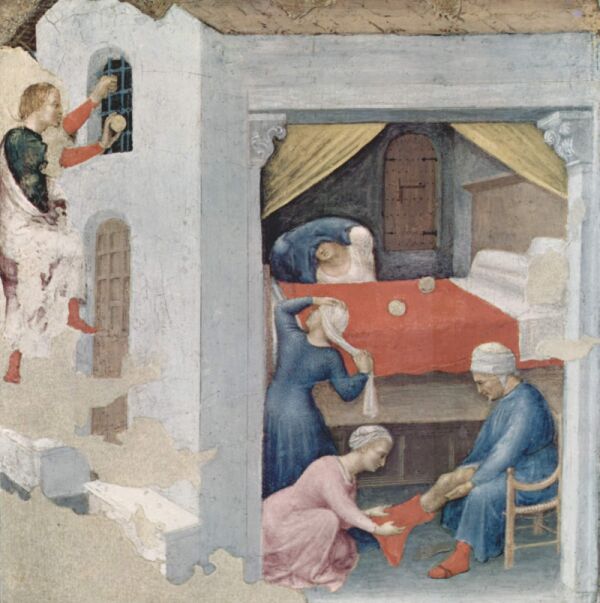
Archbishop of Genoa, tells us how the Saint threw bags of gold coins to
a man in order to provide dowries for the man's daughters and save them
from lives of lechery:
And it was so
that one, his neighbour, had then three daughters, virgins, and he was
a nobleman: but for the poverty of them together, they were
constrained, and in very purpose to abandon them to the sin of lechery,
so that by the gain and winning of their infamy they might be
sustained. And when the holy man Nicholas knew hereof he had great
horror of this villainy, and threw by night secretly into the house of
the man a mass of gold wrapped in a cloth. And when the man arose in
the morning, he found this mass of gold, and rendered to God therefor
great thankings, and therewith he married his oldest daughter.
And a little while after this holy servant of God another mass of
gold, which the man found, and thanked God, and purposed to wake, for
to know him that so had aided him in his poverty. And after a few days
Nicholas doubled the mass of gold, and cast it into the house of this
man. He awoke by the sound of the gold, and followed Nicholas, which
fled from him, and he said to him: Sir, flee not away so but that I may
see and know thee.
Then he ran after him more hastily, and knew that it was Nicholas; and
anon he kneeled down, and would have kissed his feet, but the holy man
would not, but required him not to tell nor discover this thing as long
as he lived.
The gold that
St. Nicholas gave he put in the girls' stockings, giving birth to the
Christmas tradition of hanging stockings from the hearth.
Another tale
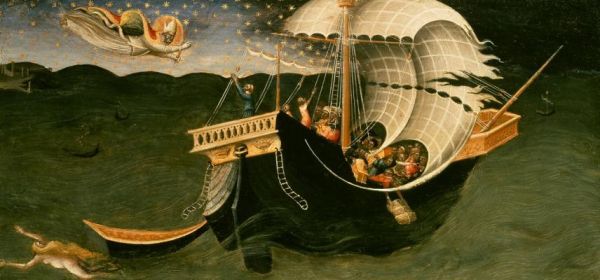
from the Golden Legend explains how St. Nicholas saved sailors from a
tempest:
It is read in a
chronicle that, the blessed Nicholas was at the Council of Nice; and on
a day, as a ship with mariners were in perishing on the sea, they
prayed and required devoutly Nicholas, servant of God, saying: If those
things that we have heard of thee said be true, prove them now.
And anon a man appeared in his likeness, and said: Lo! see ye me not?
ye called me, and then he began to help them in their exploit of the
sea, and anon the tempest ceased.
And when they were come to his church, they knew him without any man to
show him to them, and yet they had never seen him. And then they
thanked God and him of their deliverance. And he bade them to attribute
it to the mercy of God, and to their belief, and nothing to his merits.
The Golden Legend also gives us the story of a Jewish man who
was robbed, and how St. Nicholas used the event to imitate Christ,
thereby
not only bringing the Jewish man to Christ, but causing the thieves to
repent:
Another Jew saw
the virtuous miracles of St. Nicholas, and did do make an image of the
saint, and set it in his house, and commanded him that he should keep
well his house when he went out, and that he should keep well all his
goods, saying to him: Nicholas, lo! here be all my goods, I charge thee
to keep them, and if thou keep them not well, I shall avenge me on thee
in beating and tormenting thee.
And on a time, when the Jew was out, thieves came and robbed all his
goods, and left, unborne away, only the image. And when the Jew came
home he found him robbed of all his goods. He areasoned the image
saying these words: Sir Nicholas, I had set you in my house for to keep
my goods from thieves, wherefore have ye not kept them? Ye shall
receive sorrow and torments, and shall have pain for the thieves. I
shall avenge my loss, and subdue my madness in beating thee.
And then took the Jew the image, and beat it, and tormented it cruelly.
Then happed a great marvel, for when the thieves departed the goods,
the holy saint, like as he had been in his array, appeared to the
thieves, and said to them: Wherefore have I been beaten so cruelly for
you and have so many torments? See how my body is hewed and broken; see
how that the red blood runneth down by my body; go ye fast and restore
it again, or else the ire of God Almighty shall make you as to be one
out of his wit, and that all men shall know your felony, and that each
of you shall be hanged.
And they said: Who art thou that sayest to us such things? And he said
to them: I am Nicholas the servant of Jesu Christ, whom the Jew hath so
cruelly beaten for his goods that ye bare away.
Then they were afeard, and came to the Jew, and heard what he had done
to the image, and they told him the miracle, and delivered to him again
all his goods. And thus came the thieves to the way of truth, and the
Jew to the way of Jesu Christ.
Another famous
story, this one not contained in the Golden Legend, tells how three
children were killed by an butcher and put into a tub of brine. St.
Nicholas, by the power of God, brought them back to life.
St. Nicholas is also said to have given three poor children three
apples each -- apples that turned to gold.
The story is told, too, that St. Nicholas attended the Council of
Nicaea,
convened by the Emperor Constantine in A.D. 325 to deal with the
problem of Arianism. Arius spewed his heresy, and St. Nicholas, it is
said, walked up to him and slapped him across the face. Nicholas was
stripped of his bishopric and belongings, and imprisoned. While locked
up, Our Lord and Lady visited him, asking why he was jailed. He
answered, "Because of my love for you." They handed him a Book of the
Gospels and a Bishop's stole. When he was seen the next morning, chains
on the floor, holding the Gospel and stole, he was freed and restored
as Bishop.
When the great Saint died, he was buried in Myra, but the town was
later taken by the Saracens in A.D. 1034. The Italians rallied to
gather and preserve his relics from desecration, and in 1097, sailors
brought them to Bari, Italy. A lovely church -- the Church of San
Niccolo -- was built to house them, and there they can be found today.
A
curative Oil of Saints -- "Manna di San
Niccolo" -- is said to exude from them to this day.
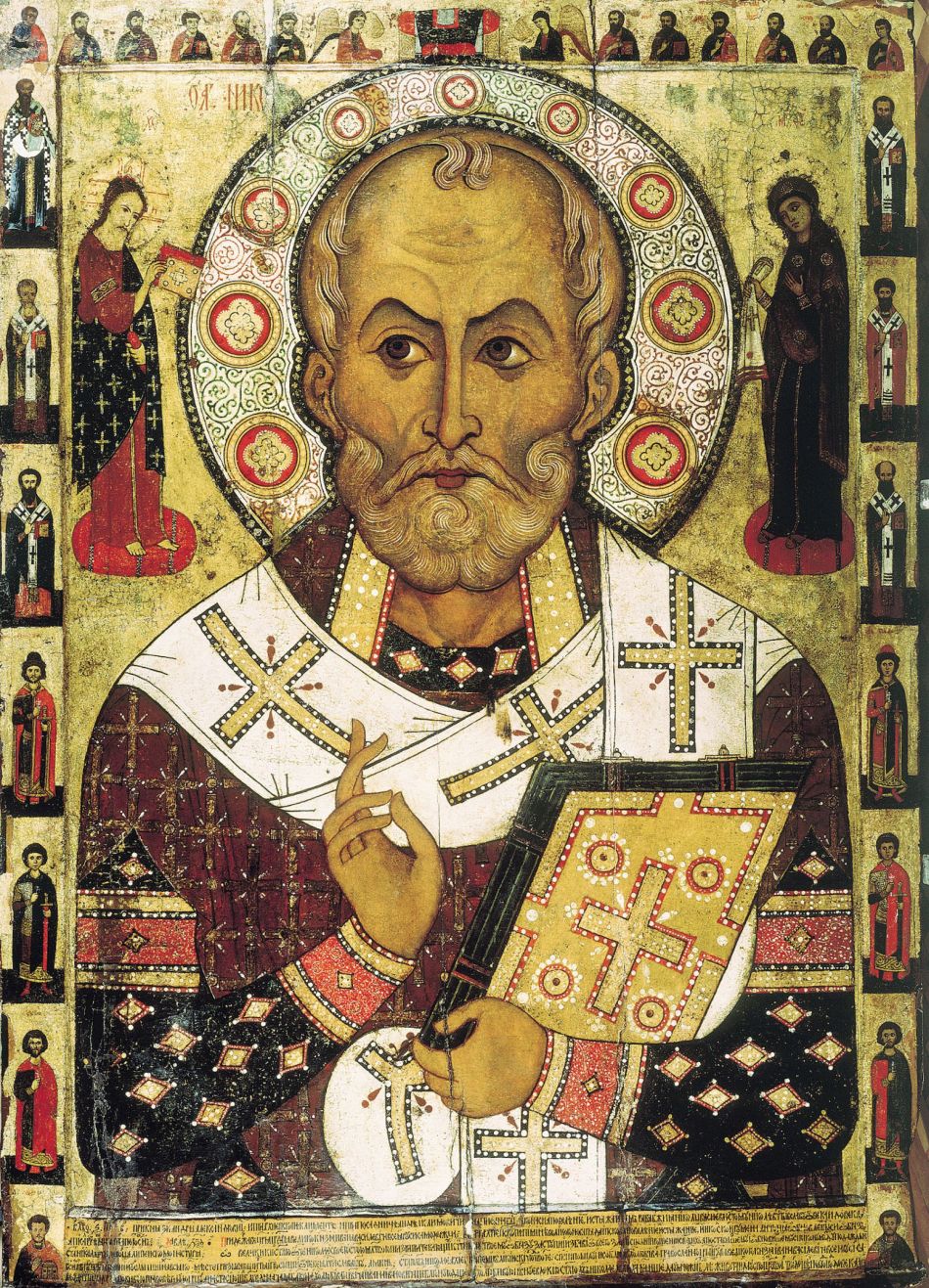
St. Nicholas is the patron of children, sailors, bakers, and
glassmakers and is
represented in art as a bearded, older man -- usually mitred -- holding
3 gold coins or a bag of coins, or three orbs. He is also often shown
with children, and/or a ship.
Customs
Many Catholics
prepare for this feast by praying the Novena
to St. Nicholas starting on November 27 and ending on December 5.
For the feast itself, this is a good traditional prayer for the day:
St. Nicholas, my
special protector, from that bright throne where thou dost enjoy the
vision of thy God, in pity turn thine eyes upon me; obtain for me from
GOD that grace and assistance of which, in my present necessities,
spiritual and temporal, I am most in want, and
especially the grace of N______ , if such be expedient for my eternal
welfare. Remember, moreover, O glorious and holy Bishop, our Sovereign
Pontiff, the Holy Church, and this City of Rome. Bring back to the
right way of salvation those who live steeped in sin or buried in the
darkness of ignorance, error, and heresy. Comfort the sorrowing,
provide for the needy, strengthen the weak-hearted, defend the
oppressed, help the sick; let all experience the effects of thy
powerful intercession with Him who is Supreme Giver of all good. Amen.
Pray a Pater, Ave,
and Gloria
V. Pray for us, blessed Nicholas.
R. That we may be made worthy of the promises of Christ.
Let us pray. O God, who hast honoured and ceasest not daily to honour
thy glorious Confessor and Pontiff, blessed Nicholas, with innumerable
miracles; grant, we beseech Thee, that by his merits and prayers we may
be delivered from the fire of hell and from all other dangers. Through
Christ our Lord Amen.
Now, the Feast
of St.
Nicholas is, for
many Catholics, the day for gift-giving (some do this on Christmas, some do this on the Feast of the Epiphany in memory of
the gifts the Three Kings gave to Baby Jesus, and some spread the
gift-giving out on all these days). In some places, especially in the
Eastern Catholic churches, "St. Nicholas," dressed as a Bishop and
often accompanied by a donkey, will
show up and hand out presents to the little ones, or children put
their shoes in front of the fireplace to be filled with candy and
presents (often including a red apple) by morning. In the spirit of
reciprocity, children will leave a little something out for St.
Nicholas and his donkey as well, in the same way American children
leave out cookies for "Santa Claus" (who is St. Nicholas!) and his
reindeer on Christmas Eve. Because coins are one of the many symbols of
St.
Nicholas, chocolate coins are a perfect thing to put in the childrens'
shoes. One can use Christmas stockings instead of shoes, or one can buy
adult-sized wooden shoes, paint and decorate them, and bring them out
for use just on St. Nicholas's Day.
In any case, an icon -- even a nice Holy Card
-- of St. Nicholas should be visible today if at all possible. Surround
it with greenery and candles, and tell your children the story of the
Saint Nicholas behind the "Santa Claus." This beautiful Bulgarian song
-- Sveti Nikola Konya Kove -- dedicated
to our Saint is perfect for the day; it is sung by Daniel Spassov and
Milen Ivanov:
Then there is this very old song by the animal-loving, English hermit
St. Godric of Finchale (d.
1170). This is one of the very earliest hymns in the English language
that have come down to us:
Sainte Nicolæs
Godes druð
tymbre us faire scone hus;
At þi burth, at þi bare
Sainte Nicolæs, bring us wel þare.
Saint Nicholas,
God’s beloved,
Build for us a fair bright house;
At the birth, at the bier,
Saint Nicholas, bring us safely there.
The French have a song about the incident involving the three children
killed by the butcher and brought back to life by St. Nicholas.You can
download the sheet music in pdf format: Saint Nicolas
(Ils Etaient
Trois Petits Enfants):
lls étaient
trois
petits enfants
Qui s'en allaient glaner aux champs.
Tant sont allés, tant sont venus,
Que sur le soir se sont perdus
S'en sont allés chez le boucher
"Boucher, voudrais tu nous loger?"
"Entrez, entrez, petits enfants,
Y a d'la place assurément."
Ils n'étaient pas sitôt entrés
Que le boucher les a tués.
Saint Nicolas, au bout d'sept ans,
Vint à passer dedans ces champs.
Alla frapper chez le boucher
Pour lui demander à souper.
"Du p'tit salé je veux avoir
Qu'y a sept ans qu'est au saloir."
Quand le boucher entendit ça,
Hors de sa porte il s'enfuya.
"Petits enfants qui dormez là,
Je suis le grand Saint Nicolas."
Et le saint au bout de son bras
Les tira de là tous les trois.
Le premier dit "J'ai bien dormi"
Le second dit "Et moi aussi"
Et le troisième répondit :
"Je croyais être en Paradis!"
There were three
little children
Who were going to glean in the fields.
So many have gone, so many have come,
That in the evening got lost
They went to the butcher
"Butcher, would you like to put us up?"
“Come in, come in, little children,
There is definitely room.
They had barely entered when
The butcher killed them.
Saint Nicolas, after seven years,
Came through these fields.
And went knocking at the butcher's place
To ask him for supper.
“I want a little salty
It's been seven years since
they've been in the salting tub."
When the butcher heard that,
Out of his door he fled.
“Little children who sleep there,
I am the great Saint Nicolas."
And the saint took his arms and
Pulled all three out..
The first says “I slept well”;
The second says “And me too”;
And the third replied:
“I thought I was in paradise!"
On St. Nicholas's Feast Day in the Netherlands and Belgium, it is
customary to serve Speculaas
cookies, a spicy cookie, cut into shapes relevant to the life of
St. Nicholas (coins, mitres, ships, balls, money bags), and painted
with colorful icing:
Speculaas
Cookies (makes 3 dozen depending on size)
Cookie:
1 Cup (2 sticks) sweet butter, at room temperature
2 cups dark brown sugar
2 eggs
Grated rind of 1 lemon
2 teaspoons cinnamon
1 teaspoon ground nutmeg or mace
1/2 teaspoon ground cloves
1/8 teaspoon ground ginger
1/8 teaspoon cardamom
1/8 teaspoon salt
4 cups flour
1 teaspoon baking powder
Icing:
Powdered sugar
Water
Lemon juice
A little beaten egg white for consistency, if desired
Food coloring
In a large bowl, cream the butter with the sugar until fluffy. Stir in
the eggs one at a time, blending thoroughly after each addition. Stir
in the lemon rind. Sift the spices and salt with the flour and baking
powder, and stir gradually into the butter mixture. Wrap in waxed paper
or plastic wrap and chill for several hours or overnight. On a floured
surface, roll out the dough to about 1/8 inch, or for larger figures to
about 1/4 inch. Cut into shapes (Bishop, Bishop's staff, Bishop's
mitre, ship, coins, etc.) and bake at 350 degrees until lightly browned
(don't overbake). When cool, mix together icing ingredients and paint
cookies as desired.
The eve of the
Feast of St. Nicholas -- that is, the night of December 5 -- is, in
areas of Germany (Bavaria), Austria, northern Italy,
Hungary, and Croatia, a night when a half demon, half goat creature
named Krampus appears alongside St. Nicholas, a creature that gives the
night its German name: Krampusnacht.
This demonic being with its cloven hooves, horns, and black fur is
bound in chains, representing the Church's power over Satan.
Traditionally, figures of Krampus and St. Nicholas parade in the
aforementioned areas on Krampusnacht, with Krampus bearing sticks with
which to swat at naughty children, and St. Nicholas bearing gifts, such
as candies, to reward well-behaved children. The "St. Nicholas and
companion" rewarding/punishing duo is seen all over Europe, with the
punishing figure changing from place to place -- e.g., in the
Netherlands and Belgium, he is known as Swarte Piet (Black Pete); in
Northern Germany, he's known as Knecht Ruprecht, etc. In the United
States, it's Saint Nicholas himself who is said to give bad children
coal in their stockings to punish bad behavior. This punishing figure
is used to keep children in line throughout the year ("You better be
good! You don't want Krampus to punish you, do you?")
Sadly, the traditions of Krampusnacht have become overwhelmingly
paganized and secularized, much the way the customs of Hallowe'en have. St.
Nicholas is downplayed, and the Krampus figure has become less
humorous, more demonically chilling, and the sole focus of
Krampusnacht. What used to be wholesome and fun demonstrations of Good
being rewarded while evil is punished have now become hedonistic
celebrations of evil in many places.
St. Nicholas is honored in Bari, Italy, where his relics reside, on May
7 also, and in Gualtieri Sicamino in Sicily, this day is known as Nocciolata:
a few days before, groups of men, accompanied by musicians
singing Viva Viva Santa Nicola,
go door to door
asking for walnuts and figs, which they entrust to one of their group
who carries a special bag to keep them in. On the feast itself,
everyone
gathers in the Piazza Duomo -- and, from the balconies come torrents of
hazelnuts, which the people rush to grab up.
Readings
From The
Liturgical Year, by Dom Prosper Gueranger
Divine Wisdom
has willed that on the way which leads to the Messias, our Great High
Priest, there should be many Pontiffs to pay him the honor due to him.
Two Popes, St. Melchiades and St. Damasus; two Holy Doctors, St. Peter
Chrysologus and St. Ambrose; two Bishops, St. Nicholas and St.
Eusebius: these are the glorious Pontiffs who have been entrusted with
the charge of preparing, by their prayers, the way of the Christian
people towards Him Who is the Sovereign Priest according to the order
of Melchisedech. As each of their feasts comes, we will show their
right to have been thus admitted into the court of Jesus. Today the
Church celebrates with joy the feast of the great Thaumaturgus
Nicholas, who is to the Greek Church what St. Martin is to us. The
Church of Rome has honored the name of Nicholas for nearly a thousand
years. Let us admire the wonderful power which God gave him over
creation; but let us offer him our most fervent congratulations in that
he was permitted to be one of the three hundred and eighteen Bishops
who proclaimed, at Nicæa, that the Word is Consubstantial to the
Father. The humiliations of the Son of God did not scandalize him.
Neither the lowliness of the flesh, which the Sovereign Lord of all
things assumed to Himself in the womb of the Virgin, nor the poverty of
the crib, hindered him from confessing to be Son of God, equal to God,
Him Who is the Son of Mary: and for this reason, God has glorified this
His servant, and given him the power to obtain, each year, for the
children of the Church, the grace of receiving this same Jesus, the
Word, with simple faith and fervent love. Let us now listen to the
eulogy of St. Nicholas, which the Roman Church has inserted in her
Liturgy.
Nicolaum;
illustri loco Pataræ in Lycia natum, parentes a Deo precibus
impetrarunt. Cujus viri sanctitas, quanta futura esset, jam ab
incunabulis apparuit. Nam infans, quum reliquos dies lac nutricis
frequens sugeret, quarta et sexta feria semel duntaxat, idque vesperi,
sugebat: quam jejunii consuetudinem in reliqua vita semper tenuit.
Adolescens parentibus orbatus, facultates suas pauperibus distribuit.
Cujus illus insigne est Christianæ benignitatis exemplum, quod quum
ejus civis egens tres filias jam nubiles in matrimonio collocare non
posset, earumque pudicitatiam prostituere cogitaret: re cognita,
Nicolaus noctu per fenestram tantum pecuniæ in ejus domum injecit,
quantum unius virginis doti satis esset: quod quum iterum et tertio
fecisset, tres illæ virgines honestis viris, in matrimonium datæ sunt.
Nicholas
was born in the celebrated city of Patara, in the province of Lycia.
His birth was the fruit of his parents’ prayers. Evidences of his great
future holiness were given from his very cradle. For when he was an
infant, he would only take his food once on Wednesdays and Fridays, and
then not till evening; while on other days he frequently took the
breast: he kept up this custom of fasting during the rest of his life.
Having lost his parents when he was a boy, he gave all his goods to the
poor. Of his Christian kindheartedness there is the following noble
example. One of his fellow citizens had three daughters; but being too
poor to obtain them an honorable marriage, he was minded to abandon
them to a life of prostitution. Nicholas having got to know the case,
went to the house during the night and threw in by the window a sum of
money sufficient for the dower of one of the daughters; he did the same
a second and a third time; and thus the three were married to
respectable men.
Quum vero
se totum Deo dedisset, in Palæstinam profectus est, ut loca sancta
viseret, et præsens veneraretur. Qua in peregrinatione navem conscedens
sereno cœlo et tranquillo mari, horribilem nantis tempestatem prædixit:
moxque ortam, quum essent omnes in summo periculo, orans mirabiliter
sedavit. Unde quum domum reversus singularis sanctitatis omnibus
documenta præberet, Dei admonitu Myram, quæ Lyciæ metropolis erat,
venit: quo tempore ejus urbis episcopo mortuo, provinciales episcopi de
successore deligendo consultabant. Itaque in ea deliberatione divinitus
admoniti sunt, ut eum eligerent, qui postridie mane primus in ecclesiam
ingrederetur, Nicolaus nomine. Qua observatione adhibita, in ecclesiæ
janua deprehensus est Nicolaus, et summo omnium consensu Myræ Episcopus
creatur. In episcopatu castitatem, quam semper coluerat, gravitatem,
orationis assiduitatem, vigilias, abstinentiam, liberalitatem et
hospitalitatem, in adhorando mansuetudinem, in reprehendendo
severitatem, perpetuo adhibuit.
Having given
himself wholly to the service of God, he set out for
Palestine, that he might visit and venerate the holy places. During
this pilgrimage, which he made by sea, he foretold to the mariners, on
embarking, though the heavens were then serene and the sea tranquil,
that they would be overtaken by a frightful storm. In a very short
time, the storm arose. All were in the most imminent danger, when he
quelled it by his prayers. His pilgrimage ended, he returned home,
giving to all men example of the greatest sanctity. He went, by an
inspiration from God, to Myra, the Metropolis of Lycia, which had just
lost its Bishop by death, and the Bishops of the province had come
together for the purpose of electing a successor. While they were
holding council for the election, they were told by a revelation from
heaven, that they should choose him who, on the morrow, should be the
first to enter the church, his name being Nicholas. Accordingly, the
requisite observations were made, when they found Nicholas to be
waiting at the church door: they took him, and, to the incredible
delight of all, made him the Bishop of Myra. During his episcopate, he
never flagged in the virtues looked for in a bishop; chastity, which
indeed he had always preserved, gravity, assiduity in prayer,
watchings, abstinence, generosity, and hospitality, meekness in
exhortations, severity in reproving.
Viduis et
orphanis pecunia, consilio, opere non defuit: oppressos adeo
sublevavit, ut etiam tres Tribunos, per calumniam a Constantino Augusto
condemnatos, qui se propter famam miraculorum ejus orationibus,
longissime absenti, commendarant, adhuc vivens, quum Imperatori,
minaciter cum terrens, apparuisset liberaverit. Quum vero contra
edictum Diocletiani et Maximiani Christianæ fidei veritatem Myreæ
prædicaret, ab Imperatorum satellitibus comprehensus, et longissime
abductus in carcerem conjectus est; ubi fuit usque ad Constantium
Imperatorem: cujus jussi ex custodia ereptus, Myram rediit. Mox ad
Nicænum Concilium se contulit: ubi cum trecentis illis decem et octo
Patribus Arianam hæresim condemnavit. Inde reversus ad episcopatum, non
ita multo post instante morte, suscipiens in cœlum, quum Angelos sibi
occurrentes intueretur, illo Psalmo pronunciato: In te, Domine,
speravi, usque ad eum locum: In manus tuas commendo spiritum meum: in
cœlestem patriam migravit. Ejus corpus Barium in Apulia translatum,
ibidem summa celebritate ac veneratione colitur.
He befriended
widows and orphans by money, by advice, and by every
service in his power. So zealous a defender was he of all who suffered
oppression, that, on once occasion, three Tribunes having been
condemned by the Emperor Constantine, who had been deceived by calumny,
and having heard of the miracles wrought by Nicholas, they recommended
themselves to his prayers, though he was living at a very great
distance from that place: the saint appeared to Constantine, and
angrily looking upon him, obtained from the terrified Emperor their
deliverance. Having, contrary to the edict of Dioclesian and Maximian,
preached in Myra the truth of the Christian faith, he was taken up by
the servants of the two Emperors. He was taken off to a great distance
and thrown into prison, where he remained until Constantine, having
become Emperor, ordered his rescue, and the Saint returned to Myra.
Shortly afterwards, he repaired to the Council which was being held at
Nicæa: there he took part with the three hundred and eighteen Fathers
in condemning the Arian heresy. Scarcely had he returned to his See,
than he was taken with the sickness of which he soon died. Looking up
to heaven, and seeing Angels coming to meet him, he began the Psalm, In
thee, O Lord, have I hoped; and having come to those words, Into thy
hands I commend my spirit, his soul took its flight to the heavenly
country. His body, having been translated to Bari in Apulia, is the
object of universal veneration.
Almost all the
Breviaries of the Latin Church, up to the 17th century, contain most
fervent praises of the virtues and miracles of St. Nicholas, and give
the beautiful Office of the holy Bishop, which was composed about the
12th century. We have spoken elsewhere upon this Office, as far as
regards the music; at present we will only mention its being drawn up
exclusively on the Acts of St. Nicholas, and its being more explicit on
some circumstances of the Saint’s life than is the Legend of the Roman
Breviary. The following portions of this Office dwell with complacency
on a fact which is not mentioned in our Liturgy: we mean the miraculous
oil, which, for almost eight hundred years, has flowed without ceasing
from the tomb of the holy Bishop, and by means of which God has
frequently wrought miracles. The Responsory and Antiphon, which we
give, are upon the miracle of the oil itself. They were formerly so
familiar to the faithful, that in the 13th century their music was sung
to the Responsory Unus Panis, and to the Antiphon O quam suavis est, of
the Office of Corpus Christi.