``Where the
Bishop is, there let the multitude of believers be;
even as where Jesus is, there is the Catholic Church'' Ignatius of
Antioch, 1st c. A.D
Hallowe'en
31 October and 1 and 2 November are called, colloquially (not
officially), "Hallowtide" or the "Days of the Dead" because on these
days we pray for or remember those who've left this world.
The days of the dead center around All Saints' Day (also
known as All
Hallows') on November 1, when we celebrate all the Saints in Heaven. On
the day after All Hallows', called "All Souls' Day," we
remember the saved souls who are in
Purgatory, being cleansed of the temporal effects of their sins before
they can enter Heaven. The day that comes before All Hallows', though,
is one on which we unofficially
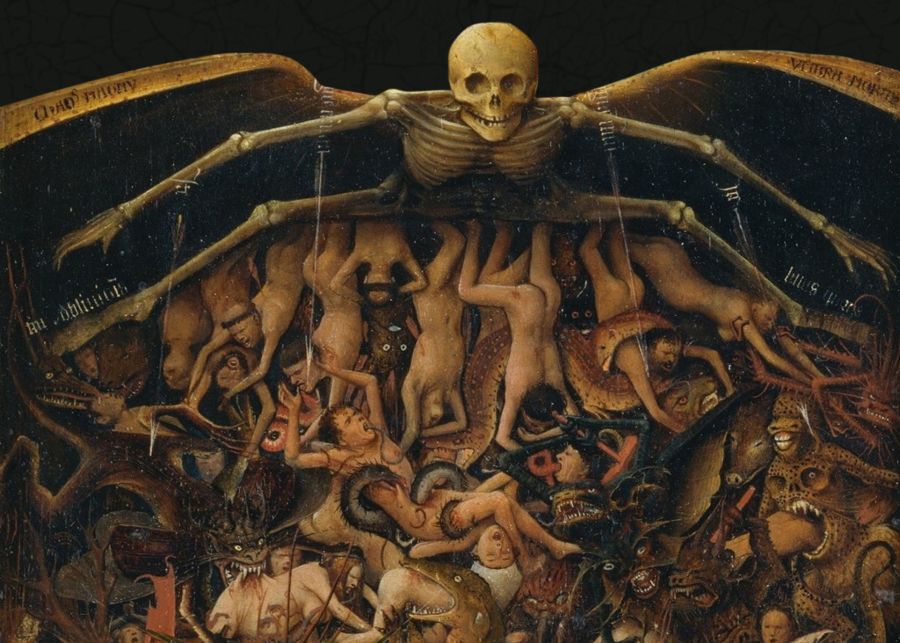
remember the damned and the reality of
Hell. The schema, then, for the Days of the Dead looks like this:
31 October:
Hallowe'en:
unofficially,
per folk custom, recalls the souls of the damned. Practices center
around recognizing and remembering the reality of
Hell and how to avoid it.
1 November:
All Saints':
set aside to officially
honor the Church Triumphant (the souls in Heaven). Practices center
around recalling our
great Saints, including those whose names are unknown to us and, so,
are not canonized
2 November:
All Souls':
set aside officially
to pray for the Church Suffering (the souls in Purgatory). Practices
center around praying for the souls in Purgatory, especially our loved
ones
The earliest
form of All Saints' (or "All Hallows'") was first celebrated in the
300s, but originally took place on 13 May, as it still does in some
Eastern Churches. The Feast first commemorated only the martyrs, but
came to include all of the Saints by 741. It was transferred to 1
November in 844 when Pope Gregory III consecrated a chapel in St.
Peter's Basilica to All Saints (so much for the theory that the day was
fixed on 1 November because Irish pagans had harvest
festivals at that time).
All Souls' has its origins in A.D. 1048 when the Bishop of Cluny
decreed that the Benedictines of Cluny pray for the souls in Purgatory
on this day. The practice spread until Pope Sylvester II recommended it
for the entire Latin Church.
The Vigil of -- i.e., the evening before -- All Hallows' ("Hallows'
Eve,"
or "Hallowe'en") came, in Irish popular piety, to be a day of
remembering the dead who are neither in Purgatory or Heaven, but are
damned, and related customs spread to many parts of the world. Thus we
have the popular focus of Hallowe'en as the reality of Hell,
and hence its scary character and focus on evil and how to avoid it,
the
sad fate of unsaved souls, etc.
One hears too often from the secular world that
"Hallowe'en is a pagan holiday" -- an impossibility because
"Hallowe'en," as said, means "All Hallows' Evening" which is as
Catholic as it gets. Some say that the holiday actually
stems from Samhain, a pagan Celtic celebration, or is Satanic, but this
isn't true, either, any more than Christmas "stems from" the Druids'
Yule, though popular customs that predated the Church -- such as the
use
of holly to decorate -- may be involved
in our celebrations (it is rather amusing that October 31 is also
"Reformation Day" in Protestant circles -- the day to recall Luther's
having nailed his 95 Theses to Wittenberg's cathedral door -- but
Protestants who reject Hallowe'en because pagans do things on
October 31 don't object to commemorating that event on this day).
Customs
Hallowe'en customs are
a mixture of Catholic popular devotions, and French, Irish, and English
customs all mixed together. From the French we get the custom of
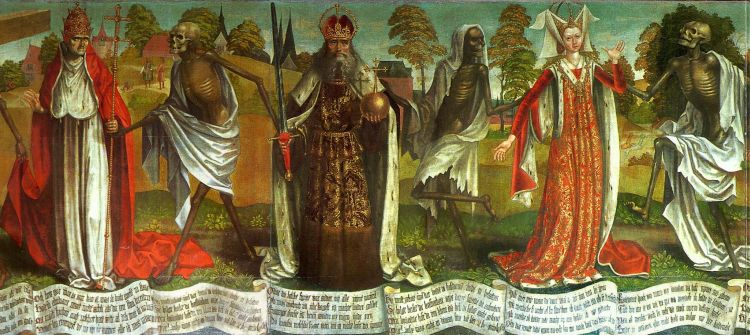
dressing up, which originated during the time of the Black Death when
artistic renderings of the dead known as the "Danse Macabre" were
popular and meant to convey that death comes to each and every one of
us, no matter our station in life. These "Dances of Death" were
rendered in paintings and frescoes, typically depicting people from
Pope to King to peasant dancing with or being surrounded by skeletons.
This genre was also acted out by people who
dressed as the dead -- nervously, comedically, to "laugh in the face of
death" and for a sense of relief from the nightmarish reality of the
plague that felled at least a third -- and possibly up to 60% -- of the
people living in Europe. These danse macabre customs were moved to
Hallowe'en
when the Irish and French began to intermarry in America.
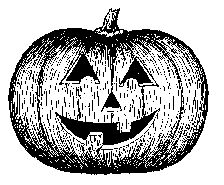
From the Irish come the carved Jack-o-lanterns, which were originally
carved turnips. The legend surrounding the Jack-o-Lantern is this:
There once was
an old drunken trickster named Jack, a man known so much for his
miserly ways that he was known as "Stingy Jack," He loved making
mischief on everyone -- even his own family, even the Devil himself!
One day, he tricked Satan into climbing up an apple tree -- but then
carved Crosses on the trunk so the Devil couldn't get back down. He
bargained with the Evil One, saying he would remove the Crosses only if
the Devil would promise not to take his soul to Hell; to this, the
Devil agreed.
After Jack died, after many years filled with vice, he went up to the
Pearly Gates -- but was told by St. Peter that he was too miserable a
creature to see the Face of Almighty God. But when he went to the Gates
of Hell, he was reminded that he couldn't enter there, either! So, he
was doomed to spend his eternity roaming the earth. The only good thing
that happened to him was that the Devil threw him an ember from the
burning pits to light his way, an ember he carried inside a
hollowed-out, carved turnip.
And when you
carve up your pumpkin, keep the seeds to roast (recipe here).
From the English
Catholics we get begging from door to door, the earlier and more pure
form of "trick-or-treating." Children would go about begging their
neighbors for a "Soul Cake," for which they would say a prayer for
those neighbors' dead. Instead of knocking on a door and saying
"Trick-or-treat," children would say either:
A Soul Cake, a
Soul Cake,
have mercy on all Christian souls for a soul cake!
or
Soul, soul, an
apple or two,
If you haven't an apple, a pear will do,
One for Peter, two for Paul,
Three for the Man Who made us all.
While Soul Cakes
were originally a type of shortbread, it is said that a clever medieval
cook wanted to make Soul Cakes designed to remind people of eternity,
so she cut a hole in the middle of round cakes before frying them,
thereby inventing donuts! Fresh plain cake donuts would be a nice food
to eat on this day.
Nowadays,
trick-or-treating typically results in being given candy -- or handing
it out if you got old. Sir Charles Coulombe recommends the practice of
handing out, alongside candy, notes requesting prayer for one's dead
loved ones (many also hand out holy cards), and Catholic
trick-or-treaters following through and praying for the dead of the
houses they visit. I love the idea; it restores the deeper meaning of
Hallowtide.
Aside from store-bought Hallowe'en candy, other customary
foods for the day include cider, nuts, popcorn, and apples --
best eaten around a bonfire or fireplace,
of course (bonfires are traditional tonight, just as they are on the
Feast of St Lucy, St. John's Eve, Walpurgisnacht, Holy Saturday, Candlemas, and other
feasts). And there is, of course, Irish Barmbrack, a sultana-studded
yeast bread
traditionally baked with trinkets inside that fortell one's fortune for
the coming year (recipes
for both cake donuts and barmbrack here).
Another Hallowe'en custom is the old Celtic "bobbing for apples." To do
this, fill a large tub two thirds full with water and float apples in
it. Children take turns trying to pick up one of the floating apples
using only their mouths (hands are not allowed and must be held or tied
behind the back!) -- very tricky to do! The first to do so wins a prize
(some say he will be the first one to marry someday). You can make the
game more fun by carving an initial into the bottom of each apple,
letting that initial indicate the name of the person each apple-bobber
will marry, and/or using different colored apples with different
assigned meanings or prizes. (You can play a dry version of this game
by tying the stems of the apples to strings and suspending them. If you
do this, carve any initials at the tops of the apples). You can find
other games to play here (pdf),
including Hallowe'en Bingo, for which I've made Bingo cards for you.
Perfect for the day, too, are scary stories! If you want greatpoems
and stories to
relate to your children on this day, try these, which you can download
in pdf format:
Little
Orphant Annie, by James Whitcomb Riley
The Little Ghost, by Edna St. Vincent Millay
The Night Wind, by Eugene Field
The Witch, by Mary Elizabeth Coleridge
Antigonish (I Met a Man Who Wasn't There), by Hughes Mearns
The Raven, by Edgar
Allan Poe
The Stolen Child,
by William Butler Yeats
The Wreck of the
Hesperus, by Henry Wadsworth Longfellow
The Highwayman, by Alfred Noyes
The Pied Piper of Hamelin, by Robert Browning
The Listeners, by Walter De La Mare
This Living Hand, Now Warm and Capable, by John Keats
The Drowned Man, by Alexandar Pushkin
The Haunted Oak, by Paul Laurence Dunbar
The Dance of Death, by Charles Baudelaire
Darkness, by Lord Byron
Another option
is to listen to Old Time Radio shows, a selection of twenty-one of
which I provide below in mp3 format. I highly recommend your listening
to them first before allowing your children to listen to them; though
old, some may be more adult or more intense than would be good for your
kids, whom you know better than I (the shows from the "Dark Fantasy"
series are unintentionally
hilarious while trying to be scary; I couldn't resist including them!).
There are also
the little japes to give children a fright. For ex., there is the trick
of getting a small box with a lid and cutting a hole just big enough
into the bottom to slide your finger into. Once your finger is lying
flat on the bottom, pack some "bloody" (that is, dotted with red food
coloring) gauze or cotton around it so the hole is not visible. Then
hold the box out to a child and tell him there's a mummified finger
inside. Have him remove the top and gaze at the gory relic -- only to
move it as you scream about it being alive. Icing your finger so
it's cold, and daring the kids to touch it before it moves would make
it extra-scary. Using your entire hand in a larger box -- and grabbing
the child's hand when he touches it -- if he dares -- is another way to
do this.
They might also like the bit based on a poem by Shel Silverstein:
The Slithery-dee
has crawled out of the Sea.
He may catch all the others, but he won't catch me.
No you won't catch me, old Slithery-dee,
You may catch all the others, but you wo---
The trick is to
stand in a doorway as you recite it, pointing to the children as you
refer to "the others," and then, when you get to the last "but you
wo--", bringing your arm up behind you and grabbing yourself around the
neck as if you're being pulled away by a monster, disappearing from
sight (or having a confederate grab you away), screaming all the while.
There's the trick of pretending you're turning into Dracula's Renfield
by hiding a raisin in a Kleenex, pretending to swat a fly, pretending
to pick the dead fly up with the tissue -- and then eating the raisin,
making the kids think you ate a fly.
Whatever little games you play, know that the goal of a good scare is
ultimately laughter after a moment of trepidation and wonder. The goal
is most definitely not trauma or any lingering
fear. When playing tricks on or telling scary stories to kids, you have
to use prudence to know how far you can -- and can't -- go given their
temperaments and maturity.
As you and your children play, perhaps a
backdrop of Bach's Toccata and Fugue in D minor (BWV 565) might help
you set the scene. This piece wasn't written for Hallowtide, but its
ominous tones invoke horror:
Or maybe scary
sound effects are what will make your Halloween party a good one. Here
are 8 hours' worth of scary sounds from the Fantasy Realm Youtube
channel:
After teaching
your children about the frightening realities of Hell and the fate of
the damned, and after giving them a good, fun,
appropriate-to-their-level-of-maturity
scare, reassure them by telling them that the Evil One has
already
been conquered! He can tempt,
obssess, and oppress us, but Satan has no ultimate power over those
who are in Christ,
and mocking him and his minions is a way of demonstrating this; teach
your children how to call on the power of Christ and His Church to protect themselves from the Evil
One's snares. Warn them that
occultic
magick
(the art
of
performing actions beyond the power of man with the aid of powers other
than the Divine) is real, that there is no such thing as
"white magick," that playing with the occult -- whether by occultic
divination,
necromancy, the casting of spells, playing with Ouija boards, etc. --
is an invitation to demons to respond, and that it is from demons that
magick gets any power it has. Remember St. Michael to them, teach them
about the power of sacramentals and prayers that ward off evil when
piously used (the Sign of the Cross, Holy Water, blessed salt,
the Crucifix, the St. Benedict Medal, St. Anthony's Brief, etc.). Teach them
to call on the Holy Name of Jesus, the
Blessed Virgin, their Guardian Angel,
and/or St. Michael when
they are afraid, etc.
P.S. Remember! If you made apple dolls on Michaelmas, now
is the
perfect day to unveil and decorate them. They tend to look a little
spooky!