``Where the
Bishop is, there let the multitude of believers be;
even as where Jesus is, there is the Catholic Church'' Ignatius of
Antioch, 1st c. A.D
The Feast
of St. Lawrence
In August of A.D. 258, the emperor Valerian ordered that all
deacons, priests, and Bishops be put to death -- but they were to bring
him all the treasure the Christians had. Tradition via the Golden
Legend, written in A.D. 1275 by Jacobus de Voragine, Archbishop of
Genoa, tells us that Pope Sixtus II met with Lawrence, saying to him:
"I shall not
leave thee, my son, but greater strifes and battles be due to thee for
the faith of Jesu Christ. We, as old men, have taken more lighter
battle, and to thee as to a young man shall remain a more glorious
battle of which thou shalt triumph and have victory of the tyrant, and
shalt follow me within three days."
Then he delivered to him all the treasures, commanding him that he
should give them to churches and poor people. And the blessed man
sought the poor people night and day, and gave to each of them that as
was needful, and came to the house of an old woman, which had hid in
her house many Christian men and women, and long she had had the
headache, and St. Laurence laid his hand opon her head, and anon she
was healed of the ache and pain.
And he washed the feet of the poor people and gave to each of them
alms. The same night he went to the house of a Christian man and found
therein a blind man, and gave to him his sight by the sign of the
cross.
And when the blessed Sixtus would not consent to Decius, ne
offer to the idols, he commanded that he should be led forth and
beheaded.
St. Lawrence
gave all the material goods he could to the poor, and then, three days
after Pope Sixtus was martyred, he was martyred as well -- the last
of the deacons of Rome to be executed. He was put to death by being
roasted on a gridiron over a fire. The Golden Legend gives us this
account:
And the
ministers despoiled him, and laid him stretched out upon a gridiron of
iron, and laid burning coals under, and held him with forks of iron.
Then said Laurence to Valerianus: Learn, thou cursed wretch, that thy
coals give to me refreshing of coldness, and make ready to thee torment
perdurable, and our Lord knoweth that I, being accused, have not
forsaken him, and when I was demanded I confessed him Christ, and I
being roasted give thankings unto God.
And after this he said with a glad cheer unto Decius, Thou cursed
wretch, thou hast roasted that one side, turn that other, and eat.
And then he, rendering thankings to our Lord, said: I thank thee, Lord
Jesu Christ, for I have deserved to enter into thy gates.
How epically
flippant! "Hey, pal, I'm cooked on the one side; time to flip me over!"
St. Lawrence was
buried in the Catacomb of Cyriaca, on the Via Tiburtina. Constantine
the Great built a chapel there in his honor, and this chapel was built
up over the years, becoming known as St. Lawrence-Outside-The-Walls
(San Lorenzo fuori le Mura),
one of the original seven patriarchal
basilicas of Rome. Another Roman church, San Lorenzo in Panisperna, was
built
at the place of his martyrdom. In this latter church, one can venerate
the gridiron upon which St. Lawrence was put to death.
St. Lawrence is patron of librarians, archivists, cooks, deacons,
glassmakers, skin diseases, and the torments of Purgatory.
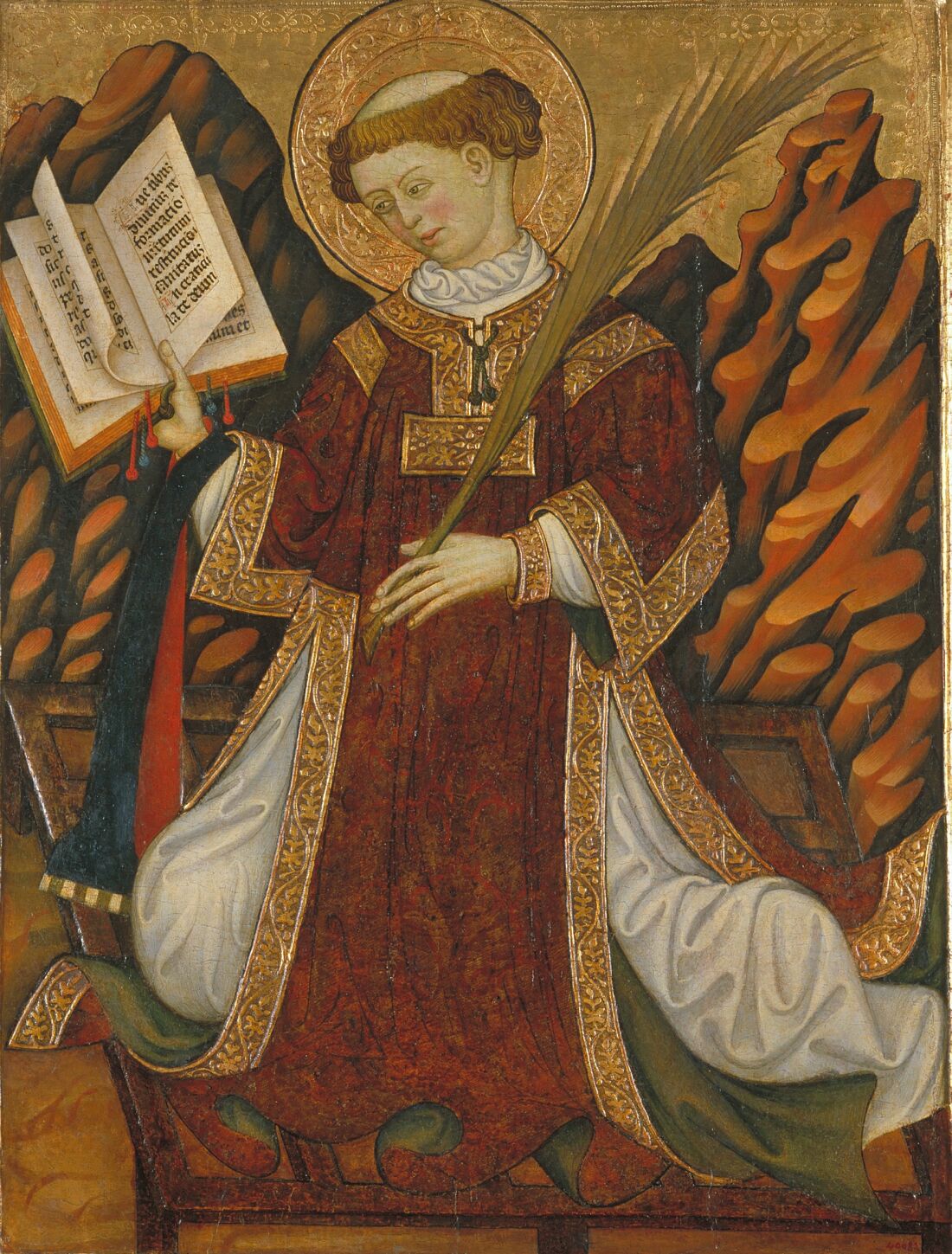
He is most often represented in art handing out the treasures of the
Church, roasting on a gridiron, or with a gridiron, the
Gospels, or a bag of money for the poor.
Customs and Traditions
Some might
prepare for this feast by praying the Novena
to St. Lawrence starting on August 1 and ending on August 9, the
eve of his feast.
Tonight, or
especially tomorrow night and up to the dawn of 12 August, 1 if you look up at a clear, dark sky in
the
Northern hemisphere, you may be blessed to see the Perseid meteor
shower, 2 debris of the comet
Swift-Tuttle whose radiant (point of apparent origin) is the
constellation of Perseus. This meteor shower is known as "the Tears of
St. Lawrence" because it is most visible at this time of year, though
these streaks of light can sometimes be seen as early as 17 July and as
late as 24 August.
To see St.
Lawrence's "fiery tears," go outside after midnight, to a place as far
away as possible from city lights (leave the city, if possible, and
drive toward the constellation so that the city lights' glow will be
behind you). Lie down on the grass and look up and toward the North,
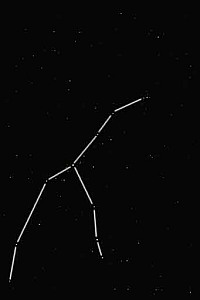
about halfway between the constellation Perseus 3 -- which will be very, very low on the horizon
to the northeast -- and the point directly overhead. Scan the sky
elsewhere, too, but this area will be the most likely place to see the
meteors. If the sky is too cloudy or the Moon is too full (see at
right) for you to get a good view of the stars, you might not have any
luck at all -- but there will always be next year to try again!
When you see a "shooting star," make a wish, as folklore says that
wishes made when seeing such a star come true. Better yet, make the
"wish" a prayer, and invoke St. Lawrence to pray it with you! (To learn
more about God's beautiful stars, see this site's Zodiac
sub-section.)
Psalm 8 ("Dómine, Dóminus noster") is a part of the Second Nocturne of
today's Divine Office, and is an especially appropriate psalm to think
of, along with its associated antiphon, while watching the tears of St.
Lawrence.
O Lord our
Governour, how excellent is thy Name in all the world; Thou hast set
Thy glory above the heavens! Out of the mouth of very babes and
sucklings hast Thou ordained strength, because of Thine enemies, that
Thou mightest still the enemy and the avenger. For I will consider Thy
heavens, even the works of Thy fingers; the moon and the stars which
Thou hast ordained.
What is man, that Thou art mindful of him? and the son of man, that
Thou visitest him? Thou madest him lower than the Angels, to crown him
with glory and worship. Thou makest him to have dominion of the works
of Thy hands; and Thou hast put all things in subjection under his feet
: All sheep and oxen; yea, and the beasts of the field; The fowls of
the air, and the fishes of the sea; and whatsoever walketh through the
paths of the seas.
O Lord our Governour, how excellent is Thy Name in all the world!
Antiphon:
Blessed Lawrence said : The darkness is no darkness with me, but the
night is as clear as the dawning, that shineth more and more unto the
perfect day.
And then there
is this prayerful poem by Joyce Kilmer, who converted from
Episcopalinism to Catholicism and later died in France as a soldier
during World War I:
St. Laurence
Within the broken Vatican
The murdered Pope is lying dead.
The soldiers of Valerian
Their evil hands are wet and red.
Unarmed, unmoved, St. Laurence waits,
His cassock is his only mail.
The troops of Hell have burst the gates,
But Christ is Lord, He shall prevail.
They have encompassed him with steel,
They spit upon his gentle face,
He smiles and bleeds, nor will reveal
The Church's hidden treasure-place.
Ah, faithful steward, worthy knight,
Well hast thou done. Behold thy fee!
Since thou hast fought the goodly fight
A martyr's death is fixed for thee.
St. Laurence, pray for us to bear
The faith which glorifies thy name.
St. Laurence, pray for us to share
The wounds of Love's consuming flame.
As to foods,
there is nothing in particular associated with this day that I am aware
of -- but, given St. Lawrence's mode of death, a barbecue seems a very
natural choice. Grill some meats, have a nice cooler of
icy-cold beer, and prepare for a late night of star-gazing and
recalling the
glory of St. Lawrence! And while you're grilling meat, grill some sweet
corn as well:
Grilled Corn
8 ears of sweet corn, still in their husks
Pull down the corn's husks, one leaf at a time, and remove the silk.
With the husks still pulled down, tie them together with
twine so the ear is exposed and so that you have a "handle" with with
to eat the corn when it's done. Rub the ears with olive oil and grill
directly over a medium high flame (about 400 degrees) until
charred on all sides (about 13 minutes). Coat with the following
mixture and serve with lime wedges, and with fresh cilantro for those
who want it:
1/2 cup sour cream
2 tablespoons mayonnaise
1/2 cup crumbled queso fresco (a crumbly Mexican cheese) or
feta
1/2 teaspoon chili powder
1/4 teaspoon garlic powder
1/4 teaspoon cumin
1/4 teaspoon kosher salt
Since you're eating outside at night, you have to make
S'Mores. That's just how it is; it's the law. In case you're from Mars
and don't know what S'Mores are, you make them like this: Get a graham
cracker, break it in half so you have two squares, place on top of one
square a half of a plain Hershey's bar, and set aside. Now get a stick
and put a large marshmallow or two on the end of it. Hold it over a
fire until
it's cooked the way you like it (I like mine charred and black after
their having been literally on fire). Put the hot marshmallow(s) on top
of
the
chocolate, top with the second graham cracker square, press together,
and eat.
Finally, I present the
priest composer Antonio Vivaldi's Concerto in FMajor (RV 286), written
just for the day, "Per la solennitŕ di S. Lorenzo":
As an aside: In Palazzolo Acreide, Siracusa, Italy, a great
celebration in honor of St. Sebastian
is held today.
Reading
Sermon LXXXV
On the Feast of S. Laurence the Martyr
By Pope St. Leo the Great
I.
The Example of the Martyrs is Most Valuable
Whilst the height of all virtues, dearly-beloved, and the fulness of
all righteousness is born of that love, wherewith God and one's
neighbour is loved, surely in none is this love found more conspicuous
and brighter than in the blessed martyrs; who are as near to our Lord
Jesus, Who died for all men, in the imitation of His love, as in the
likeness of their suffering. For, although that Love, wherewith the
Lord has redeemed us, cannot be equalled by any man's kindness, because
it is one thing that a man who is doomed to die one day should die for
a righteous man, and another that One Who is free from the debt of sin
should lay down His life for the wicked : yet the martyrs also have
done great service to all men, in that the Lord Who gave them boldness,
has used it to show that the penalty of death and the pain of the cross
need not be terrible to any of His followers, but might be imitated by
many of them. If therefore no good man is good for himself alone, and
no wise man's wisdom befriends himself only, and the nature of true
virtue is such that it leads many away from the dark error on which its
light is shed, no model is more useful in teaching God's people than
that of the martyrs. Eloquence may make intercession easy, reasoning
may effectually persuade; but yet examples are stronger than words, and
there is more teaching in practice than in precept.
II. The Saint's Martyrdom Described.
And how gloriously strong in this most excellent manner of doctrine the
blessed martyr Laurentius is, by whose sufferings to-day is marked,
even his persecutors were able to feel, when they found that his
wondrous courage, born principally of love for Christ, not only did not
yield itself, but also strengthened others by the example of his
endurance. For when the fury of the gentile potentates was raging
against Christ's most chosen members, and attacked those especially who
were of priestly rank, the wicked persecutor's wrath was vented on
Laurentius the deacon, who was pre-eminent not only in the performance
of the sacred rites, but also in the management of the church's
property , promising himself double spoil from one man's capture: for
if he forced him to surrender the sacred treasures, he would also drive
him out of the pale of true religion. And so this man, so greedy of
money and such a foe to the truth, arms himself with double weapon:
with avarice to plunder the gold; with impiety to carry off Christ. He
demands of the guileless guardian of the sanctuary that the church
wealth on which his greedy mind was set should be brought to him. But
the holy deacon showed him where he had them stored, by pointing to the
many troops of poor saints, in the feeding and clothing of whom he had
a store of riches which he could hot lose, and which were the more
entirely safe that the money had been spent on so holy a cause.
III.the Description of His Sufferings Continued.
The baffled plunderer, therefore, frets, and blazing out into hatred of
a religion, which had put riches to such a use, determines to pillage a
still greater treasure by carrying off that sacred deposit, wherewith
he was enriched, as he could find no solid hoard of money in his
possession. He orders Laurentius to renounce Christ, and prepares to
ply the deacon's stout courage with frightful tortures: and, when the
first elicit nothing, fiercer follow. His limbs, torn and mangled by
many cutting blows, are commanded to be broiled upon the fire in an
iron framework, which was of itself already hot enough to burn him, and
on which his limbs were turned from time to time, to make the torment
fiercer, and the death more lingering.
IV. Laurentius Has Conquered His Persecutor.
Thou gainest nothing, thou prevailest nothing, O savage cruelty. His
mortal frame is released from thy devices, and, when Laurentius departs
to heaven, thou art vanquished. The flame of Christ's love could not be
overcome by thy flames, and the fire which burnt outside was less keen
than that which blazed within. Thou didst but serve the martyr in thy
rage, O persecutor: thou didst but swell the reward in adding to the
pain. For what did thy cunning devise, which did not redound to the
conqueror's glory, when even the instruments of torture were counted as
part of the triumph? Let us rejoice, then, dearly-beloved, with
spiritual joy, and make our boast over the happy end of this
illustrious man in the Lord, Who is "wonderful in His saints," in whom
He has given us a support and an example, and has so spread abroad his
glory throughout the world, that, from the rising of the sun to its
going down, the brightness of his deacon's light doth shine, and Rome
is become as famous in Laurentius as Jerusalem was ennobled by Stephen.
By his prayer and intercession we trust at all times to be assisted;
that, because all, as the Apostle says, "who wish to live holily in
Christ, suffer persecution," we may be strengthened with the spirit of
love, and be fortified to overcome all temptations by the perseverance
of steadfast faith. Through our Lord Jesus Christ...
Footnotes:
1 You will probably have
better luck seeing the meteors around 10 PM tomorrow night (11
August), the last of the "Dog Days" (see footnote
1 on the page for Twelfth Night). The pre-dawn hours (early morning
of 12 August) are usually the best time for viewing.
2 A meteor
(sometimes called "shooting stars" or "falling stars" even though they
are not stars) is a meteoroid that has entered our atmosphere
and, so, is burned up by friction, often with little bursts of color
(white, blue, red, yellow, green) and, sometimes, even noise
(buzzing, popping, whistling, crackling, even the occasional,
relatively loud boom!).
A meteroid is a usually small particle -- often no bigger than
a grain of sand -- that is produced by comets.
Comets are typically balls of dust and ice
that "circle" our sun in predictable orbits. As they near the sun, the
sun's heat melts the comet's ice, releasing some of the dust particles
which then produce the comet's "tail."
If a meteor hits the earth, it is then called a meteorite.
3 Photograph of the
constellation Perseus, with lines drawn in. You will see Perseus very
low on the horizon to the Northeast. To the Northwest, about a third of
the way up from the horizon and overhead point, will be Ursa Major --
the "Great Bear," with its "Big Dipper" or "Plough":