Because
Catholicism includes a rich tradition of formal prayer, many
accuse Catholics of praying "in vain repetitions" in spite of the
admonitions against them in Matthew 6:7. In doing so, they intimate
that repeated prayers, because of repetition itself, are "vain" in the
sense of being worthless or ineffectual. First, let it be understood
from the get-go:
-
That
Catholics pray in their own words in addition to formal prayers.
-
That Catholics
are taught in the Catechism of the Catholic Church (2688) that "the
memorization of basic prayers offers an essential support to the life
of prayer, but it is important to help learners savor their meaning."
In other words, formal prayer isn't (or at least shouldn't be) mindless
lip-moving but instead a formal expression of clearly understood and
heartfelt sentiments.
Now, the people
who make these accusations 1
against Catholics don't understand, apparently:
-
That the verse
in question reads, in the King James version, "But when ye pray, use
not vain repetitions, as the heathen do: for they think that they
shall be heard for their much speaking." The operative Greek word
here for "vain repetitions" is battalogeo, or babbling. That
is, the heathens had a magical perception of prayer and thought the
more they babbled to their gods, the more that that god would respond:
I Kings 18:26: "And they took the bullock which was given them, and
they dressed it, and called on the name of Baal from morning even until
noon, saying, O Baal, hear us. But there was no voice, nor any that
answered."
-
That, two verses
after the warning in Matthew against "vain repetitions," Jesus gave us
the "Our Father" prayer which most Protestant Christians pray with no
qualms about praying "in vain." The same command in Luke
11:2 reads: "And he said unto them, When ye pray, say, Our Father..."
-- "when you pray, say..."
-
That Christ
Himself prayed in repetitions. Matthew 26:44: "And he left them, and
went away again, and prayed the third time, saying the same words".
Mark 14:39 reads: "And again he went away, and prayed, and spake
the same words."
-
That the angels
pray repetitiously. Revelation 4:8: "...and they rest not day and
night, saying, Holy, holy, holy, Lord God Almighty, which was, and
is, and is to come."
-
That God
commanded Moses to tell the Israelites: "Hear, O Israel: The LORD our
God is one LORD: And thou shalt love the LORD thy God with all thine
heart, and with all thy soul, and with all thy might. And these words,
which I command thee this day, shall be in thine heart: And thou
shalt teach them diligently unto thy children, and shalt talk of them
when thou sittest in thine house, and when thou walkest by the way, and
when thou liest down, and when thou risest up." (Deuteronomy 6:4-7)
-
That the Psalms
are nothing but a collection of prayers and litanies which were prayed
formally in the pre-Christian synagogues and early Christian churches,
are still prayed in synagogues and Catholic churches today -- and were
even prayed by Christ from the Cross.
-
That the liturgy
of the synagogue was (and is) filled with repetition and formalized
prayer. Christ said "use not vain repetitions, as the heathens do".
Were the Jews heathens? They prayed (and still pray) the sh'ma twice a
day and, in their liturgy, the Shemoneh Esrei, the Kaddish,
the morning blessings, the Aleinu, etc. Check out a Jewish
siddur (missal) sometime; does it look more typically Protestant or
Catholic?
-
That hymns are
prayers. Is it "vain" to sing "Amazing Grace" or "The Old Rugged Cross"
more than once?
In addition, the
earliest Christians (being Catholics) understood Christ's words as do
modern Catholics. The 1st century Didache (The Teaching of the
Twelve Apostles) says:
Do not pray like
the hypocrites, but rather as the Lord commanded in His Gospel, like
this:
Our Father who
art in heaven, hallowed be Thy name. Thy kingdom come. Thy will be done
on earth, as it is in heaven. Give us today our daily bread, and
forgive us our debt as we also forgive our debtors. And bring us not
into temptation, but deliver us from the evil one; for Thine is the
power and the glory for ever..
Pray this three
times each day.
|
St. John
Chrysostom (A.D. 347 A.D.-407) writes in his Homily 19 on St. Matthew:
You see that
when He was discoursing of almsgiving, He removed only that mischief
which comes of vainglory, and added nothing more; neither did He say
whence one should give alms; as from honest labor, and not from rapine
nor covetousness: this being abundantly acknowledged among all. And
also before that, He had thoroughly cleared up this point, when He
blessed them "that hunger after righteousness."
But touching prayer, He adds somewhat over and above; "not to use vain
repetitions." And as there He derides the hypocrites, so here the
heathen; shaming the hearer everywhere most of all by the vileness of
the persons. For since this, in most cases, is especially biting and
stinging, I mean our appearing to be likened to outcast persons; by
this topic He dissuades them; calling frivolousness, here, by the name
of "vain repetition:" as when we ask of God things unsuitable,
kingdoms, and glory, and to get the better of enemies, and abundance of
wealth, and in general what does not at all concern us.
"For He knoweth," saith He, "what things ye have need of." [Matthew
6:8]
And herewith He seems to me to command in this place, that neither
should we make our prayers long; long, I mean, not in time, but in the
number and length of the things mentioned. For perseverance indeed in
the same requests is our duty: His word being, "continuing instant in
prayer." [Romans 12:12]
And He Himself too, by that example of the widow, who prevailed with
the pitiless and cruel ruler, by the continuance of her intercession;
and by that of the friend, who came late at night time, and roused the
sleeper from his bed, not for his friendship's, but for his
importunity's sake; what did He, but lay down a law, that all should
continually make supplication unto Him? He doth not however bid us
compose a prayer of ten thousand clauses, and so come to Him and merely
repeat it. For this He obscurely signified when He said, "They think
that they shall be heard for their much speaking." [Mathew. 6:7]
"For He knoweth," saith He, "what things ye have need of." And if He
know, one may say, what we have need of, wherefore must we pray? Not to
instruct Him, but to prevail with Him; to be made intimate with Him, by
continuance in supplication; to be humbled; to be reminded of thy sins.
So, is it
"repetitions" that are bad or was Our Lord speaking of "vain
repetitions," vainglory, and frivolousness? Was Our Lord wrong for
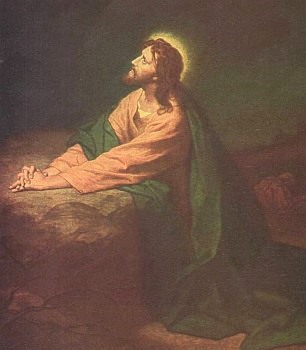
praying the same prayer more than once, using the same words, in the
Garden of Gethsemani? Are the angels in Heaven wrong for singing the
Sanctus ("Holy, Holy, Holy") all day and night, without ceasing? Was
God making a big mistake when He told Israel to pray the sh'ma all
throughout the day? Are reading the Psalms a waste of time? Have
Israelite, early Christian (Catholic), and modern Jewish, Catholic
and Orthodox liturgists been praying "vainly" for all these millennia,
only to be set straight in the past hundred or so years by sola
scriptura Protestants? Is it wrong to sing hymns that have been sung,
verbatim, before?
Or could some Protestants be simply wrong about what Catholics do when
praying formal prayers? What is the context of Matthew 6:7 as seen
below?
| Matthew 6:1-18 |
|
1
|
Take heed that ye do not
your alms before men, to be seen of
them: otherwise ye have no reward of your Father which is in heaven.
|
|
2
|
Therefore when thou doest
thine alms, do not sound a trumpet
before thee, as the hypocrites do in the synagogues and in the streets,
that they may have glory of men. Verily I say unto you, They have their
reward.
|
|
3
|
But when thou doest alms,
let not thy left hand know what thy
right hand doeth:
|
|
4
|
That thine alms may be in
secret: and thy Father which seeth
in secret himself shall reward thee openly.
|
|
5
|
And when thou prayest, thou
shalt not be as the hypocrites
are: for they love to pray standing in the synagogues and in the
corners of the streets, that they may be seen of men. Verily I say unto
you, They have their reward.
|
|
6
|
But thou, when thou
prayest, enter into thy closet, and when
thou hast shut thy door, pray to thy Father which is in secret; and thy
Father which seeth in secret shall reward thee openly.
|
|
7
|
But when ye pray, use not
vain repetitions, as the heathen
do: for they think that they shall be heard for their much speaking.
|
|
8
|
Be not ye therefore like
unto them: for your Father knoweth
what things ye have need of, before ye ask him.
|
|
9
|
After this manner therefore
pray ye [Luke 11:2 reads: "And he
said unto them, When ye pray, say, Our Father..."]: Our Father which
art in heaven, Hallowed be thy name.
|
|
10
|
Thy
kingdom come, Thy will be done in earth, as it is in heaven. |
|
11
|
Give
us this day our daily bread. |
|
12
|
And
forgive us our debts, as we forgive our debtors. |
|
13
|
And lead us not into
temptation, but deliver us from evil:
For thine is the kingdom, and the power, and the glory, for ever. Amen.
|
|
14
|
For if ye forgive men their
trespasses, your heavenly Father
will also forgive you:
|
| 15 |
But if ye forgive not men
their trespasses, neither will your
Father forgive your trespasses.
|
|
16
|
Moreover when ye fast, be
not, as the hypocrites, of a sad
countenance: for they disfigure their faces, that they may appear unto
men to fast. Verily I say unto you, They have their reward.
|
|
17
|
But thou, when thou
fastest, anoint thine head, and wash thy
face;
|
|
18
|
That thou appear not unto
men to fast, but unto thy Father
which is in secret: and thy Father, which seeth in secret, shall reward
thee openly.
|
Good Sociological and Psychological Reasons for Formal Prayer
Aside from the
liturgical imperative of formalized prayer as rooted in Old Testament
liturgy, memorized prayers are a common language and heritage that help
cement group identity and allow us to worship God corporately. It must
always be remembered that Christianity is the Old Testament religion
fulfilled, not some radical departure that amounts to spiritual
anarchy. As far away as Talmudism -- modern Judaism -- is from the Old
Testament religion, one need only look at modern religious Jewish
practice to get a sense of how formal prayer fit into the ancient
synagogues and daily Jewish life. And one need only look at the Jews
Matthew, Mark, John, Peter, Paul, etc., and the rest of the Church of
the first few centuries, to understand how it is to fit into our modern
liturgy and daily Christian life. We are to pray -- formally and
spontaneously -- at all times without ceasing. Our lives are to be a
prayer.
Another benefit of formal prayer is its value in times of crisis. When
your world falls apart, when you find yourself otherwise speechless
with pain or shock or fear, words of prayer memorized in childhood come
to the mind and lips almost as if by instinct. I know a man who was on
the USS Liberty when she was torpedoed and strafed for almost two hours
in 1967 off the coast of Gaza. He told me that some of the the men of
that ship gathered on deck to pray the "Our Father." Charlotte Corday
prayed the Rosary just before she was guillotined during the French
Revolution, and I can only imagine how glad those on the Titanic were
to have memorized the Act of Contrition as Father Byles bravely heard
last Confessions just before that ship went down. What a calming thing
for them to have had the Rosary to pray together! The short prayers we
call "ejaculations" -- e.g. "My Jesus, mercy!", "Blessed be God!",
"Lord Jesus Christ, Son of God, have mercy on me, a sinner" -- are
brief words that act as a "touchstone" in helping to re-focus one's
attention toward the Holy during life's darker moments.
Formal prayers can be thought of, too, as the "phonics" of prayer life.
Just as one learns to read by memorizing the sounds of letters,
diphthongs, and digraphs, one learns to pray by learning the great
prayers of those who've gone before us. They are templates which also
act to catechize; the child who learns the Glory Be 2 learns something about the
nature of the
Trinity. The child whose parents teach him the Prayer to Guardian Angel
not only learns of God's protecting angelic emissaries, but of God's
goodness itself -- and he falls asleep safe in that knowledge 3.
Some final thoughts on this topic, gotten off from an
Evangelical-Lutheran website 4:
Could it be
that such scorn [for formalized prayer] is actually an aversion to the
very idea that one must direct his attention to words other than his
own? One who puffs, Why say this again? is in essence complaining that
his mind wants something new to receive, something else. Is this the
creative part of the mind, then? For to create something is to
experience something new, something completely else. Without
disparaging creativity altogether—for there is surely a season for
everything— it can hardly be denied that creating one's own words or
thoughts is necessarily opposed to receiving someone else's words or
thoughts. Therefore when the matter at hand is the Word of God and the
importance and command of Christ to meditate thereon (Search the
Scriptures, John 5:39), creativity is quite out of place. We might even
suggest that it was this mischievous desire for creativity that led to
consumption of the forbidden fruit in Eden (as if to say, "We want
something new!" )...
...It is, in short, disobedience to the Sabbath commandment, with its
attendant implication that we gladly hear and learn the Word of God.
Now we can get at the reason the employment of rote ritual in worship
is a point in its favor, even in connection with the wandering of
minds. In addition to the dominical command, rote repetition is a great
divider: it helps to separate the sheep from the goats. The fact that
rote ritual is the bane of some and the blessing of others is not
unrelated to the fact that rote ritual results in the wandering of
minds. For in the first place, when the mind of the contemptuous
wanders, it will produce the closing of his mind; conversely, when the
mind of the diligent wanders, this will produce a self-chiding, and
hence a greater desire to concentrate. In fact, such a one who puts
forth the consequent effort to concentrate will quickly find that he
has no difficulty doing so, by virtue of the fact that much rote
repetition is going on, and he already knows what to expect.
This whole process is not unlike the reason Jesus gave for preaching in
parables:
Because they
seeing see not; and hearing they hear not, neither do they understand .
. . For this people's heart is waxed gross, and their ears are dull of
hearing, and their eyes they have closed; lest at any time they should
see with their eyes, and hear with their ears, and should understand
with their heart, and should be converted, and I should heal them.
(Matthew 13:14-15)
Why did Jesus
preach in parables, if He knew that some people were already dull of
hearing? His approach contains both grace and judgment: grace for those
who do hear, and implicit judgment against others who refuse, as if He
would say, This message is not for you, then. So His parables served as
a beginning of the separation of the faithful from the hypocrites. For
it was only those who asked, What does this mean? who were told.
So also does rote repetition serve to separate the faithful from the
hypocrites, and in a way to expose the hypocrisy of the latter:
Footnotes:
1 Some anti-liturgical
types who
accuse Catholics of praying in "vain repetitions" are also those likely
to pray like this: "Father God, we just ask You, Father God, to bless
this food to our bodies [whatever that means], Father God. And, Father
God, please watch over Susie, Father God. She's experiencing bad health
right now, Father God, and we just ask, Father God, that you send Your
Spirit to heal and guide her through these hard times, Father God. We
lift her up [to where?], Father God, and claim, in Jesus' name, Your
healing power, Father God. And, Father God, we just thank You, Father
God, for all You've given us, Father God, and..." well, you get the
idea. Some tend to pray "spontaneously" and "in their own words" by
using King James style English, calling God "Thee" and using words like
"unto" and such. And some, instead of wrapping up a prayer in the usual
way, are likely to end with "Amen and Amen," repeating (gasp!)
that concluding "so be it." And how many millions of copies of the
book, "The Prayer of Jabez," were sold to Protestant Christians -- the
book containing a prayer that is to be prayed every day for 30 days to
force the vending-machine god to hand out the material goods? The Jabez
prayer reads, "Oh that thou wouldest bless me indeed, and enlarge my
coast, and that thine hand might be with me, and that thou wouldest
keep me from evil, that it may not grieve me!" While the Bible states
that Jabez was "more honorable" than his brethren, the prayer itself,
barring the context of Jabez's life and personality (about which very
little is said) and as it's presented to Protestants as a "good
luck charm" to acquire material wealth/health/etc., shows a
distinct lack of humilty and a "my will be done" attitude. For this
prayer to be singled out as "the most spiritual prayer of the Bible" is
disconcerting, to say the very least.
2 The Glory Be
Prayer: "Glory be to the Father, and to the Son, and to the Holy
Spirit, as it was in the beginning, is now, and ever shall be, world
without end. Amen."
3 Prayer to
Guardian Angel: "Angel of God, my guardian dear, to whom His love
commits me here, ever this night be at my side, to light and guard, to
rule and guide. Amen."
4
http://www.gottesdienst.org/
|
|