``Where
the Bishop is, there let the multitude of believers be;
even as where Jesus is, there is the Catholic Church'' Ignatius of
Antioch, 1st c. A.D
Feast of St. Rose of Viterbo
Viterbo is a
medieval walled city situated about 42 miles northwest of Rome as the
crow
flies. That part of what is now Italy was, in the early 13th century,
part of the papal states -- an area of land with ever-changing
boundaries, under the control of the Pope. The papal states would
become a source of contention when the Holy Roman Emperor Frederick II
-- a very nasty man1 -- was on the throne, and Innocent IV
was the Pope. Frederick wanted a huge, unified state consisting of the
Italian peninsula and Sicily, with the papal states subsumed into it.
Those who were for this move and who supported Frederick were known as
the Ghibellines; those who were against it and who supported the Pope
were known as the Guelphs.
It was into this scene that St. Rose of Viterbo was born in 1233. 21st century
examination of her relics showed that she suffered from a
birth defect called Pentalogy of Cantrell, a very rare condition that
entails some degree of five different abnormalities: ectopia cordis
(the heart
is out of place -- sometimes fully outside the thorax); deformations or
complete absence of
the sternum (the "breastbone"); heart deformations (often Tetralogy of
Fallot); deformation of the pericardum (the sac around
the heart), and an omphalocele (abdominal organs protrude through
defects of the abdominal wall). I don't know the degree to which this
condition affected
her aside from knowing she lacked a sternum, but Pentalogy of Cantrell
can cause fatigue, weakness, breathlessness, irregular heart
rhythms, cyanosis, and chronic discomfort, so she likely felt
rather
sickly.
Her parents were poor and pious, and she grew up to be pious as well --
given to penance, serving the poor, and prayer -- above all, prayer for
the conversion of sinners.
In June of 1250, when she was 17 years old, she became so ill that she
was close to death. On the eve of the Feast of St. John the Baptist
the Blessed Virgin came to her in a dream or vision and told her to
take the habit as a Third Order Franciscan. She miraculously revived
the next day, and then prostrated herself before her mother, renounced
wordly goods, and begged permission to do as the Virgin asked. She
begged her mother to call on a woman named Donna Sita, likely a leader
of the local community of penitents, to accept her into their
community,
cut her hair, and give her a habit to wear. Her mother agreed, and then
Rose donned the habit, held up a crucifix, and made a public
penitential procession by walking from a church called San Giovanni in
Zoccoli (St John in Sandals) to the church of Santa Maria in Poggio (St
Mary on the Hill), both in Viterbo.
Later, stricken with illness again, she asked her mother for mint
to help relieve discomfort in her chest. Her mother gave it to her, but
soon Rose gave it back, telling her mother that Jesus not only blessed
the mint, but He also blessed the walls of the house which, she said,
would remain in her monastery.2
Rose spent time in the streets, preaching penance, and gathering crowds
because of her reputation as a prophetess. And when the powers that be
in Viterbo sided with the Ghibelines against the Guelphs, she started
preaching to promote the Pope's cause. This angered the mayor of the
town, who then exiled her and her family. They left for Soriano nel
Cimino, a town about 20 miles to the east of Viterbo, but they weren't
exiled for long; they arrived there on December 5, 1250, and on that
same day Rose prophesied the imminent death of Frederick II; he died a
few days
later, on December 13. The family then made their way back home, but
first paid a visit to Vitorchiano, a little town about 4 miles
northeast of Viterbo, a place that had been under the influence of
sorcery and fallen into great evil. Rose preached to and brought about
mass conversions there -- including the conversion of the sorceress who
started all the problems, and
she did so in a miraculous way: she stood for 3 hours in a burning
pyre, totally unscathed, preaching repentance. Other
miracles are said to have taken place in that town as well, including
the healing of the eyes of a girl who'd been blind since birth.
Once back in Viterbo, she tried to enter a proper monastery -- that of
the Poor Clares -- but was refused because she lacked a dowry. She
prophesied, though, that her body would be taken there after her death,
which came very soon, on March 6, 1251. She was buried in the church of
Santa Maria in Poggio, and very quickly the cult that had built up
around her in life grew even more, and more miracles followed. In 1258,
she appeared
in a vision to Pope Alexander IV -- who was living in Viterbo at the
time -- and he made the decision to move her relics -- with great
ceremony
on September 4 of that same year -- to the monastery she'd tried to
enter. That monastery was re-named for her -- and it came to
incorporate the house in which she lived, the house which she said
Jesus blessed for her to use as a monastery.
She was canonized in 1457, and her feast is on September 4. She is the
patron Saint of Viterbo, Italy; people in exile; members of Third
Orders; and people who've been rejected by religious orders. She is
shown
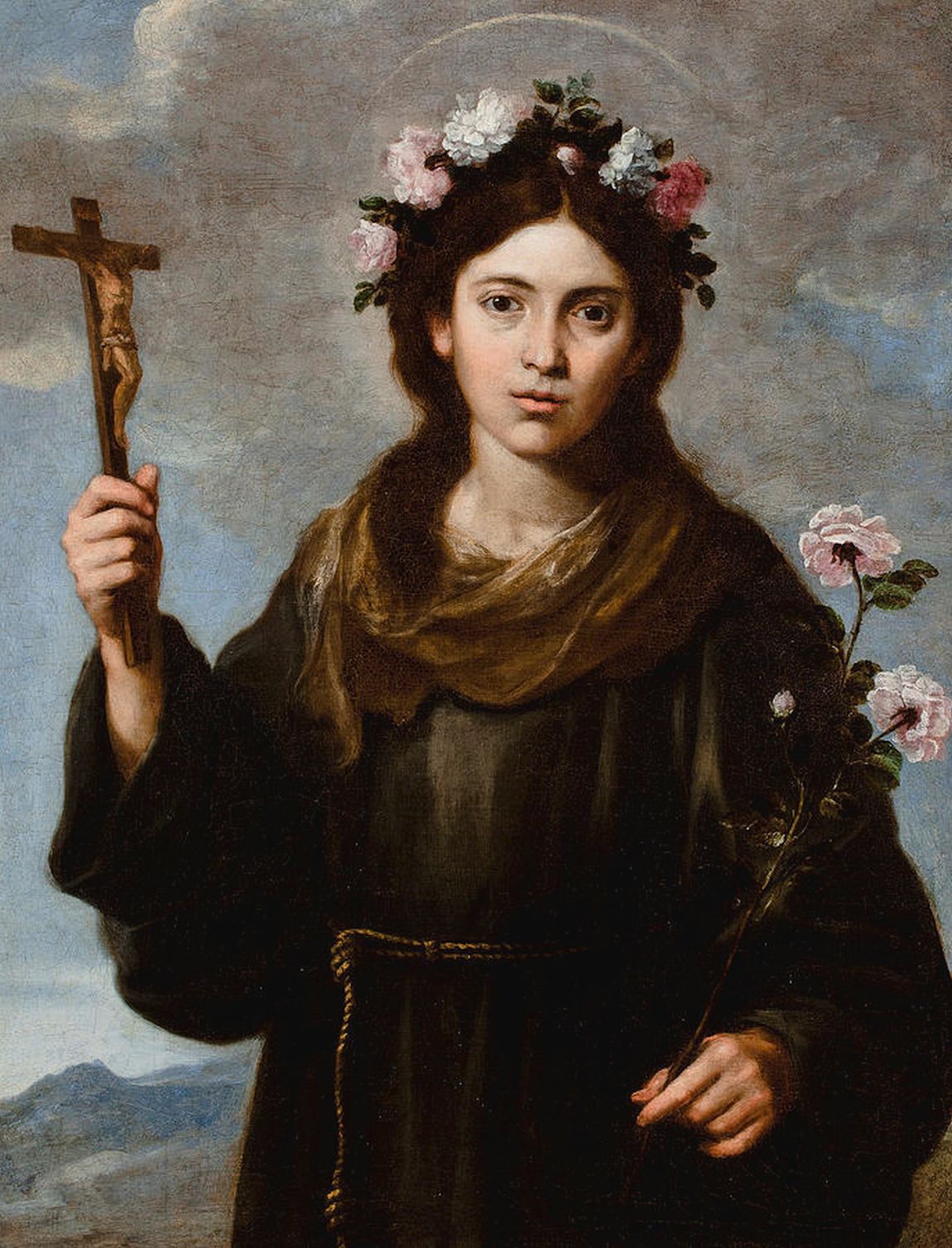
in art as a young woman in a Franciscan habit, holding a crucifix, with
a wreath of roses on
her head (compare with St. Rose of Lima
and St. Rosalia). Note that a story is
told about St. Rose that is likely
actually a story from St.
Elizabeth of Hungary's life -- a misunderstanding probably rooted
in the rose imagery associated with both Saints. It is said that when
Rose was young, she went to give bread to the poor, but was stopped by
her father for whatever reason. But when she opened her apron, roses
tumbled out instead of the bread she'd hidden there. Because of this
story, you might see St. Rose depicted as St. Elizabeth of Hungary
often is -- with an apron full of roses. Good has come from this
probable mistake, though; in Viterbo, a group called Dalle Rose al Pane -- From Roses to
Bread -- feeds the hungry, all inspired by the very real charity of St.
Rose.
Then again, maybe the story is true as is. Like miracles can happen
more than once!
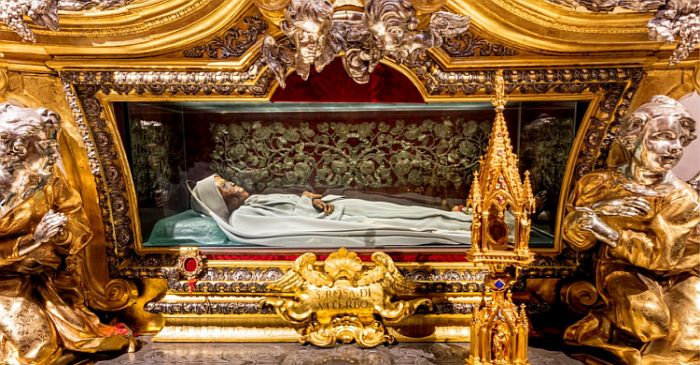
St. Rose's mummified relics may be venerated at the Santuário de Santa
Rosa in Viterbo, Italy.
Customs
Some may prepare for this feast by praying the Novena to St. Rose of Viterbo
beginning on August 26 and ending on the eve of her feast. For the day
itself, this prayer is a good one:
In the name of
the Father, and of the Son, and of the Holy Ghost. Amen.
O glorious Saint Rose of Viterbo, young flame of faith, I
turn to you with a humble and trusting heart. You, who in your tender
age demonstrated a spiritual strength capable of enlightening many
hearts, hear my prayer today.
Saint Rose, example of purity, courage, and love for God,
teach me to live with the same simplicity and ardour that guided your
life. You who did not fear difficulties, misunderstandings, and trials,
help me to remain steadfast in faith when the path becomes difficult
and my heart feels lost. Intercede for me with the Lord so that my soul
may be filled with peace, my mind with wisdom, and my spirit with
perseverance. Pray that I receive the grace to recognize God's will in
the small things of daily life and to welcome it with trust and
gratitude.
O Saint Rose, who devoted every breath to the praise of the
Lord and the defense of truth, guide my steps so that I may perform
works of goodness, sow hope where there is discouragement, and bring
light where darkness reigns. May my words be kind, my actions just, and
my heart open to love. Protect my family, support those who suffer,
console the lonely, and strengthen those who falter in faith. Pray for
us to receive the grace of a life lived in charity, patience, and trust
in the Lord.
O Saint Rose of Viterbo, humble servant of God and shining
witness of the Gospel, accompany my journey and bring me ever closer to
the heart of Christ. Amen.
Spectacular things happen in Viterbo, Italy centered on her September 4
feast.
Everything begins with a novena, of course, ten days beforehand. The
town is decorated with roses and the color pink, and on September 2,
the young people of Viterbo -- called Boccioli
("Buds") dressed in red and blue and representing St. Rose's youth --
lead a procession
through the city. They are followed by the Rosines -- young women representing
St. Rose, wearing gray and purple habits and carrying baskets of roses
and candles as gifts from the city to the Poor Clare community. A
solemn procession is made with the heart of St. Rose through the
streets of Viterbo, beginning at the Santuário
de Santa Rosa (where her house also is) and ending
at the city's cathedral, which is dedicated to St. Lawrence. The
procession is accompanied by 310 citizens dressed in clothing that
represents the various historical
phases of the city from A.D. 1200 to 1800.
The next day, on September 3 at 9:00 at night, the translation of St.
Rose's relics from their original burial spot to the monastery is
commemorated by the carrying of
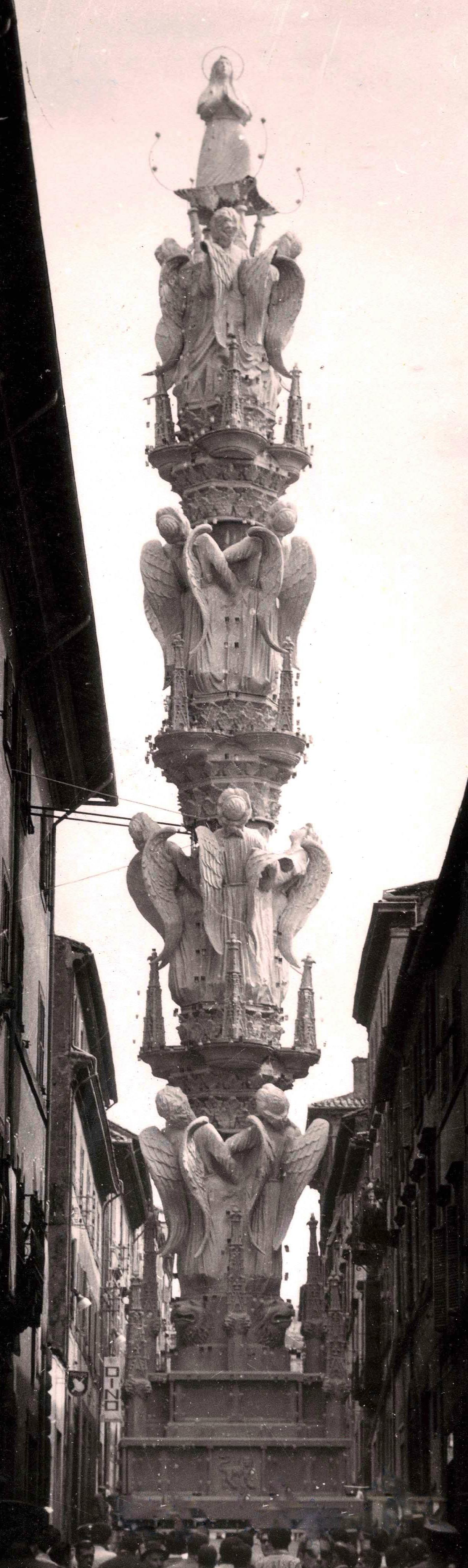
an extremely tall tower called la
macchina. When this tradition began the year after her relics
were moved, it consisted the carrying of a simple statue of St. Rose in
procession. Over the years, though, various aspects were added -- a
canopy, a wagon, etc., until now we have a huge tower that is 92 feet
tall, weighs 11,000 pounds -- i.e., 5 1/2 tons -- and is covered with
candles and lights. First, the town turns off all of its lights, then la macchina is lit up and carried
about
3/4 of a mile, from the Piazza San Sisto to the Santuário de Santa
Rosa, with five stops along the way, and the people watching yelling "Evviva Santa Rosa!" La macchina will remain by the
sanctuary for a few days.
La Macchina in 1967. Click to enlarge
The 100 or so men who carry la
macchina are known as i
facchini and
they dress in white shirts and trousers, with white scarves on their
heads, and red sashes around their waists.
These men -- the Knights of Santa Rosa -- belong to the Sodalizio dei Facchini di Santa Rosa
(Sodality of Porters of Saint Rosa) , and they have to try out every
year in order to become -- or remain -- a part of the group. Among the
criteria they must meet is the ability to carry 330 pounds on their
shoulders for almost 300 feet. They have their own song to keep
themselves in
good spirits and livelied-up: the "March of the Facchini of Santa Rosa":
A huge
competition is held every five years or so to to re-design la macchina. Architects, engineers,
and artists of all sorts, even film directors (e.g., Franco
Zeffirelli), submit their plans, and one is chosen. The appearance of la macchina over the years has
varied
from
Baroque church tower to a great triple helix. So special and unique is
the tradition of the La Macchina di
Santa Rosa that it has been included in the
UNESCO List of Intangible Cultural Heritage of Humanity since December
2013.
There are, of course, other songs pertaining to the feast of St. Rose
of Viterbo, aside from the song of the facchini.
Here is a more straightforward song sung by Fred Borzacchini:
As to special foods for this feast, the people of Viterbo eat la pagnotella di Santa Rosa today -- a bread made
with hazelnuts, chocolate,
and cinnamon. But, alas, I don't have any recipes for you.
Whatever you may do to celebrate the Feast of St. Rose of Viterbo in
your home, one good use of the day is to really think about how well
you spread and defend the Faith.
Consider St. Rose, a sickly girl, out in the streets preaching to bring
people to repentance, preaching to defend the papacy against secular
onlsaughts! Do you do the same in a manner consistent with your
vocation? When people on social media spread untruths or outright lies
about what the Catholic Church teaches, do you take the time to set
them straight, to at least post a link to accurate information? Or do
you let it slide and say nothing? Note that when on social media, there
may be hundreds of people reading over your shoulder; if you're dealing
with an incalcitrant type who refuses the Truth, consider those
hundreds who may well be listening!