``Where
the Bishop is, there let the multitude of believers be;
even as where Jesus is, there is the Catholic Church'' Ignatius of
Antioch, 1st c. A.D
Feast of St. Rose of Lima
In 1535,
Francisco Pizarro and his New World Indian allies finished their
years-long
conquest of the Incas in South America, and the Viceroyalty of Peru was
established, with Lima -- then known as La Ciudad de los Reyes (The City of
Kings) as its capital. A mere 51 years later, on April 20, 1586, Isabel
Flores de Oliva was born there to Spanish parents, Gaspar and María de
Oliva Flores.
Isabel was an uncommonly beautiful baby -- so beautiful that, as the
story goes,
...when little
Isabel was about three months old her mother and several women friends
were watching the infant as it lay quiet in the cradle, being
unaccountably attracted, and at the same time filled with a strange
awe, by some wonderfully beautiful expression on the baby face.
Suddenly a lovely and mysterious rose appeared to their wondering eyes,
floating up above the child's head. It descended with a gentle movement
to the cot, seemed to touch the little one's cheek as with a caress,
and disappeared. The mother -- so say the biographers -- caught the
child rapturously into her arms, and fervently protested that she would
henceforth consider her as a gift from heaven, and would call her, and
let her be called, by no other name than that of 'Rose.' 1
So, from then on, she was "Rose" -- Rosa in her native land. And in
Rose's case, her physical
beauty acted as a sign of inner beauty; her pious nature was evident
even when she was a toddler. She'd often
be found in her mother's room, gazing at a picture of Christ crowned
with thorns -- and she had an amazingly precocious equanimity in the
face of suffering: once, when she was only 3 years old, she got her
finger severely pinched in a cupboard door. Her mother saw what had
happened and ran to her, but Rose not only didn't scream or carry on,
she hid her finger so her mother wouldn't be alarmed. An abscess
developed, and a surgeon had to be called to remove the nail of the
injured finger. She endured the process without even a whimper. And
again when she was 3, she suffered from another abscess, this time
behind her ear. It was operated on, and the pain was so great that she
was shaking as she was lying in her bed recovering. But when asked if
it hurt, she told her mother "only a little" in order to spare her
mother's worries. As she was prone to illness, she demonstrated this
sort of fortitude all throughout her childhood.
One of eleven children, she was in many way normal in her play with her
siblings. But in other ways, she was like no one else. Always drawn to
Christ in His Passion, she would find ways to emulate Him and unite
herself to His suffering -- for ex., she asked her family's
Peruvian servant, Marianne, to place a load of heavy wood on her
shoulders so she could feel what Christ felt as He carried His Cross.
She even asked Marianne to push and kick her so she could feel what the
Lord felt as He was being humiliated in the hours before His
Crucifixion. She gave up eating meat, and even fruit, something she
loved, giving it all away to her brothers and sisters. This sacrifice
turned into an even deeper mortification when, on Wednesdays, Fridays,
and Saturdays, she ate nothing but bread and water -- after sunset.
God rewarded her devotion in interesting ways. When she was 4 1/2 years
old, her impatient, fiery-tempered mother tried to teach her how to
read, but wasn't successful at it, so gave up. But one day Rose came to
her with a book and read aloud to her from it -- and showed her a piece
of paper on which she'd written. Her mother was dumbfounded, but Rose
explained that she asked God to teach her to read and write, and He
did. This is the same way that St. Catherine of Siena, whom Rose
adopted as her patron, learned to read and write.
As she grew, she became very aware of people's reactions to her beauty,
and it bothered her greatly -- so much so that she cut her hair
short and even
began to question the idea of being called "Rose" because of her
nickname's origin. She took the problem to Our Lady, visiting the
Rosary Chapel in the church of St. Dominic and asking the Blessed
Virgin
what to do. The statue she knelt before seemed to come to life, and the
Virgin said, "Your name is infinitely pleasing to the Son I bear in my
arms; but henceforth you must add mine to it, and be called Rose of St.
Mary. Your name is to be a fragrant flower, consecrated to Jesus of
Nazareth."
Consecrated
to Jesus of Nazareth: her vocation was set.
Her mother, though, was anxious to introduce her around when she became
of age, wanting to find her a spouse. But Rose found a way to obey her
mother and mortify her flesh at the same time: she'd put on the pretty
dress or accessory her mother wanted her to wear -- but would do things
like hide a pin in it so it would pierce her skin as she wore it. The
more she grew into her vocation, though, the less she wanted to comply
with her mother's attempts to get her to socialize. She put an end to
it once and for all by rubbing pepper over her eyelids until
they burned and looked red and swollen so her physical beauty wouldn't
be obvious.
Her mother caved and let Rose wear what she wanted to wear. But that
didn't stop the marriage proposals, including one from a wealthy woman
who thought Rose would be a good wife for her son. Rose's parents and
siblings very much wanted this marriage to happen, but Rose refused and
finally revealed to her family that she was consecrated to Jesus,
something they hadn't known before. They finally relented and stopped
bothering her about getting married. She was now free to live her life
as she believed Jesus wanted.
One of the things she was intent on doing was helping her family as
much as she could. To this end, she engaged in embroidery, becoming
very quick and expert at the craft. She also devoted herself to
gardening, and was so good and blessed at it that she was able to grow
flowers out of their season -- flowers that were then taken as cut
flowers to be sold to support her family.
Above all, though, she increased the mortifications of her flesh,
engaging in penances to a degree many find shocking. Under her veil,
she wore a crown
of thorns made of pewter and nails, and wore a
horse hair shirt over her body. She donned a cilice -- a spiked chain
-- around her waist and locked it, tossing the key down the well in her
garden so she could never remove it. She scourged herself. She slept --
for
only two hours a night -- on a bed of broken pottery shards. When she
felt tired, she'd bind up what was left of her hair and fasten it to a
nail in the wall to prevent herself from falling asleep. She
increased her fasting.
And she made a decision as to which religious
order to align herself with. She wanted to become a Dominican nun, but
there was no Dominican convent in Lima at the time, so she weighed her
options, finally deciding to enter the Convent of the
Incarnation. But when she went with her brother to the Church of St.
Dominic for what she thought was the last time before becoming a
postulant, she knelt down in prayer -- and found she was "glued" to the
spot, unable to rise again, not even with the help of her brother. Then
she knew immediately that, instead of entering a convent, she was meant
to carry out her vocation at
home, as a Third Order Dominican, in the same way St. Catherine of
Siena
had. She was given further confirmation of this while walking home: a
black and white
butterfly kept flying around her with great persistence. With white and
black being the colors of the Dominican habit, she took this as a sign
that becoming a Dominican was the path she was meant to take.
So, in 1606, when she was 20 years old, she took the veil, becoming a
Third Order Dominican and consecrated virgin.
Her reputation for holiness, though, got in the way of her ability to
isolate herself and pray. People would come around to visit so often
that she got the idea of building a sort of shed in the garden in which
she could spend her days. Her mother hated the idea, so Rose went to
the Church of St. Dominic to pray about it. Once again she asked for a
sign and got one: earlier on, she'd given a coral Rosary to the church
sacristan and asked him to climb up high so he could reach the statue
of the Virgin and leave the Rosary around her neck. When she got to the
church this day, the Rosary was no longer around Mary's neck, but
hanging from the hand of the Son she held. Rose took this to mean that
her plans to live more secluded pleased God.
So, likely with the help of her brother, she built in her
family's garden a tiny "hermitage" -- a brick shed-like structure only
about 5-feet long and 4-feet wide and 6 1/2 feet tall. It had one
window, a large crucifix on one
wall, and a door so low one had to almost crawl to
enter. She slept in the family house, but spent her days in her
hermitage, and there, she did her needlework, prepared flowers for
sale,
and, above
all, prayed the Divine Office and practiced her mortifications.
She
would venture out, though, to go to church (it
was
frowned upon for women to be in the streets alone, so she could only go
to church when her mother accompanied her) and help those in need. She
also helped a local
confraternity that arranged everything needed for processions of a
statue of St. Catherine of Siena which took place three times a year;
Rose would sew beautiful garments for Catherine's statue, and
make floral arrangements to decorate it. She could also often be found
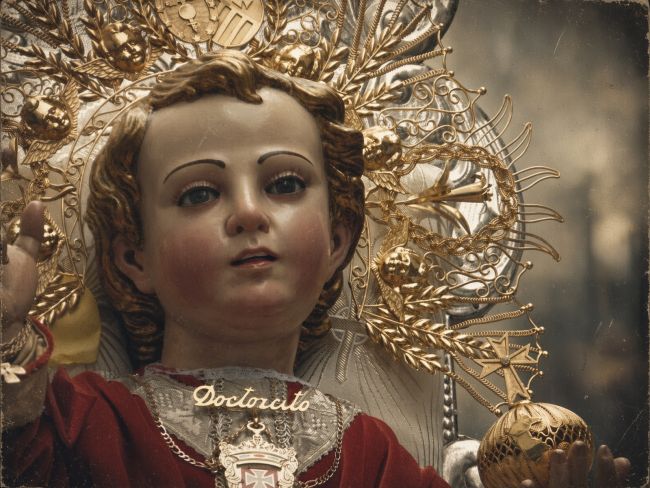
caring for the sick, bringing with her an image of the Christ Child, Whom she referred to as El Doctorcito -- "The Little
Doctor" -- and keeping it close to the ailing. When her devotion to
nursing grew even more, she convinced her mother to allow her to use a
room of the family house as an infirmary for her patients while
they convalesced.
She had special devotions of her very own. There were her "Angelic Exercises": she asked a
priest to write for her a list of 150 attributes of God. Then she added
a gloria after every ten, and prayed them often, telling the priest
that the litany made demons tremble and flee. In accord with her girly
nature and her work to help bring about the St. Catherine of Siena
processions, she had
another devotion she called "Spiritual Dress,"
a way of honoring the Blessed Virgin with "spiritual garments," which
she described like this:
Memorandum about
a dress, that I, Rose of Santa Maria, unworthy slave of the Queen of
Angels, Virgin and Mother of God, began to make with the favor and help
of our Lord. The interior tunic must be made of six hundred Avemarias,
six hundred Salves, and fifteen days of fasting: in reverence of the
most holy joy that she received when the Angel announced to her that
the Eternal Word would be made incarnate in her divine womb and heart.
The cloth from which this dress is made, must be sewn from
six hundred Avemarias, six hundred Salves, fifteen Rosaries, and
fifteen days of fasting: in reverence of the most holy joy that she
received when she went to visit her cousin Saint Elizabeth.
The trimming and embroidery of this dress must be made of six
hundred Avemarias, six hundred Salves, and fifteen days of fasting: in
reverence of the most holy joy that she received when she gave birth to
her Most Holy Son, my Lord Jesus Christ.
The jewels that must be sprinkled across this dress will be
six hundred Avemarias, six hundred Salves, and fifteen days of fasting:
in reverence of the most holy joy that she felt when she presented her
most blessed Son in the temple.
The necklace that is to be worn will be made of six hundred
Avemarias, six hundred Salves, and fifteen days of fasting: in
reverence of the most holy joy that she felt when she found her most
blessed Son debating with the doctors in the temple.
The bouquet that she is to hold in her most holy hands, must
be made of thirty-three Paternosters, many Avemarias with their Gloria
Patris, so many Salves, many other Rosaries of thanksgiving to God, as
well as other Rosaries of praises to the Virgin: in reverence of the
most holy age of my Lord Jesus Christ.And this dress is finished,
blessed be God. May His Most Holy Mother, through her great piety, make
up for my faults and pardon my boldness; ‘laus tibi Christe’.
Many aspects of her life were in some ways idyllic. Stories are told
about how, though
her garden was thick with mosquitoes, they not only wouldn't bother
her, but would join her in "singing" the Office, buzzing away as if in
choir. In addition to mosquitoes,
[a]nother and
more attractive class of the animal creation also played a great part
in St. Rose's life -- namely, birds. Their song had a peculiar
fascination for her; and they are said often to have sent her into a
rapture, so strongly did they fill her with the thought of God's
goodness. She sould often call upon them, as well as the insects, to
join her in singing His praises. Concerning this point, and apropos of
her intercourse with nature generally, such a charming description is
given in De Bussier's 'Life' of the holy maid in her mother's garden,
that we cannot do better than conclude this chapter by giving it word
for word: 'When, at sunrise, she crossed the garden to get to her
hermitage, she would call upon all Nature to glorify the Maker of all
things with her. Then might the trees be seen bowing over her path,
shaking off the dewdrops, and rustling their leaves so as to send forth
harmonious sounds. Then would the flowers sway gracefully on their
stalks, half opening their petals to give out their sweetest gragrance,
and so in their own way celebrate the praises of God. And with this the
birds began to sing their songs, and came to perch on Rose's hands and
shoulders, the insects greeted her with their joyful hum -- all things,
in short, with life or motion joined in concert with the early praises
she offered to her Lord. She had reconquered the sovereignty of man
over creation that belonged to our first father before his fall.2
And she sang almost constantly, asking God's creatures to join in, such
as with this
hymn which whe wrote to sing to and with a little bird:
Yearning voice,
compose
a hymn with united cadence
that consecrates to the Redeemer
our humble praise.
You exalt your Creator,
I, my Redeemer,
and may God be reverenced
in our two-part acclamation.
Open your beak, and together
let us give a sweet song
with tender voices, soft cadences,
interwoven harmonies.
O my God, if I loved you!
Oh, if I loved you, My God,
and loving you, I remained,
burning in flames of love.
How can I love you, Lord,
since I am only a creature
and you are my Lord?
The little bird leaves me,
the swift singer flees,
but my sweet Redeemer
is always with me.3
Not all in her life was so lovely, however. There were ferocious
demonic attacks such as many great Saints endured. There were dark
nights of the soul. And one day, a group of Dutch pirates arrived in
Lima. Because they
were expected to plunder the churches, Rose ran to her church and stood
in front of the tabernacle, ready to give her life to defend the Body
of Christ. Accounts differ as to whether the pirates entered the
church, saw Rose, and left because she and the Host were surrounded by
a glorious light -- or whether the attackers were repelled before
making their way to the church. In either case, thankfully, martyrdom
was obviated.
She persevered, though, and God kept rewarding her in spectacular ways
-- with ecstasies,
the gifts of prophecy and of reading souls, and frequent, often daily,
visions -- even of Christ Himself (usually as the Divine Child) and of
His blessed mother. Her guardian angel
was visible to her, and she would be visited by various Saints --
including St. Catherine of Siena,
the saint whom, after the Blessed Virgin, she emulated and loved the
most (these visits were sometimes visible to others, especially
children). There were the strange "little" miracles
that occurred, too, such as the time she was talking to her brother
about her
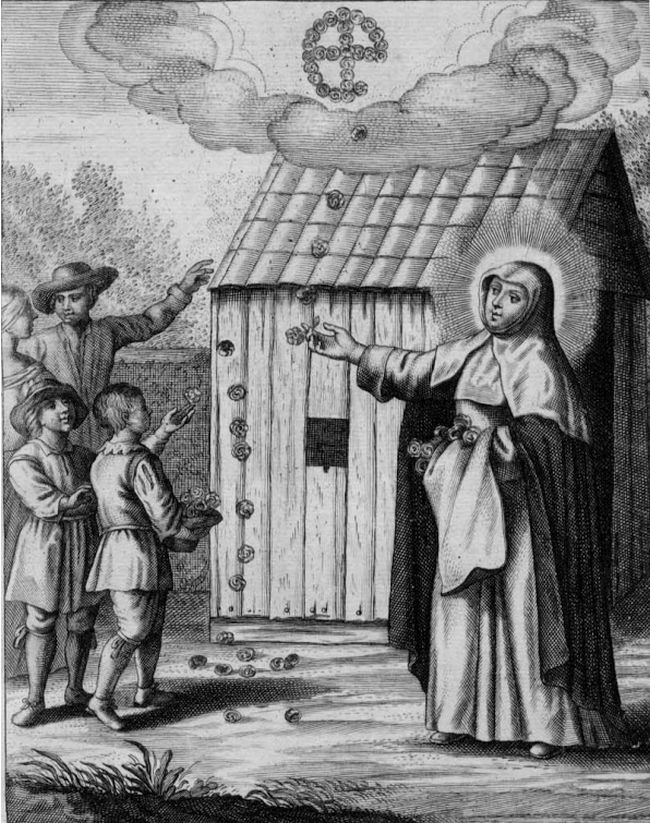
dream of starting a new convent and was tossing roses into the air. The
roses didn't drop back to the earth, but hung there and formed
themselves into the shape of a Cross. She told him the roses symbolized
the virgins that would populate the convent she dreamed of (this
convent wouldn't be built in her lifetime, but would come about after
her death). Or the miracle of the lemon tree in which the devil cursed
a lemon tree in her garden because he was angry at her unwillingness to
give in to his temptations. The tree withered and died -- but Rose
prayed over it, bringing it back to life by the power of God.
And there were the larger miracles, such as when some of the native
Peruvians fell back into paganism and began acting out violently
against the Spanish. A priest was sent to preach to them, but seemed to
only make matters worse. Then St. Rose went inside her hermitage and
engaged in intense mortifications that left her bloody and weak,
begging God for their souls all the while. That night, there was a rush
to the confessionals of those who'd gone astray.
Her greatest reward, though, was her mystic marriage to Christ, akin to
that entered into by St. Catherine of Siena. On Palm Sunday, she was at
Mass, but wasn't given a palm. Feeling as if she'd done something
wrong, she went to Our Lady and prayed. She told the Virgin she didn't
want a palm from men, but a palm from her Son. The Virgin looked toward
Jesus, Who then said to Rose, "Rose of my heart, be My spouse." Rose
replied, "I do desire it, Lord." She then asked her brother to make her
a ring, and her brother did so -- inscribing it with the very words
Christ had spoken, all without having had those words related to him by
Rose. The ring was kept in the tabernacle until the wedding day --
Easter Sunday. Then, according to Doña Maria de Uzátegui, a witness
during Rose's canonization process,
They would go to
the early Mass on Easter Sunday. And this witness did so. In this way,
this witness and the blessed Rose went to communion at the Mass said by
the superior, Fray Alonso Velazquez, who had put the ring underneath
the corporals. After he had said Mass, this priest (Fray Alonso)
returned to the altar and put the ring on the finger of the blessed
Rose. This was done with so much modesty, in a hidden and secret way,
that if the witness had not been warned, she would not have seen it at
all, even though she was at Rose’s side. In fact, neither Rose’s own
mother nor other people saw it. And from that day until just a few days
before her death, she wore this ring on her middle finger.
When she was 28 years old, Rose became very ill with tuberculosis -- so
ill that she was advised to make her final confession in preparation
for death. Through her gift of prophecy, though, she knew she was to
die on St. Bartholomew's Day when she was 31, so she reassured everyone
that now was not the time. But still, her body was severely weakened,
and she was in need of care. She left her hermitage and, for unknown
reasons, moved into a small room in the house of the De Massa family.
There she remained for 3 years until her death, which happened, after a
weeks-long agony, on August 24, 1617 -- the Feast of St. Bartholomew --
when she was 31 years old.
Five years after she died, the convent dedicated to St. Catherine that
she dreamed of building was built. After her father died, her mother
entered it.
St. Rose is the patron saint of Peru, the Philippines, the Americas
(she was the first Saint of the New World to be canonized),
embroiderers, lace-makers, seamstresses, gardeners, florists, against
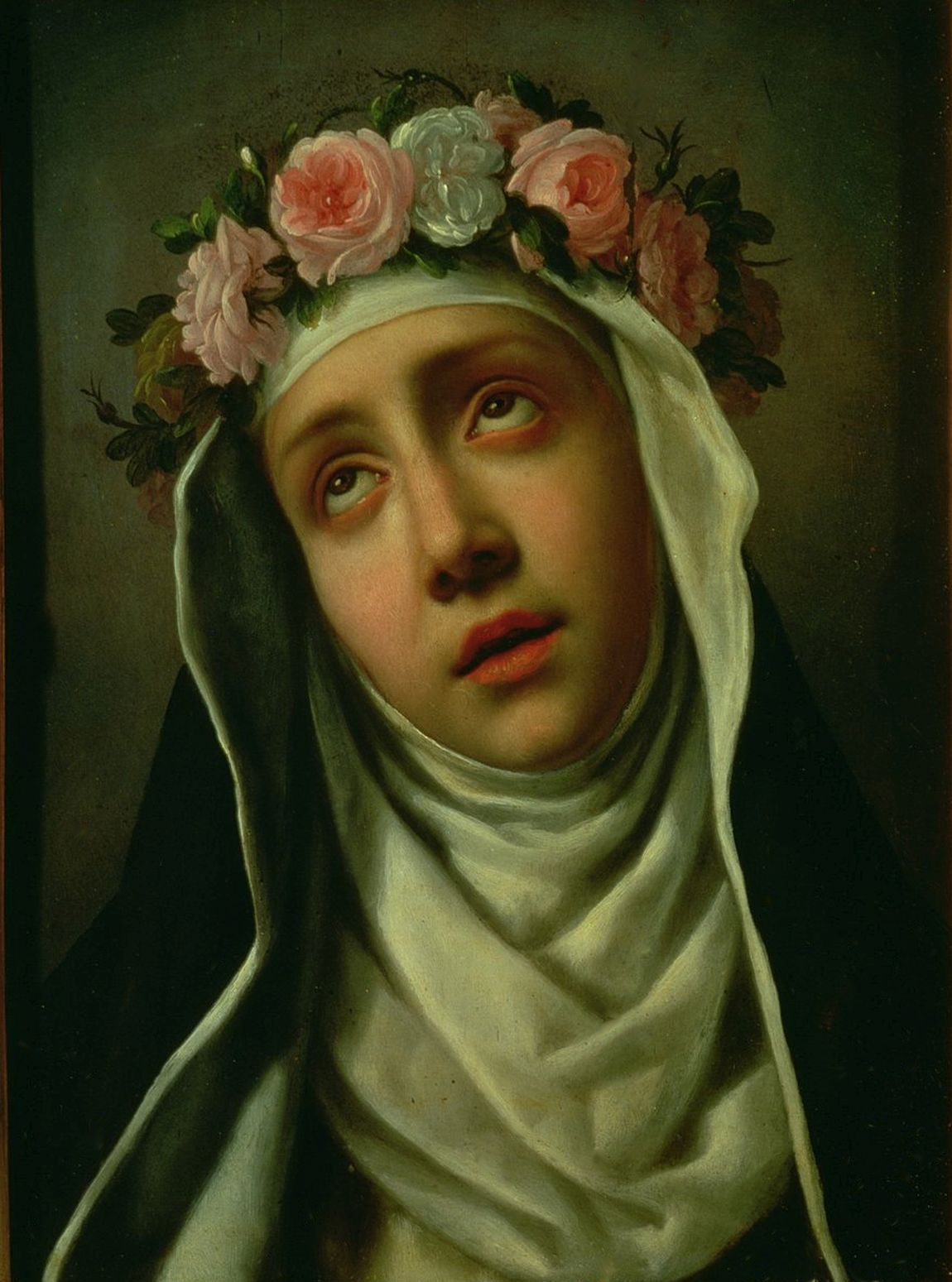
vanity, and against sickness. She can be recognized in art by her
Dominican habit, roses (usually worn as a wreath around her head), a
crown of thorns, an anchor (a symbol for Lima), and the presence of the
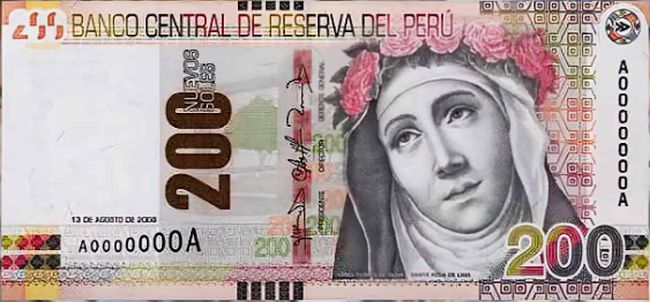
Baby Jesus. Many parishes and cities are named for her (e.g., Santa
Rosa, California), and she is shown on the highest denomination of
Peruvian currency (the 200 soles bill).
Her feast is traditionally celebrated on August 30, but is kept on
August 23 in the Novus Ordo. Her relics5 may be venerated
(alongside those of St. Martin de Porres)
at the Basilica and Convent of Our Lady of the Rosary -- commonly known
as the Church and Convent of Santo Domingo -- in Lima, Peru.
Customs
Some may prepare for this feast by praying a Novena to St. Rose of Lima
starting on August 21 and ending on August 29, the eve of her feast.
For today, the Litany of St. Rose of
Lima or St. Rose's Angelic Exercises, as described earlier, would be lovely, as would the following prayer:
O illustrious
Virgin, heavenly Rose, who with the sweet fragrance of thy virtues have
filled the whole Church of God with perfume and merited in glory an
unfading crown; we come to thy protection so that thou mayest obtain
for us from thy heavenly Spouse a heart detached from the vanities of
the world and full of divine love.
O flower, most beautiful and delicate that the New World has
produced, prodigy of grace, and model for souls who desire to closely
follow in the footsteps of the Divine Master, obtain for us the
blessings of the Lord. Protect the Church, sustain good souls, and
banish from the Christian people the darkness of error so that the
majestic light of Faith may always shine forth and that Jesus, our
life, may reign in the minds of all people and one day admit us into
His eternal and blessed dwelling. Amen.
Her feast -- on its traditional date of August 30 -- is a national
holiday in Peru, where she is
patron saint. In Lima, Peru's capital, residents makes altars adorned
with roses, candles, and images of St. Rose. Roses abound elsewhere
as well, used as decoration all over the city. Residents and pilgrims visit the Santuario de Santa Rosa de Lima,6
the site of the Saint's family home where she was born (a room of which
she used to care for the sick), and the tiny 6 feet long hermitage
where she spent her days. Here
there are her garden, preserved pieces of her famous lemon tree kept in
a reliquary, and the Pozo de los
Deseos, the 60 feet deep brick well into which St. Rose dropped
the key to her
cilice (a chain worn
as penance) as a sign of her consecration to God. The faithful drop
into this well pieces of paper on which they've written their prayer
intentions, expressions of gratitude, etc., as ex voto offerings.
Then the faithful flock three blocks east at the Basilica and the
Convent of Our Lady of
the Rosary (also called Basilica and Convent of Santo Domingo) where
they venerate St. Rose's relics and leave roses,
especially white ones and pink ones. The statue of the Christ Child
that St. Rose deemed "The Little Doctor" can be found here as well.
There follows a huge and marvelous
procession of a large statue of St. Rose, carried aloft on a grandly
decorated platform, beginning at the basilica and making its way three
blocks further east to Lima's
beautiful cathedral, the cornerstone of which was laid by the
conquistador Francisco Pizarro in 1535 (his tomb is inside). The
procession is accompanied by dancers and musicians, and the streets are
lined with people in traditional Peruvian costumes.
Traditional foods for the day include Peruvian favorites, such as
ceviche and
arroz con leche. Ceviche -- in which fish is "cooked" (denatured) by
the action of lime juice -- is a dish you should only prepare if you
live near the sea where you can get absolutely fresh fish or if you can
buy flash-frozen fish. Note, please, that ceviche is also a dish
pregnant women should skip.
Ceviche (serves 4)
2 medium red onions, julienned
1 TBSP salt
2 pounds white, raw, ocean fish (sea bass, sole, halibut,
flounder, or mahi mahi), in 1/4" cubes*
1 c. of freshly squeezed lime juice (around 10-15 limes)
1-2 aji amarillo or habanero peppers, seeded and sliced
Fresh cilantro sprig
Salt, to taste
Ice cubes
Accompaniments:
2 sweet potatoes (camote), peeled, sliced, boiled to just
tender, cooled to room temperature
1 cup of corn, cooked and cooled to room temperature
1 c. corn nuts (cancha)**
1 c. plantain chips (chifles)
Fresh cilantro, chopped
Aji or habanero pepper, chopped, to taste
Time is of the utmost essence with this dish, so first, have
all the items listed as "Accompaniments" ready (have the potatoes and
corn cooked and cooled, the cilantro and pepper chopped, etc.). Now, in
a glass bowl, mix together the red onions and salt
in enough cold water to cover and let sit for 20 minutes. Drain the
onion and put it back in the glass bowl with the cubed fish, lime
juice,
peppers, cilantro sprig, salt, and ice cubes, ensuring the fish is
covered by the juices. Cover and refrigerate for
10 minutes.
After 10 minutes -- and no more! -- remove the cilantro. Add
salt, if needed, to taste. Divide the fish and onions up onto 4 plates
and spoon a
little of the marinade on top. Sprinkle some chopped cilantro and
chopped pepper to taste and to make it look pretty. On the side for
each plate, serve 2 slices of the sweet potato, 1/4 c. corn, 1/4 c.
cancha, and 1/4 c. chifles. This dish must be eaten immediately after preparation.
Save the juices of the fish marinade: in Peru, it's called leche de tigre -- tiger's milk --
and not a drop is wasted; it's imbibed like a fine liqueur. Some fancy
up their tiger's milk by blending it up in a blender with a little bit
of the fish, onion, the removed sprig of cilantro, celery, garlic, and
some fresh ginger, and drink it as a sort of cocktail (some say it is a
hangover cure; others say it's an aphrodisiac. Maybe it's both since
it's hard to engage in the marital embrace when one is hung over.
Which, of course, one shouldn't be if one drinks prudently. Ahem.).
* No mackerel, sardines, tuna, or other oily fish. And,
again, the fish must be absolutely fresh or flash-frozen. And, once
more, don't eat this dish if you're pregnant.
** American-style corn nuts are harder and crunchier than Peruvian
corn nuts, which are more like inverted popcorn -- a bit fluffy on the
inside. To make your own Peruvian corn nuts, you need to get dried
chulpe corn (maiz chulpe).
Heat 2 TBSP lard in a big skillet over medium-high heat. Add 2 cups of
the chulpe and stir so the corn is coated with the fat. Cover with a
lid, and as soon as you hear a popping sound, turn the heat down to
medium and give the pan a good shake. Shake every 30 seconds or so and
keep cooking until the popping subsides and the corn is golden. Salt to
taste.
Peruvian Arroz con Leche
(serves 4)
1 c. short-grain rice
2 big cinnamon sticks, broken into a few pieces
rind of 1 orange or 1 lime (big pieces of rind, not grated
zest), optional
5 whole cloves
1/4 c. raisins
3 c. water
1 cup evaporated milk
1/4 c. brown sugar
1/2 c. sweetened condensed milk
cinnamon for sprinkling on top
Put all up to and including the water in a pan over low heat
and cook for 15 or 20 minutes, until the rice is tender and the water's
absorbed. Remove the cinnamon sticks, rind, and cloves. Add the
evaporated milk and cook for 7 minutes, stirring constantly. Add the
brown sugar and mix it in well. Stir in the sweetened condensed milk.
Put
into bowls and sprinkle cinnamon on top.
And chocolate might be a good choice for the day: we may well
have St. Rose of Lima to thank for the Christian acceptance of
cocoa-based yumminess:
Interesting
information is given about chocolate, which started to be known in
Europe at that time – there is a description of how once, when Rose was
weak, her mother prepared a warm drink from water and sugar, adding a
certain mass called cocola’ta
by the locals. At that time, there were conflicting opinions about the
use of chocolate and cocoa in Europe, disagreement if it was a remedy
or the devil’s invention, and if it was suitable nutrition during
fasting. Importantly, chocolate had many uses during Aztec religious
ceremonies and was associated with the heart and blood. An episode with
chocolate was also included in the above-mentioned Spanish comedy Santa Rosa del Perú.
According to the scholar who analysed the play, “This episode of Rose’s
life was actually used in the debate to argue that chocolate was a
sacred and virtuous drink."7
As to music for the day, Peru has an official song for St. Rose's feast:
Coro:
Gloria a ti Rosa bendita
Del Peru radiante estrella
Flor de los cielos mas bella
Que la flor de Jerico (bis)
Hollando con fe profunda
los placeres de este suelo,
desde joven en el cielo
tu corazón se fijó (bis)
Al suyo con lazo fuerte
Juntóle su dulce esposo
y de su amor generoso
suavemente le inflamó (bis)
Virgen te aclaman los cielos;
virgen pura, el nuevo mundo;
ángel de Dios sin segundo,
el Perú te crió (bis)
En vano, límpido espejo,
Satanás quiso empañarte
nunca pudo derribarte,
porque en Dios tu alma se fió (bis)
Chorus:
Glory to you, blessed Rose,
radiant star of Peru,
most beautiful flower of the heavens,
more beautiful than the flower of Jericho. (repeat)
Treading with deep faith
upon the pleasures of this earth,
from your youth your heart
was fixed on heaven. (repeat)
With a strong bond
your sweet Spouse joined you to Himself,
and with His generous love
He gently set you aflame. (repeat)
The heavens acclaim you as a virgin;
pure virgin of the New World;
angel of God without equal,
Peru raised you. (repeat)
In vain, spotless mirror,
Satan tried to tarnish you;
he could never cast you down,
because your soul trusted in God. (repeat)
And now, a few ideas to keep your children entertained:
Little girls
might enjoy making crowns out of roses -- real or paper ones. Off the
page about the Feast of St.
Therese of Lisieux I have instructions on
making paper roses that might help. Just cut and fold them up and
string them together or glue them onto a headband.
Another craft
idea for the day is to make a little replica of the Pozo de los Deseos -- the wishing
well near St. Rose's house. Get an empty cylindrical Quaker oats
container or its equivalent, and cut some off the top so it's more
squat in shape. Cover it with paper which your children have decorated
to look like a brick wall. Glue wooden dowels or popsicle sticks
on two opposite sides, and place another dowel at the top of them to
form a bar from which a bucket would hang (or, to make it look more
like a classic wishing well, use the vertical dowels to hold up a
peaked roof, which you make out of a piece of cardboard bent into a
V-shape. If you want to go all out, get black sandpaper and cut it into
"tiles" that are 1" long and 1/2" tall. Your children can glue them
into place on the roof, overlapping them a tiny bit in the same way
roofing tiles are laid). Your children can write out their prayer
intentions and put them inside the well, thereby emulating the pilgrims
in Lima on St. Rose's feast.
How quickly can
your children find Peru on a globe or world map?
You can make
strawberries look like roses by this method: 1) Wash the berries; 2)
Turn them upside down so the fat stem side is on the table; 3) With a
small knife, make 6 small horizontal slices downward about a third of
the
way up from the bottom of the stem-side of the berry. Make the slices
downward toward the stem and inward toward the center of the berry, but
not cutting all the way through; 4) Going up on the berry a millimeter
or so,
make 4 small horizontal slices in the same manner, but make the
slices so they're sort of in between (i.e., not parallel to) the slices
already made; 5) Do the same with a third row, making 2 or 3 slices "in
between" the slices made in the previous row; 6) Continue doing the
same all the way up the berry; 6)
Gently push the "petals" outward. Serve with a tiny bowl of powdered
sugar or whipped cream. The same thing can be done with radishes.
Above all, though, today is a good day to consider how you
react to suffering. Do you whine, complain, or become angry -- or do
you offer it up for the good of souls
and to unite your sufferings to those of Christ? Do you deeply trust God and have gratitude to Him even in the midst of grief
and suffering? Perhaps developing a habit of making a Morning Offering might help, as would,
when suffering, meditating on this paraphrase of the words of St. Paul
in Colossians 1:24:
I now rejoice in
my sufferings, and fill up those things that are wanting of the
sufferings of Christ, in my flesh, for His body, which is the Church.
Please note, though: No one should undertake the sorts of severe
mortifications that St. Rose undertook without strict spiritual
supervision by a prudent confessor, which St. Rose most definitely had
(she was told to curtail many of her mortifications). While a
willingness to take on such penances can be a sign of holiness, as in
St. Rose's case, they can also be a sign of spiritual pride, masochism,
self-hatred, borderline personality disorder, attention-seeking, etc.
For further reading about St. Rose of Lima, see the following
books
(pdf
format) from this site's Catholic
Library:
From "The Liturgical Year"
by Dom Prosper
Gueranger
The fragrance of holiness is wafted today across the dark Ocean,
renewing the youth of the Old World, and winning for the New the good
will of heaven and earth.
A century before the birth of St. Rose, Spain, having cast out the
Crescent from her own territory, received as a reward the mission of
planting the Cross on the distant shores of America. Neither heroes nor
apostles were wanting in the Catholic kingdom for the great work; but
there was also, unhappily, no lack of adventurers who, in their thirst
for gold, became the scourge of the poor Indians instead of leading
them to the true God. The speedy decadence of the illustrious nation
that had triumphed over the Moors was soon to prove how far a people,
prevented with the greatest blessings, may yet be answerable for crimes
committed by its individual representatives. It is well known how the
empire of the Incas in Peru came to an end. In spite of the indignant
protestations of the missionaries: in spite of orders received from the
mother country: in a few years, Pizarro and his companions had
exterminated one third of the inhabitants of these flourishing regions;
another third perished miserably under a slavery worse than death; the
rest fled to the mountains, carrying with them a hatred of the
invaders, and too often of the Gospel as well, which in their eyes was
responsible for atrocities committed by Christians. Avarice opened the
door to all vices in the souls of the conquerors, without, however,
destroying their lively faith. Lima, founded at the foot of the
Cordilleras, as metropolis of the subjugated provinces, seemed as if
built upon the triple concupiscence. Before the close of the century, a
new Jonas, St. Francis Solano, came to threaten this new Ninive with
the anger of God.
But mercy had already been beforehand with wrath; justice and peace had
met, in the sound of a child, who was ready, in her insatiable love, to
suffer every expiation. Here we should like to pause and contemplate
the virgin of Peru, in her self-forgetful heroism, in her pure and
candid gracefulness: Rose, who was all sweetness to those who
appreciated her, and who kept to herself the secret of the thorns
without which no rose can grow on earth. This child of predilection was
prevented from her infancy with miraculous gifts and favors. The
flowers recognized her as their queen; and at her desire they would
blossom out of season. At her invitation, the plants joyfully waved
their leaves; the trees bent down their branches; all nature exulted;
even the insects formed themselves into choirs; the birds vied with her
in celebrating the praises of their common Maker. She herself, playing
upon the names of her parents, Gaspard Flores and Maria Oliva, would
sing: “O my Jesus, how beautiful thou art among the olives and the
flowers, and thou dost not disdain thy Rose!”
Eternal Wisdom has, from the beginning, delighted to play in the world.
Clement X relates, in the Bull of Canonization, how one day when Rose
was very ill, the Infant Jesus appeared and deigned to play with her;
teaching her, in a manner suited to her tender age, the value and the
advantages of suffering. He then left her full of joy, and endowed with
a lifelong love of the Cross. Holy Church will tell us, in the Legend,
how far the Saint carried out, in her rigorous penance, the lesson thus
divinely taught. In the superhuman agonies of her last illness, when
someone exhorted her to courage, she replied: “All I ask of my Spouse
is that he will not cease to burn me with the most scorching heat, till
I become a ripe fruit that he will deign to cull from this earth for
his heavenly table.” To those who were astonished at her confidence and
her assurance of going straight to heaven, she gave this answer, which
well expresses her character: “I have a Spouse who can do all that is
greatest, and who possesses all that is rarest, and am I to expect only
little things from him?” And her confidence was rewarded. She was but
thirty-one years of age when, at midnight on the feast of St.
Bartholomew in the year 1617, she heard the cry: Behold the Bridegroom
cometh! In Lima, in all Peru, and indeed throughout America, prodigies
of conversion and miracles signalized the death of the humble virgin,
hitherto so little known. “It has been juridically proved,” said the
Sovereign Pontiff in his Bull of Canonization, “that, since the
discovery of Peru, no missionary has been known to obtain so universal
a movement of repentance.” Five years later, for the further
sanctification of Lima, there was established in its midst the
monastery of St. Catherine of Sienna, also called Rose’s monastery
because she was in the eyes of God its true foundress and mother. Her
prayers had obtained its erection, which she had also predicted: she
had designed the plan, pointed out the future religious, and named the
first superior, whom she one day prophetically endowed with her own
spirit in a mysterious embrace.
Let us read the Church’s beautiful account of her life.
The first flower of sanctity that blossomed in South America, the
virgin Rose was born of Christian parents at Lima. From her very cradle
she gave clear signs of her future holiness. Her baby face appeared one
day changed in a wonderful way into the image of a rose, and from this
circumstance she was called Rose. Later on the Virgin Mother of God
gave her also her own name, bidding her to be called thenceforward Rose
of St. Mary. At five years of age she made a vow of perpetual
virginity, and when she grew older, fearing her parents would compel
her to marry she secretly cut off her hair which was very beautiful.
Her fasts exceeded the strength of human nature. She would pass whole
Lents without eating bread, living on five grains of a citron a day.
She took the habit of the third Order of St. Dominic and after that
redoubled her austerities. Her long and rough hair-shirt was armed with
steel points, and day and night she wore under her veil a crown studded
inside with sharp nails. Following the arduous example of St. Catharine
of Sienna, she wound an iron chain three times round her waist, and
made herself a bed of the knotty trunks of trees, filling up the vacant
space between them with potsherds. She built herself a narrow little
cell in a distant corner of the garden, and there devoted herself to
the contemplation of heavenly things, subduing her feeble body by iron
disciplines, fasting and watching. Thus she grew strong in spirit, and
continually overcame the devils, spurning and dispelling their deceits.
Though she suffered greatly from severe illnesses, from the insults
offered her by her family and from unkind tongues, yet she would say
that she was not treated as badly as she deserved. During fifteen
years, she suffered for several hours a day a terrible desolation and
dryness of spirit; but she bore this suffering, worse than death
itself, with undaunted courage. After that period, she was given an
abundance of heavenly delights, she was honored with visions, and felt
her heart melting with seraphic love. Her Angel-Guardian, St. Catharine
of Sienna and our Lady used often to appear to her with wonderful
familiarity. She was privileged to hear these words from our Lord:
“Rose of my heart be thou my bride.” At length she was happily
introduced into the paradise of this her Spouse, and being famous for
miracles both before and after her death, Pope Clement X solemnly
enrolled her among the holy virgins.
Patroness of Peru, ever watch over the interests of thy fatherland.
Respond to its people’s confidence in thee by warding off from them the
calamities of even this present life: the earthquakes which spread
terror through the land, and political convulsions such as have already
so severely tried its independence. Extend thy guardianship to the
neighboring young republics; for they too love and honor thee. Hide
from them and from thy native land the Utopian mirages which rise from
the old world. Preserve them from the rash impulses and illusions to
which their youth is liable. Guard them against the poisonous teachings
of condemned sects, lest their hitherto lively faith should be
corrupted. Lastly, o thou our Lord’s beloved Rose, smile upon the whole
Church, who is enraptured today at the sight of thy heavenly beauty.
Like her, we all desire to, as the Collect of the Mass says, “run in
the fragrancy of thy sweetness.”
Teach us to let ourselves be prevented, like thee, by the dew of
heaven. Show us how to respond to the advances of the divine sculptor,
who one day allowed thee to see him making over to his loved ones the
different virtues in the form of blocks of choice marble, which he
expects them to polish with their tears, and to fashion with the chisel
of penance. Above all, fill us with love and confidence. All that the
material sun accomplishes in the vast universe, causing the flowers to
bloom, ripening the fruits, forming pearls in the depth of the ocean,
and precious stones in the heart of the mountains; all this, thou didst
say, thy divine Spouse effected in the boundless capacity of thy soul,
causing it to bring forth every variety of riches, beauty and joy,
warmth and life. May we profit, even as thou didst, of the coming of
the the Sun of Justice into our hearts in the Sacrament of union; may
we lay open our whole being to the influence of his blessed light; and
may we become, in every place, the good odor of Christ.
Footnotes:
1 "The flower of the new world; being a
short
history of St. Rose of Lima, with an introduction by the Very Rev.
Father J. Procter", by F. M. Capes, 1899
2ibid
3 Julián De Cos, The Prayer of Love: The
Mystical Experience of St. Rose of Lima According to Source Documents,
trans. Dominican Sisters of Mary, Mother of the Eucharist (Openlight
Media / Laici OP, 2025)
4 Christopher D. Gascón, “Erasure,
Exoticism,
Hybridity: Cultural Alterity in Santa Rosa del Perú”, in:
Crosscurrents. Transatlantic Perspectives on Early Modern Hispanic
Drama, ed. by Mindy Badía and Bonnie L. Gasior, Lewisburg: Bucknell
University Press, 2006, p. 48-53
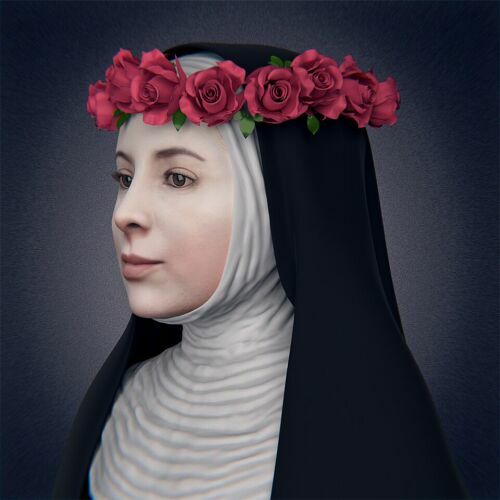
5 In
2015, scientists at the Brazilian
Team of Forensic Anthropology and Odontology, using CT scans
(tomography) and 3D photogrammetry, studied St. Rose's skull and
made a reconstruction of her face based on average tissue depths, her
ethnicity, etc. They believe this is how St. Rose looked in life:
6 The house in which St. Martin de
Porres was born -- 27 years earlier than St. Rose -- is just across the
street to the southwest of the house in which St. Rose lived. They were
friends, or at least friendly acquantainces, though I couldn't find much information about their relationship with each other.
7 Janonienė,
R. (2022). The cult and images of Saint Rose of Lima in Lithuania. Acta
Academiae Artium Vilnensis, 105, 24–[end page].
https://doi.org/10.37522/aaav.105.2022.105