``Where
the Bishop is, there let the multitude of believers be;
even as where Jesus is, there is the Catholic Church'' Ignatius of
Antioch, 1st c. A.D
Feast of St. Philip Neri
Filippo Romolo
Neri --
"Philip Neri" to the Anglosphere -- was born in Florence on July 21,
1515, the youngest of four children born to an attorney father and a
mother of noble birth. He was a virtuous child -- pious, obedient to
his parents, and respectful of his elders. He was so known for virtue
even as a boy that he was called "Il
buon Pippo." When his mother died
and his
father remarried, his step-mother was so impressed by him that she
spoke of him as if he were her own.
He had his fair share of boyhood scrapes -- for ex., there was the
incident in which he jumped on a donkey's back,which somehow sent the
donkey and himself tumbling down a flight of stairs and into a cellar,
with the donkey landing on top of him -- but he always seemed to be
taken care of by God's Providence.
When he was 18, he was sent to apprentice with a wealthy businessman
uncle in Cassino, the place where the great abbey built by St. Benedict can be found. Now, not far
from Cassino, about 30 miles southwest, on the western coast of Italy,
is a town called Gaeta. In this town is a very interesting geographical
phenomenon: la Montagna Spaccata -- Split Mountain. The story is told
that at the death of Christ, a great lightning bolt hit the mountain,
splitting it into thirds. A thousand years later, Benedictine monks
built on top of it the Santuario
della Santissima Trinità (Sanctuary of the Most Holy Trinity).
In the great crevices that were formed when the mountain split are
little grottoes, and in one of them Philip Neri used to go to pray and
meditate while he was otherwise staying with his uncle (to this day you
can see the stone "bed" on which he would sleep -- il letto di San Filippo Neri).1
It was here, on Montagna Spaccata, that St.
Philip Neri decided not to go into business with his uncle, but to give
his life to God instead.
His mind made up, he went to Rome. There, he stayed in a small, barely
furnished room and studied theology under Augustinian monks, and took
on philosophy, at which he so excelled that he came to be considered
one of the best philosophers in Rome. He also studied -- and loved --
Latin and Italian poetry, and tried his hand at
writing his own as well. Sadly, he would later burn almost all of his
writings for the sake
of humility, so little remains for us today.
Mostly though, he gave himself over to penance, eating only once a day
-- nothing but bread, with a few olives and some herbs for variety --
and
periodically fasting for days. He would engage in practices to mortify
the flesh, such as sleeping on the floor, and wearing iron chains. He
would also go to Catacombs of San Sebastian to meditate, often sleeping
there so as to surround himself with the Saints.
He also developed a tradition which remains with us today: the practice
of making a mini pilgrimage by visiting
seven churches in one night.
Catholics today do this especially on Maundy
Thursday.
Above all he devoted himself to prayer -- very intense prayer
which led to ecstasies and other great spiritual gifts, such as the
gift of prophecy, the ability to read souls, and the ability to see
into the world of spirit. Regarding that last, once he was at a place
in Rome called Capo
di Bove, a site containing ancient Roman thermal baths, about a mile
away down the Appian Way from the Catacombs of San Sebastian. He was
walking along and praying when three demons appeared to him, trying to
frighten him. He gave them no mind, and they disappeared. Another time,
as he was walking near the Coliseum on his way to the Church of St.
John Lateran, Satan showed up, appearing under the guise of a naked
person. He, too, disappeared when Philip continued praying.
The ecstasies
though! He would be so spiritually overcome that he sometimes couldn't
bear it and had to beg God to stop. The most memorable of his ecstasies
is one for which we have interesting scientific evidence (more on that
later). He was 29 years old and praying in the San Sebastian Catacombs
just before the Pentecost. Fr.
Bacci, in his book "The Life Of Saint Philip
Neri Apostle Of Rome," tells us about it:
While he was
with the greatest earnestness asking of the Holy Ghost His gifts, there
appeared to him a globe of fire, which entered into his mouth and
lodged in his breast; and thereupon he was suddenly surprised with such
a fire of love, that, unable to bear it, he threw himself on the
ground, and, like one trying to cool himself, bared his breast to
temper in some measure the flame which he felt. When he had remained so
for some time, and was a little recovered, he rose up full of unwonted
joy, and immediately all his body began to shake with a violent
tremour; and putting his hand to his bosom, he felt by the side of his
heart, a swelling about as big as a man's fist, but neither then nor
afterwards was it attended with the slightest pain or wound.
The effects of this great mystical experience were many. He came to
feel
a warmth emanating from his heart. He felt so hot that he would walk
about in winter with
loose clothing while everyone else was shivering (I don't know if this
heat was purely subjective or if his temperature was objectively high,
but it's interesting that Padre Pio had
medically surreal high body temperatures). The swelling of his
chest remained for the rest of his life; his heart had been so inflamed
with love that others could easily feel his heartbeat, which was less a
normal pulse and more a strong hammering that was visible from a
distance. And his physical heart, his
bosom, became a place of spiritual healing. Fr. Bacci again:
Whenever he
pressed any of his spiritual children to his breast, they found the
motion of his heart so great, that their heads bounded off from him, as
if they had received a smart shock from something, while at other times
the motion seemed like that of a hammer. Yet notwithstanding the shock,
they always found, in being pressed to him, a wonderful consolation and
spiritual contentment, and many found themselves in the very act
delivered from temptations.
But while upon this matter, I must not omit to relate what is
affirmed by Tiberio Ricciardelli, canon of St. Peter’s, who served the
Saint out of devotion for four successive years. “While I was serving
the father,” he says, “there came upon me a temptation to impurity, and
after I had conversed with him on the subject, he said to me, ‘Tiberio,
come here, close to my breast;’ and taking hold of me, he pressed me to
his bosom, and I was not only freed at once from the present
temptation, but it never returned afterwards; and besides this I felt
such an increase of spiritual strength, that it seemed as if I could do
nothing but pray.” Marcello Vitelleschi, canon of S. Mary Major, and
also one of Philip’s spiritual
children, declared that he had repeatedly been freed from temptations,
especially of the flesh, by the Saint’s pressing him to his bosom and
very often, when Philip knew that he was suffering from such
temptations, he used to take hold of his head and press it to him,
without uttering a word and in no case was this done without immediate
release from the temptation.
Around 1538, he took on the mission of converting souls and was
most excellent at it due to his sweetness, affability, tremendous
sense of humor, fun-loving nature, and pure joy. Many of his converts
went on to enter the religious life
-- so many that St. Ignatius of Loyola used to call him "The
Bell" because bells call people to church but remain in the belfry,
just as Philip would call people to the religious life but remained in
the world.
At around this time, too, he focused on the corporal works of mercy,
especially helping to care for the sick. In 1540, he started the
Confraternity of the Santissima Trinita de’ Pellegrini e de’
Convalescenti to care for the sick -- especially those just released
from the city hospital but who needed more time to heal -- and for
pilgrims. The group met at the church of San Girolamo della Carità (St.
Jerome of the Charity),2 but by 1588 were given their own
church: la Chiesa della Santissima Trinità dei Pellegrini. It was
during this time that Philip started yet another tradition that we
still practice today: Quarant'Ore
-- the 40 Hours Devotion before the Blessed Sacrament.
Now, all this time, Philip had been a layman. But his confessor urged
him to become a priest so he could do even more for souls. Philip
resisted, thinking himself unworthy, but his confessor convinced him to
do as he advised. And, so, in 1551, at the age of 36, Philip was
ordained, and he went to live at the church of St. Girolamo della
Carità just mentioned. Other priests lived there, too, and there he
came up with one of the things for which he is most famous: the
Oratory. Every day after dinner, Philip would gather the priests
together for spiritual exercises and discourse. Over time, the group
became more formalized, becoming not a religious order, but an
apostolic society that became known as the Confederation of
Oratories of Saint Philip Neri, or "the Oratorians." Members of the
Oratory are priests who aren't bound together by vows, but by the bonds
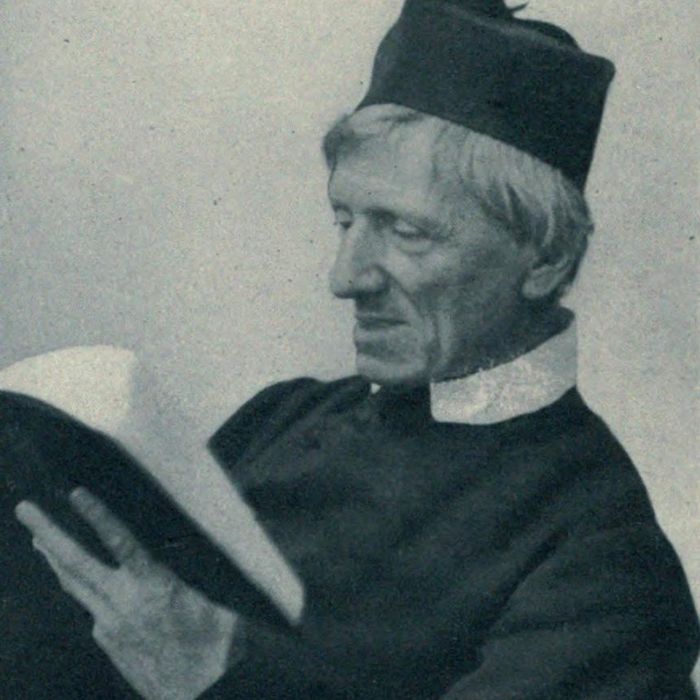
of charity and the desire to live communally for fellowship. They dress
as other secular priests do -- in black cassocks -- but instead of a
Roman collar, they often wear a white collar that folds down, rather
like a squared-off version of the collars on men's dress shirts.3
Philip and his Oratorian brothers would pray together, engage in
spiritual reading, make or listen to sacred music, and discourse on the
Saints and Church history.
These gatherings were open to visits by laymen as well, and sometimes
hundreds
of men -- men of all classes -- would show up. And sometimes he would
take everyone on his
mini-pilgrimages to the seven churches, with a sermon at one, Mass at
another, etc., and a picnic of bread, wine, cheese, eggs, and fruit
somewhere in the middle, with musicians playing while they ate. The
popularity of his Oratory and seven churches pilgrimages evoked envy in
some, and led to whispering campaigns and manipulative string-pulling
such that he had his ability to hear confessions revoked for a time.
But he prevailed in spite of these injustices. And in 1575, Pope
Gregory XIII recognized the
Oratorians as an official apostolic society, and gave them the church
of Santa
Maria in Vallicella, also called Chiesa Nuova, with an attached
convent, which they rebuilt and which is still the Oratorians' church
to this day.
Something else of importance came from St. Philip's Oratory: lots of
original music, including a new musical form known as the "oratorio" --
a sort
of mini musical mystery play. An oratorio
dramatizes a sacred subject through an encounter between at least two
characters -- Biblical
characters, Saints, God and the soul, etc., and sets it to music, but
without
staging as in an opera. Great composers such as Palestrina and Giovanni
Animuccia wrote music for Philip's Oratory. An example from the
latter composer is Lauda, a
song of praise:
And, of course, later composers such as Bach (e.g., his Passions),
Handel (e.g., his "Messiah"), and Haydn (e.g., his "Creation" and "The
Seasons") would write many oratorios.
In part II of Fr. Bacci's book, he writes, "Hitherto we have related
Philip’s actions, and the holy life which he led, as well when he was a
layman as after he became a priest; we now come to speak of his virtues
in particular, so that men may have a livelier picture of him..." I
will do the same here, summarizing in bullet points what makes St.
Philip of Neri such a marvelous and fascinating Saint. Any quotes will
be from Fr. Bacci.
His devotion to
the Blessed Sacrament and Holy Mass: Padre Pio would be so moved by the
offering of the Son to the Father at Mass that he would need to stand
on towels to catch his copious tears; Philip Neri would fall into
ecstasies and become so lost in the moment that hours would pass and he
wouldn't notice.
Wishing to unite
himself with Christ's Passion, he longed for martyrdom, but since he
wasn't called to risk his life in the mission fields, he asked God to
let him spill his own blood in a quantity that matched that of the
Blood Christ spilled on Calvary. Fr. Bacci writes of blood that would
issue from Philip's nose and mouth that "the Lord allowed [him]
many times over to shed basins full, so that his last infirmities were
nothing else but discharges of blood. Hence it has become customary to
paint him as a priest in red vestments, which is properly the exclusive
colour of martyrs, to denote the vehement desire he had to shed his
blood for the love of Christ.
He had great
devotion to the Blessed Virgin, and she did him many favors in return.
"One morning [St. Philip] sent for [Giovanni Antonio, the supervisor of
work being done to rebuild the Chiesa Nuova Church] in great haste, and
ordered him to have the roof taken off immediately, because he had seen
that it would have fallen that very night just passed, if the glorious
Virgin had not held it up with her own hands. Giovanni Antonio
immediately went with some workmen to execute the obedience, and found
that the principal beam had started from the wall, and was apparently
self-supported in the air, so that all who saw it cried out, “A
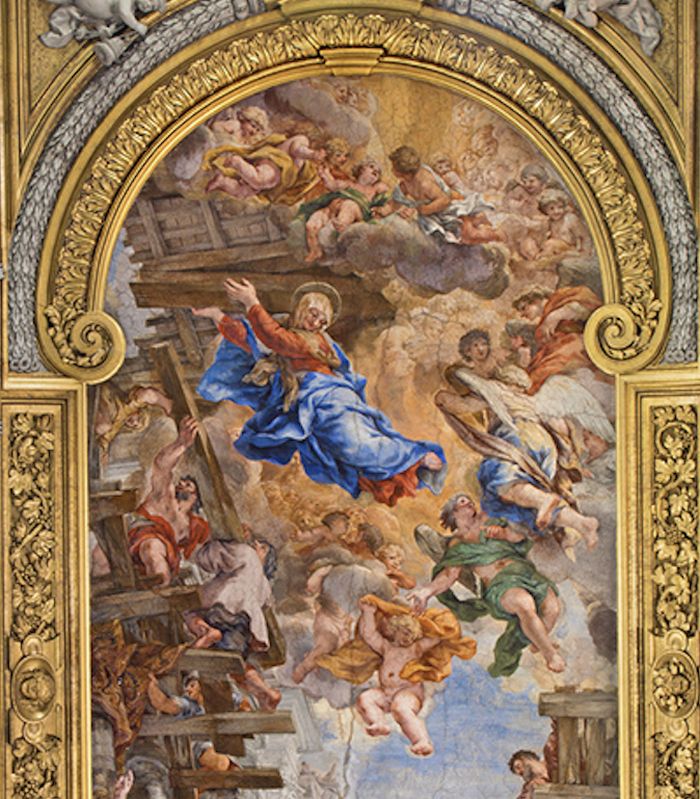
miracle! a miracle!” A fresco on the ceiling of the nave of the
Oratorians' Chiesa Nuova depicts this event.4
His holiness was
such that it affected others in a supernatural way. "Lavinia de’
Rustici, the first wife of Fabrizio de’ Massimi, before she began to
confess to the holy father, had no great opinion of him, and even
laughed at him; but one day when she heard him speak of divine things,
she felt such a movement of heavenly love in her heart, that she was
all inflamed with a desire to serve Christ. She took Philip for her
spiritual father, confessed to him, and began to communicate three
times a week, growing in contempt of herself, and giving herself up to
prayer in which she was often favoured with divine raptures; in fact
she was a lady of such piety, that the Saint said of her, that without
doubt she was in heaven rejoicing with the angels. Costanza Draghi
Crescenzi heard Philip’s mass in our church with Eugenia her servant;
and in a moment they were both of them seized unawares with such a
spirit of compunction, and such an abundance of tears, that Costanza
said to Eugenia, 'Do you feel this?' and she answered, 'Yes indeed, I
do feel it.' When they came to reflect upon this afterwards, they
concluded that it was an effect of the devotion which the Saint had
obtained for them in his mass." There are many such stories.
His
willingness to play the "holy fool" is what he is most remembered for,
it seems. "...Philip mortified himself, both in the house and out of
doors, in public and in private, with every variety of mortification.
But to come to particulars: he used for this end repeatedly to skip
about like a child, in the presence of others, even of cardinals and
prelates, and this not only in remote and uninhabited places, but even
in places of resort, such as palaces, squares, and streets. Sometimes
he jumped three or four steps at a time in the presence of others, and
then said to some of the byestanders, 'What do you think of that?' On
the first of August he began jumping in the square of S. Pietro in
Vincoli, where there was an immense concourse of people because of the
feast; and some one was heard to say, 'Look at that old fool there;'
and thus Philip gained what he so much desired, to be thought a man of
little sense."
He once went about dancing in the streets with half of his beard shaved
off. He would dress oddly -- e.g., wearing big white shoes, donning a
long red shirt over his doublet, etc. -- most anything to make himself
look foolish and to lower his social esteem.
He would keep silly books of jokes, and when upper class dignitaries
would come for a visit, would have a priest friend be reading aloud to
him from one of them when the dignitaries entered his room.
He had great
empathy and prudence in dealing with others, knowing precisely when to
be lenient, when to be more rigid, etc. His skill as a confessor --
helped by his ability to read souls -- was such that people clamored to
make it to his confessional (among his penitents was St. Ignatius of
Loyala). He was creative with the penances he gave as a confessor as
well, for ex., having members of the rich, upper class beg for alms or
sweep the steps in front of churches. He had priests prostrate
themselves in church publicly. He had one penitent who needed to learn
humility walk through the streets while ringing a bell so he'd be
thought mad. One penitent named Alberto asked Philip if he could wear a
hair shirt, to which Philip responded affirmatively -- but only if he
wore it on the outside of his gown, which he did.
"Some he ordered to kiss the feet of those who came to visit him;
others to dance and sing in the presence of cardinals and prelates. He
made several go about with a berretta of white cloth upon their heads,
and others with a huge hat and a cord passing under the chin after the
antique fashion. On others he put a large rosary, like a hermit’s,
round their neck, and made them go to Church in that costume; and on
others he put beards of taffety and gold lace. He often made F. Pietro
Consolini wear purple taffety with threads of gold round his hat, and
made him walk about Rome with it; and he repeatedly sent Giuliano
Magaluffi into the refectory during supper, with a monkey shouldering a
gun and with a berretta on its head, commanding him to walk about the
refectory in that way."
He was joyful
and playful, and had a great understanding of and patience with youth,
all of which attracted the young and inspired them to holiness. Fr.
Bacci mentions his organizing games of "batledore" (a netless precursor
to badminton) and "mall" (a game similar to croquet), his taking groups
of young men out to dine, his patiently enduring the noise and antics
of groups of young people right outside his room, etc. He encouraged
merriness, believing the cheerful were easier to spiritually guide than
the melancholy.
By the power of
God, he was able to cure those afflicted with scruples or depression.
Even just visiting his room could have this effect.
He was
exceedingly generous to the poor, giving alms, feeding the hungry,
giving women the dowries they needed to marry or enter the religious
life, etc.
He loved animals and wouldn't abide any cruelty to
them. Animals, in turn, loved him; even wild animals would allow
themselves to be touched by him. "[H]e left a cat at San Girolamo, when
he went to live at the Vallicella; and for six years together he sent
some of his people every day to look after her, and also to go to the
shambles to buy meat for her; and when they came back, even though
cardinals, prelates, or nobles, were present, he always asked after the
cat, whether they had made her comfortable, how she was, if she had
eaten cheerfully, with many other minute questions, as if it had been a
matter of the greatest importance."
He kept his
sexual purity even in spite of certain people going out of their way to
tempt him. Fr. Bacci relates a few stories: In one, he had to spend the
night at a friend's house, and a beautiful young woman entered his
bedroom in the middle of the night, only to be cast out. On another
similar occasion when he was spending the night at another's house, two
women were sent in to tempt him, his tormentor locking them in his room
with him. Philip began praying so much that the women left in shame. On
a third occasion, a beautiful woman who prided herself on her sexual
power set out to make Philip fall. She pretended she was close to death
and in need of the sacraments. When Philip showed up, he found her
covered only with a thin veil. He knew what she was trying to do, and
ran away, making her so angry that she threw a stool at him.
After that last incident, he no longer even felt tempted by such sins
of the flesh and became so disturbed by them that he could detect them
by smell -- e.g., he would sense a foul odor emanating from a sexually
promiscuous person when merely passing one on the street.
His purity was so profound that it repelled demons. Fr. Bacci relates,
"A young woman of fourteen, who was left a widow, was grievously
tormented with temptations of the flesh; her confessor, unable after
many trials to give her any relief, sent her to the holy father
[Philip], who said to her. 'When you feel temptations of this sort, say
to the devil, ‘I will accuse you to that dull ass of a Philip.’' The
woman obeyed this strange injunction, and the moment she said the words
she was freed from the temptations, and even from other temptations
besides those of impurity. The same remedy succeeded with several
others..."
During his
raptures, he would sometimes levitate. There are many, many witnesses
to his being in ecstasy on numerous occasions -- floating in the air
and surrounded by what Fr. Bacci describes as "rays of glory."
He had visions
of St. John the Baptist; of the Christ Child on the altar at Christmas
Mass; of the Blessed Virgin; of evil spirits; of people who died --
before receiving news of their deaths (he also sometimes saw angels
bearing souls to Heaven); He warned others to be very careful with such
things, reminding them to test the spirits. "One night the devil
appeared to him [Francesco, one of Philip's spiritual children] in the
form of the Blessed Virgin, with much splendour. In the morning
Francesco told Philip of it, but he answered, 'This is the devil, and
not the Virgin; if he returns again, spit in his face.' The following
night the same vision returned; Francesco spit in his face, and the
demon immediately disappeared. Francesco continued his prayer, and
presently the most holy Virgin came to him in reality; he wished to
spit at her, but she said, 'Spit if you can.' He tried to do so, but
found his month and tongue so dry and parched, that he could not. Our
Blessed Lady told him he had done well to perform the obedience which
had been given him, and then disappeared, leaving him full of
consolation and joyousness of spirit."
He had the gift
of prophecy and clairvoyance, knowing: that certain apparently healthy
people would die; that others who seemed to be on the brink of death
would recover; the sex of babies before they were born or even
conceived; who would become monks, priests, bishops, cardinals, popes,
superiors, etc. Two stories from Fr. Bacci's book, which is full of
such accounts:
"Giovanni Atrina of Marsico in the kingdom of Naples, one of the
Saint’s penitents, heard from his cousin that his mother was dead. As
he was poor, he could afford to have only one mass said for her, and
after that he went to Philip to recommend her to his prayers, but wept
so bitterly that he could not articulate a single word. The Saint said
to him, “Go your way; there is no truth in the matter; your mother is
not even ill;” and a few days afterwards Giovanni heard from his mother
who was in perfect health.
"Giulio Severa, a brother of the Congregation, went one morning to
confess to him; and as he was going, some letters were given him which
contained the news of his mother’s death, although he had not before so
much as heard that she was ill. Without mentioning it to any one he
went to the Saint and knelt down; but before he could speak a word,
Philip took his berretta off, and put it on Giulio’s head, and then
twined round his neck a rosary which he had in his hand, and said to
him, “My son, sorrow no more, for your mother is gone to salvation; be
cheerful therefore, and rejoice because of it.” When Giulio heard these
words he was overwhelmed with astonishment, as he had not spoken to any
one on the subject, and had only just received the news himself. But as
he believed implicitly the good news which Philip gave him, he ceased
to mourn, and was delighted to think that he had some one now in
Paradise to pray for him."
He was an
extremely effective exorcist,
able to determine after a single prayer who was possessed, and who was
insane.
He was able to
bilocate in the same way St. Padre Pio and some other Saints could.
"Another time, one of his penitents wishing to go to Naples, consulted
Philip about it. The Saint told him that he was by no means to go, for
that he would either be taken by the Turks or run a risk of being
drowned. The penitent, however, determined to go in spite of Philip’s
dissuasion; and when they got out to sea the ship was attacked by the
Turks. Many of those on board threw themselves into the water, and he
among the rest, but as he did not know how to swim he was on the very
point of being drowned. Seeing that his death was at hand, he
remembered what the holy father had said to him, and recommended
himself to him with all his heart, begging him to extricate him from
that danger. Wonderful to relate, Philip appeared to him instantly, and
taking him by the hair, said in his usual way, “Do not be afraid;” and
holding him in this manner he drew him safely to the shore."
By the power of
God, he was able to raise the dead, and at least once commanded a death
for the good of the person's soul. An account of that last: "One of the
chief ladies of Rome had been ill for more than a month, and Philip
went repeatedly to visit her. She was at last reduced to extremities,
and when the holy father went there one day he found her in her agony,
and apparently in great distress of mind. He stayed there a little
while, to assist and console her in that hour of need, and then
departed with the intention of returning to the Vallicella. When he had
gone some way he stopped and said to those who were with him, 'I feel
constrained to return to that sick woman,' and going back he found her
in the same condition, and it seemed as though she was not going to die
yet, but would continue till the following day. He went up to her, and
sending away some ladies who were there, he laid his hands upon her
head, breathed once or twice into her face, praying most earnestly for
her, and uttering some words with the greatest emotion. He then fixed
his eyes upon her, and said in a loud voice which several persons
heard, 'Soul! I command you in the Name of God to depart from this
body;' and at the same instant the lady expired. He then told those who
were present that if she had remained in her agony much longer she ran
the risk of giving way to certain temptations, and that on that account
he had prayed to God to accelerate her death."
When he was old, there were many times doctors thought he
would die, but he refuted them, knowing in advance the day and hour he
would go. A few days before that time came, he burned all of his
writings he could find. When the day did finally come -- May 26, 1595
-- he was in apparent great health. But he knew it was his time, and he
asked penitents to pray the Rosary for him
after he died. He performed his usual duties that day, then took to his
bed. When the hour came, he was surrounded by priests; he gave them a
final blessing and died.
Now, remember the ecstasy he fell into when he was 29 years old, while
praying in the Catacombs of San Sebastian? The ecstasy that led to the
great swelling in his chest and caused his bosom to become a place of
healing and the source of great heat? On the night of his death,
doctors were called to examine his body. They found that his heart had
enlarged so much -- to twice the size it should have been -- that it
broke two ribs, and curved them to form an arch.
St. Philip of Neri was canonized on March 12, 1622 along with five
other Saints: St. Ignatius of Loyola, St.
Teresa of Avila, St. Isidore the
Farmer, and St. Francis Xavier. He is thought of as "the Apostle of
Rome" and "the Saint of Joy" or of laughter, and is the patron Saint of
comedians; artists; Rome; US Special Forces; and the Institute of
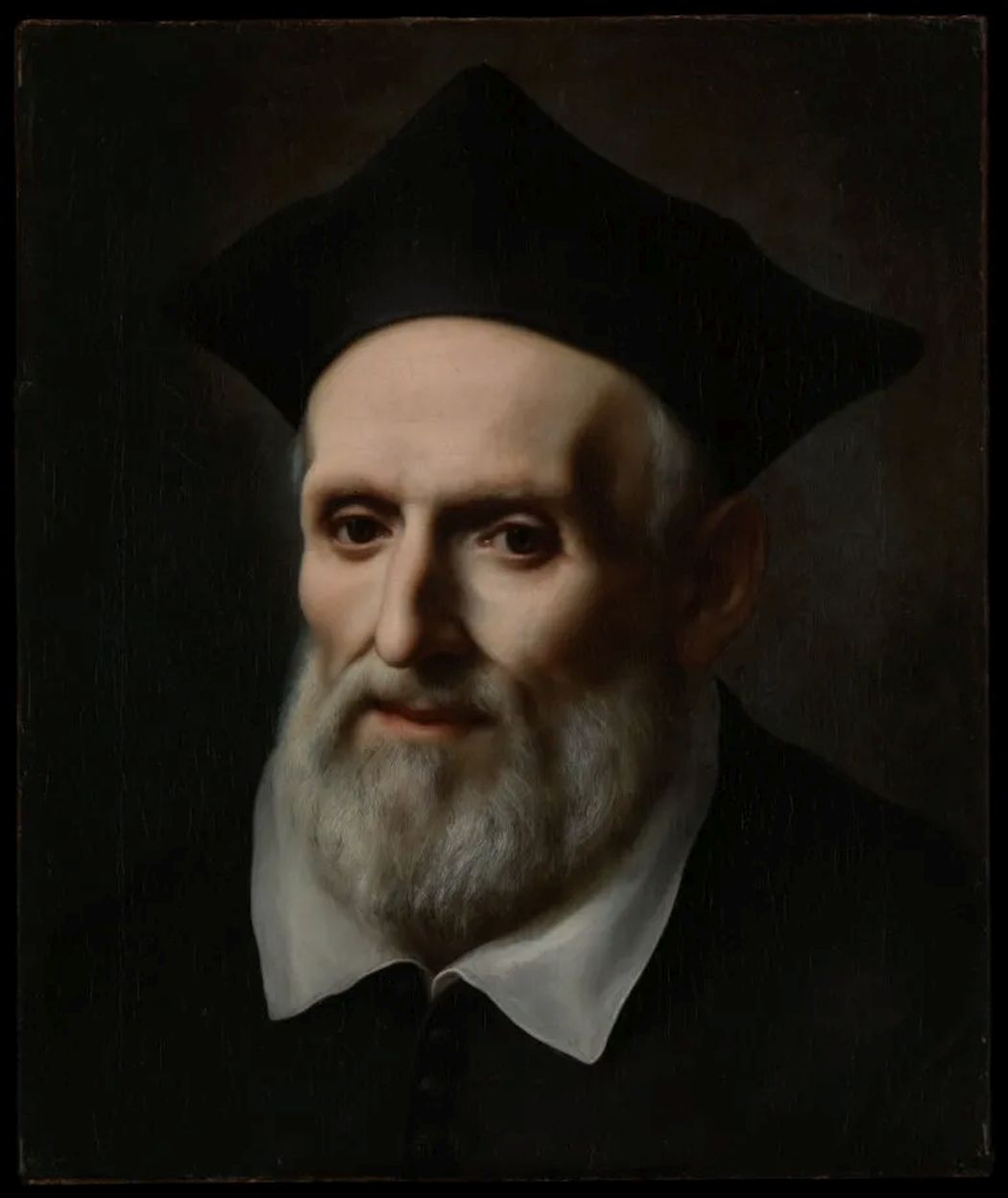
Christ the King Sovereign Priest (ICK). He can be recognized in art by
enflamed heart; a lily; the rosary; and/or an angel holding a book. His
relics may be venerated at Santa Maria in Vallicella, a.k.a. La Chiesa
Nuova in Rome, the principal church of the Oratorians he founded.
Customs
Some may prepare for St. Philip Neri's feast by praying a Novena to St.
Philip Neri beginning on May 17 and ending on May 25, the eve of
his
feast. For the feast itself, try the Litany
of St. Philip Neri or this prayer:
My holy
Advocate, Saint Philip, thou whose heart was so serene in the midst of
adversity, whose spirit was so devoted to suffering, thou who when thou
wast persecuted by the envious, or calumniated by the wicked who sought
to discredit thee, or sorely tried by Our Lord with many persistent and
painful maladies, didst endure it all with an admirable tranquility of
heart and mind; obtain for me also the spirit of fortitude in all the
tribulations of this life.
Thou seest how perturbed and indignant I become at every
light affliction, how angry and resentful at every insignificant
contradiction, and how unable I am to remember that the cross is the
only way to paradise.
Obtain for me perfect patience and readiness like thine in
carrying the crosses which Our Lord daily gives me to carry, so that I
may be made worthy to rejoice with thee in our eternal reward in
heaven. Amen
Pray one Pater,
one Ave, and one Gloria
Those in Rome might celebrate his feast at the Chiesa Nuova or
participate in a
walk to the seven churches. Those in Italy but outside of Rome might
make the 75-mile Cammino di San Filippo Neri pilgrimage
which starts in
Cassino and ends in Gaeta, at its Montagna Spaccata.5
Those in England might consider a trip to the Brompton Oratory (also
known as the London Oratory), founded by Fr. Frederick William Faber in
that country's capital (Fr. Faber is the writer of the hymn "Faith of
Our Fathers"). Not only is it known for its liturgy and music,
especially its choirs, the neo-Baroque church itself is architecturally
beautiful.
People in other parts of the world might enjoy making a pilgrimage to
seven churches, or, because most of us don't live in big cities
that have churches on every other block as Rome does, an Oratorian
church, a church named for St. Philip Neri, or a church known for its
beauty or interesting history. They can do as St. Philip did and pack
along a picnic of bread, cheese, eggs, wine, and fruit to eat along the
way.
Throw in some cookies and coffee for dessert, and bring the music of
Palestrina with you! Those who can't or don't want to leave home could
have a Roman dinner in St. Philip's honor -- after telling those who
eat to come armed with their favorite joke. If the host is bearded and
brave enough to shave half of his face, all the better! Ha!
Otherwise, there are three practices to consider -- not just for today,
but for the rest of your life, the first being
to adopt what Catholics call an "ejaculation"
or "aspiration" -- a very brief prayer -- just a few words -- to
use all throughout the day, especially in times of trouble or distress.
When horrible or amazing things happen, especially suddenly, the
typical modern response is to use language considered to be foul or,
worse, to take Lord Christ's Name in vain.
St. Philip Neri urged the habit of making an ejaculation -- or two or
three -- one's own.
Please do this if you haven't already!
Another practice St. Philip urged is one for those who are tempted by
sins against sexual purity. He had his spiritual children pray the Te lucis ante terminum -- a 7th
century Ambrosian hymn -- before bed.
Te lucis ante
terminum,
rerum Creator, poscimus
ut pro tua clementia
sis praesul et custodia.
Procul recedant somnia
et noctium phantasmata;
hostemque nostrum comprime,
ne polluantur corpora.
Praesta, Pater piissime,
Patrique compar Unice,
cum Spiritu Paraclito
regnans per omne saeculum. Amen.
To Thee, before
the close of day
Creator of the world, we pray
that with Thy wonted favor, Thou
wouldst be our Guard and Keeper now.
From all ill dreams defend our eyes,
from nightly fears and fantasies:
tread under foot our ghostly foe,
that no pollution we may know.
O Father, that we ask be done
through Jesus Christ Thine only Son,
who, with the Holy Ghost and Thee,
shall live and reign eternally. Amen.
And a third practice to consider is engaging in regular Eucharistic Adoration. Periodic,
regular visits to the Blessed Sacrament could only do you good, as
would arranging Quarant'Ore (40 Hours) Devotions, making First Fridays,
or arranging for perpetual adoration at your parish or chapel.
From "The Litrugical Year"
by Dom Prosper
Gueranger
As we have already said, Joy is the leading feature of the Paschal
Season, a supernatural joy, which springs from our delight at seeing
the glorious triumph of our Emmanuel, and from the happiness we feel at
our own being delivered from the bonds of death. This interior Joy was
the characteristic of the Saint whom we honor today. His heart was ever
full of a jubilant enthusiasm for what regards God; so that, we could
truly apply to him those words of Scripture: A secure mind is like a
continual feast (Prov. xv. 15). One of his latest disciples, the
illustrious Father Faber, tells us in his beautiful treatise, Growth in
Holiness, that Cheerfulness is one of the chief means for advancing in
Christian perfection. We, will, therefore, welcome, with gladness and
veneration, the benevolent and light-hearted Philip Neri, the Apostle
of Rome, and one of the greatest Saints produced by the Church in the
16th Century.
Love of God, but a love of the most ardent kind, and one that
communicated itself to all that came near him, was our Saint's
characteristic virtue. All the Saints loved God; for the Love of God is
the first and greatest of the Commandments: but Philip's whole life
was, in an especial manner, the fulfillment of this divine precept. His
entire existence seemed to be but one long transport of Love for his
Creator; and, had it not been for a miracle of God's power and
goodness, this burning Love would have soon put an end to his mortal
career. He was in his twenty-ninth year; when one day, it was within
the Whitsun Octave, he was seized with such a vehemence of divine
charity, that two of his ribs broke, thus making room for the action of
the heart to respond freely to the intensity of the soul's love. The
fracture was never made good; it caused a protrusion which was
distinctly observable; and, owing to this miraculous enlargement of the
region of the heart, Philip was enabled to live fifty years more,
during which time he loved His God with a fervour and strength which
would do honour to one already in heaven.
This Seraph in human flesh was a living answer to the insults heaped
upon the Catholic Church by the so-called Reformation. Luther and
Calvin had called this holy Church the harlot of Babylon; and yet she
had, at that very time, such children as Teresa of Spain, and Philip
Neri of Rome, to offer to the admiration of mankind. But Protestantism
cared little or nothing for piety or charity; its great object was the
throwing off the yoke of restraint. Under pretence of Religious
Liberty, it persecuted them that adhered to the True Faith; it forced
itself by violence, where it could not enter by seduction; but as for
leading men to love their God, this was what it never aimed at or
thought of. The result was, that, wheresoever it imposed its errors,
devotedness was at an end, we mean that devotedness, which leads man to
make sacrifices for God or for his neighbor.
A very long period of time elapsed after the Reformation, before
Protestantism ever gave a thought to the infidels who abounded in
various parts of the globe: and if, later on, it organized what it
calls its Missions, it chose a strange set of men to be the apostles of
its Bible Societies. It has made a recent discovery; it has found out
that the Catholic Church is prolific in Orders and Congregations
devoted to works of Charity. The discovery has excited it to emulation;
and, among its other imitations, it can now boast of having Protestant
Sisters of Charity. To a certain point, success may encourage it to
persevere in these tardy efforts; but anything like the devotedness of
Catholic Institutions is an impossibility for Protestantism, were it
only for this reason, that its principles are opposed to the
Evangelical Counsels, which are the great sources of the spirit of
sacrifice, and are prompted by a motive of the Love of God.
Glory, then, to Philip Neri, one of the worthiest representatives of
Charity in the 16th Century! It was owing to his zeal, that Rome, and
Christendom at large, were replenished with a new life by the
frequentation of the Sacraments and by the exercises of Catholic Piety.
His word, his very look, used to excite people to devotion. His memory
is still held in deep veneration, especially in Rome, where his Feast
is kept with the greatest solemnity on this twenty-sixth day of May. He
shares with Saints Peter and Paul the honour of being Patron of the
Holy City. His Feast is there kept as a day of obligation. The Pope
goes, with great solemnity, to the Church of Saint Mary in Vallicella,
and pays the debt of gratitude which the Holy See owes to the Saint who
accomplished such great things for the glory of our Holy Mother the
Church.
Philip had the gift of miracles; and, though seeking to be forgotten
and despised, he was continually surrounded by people, who besought him
to pray for them, either in their temporal or spiritual concerns. Death
itself was obedient to his command, as in the case of the young prince
Paul Massimo. The young Prince, when breathing his last, desired that
Philip should be sent for, in order that he might assist him to die
happily. The Saint was saying Mass at the time. As soon as the Holy
Sacrifice was over, he repaired to the palace; but he was too late; he
found the father, sister and the whole family in tears. The young
Prince had died after an illness of sixty-five days, which he had borne
with most edifying patience. Philip fell upon his knees; and, after a
fervent prayer, he put his hand on the head of the corpse, and called
the Prince by his name. Thus awakened from the sleep of death, Paul
opened his eyes, and looking at Philip, said to him: "My Father!" He
then added these words: "I only wished to go to Confession." The
assistants left the room, and Philip remained alone with the Prince.
After a few moments, the family were called back; and, in their
presence, Paul began to speak to Philip regarding his mother and sister
who had been taken from him by death, and whom he loved with the
tenderest affection. During the conversation, the Prince's face
regained all it had lost by sickness. His animation was that of one in
perfect health. The Saint then asked him if he would wish to die again?
" Oh! yes:" answered the Prince, "most willingly; for I should then see
my mother and sister in heaven." "Take then," said Philip, "take thy
departure for heaven, and pray to the Lord for me." At these words, the
young Prince expired once more, and entered into the joys of eternal
life, leaving his family to mourn his departure, and venerate a Saint
such as Philip.
He was almost continually visited by our Lord with raptures and
ecstacies; he was gifted with the spirit of prophecy, and could read
the secrets of the conscience. His virtues were such as to draw souls
to him by an irresistible charm. The youth of Rome, rich and poor, used
to flock to him. Some he warned against danger; others he saved, after
they had fallen. The poor and sick were the object of his unceasing
care. He seemed to be everywhere in the City by his works of zeal,
which gave an impulse to piety that has never been forgotten.
Philip was convinced, that one of the principal means for maintaining
the Christian spirit is the preaching the word of God: hence he was
most anxious to provide the Faithful with apostolic men, who would draw
them to God by good and solid preaching. He established, under the name
of The Oratory, an institution, which still exists, and whose object is
to encourage Christian piety among the people. By founding it, Philip
aimed at securing the services, zeal and talent, of priests who are not
called to the Religious Life, but who, by uniting their labours
together, would produce great good to the souls of men (The Oratory
founded by St. Philip is not to be confounded with the Oratoire de
France).
Thus did he afford to Priests, whose vocation does not lead them to the
Religious State, the great advantages of a common rule and mutual good
example, which are such powerful aids both in the service of God, and
in the exercise of pastoral duties. But the holy apostle was a man of
too much Faith not to have an esteem of the Religious Life as a State
of perfection. He never lost an opportunity of encouraging a Vocation
to that holy State. The Religious Orders were indebted to him for so
many members, that his intimate friend and admirer, St. Ignatius of
Loyola, used playfully to compare him to a bell, which calls others to
Church yet never goes in itself!
The awful crisis of the l6th Century, through which the Christian world
had to pass, and which robbed the Catholic Church of so many provinces,
was a source of keenest grief to Philip during the whole of his life.
His heart bled at seeing so many thousand souls fall into the abyss of
error and heresy. He took the deepest interest in the efforts that were
made to reclaim those that had been led astray by the pretended
Reformation. He kept a watchful eye on the tactics wherewith
Protestantism sought to maintain its ground. The "Centuries of
Magdeburg," for example, suggested to his zeal a counterbalance of
truth. The "Centuries" was a series of historical essays, whereby the
Reformers sought to prove that the Roman Church had changed the ancient
Faith, and introduced superstitious practices in the place of those
that were used in the early ages of Christianity. A work like this,
with its falsified quotations, its misrepresentation and, not
unfrequently, its invention, of facts, was destined to do great injury;
and Philip resolved to meet it by a work of profound erudition, a true
history, compiled from authentic sources. One of the fathers of his
Oratory, Caesar Baronius, was just the man for such an undertaking; and
Philip ordered him to take the field against the enemy. The
Ecclesiastical Annals were the fruit of this happy thought; and
Baronius himself, at the beginning of his 8th Book, acknowledges that
Philip was the originator of the work.
Three centuries have passed away since then. It is easy for us, with
the means which science now puts into our hands, to detect certain
imperfections in the Annals; at the same time, it is acknowledged on
all sides, that they form by far the truest and finest History of the
Church of the first twelve hundred years, which is as far as the
learned Cardinal went. Heresy felt the injury it must needs sustain by
such a History. The sickly and untrustworthy erudition of the
Centuriators could not stand before an honest statement of facts; and
we may safely assert, that the progress of Protestantism was checked by
the Annals of Baronius, which showed, that the Church was then, as she
had ever been, the 'pillar and ground of truth (I. Tim. iii. 15).
Philip's sanctity, and Baronius' learning, secured the victory.
Numerous conversions soon followed, consoling the Church for the losses
she had sustained. And if, in these our own days, there are so many
returning to the ancient Faith, it is but fair to attribute the
movement, in part at least, to the success of the historical method
begun by the Annals.
Let us now read
the Liturgical account of the virtues and holy deeds of the Apostle
of Rome in the 16th Century.
Philip Neri was born at Florence, of pious and respectable
parents. From his very childhood, he gave evident promise of future
sanctity. Whilst yet a young man, he gave up an ample fortune which he
inherited from an uncle, and went to Rome, where he studied theology
and philosophy, and devoted himself wholly to the service of Christ
Jesus. Such was his abstemiousness, that he frequently passed three
days without eating anything. He spent much time in watching and
prayer. He frequently made the visit of the Seven Churches of the City,
and was in the habit of spending the night in the Cemetery of Calixtus,
in the contemplation of heavenly things. Being ordained priest out of
obedience, he devoted himself without reserve to the saving souls, and,
even to the last day of his life, he was assiduous in hearing
confessions. He was the spiritual father of a countless number of
souls; and in order to nourish them with the daily food of God's word,
with the frequency of the Sacraments, with application to prayer, and
with other pious exercises, he instituted the congregation of the
Oratory.
He was ever languishing with the love of God, wherewith he
was wounded. Such was the ardour that glowed within him, that, not
being able to keep his heart within its place, his breast was
miraculously enlarged by the breaking and expansion of two of his ribs.
Sometimes, when celebrating Mass, or in fervent prayer, he was seen to
be raised up in the air, and encircled with a bright light. He looked
after the needy and the poor with an all-providing charity. He was once
rewarded by a visit from an Angel, who appeared to him in a beggar's
garb, and Philip gave him an alms. On another occasion, when carrying
loaves to the poor, during the night, he fell into a deep hole, but was
drawn forth by an Angel without having sustained any injury. So humble
was he, that he had an abiding dread of everything that savoured of
honour; and he was most resolute in refusing every ecclesiastical
dignity, though the highest offices were more than once offered to him.
He possessed the gift of prophecy, and could miraculously
read the inmost thoughts of others' souls. Throughout his whole life,
he preserved his chastity unsullied. He had also a supernatural power
of distinguishing those who were chaste from those who were not so. He
sometimes appeared to persons who were at a distance, and assisted them
in moments of danger. He restored to health many that were sick and at
death's door. He also restored a dead man to life. He was frequently
favoured with apparitions of heavenly Spirits and of the Blessed Mother
of God. He saw the souls of several persons ascending, amidst great
brightness, into heaven. At length, being in his eightieth year, he
slept in the Lord; it was in the year of our Redemption 1595, the
eighth of the Calends of June (May 25th), the feast of Corpus Christi,
after having said Mass with extraordinary spiritual joy, and at the
very hour which he had foretold, which was shortly after midnight. The
miracles, wherewith he had been honoured, being authentically proved,
he was canonized by Pope Gregory the Fifteenth.
Thy whole life, O Philip, was one long act of Love of Jesus; but it
was, also, one untiring effort to make others know and love Him, and
thus secure the end for which they were created. Thou wast the
indefatigable Apostle of Rome for forty years, and no one could
approach thee without receiving something of the divine ardour that
filled thy heart. We, too, would fain receive of thy fullness of
devotion; and therefore we pray thee to teach us how to love our Risen
Jesus. It is not enough that we adore Him and rejoice in His triumph;
we must love Him: for He has permitted us to celebrate the various
Mysteries of his Life on earth, with a view to our seeing more and more
clearly how deserving He is of our warmest love. It is Love that will
lead us to the full appreciation of His Resurrection, that bright
Mystery which shows us all the riches of the Sacred Heart. The New
Life, which He put on by rising from the Tomb, teaches us, more
eloquently than ever, how tenderly He loves us, and how earnestly He
importunes us to love Him in return. Pray for us, O Philip, that our
heart and our flesh may rejoice in the Living God (Ps. lxxxiii. 2)! Now
that we have relished the mystery of the Pasch, lead us to that of the
Ascension; prepare our souls to receive the Holy Spirit at Pentecost;
and when the august mystery of the Eucharist beams upon us, with all
its loveliness, in the approaching Festival, the very day that ushered
thee into the unveiled vision of thy Jesus, intercede for us, that we
may receive and relish that Living Bread, which giveth Life to the
world (St. John, vi. 33)!
The Sanctity that shone in thee, O Philip, was marked by the
impetuosity of thy soul's longing after her God; and all they that held
intercourse with thee, quickly imbibed thy spirit, which, in truth, is
the only one that contents our Redeemer's Heart. Thou hadst the talent
of winning souls, and leading them to perfection by the path of
confidence and generosity. In this great work, thy method consisted in
having none; thus imitating the Apostles and ancient Fathers, and
trusting to the power of God's own word. It was by thee that the
frequenting the Sacraments was restored, that surest indication of the
Christian spirit. Pray for the faithful of our times, and come to the
assistance of so many souls that are anxiously pursuing systems of
spirituality which have been coined by the hands of men, and which but
too frequently retard or even impede the intimate union of the Creature
with his Creator.
Thy love of the Church, O Philip, was most fervent: there can be no
true sanctity without it. Though thy contemplation was of the sublimest
kind, yet did it not make thee lose sight of the cruel trials which
this holy Spouse of Christ had to endure in those sad times. The
successful efforts of heresy stimulated thy zeal: oh! get us that keen
sympathy for our holy Faith, which will make us take an interest in all
that concerns its progress. It is not enough for us that we save our
own souls; we must, moreover, ardently desire, and do our utmost to
obtain the advancement of God's Kingdom on earth, the extirpation of
heresy, and the exaltation of our holy Mother the Church: if these are
not our dispositions, how can we call ourselves Children of God? May
thy example urge us to take to heart the sacred cause of our common
Mother. Pray, too, for the Church militant, of which thou wast one of
the bravest soldiers. Shield with thy protection that Rome which loves
thee so devoutly because of the services which she received at thy
hands. Thou didst lead her children to holiness during thy mortal
career; bless her and defend her now that thou art in heaven. Amen.
Footnotes:
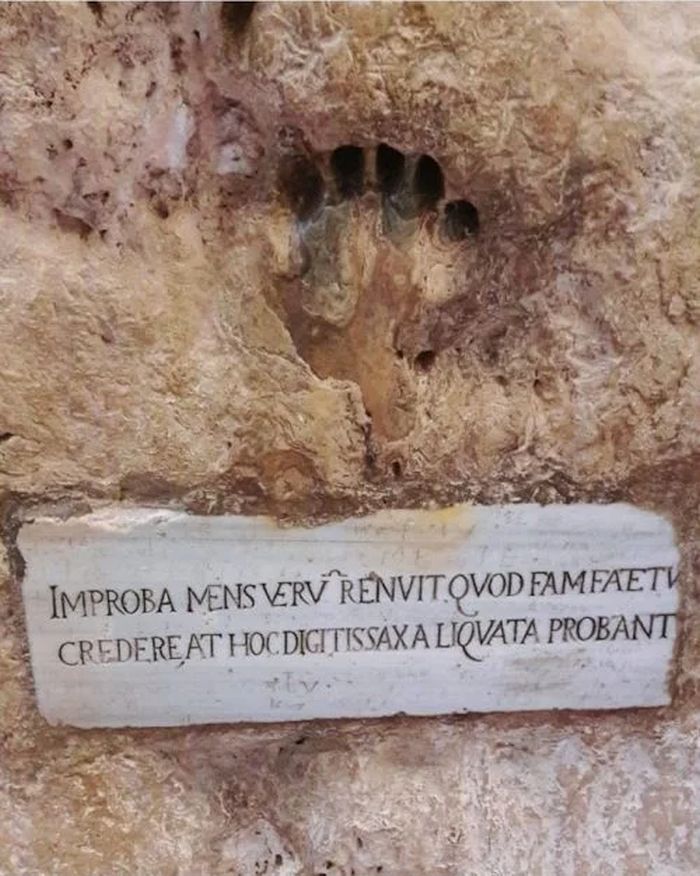
1 La Montagna Spaccata has a number of
interesting features. One of them is La
Mano del Turco -- the Turk's Hand, which formed when, in the
15th century, a Saracen sailor was mocking the idea of the mountain
having split in three at the Crucifixion. He laughed and, slapping the
wall of the mountain to make his point, said, "If that were the case,
this mountain must be made of cheese!" But when he slapped the wall,
his fingers sank deeply into the stone, and when he took his hand away,
the imprint of where he'd touched the wall remained. A sign in Latin
near the handprint reads: “Improba mens verum renuit quod fama fatetur,
crede at hoc digitis saxa liquata probant.” (“He didn't want to believe
what tradition says, but this rock that softened under his fingers
proves it.”)
Another is la Cappella del Crocifisso
(Chapel of the Crucifix) built high up in one of the crevices. It's
traditional for sailors sailing by it on the Gulf of Gaeta to salute
the Crucifix with their guns (it is near this chapel where St. Philip
Neri's bed can be found).
A Via Crucis (Way of the Cross) beginning
at the Most Holy Trinity Sanctuary leads past the Turk's hand, St.
Philip Neri's stone bed, and ends at the Chapel of the Crucifix.
2 The Church of San Girolamo della Carità
was once the home of St. Paula of Rome. Here, she hosted St. Jerome
when he was Pope Damasus's secretary, and when he translated the Hebrew
scriptures into the Latin Vulgate. It later became a Franciscan
hospice, and was later the first meeting place of St. Philip of Neri's
Oratorians.
3 Note that St. Francis de Sales and St. John
Henry Cardinal Newman became Oratorians in their times. Below you can
see the Oratorian collar as worn by John Henry Newman (you can also see
it in the painting at the top of this page): .
4
Detail from the ceiling over the nave of the Chiesa Nuova. It depicts
the Blessed Virgin holding up the ceiling of the church as it was being
rebuilt:
5
Information about the Cammino di San Filippo Neri may be found here:
https://www.camminodisanfilipponeri.com/