``Where
the Bishop is, there let the multitude of believers be;
even as where Jesus is, there is the Catholic Church'' Ignatius of
Antioch, 1st c. A.D
Feast of St. Vincent de Paul
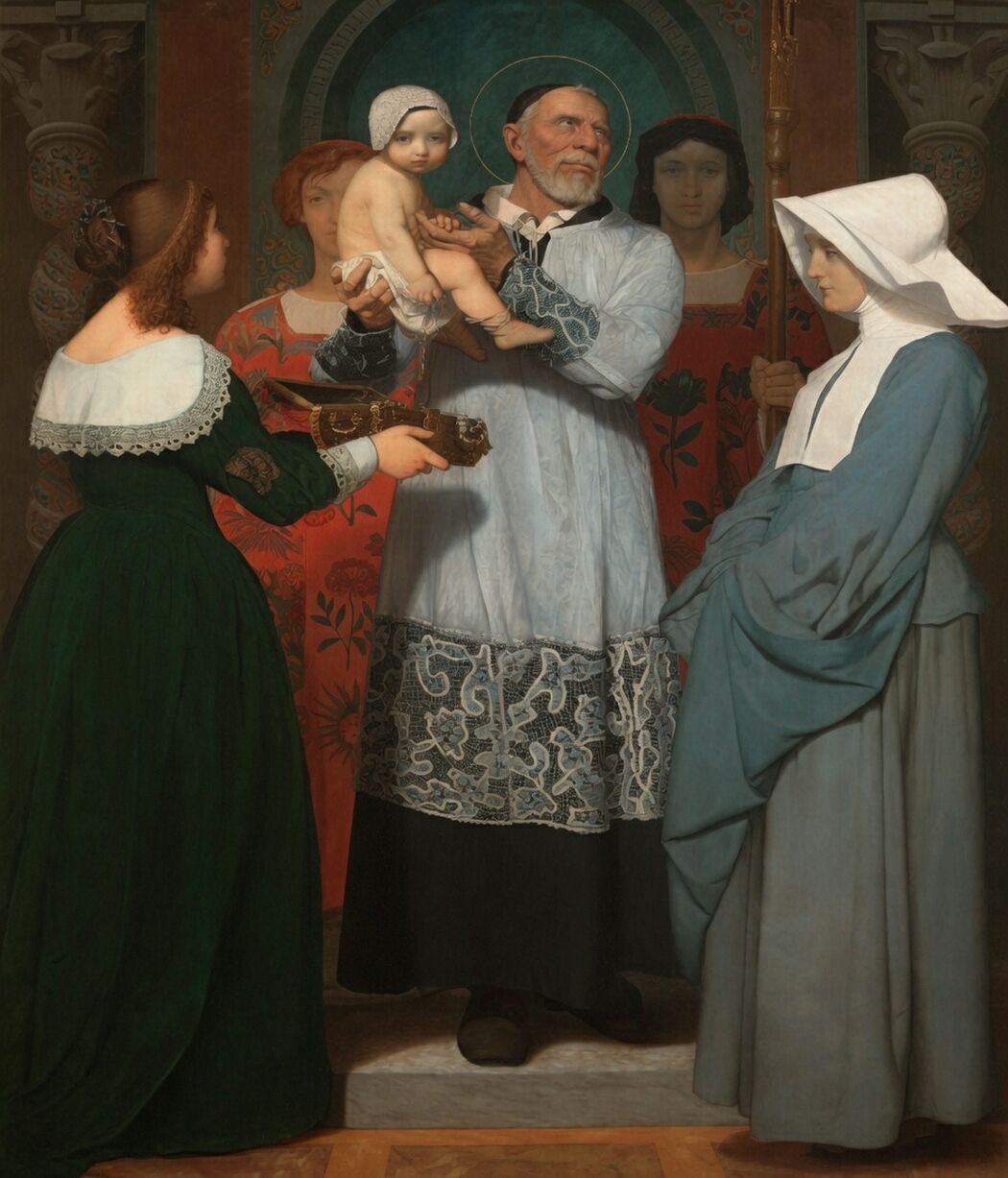
St. Vincent de
Paul was born on April 24, 1581 in a tiny village once known as Le
Pouy, but which is now called Saint-Vincent-de-Paul. It can be found in
the shadow of the Pyrenees Mountains, in the department of Landes, in
the region of Nouvelle-Aquitaine -- a part of France that used to be
called Gascony. His parents were neither rich, nor poor. They worked
hard for a living and got by raising livestock, which
Vincent tended.
But Vincent was a clever kid, and his parents wanted more out of him.
So, when he was 15, they scraped together the money needed to send him
to be
educated at the nearby
Franciscan College. An attorney at the college took an interest in him,
allowing Vincent to live with him, helping his parents pay for his
tuition, and urging him to study for the priesthood. Those urgings paid
off, and Vincent then went to study theology at the University of
Toulouse. He was ordaind a deacon at the cathedral in the town of
Tarbes in 1598, and was ordained a priest at the Château-l'Évêque near
Périgueux two years later. Then, five years after that...
<record scratch>
... he became a slave.
You see, an old woman from Toulouse had died and left him a little bit
of property. He went to Marseille to settle things, took a boat to get
back to Toulouse, but was ambushed en route by Barbary pirates --
Corsairs, as they were called. Muslims slavers. Muslims had been
slaughtering and enslaving Christians since the time of Mohammed, and
their predations grew even worse in the 16th century. They'd raid the
coasts of Europe, from Italy all the way up to England and Ireland,
kidnapping Christians wherever they went. -- around 1,250,000 of them
between the years of 1530 and 1780.
Two or three men on Vincent's boat were killed in the skirmish, and
Vincent himself was injured by an arrow. Then he was put in chains,
taken to Tunis in North Africa, and sold in a slave market. A fisherman
bought him, but had to re-sell him when he discovered Vincent's
seasickness, which made him worthless as a fisherman's slave. A
philosopher-alchemist bought him, but en route to Turkey, died. So
Vincent was sold once again, for a third and final time, being bought
by a man from Nice who'd been a Catholic priest, but who himself had
been kidnapped and taken away into slavery. He apostasized to save
himself from that fate, becoming Muslim and eventually marrying three
women. Vincent was able to "re-convert" the man, and, after ten months,
they found a chance to escape, which they took, making their way back
to France in a little boat. Vincent had been gone for two years.
After that ordeal, he spent a little time studying in Rome, and then
went to Paris, living in the Hôpital de la Charité at 45-47 Rue des
Saints-Pères. Here, he endured a calumny that truly humbled him yet
again: his
roommate accused him of theft after some valuables and money
disappeared from their room. The roommate accused Vincent
publicly, slandering him and tarnishing his name. Vincent bore the
humiliation
with patience and grace, and soon enough, the true thief was
discovered.
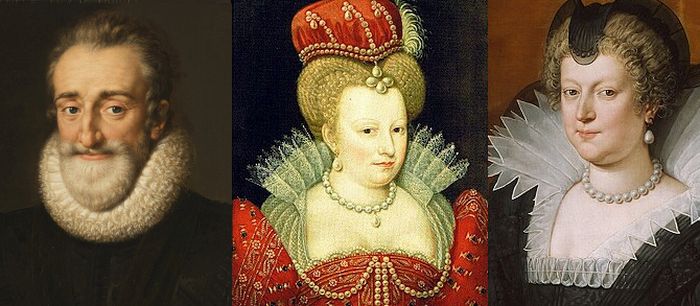
Now, the hospital in which Vincent lived was built by Queen Marie
de Médici, the
second wife of King Henry IV, the Huguenot Protestant. And the first
wife of Henry IV, whose marriage to the king
had been
annuled? That was the Catholic Queen Margaret of Valois, and the
annulment had been against her will, only consented to after she was
exiled for 20 years. After the annulment, and after she and the king
made some sort of peace in spite of his having a second wife, she
returned to Paris. And, through a friend of his, Vincent became her
chaplain.
Henry IV, Margaret of Valois, and Marie de
Medici
His hobnobbing
with royalty allowed him to meet a man who would change his life:
Cardinal de Berulle. Cardinal de Berulle did many great things for the
Church in France: he brought in the Discalced Carmelites founded by St. Teresa of Avila; following in
the footsteps of St. Philip Neri, he
would set up the first Oratory in France; and he mentored St. Francis de Sales. He did
great things for Vincent as well; he was a mystic, the leader of the
"French School of Spirituality" which stressed God's majesty and
Mystery and our total reliance on Lord Christ. His thoughts inspired
Vincent to
take his priesthood much more seriously, and to strive to serve Christ
more intensely. And the way he chose to do that was to serve the poor,
the sick, the orphans, and the slaves. After all, Christ Himself said,
Matthew 25:31-46
And when the Son of man shall come in his majesty, and all
the angels with him, then shall he sit upon the seat of his majesty.
And all nations shall be gathered together before him, and he shall
separate them one from another, as the shepherd separateth the sheep
from the goats: And he shall set the sheep on his right hand, but the
goats on his left.
Then shall the king say to them that shall be on his right
hand: Come, ye blessed of my Father, possess you the kingdom prepared
for you from the foundation of the world. For I was hungry, and
you gave me to eat; I was thirsty, and you gave me to drink; I was a
stranger, and you took me in: Naked, and you covered me: sick, and you
visited me: I was in prison, and you came to me.
Then shall the just answer him, saying: Lord, when did we see
thee hungry, and fed thee; thirsty, and gave thee drink? And when did
we see thee a stranger, and took thee in? or naked, and covered thee?
Or when did we see thee sick or in prison, and came to thee?
And the king answering, shall say to them: Amen I say to you,
as long as you did it to one of these my least brethren, you did it to
me.
Then he shall say to them also that shall be on his left
hand: Depart from me, you cursed, into everlasting fire which was
prepared for the devil and his angels. For I was hungry, and you gave
me not to eat: I was thirsty, and you gave me not to drink.I was a
stranger, and you took me not in: naked, and you covered me not: sick
and in prison, and you did not visit me.
Then they also shall answer him, saying: Lord, when did we
see thee hungry, or thirsty, or a stranger, or naked, or sick, or in
prison, and did not minister to thee? Then he shall answer them,
saying: Amen I say to you, as long as you did it not to one of these
least, neither did you do it to me. And these shall go into everlasting
punishment: but the just, into life everlasting.
So Cardinal Berulle sent him to work in a rural parish called Clichy,
just outside of Paris. He was such a good shephered to the peasants
there, and inspired them so well to live holy lives, that a religious
who came to preach a sermon there said, "I found these worthy folk
living the lives of angels. I felt in truth that I was carrying light
to the sun." Vincent was very happy there, too, but that appointment
would only last a year; Cardinal Berulle then sent him to be chaplain
and tutor to the de Gondi family -- a family of rich Florentine nobles
living in Paris -- which he did for four years. He much preferred to be
among the peasants, but this appointment will soon prove to be very
providential.
Next he was sent to Chatillon des Dombes, about 35 miles northeast of
Lyon -- a big country town filled with Huguenots. His preaching,
charity, and demeanor won back the souls of many of the Protestant
heretics and those who'd grown lax, including the Comte de Rougemont, a
famous duelist who smashed his sword againt a rock bcause he loved it
inordinately.
Most importantly, it was in this town that he started what might be
thought of as his "army against poverty": the Confraternity of Charity.
He gathered the women of his parish together, organized them by naming
a president, secretary, and treasurer, and wrote for them a rule. An
excerpt:
The first thing
she (the president) will do is to see if the invalid has need of a
white nightgown, or a white shroud. She will then persuade him to
confess his sins and to go to communion on the following morning. She
will take him a crucifix, which she will hang up in some place where he
may fix his eyes upon it and will provide him with anything else of
which he may have need.
Each of the servants of the poor in turn will carry them
their food and wait upon them for the day. She whose turn it is, having
taken from the treasury the necessary sum, will prepare the dinner and
take it to the sick. She will greet the patient cheerfully and
lovingly, set a little table on the bed, placing on it napkin, bowl,
spoon and bread. She will then wash his hands, say grace, pour out the
soup, and dish the meat, arranging all upon the little table, and then
coax the invalid to eat for the love of God and of his holy Mother. All
with as much love as though it were for her own son, or, rather, for
God, who accepts as done to Himself what we do for His poor. She will
whisper to him some little word about Our Lord, should he be very low;
she will cut up his meat and pour out his drink, and having started him
on his meal, will leave him, if there is anyone to attend to him, and
go in search of someone else to care forin like manner.
This Confraternity of Charity caught on and spread all over France.
Meanwhile, the de Gondi family wanted VIncent to come back to them. All
along, they'd been sending him letters and, apparently, trying to
persuade Cardinal Berulle to make him return. Berulle must have been
convinced because, soon enough, he ordered Vincent to return to them.
Vincent told the de Gondis about the appalling state of the peasantry,
about their religious ignorance, their poverty. He rallied the Jesuits
from Amiens to help, and then great Doctors from the Sorbonne got
involved. Madame de Gondi funded him, using her wealth to further the
cause and leaving him money in her will.
After she died in 1625, he gathered together priests and formed a
society of apostolic life called the Congregation of the Mission, known
as "Vincentians" or "Lazarists" -- that latter name "Lazarists"
stemming from
the fact that he moved them to the Priory of St. Lazare in Paris. These
Vincentian priests had as their focus serving the rural poor. They
also tended to prisoners who were condemned to work on the galleys --
French warships. These prisoners were held in terrible conditions both
in the prison system, and on the warships they eventually were made to
power through oaring. St. Vincent sent a mission to Marseille to
evangelize and
build a hospital for these men.
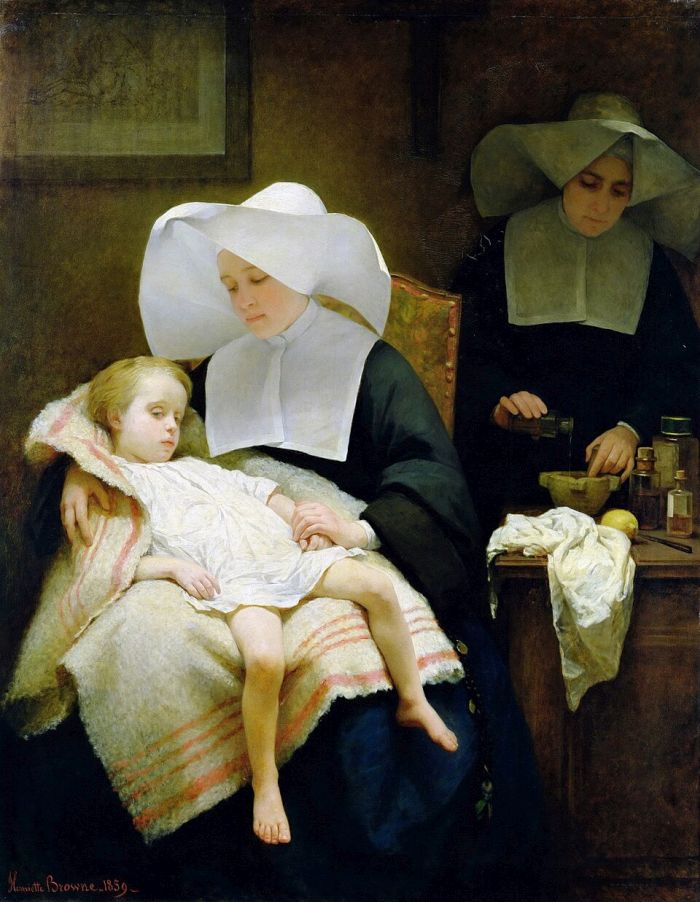
In 1633, he formed a society of apostolic life for women to do the same
sort of work, minus priestly duties: the Daughters of Charity, with
their motherhouse at 140 Rue du Bac in Paris. This group of religious
sisters
-- once easily recognizable by their distinct cornette headdresses,
which were then fashionable in the Ile de France -- did what the lay
Confraternity of Charity did, but in a much more organized fashion, and
with religious vows. With their motto "The charity of Christ compels
us!", they didn't stay cloistered in a convent; they went out into the
streets, and went on to set up orphanages, soup kitchens, homes for the
aged, and schools -- first all over France, then all
over the world. They came, in time, to include St. Catherine Labouré,
with her devotion to the Immaculate Heart, and,
in America,
St. Elizabeth Ann Seton, in her modified
habit with its black bonnet.
Then Vincent set about dealing with a problem that seems to be present
in
every age: ignorant, corrupt clergy. He set up retreats for
seminarians, and "Tuesday Conferences" -- rather like St. Philip Neri's
Oratories -- for priests at the St. Lazare priory, for the purpose of
brotherly support among priests and ongoing spiritual formation.
Typical of his advice to priests is this --
Our vocation is
to go and enflame the heart of men, to do what the Son of God did, He
who brought fire into the world to set it alight with His love. What
else can we wish for, than for it to burn and consume all things?
Thus it is true that I have been sent not only to love God,
but also to make men love Him.
It is not enough to love God if my neighbour does not love
Him. I must love my neighbour as the image of God and the object of His
love, and do everything so that in their turn men love their Creator
Who knows and considers them as His brothers, whom He has saved; I must
obtain that they love each other with mutual love, out of love for God
who loved them to the point of abandoning to death His very Son. So
that is my duty. Now, if it is true that we are called to bear God's
love near and far, if we must set nations alight, if our vocation is to
go and spread this divine fire in the whole world, if it is so, my
brothers, if it is really so, how must I myself burn of this divine
fire!
-- and this exhortation to priestly humility:
Fly as far
as possible from ever appearing to be anything. Do not seek honours
which are but the smoke of hell. Do not even seek esteem. Did you
become priests in order that people might think well of you and call
you a great preacher -- or to be praised and flattered on all sides?
Lose no opportunity to annihilate yourselves. I beseech you in all your
work to look for nothing but shame and ignominy, and in the end the
death that shall please God.
He went on to set up seminaries to ensure good priestly formation,
emphasizing his "Little Method" -- preaching without high-faluting
language, without showing off one's erudition, preaching for the very
real purpose of saving souls. So successful were his efforts that
Bishops from all over France clamored to get him to build seminaries in
their dioceses.
After the death of Henry IV's successor, Louis XIII, Louis's wife, Anne
of Austria, nominated Vincent to the Conseil de Conscience. You see,
back in the day, French royalty had the prerogative of nominating
Bishops, subject to papal approval, which they almost always got. The
Conseil de Conscience acted as advisors to the royals in this regard,
so Vincent came to have some power in the French ecclesiastical world.
He
used that power for good, eliminating those ill-suited to the task of
saving souls, and
promoting those who truly loved Christ and His Church.
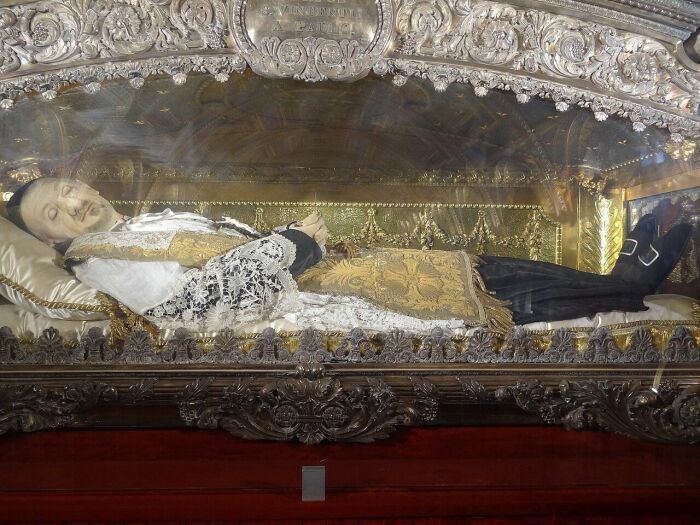
Vincent died on September 27, 1660, at the age of 79. He was exhumed 53
years after his death, in 1712, and only his eyes and nose showed any
decay. He was exhumed again in 1737 in preparation for canonization,
which took place that year, and his relics were exhumed yet again when
they had to be hidden when the Lazare Priory was sacked during the
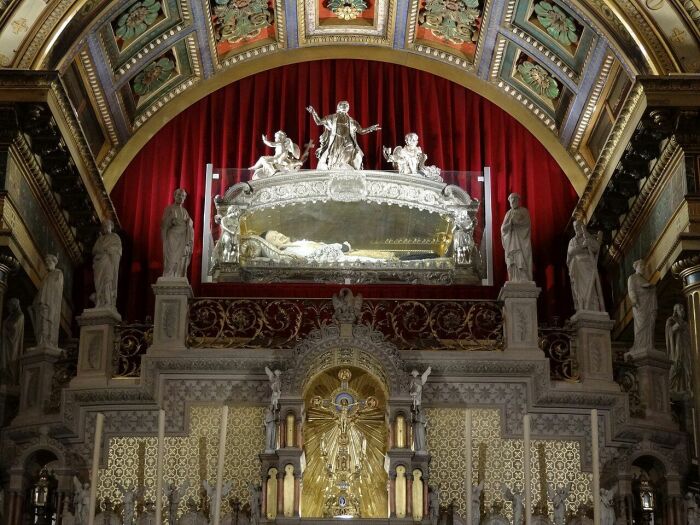
odious French Revolution. Then, in the 19th
century, a chapel -- la Chapelle Saint-Vincent-de-Paul -- was
built
near the Lazarist motherhouse that was built after the Revolution. Most
of St. Vincent's relics now lie there encased in a wax effigy inside a
silver and glass casket-like reliquary above the altar, but
his heart is kept at the motherhouse of the Daughters of Charity on Rue
du Bac.
St. Vincent de
Paul, the "Apostle of Charity," is the patron Saint of charities and
charity workers; hospitals;
lepers; and prisoners. His feast is on July 19 per the 1962
calendar, but on September 27 in the Novus Ordo. He is usually depicted
in art as a kindly-looking, gray-haired man dressed in clerical garb
and surrounded by the poor.
The St. Vincent de
Paul Society
In 1833, 173 years after St. Vincent's death, French students, led by
Blessed Frédéric Ozanam -- an attorney, and professor at the Sorbonne
-- formed the St. Vincent de Paul Society, a group of lay people who
helped the poor who lived in the slums of Paris. Their motto: "No work
of
charity is foreign to the Society." The Society and their focus grew
rapidly and the former now
consists of hundreds of thousands of members from over 150 countries.
They are grouped by Diocesan Councils, which consist of groups called
"Conferences," which are usually parish-based groups.
These Vincentians help by making home visits to those in need and
engaging with them one on one to offer help and friendship. They also
run food pantries, soup kitchens, urban farms, homeless shelters, and
thrift stores, and distribute clothing, and emergency funding to help
the poor with rent and utility bills. Those who are able also run
medical and dental clinics for those in need. You can think of them as
"the Catholic Salvation Army" -- except the Vincentians came first;
the Salvation Army came 32 years later. I just wish we'd thought up the
idea of using
red kettles and ringing bells at Christmas. Alas.
Customs
Some may prepare for this feast by praying the Novena to St. Vincent de Paul starting
on July 10 and ending on July 18, the eve of his feast (note that his
feast falls on September 27 in the Novus Ordo, so for people using the
new calendar, his novena would
begin on September 19). For his feast itself, try the Litany of St. Vincent de Paul
or this shorter prayer:
O glorious Saint
Vincent, heavenly patron of all charitable associations and father of
all who are in misery, whilst thou wast on earth thou didst never cast
out any who came to thee; ah, consider by what evils we are oppressed
and come to our assistance! Obtain from thy Lord help for the poor,
relief for the infirm, consolation for the afflicted, protection for
the abandoned, a spirit of generosity for the rich, the grace of
conversion for sinners, zeal for priests, peace for the Church,
tranquillity and order for all nations, and salvation for them all.
Yea, let all men prove the effects of thy merciful intercession, so
that, being helped by thee in the miseries of this life, we may be
united to thee in the life to come, where there shall be no more grief,
nor weeping, nor sorrow, but joy and gladness and everlasting
happiness. Amen.
Those in France who'd like to make a pilgrimage
today can find the
sites relevant to St. Vincent's life on the map below. Others may just
like to see the pictures of these places. You'll have to
zoom in closely over Paris to see all the starred sites:
There are no foods traditionally eaten on the Feast of St. Vincent de
Paul that I'm aware of, but a French site about him that I read said
there'd likely have almost always been a pot of millet on the stove
when he was a child in Gascony. So, a French recipe for millet:
Bouillie de Mil (Millet Porridge)
1 cup hulled millet
2 cups water
1 1/2 cups milk
1 pinch of salt
Sweet option:
tsp vanilla extract
1/2 tsp ground cinnamon
1-2 tbsp maple syrup, honey, or brown sugar
Put the millet straight into a saucepan over medium-low heat
and toast for 3-5 minutes until lightly browned and fragrant.
Add water, bring to a boil, then reduce the heat to a low
simmer. Cook for about 10 minutes until the water is mostly absorbed.
Add the milk and salt. Return to a gentle simmer and cook for
another 10 to 15 minutes, stirring occasionally, until the millet is
tender and has a soft, creamy consistency.
Remove from heat and decide if you want to go sweet or
savory. If you want a sweet porridge, stir in the vanilla, cinnamon,
and sweetener and let it sit for a minute or two to thicken (you can
also add chopped nuts, fruits, etc.) To go savory, let it sit for a
minute or two to thicken, and then treat it like grits, eating it along
with roasted meat and vegetables (you can stir in a bit of butter,
grated cheese, etc. to lively if up, if you like).
As to music for the day, there is this French song you might enjoy,
"Saint Vincent de Paul" by
Jean-Claude Gianadda:
Comme un grand
feu
Qui chante et danse et nous éclaire,
Un feu vivant,
Un feu puissant,
Comme un grand feu,
Une espérance qui libère.
Il est présent
Monsieur Vincent
Il est présent
Monsieur Vincent.
Il est présent dans notre monde
Lorsque la charité abonde,
Dans tous les gestes généreux
Bienheureux les cœurs audacieux.
Il est présent et il s’immisce
Dans les démarches de justice,
Là où l’on donne sans retour
Bienheureux, les cœurs pleins d’amour.
Il est présent dans notre zèle
Pour une société plus belle,
Pour dessiner un arc-en-ciel
Bienheureux les cœurs fraternels.
Like a great fire
That sings and dances and lights our way,
A living fire,
A mighty fire,
Like a great fire —
A hope that sets us free.
He is present,
Monsieur Vincent,
He is present,
Monsieur Vincent.
He is present in our world
When charity abounds,
In every generous act,
Blessed are the daring hearts.
He is present and he slips in
To every work of justice,
Where one gives without return,
Blessed are the hearts full of love.
He is present in our zeal
For a more beautiful society,
To paint a rainbow in the sky,
Blessed are the fraternal hearts.
There is a movie about our Saint that you might like to see: "Monsieur Vincent" (1947), and your
children may like these St.
Vincent de Paul coloring pages (pdf),
which includes a Daughter of Charity to color in.
More importantly, though, today is a day to think about how well you
love God by loving your neighbors. How do you care for the poor, needy,
sick, and aged? If you're a mother or father with a young family, you
likely don't have much time to volunteer or money to donate, but one
thing you can do is to go through your house and gather up things you
no longer need, clean them up well, and give them to the St. Vincent de
Paul Society. If you do have time to volunteer, try contacting your
local St. Vincent de Paul Society Conference (see your diocese's
website or the website of the St.Vincent de Paul Society) and consider
becoming a Vincentian.
Learn more about St. Vincent de Paul from these books, in pdf format,
from this site's Catholic Library:
From "The
Liturgical Year"
by Dom Prosper
Gueranger
Vincent was a man of faith that worketh by charity. At the time he came
into the world, viz., at the close of the same century in which Calvin
was born, the Church was mourning over many nations separated from the
faith; the Turks were harassing all the coasts of the Mediterranean.
France, worn out by forty years of religious strife, was shaking off
the yoke of heresy from within, while by a foolish stroke of policy she
gave it external liberty. The Eastern and Northern frontiers were
suffering the most terrible devastations, and the West and center were
the scene of civil strife and anarchy. In this state of confusion, the
condition of souls was still more lamentable. In the towns alone was
there any sort of quiet, any possibility of prayer. The country people,
forgotten, sacrificed, subject to the utmost miseries, had none to
support and direct them but a clergy too often abandoned by their
bishops, unworthy of the ministry, and well-nigh as ignorant as their
flocks. Vincent was raised up by the Holy Spirit to obviate all these
evils.
The world admires the works of the humble shepherd of Buglose, but it
knows not the secret of their vitality. Philanthropy would imitate
them; but its establishments of today are destroyed tomorrow, like
castles built by children in the sand, while the institution it would
fain supersede remains strong and unchanged, the only one capable of
meeting the necessities of suffering humanity. The reason of this is
not far to seek: faith alone can understand the mystery of suffering,
having penetrated its secret in the Passion of our Lord; and charity
that would be stable must be founded on faith. Vincent loved the poor
because he loved the God whom his faith beheld in them. “O God!” he
used to say, “it does us good to see the poor, if we look at them in
the light of God, and think of the high esteem in which Jesus Christ
holds them. Often enough they have scarcely the appearance or the
intelligence of reasonable beings, so rude and so earthly are they. But
look at them by the light of faith, and you will see that they
represent the Son of God, who chose to be poor; he in his Passion had
scarcely the appearance of a man; he seemed to the Gentiles to be a
fool, and to the Jews a stumbling-block, moreover he calls himself the
evangelist of the poor: evangelizare pauperibus misit me.”
This title of evangelist of the poor, is the one that Vincent
ambitioned for himself; the starting point and the explanation of all
that he did in the Church. His one aim was to labor for the poor and
the outcast; all the rest, he said, was but secondary. And he added,
speaking to his sons of St. Lazare: “We should never have labored for
the candidates for priesthood, nor in the ecclesiastical seminaries,
had we not deemed it necessary in order to keep the people in good
condition, to preserve in them the fruits of the missions, and to
procure them good priests.” That he might be able to consolidate his
work in all its aspects, our Lord inspired Ann of Austria to make him a
member of the Council of Conscience, and to place in his hands the
office of extirpating the abuses among the higher clergy and of
appointing pastors to the churches of France. We cannot here relate the
history of a man in whom universal charity was, as it were,
personified. But from the bagnio of Tunis where he was a slave, to the
ruined provinces for which he found millions of money, all the labors
he underwent for the relief of every physical suffering, were inspired
by his zeal for the apostolate: by caring for the body, he strove to
reach and succor the soul.
At a time when men rejected the Gospel while striving to retain its
benefits, certain wise men attributed Vincent’s charity to philosophy.
Nowadays they go further still, and in order logically to deny the
author of the works, they deny the works themselves. But if any there
be who still hold the former opinion, let them listen to his own words,
and then judge of his principles: “What is done for charity’s sake, is
done for God. It is not enough for us that we love God ourselves; our
neighbor also must love him; neither can we love our neighbor as
ourselves unless we procure for him the good we are bound to desire for
ourselves, viz.: divine love, which unites us to our Sovereign Good. We
must love our neighbor as the image of God and the object of his love,
and must try to make men love their Creator in return, and love one
another also with mutual charity for the love of God, who so loved them
as to deliver his own Son to death for them. But let us, I beg of you,
look upon this Divine Savior as a perfect pattern of the charity we
must bear to our neighbor.”
The theophilanthropy of a century ago had no more right than had an
atheist or a deist philosophy to rank Vincent, as it did, among the
great men of its Calendar. Not nature, nor the pretended divinities of
false science, but the God of Christians, the God who became Man to
save us by taking our miseries upon himself, was the sole inspirer of
the greatest modern benefactor of the human race, whose favorite saying
was: “Nothing pleases me except in Jesus Christ.” He observed the right
order of charity, striving for the reign of his Divine Master, first in
his own soul, then in others; and, far from acting of his own accord by
the dictates of reason alone, he would rather have remained hidden
forever in the face of the Lord, and have left but an unknown name
behind him.
“Let us honor,” he wrote, “the hidden state of the Son of God. There is
our center: there is what he requires of us for the present, for the
future, for ever; unless his Divine Majesty makes known in his own
unmistakable way that he demands something else of us. Let us
especially honor this Divine Master’s moderation in action. He would
not always do all that he could do, in order to teach us to be
satisfied when it is not expedient to do all that we are able, but only
as much as is seasonable to charity and conformable to the Will of God.
How royally do those honor our Lord who follow his holy Providence and
do not try to beforehand with it! Do you not, and rightly, wish your
servant to do nothing without your orders? and if this is reasonable
between man and man, how much more so between the Creator and the
creature!” Vincent then was anxious, according to his own expression,
to “keep alongside of Providence,” and not to outstep it. Thus he
waited seven years before accepting the offers of the General de
Gondi’s wife, and founding his establishment of the Missions. Thus,
too, when his faithful coadjutrix, Mademoiselle Le Gras, felt called to
devote herself to the spiritual service of the Daughters of Charity,
then living without any bond or common life, as simple assistants to
the ladies of quality whom the man of God assembled in his
Confraternities, he first tried her for a very long time. “As to this
occupation,” he wrote, in answer to her repeated petitions, “I beg of
you, once for all, not to think of it until our Lord makes known his
Will. You wish to become the servant of these poor girls, and God wants
you to be his servant.” For God’s sake, Mademoiselle, let your heart
imitate the tranquility of our Lord’s heart, and then it will be fit to
serve him. The Kingdom of God is peace in the Holy Ghost; he will reign
in you if you are in peace. Be so then, if you please, and do honor to
the God of peace and love.”
What a lesson given to the feverish zeal of an age like ours, by a man
whose life was so full! How often, in what we can call good works, do
human pretensions sterilize grace by contradicting the Holy Ghost!
Whereas, Vincent de Paul, who considered himself, “a poor worm creeping
on the earth, not knowing where he goes, but only seeking to be hidden
in thee, my God, who art all his desire,”—the humble Vincent saw his
work prosper far more than a thousand others, and almost without his
being aware of it. Towards the end of his long life, he said to his
daughters: “It is Divine Providence that set your Congregation on its
present footing. Who else was it, I ask you? I can find no other. We
never had such an intention. I was thinking of it only yesterday, and I
said to myself: Is it you who had the thought of founding a
Congregation of Daughters of Charity? Oh! certainly not. It is
Mademoiselle De Gras? Not at all. O my daughters, I never thought of
it, your ‘sœur servante’ never thought of it, neither did M. Portail
(Vincent’s first and most faithful companion in the Mission). Then it
is God who thought of it for you; Him therefore we must call the
Founder of your Congregation, for truly we cannot recognize any other.”
Although with delicate docility, Vincent could no more forestall the
action of God than an instrument the hand that uses it, nevertheless,
once the Divine impulse was given, he could not endure the least delay
in following it, nor suffer any other sentiment in his soul but the
most absolute confidence. He wrote again, with his charming simplicity,
to the helpmate given him by God: “You are always giving way a little
to human feelings, thinking that everything is going to ruin as soon as
you see me ill. O woman of little faith, why have you not more
confidence, and more submission to the guidance and example of Jesus
Christ? This Savior of the world entrusted the well-being of the whole
Church to God his Father; and you, for a handful of young women,
evidently raised up and gathered together by his Providence, you fear
that he will fail you! Come, come, Mademoiselle, you must humble
yourself before God.”
No wonder that faith, the only possible guide of such a life, the
imperishable foundation of all that he was for his neighbor and in
himself, was, in the eyes of Vincent de Paul, the greatest of
treasures. He who compassionated every suffering, even though well
deserved; who, by a heroic fraud, took the place of a galley-slave in
chains, was a pitiless foe to heresy, and could not rest till he had
obtained either the banishment or the chastisement of its votaries.
Clement XII in the Bull of canonization bears witness to this, in
speaking of the pernicious error of Jensenism, which our Saint was one
of the first to denounce and prosecute. Never, perhaps, were these
words of Holy Writ better verified: The simplicity of the just shall
guide them: and the deceitfulness of the wicked shall destroy them.
Though this sect expressed, later on, a supreme disdain for Monsieur
Vincent, it had not always been of that mind. “I am,” he said to a
friend, “most particularly obliged to bless and thank god, for not
having suffered the first and principal professors of that doctrine,
men of my acquaintance and friendship, to be able to draw me to their
opinions. I cannot tell you what pains they took, and what reasons they
propounded to me; I objected to them, amongst other things, the
authority of the Council of Trent, which is clearly opposed to them;
and seeing that they still continued, I, instead of answering them,
quietly recited my Credo; and that is how I have remained firm in the
Catholic faith.”
But it is time to give the full account which Holy Church reads today
in her Liturgy. We will only remind our readers that in the year 1883,
the fiftieth anniversary of the foundation of the St. Vincent de Paul
Conferences at Paris, the Sovereign Pontiff Leo XIII proclaimed our
Saint the Patron of the societies of charity in France.
Vincentius a Paulo, natione Gallus, Podii non procum ab Aquis Tarbellis
in Aquitania natus, jam tum a puero eximiam in pauperes charitatem præ
se tulit. A custodia paterni gregis ad litteras evocatus, humanas
Aquis, divinas cum Tolosæ, tum Cæsaraugustæ didicit. Sacerdotio
initiatus ac theologiæ laurea insignitus, in Turcas incidit, qui
captivum in Africam adduxerunt. Sed in captivitate positus herum ipsum
Christo rursus lucrifecit. Cum eo igitur ex barbaris oris, opitulante
Deipara, sese proripiens, ad apostolica limina iter instituit. Unde in
Galliam reversus, Clippiaci primum, mox Castellionis parœcias
sanctissime rexit. Renuntiatus a rege primarius Sacrorum minister in
Galliæ triremibus, mirum quo zelo et ducum et remigum saluti operam
posuerit. Monialibus Visitationis a sancto Francisco Salesio
præpositus, tanta prudentia per annos circiter quadraginta eam curam
sustinuit, ut maxime comprobaverit judicium sanctissimi præsulis, qui
sacerdotem Vincentio digniorem nullum se nosse fatebatur.
Vincent de Paul, a Frenchman, was born at Pouy, near Dax, in Aquitaine,
and from his boyhood was remarkable for his exceeding charity towards
the poor. as a child he fed his father’s flock, but afterwards pursued
the study of humanities at Dax, and of divinity first at Toulouse, then
at Saragossa. Having been ordained priest, he took his degree as
Bachelor of Theology; but falling into the hands of the Turks was led
captive by them into Africa. While in captivity he won his master back
to Christ, by the help of the Mother of God, and escaped together with
him from that land of barbarians, and undertook a journey to the
shrines of the apostles. On his return to France he governed in a most
saintly manner the parishes first of Clichy and then of Châtillon. The
king next appointed him Chaplain of the French galleys, and marvellous
was his zeal in striving for the salvation of both officers and
convicts. St. Francis of Sales gave him as superior to his nuns of the
Visitation, whom he ruled for forty years with such prudence, as to
amply justify the opinion the holy Bishop had expressed of him, that
Vincent was the most worthy priest he knew.
Evangelizandis pauperibus, præsertim ruricolis, ad decrepitam usque
ætatem indefessus incubuit, eique apostolico operi tum se, tum alumnos
Congregationis, quam sub nomine Presbyterorum sæsularium Missionis
instituit, perpetuo voto a sancta Sede confirmato, speciatim
obstrinxit. Quantum autem augendæ cleri disciplinæ allaboraverit,
testantur erecta majorum Clericorum seminaria, collationum de divinis
inter sacerdotes frequentia, et sacræ ordinationi præmittenda
exercitia, ad quæ, sicut et ad pios laicorum secessus, instituti sui
domicilia libenter patere voluit. Insuper ad amplificandam fidem at
pietatem, evangelicos misit operarios, non in solas Galliæ provincias,
sed et in Italiam, Poloniam, Scotiam, Hiberniam, atque ad Barbaros, et
Indos. Ipse vero, vita functo Ludovico decimotertio, cui morienti
hortator adstitit, a regina Anna Austriaca, matre Ludovici
decimiquarti, in sanctius consilium accitus, studiosissime egit, ut non
nisi digniores ecclesiis ac monasteriis præficerentur; civiles
discordiæ, singularia certamina, serpentes errores, quos simul sensit
et exhorruit, amputarentur; debitaque judiciis Apostolicis obedientia
præstaretur ab omnibus.
He devoted himself with unwearying zeal, even in extreme old age, to
preaching to the poor, especially to country people; and to this
Apostolic work he bound both himself and the members of the
Congregation which he founded, called the Secular Priests of the
Mission, by a special vow which the Holy See confirmed. He labored
greatly in promoting regular discipline among the clergy, as is proved
by the seminaries for clerics which he built, and by the establishment,
through his care, of frequent Conferences for priests, and of exercises
preparatory to Holy Orders. It was his wish that the houses of his
institution should always lend themselves to these good works, as also
to the giving of pious retreats for laymen. Moreover, with the object
of extending the reign of faith and love, he sent evangelical laborers
not only into the French provinces, but also into Italy, Poland,
Scotland, Ireland, and even to Barbary, and to the Indies. On the
demise of Louis XIII, whom he had assisted on his death-bed, he was
made a member of the Council of conscience, by Queen Anne of Austria,
mother of Louis XIV. In this capacity, he was most careful that only
worthy men should be appointed to ecclesiastical and monastic
benefices, and strove to put an end to civil discord and duels, and to
the errors then creeping in, which had alarmed him as soon as he knew
of their existence; moreover, he endeavored to enforce upon all a due
obedience to the judgments of the Apostolic See.
His paternal love brought relief to every kind of misfortune. The
faithful groaning under the Turkish yoke, destitute children,
incorrigible young men, virgins exposed to danger, nuns driven from
their monasteries, fallen women, convicts, sick strangers, invalided
workmen, even madmen, and innumerable beggars. All these he aided and
received with tender charity into his hospitable institutions which
still exist. When Lorraine, Campania, Picardy, and other districts were
devastated by pestilence, famine, and war, he supplied their
necessities with open hand. He founded other associations for seeking
out and aiding the unfortunate; amongst others the celebrated Society
of Ladies, and the now widespread institution of the Sisters of
Charity. To him also is due the foundation of the Daughters of the
Cross, of Providence, and of St. Genevieve, who are devoted to the
education of girls. Amid all these and other important undertakings his
heart was always fixed on God; he was affable to every one, and always
true to himself, simple, upright, humble. He ever shunned riches and
honors, and was heard to say that nothing gave him any pleasure, except
in Christ Jesus, whom he strove to imitate in all things. Worn out at
length, by mortification of the body, labors, and old age, on the 27th
September, in the year of salvation 1660, the 85th of his age, he
peacefully fell asleep, at Paris, at Saint Lazare, the mother-house of
the Congregation of the Mission. His virtues, merits, and miracles
having made his name celebrated, Clement XII enrolled him among the
Saints, assigning for his annual feast the 17th July. Leo XIII, at the
request of several Bishops, declared and appointed this great hero of
charity, who has deserved so well of the human race, the peculiar
patron before God of all the charitable societies existing throughout
the Catholic world, and of all such as may hereafter be established.
How full a sheaf dost thou bear, O Vincent, as thou ascendest laden
with blessings from earth to thy true country! O thou, the most simple
of men, though living in an age of splendors, thy renown far surpasses
the brilliant reputation which fascinated thy contemporaries. The true
glory of that century, and the only one that will remain to it when
time shall be no more, it to have seen, in its earlier part, Saints
powerful alike in faith and love, stemming the tide of Satan’s
conquests, and restoring to the soil of France, made barren by heresy,
the fruitfulness of its brightest days. And now, two centuries and more
after thy labors, the work of the harvest is still being carried on by
thy sons and daughters, aided by new assistants who also acknowledge
thee for their inspirer and father. Thou art now in the kingdom of
heaven where grief and tears are no more, yet day by day thou still
receivest the grateful thanks of the suffering and the sorrowful.
Reward our confidence in thee by fresh benefits. No name so much as
thine inspires respects for the Church in our days of blasphemy. And
yet those who deny Christ, now go so far as to endeavor to stifle the
testimony which the poor have always rendered to him on thy account.
Wield, against these ministers of hell, the two-edged sword, wherewith
it is given to the Saints to avenge God in the midst of the nations:
treat them as thou didst the heretics of thy day; make them either
deserve pardon or suffer punishment, be converted or be reduced by
heaven to the impossibility of doing harm. Above all, take care of the
unhappy beings whom these satanic men deprive of spiritual help in
their last moments. Elevate thy daughters to the high level required by
the present sad circumstances, when men would have their devotedness to
deny its Divine origin and cast off the guise of religion. If the
enemies of the poor man can snatch from his deathbed the sacred sign of
salvation, no rule, no law, no power of this world or the next, can
cast out Jesus from the soul of the Sister of Charity, or prevent his
name from passing from her heart to her lips: neither death nor hell,
neither fire nor flood can stay him, says the Canticle of Canticles.
Thy sons, too, are carrying on thy work of evangelization; and even in
our days their apostolate is crowned with the diadem of sanctity and
martyrdom. Uphold their zeal; develop in them thy own spirit of
unchanging devotedness to the Church and submission to the supreme
Pastor. Forward all the new works of charity springing out of thy own,
and placed by Rome to thy credit and under thy patronage. May they
gather their heat from the Divine fire which thou didst rekindle on the
earth; may they ever seek first the kingdom of God and his justice,
never deviating, in the choice of means, from the principle thou didst
lay down for them of “judging, speaking, and acting, exactly as the
Eternal Wisdom of God, clothed in our weak flesh, judged, spoke, and
acted.”