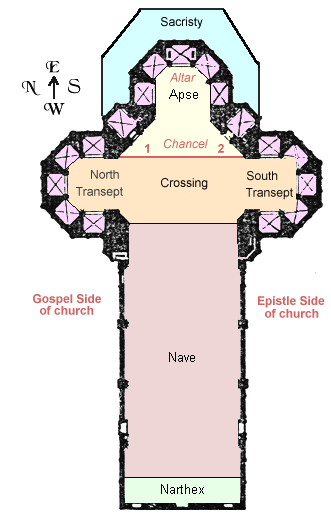
Narthex
(or "Vestibule")
A true narthex is either an outside, covered porch-like structure or an
inside area separated from the nave (the "body" of the church) by a
screen, but this word has come to mean "entry" or "foyer." Originally,
penitents and Catechumens were confined to this area until their
reconciliation with or initiation into the Church. A westwork (or
"westwerk") is the front of a large cathedral that has a tall facade
and, usually, towers and an upper chamber (imagine the front entry of
Notre Dame Cathedral in Paris with its towers and sculpture).
When entering a church, we dip our fingers into the holy water font, cross
ourselves and recall and show gratitude for our Baptism. We then genuflect
on our right knee while facing Christ in the tabernacle beside our pew
before sitting down. When leaving, we genuflect toward the tabernacle
once more beside the pew we've just left.
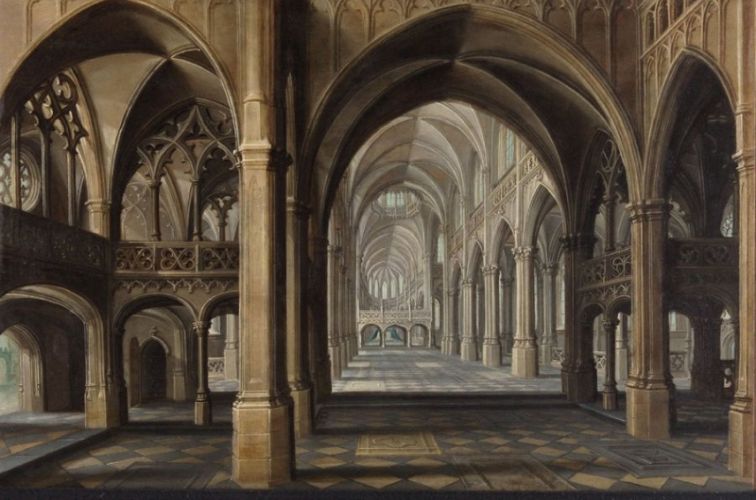
Nave
Referring to the "barque of Peter" and "Noah's Ark," the word "nave" is
derived from the Latin word for ship, navis, and has come to
mean the area where the parishioners sit or stand (pews are a very late
addition to the nave area, and, even today, parishioners stand during
the liturgy in many Eastern Catholic and Orthodox Churches). In Gothic
architecture, the nave had an aisle (or two) on both sides.
Crossing
The place where the nave, chancel and transept intersect. This area is
often domed.
Transept
The transverse arm of a cruciform church is called the transept.
Because the liturgy is supposed to be celebrated ad orientem
(facing East), the left side of the transept is called the North
transept and the right side of the transept is called the South
transept. This is so even if the actual orientation of the Church is
other than with the Altar at the East side. Some churches have
transepts at the West end of the church, too -- especially English
Gothic churches.
Sanctuary and Choir (Chancel)
The word "chancel" comes from the word cancelli, meaning
"lattice work," once used to rail off the choir, where the religious
would sit on long benches to sing the responses at Mass and chant the
Divine Office, from the nave, where the people sit.
Medieval churches often had "rood screens" ("rood" means "cross")
separating the Sanctuary and choir from the body of the nave. The rood
screen had the rood -- the Crucifix -- often flanked by images of the
Virgin and St. John and by oil lamps. This screen totally separated the
sanctuary from the place the people sat so that the sanctuary was truly
treated as the Holy of Holies. (In Eastern Catholic churches and in
Orthodox churches, the sanctuary is separated from the congregation by
a lovely iconostasis -- a screen or wall with at least two icons (some
are covered with them). The iconostasis has three doors: the Door of
the Proskomide (preparation for Liturgy) on the left; the Royal Door in
the middle which leads directly to the altar; and the Deacon's Door at
the right (from the parishioner's point of view).
The rise of Renaissance architecture saw the disappearance of the choir
area, the bringing forward of the sanctuary, and the general
disappearance of the rood screens. The sanctuary was, instead,
separated from the nave (as they should be today if there is no rood
screen or iconostasis) by altar rails at which communicants must kneel
to receive the Eucharist.
Aside from being the place of the Altar, the sanctuary is the place
where the Tabernacle, which holds the Blessed Sacrament, is kept and
over which there should always be burning a tabernacle light. The other
place where the Tabernacle might be kept is a separate, conspicuous,
well-adorned side chapel in churches in which the Altar area is used
for the solemn conduct of the Divine Office or for Pontifical
ceremonies. When we see the Tabernacle, we genuflect. If the Blessed
Sacrament is exposed, we kneel on both knees.
Apse
As the term is commonly used in church architecture, "apse" denotes the
often domed, semicircular or polygonal termination where the altar is
located.
Altar
The High Altar (the main altar) is the place where the Eucharistic
Sacrifice is offered (in a single church, there should be more than one
Altar). While ancient synagogue liturgy was oriented toward Jerusalem,
Christian liturgy is supposed to be celebrated with the priest and the
congregation facing East ("ad orientem"), the direction whence Jesus,
as symbolized by the rising Sun, will come again; the High Altar ,
therefore, has traditionally been at the East side of the church. In
older churches, you might still see gorgeous altar screens or "Altar
pieces" behind the Altar. The more fanciful, ornate ones are called
"reredos" and can be quite exquisite, full of sculpture and with
different panels.
The High Altar should: be fixed, of natural stone (bishops conferences
have some leeway here), and contain a relic of a Saint (martyrs are
favored). The Altar is venerated because it is the place of sacrifice,
and because it is the place of Sacrifice, the Tabernacle is usually
kept on it.
Some churches may have side altars (and some may even have side chapels
devoted to various Saints). These are used for private Masses.
Pulpit
The podium on the left side of the church as you face the Altar (the
"Gospel side"), from where the Gospel is read (and which is reserved
for clergy). Not all churches have both a lectern (see below) and a
pulpit; some just have one single speaker's podium called an ambo. Note
that the Gospel side of the church is also informally referred to as
the "Mary side" of the church because it is there a statue of her is
often placed.
Lectern
The stand on the right side of the church as you face the Altar (the
"Epistle side") from where the Epistles are read (and which can be used
by lay-people). Not all churches have both a lectern and a pulpit (see
above); some just have one single speaker's podium called an ambo. Note
that the Epistle side of the church is also informally referred to as
the "St. Joseph side" of the church because it is there a statue of him
is often placed.
You can remember which side of the Church is which by taking the
vantage point of Christ on the Crucifix: His right is the
Gospel/Mary side of the Church; His left is the Epistle/Joseph side of
the Church. Mary and the Gospel are greater than Joseph and the Epistle
so are at Jesus' right. This will be so unless there is a
statue of, say, our Lord, in which case it will be placed to the right
of Jesus' vantage point from the Crucifix while Mary is to the left.
Ambulatory
An ambulatory is basically a sort of walkway which can be either inside
or outside of a structure. In Gothic architecture, ambulatories often
had projecting chapels and were especially common around the apse. If
an ambulatory is outdoors and is built such that one side is wall while
the other has columns or arches, especially opening onto a courtyard,
it is often called a cloister (the word "cloister" also refers to the
area within a monastery to which some religious are confined).
Sacristy (or "Vestry")
The Sacristy is where sacred vestments, liturgical vessels, etc., are
stored. When the sacristy is behind the chancel and has two entrances,
the priests enter on the Gospel side and exit through the Epistle side
door.
In the sacristy you will find the sacrarium -- a special sink with a
pipe that bypasses the sewer, unlike an ordinary sink, but instead goes
straight into the earth. This sink is made thus to preserve the dignity
of sacred things which can no longer be used. For ex., the sacred
vessels are rinsed there so that no particle of the consecrated Host or
no drop of the Precious Blood will end up in the sewer. The first rinse
used to clean Altar linens, old baptismal water, sacred oils, blessed ashes,
etc., all these are
disposed of in the sacrarium, returning
those substances to the earth.
|