``Where the
Bishop is, there let the multitude of believers be;
even as where Jesus is, there is the Catholic Church'' Ignatius of
Antioch, 1st c. A.D
Feast of
Our Lady of Guadalupe
Our Lady, as an instrument of the Holy Ghost, is responsible for the
conversion of the Mexican people in the 16th c. when she appeared to
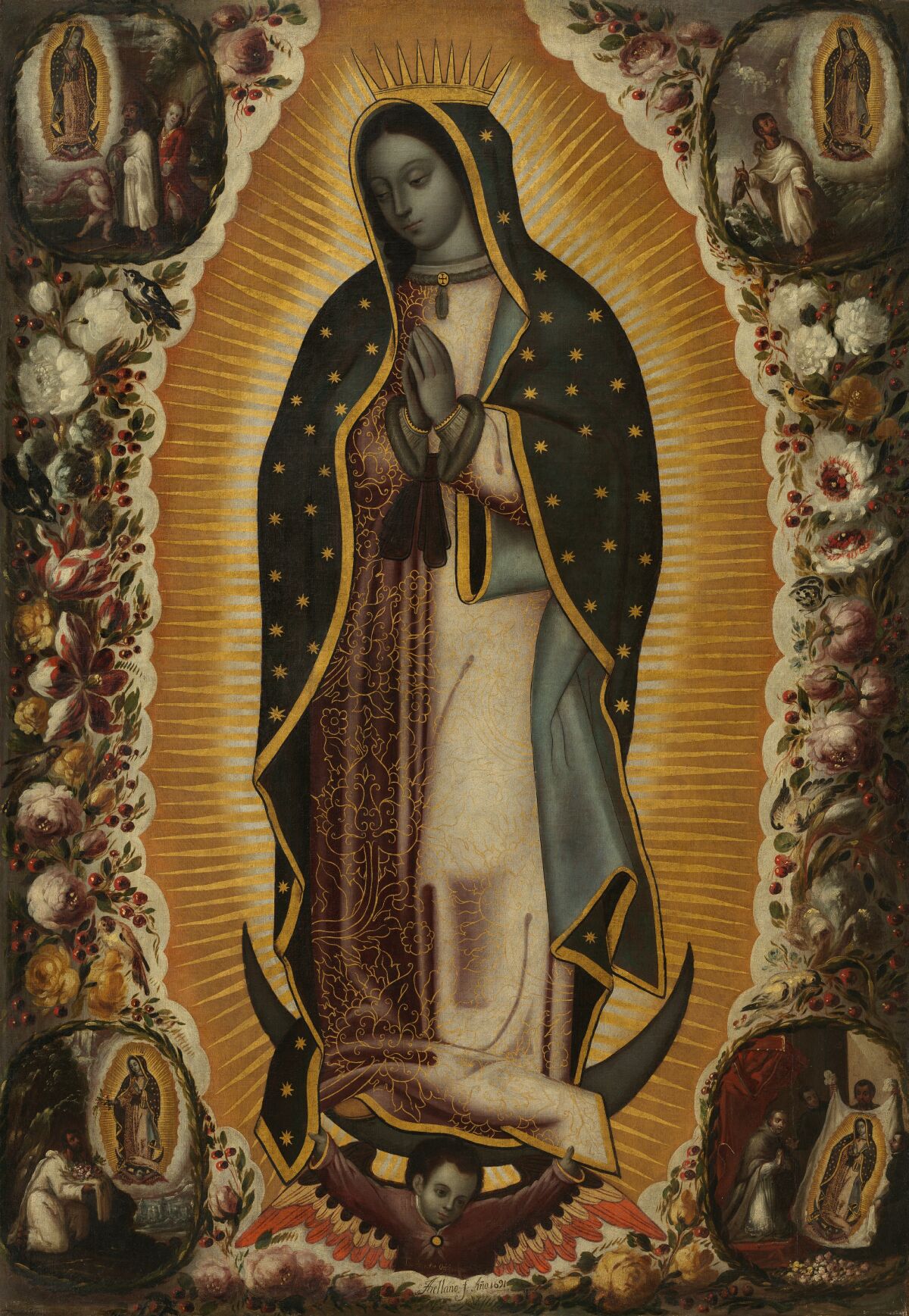
St. Juan Diego, a peasant. On this date in 1531, Juan saw the Blessed
Virgin
on Tepeyac Hill in what is now Mexico City. Speaking
in Juan's native Aztec language known as Nahuatl, she requested that he
go to
the Bishop in order to have a church built.
The Bishop, though, didn't believe Juan. Later that same day, Juan met
the Lady again, and she insisted that he return to the Bishop and make
her request again.
Once more, the Bishop disbelieved. He told Juan to ask the Lady for a
sign to prove who she is, so Juan returned to the place where he saw
the Lady. This time, she told Juan that she would give him a sign the
next day if he'd return to the hill.
By the time the next day came, Juan's Uncle had become very sick, so
Juan busied himself with getting a priest to visit with him. He was
embarrassed at not heeding the Lady's request, so took a route to avoid
the hill where he'd met the Woman. But the Lady appeared to him anyway
on that divergent path, and she admonished him for not returning to the
hill as she'd asked. She said to him, "¿No
estoy yo aquí que soy tu
madre?" ("Am I not here, I who am your mother?").
She told him, too, that his Uncle had been healed and that he should
now go to the hill and pick the flowers he'd find there. He obeyed, and
gathered up roses -- roses which shouldn't have been blooming at all at
that time of year. He wrapped them up in his cloak -- his "tilma" --
and rushed off to show the Bishop the sign that the Lady gave. And when
he unfurled his tilma before the Bishop, and the roses scattered to the
floor, there appeared on his cloak a miraculous image of the Lady he'd
seen.
The image, the nature of which is
still
unexplained by science, is extant today, though that tilma should
have
disintegrated centuries ago. It is kept in the "New Basilica" a few
miles northeast of Mexico City, in the neighborhood of Villa de
Guadalupe Hidalgo. This great evidence of a miraculous apparition led
to the conversion of literally millions of Indians. Their coming to
Christ was the single greatest single Christian conversion event in all
of
history,
Read about St. Juan Diego's encounter in more detail, and take a much
closer look at the tilma here --
-- then come back to this
page and listen to the audio below to learn about the ancient Aztec
"Flower
World prophecy" and how it prepared the Aztecs to receive the Gospel
through the miracle that
took place on Tepeyac Hill in the same sort of way that the European
world was prepared by the prophecies of the
sibyls. All of this is related in the book
"Guadalupe and the Flower World Prophecy: How God Prepared the Americas
for Conversion Before the Lady Appeared" by Joseph Julián González and
Monique González:
Today's Feast remembers Our Lady's appearance to St. Juan Diego, and as
she is Patroness of the Americas, it is a very
important Feast for those who live in "the New World" to thank God for
using His
favorite daughter/mother/spouse in such a miraculous and effective way.
Customs
Some may prepare for this feast by praying a Novena to Our Lady of Guadalupe
starting on December 3 and ending on December 11, the eve of this
feast. A prayer for the feast itself, prayed by Pope John Paul II on
his first papal trip, which included a stop in Mexico City, in 1979:
O Immaculate
Virgin, Mother of the true God and Mother of the Church, who from this
place reveal your clemency and your pity to all those who ask for your
protection, hear the prayer that we address to you with filial trust,
and present it to your Son Jesus, our sole Redeemer. Mother of Mercy,
Teacher of hidden and silent sacrifice, to you, who come to meet us
sinners, we dedicate on this day all our being and all our love. We
also dedicate to you our life, our work, our joys, our infirmities and
our sorrows. Grant peace, justice and prosperity to our peoples; for we
entrust to your care all that we have and all that we are, our Lady and
Mother. We wish to be entirely yours and to walk with you along the way
of complete faithfulness to Jesus Christ in His Church; hold us always
with your loving hand.
Virgin of Guadalupe, Mother of the Americas, we pray to you for all the
Bishops, that they may lead the faithful along paths of intense
Christian life, of love and humble service of God and souls.
Contemplate this immense harvest, and intercede with the Lord that He
may instill a hunger for holiness in the whole people of God, and grant
abundant vocations of priests and religious, strong in the faith and
zealous dispensers of God’s mysteries.
Grant to our homes the grace of loving and respecting life in its
beginnings, with the same love with which you conceived in your womb
the life of the Son of God. Blessed Virgin Mary, protect our families,
so that they may always be united, and bless the upbringing of our
children.
Our hope, look upon us with compassion, teach us to go continually to
Jesus and, if we fall, help us to rise again, to return to Him, by
means of the confession of our faults and sins in the Sacrament of
Penance, which gives peace to the soul.
We beg you to grant us a great love for all the holy Sacraments, which
are, as it were, the signs that your Son left us on earth. Thus, Most
Holy Mother, with the peace of God in our conscience, with our hearts
free from evil and hatred, we will be able to bring to all true joy and
true peace, which come to us from your son, our Lord Jesus Christ, who
with God the Father and the Holy Spirit, lives and reigns for ever and
ever. Amen.
In Mexico City, twelve days of prayer -- a dozavario -- precede this
feast. The time from December 1 to to today is filled with Masses,
processions, Rosaries, and fireworks, and
culminates with Catholics -- often in traditional
Mexican costumes -- lighting torches from fire lit in the
sanctuary of the Basilica and bringing the fire, which symbolizes the
light of Christ, back to their own parishes and homes in relays.
Matachines -- traditional dance troupes whose history can be
tracted back to Spain -- dress in colorful bouffons and dance in the streets
for the Virgin. Flowers abound, and, of course, roses are placed at the
feet of the
Virgin in churches and homes all over the country. Paper cut
in the shape of the Immaculate Heart are covered
in foil, decorated,
and placed near altars as ex-votos
to symbolize favors sought, or
gratitude for favors received (see below). All the while,
millions of pilgrims pour
into the city. On the eve of the feast, churches are filled in
anticipation of serenading the Virgin -- la Lupita -- early the next day, on
"the
morning of the Guadalupana.". To begin things on the feast itself, at
midnight, the Mexican birthday song -- Las Mañanitas
-- is sung to Mary:
Estas son las
mañanitas
que cantaba el rey David
hoy por ser día tu cumpleaños,
te las cantamos a ti.
Despierta, mi bien, despierta
mira que ya amaneció,
ya los pajaritos cantan,
la luna ya se metió.
Qué linda está la mañana,
en que vengo a saludarte,
Venimos todos con gusto
y placer a felicitarte,
El día en que tú naciste,
nacieron todas las flores,
El la pila del bautismo,
cantaron los ruiseñores,
Ya viene amaneciendo,
ya la luz el día nos dio,
Levántate de mañana,
Mira que ya almaneció.
These are “The
Beloved Mornings”
which King David used to sing.
For today is your birthday;
we sing them to you.
Wake up, my love, wake up.
Look at what has dawned,
Already the little birds are singing,
The moon has already set.
How pretty is the morning
In which I come to greet you.
We all came with pleasure
and joy to congratulate you.
On the day you were born
All the flowers were born.
At the baptismal font
The nightingales sang.
It is starting to be dawn,
The day has given us light.
Get up in the morning,
Look that it has already dawned.
Another song heard
throughout the celebrations is La
Guadalupana, which you can listen to below. Lyrics follow:
Desde el cielo
una hermosa mañana (2x)
La Guadalupana, la Guadalupana,
La Guadalupana bajo al Tepeyac (2x)
Suplicante juntaba sus manos (2x)
Y eran mexicanos, y eran mexicanos
Y eran mexicanos su porte y su faz. (2x)
Junto al monte pasaba Juan Diego (2x)
Y acercose luego, y acercose luego
Y acercose luego al oír cantar. (2x)
A Juan Diego la Virgen le dijo (2x)
Este cerro elijo, este cerro elijo
Este cerro elijo para hacer mi altar. (2x)
Desde entonces para el mexicano (2x)
Ser Guadalupano, ser Guadalupano,
Ser Guadalupano es algo esencial. (2x)
From Heaven, one
beautiful morning (2x)
La Guadalupana, La Guadalupana,
La Guadalupana came down to Tepeyac. (2x)
Both her hands she folded in prayer, (2x)
And her hands were Mexican! And her hands were Mexican!
And her hands were Mexican as was her face! (2x)
Juan Diego crossed over the hilltop, (2x)
But he came near and stopped, but he came near and stopped,
But he came near and stopped when he heard a song. (2x)
To Juan Diego the Virgin did say, (2x)
"This hill I have chosen, this hill I have chosen,
This hill I have chosen to become my shrine." (2x)
Since then for every Mexican (2x)
Being a Guadalupano, being a Guadalupano,
Being a Guadalupano is essential. (2x)
Elsewhere in Mexico and in North American parishes with large Mexican
American
populations, this day is particularly celebrated, with processions,
dancing, traditional Mexican and Indian costumes, a blessing of roses,
and delicious Mexican foods, such as tamales, gorditas, tacos al
pastor, and buñuelos -- fried cakes of dough
either drizzled with honey or syrup, or coated with sugar and cinnamon.
Buñuelos
3 cups all-purpose flour
1 teaspoon baking powder
1 teaspoon salt
1 tablespoon sugar
1/2 cup vegetable shortening
1 cup cold water
Canola oil
As desired: honey, syrups, cinnamon-sugar mixture
Mix flour, powder, salt, and the sugar. Add the shortening
and mix until you get a mixture that may remind you of wet sand.
Gradually add the water, a tiny bit at a time until it's all
incorporated. Knead a few times on on a floured surface, then cover the
dough and let it rest for 30 minutes.
Pour about an inch of the oil into a large skillet and heat
up to medium heat.
When your oil is hot enough, grab pieces of the dough and
form into balls that are about 2 1/2 inches in size (you should have
around 24 balls. Keep them covered as you roll them up.). Next, roll a
couple of the balls out to form very thin disks about 5 inches around.
Keep the dough covered while you fry the rolled out circles in the hot
oil for about 2 minutes, and then flip and fry for about 2 minutes
more. Drain on paper towels, and either sprinkle with cinnamon-sugar
mixture, or serve with honey or syrups. Repeat with the rest of the
dough balls.
While people in Mexico make pilgrimage to Mexico City, folks in North
America might consider a pilgrimage to the beautiful Shrine of Our Lady
of Guadalupe in La Crosse, Wisconsin. The shrine, begun by then Bishop
-- now Cardinal -- Raymond Burke, is designed "to offer a place where
people could “come away … and rest a while” (Mk 6:31), step away from
everyday busyness and quiet their hearts, to help them encounter Our
Lord through His Mother".
In parts of Puerto Rico, celebrations being in the pre-dawn hours, in
the morning -- la mañana --
which gives to the proceedings the name Las Mañanitas. A parade, Mass, and
great communal breakfast mark the
occasion. The "Las Mañanitas" birthday song (above) sung in
Mexico and many South American countries is sung to the
Virgin on this day there as well.
And speaking of music, I have to bring your attention to a seven-voice
musical group called Savae, which uses the traditional wind and
percussion instruments of the Aztecs to make beautiful Catholic music,
a fusion of Indigenous American and Colonial Spanish music. Their music
is historically authentic, based on musical transcriptions found in
cathedral archives in Guatemala, Mexico and Peru. In other words, their
music reflects what the Church Militant would have heard in 16th.
century Central and South America. A sample of their work: De La
Sagrada Maria:
When all the singing, dancing, and feasting is done, it is a
good day,
too, to reflect deeply on Our Lady's appearance at Fatima,
her warning about Russia spreading "her errors," and the brutal reality
of that prophecy come true, both in terms of literal Communism and in
terms of cultural Marxism -- in Mexico, in Spain, in China, Cuba,
Brazil, the U.S.A., etc. Recall these two apparitions, study the
history of Revolutions (from the traditional Catholic perspective),
read papal encyclicals concerning Communism and Freemasonry, learn
about the brave Mexican Cristeros who held out as best they could
against Masonic revolution, and pray that all will come to know that Christ is
King.
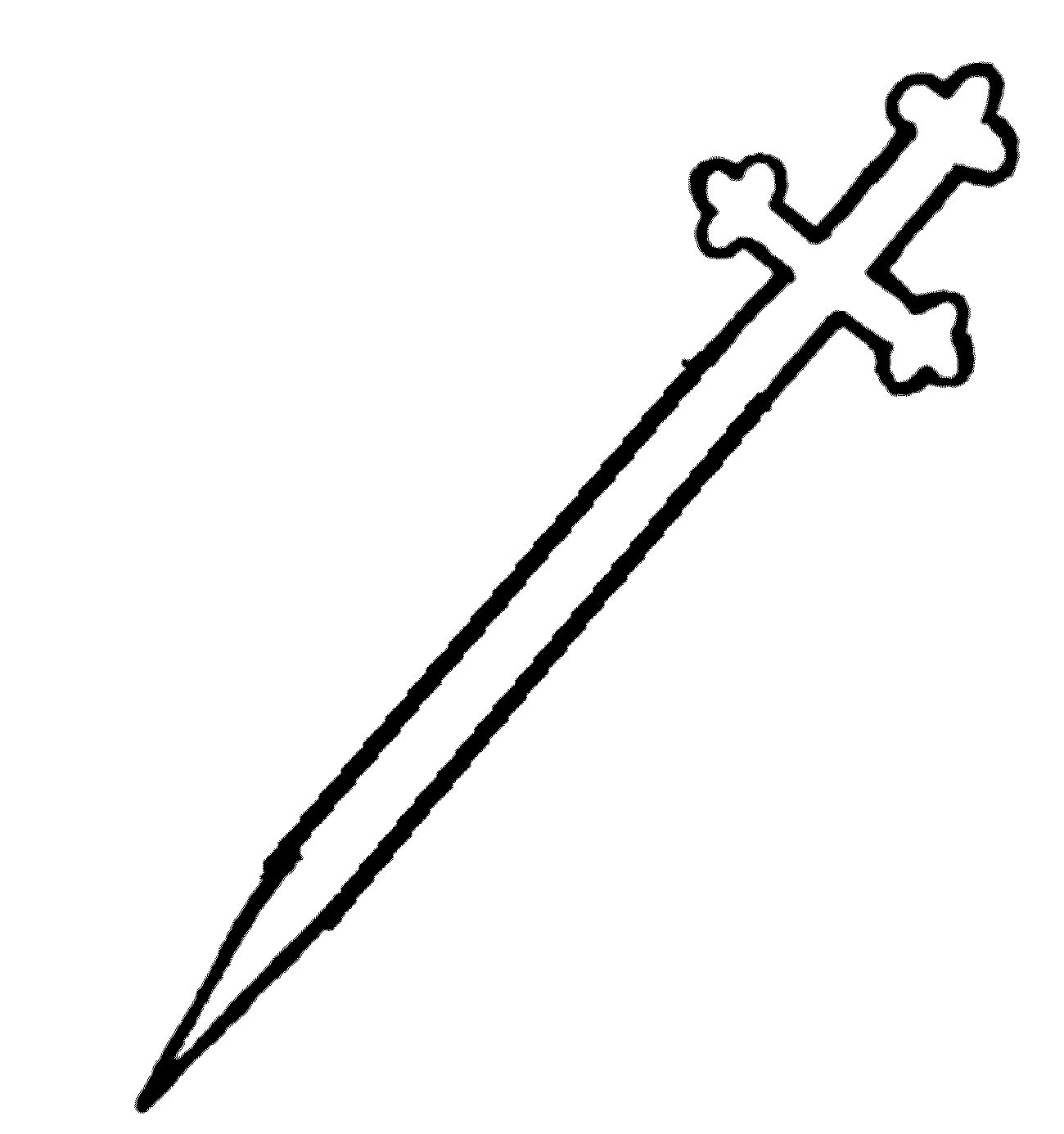
For something to
do, your children might enjoy making Immaculate Heart ex-votos: print
out the following graphics, trace them on to cardboard or heavy paper,
cut them out, cover them with tin foil (they make gold tin foil, by the
way), colorful tissue paper, paper roses,
etc. Cut
slits into the heart and insert the sword. The obverse side could be
decorated as the Immaculate Heart; the reverse side could be decorated
to contain a prayer intention or to express gratitude for a favor
received.
The graphics you need, and instructions to make paper roses (from off
the page on the Feast of St.
Therese of Lisieux):
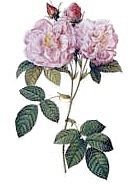
By the way, the
miraculously blooming roses found by the
now-Sainted Juan Diego were "Castilian Roses" (also called "Damascus
Roses"), or Rosa damascena, which didn't grow in Mexico but
were native to Spain.
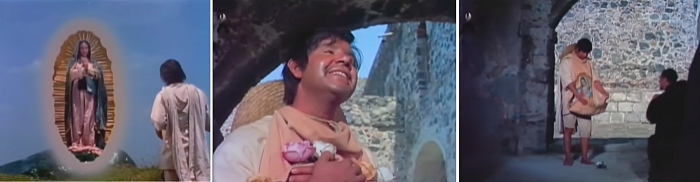
As to movies, for Spanish-speakers, there is "Las Rosas del Milagro"
(1960).
Another movie that may be of interest on this day is "For Greater Glory" (2012),
about the Mexican Cristeros. And to get a feel for the sort of world
that was converted by the
Spanish, watch the brilliant Mel Gibson's "Apocalypto,"
a thrilling, intense, and visually stunning movie that shows the
nightmarish world Our Lady of
Guadalupe helped change. It's a violent movie, not for most children,
so be
warned.