``Where the
Bishop is, there let the multitude of believers be;
even as where Jesus is, there is the Catholic Church'' Ignatius of
Antioch, 1st c. A.D
Spy Wednesday
In the Old Testament Joseph, who prefigured Christ, was
betrayed by his older brother, Judah -- the father of the tribe whence
came King David and through which the Messianic prophecies were
fulfilled -- when Judah sold Joseph into slavery in Egypt for so many
shekels of silver (see Genesis 37-38, and also Psalm 68:2-29 and Acts
1:13-20).
From that tribe of Judah came Our Lord, Who was betrayed by another
Judah, a man who is more commonly known as Judas Iscariot ("Iscariot"
refers to Kerioth, a town in Judea). This Judas handled the money for
the Apostles and became offended by the extravagance of Mary Magdalen's gesture of
love toward Jesus:
John 12:1-8 1
Jesus therefore, six days before the pasch, came to Bethania, where
Lazarus had been dead, whom Jesus raised to life. And they made him a
supper there: and Martha served: but Lazarus was one of them that were
at table with him. Mary therefore took a pound of ointment of right
spikenard, of great price, and anointed the feet of Jesus, and wiped
his feet with her hair; and the house was filled with the odour of the
ointment.
Then one of his disciples, Judas Iscariot, he that was about to betray
him, said: Why was not this ointment sold for three hundred pence, and
given to the poor? Now he said this, not because he cared for the poor;
but because he was a thief, and having the purse, carried the things
that were put therein.
Jesus therefore said: Let her alone, that she may keep it against the
day of my burial. For the poor you have always with you; but me you
have not always.
Immediately
after this, Judas met with the chief priests to betray Our Lord for
thirty pieces of silver. Here is St. Matthew's version of History:
Matthew 26:6-15
And when Jesus was in Bethania, in the house of Simon the leper, There
came to Him a woman having an alabaster box of precious ointment, and
poured it on His head as He was at table.
And the disciples seeing it, had indignation, saying: To what purpose
is this waste? For this might have been sold for much, and given to the
poor.
And Jesus knowing it, said to them: Why do you trouble this woman? for
she hath wrought a good work upon me. For the poor you have always with
you: but me you have not always. For she in pouring this ointment upon
my body, hath done it for my burial. Amen I say to you, wheresoever
this gospel shall be preached in the whole world, that also which she
hath done, shall be told for a memory of her.
Then went one of the twelve, who was called Judas Iscariot, to the
chief priests, And said to them: What will you give me, and I will
deliver him unto you? But they appointed him thirty pieces of silver.
For thirty
pieces of silver was Our Lord betrayed, as prophecied by
Zacharias: 1
Zacharias 11:9
-12
I will not feed you: that which dieth, let it die: and that which is
cut off, let it be cut off: and let the rest devour every one the flesh
of his neighbour. And I took my rod that was called Beauty, and I cut
it asunder to make void my covenant, which I had made with all people.
And it was made void in that day: and so the poor of the flock that
keep for me, understood that it is the word of the Lord. And I said to
them: If it be good in your eyes, bring hither my wages: and if not, be
quiet. And they weighed for my wages thirty pieces of silver.
St. Luke
explains how this vile betrayal happened: a devil entered into Judas:
Luke 22:3-6
And Satan entered into Judas, who was surnamed Iscariot, one of the
twelve. And he went, and discoursed with the chief priests and the
magistrates, how he might betray Him to them. And they were glad, and
convenanted to give him money. And he promised. And he sought
opportunity to betray him in the absence of the multitude.
Note well that
John 13:2 explains when and how a devil possessed Judas: it was after
Judas unworthily received the Eucharist:
John 13:2
And when supper was done,
(the devil having now put into the heart of Judas Iscariot, the son of
Simon, to betray him
But Jesus
already knew this would happen, as we know from this earlier exchange
with His Apostles, after He revealed that we must eat His Body and
drink His Blood. He knew what Judas would do with the free will God
gives to all men:
John 6:64-72
The words that I have spoken to you, are spirit and life. But there are
some of you that believe not. For Jesus knew from the beginning, who
they were that did not believe, and who he was, that would betray him.
And He said: Therefore did I say to you, that no man can come to Me,
unless it be given him by my Father.
After this many of his disciples went back; and walked no more with
Him. Then Jesus said to the twelve: Will you also go away?
And Simon Peter answered him: Lord, to whom shall we go? Thou hast the
words of eternal life. And we have believed and have known, that Thou
art the Christ, the Son of God (see also John 12:26-29 and Matthew
26:25).
Jesus answered them: Have not I chosen you twelve; and one of you is a
devil? Now he meant Judas Iscariot, the son of Simon: for this same was
about to betray Him, whereas he was one of the twelve.
After the Last
Supper (commemorated tomorrow, on Maundy
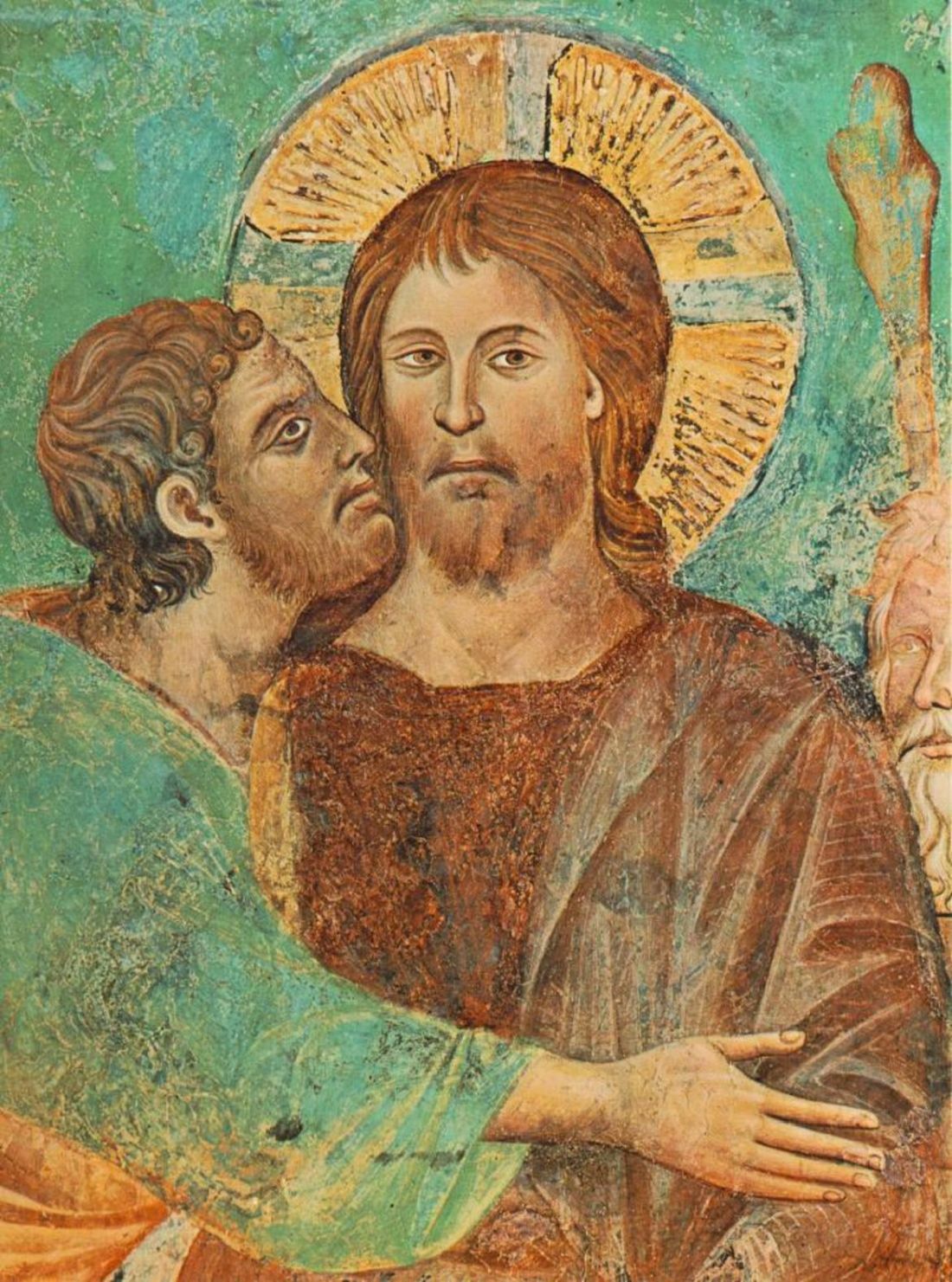
Thursday), Judas led the high priests to Jesus in the Garden of
Gethsemani, and let them know Who He is by greeting Him with the words,
"Hail, Rabbi" and kissing Him. Jesus responded, "Judas, dost thou
betray the Son of man with a kiss?" (Matthew 26:48-49).
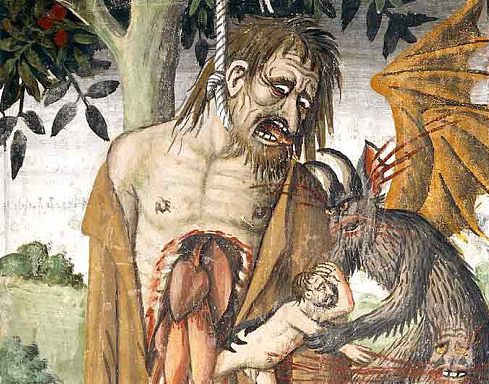
After Jesus's arrest tomorrow night, on Maundy Thursday, Judas returned
to the chief priests and threw the
thirty pieces of silver at them, repenting of his deed. The priests
consider it blood money, so refuse to put it in the Temple's coffers.
They instead buy a potter's field -- the "field of blood" -- to be used
for burying strangers. Judas went and hanged himself (Matthew 27:5),
and then his body fell and burst open (Acts 1:18) -- possibly due to a
build-up of gases after death -- like the potter's vessel that Jeremias
spoke of as a symbol
of faithless Israel:
Jeremias 18:1-10
The word that came from Jeremias to the Lord, saying: Arise, and go
down to the potter's house, and there thou shalt hear my words. And I
went down into the potter's house, and behold he was doing a work on
the wheel. And the vessel was broken which he was making with clay with
his hands: and turning he made another vessel, as it seemed good in his
eyes to make it.
Then the word of the Lord came to me, saying: Cannot I do with you as
this potter, saith the Lord? behold as clay is in the hand of the
potter, so are you in my hand, O house of Israel. I will suddenly speak
against a nation, and against a kingdom, to root out, and to pull down,
and to destroy it. If that nation against which I have spoken, shall
repent of their evil, I also will repent of the evil that I have
thought to do to them. And I will suddenly speak of a nation and of a
kingdom, to build up and plant it. If it shall do evil in my sight,
that it obey not my voice: I will repent of the good that I have spoken
to do unto it.
Jeremias 19:1-13
Thus saith the Lord: Go, and take a potter's earthen bottle, and take
of the ancients of the people, and of the ancients of the priests: And
go forth into the valley of the son of Ennom, which is by the entry of
the earthen gate: and there thou shalt proclaim the words that I shall
tell thee.
And thou shalt say: Hear the word of the Lord, O ye kings of Juda, and
ye inhabitants of Jerusalem: Thus saith the Lord of hosts, the God of
Israel: Behold I will bring an affliction upon this place: so that
whoever shall hear it, his ears shall tingle: Because they have
forsaken me, and have profaned this place: and have sacrificed therein
to strange gods, whom neither they nor their fathers knew, nor the
kings of Juda: and they have filled this place with the blood of
innocents. And they have built the high places of Baalim, to burn their
children with fire for a holocaust to Baalim: which I did not command,
nor speak of, neither did it once come into my mind.
Therefore behold the days come, saith the Lord, that this place shall
no more be called Topheth, nor the valley of the son of Ennom, but the
valley of slaughter. And I will defeat the counsel of Juda and of
Jerusalem in this place: and I will destroy them with the sword in the
sight of their enemies, and by the hands of them that seek their lives:
and I will give their carcasses to be meat for the fowls of the air,
and for the beasts of the earth. And I will make this city an
astonishent, and a hissing: every one that shall pass by it, shall be
astonished, and shall hiss because of all the plagues thereof. And I
will feed them with the flesh of their sons, and with the flesh of
their daughters: and they shall eat every one the flesh of his friend
in the siege, and in the distress wherewith their enemies, and they
that seek their lives shall straiten them.
And thou shalt break the bottle in the sight of the men that shall go
with thee. And thou shalt say to them: Thus saith the Lord of hosts:
even so will I break this people, and this city, as the potter's vessel
is broken, which cannot be made whole again: and they shall be buried
in Topheth, because there is no other place to bury in. Thus will I do
to this place, saith the Lord, and to the inhabitants thereof: and I
will make this city as Topheth. And the houses of Jerusalem, and the
houses of Juda shall be unclean as the place of Topheth: all the houses
upon whose roots they have sacrificed to all the host of heaven, and
have poured out drink offerings to strange gods.
Woe to Judas!
Jesus Himself said of him at the Last Supper, "The Son of man indeed
goeth, as
it is written of him: but woe to that man by whom the Son of man shall
be betrayed: it were better for him, if that man had not been born"
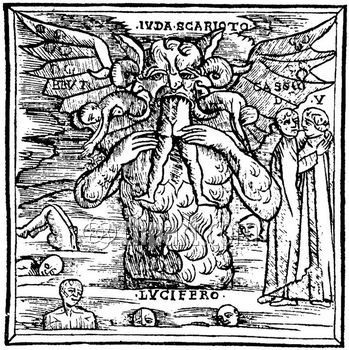
(Matthew 26:24). His name is synonymous with betrayal, and Dante, in
Canto XXXIV of his "Inferno," places him in the very innermost circle
of
Hell -- the circle made for traitors -- being devoured eternally by a
three-faced, bat-winged devil:
When we had
gotten far enough along
that my master was pleased to let me see
the creature who was once so fair of face
he took a step aside, then brought me to a halt:
'Look there at Dis! And see the place
where you must arm yourself with fortitude.'
Then how faint and frozen I became,
reader, do not ask, for I do not write it,
since any words would fail to be enough.
It was not death, nor could one call it life.
Imagine, if you have the wit,
what I became, deprived of both.
The emperor of the woeful kingdom
rose from the ice below his breast,
and I in size am closer to a giant
than giants are when measured to his arms.
Judge, then, what the whole must be
that is proportional to such a part.
If he was fair as he is hideous now,
and raised his brow in scorn of his creator,
he is fit to be the source of every sorrow.
Oh, what a wonder it appeared to me
when I perceived three faces on his head.
The first, in front, was red in color.
Another two he had, each joined with this,
above the midpoint of each shoulder,
and all the three united at the crest.
The one on the right was a whitish yellow,
while the left-hand one was tinted like the people
living at the sources of the Nile.
Beneath each face two mighty wings emerged,
such as befit so vast a bird:
I never saw such massive sails at sea.
They were featherless and fashioned
like a bat's wings. When he flapped them,
he sent forth three separate winds,
the sources of the ice upon Cocytus.
Out of six eyes he wept and his three chins
dripped tears and drooled blood-red saliva.
With his teeth, just like a hackle
pounding flax, he champed a sinner
in each mouth, tormenting three at once.
For the one in front the gnawing was a trifle
to the clawing, for from time to time
his back was left with not a shred of skin.
'That soul up there who bears the greatest pain,'
said the master, 'is Judas Iscariot, who has
his head within and outside flails his legs.
'As for the other two, whose heads are dangling down,
Brutus is hanging from the swarthy snout --
see how he writhes and utters not a word! --
'and from the other, Cassius, so large of limb.
But night is rising in the sky. It is time
for us to leave, for we have seen it all.'
The Golden
Legend, written in A.D. 1275 by Jacobus de Voragine, Archbishop of
Genoa, recounts both fascinating, fantastical medieval legend and the
true History regarding Judas in its section "Of St. Matthias." The
writer clearly differentiates between legend and verified truth with
his words "Thus far it is read in the history which is not authentic,"
so you can easily discern:
It is read in a
history, though it be named apocrypha, that there was a man in
Jerusalem named Reuben, and by another named Simeon, of the kindred of
David, or, after S. Jerome, of the tribe of Issachar, which had a wife
named Ciborea, and on the night that Judas was conceived his mother had
a marvellous dream whereof she was so sore afeard. For her seemed that
she had conceived a child that should destroy their people, and because
of the loss of all their people her husband blamed her much, and said
to her: Thou sayest a thing over evil, or the devils will deceive thee.
She said: Certainly if so be that I shall have a son, I trow it shall
be so, as I have had a revelation and none illusion.
When the child was born the father and mother were in great doubt, and
thought what was best to do, for they durst not slay the child for the
horror that they should have therein, neither they wist not how they
might nourish one that should destroy their lineage. Then they put him
to a little fiscelle or basket well pitched, and set it in the sea, and
abandoned him to drive whither it would. And anon the floods and waves
of the sea brought and made him arrive in an island named Scarioth, and
of this name was he called Judas Scariotes.
Now it happed that the queen of this country went for to play on the
rivage of the sea, and beheld this little nacelle and the child
therein, which was fair, and then she sighed and said: O Lord God, how
should I be eased if I had such a child, then at the least should not
my realm be without heir. Then commanded she that the child should be
taken up, and be nourished, and she fained herself to be great with
child and after published that she had borne a fair son. When her
husband heard say hereof he had great joy, and all the people of the
country made great feast. The king and queen did do nourish and keep
this child like the son of a king.
Anon after, it happed that the queen conceived a son, and when it was
born and grown Judas beat oft that child, for he weened that he had
been his brother, and oft he was chastised therefore, but alway he made
him to weep so long that the queen which knew well that Judas was not
her son, and at the last she said the truth, and told how that Judas
was found in the sea. And ere this yet was known Judas slew the child
that he had supposed to be his brother, and was son to the king, and in
eschewing the sentence of death he fled anon and came into Jerusalem,
and entered into the court of Pilate which then was provost. And he so
pleased him that he was great with him, and had in great cherety and
nothing was done without him.
Now it happed on a day that Pilate went for to disport him by a garden
belonging to the father of Judas, and was so desirous to eat of the
fruit of the apples that he might not forbear them. And the father of
Judas knew not Judas his son, for he supposed that he had been drowned
in the sea long tofore, ne the son knew not the father. When Pilate had
told to Judas of his desire, he sprang into the garden of his father
and gathered of the fruit for to bear to his master, but the father of
Judas defended him, and there began between them much strife and
debate, first by words and after with fighting, so much that Judas
smote his father with a stone on the head that he slew him, and after
brought the apples unto Pilate, and told to him how that he had slain
him that owned the garden. Then sent Pilate to seize all the good that
the father of Judas had, and after gave his wife to Judas in marriage,
and thus Judas wedded his own mother.
Now it happed on a day that the lady wept and sighed much strongly and
said: Alas! how unhappy that I am! I have lost my son and my husband.
My son was laid on the sea, and I suppose that he be drowned, and my
husband is dead suddenly, and yet it is more grievous to me that Pilate
hath remarried me against my will. Then demanded Judas of this child,
and she told him how he was set in the sea, and Judas told to her how
he had been found in the sea, in such wise that she wist that she was
his mother, and that he had slain his father and wedded his mother.
Wherefore then he went to Jesu Christ, which did so many miracles, and
prayed him of mercy and forgiveness of his sins. Thus far it is read in
the history which is not authentic.
Our Lord made Judas one of his apostles and retained him in his
company, and was so privy with him that he was made his procurator, and
bare the purse for all the other, and stole of that which was given to
Christ. Then it happed that he was sorry and angry for the ointment
that Mary Magdalene poured on the head and feet of our Lord Jesu Christ
and said that it was worth three hundred pence, and said that so much
he had lost, and therefore sold he Jesu Christ for thirty pence of that
money usual, of which every penny was worth ten pence, and so he
recovered three hundred pence. Or after that some say that he ought to
have of all the gifts that was given to Jesu Christ the tenth penny,
and so he recovered thirty pence of that he sold him, and nevertheless
at the last he brought them again to the temple, and after hung himself
in despair, and his body opened and cleft asunder and his bowels fell
out. And so it appertained well that it should so be, for the mouth
which God had kissed ought not to be defouled in touching, and also he
ought not to die on the earth because all earthly creatures ought to
hate him, but in the air where devils and wicked spirits be, because he
had deserved to be in their company.
Customs
Today and during
the Sacred Triduum, the Matins and Lauds of the Divine Office are often
sung in a haunting service known as the Tenebrae service ("tenebrae"
meaning "shadows"), which is basically a funeral service for Jesus.
During the Matins on Good Friday, one by one, fourteen of fifteen
candles are
extinguished in the Church, and the fifteenth candle is hid,
representing Jesus hiding Himself away. The congregation is left in
total darkness,
and in a silence that is punctuated at the end by the strepitus
-- a clattering, banging sound meant to
evoke the convulsion of nature at the death of Christ. It has also been
described as the sound of the tomb door closing.
During the Triduum,
the Matins and Lauds readings come from the following day's readings
each night because the hours of Matins and Lauds were pushed back so
that the public might better participate during these special three
days (i.e., the Matins and Lauds readings heard at Spy Wednesday's
tenebrae service are those for Maundy Thursday, the readings for Maundy
Thursday's tenebrae service are from
Good Friday, and Good Friday's readings are from Holy Saturday's Divine
Office). Relevant Scripture for Spy Wednesday includes Matthew 26:1-16;
Mark 14:1-11; Luke 22:1-6; and John 12:1-8. And read Psalm 54 (55 in
Bibles with Masoretic numbering):
Be attentive to
me and hear me. I am grieved in my exercise; and am troubled, At
the voice of the enemy, and at the tribulation of the sinner. For they
have cast iniquities upon me: and in wrath they were troublesome to me.
My heart is troubled within me: and the fear of death is fallen upon
me.Fear and trembling are come upon me: and darkness hath covered me.
And I said: Who will give me wings like a dove, and I will fly and be
at rest? Lo, I have gone far off flying away; and I abode in the
wilderness. I waited for him that hath saved me from
pusillanimity of spirit, and a storm. Cast down, O Lord, and
divide their tongues; for I have seen iniquity and contradiction in the
city. Day and night shall iniquity surround it upon its walls: and in
the midst thereof are labour, And injustice. And usury and deceit
have not departed from its streets.
For if my enemy had reviled me, I would verily have borne with it. And
if he that hated me had spoken great things against me, I would perhaps
have hidden myself from him. But thou a man of one mind, my
guide, and my familiar, Who didst take sweetmeats together with
me: in the house of God we walked with consent.
Let death come upon them, and let them go down alive into hell. For
there is wickedness in their dwellings: in the midst of them. But
I have cried to God: and the Lord will save me. Evening and
morning, and at noon I will speak and declare: and he shall hear my
voice. He shall redeem my soul in peace from them that draw near
to me: for among many they were with me. God shall hear, and the
Eternal shall humble them. For there is no change with them, and they
have not feared God: He hath stretched forth his hand to repay. They
have defiled his covenant, They are divided by the wrath Of his
countenance, and his heart hath drawn near. His words are smoother than
oil, and the same are darts. Cast thy care upon the Lord, and he
shall sustain thee: he shall not suffer the just to waver for ever. But
thou, O God, shalt bring them down into the pit of destruction. Bloody
and deceitful men shall not live out half their days; but I will trust
in thee, O Lord.
In Quito, Ecuador and a small handful of other Hispanic New
World countries, a very interesting ceremony once practiced in Seville,
Spain takes place. It's called the Reseña
(Review) or Arrastre de Caudas
(Dragging of the Trains), and occurs during Vespers. Canons process
through the town wearing black hooded caps (cappas) with 16-feet long trains,
all symbolizing the sins of man. They arrive at the cathedral and
prostrate themselves while the archbishop waves over them a large black
flag adorned with a great red Cross, symbolizing Christ's washing away
of man's sins.
As to keeping Spy Wednesday in the home, you can play a game with your
children on this day: hide "30 pieces of
silver" around the house and see if your kids can find them. For the
"silver", you can use either 30 nickels (($1.50 total) or 30 quarters
($7.50 total). Though nickels and quarters actually don't contain
silver but are nickel-copper alloys, they can be a way to help you
teach your children about Judas and his fate, betrayal, that evil
exists in the world and that some people don't value life, etc. Perhaps
you and your children can think of the best way to give those "30
pieces of silver" away to a good cause, perhaps by buying a small gift
for someone.
Teach your children how we all betray Christ with our sins, and how
important it is to repent and try to do right in the future when we
fail Him. And teach them the importance of loyalty! To this end, a
story about loyalty that children love very much is the story of
"Greyfriar's Bobby" ("Greyfriars" are Franciscans). To recount it in a
few paragraphs:
To Edinburgh,
Scotland, in the year of Our Lord 1850, a man named John Gray moved
with his family. He took a job as a night watchman, walking the
cobblestone streets after the Sun went down to ensure everyone in the
city would be safe. On one of his rounds five years after he became a
watchman, he met a little dog -- a Skye terrier -- whom he named
"Bobby."
The wee dog would follow along with "Auld Jock," as Mr. Gray was known.
Up and down the streets they'd go, and along the way, they became best
friends.
After three years of friendship, Auld Jock caught
tuberculosis and died. He was buried in Greyfriar's Kirkyard, and
Little Bobby was there at his funeral. After Jock was buried, the
people who grieved him left, but Bobby stayed at his grave, wanting to
be close to the master he loved. The people of Edinburgh saw how loyal
Bobby was to his best friend and brought him food. I imagine he
got petted a lot, too! The Lord Provost of Edinburgh -- a man who acted
as a sort of mayor of the city -- gave him a license and a beautiful
collar so he could go anywhere in the city he wanted. But for fourteen
years little Bobby stayed at Auld Jock's grave. He stayed there until
he, himself, died in 1872. If you go to Greyfriar's Kirkyard in
Edinburgh today, you will see the graves of Jock and his beloved Bobby.
And you'll see, too, a statue of the beautiful terrier with the
faithful heart.
As to music for the day, there is this very old French song "Écoutez Tous Petits et Grands" --
made by Eric
Montbel -- which captures the feeling of this time very well:
Écoutez tous
petits et grands
Si vous voulez l’entendre
Ah Jésus ! Si vous voulez l’entendre
Quand Jésus était tout petit
Il ressemble un ange Ah Jésus !…..
Il a jeûné quarante jours
Sans prendre soutenance Ah Jésus !….
Au bout de ces quarante jours
Il a pris soutenance
Il a pris une gout’ de vin blanc
Et un morceau d’orange
Saint Jean a dit à notre Seigneur
La trahison est grande
Avant qu’il soit Vendred’ minuit
Vous voirez mon côt’ pendre
Vous voirez mon côté parcé
Du ferre de la lance
Vous voirez mon sang répandu
Tout le long de mes membres
Vous voirez mon sang ramassé
Par trois ou quatre-s-anges
Vous les voirez monter au Ciel
En chantant les louanges
Vous voirez mon corps porter en terre
Par trois ou quatre-s-anges
Vous entendrez le coq chanter
Aussi la poule blanche
Vous voirez les étoiles tomber
Les pierres, les cailloux fendre
Vous voirez la mer surmonter
Au-dessus des montagnes
Vous entendrez toutes les oiseaux
Qu’ils crieront vengeance
Vengeance ici, vengeance et là
C’est le Sauveur du Monde Ah Jésus !
C’est le Sauveur du Monde
Listen,
everyone,
young and old
If you want to hear it
Oh Jesus! If you want to hear it
When Jesus was little
He looks like an angel Ah Jesus!…..
He fasted forty days
Without taking sustenance Ah Jesus!….
At the end of these forty days
He took sustenance
He took a taste of white wine
And a piece of orange
Saint John said to our Lord
The betrayal is great
Before it's midnight Friday
You will see my side hang open
You will see my side pierced by a
Spearhead
You will see my blood spilled
All along my limbs
You will see my blood picked up
By three or four angels
You will see them ascend to Heaven
Singing the praises
You will see my body carried to earth
By three or four angels
You will hear the rooster crow
Also the white hen
You will see the stars fall
The stones, the pebbles to split
You will see the sea overcome
above the mountains
You will hear all the birds
That they will cry revenge
Revenge here, revenge and there
He is the Savior of the World Ah Jesus!
He is the savior of the world
Legend says that the tree upon which Judas hanged himself was
the Cercis
siliquastrum -- a tree that is now known as the "Judas Tree." It
is a beautiful tree, native to the Mediterranean region, with brilliant
deep pink flowers in the spring -- flowers that are said to have
blushed in shame after Judas's suicide.
Readings
St. John Chrysostom's Homily 81 on Matthew
Matthew 26:17-18.
Now the first day of the feast of unleavened bread the disciples came
to Jesus, saying, Where will You that we prepare for You to eat the
Passover? And He said, Go into the city to such a man, and say unto
him, The Master says, My time is at hand; I will keep the Passover at
your house with My disciples.
By the first day of the feast of unleavened bread, he means the day
before that feast; for they are accustomed always to reckon the day
from the evening, and he makes mention of this in which in the evening
the passover must be killed; John 13:1 for on the fifth day of the week
they came unto Him. And this one calls the day before the feast of
unleavened bread, Luke 22:7 speaking of the time when they came to Him,
and another says on this wise, Then came the day of unleavened bread,
when the passover must be killed; by the word came, meaning this, it
was near, it was at the doors, making mention plainly of that evening.
For they began with the evening, wherefore also each adds, when the
passover was killed.
And they say, Where will You that we prepare for You to eat the
passover? So even from this it is manifest, that He had no house, no
place of sojourning; and I suppose neither had they. For surely they
would have entreated him to come there. But neither had they any,
having now parted with all things.
But wherefore did He keep the passover? To indicate by all things unto
the last day, that He is not opposed to the law.
And for what possible reason does He send them to an unknown person? To
show by this also that He might have avoided suffering. For He who
prevailed over this man's mind, so that he received them, and that by
words; what would He not have done with them that crucified Him, if it
had been His will not to suffer? And what He did about the ass, this He
did here also. For there too He says, If any man say anything unto you,
you shall say, that the Lord has need of them; Matthew 21:3 and so
likewise here, The Master says, I will keep the passover at your house.
But I marvel not at this only, that he received Him, being unknown, but
that expecting to bring upon himself such enmity and implacable
hostility, he despised the enmity of the multitude.
After this, because they knew him not, He gave them a sign, like as the
prophet touching Saul, saying, You shall find one going up and carrying
a bottle; 1 Samuel 10:3 and here, carrying a pitcher. And see again the
display of his power. For He did not only say, I will keep the
passover, but He adds another thing also, My time is at hand. And this
He did, at once continually reminding His disciples of the passion, so
that exercised by the frequency of the prediction, they should be
prepared for what was to take place; and at the same time to show to
themselves, and to him that was receiving Him, and to all the Jews,
which I have often mentioned, that not involuntarily does He come to
His passion. And He adds, with my disciples, in order that both the
preparation should be sufficient, and that the man should not suppose
that He was concealing Himself.
Now when the evening had come, He sat down with the twelve disciples.
Oh the shamelessness of Judas! For he too was present there, and came
to partake both of the mysteries, and of the meal, and is convicted at
the very table, when although he had been a wild beast, he would have
become tame.
For this cause the evangelist also signifies, that while they are
eating, Christ speaks of His betrayal, that both by the time and by the
table he might show the wickedness of the traitor.
For when the disciples had done, as Jesus had appointed them, when the
evening had come, He sat down with the twelve. And as they did eat, He
said, we are told, Verily, I say unto you, that one of you shall betray
me. And before the supper, He had even washed his feet. And see how He
spares the traitor. For He said not, such a one shall betray me; but,
one of you, so as again to give him power of repentance by concealment.
And He chooses to alarm all, for the sake of saving this man. Of you,
the twelve, says He, that are everywhere present with me, whose feet I
washed, to whom I promised so many things.
Intolerable sorrow thereupon seized that holy company. And John indeed
says, they were in doubt, and looked one upon another, and each of them
asked in fear concerning himself, although conscious to themselves of
no such thing. But this evangelist says, that being exceeding
sorrowful, they began every one of them to say unto Him, Is it I, Lord?
Matthew 26:22 And He answered and said, He it is, to whom I shall give
a sop, when I have dipped it.
Mark at what time He discovered him. It was when it was His will to
deliver the rest from this trouble, for they were even dead with the
fear, wherefore also they were instant with their questions. But not
only as desiring to deliver them from their distress He did this, but
also as willing to amend the traitor. For since after having often
heard it generally, he continued incorrigible, being past feeling, He
being minded to make him feel more, takes off his mask.
For when being sorrowful they began to say, Is it I, Lord? He answered
and said, He that dips with me in the dish, the same shall betray me.
The Son of Man goes, as it is written of Him, but woe to the man by
whom the Son of Man is betrayed. It had been good for that man if he
had not been born.
Now some say that he was so bold as not to honor his Master, but to dip
with Him: but to me Christ seems to have done this too, to shame him
the more, and bring him over to a better disposition. For this act
again has something more in it.
2. But these things we ought not to pass by at random, but they should
be instilled in our minds, and wrath would find no place at any time.
For who, bearing in mind that supper, and the traitor sitting at meat
with the Saviour of all, and Him who was to be betrayed thus meekly
reasoning, would not put away all venom of wrath and anger? See at any
rate how meekly He conducts Himself towards him, The Son of Man goes,
as it is written of Him.
And these things again He said, both to restore the disciples, that
they might not think the thing was a sign of weakness, and to amend the
traitor.
But woe unto that man by whom the Son of Man is betrayed! It had been
good for that man if he had not been born. See again in His rebukes His
unspeakable meekness. For not even here with invective, but more in the
way of compassion, does He apply what He says, but in a disguised way
again; and yet not his former senselessness only, but his subsequent
shamelessness was deserving of the utmost indignation. For after this
conviction he says, Is it I, Lord? Oh insensibility! He inquires, when
conscious to himself of such things. For the evangelist too, marvelling
at his boldness, says this. What then says the most mild and gentle
Jesus? You say. And yet He might have said, O thou unholy, thou all
unholy one; accursed, and profane; so long a time in travail with
mischief, who hast gone your way, and made satanical compacts, and hast
agreed to receive money, and hast been convicted by me too, do you yet
dare to ask? But none of these things did He say; but how? You say?
fixing for us bounds and rules of long suffering.
But some one will say, Yet if it was written that He was to suffer
these things, wherefore is Judas blamed, for he did the things that
were written? But not with this intent, but from wickedness. For if you
inquire not concerning the motive, you will deliver even the devil from
the charges against him. But these things are not, they are not so. For
both the one and the other are deserving of countless punishments,
although the world was saved. For neither did the treason of Judas work
out salvation for us, but the wisdom of Christ, and the good
contrivance of His fair skill, using the wickednesses of others for our
advantage.
What then, one may say, though Judas had not betrayed Him, would not
another have betrayed Him? And what has this to do with the question?
Because if Christ must needs be crucified, it must be by the means of
some one, and if by some one, surely by such a person as this. But if
all had been good, the dispensation in our behalf had been impeded. Not
so. For the Allwise knows how He shall bring about our benefits, even
had this happened. For His wisdom is rich in contrivance, and
incomprehensible. So for this reason, that no one might suppose that
Judas had become a minister of the dispensation, He declares the
wretchedness of the man. But some one will say again, And if it had
been good if he had never been born, wherefore did He suffer both this
man, and all the wicked, to come into the world? When you ought to
blame the wicked, for that having the power not to become such as they
are, they have become wicked, you leave this, and busiest yourself, and
art curious about the things of God; although knowing that it is not by
necessity that any one is wicked.
But the good only should be born, he would say, and there were no need
of hell, nor punishment, nor vengeance, nor trace of vice, but the
wicked should either not be born at all, or being born should
straightway depart.
First then, it were well to repeat to you the saying of the apostle,
Nay but, O man, who are you that repliest against God? Shall the thing
formed say to Him that formed it, Why have You made me thus?
But if you still demandest reasons, we would say this, that the good
are more admired for being among the bad; because their long-suffering
and great self-command is then most shown. But you take away the
occasion of their wrestlings, and conflicts, by saying these things.
What then, in order that these may appear good, are others punished?
says he. God forbid, but for their own wickedness. For neither because
they were brought into the world did they become wicked, but on account
of their own wickedness; wherefore also they are punished. For how
should they fail to be deserving of punishment, seeing they have so
many teachers of virtue, and gain nothing therefrom. For like as the
noble and good are worthy of double honor, because they both became
good, and took no hurt from the wicked; so also the worthless deserve
twofold punishment, both because they became wicked, when they might
have become good (they show it who have become such), and because they
gained nothing from the good.
But let us see what says this wretched man, when convicted by his
Master. What then says he? Is it I, Rabbi? Matthew 26:25 And why did he
not ask this from the beginning? He thought to escape knowledge by its
being said, one of you; but when He had made him manifest, he ventured
again to ask, confiding in the clemency of his Master, that He would
not convict him.
3. O blindness! Whereunto has it led him? Such is covetousness, it
renders men fools and senseless, yea reckless, and dogs instead of men,
or rather even more fierce than dogs, and devils after being dogs. This
man at least received unto him the devil even when plotting against
him, but Jesus, even when doing him good, he betrayed, having already
become a devil in will. For such does the insatiable desire of gain
make men, out of their mind, frenzy-smitten, altogether given up to
gain, as was the case even with Judas.
But how do Matthew and the other evangelists say, that, when he made
the agreement touching the treason, then the devil seized him; but
John, that after the sop Satan entered into him. John 13:27 And John
himself knew this, for further back he says, The devil having now put
into the heart of Judas, that he should betray Him. How then does he
say, After the sop Satan entered into him? Because he enters not in
suddenly, nor at once, but makes much trial first, which accordingly
was done here also. For after having tried him in the beginning, and
assailed him quietly, after that he saw him prepared to receive him, he
thenceforth wholly breathed himself into him, and completely got the
better of him.
But how, if they were eating the passover, did they eat it contrary to
the law? For they should not have eaten it, sitting down to their meat.
Exodus 12:11 What then can be said? That after eating it, they then sat
down to the banquet.
But another evangelist says, that on that evening He not only ate the
passover, but also said, With desire I have desired to eat this
passover with you, Luke 22:15 that is, on that year. For what reason?
Because then the salvation of the world was to be brought about, and
the mysteries to be delivered, and the subjects of sorrow to be done
away with by His death; so welcome was the cross to Him. But nothing
softened the savage monster, nor moved, nor shamed him. He pronounced
him wretched, saying, Woe to that man. He alarmed him again, saying, It
were good for him if he had not been born. He put him to shame, saying,
To whom I shall give a sop, when I have dipped it. And none of these
things checked him, but he was seized by covetousness, as by some
madness, or rather by a more grievous disease. For indeed this is the
more grievous madness.
For what would the madman do like this? He poured not forth foam out of
his mouth but he poured forth the murder of his Lord. He distorted not
his hands, but stretched them out for the price of precious blood.
Wherefore his madness was greater, because he was mad being in health.
But he does not utter do you say, sounds without meaning. And what is
more without meaning than this language. What will you give me, and I
will deliver Him unto you? Matthew 26:15 I will deliver, the devil
spoke by that mouth. But he did not smite the ground with his feet
struggling? Nay, how much better so to struggle, than thus to stand
upright. But do you say, he did not cut himself with stones? Yet how
much better, than to do such things as these!
Will ye, that we bring forward the possessed and the covetous, and make
a comparison between the two. But let no one account what is done a
reproach to himself. For we do not reproach the nature, but we lament
the act. The possessed was never clad with garments, cutting himself
with stones, and running, he rushes over rough paths, driven headlong
of the devil. Do not these things seem to be dreadful? What then, if I
shall show the covetous doing more grievous things than these to their
own soul, and to such a degree more grievous, that these are considered
child's play compared with those. Will you indeed shun the pest? Come
then, let us see if they are in any respect in a more tolerable state
than they. In none, but even in a more grievous condition; for indeed
they are more objects of shame than ten thousand naked persons. For it
were far better to be naked as to clothing, than being clad with the
fruits of covetousness, to go about like them that celebrate the orgies
for Bacchus. For like as they have on madmen's masks and clothes, so
have these also. And much as the nakedness of the possessed is caused
by madness, so does madness produce this clothing, and the clothing is
more miserable than the nakedness.
And this I will hereby endeavor to prove. For whom should we say was
more mad, among madmen themselves; one who should cut himself, or one
who together with himself should hurt those who met him? It is quite
clear that it is this last. The madmen then strip themselves of their
clothing, but these all that meet them. But these tear their clothes to
pieces. And how readily would every one of those that are injured
consent that his garment should be torn, rather than be stripped of all
his substance?
But those do not aim blows at the face. In the first place, the
covetous do even this, and if not all, yet do all inflict by famine and
penury more grievous pains on the belly.
But those bite not with the teeth. Would that it were with teeth, and
not with the darts of covetousness fiercer than teeth. For their teeth
are weapons and darts. For who will feel most pained, he that was
bitten once, and straightway healed, or he that is for ever eaten up by
the teeth of penury? For penury when involuntary is more grievous than
furnace or wild beast.
But those rush not into the deserts like the possessed of devils. Would
it were the deserts, and not the cities, that they overran, and so all
in the cities enjoyed security. For now in this respect again, they are
more intolerable than all the insane, because they do in the cities
these things which the others do in the deserts, making the cities
deserts, and like as in a desert, where there is none to hinder, so
plundering the goods of all men.
But they do not pelt with stones them that meet them. And what is this?
Of stones it were easy to beware; but of the wounds which by paper and
ink they work to the wretched poor (framing writings full of blows
without number), who, out of those that fall in with them, can ever
easily beware?
4. And let us see also what they do to themselves. They walk naked up
and down the city, for they have no garment of virtue. But if this does
not seem to them to be a disgrace, this again is of their exceeding
madness, for that they have no feeling of the unseemliness, but while
they are ashamed of having their body naked, they bear about the soul
naked, and glory in it. And if you wish, I will tell you also the cause
of their insensibility. What then is the cause? They are naked among
many that are thus naked, wherefore neither are they ashamed, like as
neither are we in the baths. So that if indeed there were many clothed
with virtue, then would their shame appear more. But now this above all
is a worthy subject for many tears, that because the bad are many, bad
things are not even esteemed as a disgrace. For besides the rest, the
devil has brought about this too, not to allow them to obtain even a
sense of their evil deeds, but by the multitude of them that practise
wickedness, to throw a shade over their disgrace; since if it came to
pass that he was in the midst of a multitude of persons practising
self-restraint, such a one would see his nakedness more.
That they are more naked than the possessed is evident from these
things; and that they go into the deserts, neither this again could any
one gainsay. For the wide and broad way is more desert than any desert.
For though it have many that journey on it, yet none from among men,
but serpents, scorpions, wolves, adders, and asps. Such are they that
practise wickedness. And this way is not only desert, but much more
rugged than that of the mad. And this is hereby evident. For stones and
ravines and crags do not so wound those that mount them, as robbery and
covetousness the souls that practise them.
And that they live by the tombs, like the possessed, or rather that
they themselves are tombs, is plain by this. What is a tomb? A stone
having a dead body lying in it. Wherein then do these men's bodies
differ from those stones? Or rather, they are more miserable even than
they. For it is not a stone containing a dead body, but a body more
insensible than stones, bearing about a dead soul. Wherefore one would
not be wrong in calling them tombs. For so did our Lord too call the
Jews, for this reason most especially; He went on at least to say,
Their inward parts are full of ravening and covetousness.
Would ye that I show next, how they also cut their heads with stones?
Whence then first, I pray you, will you learn this? From the things
here, or from the things to come? But of the things to come they have
not much regard; we must speak then of the things here. For are not
anxieties more grievous than many stones, not wounding heads, but
consuming a soul. For they are afraid, lest those things should justly
go forth out of their house, which have come unto them unjustly; they
tremble in fear of the utmost ills, are angry, are provoked, against
those of their own house, against strangers; and now despondency, now
fear, now wrath, comes upon them in succession, and they are as if they
were crossing precipice after precipice, and they are earnestly looking
day by day for what they have not yet acquired. Wherefore neither do
they feel pleasure in the things they have, both by reason of not
feeling confidence about the security of them, and because with their
whole mind they are intent upon what they have not yet seized. And like
as one continually thirsting, though he should drink up ten thousand
fountains, feels not the pleasure, because he is not satisfied; so also
these, so far from feeling pleasure, are even tormented, the more they
heap around themselves; from their not feeling any limit to such desire.
And things here are like this; but let us speak also of the day to
come. For though they give not heed, yet it is necessary for us to
speak. In the day to come then, one will see everywhere such men as
these undergoing punishment. For when He says, I was an hungered, and
you gave me no meat; I was thirsty, and you gave me no drink; Matthew
25:42 He is punishing these; and when He says, Depart into the eternal
fire prepared for the devil, He is sending there them that make a bad
use of riches. And the wicked servant, who gives not to his
fellow-servants the goods of his Lord, is of the number of these men,
and he that buried his talent, and the five virgins.
And wherever you shall go, you will see the covetous punished. And now
they will hear, There is a void between us and you; now, Depart from me
into the fire that is prepared. Matthew 25:41 And now being cut
asunder, they will go away, where there is gnashing of teeth, and from
every place one may see them driven, and finding a place nowhere, but
gathered in hell alone.
5. What then is the use of the right faith to us for salvation, when we
hear these things? There, gnashing of teeth, and outer darkness, and
the fire prepared for the devil, and to be cut asunder, and to be
driven away; here, enmities, evil speakings, slanders, perils, cares,
plots, to be hated of all, to be abhorred of all, even of the very
persons that seem to flatter us. For as good men are admired not by the
good only but even by the wicked; so bad men, not the good only, but
also the worthless, hate. And in proof that this is true, I would
gladly ask of the covetous, whether they do not feel painfully one
toward another; and account such more their enemies than those that
have done them the greatest wrong; whether they do not also accuse
themselves, whether they do not account the thing an affront, if any
one brings this reproach upon them. For indeed this is an extreme
reproach, and a sure proof of much wickedness; for if you dost not
endure to despise wealth, of what will you ever get the better? Of
lust, or of the mad desire of glory, or anger, or of wrath? And how
would any be persuaded of it? For as to lust, and anger, and wrath,
many impute it even to the temperament of the flesh, and to this do
students of medicine refer the excesses thereof; and him that is of a
more hot and languid temperament, they affirm to be more lustful; but
him that runs out into a drier kind of ill temperament, eager, and
irritable, and wrathful. But with respect to covetousness, no one ever
heard of their having said any such thing. So entirely is the pest the
effect of mere remissness, and of a soul past feeling.
Therefore, I beseech you, let us give diligence to amend all such
things, and to give an opposite direction to the passions that come
upon us in every age. But if in every part of our life we sail past the
labors of virtue, everywhere undergoing shipwrecks; when we have
arrived at the harbor destitute of spiritual freight, we shall undergo
extreme punishment. For our present life is an outstretched ocean. And
as in the sea here, there are different bays exposed to different
tempests, and the Ægean is difficult because of the winds, the
Tyrrhenian strait because of the confined space, the Charybdis that is
by Africa because of the shallows, the Propontis, which is without the
Euxine sea, on account of its violence and currents, the parts without
Cadiz because of the desolation, and tracklessness, and unexplored
places therein, and other portions for other causes; so also is it in
our life.
And the first sea to view is that of our childish days, having much
tempestuousness, because of its folly, its facility, because it is not
steadfast. Therefore also we set over it guides and teachers, by our
diligence adding what is wanting to nature, even as there by the
pilot's skill.
After this age succeeds the sea of the youth, where the winds are
violent as in the Ægean, lust increasing upon us. And this age
especially is destitute of correction; not only because he is beset
more fiercely, but also because his faults are not reproved, for both
teacher and guide after that withdraw. When therefore the winds blow
more fiercely, and the pilot is more feeble, and there is no helper,
consider the greatness of the tempest.
After this there is again another period of life, that of men, in which
the cares of the household press upon us, when there is a wife, and
marriage, and begetting of children, and ruling of a house, and thick
falling showers of cares. Then especially both covetousness flourishes
and envy.
When then we pass each part of our life with shipwrecks, how shall we
suffice for the present life? How shall we escape future punishment.
For when first in the earliest age we learn nothing healthful, and then
in youth we do not practise sobriety, and when grown to manhood do not
get the better of covetousness, coming to old age as to a hold full of
bilgewater, and as having made the barque of the soul weak by all these
shocks, the planks being separated, we shall arrive at that harbor,
bearing much filth instead of spiritual merchandise, and to the devil
we shall furnish laughter, but lamentation to ourselves, and bring upon
ourselves the intolerable punishments.
That these things may not be, let us brace ourselves up on every side,
and, withstanding all our passions, let us cast out the lust of wealth,
that we may also attain unto the good things to come, by the grace and
love towards man of our Lord Jesus Christ, to whom be glory forever and
ever. Amen.
Footnotes: 1 St. Matthew attributes
this prophecy to Jeremias in Matthew 27:9, "Then was fulfilled that
which was spoken by Jeremias the prophet, saying: And they took the
thirty pieces of silver, the price of him that was prized, whom they
prized of the children of Israel." It is assumed that he was reading
the prophecies of Jeremias and Zacharias together because of the
latter's allusions to Israel being as a piece of clay in a potter's
hands (Jeremias 18:1-10, Jeremias 32:6-9, Jeremias 19:1-13) and how
this relates to Israel's fate as typified by Judas's body bursting
open, etc.