``Where the
Bishop is, there let the multitude of believers be;
even as where Jesus is, there is the Catholic Church'' Ignatius of
Antioch, 1st c. A.D
4th Sunday of Lent
(Laetare Sunday)
The fourth Sunday of Lent is rather unique; like the third
Sunday of Advent ("Gaudete Sunday"),
the fourth Sunday of Lent is a
break in an otherwise penitential season. The vestments for this day
will be rose, as they are on Gaudete Sunday in Advent, and flowers may
adorn the Altar. This day is called "Laetare Sunday" (also "Rose
Sunday" ), and takes its name from the opening words of the Mass, the
Introit's "Laetare, Jerusalem," taken from Isaias 66:10 and Psalm
121:1, chanted here by the Gregorian Chant
Academy:
Laetare
Jerusalem: et conventum facite omnes qui diligitis eam: gaudete cum
laetitia, qui in tristitia fuistis: ut exsultetis, et satiemini ab
uberibus consolationis vestrae. (Psalm) Laetatus sum in his, quae dicta
sunt mihi: in domum Domini ibimus. Gloria Patri.
Rejoice, O
Jerusalem: and come together all you that love her: rejoice with joy,
you that have been in sorrow: that you may exult, and be filled from
the breasts of your consolation. (Psalm) I rejoiced at the things that
were said to me: we shall go into the house of the Lord. Glory be to
the Father.
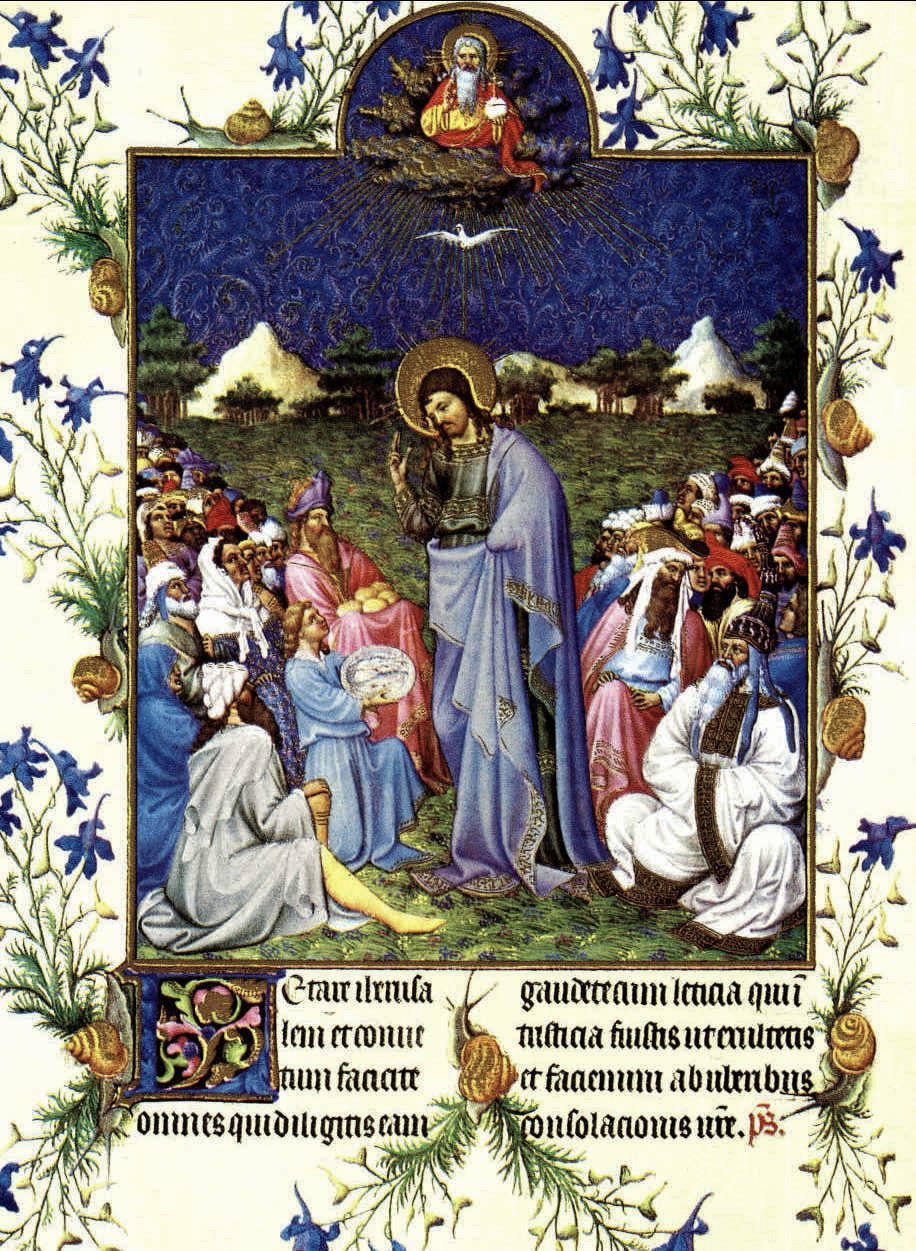
The Gospel reading will be John 6:1-15, on the multiplication
of the loaves and the fishes -- symbols of the Eucharist to come in 18
days (on Maundy Thursday of Holy Week). Note the language used in St.
Matthew's account -- and in the consecration of the Mass:
Matthew 15:36
And taking the seven loaves and the fishes, and giving
thanks, he brake, and gave to his disciples, and
the disciples to the people.
And from the
Mass:
Who, the day
before He suffered, took bread into His Holy and venerable
hands, and having lifted up His eyes to heaven, to Thee, God, His
Almighty Father, giving thanks to Thee, blessed it, broke
it, and gave it to His disciples, saying: Take and eat ye all
of this.
And after the
miracle of the loaves and fishes, this is what happens, according to
John's Gospel:
John 6:12-13
And when they were filled, he said to his disciples: Gather up the
fragments that remain, lest they be lost. They gathered up therefore,
and filled twelve baskets with the fragments of the five barley loaves,
which remained over and above to them that had eaten.
"Gather up the
fragments lest they be lost," He said to them. And the Twelve did,
symbolizing their future ordinations, their being given to power to
feed His sheep with His Body and Blood as foreshadowed in the miracle
of the loaves and fishes.
Customs
Laetare Sunday
is also known as "Mothering Sunday" because of the Introit's feminine
imagery, and because of the Epistle reading that
speaks of how not the Jews because of their DNA, but all those who come
to Christ -- Jewish or not, regardless of
their ancestry -- are the inheritors of Abraham's promise:
Galatians
4:22-31
For it is written that Abraham had two sons: the one by a bondwoman,
and the other by a free woman. But he who was of the bondwoman, was
born according to the flesh: but he of the free woman, was by promise.
Which things are said by an allegory. For these are the two testaments.
The one from mount Sina, engendering unto bondage; which is Agar: For
Sina is a mountain in Arabia, which hath affinity to that Jerusalem
which now is, and is in bondage with her children. But that Jerusalem,
which is above, is free: which is our mother. For it is written:
Rejoice, thou barren, that bearest not: break forth and cry, thou that
travailest not: for many are the children of the desolate, more than of
her that hath a husband. Now we, brethren, as Isaac was, are the
children of promise. But as then he, that was born according to the
flesh, persecuted him that was after the spirit; so also it is now. But
what saith the scripture? Cast out the bondwoman and her son; for the
son of the bondwoman shall not be heir with the son of the free woman.
So then, brethren, we are not the children of the bondwoman, but of the
free: by the freedom wherewith Christ has made us free.
The old practice
of visiting the parish in which one was baptized (or the cathedral of
one's diocese) on this
day is another reason for the name, since it is by baptism that we
become children of the Church. In England, natural mothers are
honored today, too, in a manner rather like the American Mother's
Day, which is celebrated on the second Sunday of May. Violets and
spring bulb flowers (daffodils, for ex.) are given to mothers,
and simnel cake is made to celebrate the occasion -- a very rich way to
break the Lenten fast. The word "simnel" comes from
the Latin "simila," a high grade flour:
Simnel Cake
Almond Paste:
9 ounces white sugar
9 ounces ground almonds
2 large eggs, at room temperature
Combine all ingredients in a mixer. Once you’ve got a rough dough,
knead it by hand for a minute to smooth it into a silky paste. Divide
this in thirds, wrap in plastic wrap and set aside.
Cake:
6 ounces butter, at room temperature
6 ounces golden caster sugar (or 3oz white sugar and 3oz light brown
sugar)
3 pieces large eggs, at room temperature
6 ounces all-purpose flour
1/2 tsp ground cinnamon
12 ounces dried fruit (such as sultanas, golden raisins, and currants)
2 ounces glace cherries
2 to 3 tablespoons orange zest
18 ounces marzipan, divided into 3, for the topping
3 ounces apricot preserves
Preheat the oven to 300F. Grease and line the sides and bottom of an
8-inch cake pan.
Cream the butter and sugar together until pale and fluffy. Add the eggs
and the flour alternately, scraping down the mixer to combine. Stir in
the cinnamon, dried fruit, glace cherries, and orange zest.
Take a third of the almond paste and roll it into an 8-inch disk and
set aside.
Spoon half the cake mixture into the pan. Top with the marzipan disk.
Spoon rest of cake batter over disk and smooth the top. Make a double
layer of parchment paper, place on top of cake pan and tie in place
with twine. Then make a
quarter-sized hole in the middle of the parchment to allow steam to
escape. Bake for 2
1/2 hours or so until the top is browned and springs back when touched.
Let cool.
Take another third of your almond paste and roll into another 8-inch
disk. Spread some apricot jam over the top of the cake and top with the
disk. Take the final third of the almond paste and make 11 equal sized
balls to represent each of the 12 Apostles minus Judas. Place the balls
evenly around the perimeter of the cake, keeping them in place with
more apricot preserves. Broil the cake very briefly to make the balls
golden (or use a blow torch).
Throughout the festivities, the color pink, and pink roses
are natural symbols to decorate with.
The Golden Rose
The wearing of rose vestments on Laetare Sunday is a custom originating
in the
fact that, as a symbol of joy and hope in the middle of this somber
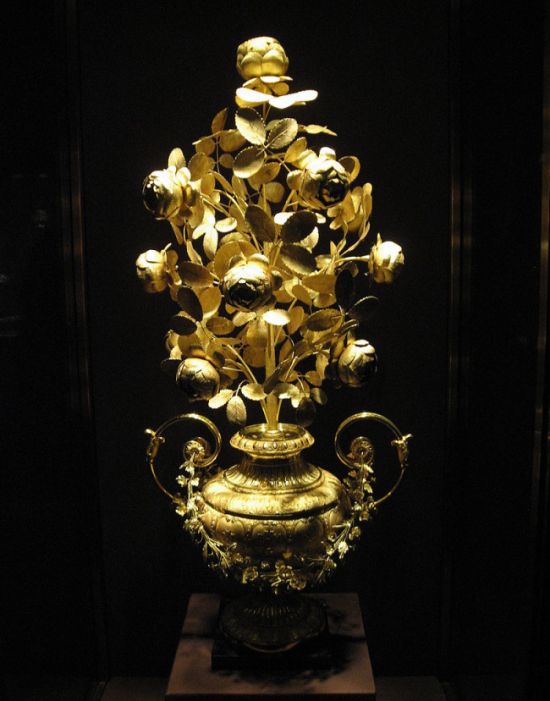
season, popes used to carry a golden rose in their right hand when
returning from the celebration of Mass on this day (way back in 1051,
Pope Leo IX called this custom an "ancient institution.")
Originally it was natural rose, then a single golden rose of natural
size, but since the fifteenth century it has consisted of a cluster or
branch of roses wrought of pure gold in brilliant workmanship by famous
artists. The popes bless at least one every year, and often confer it
upon churches, shrines, cities, or distinguished persons as a token of
esteem and paternal affection.
The golden rose represents Christ in the shining splendor of His
majesty, the "flower sprung from the root of Jesse," and it is blessed
with these words:
O God! by Whose
word and power all things have been created, by Whose will all things
are directed, we humbly beseech Thy Majesty, Who art the joy and
gladness of all the faithful, that Thou wouldst deign in Thy fatherly
love to bless and sanctify this rose, most delightful in odor and
appearance, which we this day carry in sign of spiritual joy, in order
that the people consecrated by Thee and delivered from the yoke of
Babylonian slavery through the favor of Thine only-begotten Son, Who is
the glory and exultation of the people of Israel and of that Jerusalem
which is our Heavenly mother, may with sincere hearts show forth their
joy. Wherefore, O Lord, on this day, when the Church exults in Thy name
and manifests her joy by this sign, confer upon us through her true and
perfect joy and accepting her devotion of today; do Thou remit sin,
strengthen faith, increase piety, protect her in Thy mercy, drive away
all things adverse to her and make her ways safe and prosperous, so
that Thy Church, as the fruit of good works, may unite in giving forth
the perfume of the ointment of that flower sprung from the root of
Jesse and which is the mystical flower of the field and lily of the
valleys, and remain happy without end in eternal glory together with
all the saints.
After the rose
is blessed, the Pope incenses musk and balsam and then places them
inside the cup of the largest rose. Then the entire rose is incensed
and sprinkled with holy water.
Note: you can remember to differentiate between Advent's Gaudete Sunday
and Lent's Laetare Sunday -- the two "rose vestment" Sundays -- by
remembering that Laetare Sunday comes in Lent, both of
which begin with the letter "L."
Reading
From Dom Prosper
Gueranger's "The Liturgical Year"
This Sunday, called, from the first word of the Introit,
Laetare Sunday, is one of the most solemn of the year. The Church
interrupts her Lenten mournfulness; the chants of the Mass speak of
nothing but joy and consolation; the Organ, which has been silent
during the preceding three Sundays, now gives forth its melodious
voice; the Deacon resumes his Dalmatic, and the Subdeacon his Tunic;
and instead of purple, Rose-coloured Vestments are allowed to be used.
These same rites were practised in Advent, on the third Sunday, called
Gaudete. The Church’s motive for introducing this expression of joy in
to-day’s Liturgy, is to encourage her Children to persevere fervently
to the end of this holy Season. The real Mid-Lent was last Thursday, as
we have already observed; but the Church, fearing lest the joy might
lead to some infringement on the spirit of penance, has deferred her
own notice of it to this Sunday, when she not only permits, but even
bids, her children to rejoice!
The Station at Rome, is in the Basilica of Holy Cross in Jerusalem, one
of the seven principal Churches of the Holy City. It was built in the
fourth century, by the Emperor Constantine, in one of his villas,
called Sessorius, on which account it goes also under the name of the
Sessorian Basilica. The Emperor’s mother, St. Helen, enriched it with
most precious relies, and wished to make it the Jerusalem of Rome. It
was with this intention that she ordered a great quantity of earth,
taken from Mount Calvary, to be put on the site. Among the other Relics
of the Instruments of the Passion which she gave to this Church, was
the Inscription which was fastened to the Cross; it is still kept
there, and is called the Title of the Cross. The name of Jerusalem, -
which has been given to this Basilica, and which recals to our minds
the heavenly Jerusalem, towards which we are tending, - suggested the
choosing it as to-day’s Station. Up to the fourteenth century, (when
Avignon became, for a time, the City of the Popes,) the ceremony of the
Golden Rose took place in this Church; at present, it is blessed in the
Palace where the Sovereign Pontiff happens to be residing at this
Season.
The blessing of the Golden Rose is one of the ceremonies peculiar to
the Fourth Sunday of Lent, which is called on this account Rose Sunday.
The thoughts suggested by this flower harmonise with the sentiments
wherewith the Church would now inspire her Children. The joyous time of
Easter is soon to give them a spiritual Spring, of which that of nature
is but a feeble image. Hence, we cannot be surprised that the
institution of this ceremony is of a very ancient date. We find it
observed under the Pontificate of St. Leo the Ninth (eleventh century);
and we have a Sermon on the Golden Rose preached by the glorious Pope
Innocent the Third, on this Sunday, and in the Basilica of Holy Cross
in Jerusalem. In the Middle Ages, when the Pope resided in the Lateran
Palace, having first blessed the Rose, he went on horseback to the
Church of the Station. He wore the mitre, was accompanied by all the
Cardinals, and held the blessed Flower in his hand. Having reached the
Basilica, he made a discourse on the mysteries symbolised by the
beauty, the colour, and the fragrance of the Rose. Mass was then
celebrated. After the Mass, the Pope returned to the Lateran Palace.
Surrounded by the sacred College, he rode across the immense plain
which separates the two Basilicas, with the mystic Flower still in his
hand. We may imagine the joy of the people as they gazed upon the holy
symbol. When the procession had got to the Palace gates, if there were
a Prince present, it was his privilege to hold the stirrup, and assist
the Pontiff to dismount; for which filial courtesy he received the
Rose, which had received so much honour and caused such joy.
At present, the ceremony is not quite so solemn; still the principal
rites are observed. The Pope blesses the Golden Rose in the Vestiary;
he anoints it with Holy Chrism, over which he sprinkles a scented
powder, as formerly; and when the hour for Mass is come, he goes to the
Palace Chapel, holding the Flower in his hand. During the Holy
Sacrifice, it is fastened to a golden rose-branch prepared for it on
the Altar. After the Mass, it is brought to the Pontiff, who holds it
in his hand as he returns from the Chapel to the Vestiary. It is usual
for the Pope to send the Rose to some Prince or Princess, as a mark of
honour; sometimes, it is a City or a Church that receives the Flower.
We subjoin a free translation of the beautiful Prayer used by the
Sovereign Pontiff when blessing the Golden Rose. It will give our
readers a clearer appreciation of this ceremony, which adds so much
solemnity to the Fourth Sunday of Lent. “O God! by whose word and power
all things were created, and by whose will they are all governed! O
thou, that art the joy and gladness of all thy Faithful people! we
beseech thy Divine Majesty, that thou vouchsafe to bless and sanctify
this Rose, so lovely in its beauty and fragrance. We are to bear it,
this day, in our hands, as a symbol of spiritual joy; that thus, the
people that is devoted to thy service, being set free from the
captivity of Babylon, by the grace of thine Only Begotten Son, who is
the glory and the joy of Israel, may show forth, with a sin cere heart,
the joys of that Jerusalem, which is above, and is our Mother. And
whereas thy Church seeing this symbol, exults with joy, for the glory
of thy Name;- do thou, O Lord! give her true and perfect happiness.
Accept her devotion, forgive us our sins, increase our faith; heal us
by thy word, protect us by thy mercy; remove all obstacles; grant us
all blessings; that thus, this same thy Church may offer unto thee the
fruit of good works; and walking in the odour of the fragrance of that
Flower, which sprang from the Root of Jesse, and is called the Flower
of the Field, and the Lily of the Valley, may she deserve to enjoy an
endless joy in the bosom of heavenly glory, in the society of all the
Saints, together with that Divine Flower, who liveth and reigneth with
thee in the unity of the Holy Ghost, world without end. Amen.”
We now come to the explanation of another name given to the Fourth
Sunday of Lent, which was suggested by the Gospel of the day. We find
this Sunday called in several ancient documents, the Sunday of the Five
Loaves. The miracle alluded to in this title not only forms an
essential portion of the Church’s instructions during Lent, but it is
also an additional element of to-day’s joy. We forget for an instant
the coming Passion of the Son of God, to give our attention to the
greatest of the benefits he has bestowed on us; for under the figure of
these Loaves multiplied by the power of Jesus, our Faith sees that
Bread which came down from heaven, and given life to the world’[ St.
John, vi. 33]. The Pasch, says our Evangelist, was near at hand; and,
in a few days, our Lord will say to us: With desire I have desired to
eat this Pasch with you [St. Luke, xxii. 15]. Before leaving this world
to go to his Father, Jesus desires to feed the multitude that follows
him; and in order to this, he displays his omnipotence. Well may we
admire that creative power, which feeds five thousand men with five
loaves and two fishes, and in such wise, that even after all have
partaken of the feast as much as they would, there remain fragments
enough to fill twelve baskets. Such a miracle is, indeed, an evident
proof of Jesus’ mission; but he intends it as a preparation for
something far more wonderful; he intends it as a figure and a pledge of
what he is soon to do, not merely once or twice, but every day, even to
the end of time; not only for five thousand men, but for the countless
multitudes of believers. Think of the millions, who, this very year,
are to partake of the banquet of the Pasch; and yet, He whom we have
seen born in Bethlehem, (the House of Bread,) He is to be the
nourishment of all these guests; neither will the Divine Bread fail. We
are to feast as did our fathers before us; and the generations that are
to follow us, shall be invited as we now are, to come and taste how
sweet is the Lord [Ps. xxxiii. 9].
But observe, it is in a desert place, (as we learn from St. Matthew,
[St. Matth, xiv. 13]) that Jesus feeds these men, who represent us
Christians. They have quitted the bustle and noise of cities in order
to follow him. So anxious are they to hear his words, that they fear
neither hunger nor fatigue; and their courage is rewarded. A like
recompense will crown our labours, - our fasting and abstinence, -
which are now more than half over. Let us, then, rejoice, and spend
this day with the light-heartedness of pilgrims, who are near the end
of their journey. The happy moment is advancing, when our soul, united
and filled with her God, will look back with pleasure on the fatigues
of the body, which, together with our heart’s compunction, have merited
for her a place at the Divine Banquet.
The primitive Church proposed this miracle of the multiplication of the
loaves as a symbol of the Eucharist, the Bread that never fails. We
find it frequently represented in the paintings of the Catacombs and on
the bas-reliefs of the ancient Christian tombs. The Fishes, too, that
were given together with the Loaves, are represented on these venerable
monuments of our faith; for the early Christians considered the Fish to
be the symbol of Christ, because the word Fish in Greek, is made up of
five letters, each of which is the initial of these words: Jesus
Christ, Son (of) God, Saviour.
The Greek Church, too, keeps this Sunday with much solemnity. According
to her manner of counting the days of Lent, this is the great day of
the week called, as we have already noticed, Mesonestios. The solemn
adoration of the Cross takes place to-day; and breaking through her
rule of never admitting a Saint’s Feast during Lent, this mid-Lent
Sunday is kept in honour of the celebrated Abbot of the Monastery of
Mount Sinai, St. John Climacus, who lived in the 6th century.