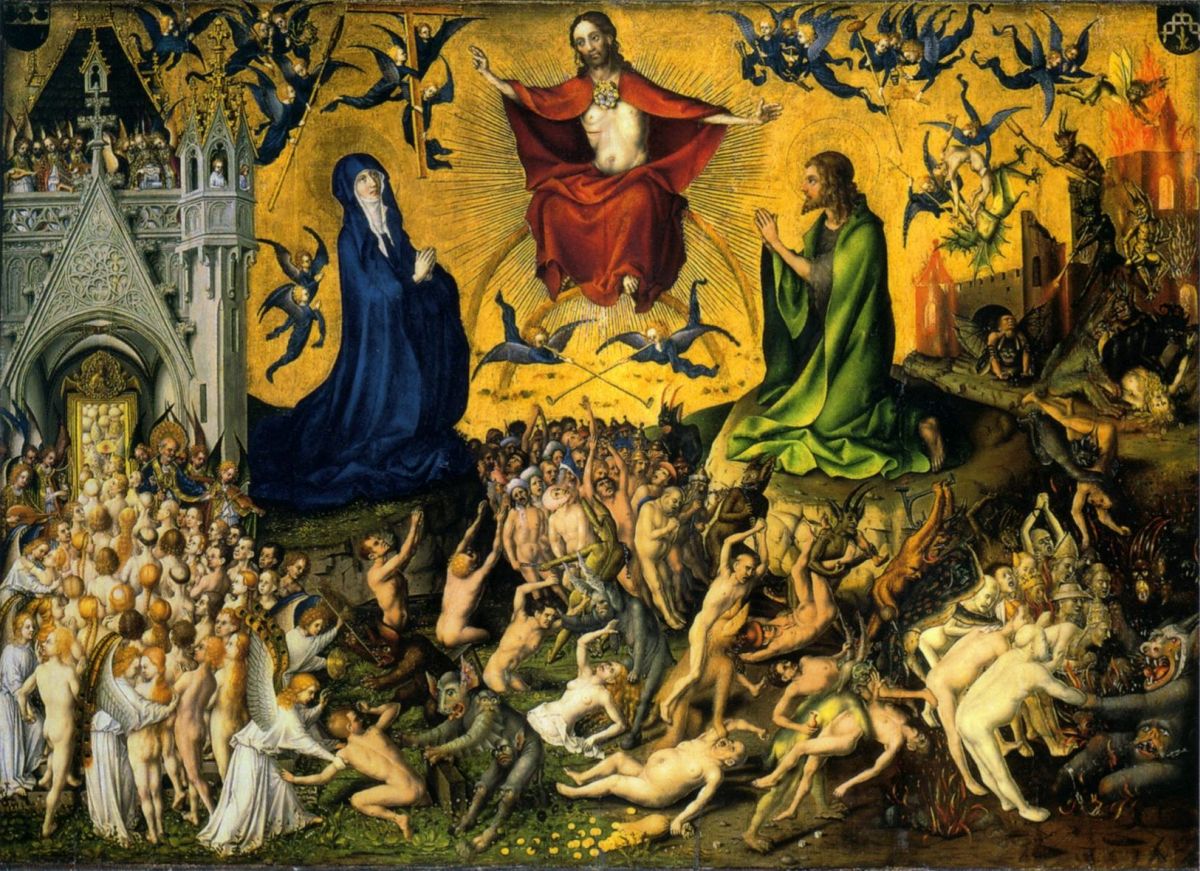
Today we've
almost completed the liturgical cycle, which
starts over again with Advent next Sunday. Our focus now is on
universal "Last Things": the
Second Coming of Christ (the "Parousia"), the Last Judgment, the fate
of Hell for the damned, and the
Heavenly Jerusalem for the saved -- or "Death, Judgment, Heaven, and
Hell" as the four Last Things are commonly listed. Today's Mass
readings will include
the frightening
"Olivet Discourse" (Matthew 24:15-35).
What does the Church teach about the Parousia? That, while Jesus first
came as a tiny Baby, now he will come in
glory, as a Judge -- and unexpectedly so that no man knows when this
will be. That
when He comes, the bodies of the dead -- who've already been judged in
what is called the "particular judgment" that takes place just after
death -- will be raised and united with their souls. All who have
ever lived will be judged in what is called the "Last Judgment" which
will happen such that everyone will know Who Christ is and
that His judgments are just.
This world will be destroyed, and a new world will take its place.
The damned will be damned for eternity, and Christ will reign in His
Kingdom forever and ever with His saints.
Apocalypse
21:1-5, 22:1-5
And I saw a new heaven and a new earth. For the first heaven and the
first earth was gone, and the sea is now no more. And I John saw the
holy city, the new Jerusalem, coming down out of heaven from God,
prepared as a bride adorned for her husband. And I heard a great voice
from the throne, saying: Behold the tabernacle of God with men, and He
will dwell with them. And they shall be His people; and God Himself
with them shall be their God. And God shall wipe away all tears from
their eyes: and death shall be no more, nor mourning, nor crying, nor
sorrow shall be any more, for the former things are passed away. And he
that sat on the throne, said: Behold, I make all things new. And He
said to me: Write, for these words are most faithful and true...
...And He showed me a river of water of life, clear as crystal,
proceeding from the throne of God and of the Lamb. In the midst of the
street thereof, and on both sides of the river, was the tree of life,
bearing twelve fruits, yielding its fruits every month, and the leaves
of the tree were for the healing of the nations. And there shall be no
curse any more; but the throne of God and of the Lamb shall be in it,
and his servants shall serve him. And they shall see His Face: and His
Name shall be on their foreheads. And night shall be no more: and they
shall not need the light of the lamp, nor the light of the sun, because
the Lord God shall enlighten them, and they shall reign for ever and
ever.
It is
interesting that the readings from Matthew for today's Mass are almost
duplicated in next week's Mass's readings from Luke 21:25-33. Next
Sunday -- the
first Sunday of Advent -- we hear again of the destruction of
Jerusalem,
but this time with an eye toward His Second Coming -- even as we ready
ourselves to remember His First Coming at the Feast of the
Nativity. The first and last Sundays of the year meet and together
remind us to prepare.
To help you imagine this great day of judgment to come, I present a
collection of samplings of
the Dies Irae by various composers (these were compiled by David
Raveh at Youtube). The first grouping consists of the Dies Irae by
Verdi (breathtaking!), Britten, Mozart, Dvorák, Fauré, Duruflé,
Pizzetti, and Hadyn, in
that order; the second consists of the same by Saint-Saëns, Suppé,
Cherubini, Kozlovsky, Cherubini, Belioz, Jenkins, and Ligeti.
| Latin text: |
English
text: |
Dies irae, dies
illa,
solvet saeculum in favilla,
teste David cum Sibylla. |
That day of
wrath, that dreadful day,
shall heaven and earth in ashes lay,
as David and the Sybil say. |
Quantus tremor
est futurus,
quando iudex est venturus,
cuncta stricte discussurus! |
What horror must
invade the mind
when the approaching Judge shall find
and sift the deeds of all mankind! |
Tuba mirum
spargens sonum
per sepulcra regionum,
coget omnes ante thronum. |
The mighty
trumpet's wondrous tone
shall rend each tomb's sepulchral stone
and summon all before the Throne. |
Mors stupebit et
natura,
cum resurget creatura,
iudicanti responsura. |
Now death and
nature with surprise
behold the trembling sinners rise
to meet the Judge's searching eyes. |
Liber scriptus
proferetur,
in quo totum continetur,
unde mundus iudicetur. |
Then shall with
universal dread
the Book of Consciences be read
to judge the lives of all the dead. |
Iudex ergo cum
sedebit,
quidquid latet apparebit:
nil inultum remanebit. |
For now before
the Judge severe
all hidden things must plain appear;
no crime can pass unpunished here. |
Quid sum miser
tunc dicturus?
quem patronum rogaturus?
cum vix iustus sit securus. |
O what shall I,
so guilty plead?
and who for me will intercede?
when even Saints shall comfort need? |
Rex tremendae
maiestatis,
qui salvandos salvas gratis,
salva me, fons pietatis. |
O King of
dreadful majesty!
grace and mercy You grant free;
as Fount of Kindness, save me! |
Recordare Iesu
pie,
quod sum causa tuae viae:
ne me perdas illa die. |
Recall, dear
Jesus, for my sake
You did our suffering nature take
then do not now my soul forsake! |
Quarens me,
sedisti lassus:
redemisti crucem passus:
tantus labor non sit cassus. |
In weariness You
sought for me,
and suffering upon the tree!
let not in vain such labor be. |
Iuste iudex
ultionis,
donum fac remissionis,
ante diem rationis. |
O Judge of
justice, hear, I pray,
for pity take my sins away
before the dreadful reckoning day. |
Ingemisco,
tamquam reus:
culpa rubet vultus meus:
supplicanti parce Deus. |
You gracious
face, O Lord, I seek;
deep shame and grief are on my cheek;
in sighs and tears my sorrows speak. |
Qui Mariam
absolvisti,
et latronem exaudisti,
mihi quoque spem dedisti. |
You Who did
Mary's guilt unbind,
and mercy for the robber find,
have filled with hope my anxious mind. |
Preces meae non
sunt dignae:
sed tu bonus fac benigne,
ne perenni cremer igne. |
How worthless
are my prayers I know,
yet, Lord forbid that I should go
into the fires of endless woe. |
Inter oves locum
praesta,
et ab haedis me sequestra,
statuens in parte dextera. |
Divorced from
the accursed band,
O make me with Your sheep to stand,
as child of grace, at Your right Hand. |
Confutatis
maledictis,
flammis acribus addictis.
voca me cum benedictis. |
When the doomed
can no more flee
from the fires of misery
with the chosen call me. |
Oro supplex et
acclinis,
cor contritum quasi cinis:
gere curam mei finis. |
Before You,
humbled, Lord, I lie,
my heart like ashes, crushed and dry,
assist me when I die. |
Lacrimosa dies
illa,
qua resurget ex favilla.
iudicandus homo reus:
huic ergo parce Deus. |
Full of tears
and full of dread
is that day that wakes the dead,
calling all, with solemn blast
to be judged for all their past. |
Pie Iesu Domine,
dona eis requiem. Amen. |
Lord, have
mercy, Jesus blest,
grant them all Your Light and Rest. Amen. |
While pondering doomsday -- the end of time -- is fascinating and
somewhat frightening, it's exceedingly important to remember that each
of us will experience our own earthly "end time" -- i.e., each of us
will die and face Christ as Judge with our own "particular judgment."
We should resolve to do our best to be ready for that day which can
come at any time!
To learn more about the Four Last Things, the end of the world and
time, etc., and for free books (in pdf format) on the topic, see this
page: Last Things: Death, Judgment, Heaven,
and Hell
Reading
from Dom
Gueranger's "The Liturgical Year"
...Our readers
will remember that, in the time of St. Gregory, Advent was longer than
we now have it; and that, in those days, its weeks commenced in that
part of the cycle which is now occupied by the last Sundays after
Pentecost. This is one of the reasons for the lack of liturgical riches
in the composition of the dominical Masses which follow the
twenty-third.
Even on this one, the Church, without losing sight of the last day,
used to lend a thought to the new season which was fast approaching,
the season, that is, of preparation for the great feast of Christmas.
There was read, as Epistle, the following passage from Jeremias, which
was afterwards, in several Churches, inserted in the Mass of the first
Sunday of Advent: 'Behold! the days come, saith the Lord, and I will
raise up to David a just branch: and a King shall reign, and shall be
wise: and shall execute judgment and justice in the earth. In those
days, shall Juda be saved, and Israel shall dwell confidently: and this
is the name that they shall call Him: The Lord our Just One. Therefore,
behold the days come, saith the Lord, and they shall say no more: The
Lord liveth, who brought up the children of Israel out of the land of
Egypt! But: The Lord liveth, who hath brought out, and brought hither,
the seed of the house of Israel, from the land of the north, and out of
all the lands, to which I had cast them forth! And they shall dwell in
their own land.'
As is evident, this passage is equally applicable to the conversion of
the Jews and the restoration of Israel, which are to take place at the
end of the world. This was the view taken by the chief liturgists of
the middle ages, in order to explain thoroughly the Mass of the
twenty-third Sunday alter Pentecost. Bearing in mind that, originally,
the Gospel of this Sunday was that of the multiplication of the five
loaves, let us listen to the profound and learned Abbot Rupert, who,
better than anyone, will teach us the mysteries of this day, which
brings to a close the grand and varied Gregorian melodies.
'Holy Church,' he says, 'is so intent on paying her debt of
supplication, and prayer, and thanksgiving, for all men, as the apostle
demands, that we find her giving thanks also for the salvation of the
children of Israel, who, she knows, are one day to be united with her.
And, as their remnants are to be saved at the end of the world, so, on
this last Sunday of the year, she delights in them, as though they were
already her members. In the Introit, calling to mind the prophecies
concerning them, she thus sings every year: My thoughts are thoughts of
peace, and not of affliction. Verily, His thoughts are those of peace,
for He promises to admit to the banquet of His grace the Jews, who are
His brethren according to the flesh; thus realizing what had been
prefigured in the history of the patriarch Joseph. The brethren of
Joseph, having sold him, came to him when they were tormented by
hunger; for then he ruled over the whole land of Egypt. He recognized
them; he received them; and made, together with them, a great feast.
So, too, our Lord, who is now reigning over the whole earth, and is
giving the bread of life, in abundance, to the Egyptians (that is, to
the Gentiles), will see coming to Him the remnants of the children of
Israel. He, whom they had denied and put to death, will admit them to
His favour, will give them a place at His table, and the true Joseph
will feast delightedly with His brethren.
'The benefit of this divine Table is signified, in the Office of this
Sunday; by the Gospel, which tells us of our Lord's feeding the
multitude with five loaves. For it will be then that Jesus will open to
the Jews the five Books of Moses, which are now being carried whole,
and not yet broken; yea, carried by a child, that is to say, this
people itself, who, up to that time, will have been cramped up in the
narrowness of a childish spirit.
'Then will be fulfilled the prophecy of Jeremias, which is so aptly
placed before this Gospel: ``They shall say no more: The Lord liveth,
who brought up the children of Israel out of the land of Egypt! But,
the Lord liveth, who hath brought out the seed of Israel from the land
of the north, and from all the lands into which they had been cast.''
'Thus delivered from the spiritual bondage which still holds them, they
will sing with all their heart the words of thanksgiving as we have
them in the Gradual: "Thou hast saved us, O Lord, from them that
afflict us!"
'The words we use in the Offertory: "From the depths I have cried to
thee, O Lord," clearly allude to the same events; for, on that day, His
brethren will say to the great and true Joseph: "We beseech thee to
forget the wickedness of thy brethren!" The Communion: "Amen, I say to
you, all things whatsoever ye ask, when ye pray," etc., is the answer
made by that same Joseph, as it was by the first: "Fear not! Ye thought
evil against me: but God turned it into good, that He might exalt me,
as at present ye see, and might save many people. Fear not, therefore,
I will feed you, and your children."'
Although the choice of this Gospel for the twenty-third Sunday is not
of great antiquity, yet is it in most perfect keeping with the
post-pentecostal liturgy, and confirms what we have stated relative to
the character of this portion of the Church's year. St. Jerome tells
us, in the homily selected for the day, that the hemorrhoissa, healed
by our Lord, is a type of the Gentile world; whilst the Jewish people
is represented by the daughter of the ruler of the Synagogue. This
latter is not to be restored to life until the former has been cured;
and this is precisely the mystery we are so continually commemorating
during these closing weeks of the liturgical year, viz., the fullness
of the Gentiles recognizing and welcoming the divine Physician, and the
blindness of Israel at last giving way to the light.
The liturgy at this close of the year continually alludes to the end of
the world. The earth seems to be sinking away, down into some deep
abyss; but it is only that it may shake off the wicked from its
surface, and then it will come up again blooming in light and love.
After the divine realities of this year of grace, we ought to be
capable of feeling a thrill of admiration at the mysterious, yet, at
the same time, the strong and sweet ways of eternal Wisdom. At the
beginning, when man was first created, sin soon followed, breaking up
the harmony of God's beautiful world, and throwing man off the divine
path where his Creator had placed him. Wickedness went on increasing,
until God's mercy fell upon one family. The light which beamed on that
privileged favourite only showed more plainly the thick darkness in
which the rest of mankind were enveloped. The Gentiles, abandoned to
their misery, all the more terrible because they had caused it and
loved it, saw God's favours all bestowed on Israel, whilst they
themselves were disregarded, and wished to be so. Even when the time
came for original sin to be remedied, it seemed to be the very time for
the final reprobation of the Gentiles; for the salvation that came down
from heaven in the person of the Man-God was seen to be exclusively
directed towards the Jews and the lost sheep of the house of Israel.
But the people that had been treated with so much predilection, and
whose fathers and first rulers had so ardently prayed for the coming of
the Messias, was no longer in the position to which it had been raised
by the holy patriarchs and prophets. Its beautiful religion, founded on
desire and hope, was then nothing but a sterile expectancy, which kept
it motionless and unable to advance a single step towards its Redeemer.
As to its Law, Israel then minded nothing but the letter, and, at last,
turned it into a mummy of sectarian formalism. Now, whilst in spite of
all this sinful apathy it was mad with jealousy, pretending that no one
else had any right to heaven's favours, the Gentile, whose
ever-increasing misery urged him to go in search of some deliverer,
found one, and recognized him in Jesus the Saviour of the world. He was
confident that this Jesus could cure him; so he took the bold
initiative, went up to Him, and had the merit of being the first to be
healed. True, our Lord had treated him with an apparent disdain; but
that had only had the effect of intensifying his humility, and humility
has a power of making way anywhere, even into heaven itself.
Israel, therefore, was now made to wait. One of the Psalms he sang ran
thus: 'Ethiopia shall be the first to stretch out her hands to God.' It
is now the turn for Israel to recover, by the pangs of a long
abandonment, the humility which had won the divine promises for his
fathers, the humility which alone could merit his seeing those promises
fulfilled.
By this time, however, the word of salvation has made itself heard
throughout all the nations, healing and saving all who desired the
blessing. Jesus, who has been delayed on the road, comes at last to the
house towards which He first purposed to direct His sacred steps; He
reaches, at last, the house of Juda, where the daughter of Sion is in a
deep sleep. His almighty compassion drives away from the poor abandoned
one the crowd of false teachers and lying prophets, who had sent her
into that mortal sleep, by all the noise of their vain babbling: He
casts forth for ever from her house those insulters of Himself, who are
quite resolved to keep the dead one dead. Taking the poor daughter by
the hand, He restores her to life, and to all the charm of her first
youth; proving thus, that her apparent death had been but a sleep, and
that the long delay of dreary ages could never belie the word of God,
which He had given to Abraham, His servant.
Now therefore, let this world hold itself in readiness for its final
transformation; for the tidings of the restoration of the daughter of
Sion puts the last seal to the accomplishment of the prophecies. It
remains now but for the graves to give back their dead. The valley of
Josaphat is preparing for the great meeting of the nations; Mount
Olivet is once more to have Jesus standing upon it, but this time as
Lord and Judge!
|