``Where the
Bishop is, there let the multitude of believers be;
even as where Jesus is, there is the Catholic Church'' Ignatius of
Antioch, 1st c. A.D
Feast of
St. Catherine of Alexandria
St. Catherine -- one of the Fourteen
Holy
Helpers -- was a brilliant young woman of noble birth who,
according to myth, had a mystical marriage to Christ. According to the
Golden Legend, compiled by Jacobus de Voragine, Archbishop of Genoa, in
1275, Jesus said to Catherine,
Katherine, come
hither to me.
And as soon as she heard him name her name, so great a
sweetness entered into her soul that she was all ravished, and
therewith our Lord gave to her a new strength which passed nature, and
said to her: Come my spouse, and give to me your hand.
And there our Lord espoused her in joining himself to her by
spiritual marriage, promising ever to keep her in all her life in this
world, and after this life to reign perpetually in his bliss, and in
token of this set a ring on her finger, which he commanded her to keep
in remembrance of this, and said: Dread ye not, my dear spouse, I shall
not depart from you, but always comfort and strengthen you.
Then said this new spouse: O blessed Lord, I thank you with
all mine heart of all your great mercies, beseeching you to make me
digne and worthy to be thy servant and handmaid, and to please you whom
my heart loveth and desireth above all things.
And thus this glorious marriage was made, whereof all the
celestial court joyed and sang this verse in heaven: Sponsus amat
sponsam, salvator visitat illam, with so great melody that no heart may
express ne think it.
This was a glorious and singular marriage to which was never
none like before in earth, wherefore this glorious virgin, Katherine,
ought to be honoured, lauded, and praised among all the virgins that
ever were in earth.
Whatever fantastical stories may have been assigned to her life, there
is no doubt that she was a genius, a true intellectual. When she was
just eighteen years old, went before the Emperor Maximinus, who ruled
from 310 to 313, to correct
him for worshipping false gods and to upbraid him for his persecution
of Christians. He sent some of his greatest scholars and philosophers
to debate her -- but she ended up converting many of them, and they
were put to death and Catherine was beaten and jailed.
The Emperor's wife, intrigued by Catherine, went to visit her with the
head of the Emperor's troops. They, too, were converted and put to
death.
So the king decided to put Catherine on a breaking wheel to end her.
The
Golden Legend, gives the account of what happened next:
And then a
master warned and advised the king, being wood for anger, that he
should make four wheels of iron, environed with sharp razors, cutting
so that she might be horribly all detrenched and cut in that torment,
so that he might fear the other christian people by ensample of that
cruel torment. And then was ordained that two wheels should turn
against the other two by great force, so that they should break all
that should be between the wheels, and then the blessed virgin prayed
our Lord that he would break these engines to the praising of his name,
and for to convert the people that were there. And anon as this blessed
virgin was set in this torment, the angel of our Lord brake the wheels
by so great force that it slew four thousand paynims.
After escaping the wheel, she was then beheaded. Legend says that the
angels carried her body to Mt. Sinai.
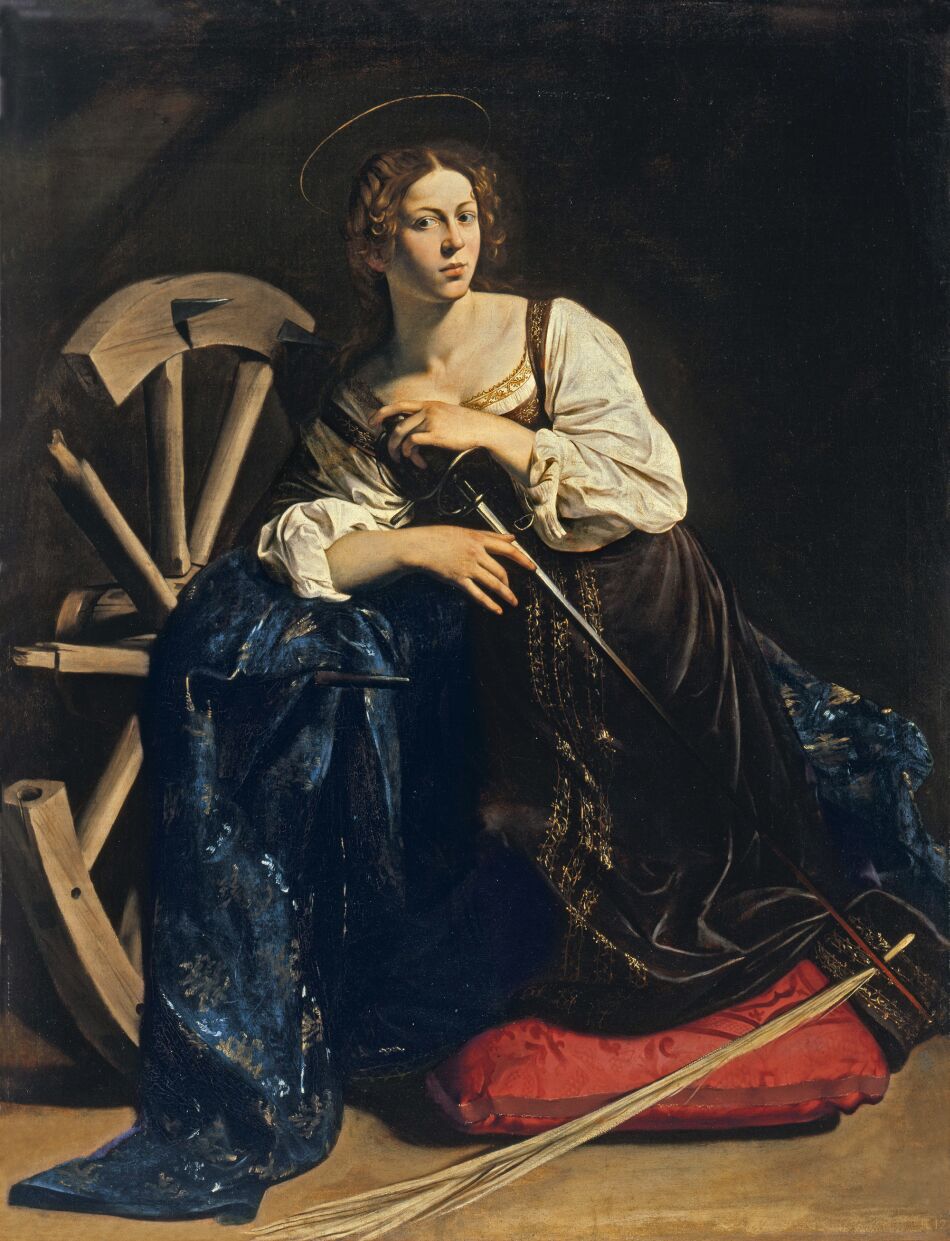
She is the patron of unmarried women, students, philosophers, craftsmen
who use wheels (e.g., potters), lacemakers, and milliners. She's
usually depicted in art with a wheel, sword, and/or palm of martyrdom.
Note that it was she,
along with St. Margaret of Antioch and St.
Michael the Archangel, who visited St.
Joan of Arc.
Customs
The Novena to St. Catherine
can be prayed any time, but it's customary to especially pray it on
November 16 and ending on November 24, the eve of St. Catherine's feast.
On St.
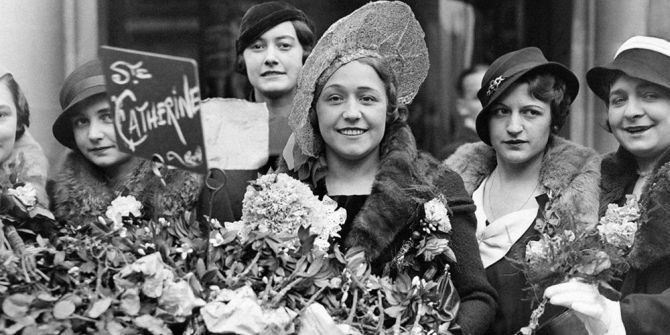
Catherine's Day, it is also customary for unmarried women to pray for
husbands, and to honor women who've reached 25 years of age but haven't
married -- called "Catherinettes" in France. Catherinettes send
postcards to each other, and friends of the Catherinettes make hats for
them -- traditionally using the colors yellow (faith) and green
(wisdom), often outrageous -- and crown them for the day. Pilgrimage is
made to a St. Catherine's statue -- which is also crowned by a
fantastical hat -- and the Saint is asked to intercede in
finding husbands for the unmarried lest they "don St. Catherine's
bonnet" and become spinsters. The Catherinettes are supposed to wear
the hat all day long, and they are usually feted with a meal among
friends. Because of this hat-wearing custom, French milliners have big
parties to show off their wares on this day.
The French say that before a girl reaches 25, she prays: "Donnez-moi,
Seigneur, un mari de bon lieu! Qu'il soit doux, opulent, libéral et
agréable!" (Lord, give me a well-situated husband. Let him be
gentle,
rich, generous, and pleasant!") After 25, she prays: "Seigneur, un qui
soit supportable, ou qui, parmi le monde, au moins puisse passer!"
(Lord, one who's bearable, or who can at least pass as bearable in the
world!") And when she's pushing 30: "Un
tel qu'il te plaira Seigneur,
je m'en contente!" ("Send whatever you want, Lord; I'll take
it!"). An
English version goes,
St Catherine, St
Catherine, O lend me thine aid
And grant that I never may die an old maid.
And there is
this, a fervent French prayer:
Sainte
Catherine, soyez bonne
Nous n'avons plus d'espoir
qu'en vous
Vous êtes notre patronne
Ayez pitié de nous
Nous vous implorons à genoux
Aidez-nous à nous marier
Pitié, donnez-nous un époux
Car nous brûlons d'aimer
Daignez écouter la prière
De nos cœurs fortement épris
Oh, vous qui êtes notre mère
Donnez-nous un mari
Saint Catherine
be good
We have no hope
but you
You are our protector
Have pity on us
We implore you on our knees
Help us to get married
For pity's sake, give us a husband
For we're burning with love
Deign to hear the prayer
Which comes from our overburdened hearts
Oh you who are our mother
Give us a husband
... which is
summed up more quickly in this, an English prayer:
A husband, St.
Catherine
A handsome one, St. Catherine
A rich one, St. Catherine
A nice one, St. Catherine
And soon, St. Catherine
Another French saying is "A la Sainte Catherine, tout bois
prend racine" -- "on St. Catherine's day, the trees take root."
Gardeners know that today is a good day for planting trees...
And the French also give us a song for the day: "Sainte Catherine":
Given all the millinery customs, a fun thing to do today, at least for
young girls, is to buy or make hats, and then wear them for a tea. You could buy inexpensive, plain straw
hats, artificial flowers, variously colored ribbons, and bits of
netting in different colors to use as fascinators, and let the girls
have at it all with scissors and glue, decorating their own hats to
wear for the day.
Now, because St. Catherine is the
patron Saint of lacemakers, and because Queen Catherine of Aragon --
the first of Henry VIII's six unfortunate wives -- was also associated
with lacemaking, it is a good day to think of the latter woman, too.
The pious, Catholic Queen Catherine is said to have taught lacemaking
to the poor of Ampthill while the divorce she fought all the way to
Rome was pending, and she is also said to have burned all her lace only
so she would have to order more, thereby keeping the poor lacemakers
employed. In honor of the Saint and of the good Catholic Queen,
"Cattern Cakes" 1 are eaten
today:
Mix everything
up to and including the caraway seeds together in a mixing bowl.
Add the melted butter and the beaten egg and mix well to give a soft
dough.
Roll the dough out on a floured board, into a rectangle about 12″ x
10″.
Brush the dough with water. Mix together the brown sugar and remaining
cinnamon and sprinkle on top.
Gently roll the dough up like you're making cinnamon rolls -- not too
tightly -- and then cut the rolled up dough into 3/4″ slices (there
should be about 12 slices when done).
Place these slices on to a well-greased and lined baking tray, making
sure that they are spaced well apart by at least an inch.
Bake for about 10 minutes, or until golden and crispy on top.
Allow to cool on a wire rack. Sprinkle with extra caraway seeds, sugar
and cinnamon if desired.
Store in an airtight tin for up to 7 days.
If you have a
trained pyrotechnician in the house, the lighting of the firework known
as a "St. Catherine's Wheel" would be a very showy thing to do. A
Catherine's Wheel is a long tube filled with powder and coiled around a
wooden center which is attached to a stationary pole of some sort. When
lit, centrifugal force rotates the coil very quickly, and as it burns,
a wheel of colored flames, sparks, and smoke is produced. Other
pinwheel-shaped objects are also described as "Catherine Wheels," --
e.g.,
rose windows are called such.