``Where the
Bishop is, there let the multitude of believers be;
even as where Jesus is, there is the Catholic Church'' Ignatius of
Antioch, 1st c. A.D
Feast of
the Nativity of Mary
Nine months ago, Mary was immaculately conceived in the womb
of her
mother, St. Anne, by her father St.
Joachim. The Feast of that
Immaculate Conception, 8 December, is a much greater Feast than
today's
(it's a Holy Day of Obligation, in fact); but we recall Mary's
birthday, too -- the birth of the woman destined by God from the
beginning of time to be born of the House of David and the Tribe of
Judah, the women whose enmity toward Satan was spoken of as far back as
Genesis, the woman whom St. John saw crowned with stars and with the
moon at her feet, the woman whom God chose to bear His Son and bring
life to the world. With today's Feast, the line between the Old and New
Testaments has been crossed; the New Covenant is imminent!
Today's Feast is one of the only three birthdays honored in the
liturgical year (the others being that of St. John the Baptist and that
of Jesus Christ Himself, all three born without original sin, though
only Mary and Jesus were free from sin at the moments of their
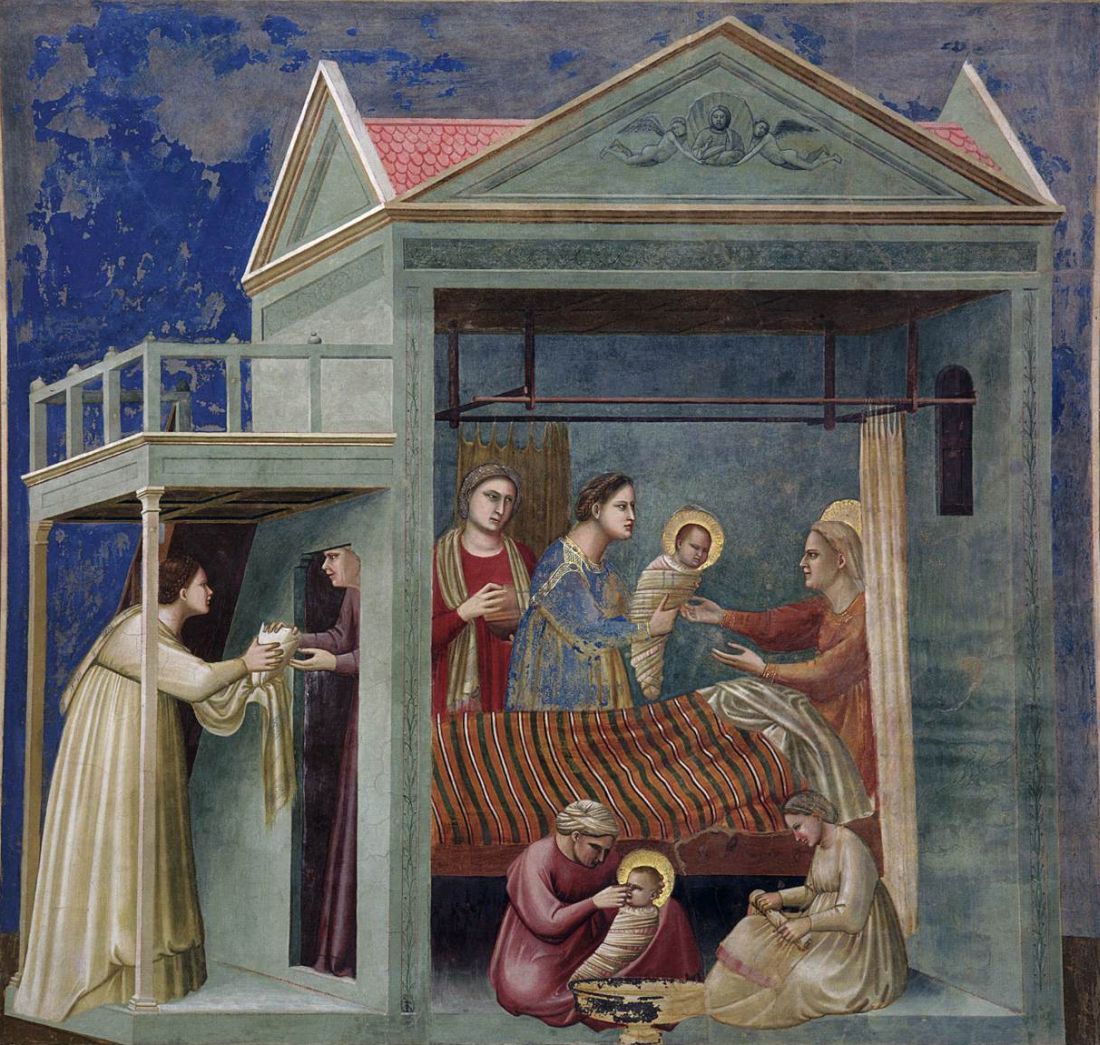
conceptions). We know little about Mary's birth and youth, most of our
information coming from the apocryphal Gospel
of the Nativity of Mary (translated from the Hebrew by St. Jerome,
A.D. 340-420), the Protevangelium of
St. James (dated to ca. A.D. 125), and the visions of various
mystics through the years.
Specific traditions today are mostly like those offered on all
Marian Feasts, such as a recitation of the Little
Crown of the Blessed Virgin Mary, the Litany
of Loreto, or other like prayers. This one to Maria Bambina
(the Baby Mary) is particularly appropriate:
Hail, Infant
Mary, full of grace, the Lord is with thee, blessed art thou forever,
and blessed are thy holy parents Joachim and Anne, of whom thou wast
miraculously born. Mother of God, intercede for us.
We fly to thy patronage, holy and amiable Child Mary, despise not our
prayers in our necessities, but deliver us from all dangers, glorious
and blessed Virgin.
V. Pray for us, holy Child Mary.
R. That we may be made worthy of the promises of Christ.
Let us Pray: O almighty and merciful God, Who through the cooperation
of the Holy Ghost, didst prepare the body and soul of the Immaculate
Infant Mary that she might be the worthy Mother of Thy Son, and didst
preserve her from all stain, grant that we who venerate with all our
hearts her most holy childhood, may be freed, through her merits and
intercession, from all uncleanness of mind and body, and be able to
imitate her perfect humility, obedience and charity. Through Christ Our
Lord. Amen.
There is also
this marvelous prayer in honour of Our Lady's Nativity, written by St.
Anselm:
Vouchsafe that I
may praise thee, O sacred Virgin; give me strength against thine
enemies, and against the enemy of the whole human race. Give me
strength humbly to pray to thee. Give me strength to praise thee in
prayer with all my powers, through the merits of thy most sacred
nativity, which for the entire Christian world was a birth of joy, the
hope and solace of its life.
When thou wast born, O most holy Virgin, then was the world made light.
Happy is thy stock, holy thy root, and blessed thy fruit, for thou
alone as a virgin, filled with the Holy Spirit, didst merit to conceive
thy God, as a virgin to bear Thy God, as a virgin to bring Him forth,
and after His birth to remain a virgin.
Have mercy therefore upon me a sinner, and give me aid, O Lady, so that
just as thy nativity, glorious from the seed of Abraham, sprung from
the tribe of Juda, illustrious from the stock of David, didst announce
joy to the entire world, so may it fill me with true joy and cleanse me
from every sin.
Pray for me, O Virgin most prudent, that the gladsome joys of thy most
helpful nativity may put a cloak over all my sins.
O holy Mother of God, flowering as the lily, pray to thy sweet Son for
me, a wretched sinner. Amen.
For a bit of music to celebrate this feast, there is Mozart's
Sancta Maria, Mater
Dei (K. 273), which he wrote for this feast and as an act of
consecration to the Blessed Virgin. The music and its lyrics:
Sancta Maria,
mater Dei,
ego omnia tibi debeo,
sed ab hac hora singulariter
me tuis servitiis devoveo.
Te patronam,
te sospitatricem eligo.
Tuus honor et cultus
aeternum mihi cordi fuerit,
quem ego nunquam deseram
neque ab aliis mihi subditis
verbo factoque violari patiar.
Sancta Maria, tu pia
me pedibus tuis advolutum recipe,
in vita protege,
in mortis discrimine defende.
Amen.
Holy Mary,
Mother of God,
I owe all to you,
And from this hour
I devote myself only to your service.
You as a protector,
you as a preserver I choose.
Your reverence and honour
will be eternally in my heart,
which I shall never desert
nor submit, from others liable to me,
to it being violated by deed and by word.
Holy Mary, pious,
receive me, begging at your feet,
in life protect me,
defend me from the risk of death.
Amen.
As
to other customs, in France, the day is associated with the grape
harvest, so grapes are taken to churches to be blessed, and meals
involving grapes are eaten. It's also the day on which seeds that are
sown in Autumn are blessed.
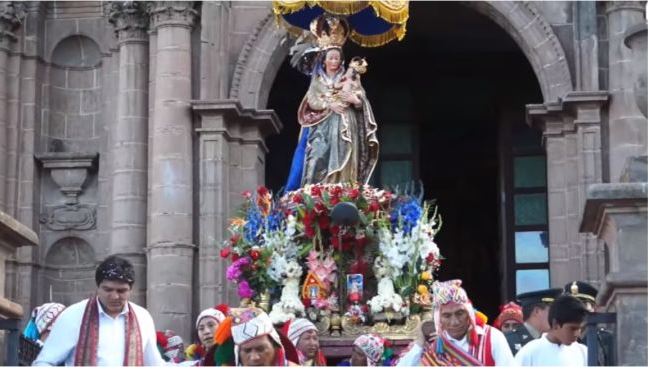
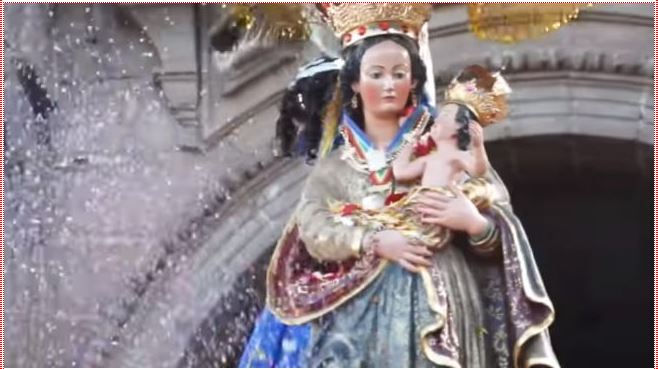
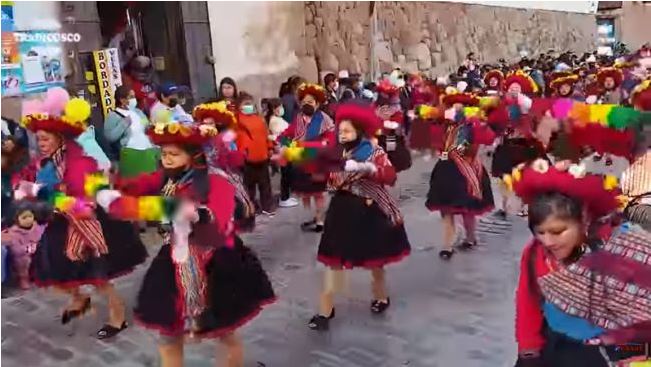
A great affair is made of Our Lady's birthday in Cusco, Peru. On the
eve of this feast, there are fireworks and music, and on the feast
itself, people from all over the country and from Bolivia gather in
their regional costumes and attend Mass at the Plaza de la Almudena, on
a
special altar installed just for that day. This is follwed by
processions, parades, dances, food, and confetti -- all festooned with
flowers, making for a riot of color.
In Florence, Italy, the this feast is known as "la Festa della
Rificolona": the Feast of the Paper Lanterns. On its eve, the town
square is filled with residents and pilgrims bearing beautifully
ornate, usually homemade paper lanterns on long sticks. They process
from the Piazza Santa Felicita to the Piazza Santissima Annunziata
where a great farmer's market is held at which cheeses and mushrooms
can be bought, and awards are given for the most beautiful lanterns. A
game is made with older children using little pipes to blow beads on to
the lanterns (think of spitwads shot through straws) to try to break
through the lanterns' skin, and knock over the candle inside, setting
it on fire. There's even a special song for the occasion:
Ona, ona, ona ma
che bella Rificolona!
E l’è più bella
la mia che di quella della zia,
La mia l’è co’ fiocchi e la tua l’è co’ i pidocchi!
Ona, ona, ona,
what a beautiful lantern!
Mine is more beautiful than my aunt's
Mine has ribbons, yours has lice!
Look, it rhymes
(and I remember American kids singing about "greasy, grimy gopher
guts," so...)
Anyway, for those
outside of Cusco or Florence, a birthday cake for the Virgin
is a lovely idea. Here's a recipe for a very good vanilla cake:
Vanilla Cake
1 cup (2 sticks)
butter, softened
1/2 cup
vegetable shortening
3 cups
granulated sugar
5 eggs, room
temperature
3 cups
all-purpose flour
2 teaspoons
baking powder
1/4 teaspoon salt
1/2 cup whole
milk, room temperature
1/2 cup
buttermilk, room temperature
2 teaspoons
vanilla extract
Icing:
1 cup butter (2
sticks), softened
3 - 4 cups
confectioner’s sugar, sifted
2 teaspoons
vanilla
pinch salt
2-3
tablespoons milk, heavy cream, or half-and-half
Preheat oven to
350o F. Prepare three 9-inch round cake pans with nonstick
baking spray or coated well with shortening or butter and floured,
taking care to remove all excess flour.
Cream together
butter and shortening until light and fluffy with an electric mixer.
Slowly add sugar one cup at a time, making sure to fully incorporate
each cup before adding another. Add eggs one at a time, making sure to
fully incorporate each egg before adding another.
Sift together
flour, baking powder, and salt. Pour milks and vanilla into measuring
cup and whisk together with a fork. Add to butter and shortening
mixture alternately with milk mixture, beginning and ending with dry
ingredients.
Gently stir all
ingredients until well combined. Stop mixer and scrape down sides and
bottom of bowl, making sure to have all ingredients mixed well.
Evenly
distribute cake batter between cake pans and place pans into oven. Bake
for 25-30 minutes, or until a toothpick or cake tester inserted in the
center comes out clean. Remove and allow to cool slightly in cake pans
for about 5 minutes, then cool completely on a wire rack.
Icing: Cream the
butter until it is smooth and has lightened in color, about 3 minutes.
Add the confectioner's sugar, 1/2 a cup at a time, beating well after
each addition. Add vanilla and a pinch of salt and combine until
well-incorporated. Add the milk, heavy cream or half-and-half until the
frosting has reached the preferred consistency. For a firmer frosting,
add more confectioner's sugar, a quarter cup at a time. For a softer
frosting, add more milk or cream, a tablespoon at a time. Since this
cake is for Mary, consider drawing a letter M on top in
differently-colored icing, and/or decorate with sugar roses.
If you're having a large party, another option is to double this
recipe, and bake the batter in muffin tins filled half full (bake for
18 minutes). This should make around 72 cupcakes. Now ice 54 of them in
one color (such as white), and 5 in a different color (such as blue)
and arrange them to form a "Rosary", with the white cakes being the Ave
beads, and the blue ones the Pater beads.
And if you want to sing a Latin Happy Birthday song, try this one (the
words mean simply "Many years!"):
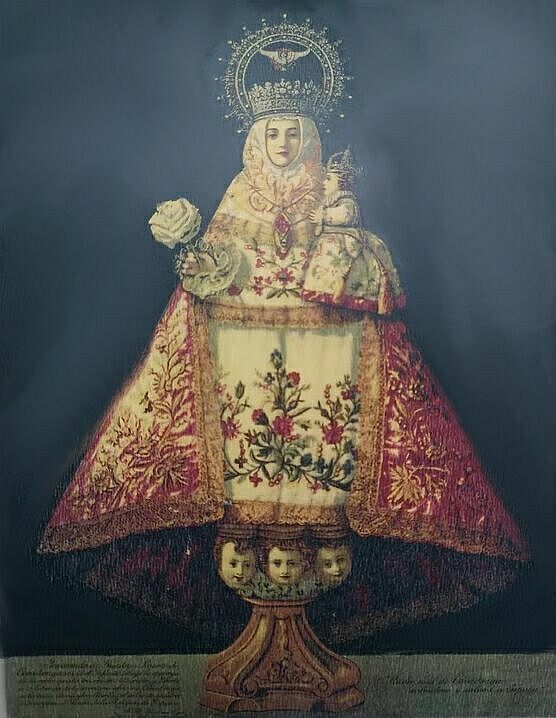
Today, on Our Lady's birthday, we also commemorate the Blessed Virgin
as Our Lady of Covadonga
-- La Santina -- who helped
Christians defeat the invading Moors in Spain in 722. These Muslim
hordes had been pounding what was then the Visigothic Kingdom for
years, soundly defeating King Rodrigo and causing the Christians to
retreat and scatter.
But King Pelayo (Pelagius), a relative of the dead king Rodrigo,
gathered up 300 men and took them to a cave to turn them into a
fighting force. There, he discovered a criminal who was using the cave
as a hide-out. He went to capture him, but was approached by a hermit
who told him that the cave is a sanctuary that is holy to Mary, and
that if he were to forgive the miscreant, he would later take back the
kingdom. So King Pelayo forgave him, and pressed on forming his army.
A traitorous Christian Bishop tried to convince King Pelayo to submit
to
defeat, but King Pelayo told him,
Have you not
read in Scriptures that the Church of the Lord is like the mustard
seed, which, small as it is, grows more than any other through the
mercy of God? Our hope is in Christ; this little mountain will be the
salvation of Spain and of the people of the Visigoths; the mercy of
Christ will free us from that multitude.
Then the Muslims began their approach, and King Pelayo and his men went
to the cave to pray. When up the steep cliffs came the Muslims --
thousands of them -- Our Lady appeared and told the king, "Arouse
thy strength; go forth in the Name of Jesus Christ, and thou shalt
conquer."
And he did. The Spanish Reconquista had begun! The general war against
Muslim invaders would reach a major turning point under Charles
Martel at the Battle of Tours in 732, and would finally end hundreds of years later
at the Battle of Vienna in 1683, where Our Lady once more played a
leading role
and which we will recall on the Feast
of
the Most Holy Name of Mary in four days, on September 12. From the
first victory against the Muslims to the last, Our Lady was there.
If you go to Covadonga, Asturias, Spain, you can visit the holy cave --
la Santa Cueva de
Covadonga. When King Pelayo died in 737, he was buried in a
local church, but King Alfonso X of Castile (d. 1284) had his remains
transferred to the holy cave, along with those of Pelayo's wife. Very
near the cave, you can also visit the pink limestone Basílica de Santa María la Real de
Covadonga.
An old song called La Virgen de
Covadonga, sung
by José Carreño:
What I hope each person reading this will do is to take King Pelayo's
words to the Judas-hearted Bishop and apply them to our times:
Have you not
read in Scriptures that the Church of the Lord is like the mustard
seed, which, small as it is, grows more than any other through the
mercy of God? Our hope is in Christ; this little remnant of the
Catholic faithful will be the salvation of our respective nations and
of the people of the world; the mercy of Christ will free us from the
forces of secularism and evil!
Sermon I on
the Dormition of Mary
By St. John Damascene (John of Damascus), (A.D. 676 - 754/787)
The birth of
her, whose Child was marvellous, was above nature and understanding,
and it was salvation to the world; her death was glorious, and truly a
sacred feast. The Father predestined her, the prophets foretold her
through the Holy Ghost. His sanctifying power overshadowed her,
cleansed and made her holy, and, as it were, predestined her. Then
Thou, Word of the Father, not dwelling in place, didst invite the
lowliness of our nature to be united to the immeasurable greatness of
Thy inscrutable Godhead. Thou, who didst take flesh of the Blessed
Virgin, vivified by a reasoning soul, having first abided in her
undefiled and immaculate womb, creating Thyself, and causing her to
exist in Thee, didst become perfect man,, not ceasing to be perfect
God, equal to Thy Father, but taking upon Thyself our weakness through
ineffable goodness. Through it Thou art one Christ, one Lord, one Son
of God, and man at the same time, perfect God and perfect man, wholly
God and wholly man, one Substance from two perfect natures, the Godhead
and the manhood. And in two perfect natures, the divine and the human,
God is not pure God, nor the man only man, but the Son of God and the
Incarnate God are one and the same God and man without confusion or
division, uniting in Himself substantially the attributes of both
natures. Thus, He is at once uncreated and created, mortal and
immortal, visible and invisible, in place and not in place. He has a
divine will and a human will, a divine action and a human also, two
powers of choosing divine and human. He shows forth divine wonders and
human affections--natural, I mean, and pure. Thou hast taken upon
Thyself, Lord, of Thy great mercy, the state of Adam as he was before
the fall, body, soul, and mind, and all that they involve physically,
so as to give me a perfect salvation. It is true indeed that what was
not assumed was not healed. Having thus become the mediator between God
and man, Thou didst destroy enmity, and lead back to Thy Father those
who had deserted Him, wanderers to their home, and those in darkness to
the light. Thou didst bring pardon to the contrite, and didst change
mortality into immortality. Thou didst deliver the world from the
aberration of many gods, and didst make men the children of God,
partakers of Thy divine glory. Thou didst raise the human race, which
was condemned to bell, above all power and majesty, and in Thy person
it is seated on the King's eternal throne. Who was the instrument of
these infinite benefits exceeding all mind and comprehension, if not
the Mother ever Virgin who bore Thee?
Realise, Beloved in the Lord, the grace of today, and its wondrous
solemnity. Its mysteries are not terrible, nor do they inspire awe.
Blessed are they who have eyes to see. Blessed are they who see with
spiritual eyes. This night shines as the day. What countless angels
acclaim the death of the life-giving Mother! How the eloquence of
apostles blesses the departure of this body which was the receptacle of
God. How the Word of God, who deigned in His mercy to become her Son,
ministering with His divine hands to this immaculate and divine being,
as His mother, receives her holy soul. O wondrous Law-giver, fulfilling
the law which He bad Himself laid down, not being bound by it, for it
was He who enjoined children to show reverence to their parents.
"Honour thy father and thy mother," He says. The truth of this is
apparent to every one, calling to mind even dimly the words of holy
Scripture. If according to it the souls of the just are in the hands of
God, how much more is her soul in the hands of her Son and her God.
This is indisputable. Let us consider who she is and whence she came,
how she, the greatest and dearest of all God's gifts, was given to this
world. Let us examine what her life was, and the mysteries in which she
took part. Heathens in the use of funeral orations most carefully
brought forward anything which could be turned to praise of the
deceased, and at the same time encourage the living to virtue, drawing
generally upon fable and fiction, not having fact to go upon. How then,
shall we not deserve scorn if we bury in silence that which is most
true and sacred, and in very deed the source of praise and salvation to
all ? Shall we not receive the same punishment as the man who hid his
master's talent ? Let us adapt our subject to the needs of those who
listen, as food is suited to the body.
Joachim and Anne were the parents of Mary. Joachim kept as strict a
watch over his thoughts as a shepherd over his flock, having them
entirely under his control. For the Lord God led him as a sheep, and he
wanted for none of the best things. When I say best, let no one think I
mean what is commonly acceptable to the multitude, that upon which
greedy minds are fixed, the pleasures of life that can neither endure
nor make their possessors better, nor confer real strength. They follow
the downward course of human life and cease all in a moment, even if
they abounded before. Far be it from us to cherish these things, nor is
this the portion of those who fear God. But the good things which are a
matter of desire to those who possess true knowledge, delighting God,
and fruitful to their possessors, namely, virtues, bearing fruit in due
season, that is, in eternity, will reward with eternal life those who
have laboured worthily and have persevered in their acquisition as far
as possible. The labour goes before, eternal happiness follows. Joachim
ever shepherded his thoughts. In the place of pastures, dwelling by
contemplation on the words of sacred Scripture, made glad on the
restful waters of divine grace, withdrawn from foolishness, he walked
in the path of justice. And Anne, whose name means grace, was no less a
companion in her life than a wife, blessed with all good gifts, though
afflicted for a mystical reason with sterility. Grace in very truth
remained sterile, not being able to produce fruit in the souls of men.
Therefore, men declined from good and degenerated; there was not one of
understanding nor one who sought after God. Then His divine goodness,
taking pity on the work of His hands, and wishing to save it, put an
end to that mystical barrenness, that of holy Anne, I mean, and she
gave birth to a child, whose equal had never been created and never can
be. The end of barrenness proved clearly that the world's sterility
would cease and that the withered trunk would be crowned with vigorous
and mystical life.
Hence the Mother of our Lord is announced. An angel foretells her
birth. It was fitting that in this, too, she, who was to be the human
Mother of the one true and living God, should be marked out above every
one else. Then she was offered in God's holy temple, and remained
there, showing to all a great example of zeal and holiness, withdrawn
from frivolous society. When, however, she reached full age and the law
required that she should leave the temple, she was entrusted by the
priests to Joseph, her bridegroom, as the guardian of her virginity, a
steadfast observer of the law from his youth. Mary, the holy and
undefiled, went to Joseph, contenting herself with her household
matters, and knowing nothing beyond her four walls.
In the fulness of time, as the divine apostle says, the angel Gabriel
was sent to this true child of God, and saluted her in the words,
"Hail, full of grace, the Lord is with thee." Beautiful is the angel's
salutation to her who is greater than an angel. He is the bearer of joy
to the whole world. She was troubled at his words, not being used to
speak with men, for she had resolved to keep her virginity unsullied.
She pondered in herself what this greeting might be. Then the angel
said to her: "Fear not, Mary. Thou hast found grace before God." In
very deed, she who was worthy of grace had found it. She found grace
who had done the deeds of race, and had reaped its fulness. She found
grace who brought forth the source of grace, and was a rich harvest of
grace. She found an abyss of grace who kept undefiled her double
virginity, her virginal soul no less spotless than her body; hence her
perfect virginity. "Thou shalt bring forth a Son," he said, "and shalt
call His name Jesus" (Jesus is interpreted Saviour). "He shall save His
people from their sins." What did she, who is true wisdom, reply? She
does not imitate our first mother Eve, but rather improves upon her
incautiousness, and calling in nature to support her, thus answers the
angel: "How is this to be, since I know not man? What you say is
impossible, for it goes beyond the natural laws laid down by the
Creator. I will not be called a second Eve and disobey the will of my
God. If you are not speaking godless things, explain the mystery by
saying how it is to be accomplished." Then the messenger of truth
answered her: "The Holy Spirit shall come to thee, and the power of the
Most High shall overshadow thee. Therefore He who is born to thee shall
be called the Son of God." That which is foretold is not subservient to
the laws of nature. For God, the Creator of nature, can alter its laws.
And she, listening in holy reverence to that sacred name, which she had
ever desired, signified her obedience in words full of humility and
joy: "Behold the handmaid of the Lord. Be it done unto me according to
thy word."
"O the depth of the riches, of the wisdom, and of the knowledge of
God," I will exclaim in the apostle's words. "How incomprehensible are
His judgments, and how unsearchable His ways." O inexhaustible goodness
of God! O boundless goodness! He who called what was not into being,
and filled heaven and earth, whose throne is heaven, and whose
footstool is the earth, a spacious dwelling-place, made the womb of His
own servant, and in it the mystery of mysteries is accomplished. Being
God He becomes man, and is marvellously brought forth without detriment
to the virginity of His Mother. And He is lifted up as a baby in
earthly arms, who is the brightness of eternal glory, the form of the
Father's substance, by the word of whose mouth all created things
exist. O truly divine wonder! O mystery transcending all nature and
understanding! O marvellous virginity! What, O holy Mother and Virgin,
is this great mystery accomplished in thee? Blessed art thou amongst
women, and blessed is the fruit of thy womb. Thou art blessed from
generation to generation, thou who alone art worthy of being blessed.
Behold all generations shall call thee blessed as thou hast said. The
daughters of Jerusalem, I mean, of the Church, saw thee. Queens have
blessed thee, that is, the spirits of the just, and they shall praise
thee for ever. Thou art the royal throne which angels surround, seeing
upon it their very King and Lord. Thou art a spiritual Eden, holier and
diviner than Eden of old. That Eden was the abode of the mortal Adam,
whilst the Lord came from heaven to dwell in thee. The ark foreshadowed
thee who hast kept the seed of the new world. Thou didst bring forth
Christ, the salvation of the world, who destroyed sin and its angry
waves. The burning bush was a figure of thee, and the tablets of the
law, and the ark of the testament. The golden urn and candelabra, the
table and the flowering rod of Aaron were significant types of thee.
From thee arose the splendour of the Godhead, the eternal Word of the
Father, the most sweet and heavenly Manna, the sacred Name above every
name, the Light which was from the beginning. The heavenly Bread of
Life, the Fruit without seed, took flesh of thee. Did not that flame
foreshadow thee with its burning fire an image of the divine fire
within thee? And Abraham's tent most clearly pointed to thee. By the
Word of God dwelling in thee human nature produced the bread made of
ashes, its first fruits, from thy most pure womb, the first fruits
kneaded into bread and cooked by divine fire, becoming His divine
person, and His true substance of a living body quickened by a
reasoning and intelligent soul. I had nearly forgotten Jacob's ladder.
Is it not evident to every one that it prefigured thee, and is not the
type easily recognised? just as Jacob saw the ladder bringing together
heaven and earth, and on it angels coming down and going up, and the
truly strong and invulnerable God wrestling mystically with himself, so
art thou placed between us, and art become the ladder of God's
intercourse with us, of Him who took upon Himself our weakness, uniting
us to Himself, and enabling man to see God. Thou hast brought together
what was parted. Hence angels descended to Him, ministering to Him as
their God and Lord, and men, adopting the life of angels, are carried
up to heaven.
How shall I understand the prediction of prophets ? Shall I not refer
them to thee, as we can prove them to be true? What is the fleece of
David which receives the Son of the Almighty God, co-eternal and
co-equal with His Father, as rain falls upon the soil? Does it not
signify thee in thy bright shining? Who is the virgin foretold by
Isaias who should conceive and bear a Son, God ever present with us,
that is, who being born a man should remain God? What is Daniel's
mountain from which arose Christ, the Corner-Stone, not made by the
hand of man? Is it not thee, conceiving without man and still
remaining a virgin? Let the inspired Ezechiel come forth and show us
the closed gate, sealed by the Lord, and not yielding, according to his
prophecy -- let him point to its fulfilment in thee. The Lord of all
came to thee, and taking flesh did not open the door of thy virginity.
The seal remains intact. The prophets, then, foretell thee. Angels and
apostles minister to thee, O Mother of God, ever Virgin, and John the
virgin apostle. Angels and the spirits of the just, patriarchs and
prophets surround thee to-day in thy departure to thy Son. Apostles
watched over the countless host of the just who were gathered together
from every corner of the earth by the divine commands, as a cloud
around the divine and living Jerusalem, singing hymns of praise to
thee, the author of our Lord's life-giving body.
"The Life of the Blessed Virgin Mary"
by Blessed Anne
Catherine Emmerich
Chapter 4
4.1 The Uniting of Mary's Soul and Body
I had a vision of the creation of Mary's most holy soul and of its
being united to her most pure body. In the glory by which the Most Holy
Trinity is usually represented in my visions I saw a movement like a
great shining mountain, and yet also like a human figure; and I saw
something rise out of the midst of this figure towards its mouth and go
forth from it like a shining brightness. Then I saw this brightness
standing separate before the Face of God, turning and shaping itself--
or rather being shaped, for I saw that while this brightness took human
form, yet it was by the Will of God that it received a form so
unspeakably beautiful. I saw, too, that God showed the beauty of this
soul to the angels, and that they had unspeakable joy in its beauty. I
am unable to describe in words all that I saw and understood.
When seventeen weeks and five days after the conception of the Blessed
Virgin had gone by (that is to say, five days before Anna's pregnancy
was half accomplished), I saw the Blessed Virgin's holy mother lying
asleep in her bed in her house near Nazareth. Then there came a shining
light above her, and a ray from this light fell upon the middle of her
side, and the light passed into her in the shape of a little shining
human figure. In the same instant I saw the Blessed Virgin's holy
mother raise herself on her couch surrounded by light. She was in
ecstasy, and had a vision of her womb opening like a tabernacle to
enclose a shining little virgin from whom man's whole salvation was to
spring. I saw that this was the instant in which for the first time the
child moved within her. Anna then rose from her couch, dressed herself,
and announced her joy to the holy Joachim. They both thanked God, and I
saw them praying under the tree in the garden where the angel had
comforted Anna. It was made known to me that the Blessed Virgin's soul
was united to her body five days earlier than with other children, and
that her birth was twelve days earlier.
4.2 Mary's Birth
Several days before the Blessed Virgin's birth Anna had told Joachim
that the time was approaching for her to be delivered. She sent
messengers to Sephoris, where her younger sister Maraha lived; to the
widow Enue (sister of Elizabeth) in the valley of Zabulon; and to her
niece Mary Salome at Bethsaida, asking these three women to come to
her. I saw them on their journeys. The widow Enue had a serving lad
with her; the other two women were accompanied by their husbands who,
however, went back on approaching Nazareth. I saw that on the day
before Anna was delivered Joachim sent his many menservants out to the
herds, and among Anna's new maidservants he kept in the house only
those who were needed. He, too, went out into his nearest pasture. I
saw that Anna's firstborn daughter, Mary Heli, looked after the house.
She was then about nineteen years old and was married to Cleophas, one
of Joachim's chief shepherds, by whom she had a little daughter, Mary
Cleophas, now about four years old. After praying, Joachim chose out
his finest lambs, kids, and cattle, sending shepherds to take them to
the Temple as a thank-offering. He did not return home until nightfall.
I saw the three cousins arriving at Anna's house in the evening. They
went to her in her room behind the hearth and embraced her. After Anna
had told them that the time was near for her to be delivered, they
stood up and sang a hymn together: Praise the Lord God; He has shown
mercy to His people, and has redeemed Israel, and has fulfilled the
promise which He gave to Adam in Paradise that the seed of the woman
should crush the head of the serpent,' and so on. I can no longer
recite it all by heart. Anna prayed as though in ecstasy. She
introduced into the hymn all the prophetic symbols of Mary. She said:
The seed given by God to Abraham has ripened in me.' She spoke of the
promise to Sarah of Isaac's birth and said: The blossoming of Aaron's
rod is perfected in me.' At that moment I saw her as though suffused
with light; I saw the room full of radiance, and Jacob's ladder
appearing above it. The women were overcome with astonishment and joy,
and I think that they also saw the vision. When the prayer of welcome
was over, the travelers were refreshed with a slight meal of bread and
fruit, and water mixed with balsam. They ate and drank standing up, and
then lay down till midnight to rest from their journey. Anna did not go
to bed, but prayed, and at midnight woke the other women to pray with
her. They followed her to her praying-place behind a curtain.
Anna opened the doors of a little cupboard in the wall which contained
a casket with holy objects. On each side were lights--perhaps lamps,
but I am not sure. They had to be pushed up in their holders, and then
little bits of shavings put underneath to prevent them from sinking
down. After this the lights were lit. There was a cushioned stool at
the foot of this sort of little altar. The casket contained some of
Sarah's hair (Anna had a great veneration for her), some of Joseph's
bones (brought by Moses from Egypt), and something belonging to Tobias,
I think a relic of his clothing; also the little shining, white,
pear-shaped goblet from which Abraham had drunk when blessed by the
angel. (This had been given to Joachim from the Ark of the Covenant
when he was blessed in the Temple. I now know that this blessing took
the form of wine and bread and was a strengthening and sacramental
food.)
Anna knelt before the little cupboard with one of the women on each
side and the third behind her. She recited another hymn; I think it
mentioned the burning bush of Moses. Then I saw the room filled with
supernatural light which became more intense as it wove itself round
Anna. The women sank to the ground as though stunned. The light round
Anna took the exact form of the burning bush of Moses on Horeb, and I
could no longer see her. The whole flame streamed inwards; and then I
suddenly saw that Anna received the shining child Mary in her hands,
wrapped her in her mantle, pressed her to her heart, and laid her naked
on the stool in front of the holy relics, still continuing her prayer.
Then I heard the child cry, and saw that Anna brought out wrappings
from under the great veil which enveloped her. She wrapped the child
first in gray and then in red swaddling bands up to her arms; her
breast, arms, and head were bare. The appearance of the burning bush
around Anna had now vanished.
The women stood up and received the newborn child in their arms with
great astonishment. They shed tears of joy. They all joined in a hymn
of praise, and Anna lifted her child up on high as though making an
offering. I saw at that moment the room full of light, and beheld
several angels singing Gloria and Alleluia. I heard all their words.
They announced that on the twentieth day the child was to be called
Mary.
Anna now went into her bedroom and lay down on her couch. The women in
the meantime unwrapped the child, bathed it, and wrapped it up again,
and then laid it beside its mother. There was a little woven wicker
basket which could be fastened beside the bed or against the wall or at
the foot of the bed, whichever was wanted, so that the child could
always have its place near its mother and yet separate.
The women now called Joachim, the father. He came to Anna's couch and
knelt down weeping, his tears falling on the child; then he lifted it
up in his arms and uttered his song of praise, like Zechariah at John's
birth. He spoke in this hymn of the holy seed, implanted by God in
Abraham, which had continued amongst God's people by means of the
covenant ratified by circumcision, but had now reached its highest
blossoming in this child and was, in the flesh, completed. I also heard
how this song of praise declared that now was fulfilled the word of the
prophet: There shall come forth a rod out of the root of Jesse.' He
said, too, in great humility and devoutness, that he would now gladly
die.
It was only then that I noticed that Mary Heli, Anna's elder daughter,
did not have sight of the child until later. Although she had become
the mother of Mary Cleophas several years before, she was not present
at the Blessed Virgin's birth--perhaps because, according to Jewish
rules, it was not considered seemly for a daughter to be with her
mother at such a time.
Next morning I saw the serving men and maids and many people from
nearby gathered round the house. They were allowed to enter in groups,
and the child was shown by the women to them all. Many were greatly
moved, and some led better lives thereafter. The neighbors had come
because they had seen in the night a glowing light above the house, and
because the birth of Anna's child after long unfruitfulness was looked
upon as a great favor from heaven.
4.3 Joy at Mary's Birth in Heaven
In the moment when the newborn child lay in the arms of her holy mother
Anna, I saw that at the same time the child was presented in heaven in
the sight of the Most Holy Trinity, and greeted with unspeakable joy by
all the heavenly host. Then I understood, that there was made known to
her in a supernatural manner her whole future with all her joys and
sorrows. Mary was taught infinite mysteries, and yet was and remained a
child. This knowledge of hers we cannot understand, because our
knowledge grows on the tree of good and evil. She knew everything in
the same way as a child knows its mother's breast and that it is to
drink from it. As the vision faded in which I saw the child Mary being
thus taught in heaven through grace, I heard her weep for the first
time.
I often see pictures like this, but for me they are inexpressible and
probably for most people not quite comprehensible; therefore I do not
relate them.
4.4 The Proclaiming of Mary's Birth in Limbo
In the moment of Mary's birth I saw the tidings brought to the
patriarchs in limbo. I saw them all, especially Adam and Eve, filled
with inexpressible joy at the fulfillment of the promise given in
Paradise. I also perceived that the patriarchs advanced in their state
of grace, that the place of their sojourn became brighter and more
spacious, and that it was given to them to have more influence on
earth. It was as if all their labor and penance, all the struggling,
crying and yearning of their lives had matured into its destined fruit.
4.5 Agitation in Nature and Mankind at Mary's Birth
At the time of Mary's birth I saw a great and joyful agitation in
nature, in the animal world, in the hearts of all good men, and I heard
the sound of sweet singing. Sinners, however, were overwhelmed by fear
and sorrow. I saw, specially near Nazareth, but also in the rest of the
Promised Land, many who were possessed break out at that time into
violent ravings. They were hurled from side to side with loud cries,
and the devils shrieked from within them, We must surrender, we must go
out!'
In Jerusalem I saw how the aged priest Simeon, who lived in the Temple,
was startled at the moment of Mary's birth by loud shrieks coming from
the madmen and those possessed of the devil, of whom many were shut up
in a building in one of the streets on the Temple Hill. Simeon lived
near them and was partly responsible for looking after them. About
midnight I saw him go to the open space before the house of those
possessed and inquire of one of them who lived nearest as to the cause
of the loud cries with which everyone had been roused from their sleep.
The man cried still louder that he must go out. Simeon opened the door;
the possessed one rushed out, and Satan cried from within him: I must
go out. We must all go out! A virgin has been born! There are so many
angels on earth who torment us! We must now go out and may nevermore
enter into men!' I saw Simeon praying fervently; the wretched man was
flung back and forth on the open space, and I saw the devil go out of
him. It gave me great pleasure to see the aged Simeon. I also saw the
prophetess Anna and Noemi wakened and informed by visions of the birth
of a chosen child. [Noemi was the sister of Lazarus' mother; she was in
the Temple and later became Mary's teacher.] They met and told each
other of what they had seen. I think they knew Anna, the Blessed
Virgin's mother.
4.6 The Proclaiming of Mary's Birth in Chaldea
In the night of Mary's birth I saw in a city of the Chaldeans that five
sibyls, or virgin prophetesses, were granted visions. I saw them
hastening to the priests, who then made known in many places that these
prophetesses had seen that a virgin had been born and that many gods
had come down to earth to greet her, while other spirits fled before
her lamenting. I saw, too, that the picture of a Virgin holding scales
evenly balanced with corn and grapes, which the watchers of the stars
had seen since Mary's conception, was no longer visible to them. In the
hour of Mary's birth it seemed to move out of the star, in which it
left a gap, and to sink down and away from it in one particular
direction. They now made and set up in their temple the great idol
which I saw there in my visions of the life of Jesus; it had some
connection with the Blessed Virgin.
Later they set up in their temple another symbolic image of the Blessed
Virgin, the closed garden. I saw live animals lying in this temple and
being cared for. I am not sure whether they were dogs. They were fed
with the flesh of other animals. Within the temple of the three holy
kings I had till now always seen a wonderful illumination at night. It
was as if one looked up into a starry sky set with all the
constellations. They used to make alterations in this artificial sky in
their temple according to the visions they saw in the heavens. Thus
after the birth of Mary the illumination which had previously come from
outside now came from within.
4.7 Events in Egypt During Mary's Birth
When the Blessed Virgin was born, I saw that image of a winged woman
with a balance in her hand (bending down over a child in a little ship
lying in the top of a tree) cast into the sea from its place in the
temple on an island in a river. I had seen the image placed there long
ago, before the time of Elijah, in accordance with the forced utterance
of an idol. The little tree on which lay the child in the ship,
remained in its place. A church was built there later.
At the moment of Mary's birth I saw falling from the temple ceiling
pieces of that winged female figure with three breasts which I had seen
fixed to the ceiling of a temple when a messenger from Elijah announced
his master's prophecy of a coming Virgin. The face, the three breasts,
and the lower part of the body all fell down and were broken to pieces.
The bushel-shaped crown, the arms with the ears of corn, the upper part
of the body and the wings did not fall down.
4.8 Visits with the Newborn Baby Mary
On the 9th of September, the day after Mary's birth, I saw in the house
several other relations from the neighborhood. I heard many names but
have forgotten them again. I also saw many of Joachim's menservants
arriving from the more distant pastures. All were shown the newborn
child, and all were filled with great joy. The meal in the house was
accompanied by much rejoicing.
On the 10th and 11th of September I again saw many visiting the child
Mary. Among them were relations of Joachim's from the valley of
Zabulon. On these occasions the child was brought into the front part
of the house in its little cradle and put on a high stand (like a
sawing bench) to be shown to the people. The child was wrapped in red,
covered with transparent white stuff, up to its bare arms, and had a
transparent little veil round its neck. The cradle was covered with red
and white stuff.
I saw Mary Cleophas (the two- or three-year old child of Anna's elder
daughter and of Cleophas) playing with the child Mary and caressing
her. Mary Cleophas was a fat, sturdy child, and wore a sleeveless white
dress, with a red hem hung with red buttons like tiny apples. Round her
bare arms she wore little white wreaths, which seemed to be made of
feathers, silk, or wool.
4.9 The Child Receives the Name Mary
[September 22nd-23rd] Today I saw great preparations for a feast in
Anna's house. All the furniture was moved aside, and in the front part
of the house the dividing screens had been taken away to make one large
hall instead of a number of small rooms. Along each side of this hall I
saw a long, low table set out for a meal with many things that I had
not noticed before. Fragile vases with openwork tops like baskets stood
on the table; they may have been for flowers. On a side-table I saw
many little white sticks, apparently made of bone, and spoons shaped
like deep shells, with handles ending in a ring. There were also little
curved tubes, perhaps for sucking up liquid.
In the center of the hall, a kind of altar table had been set up,
covered in red and white. On it lay a little trough-shaped
basket-cradle, of red and white wickerwork, covered with a sky-blue
cloth. Beside this altar stood a lectern draped in a cloth on which lay
parchment prayer scrolls. Five priests from Nazareth stood before the
altar, one of them wearing grander vestments than the others; Joachim
stood near them. In the background near the altar were several men and
women belonging to the families of Anna and Joachim, all in festal
attire. I remember seeing Anna's sister Maraha from Sephoris, and
Anna's elder daughter and others. Anna herself, though no longer in
bed, remained in her room behind the hearth and did not appear at the
ceremony.
Enue, Elizabeth's sister, brought out the child Mary, wrapped to the
arms in red swaddling clothes covered with transparent white stuff, and
laid her in Joachim's arms. The priests approached the altar where the
scrolls lay and prayed aloud. Two of them held up the train of the
principal one. Joachim then laid the child in the hands of the high
priest, who, lifting her up in offering as he prayed, laid her in the
cradle on the altar. He then took a pair of scissors which, like our
snuffers, had a little box at the end to hold what was cut off. With
this he cut off three little tufts of hair from the child's head (one
from each side and one from the top) and burnt them in a brazier. Then
he took a vase of oil and anointed the child's five senses, touching
with his thumb her ears, eyes, nose, mouth, and breast. He also wrote
the name Mary on a parchment and laid it on the child's breast. She was
then returned to Joachim, who gave her to Enue to be taken back to
Anna. Hymns were sung and after that the meal began, but I saw no more.